Anti Aging Peptides: Evidence & Safety
No peptide is proven to slow human aging; compare 7 popular options, their evidence limits, FDA status, risks, routes, and costs.

Anti aging peptides are short amino acid chains marketed for skin, recovery, metabolism, or longevity, but none is proven to slow human aging. Some peptide medicines are used for specific health conditions; that does not make them approved anti-aging treatments.
A ClinicalTrials.gov search lists 18 studies under “Anti-Aging & Longevity,” covering different treatments rather than proving that a peptide reverses aging 12. The useful question is whether a specific product has been tested for the result you want, and whether its risks are known.
Key takeaways
- Peptides are short amino acid chains that can signal cells, but a plausible mechanism is not proof of longer life or younger skin.
- The “Anti-Aging & Longevity” search lists 18 studies, including different interventions rather than a head-to-head test of popular peptides 12.
- FDA Category 2 is an interim category for certain bulk substances nominated for compounding that may present significant safety risks 1.
- Topical creams and injections deliver ingredients differently; an injection is not automatically more effective.
- Ask a licensed clinician to review the exact product, your medicines, and the evidence before starting any peptide.
Peptides for anti-aging & longevity
Argireline (Acetyl Hexapeptide-3)
Not approvedA small 4-week trial found wrinkle improvements, but lasting effects, ideal concentration, and Argireline-specific side-effect rates remain unknown.
Learn moreAHK-Cu
Not approvedAHK-Cu has early lab findings related to hair follicles, but human hair benefits, safe dosing, and side-effect rates are not established.
Learn moreAHK (Tripeptide-3)
Not establishedAHK-Cu is a copper tripeptide used as a cosmetic ingredient, but human hair-growth benefit and a proven scalp dose remain unestablished.
Learn moreBronchogen
Research UseBronchogen is an experimental four-amino-acid peptide with preclinical lung findings, but no established human dose, safety profile, or treatment benefit.
Learn moreEpithalon
Research UseEpithalon has laboratory and animal findings, but benefits, a human dose, and long-term safety for the synthetic peptide remain unestablished.
Learn moreFOXO4-DRI
Research UseFOXO4-DRI is an experimental senolytic peptide studied in cells and animals; no human trial has established a safe dose or clinical benefit.
Learn moreFraternine
Research UseFraternine has early Parkinson-like mouse findings, but no established human dose, human efficacy results, or human side-effect profile.
Learn moreGHK-Cu
Not approvedGHK-Cu has a plausible skin-repair mechanism, but dependable human evidence for wrinkles, hair, wounds, or injections is still lacking.
Learn moreMOTS-c
Not approvedMOTS-c is a 16-amino-acid research peptide; no human treatment benefit, safe dose, route, or long-term safety profile is established.
Learn morePal-AHK
Research UsePal-AHK is a modified AHK peptide with no established human dose, clinical benefit, or FDA-approved therapeutic product.
Learn morePalmitoyl Dipeptide-6
Not establishedPalmitoyl dipeptide 6 is not clearly identified in the cited evidence, and its sequence, dose, clinical effects, and side-effect rates are unknown.
Learn moreRigin (Palmitoyl Tetrapeptide-7)
Not approvedA palmitoylated peptide associated with rigin; immune research exists, but human skin benefits, doses, and side-effect rates have not been established.
Learn moreSNAP-8
Not approvedsnap 8 is a topical peptide marketed for expression lines, but its clinical effect size, ideal use, and value remain uncertain.
Learn moreSyn-Coll (Palmitoyl Tripeptide-5)
Not approvedSyn-Coll has limited sponsor-run human data, supplier-dependent use directions, and no established rate for side effects or effect on sagging skin.
Learn moreTripeptide-29
Not approvedTripeptide-29 is a synthetic collagen-related skincare ingredient; its lab results are promising, but benefits on human skin have not been established.
Learn moreVesugen
Not approvedVesugen is a synthetic KED peptide studied in cells and one small human report; clinical benefits and a safe human dose have not been established.
Learn moreNAD+
Not approvedNAD+ helps cells make energy, but human evidence for treatment is limited; an 80-person trial tested oral NMN, not NAD+ injections.
Learn moreGlutathione
Not approvedGlutathione injections are not FDA-approved for skin brightening or general wellness, and controlled evidence has not established a reliable dose or benefit.
Learn morePancragen
Not approvedPancragen is an experimental four-amino-acid peptide; limited human and animal studies do not establish a safe or effective treatment dose.
Learn moreCartalax
Research UseCartalax is promoted for cartilage support, but human benefit, a standard dose, and trial-based safety rates have not been established.
Learn moreK-Copper
Not approvedK copper peptide usually means GHK-Cu, a copper-binding tripeptide with proposed skin effects but limited verified human evidence.
Learn moreWhat peptide therapy for anti-aging means
Peptides are short chains of amino acids, the building blocks of proteins. Many act as signals: they bind to a cell receptor and prompt a response. Insulin is a familiar peptide hormone involved in blood sugar control. Its established role does not show that another peptide can slow aging.
“Peptide therapy” is a broad label, not one standard treatment. It can refer to a prescription medicine for a diagnosed condition, a compounded injection, a topical skin product, or a vial labeled for laboratory research. These products can differ in ingredients, quality controls, route, and regulatory status. Ask for the exact compound and formulation, not just the name of a clinic’s blend.
Aging involves connected processes, including immune change, inflammation, metabolism, and cellular stress. “Inflamm-aging” describes a gradual increase in background inflammatory activity that may contribute to age-related disease 2. Changing one pathway in a cell or animal does not establish that a treatment improves a person’s lifespan, function, or disease risk.
Longevity research also examines proteins such as Klotho. Mice lacking Klotho or FGF23 develop features of premature aging, while increased Klotho expression can extend lifespan in mice 5. These findings help researchers study aging biology; they do not show that a peptide injection can reproduce the effect in people.
There is no single biological clock that captures every part of aging. A treatment that changes a lab marker, such as a hormone level or an “aging clock,” may still fail to improve how long a person lives or how well they function. The meaningful test is whether a health outcome improves, not whether a marker changes.
How peptides are proposed to work
Each peptide has its own structure and target. A hormone-like peptide may bind a receptor and change hormone release. A topical ingredient may act near the skin surface. A mitochondrial-derived peptide may take part in cell signaling. These are proposed actions; a target identified in a laboratory is not a proven treatment result.
One research area concerns mitokines: signals that help communicate mitochondrial stress between cells and tissues. FGF21, GDF15, and humanin are among the signals discussed in this research 4. Whether changes in these signals drive aging or partly represent the body’s response to stress remains unresolved 4.
MOTS-c is promoted as a mitochondrial peptide, but the mitokine review discusses humanin, FGF21, and GDF15 rather than a clinical outcome for MOTS-c 4. General findings about mitochondrial signaling do not prove that MOTS-c improves human longevity.
Growth-hormone-releasing peptides are promoted on the idea that changing growth hormone might address age-related decline. A rise in a hormone is a measurable body response, not proof of longer life, fewer wrinkles, or better function. The relevant question is whether a meaningful health outcome improves and whether the treatment causes harm.
Researchers also study sirtuin 1 (SIRT1), a protein linked to metabolism and mitochondrial activity. Its effects on mitochondrial formation and turnover remain an active research subject, not a simple switch shown to reverse human aging 3.
Popular peptides and the evidence for each

There is no evidence-based ranking of these options as anti-aging treatments. The registry search lists 18 studies across a broad category, not trials that compare these seven peptides or prove that they extend human life 12. No peptide-specific registry result is reported; the only count available is the 18-study category total 12, not a treatment effect.
Epitalon (epithalon): It is marketed for longevity, but a claim about a proposed mechanism is not evidence of longer life or better health. The “Anti-Aging & Longevity” search lists 18 studies overall; the listed records do not report an epitalon treatment result 12. A human anti-aging benefit has not been established.
GHK-Cu: This copper-binding peptide is marketed for skin repair and visible aging. A claim about collagen or skin remodeling is not the same as a measured improvement in wrinkles or firmness in people. The registry search lists 18 studies across the category, but the registry entries do not report a GHK-Cu effect estimate 12. Topical and injectable forms are different products.
BPC-157: This peptide is marketed for tissue repair and recovery. A proposed repair mechanism does not establish prevention of age-related decline or a recovery benefit in people. The registry search lists 18 studies overall, but the listed records do not provide a BPC-157 treatment result 12. Human anti-aging benefit and long-term safety remain unestablished.
TB-500: Products using this name are promoted around tissue repair. The exact ingredient matters because a label alone cannot confirm what is in a vial. The 18-study registry count is not a TB-500 result and does not establish a human anti-aging benefit 12.
MOTS-c: This peptide is promoted for mitochondrial and metabolic effects. A review of mitokines describes humanin, FGF21, and GDF15 but does not establish a clinical effect for MOTS-c 4. The 18 studies in the broad registry search do not provide a MOTS-c result 12.
CJC-1295 and ipamorelin: These are promoted as growth-hormone releasers, sometimes in combination. A change in growth-hormone signaling is not the same as evidence of a longer life or younger-looking skin. The registry’s 18-study count does not establish a benefit for this combination 12.
Sermorelin: Some clinics promote this peptide for growth-hormone changes. Treatment for a specific medical reason is different from treatment proven to slow aging. The registry information does not provide a sermorelin effect estimate for lifespan, skin, or physical function 12.
What has more clinical evidence? Semaglutide and tirzepatide are used in evidence-based obesity care, but that does not prove that they slow aging 10. The registry includes a Phase 2 tirzepatide study of organ-specific biological aging; a study listing is not a positive result 12. No peptide in this comparison is proven to extend human life.
Skin claims: collagen, firmness, and wrinkles
Collagen and elastin help give skin structure and stretch. Peptide skin products are marketed with claims that they support collagen, improve firmness, or soften wrinkles. Judge those claims against studies of the exact ingredient and product; do not assume that a peptide’s ability to signal cells proves a visible result.
A topical GHK-Cu cream and an injectable product are not interchangeable. A cream contacts the skin surface; an injection places material through the skin barrier and into tissue or the bloodstream, depending on the route. Different delivery does not prove better results. The registry search does not provide a GHK-Cu wrinkle or firmness result 12.
For a cream, check the ingredient list and whether it is sold as a cosmetic or a drug. For an injection, ask who prescribed it, who made it, what the full ingredient list is, and what monitoring is planned. “Bypasses the skin barrier” describes delivery; it does not establish a benefit.
Skin aging is also linked to cellular senescence and inflammatory signals, but those mechanisms do not establish that a particular peptide cream reverses visible aging 11. Compare measured skin outcomes with a basic skin-care plan, not with a promise of “cellular rejuvenation.”
FDA-approved, compounded, and research-only products

FDA Category 2 is an interim policy category for certain bulk drug substances nominated for compounding that may present significant safety risks. Category 2 is not an approval list 1. FDA records a date added and a potential safety risk for each listed bulk drug substance 1.
The FDA page describes potential safety risks for bulk substances considered under compounding policies 1. Ask the prescriber or pharmacist to identify the substance by its full name and check its current FDA status. A pharmacy’s ability to prepare a compounded product does not make that product FDA-approved.
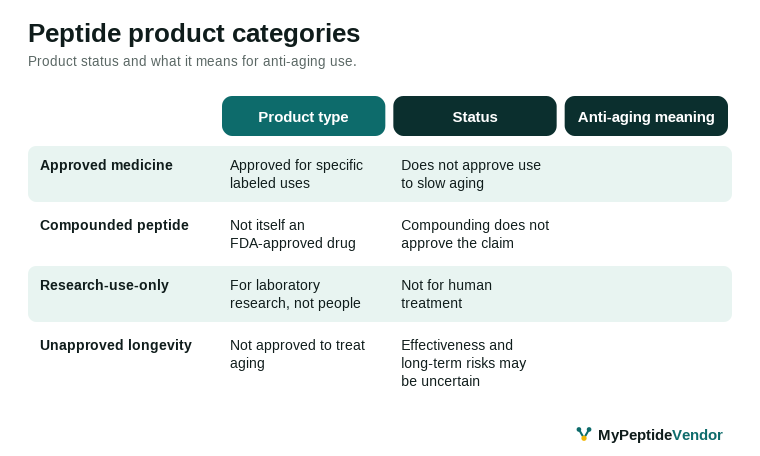
The table separates common product categories. Approval for a specific condition does not establish approval for anti-aging use; semaglutide and tirzepatide are discussed in clinical obesity care, while FDA’s compounding page describes potential safety risks 1,10.
| Product type | What the status means | What it means for anti-aging |
|---|---|---|
| FDA-approved peptide medicine | A specific product has FDA approval for specific labeled uses. | Approval for a condition does not establish approval to slow aging. |
| Compounded peptide | A prescriber and pharmacy prepare a product under applicable compounding rules; the compounded product is not itself an FDA-approved drug. | Compounding does not turn an unapproved anti-aging claim into an approved treatment. |
| Research-use-only product | Marketed for laboratory research, not human treatment. | Do not inject or ingest it. The label is not a safety or quality seal. |
| Unapproved peptide marketed for longevity | Not approved to prevent or treat aging. | Effectiveness, dose, product quality, and long-term risks may be uncertain. |
FDA-approved peptide medicines can be useful for conditions on their labels. Semaglutide and tirzepatide are discussed in clinical obesity care, but that is different from claiming that either drug slows aging 10. Do not start or stop an approved medicine for a longevity goal without the clinician who manages that treatment.
FDA Category 2 concerns specific bulk substances proposed for compounding and identifies potential safety concerns under interim policies 1. It should not be read as a simple “safe” or “unsafe” verdict for every product. Verify the exact substance, pharmacy, and current regulatory position rather than relying on an influencer’s summary.
Use this chart
Free to reuse with a link back:
If you and a clinician decide it fits, one option is Menergy Meds: nAD+ program for men, delivered to your door (US only). Affiliate link
How to choose: or decide not to use one
Start with a health goal, not a peptide name. Improving a skin concern is different from treating obesity, diabetes, or a diagnosed hormone disorder. A clinician can check whether a standard treatment has evidence for that goal and whether a peptide claim rests on a mechanism, a small study, or a meaningful clinical outcome.
Ask the prescriber to name the exact ingredient, route, intended benefit, known risks, and plan for reviewing results. Ask what would count as success and what would lead to stopping. If a clinic proposes several peptides at once, ask why each is included and how you will know which caused a benefit or side effect.
Use this checklist before accepting an injectable product:
- Prescription and clinician: Is a licensed clinician assessing you and prescribing for a medical reason?
- Product identity: Does the label name every active ingredient, strength, manufacturer or compounding pharmacy, and lot number?
- Quality documents: Can the dispensing pharmacy explain its quality controls and provide relevant documentation? A certificate of analysis alone does not prove a product is safe for injection.
- Research label: Does the package say “research use only” or “not for human use”? Do not use it as a medicine.
- Claims: Does the seller promise guaranteed reversal of aging, rapid results, or no side effects? Treat those promises as a warning sign.
- Medication review: Has a clinician or pharmacist checked your prescriptions, supplements, allergies, and health conditions?
A missing lot number or a seller who will not name the pharmacy makes it harder to trace a product if a problem occurs. FDA identifies potential significant safety risks for certain bulk substances nominated for compounding 1. Avoid products sold through channels that cannot answer basic questions about identity and handling.
Ask whether the expected benefit is worth the uncertainty. A result in a dish, an animal, or a lab marker is not the same as fewer wrinkles, better mobility, or longer life in a person. The registry’s 18-study count includes different interventions and cannot substitute for a trial of the exact peptide you are considering 12.
Costs and insurance

There is no single reliable price for peptide therapy; cost depends on the compound, formulation, dose, route, pharmacy, visits, and monitoring. A program with several products, lab work, and follow-up visits will have different costs from a topical product.
Insurance coverage depends on the medicine, diagnosis, and plan rules. A medicine used for a covered medical condition may be treated differently from a compounded product or a prescription for an unapproved anti-aging goal. Ask your insurer and pharmacy about coverage, prior authorization, and out-of-pocket costs before starting.
Compare the full plan, not just the vial price. Ask whether the quoted amount includes clinical assessment, supplies, follow-up, and any needed testing. A higher fee does not show that a product works better, and a low price does not confirm that an online vial is genuine or safe.
Safety and possible downsides
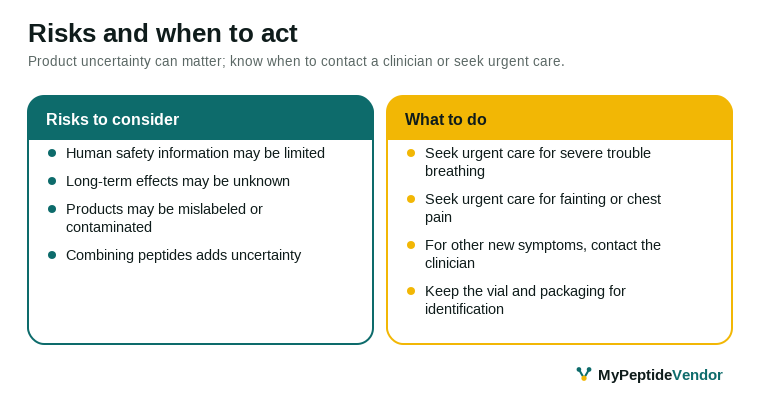
Risk depends on the substance, dose, route, product quality, and the person using it. For an unapproved peptide, human safety information may be limited, and long-term effects may be unknown. Taking several peptides together adds uncertainty because their combined effects may not have been studied.
Online or unregulated products can be mislabeled, contaminated, incorrectly concentrated, or different from what the seller advertised. A “research use only” label means the product is not intended for human treatment; it does not confirm that the contents are suitable for injection. FDA’s Category 2 process reflects concerns that certain nominated bulk substances may present significant safety risks in compounding 1.
Injections add risks related to handling, storage, dosing, and infection. A sterile-looking vial is not proof of sterility. If a product has no traceable lot information or comes from a seller that will not disclose its source, a patient cannot reliably confirm what is in it.
Changes in biological signals can also have unwanted effects. The mitokine review notes that both insufficient and excessive signaling may be harmful; higher levels of some mitokines are associated with conditions such as cancer and heart failure, while their role in aging is not settled 4. That is a reason not to assume that more signaling is always better.
Seek urgent medical care for severe trouble breathing, fainting, chest pain, or a rapidly worsening reaction after an injection. For other new symptoms, contact the prescribing clinician before taking another dose. Keep the vial and packaging so a clinician or pharmacist can identify the product.
Tell your clinician about every medicine and supplement you take before considering a peptide. The evidence does not establish how every unapproved peptide interacts with other drugs or with another peptide. A licensed clinician should review your health conditions and the exact product before treatment.
Use this chart
Free to reuse with a link back:
How to get started: telehealth or an in-person clinic
A telehealth visit can be a first step if a licensed clinician can review your history, medicines, goals, and relevant records. An in-person visit may be needed for an examination, testing, or a problem that cannot be assessed safely by video. In either setting, the clinician should discuss the exact product rather than treating “peptide therapy” as one uniform treatment.
Before the visit, write down your main goal, current medicines and supplements, allergies, and any past reaction to an injection. Ask whether an approved treatment exists for that goal, what benefit is realistic, what monitoring is needed, and what the full cost may be. If the plan uses a compounded product, ask which pharmacy prepares it and why compounding is being considered.
The registry search lists 18 studies under “Anti-Aging & Longevity.” These six records illustrate that the category covers different treatments and outcomes; a study listing or status is not evidence that the treatment works 12.
| Study | Status and phase | What it tests |
|---|---|---|
| NCT07906041 | Enrolling by invitation; Phase 2 | Tirzepatide and organ-specific biological aging |
| NCT07475546 | Completed; Phase 3 | Combination gerotherapeutic interventions for healthspan improvement |
| NCT07888595 | Enrolling by invitation; Early Phase 1 | Systemic and topical geroprotective rejuvenation assessed by aging clocks |
| NCT07879833 | NCT07879833 | Completed; phase NA (not applicable). | AI-personalized skincare for facial photoaging in women |
| NCT07528469 | Active, not recruiting; phase not listed | PeptiStrong and whey for muscle function in older adults |
| NCT06620666 | Active, not recruiting; phase not listed | Neuromuscular training for enhanced age longevity |
These six records are examples from the 18-study search, not a full list and not proof of a positive result 12. One tests tirzepatide, and another tests PeptiStrong with whey in older adults; neither registry entry establishes that an unapproved longevity peptide works 12. Check the current study record and ask the study team about eligibility before considering participation.
Frequently asked questions
Celebrity claims do not establish what a person used, whether a product was prescribed, or whether it is safe. A name repeated online is not a substitute for a verified medical record or a clinical trial.
Dosing protocols
Cardiogen 20 mg
Research UseNo approved human dose or validated cycle exists for Cardiogen peptide; its published findings are preclinical, not a dosing protocol.
View protocolChonluten 20 mg
Research UseNo human Chonluten dose or titration schedule is established; the cited research tested cells, not people.
View protocolCortagen 20 mg
Research UseCortagen has no established human dose; this guide explains 20 mg vial math and the limits of the animal and laboratory evidence.
View protocolCrystagen 20 mg
Research UseNo approved human dose or validated vial instructions are established; the 20 mg label states vial content, not a treatment schedule.
View protocolGHK-Cu 50 mg
Research UseA 50 mg GHK-Cu vial is not a 50 mg dose; no FDA-approved human dose or validated injection schedule exists.
View protocolMOTS-c 5 mg
Not approvedNo approved human MOTS-c dose exists; a 5 mg vial is its total contents, not a validated dose or schedule.
View protocolNAD+ 500 mg
Not approvedA 500mg vial is not an established injection dose; no FDA-approved human NAD+ injection schedule is established.
View protocolProstamax 20 mg
Not approvedNo validated human Prostamax dose exists; vial calculations are educational and do not make an unverified product safe to inject.
View protocolSNAP-8 10 mg
Research UseA 10 mg SNAP-8 vial states the amount of material, not a human dose; no approved human dosing or injection schedule exists.
View protocolSS-31 10 mg
Research UseA 10 mg vial states the total amount in the vial; it does not establish a safe human dose or a self-use schedule.
View protocolBuyer's guides
Where to Get Anti-aging & Longevity Treatment Legally
Through your own doctor
Ask your doctor whether this treatment is appropriate and which licensed pharmacy can supply it.
Menergy Meds
NAD+ program for men, delivered to your door.
- Online intake reviewed by a licensed provider
- NAD+ shipped to your home if appropriate
- Program aimed at energy and healthy aging
Brightmeds NAD+
Prescription NAD+ injections with a licensed US provider.
- Online consultation with a licensed provider
- NAD+ shipped to your home if prescribed
- Ongoing provider support
Affiliate disclosure: we may earn a commission if you sign up through the link above. It never changes what we write.
Frequently asked questions
What’s the best peptide for anti-aging?
None is proven to slow human aging, so there is no evidence-based “best” peptide. The 18-study registry search covers different interventions, not a head-to-head ranking of longevity peptides 12.
What peptides does Jennifer Aniston take?
Her peptide use cannot be verified from public clinical evidence, so no specific peptide should be attributed to her. Celebrity claims do not show that a product is safe or effective.
Do peptides really work for anti-aging?
Some peptide medicines are used for specific conditions, but that does not prove they slow aging. For longevity-focused peptides, a proposed mechanism or registry entry is not the same as a demonstrated benefit in people; the registry search lists 18 studies across different interventions 12.
What is the downside of taking peptides?
Unapproved or online products may have uncertain contents, quality, dose, interactions, and long-term effects. Injections add handling and administration risks, and FDA identifies potential significant safety risks for certain bulk substances nominated for compounding 1.
References
- FDA: Certain bulk drug substances for use in compounding that may present significant safety risks
- Franceschi et al. Inflamm-aging. An evolutionary perspective on immunosenescence. Ann N Y Acad Sci. 2000.
- Tang et al. Sirt1 and the Mitochondria. Mol Cells. 2016.
- Burtscher et al. Mitochondrial stress and mitokines in aging. Aging Cell. 2023.
- Kuro-o et al. Klotho. Pflugers Arch. 2010.
- Nguyen et al. Interleukin-7 and Immunosenescence. J Immunol Res. 2017.
- Kenyon et al. The genetics of ageing. Nature. 2010.
- Kolovou et al. We are ageing. Biomed Res Int. 2014.
- Maeyens et al. Visceral adiposity, metabolic health and aging. Nat Aging. 2026.
- Tuccinardi et al. Precision obesity medicine: A phenotype-guided framework for pharmacologic therapy across the lifespan. J Endocrinol Invest. 2025.
- Boyajian et al. Microbiome and Human Aging: Probiotic and Prebiotic Potentials in Longevity, Skin Health and Cellular Senescence. Nutrients. 2021.
- ClinicalTrials.gov: 18 registered studies (search: Anti-Aging & Longevity)
Written by the MyPeptideVendor editorial team from the FDA label, peer-reviewed studies and ClinicalTrials.gov records listed above, fact-checked line by line and reviewed 2026-11-12.
Cite this page
MyPeptideVendor Editorial Team. Anti Aging Peptides: Evidence & Safety. MyPeptideVendor. Updated November 12, 2026. https://mypeptidevendor.com/treatment/anti-aging-longevity/MyPeptideVendor Editorial Team. (2026, November 12). Anti Aging Peptides: Evidence & Safety. MyPeptideVendor. https://mypeptidevendor.com/treatment/anti-aging-longevity/