Ss 31 Dosage 10mg: Protocol & Safety
A 10 mg vial states the total amount in the vial; it does not establish a safe human dose or a self-use schedule.
Quickstart Highlights for SS-31 Dosage 10mg
SS-31 dosage 10mg has no established self-directed schedule for a research vial. The 10 mg figure is the vial’s total amount, not a tested daily dose.
Elamipretide has been studied in clinical trials, but the trial review and registry records cited here do not provide a dose schedule for a research vial 7,10. This page is educational, not medical advice. It does not replace current prescribing information for any approved product.
- Do not treat vial mass as a dose. A vial marked 10 mg contains that total amount; it does not define a daily amount or prove that injection is appropriate.
- Mechanism is not a dosing guide. Elamipretide binds cardiolipin, a lipid in the inner mitochondrial membrane. A review describes effects on mitochondrial structure, oxidative stress, and ATP production 7. Those findings do not predict an individual response.
- Trial names do not provide a schedule. PROGRESS-HF, TAZPOWER, MMPOWER-3, and ReCLAIM are discussed in a review, but its summary gives no per-day dose 7.
- There is no validated week-by-week titration here. Neither 7 nor 10 establishes a dose for a research vial.
- Verify the exact product. A research-use vial is not automatically the same formulation, quality, or instructions as a prescribed medicine.
Key takeaways
- A 10 mg vial contains 10 mg total; that amount does not tell you how much to inject or how often.
- Elamipretide is a tetrapeptide that binds cardiolipin on the inner mitochondrial membrane 7.
- The review names PROGRESS-HF, TAZPOWER, MMPOWER-3, and ReCLAIM, but does not report their per-day doses 7.
- Adding 1 mL to a 10 mg vial gives 10 mg/mL by arithmetic; U-100 unit examples are concentration-dependent.
- Neither 5, 7, nor 10 establishes a 4–12 week cycle, an off-period, or an SS-31 and MOTS-c combination schedule.
Dosing Schedule: What Is Established

The review describes clinical trials such as PROGRESS-HF, TAZPOWER, MMPOWER-3, and ReCLAIM without giving their daily doses or titration schedules 7. ClinicalTrials. ClinicalTrials.gov lists NCT05168774 as a completed Phase 1/2 FRDA study and NCT05194631 as a completed satellite-cell regeneration study; neither registry entry gives a usable dose schedule 10.
The table is deliberately not a dosing recommendation. No FDA-label titration schedule for a research vial can be inferred from these review and registry summaries. If a clinician prescribes an approved product, follow that product’s current FDA-approved labeling rather than this table.
| Week | Dose (mg) | Dose (mcg) | U-100 units |
|---|---|---|---|
| 1 | Not established | Not established | Not established |
| 2 | Not established | Not established | Not established |
| 3 | Not established | Not established | Not established |
| 4 | Not established | Not established | Not established |
| 5 | Not established | Not established | Not established |
| 6 | Not established | Not established | Not established |
| 7 | Not established | Not established | Not established |
| 8 | Not established | Not established | Not established |
| 9 | Not established | Not established | Not established |
| 10 | Not established | Not established | Not established |
| 11 | Not established | Not established | Not established |
| 12 | Not established | Not established | Not established |
For concentration arithmetic only, a 10 mg vial mixed to a final volume of 1 mL is 10 mg/mL. At that concentration, 1 mg is 10 U, 2.5 mg is 25 U, 5 mg is 50 U, and 10 mg is 100 U on a U-100 syringe. These examples do not establish that any of those amounts is safe or suitable. If the vial mass, final volume, or syringe differs, the marks change; ask a pharmacist to verify the calculation before handling an injectable product.
Syringe Unit Conversion Table
Units to draw on a U-100 insulin syringe (100 units = 1 mL) from a 10 mg vial. Find your dose, then read the column for the water you added. Every number is calculated, not estimated.
| Dose | 1 mL water 10 mg/mL · 1 unit = 100 mcg | 2 mL water 5 mg/mL · 1 unit = 50 mcg | 2.5 mL water 4 mg/mL · 1 unit = 40 mcg |
|---|---|---|---|
| 50 mcg | 0.5 · 200 doses | 1 · 200 doses | 1.25 · 200 doses |
| 100 mcg | 1 · 100 doses | 2 · 100 doses | 2.5 · 100 doses |
| 200 mcg | 2 · 50 doses | 4 · 50 doses | 5 · 50 doses |
| 250 mcg | 2.5 · 40 doses | 5 · 40 doses | 6.25 · 40 doses |
| 300 mcg | 3 · 33 doses | 6 · 33 doses | 7.5 · 33 doses |
| 500 mcg | 5 · 20 doses | 10 · 20 doses | 12.5 · 20 doses |
| 750 mcg | 7.5 · 13 doses | 15 · 13 doses | 18.75 · 13 doses |
| 1 mg | 10 · 10 doses | 20 · 10 doses | 25 · 10 doses |
| 1.5 mg | 15 · 6 doses | 30 · 6 doses | 37.5 · 6 doses |
| 1.7 mg | 17 · 5 doses | 34 · 5 doses | 42.5 · 5 doses |
| 2 mg | 20 · 5 doses | 40 · 5 doses | 50 · 5 doses |
| 2.4 mg | 24 · 4 doses | 48 · 4 doses | 60 · 4 doses |
| 2.5 mg | 25 · 4 doses | 50 · 4 doses | 62.5 · 4 doses |
| 3 mg | 30 · 3 doses | 60 · 3 doses | 75 · 3 doses |
| 4 mg | 40 · 2 doses | 80 · 2 doses | 100 · 2 doses |
| 5 mg | 50 · 2 doses | 100 · 2 doses | over 100 |
| 7.5 mg | 75 · 1 doses | over 100 | over 100 |
| 10 mg | 100 · 1 doses | over 100 | over 100 |
SS-31 10 mg Vial Dosage Calculator
Shows the exact insulin-syringe units to draw. Pre-loaded with the 10 mg vial; change any value to match yours.
Total volume of your syringe?
How much mg is in the vial?
How much bacteriostatic water are you adding?
Dose per injection?
Educational tool only. Concentration = vial ÷ water; units = dose ÷ concentration × 100 (U-100 syringe). Confirm every dose with your prescriber. Different vial or peptide? Use the peptide calculator.
MYPEPTIDEVENDORAffiliate link · we may earn a commission.
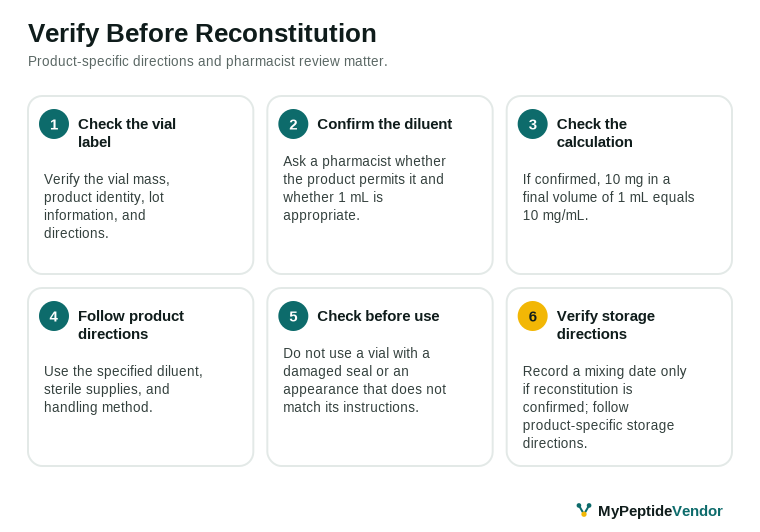
Reconstitution Steps
Reconstitution instructions are product-specific. The calculation below does not verify a vial’s identity, sterility, stability, or suitability for human injection. Do not mix or inject a research product unless a qualified pharmacist has reviewed the exact vial and its instructions.
- Check the label for the stated vial mass, product identity, lot information, and directions. Stop if any detail is missing, inconsistent, or unclear.
- Confirm with a pharmacist whether the exact product permits bacteriostatic water and whether a 1 mL final volume is appropriate. If confirmed, 10 mg in a final volume of 1 mL equals 10 mg/mL.
- Use only the diluent, sterile supplies, and handling method specified for that product. Do not assume that instructions for another vial apply.
- Follow the product’s directions for mixing and appearance. Do not use a vial if its seal is damaged or the solution does not match its stated instructions.
- Record the mixing date only if the pharmacist confirms the product may be reconstituted, then follow its specific storage and beyond-use directions.
Storage temperature for an unidentified vial cannot be confirmed from the available evidence 7,10. Use the exact product’s verified directions instead.
Use this chart
Free to reuse with a link back:
Supplies Needed
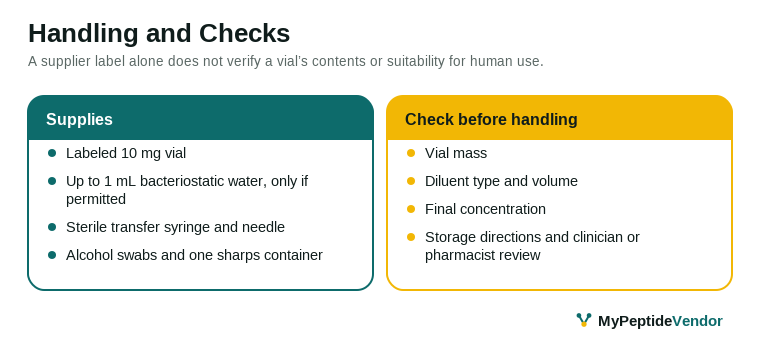
For a single-vial handling discussion, prepare one labeled 10 mg vial, up to 1 mL of bacteriostatic water only if the exact product instructions permit it, one sterile transfer syringe and needle, alcohol swabs for the vial stopper and skin, and one sharps container. A U-100 syringe is relevant only if a clinician has prescribed a measured injection and confirmed the correct concentration.
Before any handling, check five items: vial mass, diluent type and volume, final concentration, storage directions, and clinician or pharmacist review. A supplier label alone does not verify a vial’s contents or make it appropriate for human use.
Use this chart
Free to reuse with a link back:
Protocol Overview & Cycle Notes

SS-31, also called elamipretide, is a mitochondria-targeted tetrapeptide that selectively binds cardiolipin in the inner mitochondrial membrane 7. A separate review describes effects on mitochondrial biogenesis pathways involving PGC-1α and TFAM, mitochondrial fusion involving OPA1, fission pathways involving Drp-1, inflammatory markers, and amyloid-beta 9. These are review-level and mechanistic findings, not proof of a treatment benefit for a person.
The primary sources cited here do not establish those dose bands, cycle lengths, off-periods, or reassessment intervals. A safe duration beyond the studied protocols has not been established, and further study of long-term efficacy and safety is needed 7.
Splitting amounts above 10 mg into two injections is not supported by the cited review or registry records as a validated schedule 7,10. Treat that advice as an unverified convention, not a clinical rule. Do not create a split-dose plan without a prescriber.
SS-31 and MOTS-c are discussed in peptide research 5, but there is no human evidence or validated dose or timing plan for taking them together. Taking both in the morning, taking them at the same time, or separating them has not been established as a clinical protocol here.
Reviews also discuss SS-31 as a research candidate for age-related macular degeneration and nonalcoholic fatty liver disease 2,8. A candidate compound is not an established treatment for either condition. Elamipretide is also called SS-31, MTP-131, and Bendavia in review literature 7; the sources cited here do not establish whether a particular research vial matches any prescribed product.
Storage & Handling
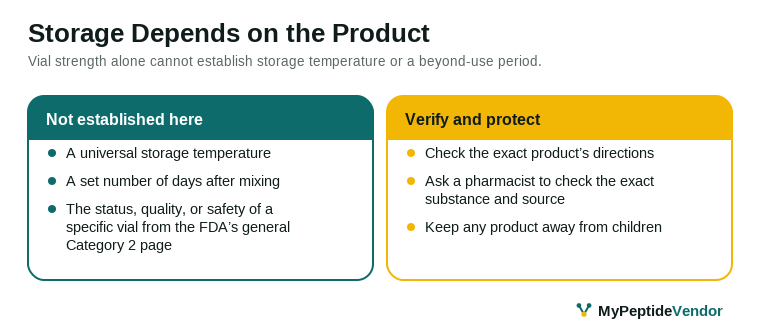
Do not assume that every SS-31 vial should be stored at 2–8 °C or used for a set number of days after mixing. The correct conditions depend on the verified product and its directions; vial strength alone cannot establish storage temperature or a beyond-use period.
The FDA describes Category 2 for certain bulk substances nominated for compounding that may present significant safety risks 1. That general page does not, by itself, verify the legal status, quality, or safety of a specific SS-31 vial. Ask a pharmacist to check the exact substance and source, and keep any product away from children.
Use this chart
Free to reuse with a link back:
Injection & Tracking Tips

U-100 marks measure volume, not milligrams. A mark represents a different drug amount when the concentration changes, so never reuse a unit chart after changing the diluent volume or vial mass. Have a pharmacist verify the concentration and the prescribed measurement on the exact syringe before use.
If a clinician is supervising treatment, keep a record of the product name, lot, date, prescribed amount, and symptoms. Record one change at a time when your clinician advises it; otherwise, it can be hard to identify what caused a new symptom. Do not increase an amount or add MOTS-c based on online reports.
Safety & Side Effects
A sports-medicine review describes rigorous human safety data for unapproved peptide use as scarce and warns of potential serious harm 5. Reliable side-effect frequencies for SS-31 are not reported in 5,7; no percentage can be stated. Missing frequency data do not mean that a product is risk-free.
Seek urgent medical care for trouble breathing, fainting, or signs of a severe allergic reaction. Contact a clinician promptly about any unexpected or worsening symptom. Do not restart, increase, or combine products without medical advice.
This page is not medical advice. A qualified clinician or pharmacist should review the exact product before use. Research-vial calculations are not a substitute for current approved labeling or a prescription.
Frequently asked questions
What dose of SS-31 did clinical trials use?
The review names PROGRESS-HF, TAZPOWER, MMPOWER-3, and ReCLAIM but does not provide their dose schedules 7. The registry entries NCT05168774 and NCT05194631 identify study details and status, but the records cited here do not give a usable dose for a research vial 10.
How many U-100 units are in 1 mg of SS-31?
There is no concentration-independent answer. At 10 mg/mL, 1 mg corresponds to 10 U; ask a pharmacist to check the vial and final concentration before measuring any prescribed amount.
How do you reconstitute a 10 mg SS-31 vial?
Do not assume every vial can be mixed the same way. If a pharmacist confirms that the exact product permits it, a final volume of 1 mL gives 10 mg/mL by arithmetic; product-specific directions must govern diluent, sterile handling, storage, and use time.
Is SS-31 the same as Forzinity?
Review literature uses elamipretide, SS-31, MTP-131, and Bendavia as names for the compound 7. Approved-product status, and whether a research vial matches a prescribed product, are not established 7.
Can SS-31 be stacked with MOTS-c?
The cited review discusses both peptides, but does not establish human evidence or a validated schedule for using them together 5. Ask a clinician before combining compounds.
References
- FDA: Certain bulk drug substances for use in compounding that may present significant safety risks
- Nashine et al. Potential Therapeutic Candidates for Age-Related Macular Degeneration (AMD). Cells. 2021.
- Sherrod et al. Effect of Aficamten on Health Status Outcomes in Obstructive Hypertrophic Cardiomyopathy: Results From SEQUOIA-HCM. J Am Coll Cardiol. 2024.
- Pavlović et al. Mitochondrial Dysfunction: The Silent Catalyst of Kidney Disease Progression. Cells. 2025.
- Mendias et al. Safety and Efficacy of Approved and Unapproved Peptide Therapies for Musculoskeletal Injuries and Athletic Performance. Sports Med. 2026.
- Thapak et al. The bioenergetics of traumatic brain injury and its long-term impact for brain plasticity and function. Pharmacol Res. 2024.
- Tung et al. Elamipretide: A Review of Its Structure, Mechanism of Action, and Therapeutic Potential. Int J Mol Sci. 2025.
- Zhang et al. The emerging significance of mitochondrial targeted strategies in NAFLD treatment. Life Sci. 2023.
- Nhu et al. Neuroprotective Effects of a Small Mitochondrially-Targeted Tetrapeptide Elamipretide in Neurodegeneration. Front Integr Neurosci. 2021.
- ClinicalTrials.gov: 2 registered studies (search: SS-31)
Written by the MyPeptideVendor editorial team from the FDA label, peer-reviewed studies and ClinicalTrials.gov records listed above, fact-checked line by line and reviewed 2026-11-12.
Cite this page
MyPeptideVendor Editorial Team. ss 31 dosage 10mg: Protocol & Safety. MyPeptideVendor. Updated November 12, 2026. https://mypeptidevendor.com/protocols/ss-31-dosing-10mg/MyPeptideVendor Editorial Team. (2026, November 12). ss 31 dosage 10mg: Protocol & Safety. MyPeptideVendor. https://mypeptidevendor.com/protocols/ss-31-dosing-10mg/Related protocols
Cardiogen 20 mg
Research UseNo approved human dose or validated cycle exists for Cardiogen peptide; its published findings are preclinical, not a dosing protocol.
View protocolChonluten 20 mg
Research UseNo human Chonluten dose or titration schedule is established; the cited research tested cells, not people.
View protocolCortagen 20 mg
Research UseCortagen has no established human dose; this guide explains 20 mg vial math and the limits of the animal and laboratory evidence.
View protocol