Aicar Dosage 50mg: Dose & Safety Guide
AICAR has no approved human dose or validated injection schedule; a 50 mg vial does not establish a safe dose, dilution, or cycle.
Quickstart highlights for an AICAR 50 mg vial
aicar dosage 50mg has no approved human dose or validated injection schedule. The 50 mg figure describes the vial’s contents, not an amount known to be safe to inject.
AICAR is a research compound, not an established self-injection treatment. Human dosing, injection instructions, and a safe cycle length have not been established 11.
- Dose: No approved or clinically established human dose is available. Vial strength is not a dose recommendation 11.
- Titration: There is no FDA-approved AICAR label with a starting dose or escalation plan. A week-by-week injection schedule cannot be presented as validated medical guidance.
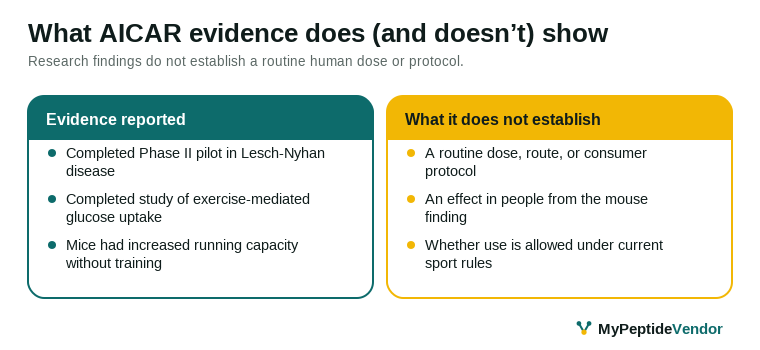
- Human evidence: The registry lists a completed Phase II pilot for AICAR in Lesch-Nyhan disease and a completed study of exercise-mediated glucose uptake in type 2 diabetes 11. Registry titles alone do not establish a routine dose, route, or consumer protocol.
- Animal evidence: A review reports increased running capacity in mice given AICAR without training. That finding does not establish an effect in people 9.
- Sport status: A 2015 review says the mouse study prompted WADA to include certain AMPK activators on its forbidden list 9. Do not assume the rule applies only during competition; check the current WADA list and your sport’s rules.
Use this chart
Free to reuse with a link back:
Key takeaways
- No approved human AICAR dose or titration schedule is established; do not treat a 50 mg vial as a prescription 11.
- A review reports that AICAR increased running capacity in mice, but that result does not establish a human endurance benefit 9.
- ClinicalTrials.gov lists a Phase II pilot for Lesch-Nyhan disease and a separate type 2 diabetes exercise-mediated glucose uptake study; neither listing gives a consumer injection schedule 11.
- FDA generally advises discarding multi-dose sterile medication vials within 28 days after first use, but that general advice does not establish AICAR stability 1.
- A 2015 Sports Medicine review reports that the mouse study prompted WADA to include certain AMPK activators on its forbidden list; check current sport rules for exact status 9.
AICAR dosing schedule: no validated human titration

No FDA label or human trial schedule establishes a week-by-week AICAR titration. ClinicalTrials.gov lists NCT00004314 as a completed Phase II pilot of aminoimidazole carboxamide riboside for Lesch-Nyhan disease and NCT00168519 as a completed study of exercise-mediated glucose uptake in type 2 diabetes 11. Those entries do not provide a consumer dose, a subcutaneous schedule, or a plan for a 50 mg vial.
No human AICAR study identified in ClinicalTrials.gov 11 provides an mg/kg subcutaneous dose supporting consumer use.
| Week | Dose per injection (mg) | Dose per injection (mcg) | U-100 units | Evidence status |
|---|---|---|---|---|
| 1 | Not established | Not established | Not provided | No approved starting dose |
| 2 | Not established | Not established | Not provided | No validated titration step |
| 3 | Not established | Not established | Not provided | No validated titration step |
| 4 | Not established | Not established | Not provided | No validated titration step |
| 5 | Not established | Not established | Not provided | No validated titration step |
| 6 | Not established | Not established | Not provided | No validated titration step |
| 7 | Not established | Not established | Not provided | No validated titration step |
| 8 | Not established | Not established | Not provided | No validated titration step |
Turning an amount into U-100 syringe units only gives a liquid volume after a concentration is chosen. It does not establish that the dose, diluent, vial, or route is safe. For that reason, this page does not provide dilution volumes, syringe-unit conversions, or a dose calculator.
Syringe Unit Conversion Table
Units to draw on a U-100 insulin syringe (100 units = 1 mL) from a 50 mg vial. Find your dose, then read the column for the water you added. Every number is calculated, not estimated.
| Dose | 2.5 mL water 20 mg/mL · 1 unit = 200 mcg | 4 mL water 12.5 mg/mL · 1 unit = 125 mcg | 5 mL water 10 mg/mL · 1 unit = 100 mcg |
|---|---|---|---|
| 50 mcg | 0.25 · 1000 doses | 0.4 · 1000 doses | 0.5 · 1000 doses |
| 100 mcg | 0.5 · 500 doses | 0.8 · 500 doses | 1 · 500 doses |
| 200 mcg | 1 · 250 doses | 1.6 · 250 doses | 2 · 250 doses |
| 250 mcg | 1.25 · 200 doses | 2 · 200 doses | 2.5 · 200 doses |
| 300 mcg | 1.5 · 166 doses | 2.4 · 166 doses | 3 · 166 doses |
| 500 mcg | 2.5 · 100 doses | 4 · 100 doses | 5 · 100 doses |
| 750 mcg | 3.75 · 66 doses | 6 · 66 doses | 7.5 · 66 doses |
| 1 mg | 5 · 50 doses | 8 · 50 doses | 10 · 50 doses |
| 1.5 mg | 7.5 · 33 doses | 12 · 33 doses | 15 · 33 doses |
| 1.7 mg | 8.5 · 29 doses | 13.6 · 29 doses | 17 · 29 doses |
| 2 mg | 10 · 25 doses | 16 · 25 doses | 20 · 25 doses |
| 2.4 mg | 12 · 20 doses | 19.2 · 20 doses | 24 · 20 doses |
| 2.5 mg | 12.5 · 20 doses | 20 · 20 doses | 25 · 20 doses |
| 3 mg | 15 · 16 doses | 24 · 16 doses | 30 · 16 doses |
| 4 mg | 20 · 12 doses | 32 · 12 doses | 40 · 12 doses |
| 5 mg | 25 · 10 doses | 40 · 10 doses | 50 · 10 doses |
| 7.5 mg | 37.5 · 6 doses | 60 · 6 doses | 75 · 6 doses |
| 10 mg | 50 · 5 doses | 80 · 5 doses | 100 · 5 doses |
| 12.5 mg | 62.5 · 4 doses | 100 · 4 doses | over 100 |
| 15 mg | 75 · 3 doses | over 100 | over 100 |
AICAR 50 mg Vial Dosage Calculator
Shows the exact insulin-syringe units to draw. Pre-loaded with the 50 mg vial; change any value to match yours.
Total volume of your syringe?
How much mg is in the vial?
How much bacteriostatic water are you adding?
Dose per injection?
Educational tool only. Concentration = vial ÷ water; units = dose ÷ concentration × 100 (U-100 syringe). Confirm every dose with your prescriber. Different vial or peptide? Use the peptide calculator.
Reconstitution steps for a 50 mg AICAR vial
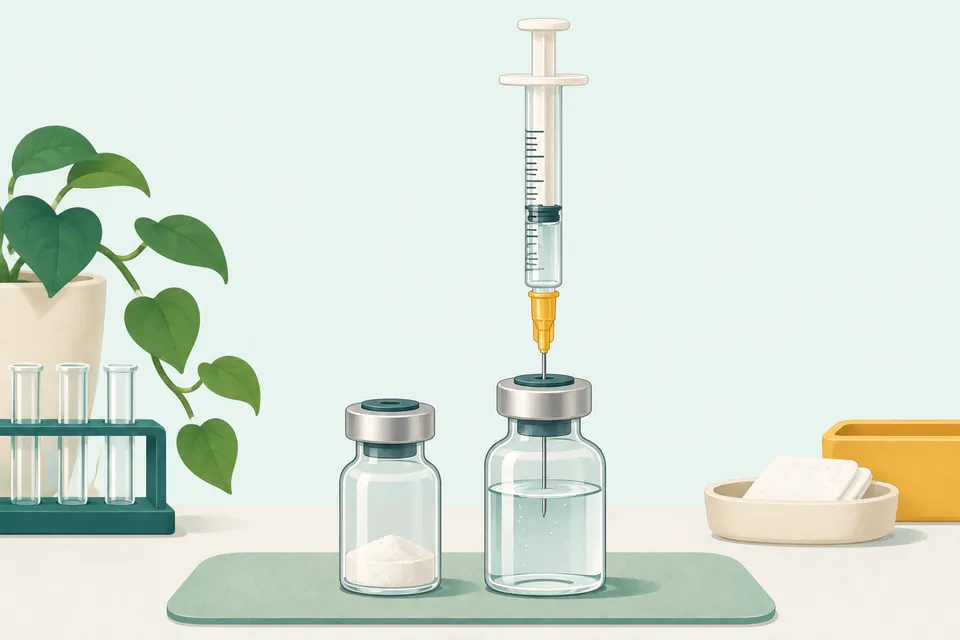
- Do not reconstitute a research-labeled AICAR vial for personal injection. No approved product directions establish a human diluent, concentration, route, or dose.
- Do not use an online conversion chart to choose an amount. U-100 markings measure liquid volume; they do not verify the vial’s identity, sterility, or contents.
- If a licensed clinician has prescribed a legally supplied medicine, ask the dispensing pharmacist to confirm the product, preparation instructions, measuring device, and beyond-use date before use.
- For laboratory work, follow the institution’s handling procedures and product-specific safety documentation.
A concentration calculation does not prove that a preparation is sterile, stable, or suitable for injection. FDA states that unapproved GLP-1 drugs, such as semaglutide and tirzepatide, do not undergo its review for safety, effectiveness, and quality before they are marketed 1.
Supplies needed for a full vial
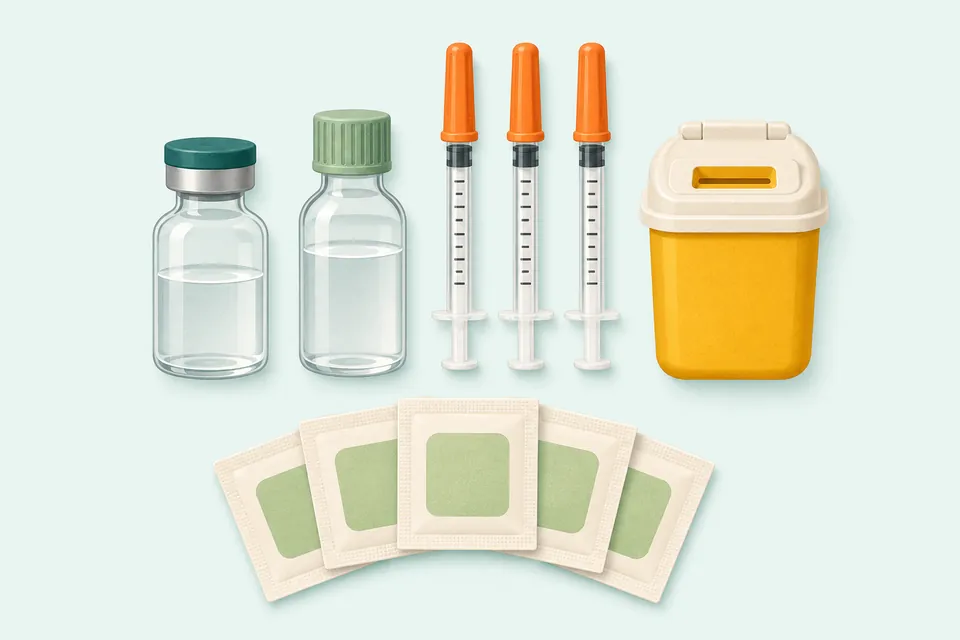
For personal injection, recommended quantities are zero. No human injection schedule is established, so listing a number of syringes, swabs, or milliliters of bacteriostatic water would imply a validated use that does not exist.
For laboratory work, supply quantities depend on the assay and the lab’s procedures. A certificate of analysis may report a test result, but it does not by itself establish sterility, accurate vial contents, or suitability for injection in people.
For compounded GLP-1 multi-dose vials, FDA advises always using a new, sterile needle and syringe for each dose because reusing them can contaminate the medication 1. That general advice does not make a research-labeled AICAR product appropriate for human use.
Protocol overview and cycle notes
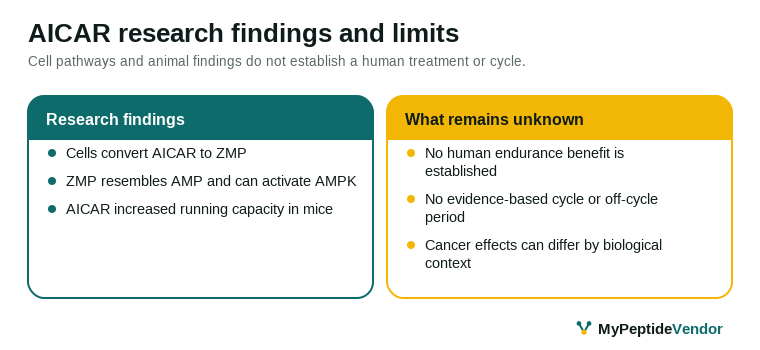
AICAR enters cells and is converted to ZMP, a molecule that resembles AMP and can activate AMP-activated protein kinase (AMPK), a cellular energy-sensing enzyme 9. This pathway makes AICAR useful in metabolic research; it does not prove that an injection improves human health or fitness.
AMPK signaling is linked to autophagy, the breakdown and recycling of cell material, and mitophagy, the selective removal of mitochondria. Reviews discuss AICAR among drugs that may modulate autophagy and mitophagy through AMPK signaling 8. Those mechanisms do not establish a personal cycle duration, dose, or treatment effect.
The mouse endurance finding does not establish a measured human outcome. A 2015 review reports that AICAR increased running capacity in mice without training and that the result prompted WADA to include certain AMPK activators on its forbidden list 9. No human endurance benefit is established by that animal result.
In a study of muscle cells, treatment with AICAR increased secretion of cathepsin B (CTSB). Treadmill exercise also raised plasma CTSB in humans, and changes in CTSB correlated with fitness and hippocampus-dependent memory 6. The human observation involved exercise, not AICAR injections, and a correlation does not show that AICAR improves memory.
AMPK is not simply a cancer-promoting or cancer-blocking switch. A review describes context-dependent tumor-promoting effects, including support for cancer-cell survival, as well as tumor-suppressing effects, including inhibition of cancer-cell growth 4. The oncology risk of sustained AICAR exposure has not been established; these findings cannot show that long-term use is safe or harmful for an individual.
MOTS-c is a different mitochondrial-derived peptide. A review describes some MOTS-c effects as involving the AICAR-AMPK pathway 7. A shared pathway does not make the compounds interchangeable or establish a dose for either one.
No evidence-based AICAR cycle length or off-cycle period is established. Without a validated human dose, there is no supported basis for recommending a set number of weeks on or off.
Use this chart
Free to reuse with a link back:
Storage and handling
No AICAR-specific storage temperature or post-reconstitution stability period is established for a consumer vial. Do not assume that a temperature or use-by period for another injectable product applies to AICAR. Follow product-specific directions only when they come from a licensed pharmacy or the research institution responsible for the material.
For compounded GLP-1 medications in multi-dose sterile vials, FDA recommends discarding the vial within 28 days after first use, even if medication remains 1. This general guidance does not prove that reconstituted AICAR remains sterile, potent, or safe for 28 days.
Do not use material with damaged packaging, unclear identity, or missing handling instructions. These are practical reasons to stop and ask a licensed professional to verify the product rather than guessing at its contents or storage conditions.
Injection and tracking tips
This guide does not recommend injecting AICAR or provide injection-site directions because a human dose and product-specific injection instructions are not established. Do not treat a vendor’s dose chart as a prescription. Ask a licensed clinician or pharmacist before taking any action with a vial intended for personal use.
For a clinical discussion, record the product name, stated vial strength, lot number, source, and any symptoms or other medicines. The type 2 diabetes registry entry concerns exercise-mediated glucose uptake; it does not establish an AICAR treatment plan or justify changing diabetes medicines 11.
A 2015 Sports Medicine review reports that the mouse study prompted WADA to include certain AMPK activators on its forbidden list 9. It does not give the exact current wording or timing rule. Do not assume AICAR is allowed out of competition; check the current WADA Prohibited List and your sport’s rules before using any substance.
Safety and side effects
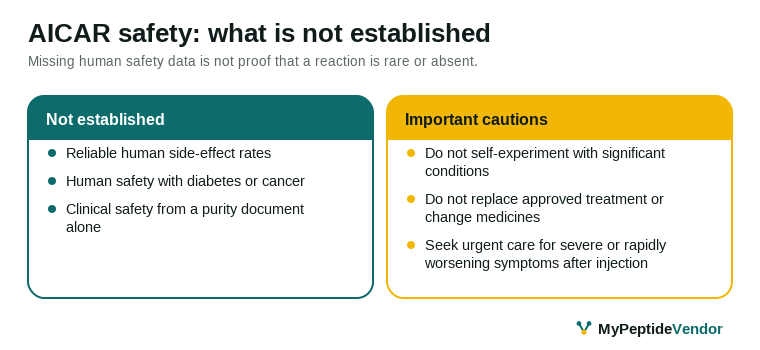
Reliable human rates for AICAR side effects are not established by the ClinicalTrials.gov entries described here 11. Those registry listings do not give a frequency such as “common” or a percentage for a reaction. Missing frequency data do not mean a side effect is rare.
Do not self-experiment with AICAR if you have diabetes, cancer, or another significant medical condition. Human safety in these settings is not established, and AMPK can have different effects in different biological contexts 4. This is a caution under uncertainty, not proof that AICAR causes a specific complication.
Do not use a research product in place of an approved treatment or change prescribed medicines to accommodate it. The registered Lesch-Nyhan and type 2 diabetes studies do not establish that a research vial is safe for self-injection 11.
FDA warns that products marketed directly to consumers as “for research purposes” or “not for human consumption” may be of unknown quality and harmful in the situations covered by its guidance 1. A purity document alone cannot establish sterility, correct identity, accurate concentration, or clinical safety. Seek urgent medical care for severe or rapidly worsening symptoms after any injection.
Use this chart
Free to reuse with a link back:
Frequently asked questions
What is a typical AICAR dose for a 50 mg vial?
There is no typical, clinically established human dose for a 50 mg AICAR vial. ClinicalTrials.gov listings do not establish a consumer self-injection schedule 11.
Does AICAR increase endurance in humans?
The cited endurance finding is in mice, not people 9. The human endurance effect has not been established.
Is AICAR the same as acadesine?
Acadesine is a name for AICAR used in clinical and research contexts; the registry lists the compound as aminoimidazole carboxamide riboside (AICAR) 11. That naming does not prove that a research vial matches the formulation or handling of material used in a clinical study.
How long should an AICAR cycle last, and how long should the break be?
No evidence-based personal cycle length or off-cycle period is established. A calendar schedule cannot replace a validated human dosing study.
How should a reconstituted AICAR vial be stored?
No AICAR-specific consumer storage temperature or stability period is established. FDA’s general 28-day advice for multi-dose sterile medication vials is not an AICAR stability finding 1.
Is AICAR FDA-approved or allowed in sport?
No approved AICAR human dose or label is established by the clinical registry entries 11. A 2015 review says certain AMPK activators were added to WADA’s forbidden list after the mouse study, but the current list is the place to verify exact status and timing 9.
What did the AICAR bypass-surgery trial test?
The cited registry entries describe a Lesch-Nyhan disease pilot and a type 2 diabetes study of exercise-mediated glucose uptake 11. They do not describe a bypass-surgery trial, so they cannot establish its route, dose, or results.
References
- FDA: Concerns with unapproved GLP-1 drugs used for weight loss
- FDA: Certain bulk drug substances for use in compounding that may present significant safety risks
- Devis-Jauregui et al. Autophagy in the physiological endometrium and cancer. Autophagy. 2021.
- Penugurti et al. AMPK: The energy sensor at the crossroads of aging and cancer. Semin Cancer Biol. 2024.
- Yumoto et al. Targeting AMP-activated protein kinase in sepsis. Front Endocrinol (Lausanne). 2024.
- Moon et al. Running-Induced Systemic Cathepsin B Secretion Is Associated with Memory Function. Cell Metab. 2016.
- Gao et al. MOTS-c Functionally Prevents Metabolic Disorders. Metabolites. 2023.
- Dombi et al. Modulating Mitophagy in Mitochondrial Disease. Curr Med Chem. 2018.
- Niederberger et al. Activation of AMPK and its Impact on Exercise Capacity. Sports Med. 2015.
- Procaccio et al. Perspectives of drug-based neuroprotection targeting mitochondria. Rev Neurol (Paris). 2014.
- ClinicalTrials.gov: 6 registered studies (search: AICAR)
Written by the MyPeptideVendor editorial team from the FDA label, peer-reviewed studies and ClinicalTrials.gov records listed above, fact-checked line by line and reviewed 2026-11-12.
Cite this page
MyPeptideVendor Editorial Team. aicar dosage 50mg: Dose & Safety Guide. MyPeptideVendor. Updated November 12, 2026. https://mypeptidevendor.com/protocols/aicar-dosing-50mg/MyPeptideVendor Editorial Team. (2026, November 12). aicar dosage 50mg: Dose & Safety Guide. MyPeptideVendor. https://mypeptidevendor.com/protocols/aicar-dosing-50mg/Related protocols
5-Amino-1MQ 50 mg
Not approvedNo approved human dose exists; this guide separates 50 mg vial math from dosing advice and explains evidence, handling, and safety limits.
View protocolAOD-9604 10 mg
Not approvedAOD-9604 is not FDA-approved, and no validated human subcutaneous dose, titration schedule, or cycle is established.
View protocolCagrilintide 10 mg
Not approvedCagrilintide is not FDA-approved; a 10 mg vial is not a dose, and trial schedules do not establish a safe home-use protocol.
View protocol