Adipotide FTPP: Evidence, Risks & U.S. Status
Experimental proapoptotic peptidomimetic
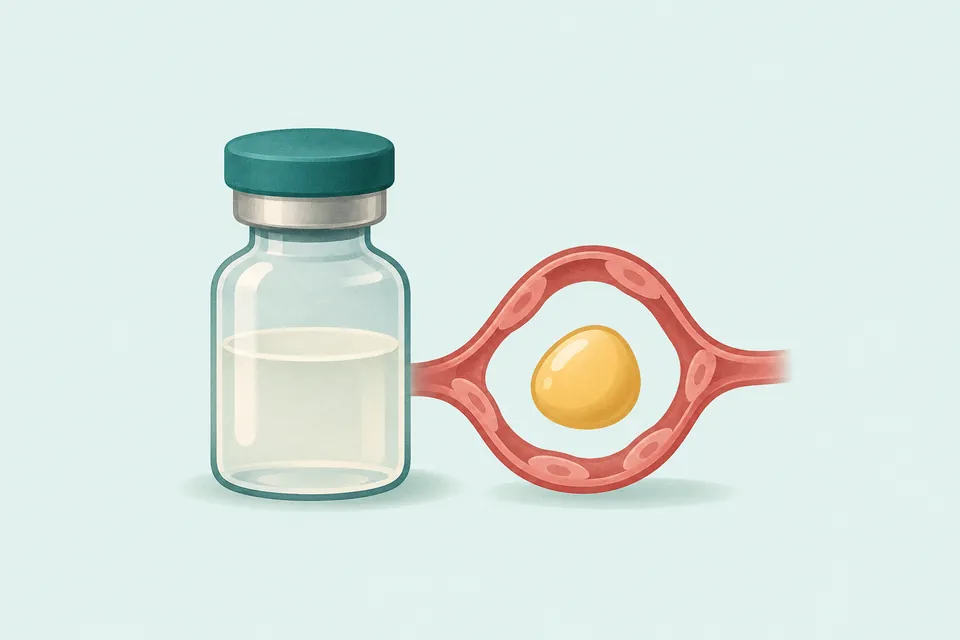
Adipotide is an experimental peptide studied for its potential to reduce white fat by damaging the blood vessels that supply it. The 2011 primate study reported weight loss and improved insulin resistance in obese monkeys, but it did not establish a human treatment or dose 5.
The same study reported reversible changes in kidney proximal-tubule function at experimentally determined optimal doses in Old World monkeys across three species 5. Human side-effect percentages, human weight-loss results, and a safe dose for people are not established.
Key takeaways
- The 2011 Barnhart study reported weight loss, improved insulin resistance, and reduced white fat in obese monkeys from three different species; its abstract does not give the sample size, duration, or numeric weight-loss result 5.
- Reversible changes in kidney proximal-tubule function were reported at experimentally determined optimal doses in monkeys from three different species 5.
- A 2012 comment questioned whether reduced food consumption, rather than blood-vessel apoptosis, could explain the monkey weight loss 4.
- A different, nanoparticle-based treatment reduced body weight and liver and muscle fat in diet-induced obese mice, with no detectable hepatotoxicity reported 3.
- Adipotide has no established human dose or human side-effect rate; FDA warnings about research-labeled products concern unapproved GLP-1 products, not an Adipotide-specific FDA action 1.
Adipotide (FTPP) at a glance
- Class
- Experimental proapoptotic peptidomimetic
- Mechanism
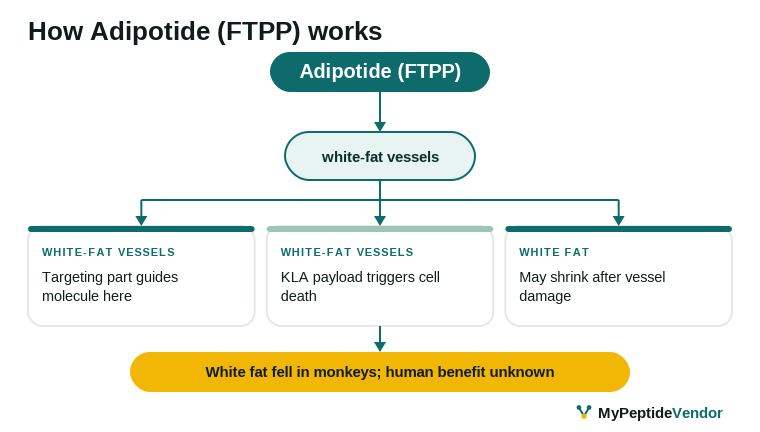
- Designed to target white-fat blood vessels and cause apoptosis; the linked payload is intended to trigger cell death.
- FDA Status
- Not approved for human use; no licensed Adipotide product is established.
- Brand names
- Adipotide; FTPP is used in the target search term but is not established as an alternate name in the cited primate paper.
- Administration
- Systemic injection was used in the mouse nanoparticle study; the primate abstract does not state the route.
- Typical Dose
- No established human dose. The primate abstract gives no numeric dose.
- Half-life
- Not established in the cited studies.
- Primary Uses
- Research into obesity and white-adipose-tissue biology; no established human medical use.
What is it?

Adipotide is an experimental peptide-like molecule studied as a way to reduce white adipose tissue, the body’s main energy-storing fat. The primate research describes it as a peptidomimetic called adipotide and reports that it induced apoptosis within blood vessels in white fat 5. It has not become an approved medicine for people.
The molecule joins a targeting sequence to a proapoptotic payload. The primate paper gives the sequence as CKGGRAKDC-GG-(D)(KLAKLAK)₂ 5. In plain terms, one part is meant to guide the molecule toward its target, while the KLA-containing part is meant to damage cells after delivery.
“Proapoptotic” means intended to start apoptosis, the controlled process by which a cell dies. “Peptidomimetic” means a molecule designed to imitate some features of a peptide. Those terms describe the experimental design; they do not show that Adipotide reaches only fat tissue or is safe in humans 5.
That naming point does not change the evidence: the reported results are from animals, not human treatment trials.
What makes it different
Adipotide was designed to damage blood vessels supplying white fat, rather than to act as an established appetite or weight-management medicine. The primate study reported targeted apoptosis within white-fat blood vessels and a marked reduction in white adipose tissue measured by MRI and dual-energy x-ray absorptiometry (DEXA) 5. Those findings show what happened in the study animals; they do not prove a human benefit.
The idea is unusual because the target is the tissue’s blood supply, not simply a signal involved in eating or fullness. But the study does not establish that every pound lost resulted from vessel damage. In a 2012 comment, Criscione and colleagues argued that Adipotide might directly reduce food consumption, which could explain the weight loss 4. That alternative has not been resolved by the evidence described here.
Kidney findings also make the safety question central. In three Old World monkey species, investigators reported predictable and reversible changes in renal proximal-tubule function at experimentally determined optimal doses 5. The abstract does not identify the species or give the dose range that caused the changes. It also does not establish where the compound acted to produce them.
A separate mouse study tested KLA-PTNP, a nanoparticle carrying a proapoptotic KLA peptide and targeting prohibitin, an adipose vascular marker 3. At a low dose, this nanoparticle treatment reduced body weight and ectopic fat in the liver and muscle in diet-induced obese mice. No detectable hepatotoxicity was reported 3. KLA-PTNP is a different formulation from the Adipotide bioconjugate; its results cannot be treated as proof that free Adipotide is safe or effective.
The difference between these approaches matters. Hossen and colleagues compared a nanoparticle-targeted treatment with a bioconjugate composed of the same targeting peptide and KLA, identified in the study as Adipotide 3. The positive low-dose results reported in the abstract were for KLA-PTNP rather than the bioconjugate. A delivery improvement in mice does not answer the primate kidney question or establish a human treatment.
How does it work?
In plain language, Adipotide was designed to find blood vessels associated with white fat and trigger cell death in those vessels. If that happens, the fat tissue supplied by them may shrink. In obese monkeys, the study reported apoptosis in white-fat blood vessels and a reduction in white adipose tissue measured with MRI and DEXA 5.
The targeting sequence is linked to a cell-killing payload. In the mouse nanoparticle research, prohibitin is described as an adipose vascular marker, and the nanoparticle was used to deliver the KLA payload toward adipose endothelial cells, the cells lining blood vessels in fat 3. The primate study reports the adipotide sequence and vascular findings, but its abstract does not explain every step in the molecule’s uptake or action 5.
MRI and DEXA are ways to measure body composition. MRI images fat depots, while DEXA estimates fat and lean tissue. In the monkey study, those measures supported the report of reduced white adipose tissue 5. A change in an imaging endpoint is not the same as evidence that a treatment improves health or produces lasting weight loss in people.
The proposed vascular mechanism is not the only explanation under discussion. Criscione and colleagues suggested that a direct effect on food consumption could explain the weight loss 4. The available primate report and comment do not settle whether reduced intake, vessel apoptosis, or both contributed to the observed change.
Kidney effects are another unresolved part of the mechanism. The primate abstract reports changes in renal proximal-tubule function, but it does not show where the drug acted or establish why those changes occurred 5. The kidney finding is a safety signal to take seriously; it does not, by itself, prove that the intended targeting failed.
Use this chart
Free to reuse with a link back:
What the clinical evidence actually shows

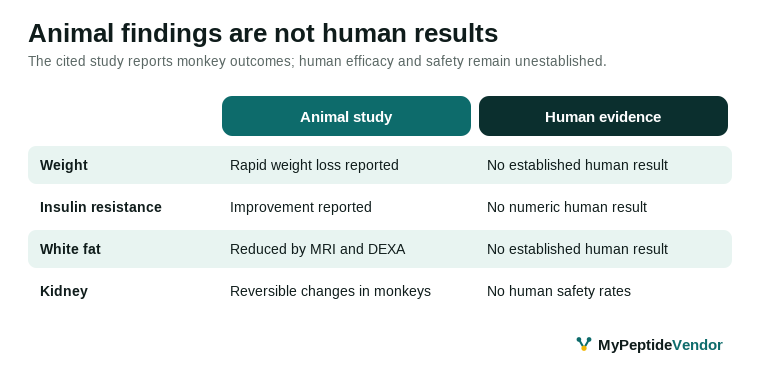
There are no established human efficacy results or human safety rates for Adipotide. The key primate paper is Barnhart and colleagues’ 2011 study, “A peptidomimetic targeting white fat causes weight loss and improved insulin resistance in obese monkeys” 5. It reports obese Old World monkeys, rapid weight loss, improved insulin resistance, and a marked reduction in white adipose tissue measured by MRI and DEXA 5.
The abstract does not state the number of monkeys, treatment duration, numeric dose, or percentage of body weight lost 5. It therefore does not support a reliable pounds-lost estimate for a person or a human-equivalent dose. It also does not provide a numeric result for the change in insulin resistance.
The renal findings were reported across three Old World monkey species 5. At experimentally determined optimal doses, the researchers described predictable and reversible changes in renal proximal-tubule function 5. The abstract does not give a dose range for those changes, the lowest dose associated with them, or a threshold considered free of risk.
“Reversible” describes what happened under the study conditions; it does not mean the kidney changes were harmless. The abstract does not establish whether repeated exposure would be safe in people, whether every kidney effect would resolve, or how long recovery took 5. Those questions have not been answered by the primate result.
Criscione and colleagues challenged the interpretation in a 2012 comment. They proposed that a direct effect on food consumption might explain the weight loss attributed to apoptosis of blood vessels around white fat 4. The monkey report describes the vascular and weight findings, but the comment highlights that the cause of weight loss remains contested 45.
Hossen and colleagues’ 2013 study examined KLA-PTNP in diet-induced obese mice, not the same free-peptide formulation used in the primate study 3. Systemic injection of the low-dose nanoparticle treatment reduced body weight and ectopic fat in the liver and muscle; the researchers reported no detectable hepatotoxicity 3. These findings do not show that KLA-PTNP prevents kidney effects in primates or is safe for people.
The evidence ladder is short: the cited work includes a targeting strategy, rodent research, and a primate study, but it does not establish a human treatment 35. Primate results are useful for deciding what to study next, but they are still animal results. They cannot supply a human dose, expected weight-loss amount, or side-effect percentage.
Evidence ladder:
| Evidence level | Study or approach | What was reported | What remains unknown |
|---|---|---|---|
| Targeting design | Adipotide sequence linked to a proapoptotic payload | Designed to target white-fat blood vessels and cause apoptosis. | How selective the effect would be in people. |
| Rodents | KLA-PTNP in diet-induced obese mice | Lower body weight and ectopic liver and muscle fat; no detectable hepatotoxicity. | Whether results apply to free Adipotide or people. |
| Primates | Barnhart study in obese Old World monkeys | Weight loss, improved insulin resistance, reduced white fat, and reversible renal proximal-tubule changes. | Sample size, treatment duration, numeric dose, and the role of food intake. |
| Humans | No human results established here. | No established human weight-loss benefit or side-effect rate. | Human efficacy, dose, durability, and organ risks. |
What we still do not know: the human dose, whether any weight loss would last after treatment, which primate dose range caused kidney changes, and whether lower food intake explains some of the animal weight change. The cited animal studies and comment do not answer those questions 345.
Use this chart
Free to reuse with a link back:
Typical dosing

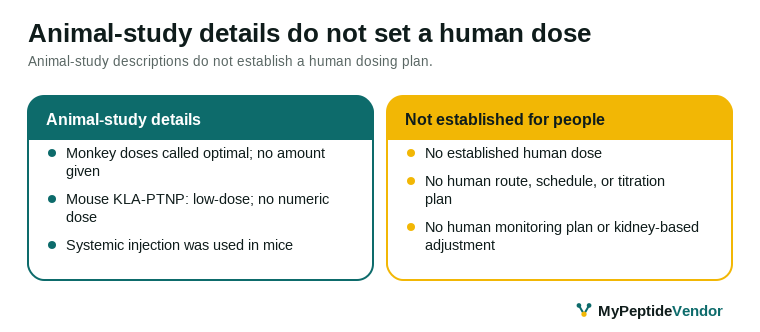
There is no established dose for people. The monkey abstract refers to “experimentally determined optimal doses” but does not give a numeric amount, treatment schedule, or dose range 5. That phrase is not a usable prescription or a human safety threshold.
The Hossen mouse study describes KLA-PTNP as a low-dose treatment, but its abstract does not give a numeric dose 3. KLA-PTNP is a nanoparticle formulation, not a validated substitute for free Adipotide. A dose used for one formulation cannot be assumed to apply to another.
Systemic injection was used in the mouse nanoparticle study 3. The primate abstract does not state the route 5. Neither detail establishes a human route, titration schedule, monitoring plan, or dose adjustment for kidney function.
Human injection directions from an online seller are not clinical dosing evidence. FDA warns that unapproved products labeled for research use can be sold directly to consumers with dosing instructions, and that such products may be of unknown quality 1. Do not treat those instructions or an animal-study description as medical dosing advice.
Use this chart
Free to reuse with a link back:
Side effects: what to actually expect
The clearest reported safety finding is a change in renal proximal-tubule function in monkeys. The study describes the changes as predictable and reversible at experimentally determined optimal doses across three Old World monkey species 5. It does not report the percentage of animals affected or the numeric dose range linked to the changes.
There are no established human trial percentages for kidney problems, nausea, vomiting, injection-site reactions, or other Adipotide side effects. Without human results, a person’s chance of a specific reaction cannot be calculated from the monkey findings 5.
The word “reversible” is useful but limited. It means the reported changes could reverse under the study conditions; it does not guarantee that kidney effects would be harmless or reversible in every person 5. The study abstract does not provide a human monitoring plan or a safe exposure limit.
The mouse nanoparticle study reported no detectable liver toxicity with KLA-PTNP 3. That finding applies to the nanoparticle and mouse model. It does not establish liver safety in people or remove the kidney concern reported in primates receiving Adipotide 35.
Adipotide’s design includes a proapoptotic payload, and primate research reported renal proximal-tubule changes 5. The risks of unsupervised use are therefore unknown; that is a safety inference, not a measured human adverse-event rate. FDA separately warns that unapproved products sold as “for research purposes” or “not for human consumption” may be of unknown quality and may be harmful when marketed for people to take 1.
Regulatory & access status in the U.S. (as of 2026)
The reported evidence for adipotide comes from animal research 5. No licensed Adipotide product is established by the clinical evidence described here.
FDA says unapproved versions of drugs do not receive its review for safety, effectiveness, and quality before marketing. Its warning about products labeled “for research purposes” or “not for human consumption” addresses unapproved products sold directly to consumers for human use; it is a general safety warning, not an Adipotide-specific action 1. A research label does not establish that a vial is suitable for patient use.
FDA’s Category 2 page concerns certain bulk drug substances nominated for compounding that may present significant safety risks 2. Adipotide's status on the complete Category 2 list is not established. In any event, appearing on or not appearing in a compounding list would not by itself make a substance an FDA-approved treatment 2.
For a patient, a research-chemical vendor is not the same as a licensed pharmacy. A certificate of analysis may describe a test of a particular sample, but it does not make the product FDA-approved or establish that it was manufactured and dispensed as a medicine. FDA advises patients seeking prescription medicines to obtain a prescription from a doctor and use a state-licensed pharmacy 1.
Red flags to discuss with a clinician: a vial says “research use only” but comes with human injection directions; a seller claims proven human weight loss despite the absence of established human results; no licensed prescriber screens the buyer; or the seller cannot identify a state-licensed pharmacy responsible for dispensing the product. FDA lists the absence of screening and a prescription as an online-sales warning sign for unapproved GLP-1 products 1. That specific FDA warning is about GLP-1 products, but it illustrates why research labeling should not be mistaken for pharmacy dispensing.
The reason Adipotide did not become a licensed treatment is not established by the cited animal reports. Those reports do not explain a development decision or provide human trial results 5.
How it compares with its closest alternative
Adipotide and retatrutide should not be treated as interchangeable weight-loss peptides. Adipotide was designed to target white-fat blood vessels and trigger apoptosis; the reported Adipotide findings are from animals 5. FDA says retatrutide has not been found safe and effective for any condition and cannot be used in compounding under federal law 1. The cited FDA information does not provide a head-to-head comparison or a retatrutide mechanism, so a direct ranking of effectiveness is not supported.
Semaglutide is a different comparison because FDA recognizes approved versions while warning that compounded versions are not FDA-approved 1. FDA’s GLP-1 warning also describes risks involving dosing errors with compounded products, including reports of serious events requiring medical attention 1. Those reports concern compounded semaglutide and tirzepatide products, not Adipotide.
| Feature | Adipotide | Retatrutide | Semaglutide |
|---|---|---|---|
| Approach | Designed to target white-fat blood vessels and cause apoptosis. | The FDA information cited here does not describe its mechanism. | FDA identifies semaglutide as a GLP-1 receptor agonist. |
| Evidence described here | Mouse nanoparticle research and an obese-monkey study; no established human results. | FDA says it has not been found safe and effective for any condition. | FDA distinguishes approved versions from compounded versions. |
| U. S. status | Not an FDA-approved human treatment. | Unapproved; cannot be used in compounding under federal law. | FDA-approved versions exist; compounded versions are not FDA-approved. |
| Route and dose | No established human route or dose; the primate abstract does not state the route. | No approved human product or compounding dose established by the FDA information cited here. | Use of an approved product follows its prescribing information; compounded versions are not FDA-approved. |
| Key safety point | Reversible renal proximal-tubule changes were reported in primates at experimentally determined optimal doses. | FDA warns against unapproved sales and compounding. | FDA reports dosing-error concerns and adverse-event reports involving compounded versions. |
There is no evidence-based answer to “which is strongest” that can compare Adipotide’s animal results with human treatment outcomes. Adipotide has no established human benefit, while the FDA information cited here says retatrutide is unapproved and identifies approved semaglutide products separately from compounded products 15. Human evidence, safety, approval, and a person’s health needs matter more than a dramatic proposed mechanism.
Glossary
Prohibitin: a protein described as an adipose vascular marker in the nanoparticle study 3. Proapoptotic: intended to trigger apoptosis, or controlled cell death. Peptidomimetic: a molecule designed to imitate some features of a peptide.
KLA: the proapoptotic peptide payload used in the Adipotide design and in the KLA-PTNP nanoparticle study 35. DEXA: an imaging method used to estimate body composition. MRI: magnetic resonance imaging, used alongside DEXA to assess white-fat tissue in the primate study 5. These measures quantify body composition; they do not establish a human treatment benefit.
Frequently asked questions
What are Adipotide peptide side effects?
The main reported concern is a change in kidney proximal-tubule function in monkeys. The researchers described the changes as reversible at experimentally determined optimal doses, but did not give the percentage of animals affected 5. Human reactions and their frequency have not been established.
What is the strongest peptide for weight loss?
There is no sound way to rank Adipotide against medicines with human results as if the evidence were equivalent. Adipotide has animal findings but no established human benefit, and FDA says retatrutide is unapproved and cannot be used in compounding 15.
What is Adipotide good for?
Adipotide was studied in obese monkeys for targeted apoptosis in white-fat blood vessels 5. It is not an established treatment for weight loss or another condition in people.
What are the differences between Adipotide and retatrutide?
Adipotide was designed to target white-fat blood vessels and trigger cell death, and its reported results are from animals 5. FDA says retatrutide has not been found safe and effective for any condition and cannot be used in compounding under federal law 1. The evidence cited here does not support a head-to-head comparison of their weight-loss effects.
References
- FDA: Concerns with unapproved GLP-1 drugs used for weight loss
- FDA: Certain bulk drug substances for use in compounding that may present significant safety risks
- Hossen et al. A comparative study between nanoparticle-targeted therapeutics and bioconjugates as obesity medication. J Control Release. 2013.
- Criscione et al. Comment on "a peptidomimetic targeting white fat causes weight loss and improved insulin resistance in obese monkeys". Sci Transl Med. 2012.
- Barnhart et al. A peptidomimetic targeting white fat causes weight loss and improved insulin resistance in obese monkeys. Sci Transl Med. 2011.
Written by the MyPeptideVendor editorial team from the FDA label, peer-reviewed studies and ClinicalTrials.gov records listed above, fact-checked line by line and reviewed 2026-11-12.
Cite this page
MyPeptideVendor Editorial Team. Adipotide FTPP: Evidence, Risks & U.S. Status. MyPeptideVendor. Updated November 12, 2026. https://mypeptidevendor.com/peptides/adipotide-ftpp/MyPeptideVendor Editorial Team. (2026, November 12). Adipotide FTPP: Evidence, Risks & U.S. Status. MyPeptideVendor. https://mypeptidevendor.com/peptides/adipotide-ftpp/Related peptides
5-Amino-1MQ
Not approved5-Amino-1MQ is a small molecule, not a peptide; its human benefits, dose, side effects, and long-term safety are not established.
Learn moreAOD-9604
Not approvedAOD-9604 was studied for obesity, but available evidence does not establish meaningful weight loss, a standard dose, or FDA approval.
Learn moreCagrilintide
Not approvedCagrilintide is an investigational weekly amylin analogue; FDA says it has not been found safe and effective for any condition.
Learn more