GHK-Cu: Evidence, Dosing & FDA Status
Copper-binding tripeptide
Brand names: No FDA-approved GHK-Cu drug brand is identified in the cited reviews.

GHK-Cu is a copper-bound peptide made from three amino acids, studied mainly for skin repair and wound healing 2. It is not a proven treatment for wrinkles, hair loss, or injury: an anti-wrinkle review reports a surprising absence of clinical studies, and injectable uses lack established clinical support 34.
ClinicalTrials.gov lists 4 GHK-Cu search results, including 1 recruiting Phase 2 trial of topical gel for acute skin wounds 10. The registry entries do not provide participant counts, treatment durations, or results 10.
Key takeaways
- GHK-Cu is a copper complex of the three-amino-acid peptide GHK, with reported effects on fibroblasts and connective-tissue components in biological research 2.
- A review reports no clinical studies of GHK-Cu or Pal-GHK anti-wrinkle products, so reliable human effect sizes and timelines are unavailable 4.
- ClinicalTrials.gov lists 4 GHK-Cu search results; 1 is a recruiting Phase 2 topical wound-healing study 10.
- The cited reviews and registry establish no standard topical concentration or injectable schedule 34610.
- Reviews describe GHK-Cu as an unapproved peptide use and warn that rigorous human safety data for unapproved peptides are scarce 36.
GHK-Cu at a glance
- Class
- Copper-binding tripeptide
- Mechanism
- Reported to support dermal fibroblast function and collagen, elastin, and glycosaminoglycan synthesis.
- FDA Status
- Not FDA-approved as a drug; injectable uses are unapproved.
- Brand names
- No FDA-approved GHK-Cu drug brand is identified in the cited reviews.
- Administration
- Topical cosmetic products are marketed; injectable use lacks an established clinical protocol.
- Typical Dose
- No standard clinical concentration, dose, or schedule is established in the cited reviews.
- Half-life
- Not established in the cited clinical reviews.
- Primary Uses
- Marketed for skin appearance and studied for wound repair; human benefit varies by use and remains unestablished.
What is it?

GHK-Cu combines GHK, a short peptide made from three amino acids, with copper 2. Pickart et al. describe GHK as a human peptide and discuss its proposed roles in tissue repair and skin biology 2. The review abstract does not establish that GHK-Cu occurs in plasma, saliva, or urine 2.
A naturally occurring peptide is not automatically a treatment. A product must reach the relevant tissue, remain stable, and improve an outcome people can measure. For topical GHK-Cu, skin penetration and clinical benefit remain open questions; for injectable use, the cited reviews do not establish a dose or proven benefit 347.
GHK-Cu appears in topical skin products, while injectable versions are promoted as peptide therapies 346. These routes are not interchangeable: topical products face the skin barrier, while the injection literature lacks established clinical dosing, frequency, and duration 3467.
Claims commonly focus on wrinkles and skin texture, wound healing, and hair. The evidence is not equally developed: the anti-wrinkle review reports an absence of clinical studies for GHK-Cu products, wound healing is being studied in a registered trial, and the cited reviews do not provide a controlled human hair-regrowth trial 4510.
In practical terms, a face serum and an injection are different propositions. A cosmetic serum is applied to the skin, where the outer barrier may limit delivery; an injection bypasses that barrier but adds risks tied to the product and administration 3467. Evidence for one route cannot be used to establish the safety or benefit of the other.
What makes it different
GHK-Cu has both a peptide component and a copper component. Research summarized by Pickart et al. describes support for dermal fibroblast function and increased synthesis of collagen, elastin, and glycosaminoglycans 2. Those findings give researchers a reason to test it; they do not show that a person will see fewer wrinkles or heal a wound faster.
Copper also has a basic biological role: it acts as a helper (cofactor) for some enzymes involved in tissue structure. GHK binds copper, but the cited clinical evidence does not establish how much of any observed effect comes from copper delivery versus signaling by the peptide 2.
Formulation makes a practical difference. GHK-Cu is fairly water-loving (hydrophilic), while the skin’s outer layer, the stratum corneum, has oily properties that can limit passage 7. A serum therefore cannot be assumed to deliver an effective amount to deeper skin layers, where much of the structural tissue is found 47.
Liposomes are small delivery structures that can carry ingredients, and researchers have proposed them as a way to improve GHK-Cu passage through skin 7. But transport of liposome-encapsulated GHK-Cu has received little study, so no dependable percentage of a topical dose reaching the dermis is known 7. A product description that says “liposomal” does not, by itself, show how much reaches its intended site.
The topical and injectable evidence should stay separate. A possible effect of a cream on skin would not prove that an injection treats a tendon, speeds whole-body healing, or changes aging 36. Reviews of injectable peptide use report no clinical support for GHK-Cu in musculoskeletal conditions and say that dosing, frequency, and duration remain unknown 3.
Hair is another area where marketing runs ahead of evidence. The cited reviews do not provide controlled human hair-regrowth results, participant counts, or treatment durations for GHK-Cu 2458. They therefore do not support a claim that it regrows hair or show how it compares with established hair-loss treatments.
Wound repair has a stronger research rationale than a proven patient benefit. Reviews discuss repair-related biological and preclinical effects, and one registered study is testing topical gel for acute skin wounds 2510. Until that study reports results, it cannot tell patients whether GHK-Cu shortens healing time or improves wound outcomes.
How does it work?
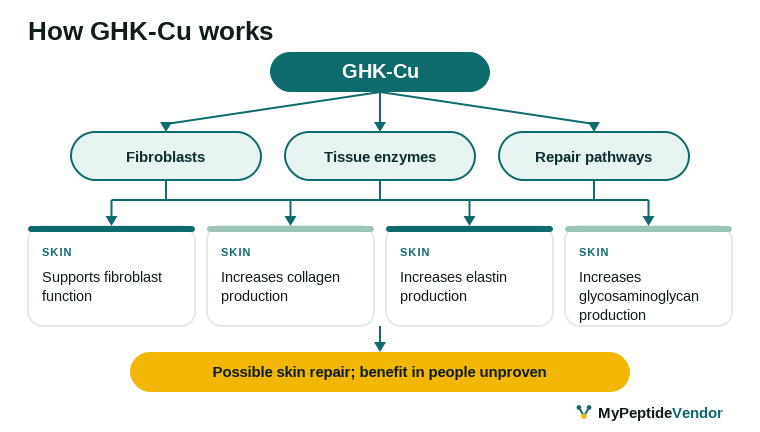
In plain words, GHK-Cu may signal some repair cells to build and organize more of the materials that support skin 2. Researchers describe effects on fibroblasts, the cells that help maintain connective tissue, and on the production of collagen, elastin, and glycosaminoglycans 2. These are biological findings, not a measured amount of wrinkle reduction in people.
Collagen gives connective tissue much of its strength, elastin helps it stretch and return, and glycosaminoglycans help tissue hold water 2. GHK-Cu has been reported to increase synthesis of these components in research settings 2. Whether a topical product delivers enough peptide to the relevant skin layer remains uncertain because GHK-Cu crosses the outer skin barrier poorly and delivery research is limited 47.
Fibroblast activation means changing the activity of cells that build connective tissue. Pickart et al. describe GHK-Cu as supporting dermal fibroblast function and tissue repair 2. The anti-wrinkle review states that cellular studies show GHK can be considered an anti-wrinkle ingredient, but that clinical studies of GHK-Cu and Pal-GHK are surprisingly absent 4.
Copper can act as a helper for enzymes involved in tissue structure, but the cited reviews do not determine how much copper-related activity explains GHK-Cu’s proposed effects 2. The balance between copper’s role and the peptide’s signaling effects has not been settled by clinical trials 24.
Researchers also discuss pathways related to inflammation, blood-vessel growth, and repair 25. Those mechanisms help explain why GHK-Cu is studied, but they do not prove that an injection treats an injury or that a topical product prevents visible aging 346. A clinical result requires a controlled human study, not only a plausible mechanism.
Mechanism and delivery are separate questions. A substance can affect cells in a laboratory dish yet fail to reach those cells when placed on intact skin 47. For GHK-Cu, the limited passage through the skin’s outer layer and the lack of well-described clinical outcomes leave both questions open 47.
Use this chart
Free to reuse with a link back:
What the clinical evidence actually shows

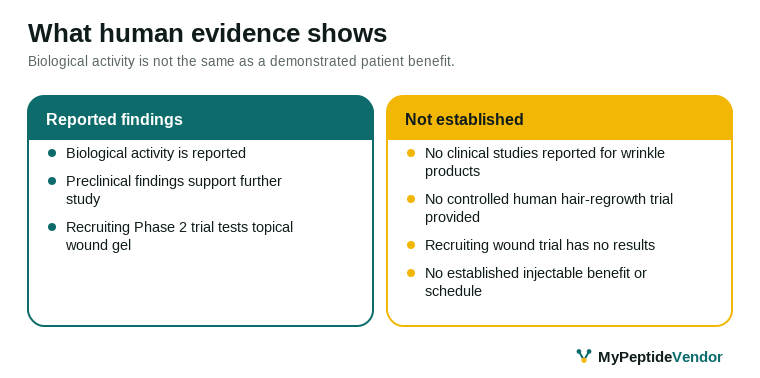
The short answer to “does it work?” is that GHK-Cu has reported biological activity, but dependable human evidence for its advertised benefits is not established. A review focused on topical anti-wrinkle use reports a surprising absence of clinical studies using GHK-Cu or Pal-GHK products 4. Reviews of peptide therapy and wound repair also describe a shortage of clinical trials, with much support coming from preclinical research 358.
For wrinkles, the cited anti-wrinkle review does not report participant counts, treatment durations, or numerical clinical outcomes for GHK-Cu products 4. A widely repeated claim of about a 28% collagen increase at 12 weeks, with 51% of top responders, is not reported in the abstract of the review commonly cited for it 2. Those figures cannot be treated as verified clinical trial results from that review 2.
A second often-circulated claim is a 55.8% reduction in wrinkle volume. That result is not reported in the cited reviews, and the anti-wrinkle review instead points to the absence of clinical studies for GHK-Cu and Pal-GHK anti-wrinkle products 4. Without a traceable human trial report, there is no dependable effect size to give someone considering a serum.
For hair, the cited reviews do not provide a controlled human GHK-Cu hair-regrowth trial with a participant count, timeframe, or measured result 2458. That does not prove no research exists anywhere; it means the cited clinical evidence cannot establish human regrowth, an expected timeline, or a comparison with standard treatments.
For wound healing, biological and preclinical findings support further study, but they do not establish that a consumer product speeds healing in patients 25. A recruiting Phase 2 trial is registered for topical GHK-Cu gel in acute skin wounds, but its registry entry does not give participant numbers, duration, or results 10. A trial that is recruiting is a test in progress, not evidence that the treatment works.
For injectable and systemic use, the cited reviews do not establish a clinical benefit for musculoskeletal conditions or a human injection schedule 36. A 2026 review says that information on indications, dosing, frequency, and duration remains unknown for injectable peptide therapy, while another review warns that rigorous human safety data for unapproved peptides are scarce 36.
ClinicalTrials.gov lists 4 GHK-Cu search results 10. NCT07437586 is a recruiting Phase 2 topical wound-healing trial; the Hydrafacial study measures a different intervention and is not a GHK-Cu treatment trial 10.
The registry entries do not list participant counts, study durations, or outcome results 10. The Hydrafacial study (NCT05932732) is not a GHK-Cu treatment trial 10.
ClinicalTrials.gov lists the following study identifiers, phases, and statuses; the registry information does not give the participant counts, durations, or results needed to estimate treatment effects 10.
| Study | Phase and status | What it measures |
|---|---|---|
| NCT07437586 | Phase 2; recruiting | Topical GHK-Cu gel for acute skin wound healing |
| NCT07888595 | Early Phase 1; enrolling by invitation | Systemic and topical rejuvenation assessed with START/REST aging clocks |
| NCT07706361 | NCT07706361 is listed as NA (not applicable) phase and not yet recruiting. | Effects of the X39 patch on circulating GHK and GHK-Cu levels in healthy adults |
| NCT05932732 | Phase 4; completed | Three Hydrafacial treatments and facial skin quality, hydration, and skin barrier; not a GHK-Cu treatment |
Evidence grade differs by claimed use. Laboratory and preclinical findings offer a reason to investigate the peptide, while the registry provides one active Phase 2 wound study and no reported results 2345810.
| Claimed use | Evidence described | What can be concluded |
|---|---|---|
| Wrinkles and skin texture | Cell and mechanistic findings; review reports no clinical studies of GHK-Cu or Pal-GHK anti-wrinkle products | Biological rationale, but no dependable human effect size or timeline |
| Hair growth | No controlled human hair-regrowth results described in the cited reviews | Human benefit is not established by this evidence |
| Wound healing | Preclinical findings and a registered recruiting Phase 2 topical trial | Clinical benefit remains under study |
| Injectable systemic or musculoskeletal use | Preclinical promise; reviews report limited clinical support and scarce safety data | No validated dose, schedule, or proven clinical benefit |
How long results last after stopping is also unknown. The cited anti-wrinkle review reports a lack of clinical studies, and the injectable reviews do not establish a lasting benefit or a treatment-free follow-up period 346.
The 2018 review describes biological actions and research on GHK-Cu, but its abstract does not provide the collagen and responder percentages sometimes attributed to it 2. The anti-wrinkle review likewise does not give the often-quoted wrinkle-volume result 4.
The 28% collagen increase, 51% top-responder figure, and 55.8% wrinkle-volume reduction cannot be verified as human clinical outcomes from the cited primary sources 24. A precise percentage can sound persuasive, but without a traceable trial report, its population, treatment, measurement method, and timeframe cannot be checked.
| Repeated claim | What the cited source reports | Assessment |
|---|---|---|
| About 28% collagen increase at 12 weeks | The cited review abstract does not report this clinical figure | Not verifiable from the cited primary sources |
| 51% of top responders | The cited review abstract does not report responder percentages | Not verifiable from the cited primary sources |
| 55.8% reduction in wrinkle volume | The cited anti-wrinkle review reports that clinical studies of GHK-Cu and Pal-GHK products are absent | Not verifiable from the cited primary sources |
Use this chart
Free to reuse with a link back:
Typical dosing

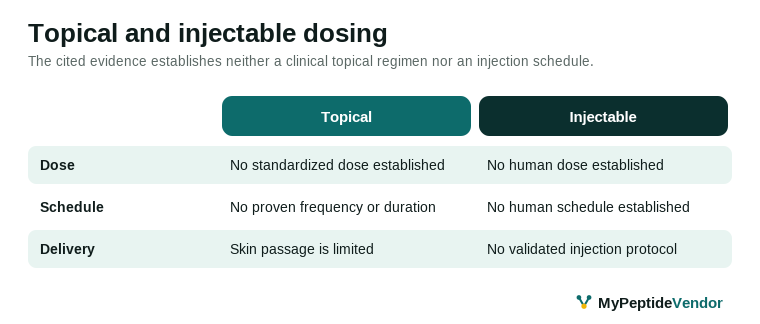
No standardized clinical dose for GHK-Cu is established in the cited reviews 346. They do not provide a validated topical concentration, number of applications per day, treatment duration, or dose that reliably improves wrinkles 34. For a cosmetic product, follow that product’s directions; a label instruction is not the same as a clinically proven dose.
The cited clinical material does not establish a reliable topical trial range. Formulations differ, and a stated percentage alone does not show how much peptide remains stable or reaches deeper skin 47. GHK-Cu’s hydrophilic character and limited passage through the stratum corneum make delivery a central question 7.
No human injectable dose or schedule can be recommended from the cited evidence. A 2026 review of injectable peptide therapy says indications, dose, frequency, and duration remain unknown, and a separate review says rigorous human safety data for unapproved peptides are scarce 36. Online injection schedules are not a substitute for a studied protocol.
Topical safety cannot establish injection safety. Injectable products raise separate concerns about product identity, dose accuracy, sterility, and administration, while the cited reviews do not provide a validated GHK-Cu injection protocol 36. Do not inject a topical cosmetic or a product sold for research use.
There is no evidence-based timeline such as a reliable number of weeks to visible results. The anti-wrinkle review reports no clinical trials of GHK-Cu products, and the registered wound-healing trial has no results in the registry entry 410.
For a topical product, “use as directed” is the only label-based guidance available here; it should not be mistaken for a trial-tested regimen 4. For injection, no human dosing range or schedule is established in the cited reviews, so an online amount cannot be described as a typical clinical dose 36.
Use this chart
Free to reuse with a link back:
Side effects: what to actually expect
The cited sources provide no reliable side-effect percentages for topical or injectable GHK-Cu 46. They also provide no GHK-Cu drug-label adverse-event table with rates to quote 346. No reported percentage is not the same as proof that a product has no risk.
With a topical product, stop using it and seek advice if you develop a persistent rash, burning, swelling, or worsening skin irritation. These are practical warning signs for skin products, but their frequency with GHK-Cu is not established in the cited evidence 4. A clinician can assess whether the problem is irritation, an allergy, or another skin condition.
“Copper uglies” is not defined in the cited reviews and has no clinical definition or measured frequency in this evidence 246. If the phrase is being used to describe a skin change, treat the change as a symptom to assess rather than assuming it is an expected stage of treatment. There is no cited trial evidence showing that a temporary worsening of appearance is a normal or necessary response.
Injectable use warrants extra caution because reviews describe scarce rigorous human safety data for unapproved peptides and warn that serious harm is possible 6. The cited sources do not quantify GHK-Cu injection complications or show that an online schedule is safe 36. Seek urgent medical help for severe allergic symptoms, trouble breathing, fainting, or rapidly worsening swelling after an injection.
The cited human evidence does not establish safety during pregnancy or breastfeeding 346. None of these reviews gives pregnancy- or lactation-specific GHK-Cu safety findings, so those groups do not have human safety data here to rely on 346.
Stop and get medical advice if a topical product causes persistent symptoms, and contact a clinician promptly after a concerning injection reaction. For pregnancy or breastfeeding, discuss any proposed use with a physician because the cited reviews provide no specific human safety data 346.
There are no trial-derived rates for redness, irritation, allergy, or injection reactions in the cited material 346. That means a precise percentage for any of these effects would give a false impression of how well GHK-Cu safety has been measured.
Regulatory & access status in the US (as of 2026)
GHK-Cu is among peptides discussed as unapproved in a review of marketed peptides 6. That is not the same as an FDA-approved drug indication. A product sold for research use is not an approved treatment, and a compounded product does not become FDA-approved because a clinician prescribes it.
The FDA’s Category 2 page concerns bulk drug substances nominated for compounding that may present significant safety risks 1. The category framework is not a finding that a substance is an approved drug, nor does a nomination establish that a specific preparation is safe or effective 1. Whether a particular compounded preparation may be made depends on applicable federal requirements; ask the prescriber and pharmacy to explain the product’s status and quality controls.
Compounding is not the same as FDA approval. A compounded preparation is not an FDA-approved product merely because it is prescribed by a clinician. FDA approval requires a distinct review of a drug’s safety and effectiveness for its intended use.
A cosmetic serum and an injectable drug are different product types. A cosmetic claim about appearance does not establish treatment of a wound, hair loss, or a medical condition 4. The anti-wrinkle review’s finding of no clinical studies for GHK-Cu and Pal-GHK products is a reason to read cosmetic claims cautiously 4.
For a topical product, ask for the ingredient identity, concentration, batch testing, and storage directions. For an injectable product, ask the prescriber and dispensing pharmacy about identity, purity, copper content, sterility, and storage. A certificate of analysis can help document what was tested in a batch, but it does not prove clinical benefit.
Be skeptical of before-and-after images that do not show the same lighting, camera angle, product, and timeframe. No dependable clinical wrinkle effect size is established in the anti-wrinkle review, and the commonly repeated 28%, 51%, and 55.8% figures are not verifiable as clinical outcomes from the cited reviews 24.
Buyer checklist: request a batch-specific certificate of analysis, clear purity and copper-content testing, and storage conditions. For injectable products, ask for sterility testing and the pharmacy’s dispensing information. Treat missing batch details, unclear product identity, or unverifiable before-and-after photos as warning signs; none of these checks can replace clinical evidence of benefit.
Safety checklist: report a persistent rash, burning, swelling, or other concerning reaction to a clinician; seek urgent care for severe or rapidly worsening symptoms. People who are pregnant or breastfeeding have no human GHK-Cu safety data in the cited reviews, so they should not assume the product is safe 346.
Research-grade GHK-Cu is available from American Peptides (GHK-Cu (Copper Peptide), from $50.00); code MYPEPTIDEVENDOR takes 15% off. Sold for laboratory research only, not for human use. Affiliate link
How it compares with its closest alternative
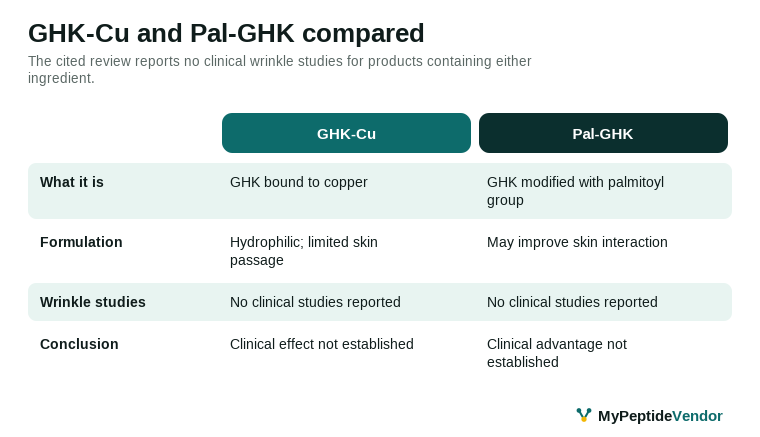
Pal-GHK is a close topical comparison: it is GHK modified with a palmitoyl group, while GHK-Cu is GHK bound to copper 4. The anti-wrinkle review discusses both ingredients and reports a lack of clinical studies for products containing either one 4.
| Feature | GHK-Cu | Pal-GHK |
|---|---|---|
| What it is | GHK bound to copper | GHK modified with a palmitoyl group |
| Formulation question | Hydrophilic character can limit passage through the oily outer skin barrier | Hydrophobic modification may improve skin interaction, but does not establish clinical delivery |
| Human wrinkle evidence | Review reports no clinical studies of GHK-Cu anti-wrinkle products | Review reports no clinical studies of Pal-GHK anti-wrinkle products |
| What can be concluded | Laboratory rationale; clinical effect is not established | Possible formulation advantage; clinical advantage is not established |
| Injection evidence | No established clinical dose or schedule in the cited reviews | Not established as an injectable alternative in the cited reviews |
Neither ingredient can be ranked as more effective from the cited human evidence. A formulation that crosses skin more easily may still fail to produce a meaningful wrinkle change, and skin delivery remains insufficiently studied 47.
Use this chart
Free to reuse with a link back:
Where to Buy GHK-Cu for Research
American Peptides
GHK-Cu (Copper Peptide) · from $50.00
US-made research peptides, every lot third-party tested with a lot-matched COA.
15% offMYPEPTIDEVENDOR at checkout
- ≥99% purity verified by HPLC + mass spec, endotoxin tested
- Ships tracked from Louisiana, free shipping over $300
- 15% off your first order with code MYPEPTIDEVENDOR
Certified-Pep
US-made research peptides with batch-specific lab reports (COA) and a QR code on every vial.
- Independent laboratory testing (Vanguard Laboratory)
- Made in the USA, ships in 1-2 business days
- Research use only, not for human or veterinary use
Affiliate disclosure: we may earn a commission if you order through the link above. GHK-Cu is not approved by the FDA for human use.
Ranked in our guides
Frequently asked questions
What is GHK-Cu peptide used for?
It is sold in topical products aimed at skin appearance, and researchers are testing topical gel for acute wounds 410. Hair growth is also claimed, but the cited reviews do not establish human regrowth.
What are the negative side effects of GHK-Cu?
No reliable rate for side effects is established in the cited evidence 46. A persistent rash, burning, or swelling is a reason to stop a topical product and ask a clinician; serious or rapidly worsening symptoms after an injection need prompt medical attention.
Does GHK-Cu actually work?
It has reported biological effects on cells involved in connective-tissue repair 2. Whether those effects produce a meaningful change in people remains unproven for wrinkles, hair, and injectable uses; wound healing is still being studied 34510.
What shouldn't you mix with copper peptides?
No topical ingredient has been established as one that must never be combined with GHK-Cu, and no proven interaction list exists for it. Follow the product directions, avoid layering it onto irritated skin, and do not combine injectable peptides on the basis of online advice because safe combinations have not been established 36.
References
- FDA: Certain bulk drug substances for use in compounding that may present significant safety risks
- Pickart et al. Regenerative and Protective Actions of the GHK-Cu Peptide in the Light of the New Gene Data. Int J Mol Sci. 2018.
- Mayfield et al. Injectable Peptide Therapy: A Primer for Orthopaedic and Sports Medicine Physicians. Am J Sports Med. 2026.
- Mortazavi et al. Topically applied GHK as an anti-wrinkle peptide: Advantages, problems and prospective. Bioimpacts. 2025.
- Rahman et al. Therapeutic Peptides in Orthopaedics: Applications, Challenges, and Future Directions. J Am Acad Orthop Surg Glob Res Rev. 2026.
- Mendias et al. Safety and Efficacy of Approved and Unapproved Peptide Therapies for Musculoskeletal Injuries and Athletic Performance. Sports Med. 2026.
- Ogórek et al. Are We Ready to Measure Skin Permeation of Modern Antiaging GHK-Cu Tripeptide Encapsulated in Liposomes? Molecules. 2025.
- Renke et al. Therapeutic Peptides in Aesthetic, Metabolic and Endocrine Conditions: Effects, Safety, Clinical Applications, and Future Perspectives. Int J Mol Sci. 2026.
- Mavrych et al. Therapeutic peptides in gerontology: mechanisms and applications for healthy aging. Front Aging. 2026.
- ClinicalTrials.gov: 4 registered studies (search: GHK-Cu)
Written by the MyPeptideVendor editorial team from the FDA label, peer-reviewed studies and ClinicalTrials.gov records listed above, fact-checked line by line and reviewed 2026-11-12.
Cite this page
MyPeptideVendor Editorial Team. ghk cu: Evidence, Dosing & FDA Status. MyPeptideVendor. Updated November 12, 2026. https://mypeptidevendor.com/peptides/ghk-cu/MyPeptideVendor Editorial Team. (2026, November 12). ghk cu: Evidence, Dosing & FDA Status. MyPeptideVendor. https://mypeptidevendor.com/peptides/ghk-cu/Related peptides
Argireline (Acetyl Hexapeptide-3)
Not approvedA small 4-week trial found wrinkle improvements, but lasting effects, ideal concentration, and Argireline-specific side-effect rates remain unknown.
Learn moreAHK-Cu
Not approvedAHK-Cu has early lab findings related to hair follicles, but human hair benefits, safe dosing, and side-effect rates are not established.
Learn moreAHK (Tripeptide-3)
Not establishedAHK-Cu is a copper tripeptide used as a cosmetic ingredient, but human hair-growth benefit and a proven scalp dose remain unestablished.
Learn more