AHK Tripeptide 3: Hair Evidence & Safety
Copper-bound tripeptide
Brand names: AHK-Cu; copper tripeptide-3.

AHK tripeptide 3 is alanine-histidine-lysine bound to copper, also called AHK-Cu or copper tripeptide-3. A cosmetic use or hair-growth effect for AHK-Cu is not established, and a human trial showing regrowth has not been identified.
The ClinicalTrials.gov results for “AHK (Tripeptide-3)” include unrelated studies, not an AHK-Cu hair study 8. That leaves no human hair-trial dose, participant count, treatment duration, or measured hair result to guide use.
Key takeaways
- The listed copper complex has a molecular weight of 415.94 g/mol and formula C15H24CuN6O4.
- No AHK-Cu hair trial appears among the registered studies returned by the ClinicalTrials.gov search 8.
- The AbMole research product is marked for research use only and not for human consumption 4.
- No human study establishes a scalp concentration, application schedule, or time to visible hair results 8.
- AHK-Cu’s FDA status is not established by the FDA Category 2 page; that page concerns bulk substances that may present safety risks 1.
AHK (Tripeptide-3) at a glance
- Class
- Copper-bound tripeptide
- Mechanism
- Hair-follicle and dermal-papilla effects are proposed, but a specific mechanism in people is not established.
- FDA Status
- Not established by the cited FDA Category 2 page.
- Brand names
- AHK-Cu; copper tripeptide-3.
- Administration
- Topical use is described for cosmetic formulations; research-grade powder is not for human consumption.
- Typical Dose
- No human hair-trial dose or concentration is established.
- Half-life
- Not established for topical scalp use.
- Primary Uses
- Cosmetic ingredient reported to have a hair-growth effect.
What is it?

AHK-Cu is a short peptide made from alanine, histidine, and lysine bound to a copper ion. It is also called copper tripeptide-3 4. The name tells you the ingredient identity; it does not tell you how much peptide or copper is in a finished serum.
There is a molecular-weight mismatch in product descriptions. Those figures describe different chemical forms, not necessarily a disagreement about the same material.
AHK is an ambiguous search term. In bacterial biology, alpha-hydroxyketones (AHKs) are signaling molecules studied in Legionella and Vibrio 25. In plants, AHK2, AHK3, and AHK4 are cytokinin receptors 3, and AHK also appears in research on plant responses to compacted soil 7. AutoHotkey is computer-automation software 6. This profile is about the copper peptide.
What makes it different
AHK-Cu is distinct from other peptides because its name identifies a three-amino-acid copper complex. That description is not the same as proof of benefit in people.
Product format matters for use, not proven effectiveness. A leave-on scalp product stays on the skin, while shampoo and conditioner are rinsed away according to their directions. No human comparison establishes which format, concentration, or contact time produces a hair-growth result.
To judge a finished product, look for the full ingredient list, clear topical-use directions, a stated amount or concentration, storage instructions, and a batch-specific certificate of analysis (COA). A useful COA identifies the tested material, the test methods, the laboratory, and results for identity, purity, and copper content where relevant. Testing can help check product quality; it cannot prove that the product regrows hair.
Check whether the seller labels the product for cosmetic use or laboratory research. A product listing that gives a purity figure but no human-use directions is not a scalp-use guide.
How does it work?
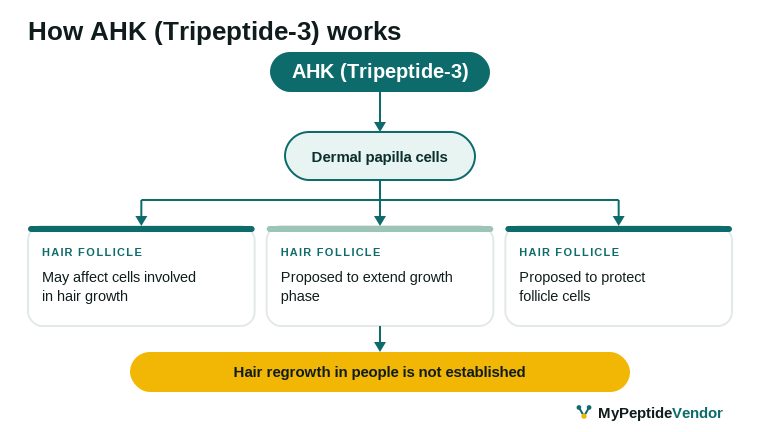
In plain terms, the claim is that AHK-Cu may affect the cells involved in hair growth. Hair claims often focus on dermal papilla cells, which sit at the base of a follicle and help regulate its growth cycle. But the available product description does not identify a specific pathway or show that topical AHK-Cu reaches or changes these cells in people 4.
Claims about extending the hair-growth phase or protecting follicle cells should therefore be treated as proposed explanations, not established effects. The registered-study search does not identify an AHK-Cu hair study that measures follicle activity or a scalp mechanism in people 8.
A laboratory result, if available, would not by itself show that a serum works on the scalp. A finished formula can differ in concentration, stability, and skin delivery, and a rinse-off product has a different contact time from a leave-on product. No human study establishes how those differences affect AHK-Cu hair outcomes.
Use this chart
Free to reuse with a link back:
What the clinical evidence actually shows

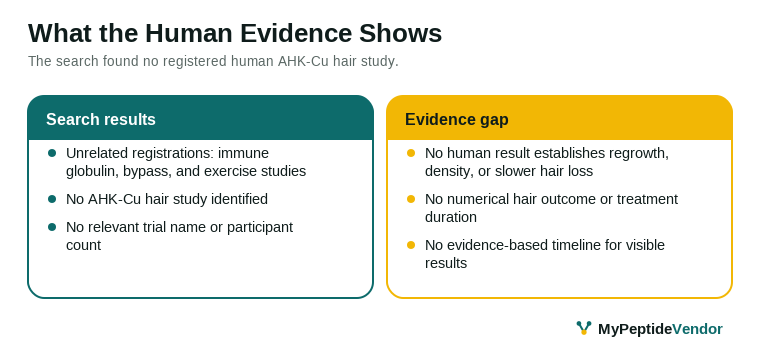
No human AHK-Cu hair trial result establishes regrowth, improved density, or slower hair loss. The ClinicalTrials.gov search for “AHK (Tripeptide-3)” returned unrelated registrations, including immune globulin, cardiopulmonary bypass, and exercise studies; none is an AHK-Cu hair study 8. The search results do not provide a relevant trial name, participant count, treatment duration, or numerical hair outcome.
This is a gap in human evidence, not proof that the peptide has no biological activity. It means a benefit for people with hair loss has not been shown in a registered human hair study.
There is no evidence-based timeline for visible AHK-Cu results. Hair changes can have different causes, and a change after starting a cosmetic product would not show that the peptide caused it. Sudden, patchy, painful, or inflamed scalp changes call for medical assessment rather than relying on a cosmetic product.
AHK-Cu products may state a concentration or suggested schedule, but those directions are not a clinical dose unless tested in a human study. No cited source supports using AHK-Cu as a proven replacement for medical assessment or established treatment.
Use this chart
Free to reuse with a link back:
Typical dosing

No clinical study establishes an AHK-Cu scalp dose, concentration, amount per application, or frequency 8. A percentage printed on a product is not a medically proven dose; no human study links a particular concentration to hair regrowth.
For a finished topical product, follow its own label. Apply it only to the stated area, use the stated amount and frequency, and use shampoo or conditioner as directed. Do not turn a research powder into a homemade scalp product: the research listing does not establish that the material or formulation is suitable for personal use.
No cited clinical study establishes how AHK-Cu should be combined with minoxidil or finasteride. Ask a clinician or pharmacist before adding a scalp product to a prescription treatment, especially if you have an active scalp condition.
Side effects: what to actually expect
No AHK-Cu hair trial or topical-product label with side-effect percentages is identified, so a numerical rate cannot be given. A topical formula can cause irritation or an allergic skin reaction; the full formula, not just the peptide, may be responsible.
Stop using a product if persistent burning, itching, redness, swelling, or a rash develops. These can signal irritation or allergy. Seek urgent care for breathing trouble or severe facial swelling. Do not apply a product to broken or actively inflamed skin unless a clinician advises you to do so.
If you have had a reaction to a copper-containing product or know you are allergic to an ingredient in the formula, check the ingredient list and ask a health professional before use. Risk rates for people with copper sensitivity or scalp disease have not been established.
A reliable percentage for those reactions is not established here; the risk can also depend on the rest of the formula.
Regulatory & access status in the US
AHK-Cu’s FDA status is not established by the FDA Category 2 page 1. That page concerns bulk substances nominated for compounding that may present significant safety risks; it is not an approval list. The page alone does not establish whether AHK-Cu is approved, safe, or eligible for compounding.
That warning applies to that research product; it should not be confused with directions for a finished cosmetic formulation.
Before buying, check that the product is clearly identified for topical cosmetic use, has a complete ingredient list and directions, and offers batch testing that can be reviewed. Confirm storage conditions and a way to contact the seller. A COA and a commercial listing do not establish hair-growth benefit or FDA approval.
These are product storage specifications, not directions for storing or using a finished scalp cosmetic.
How it compares to its closest alternative
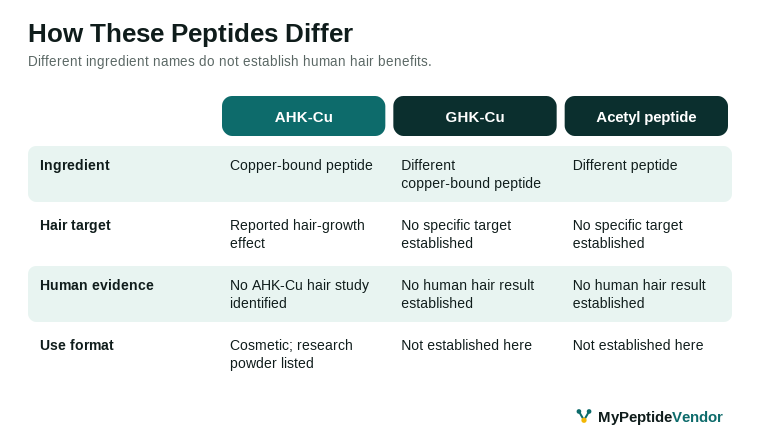
AHK-Cu, GHK-Cu, and acetyl tetrapeptide-3 are different ingredient names, and the registry search identifies no AHK-Cu hair trial 8. The comparison below separates that claim from evidence of human benefit.
| Ingredient | What it is | Hair target or claim | Human hair evidence | Use format |
|---|---|---|---|---|
| AHK-Cu | Alanine-histidine-lysine bound to copper | Reported hair-growth effect as a cosmetic ingredient | No AHK-Cu hair study identified | Cosmetic ingredient; research-grade powder is also listed |
| GHK-Cu | A different copper-bound peptide | No specific hair target established here | No human hair result established here | Not established here |
| Acetyl tetrapeptide-3 | A different peptide, not copper tripeptide-3 | No specific hair target established here | No human hair result established here | Not established here |
Acetyl tetrapeptide-3 is not AHK-Cu with an extra amino acid. The names refer to different ingredients, so check the ingredient list rather than relying on a product title. Neither a peptide name nor a hair-growth claim is proof of clinical benefit.
If you are choosing a product for hair loss, first consider the cause and discuss treatment options with a clinician. A cosmetic peptide may be part of a hair-care routine, but its use should not delay assessment of ongoing or worsening hair loss.
Use this chart
Free to reuse with a link back:
Frequently asked questions
Is copper tripeptide good for hair?
Copper tripeptide-3, or AHK-Cu, is described as a cosmetic ingredient. The ClinicalTrials.gov search did not identify an AHK-Cu hair study 8, so whether it regrows hair or improves density in people is not established.
Is AHK-Cu peptide available for sale?
A research chemical is not the same as a finished topical cosmetic; check the stated use, directions, and testing before buying.
What are the negative side effects of GHK-Cu?
A reliable side-effect percentage is not established, so stop use if symptoms persist or worsen.
Is acetyl tetrapeptide 3 good for hair?
Acetyl tetrapeptide-3 is a different ingredient from AHK-Cu. Human hair-growth benefit is not established, so a product claim should not be treated as proof that it regrows hair.
References
- FDA: Certain bulk drug substances for use in compounding that may present significant safety risks
- Tiaden et al. Bacterial gene regulation by alpha-hydroxyketone signaling. Trends Microbiol. 2010.
- Müller et al. Arabidopsis cytokinin signaling pathway. Sci STKE. 2007.
- Hoke et al. Comparison of sevral wild-type influenza viruses in the ferret tracheal organ culture system. Rev Infect Dis. 1979.
- Tiaden et al. α-Hydroxyketone synthesis and sensing by Legionella and Vibrio. Sensors (Basel). 2012.
- Joyce et al. How I Do It: Leveraging AutoHotkey and programmable peripheral devices for high efficiency diagnostic radiology. Curr Probl Diagn Radiol. 2025.
- Hasan et al. Plants breathing under pressure: mechanistic insights into soil compaction-induced physiological, molecular and biochemical responses in plants. Planta. 2025.
- ClinicalTrials.gov: 8 registered studies (search: AHK (Tripeptide-3))
Written by the MyPeptideVendor editorial team from the FDA label, peer-reviewed studies and ClinicalTrials.gov records listed above, fact-checked line by line and reviewed 2026-11-12.
Cite this page
MyPeptideVendor Editorial Team. AHK Tripeptide 3: Hair Evidence & Safety. MyPeptideVendor. Updated November 12, 2026. https://mypeptidevendor.com/peptides/ahk-tripeptide-3/MyPeptideVendor Editorial Team. (2026, November 12). AHK Tripeptide 3: Hair Evidence & Safety. MyPeptideVendor. https://mypeptidevendor.com/peptides/ahk-tripeptide-3/Related peptides
Argireline (Acetyl Hexapeptide-3)
Not approvedA small 4-week trial found wrinkle improvements, but lasting effects, ideal concentration, and Argireline-specific side-effect rates remain unknown.
Learn moreAHK-Cu
Not approvedAHK-Cu has early lab findings related to hair follicles, but human hair benefits, safe dosing, and side-effect rates are not established.
Learn moreBronchogen
Research UseBronchogen is an experimental four-amino-acid peptide with preclinical lung findings, but no established human dose, safety profile, or treatment benefit.
Learn more