AHK-Cu: Hair Evidence, Dosing & Safety
Copper-binding tripeptide
Brand names: AHK-Cu; L-alanyl-L-histidyl-L-lysine-Cu2+
AHK-Cu is a copper-bound tripeptide made of alanine, histidine, and lysine. Researchers have tested it for possible hair-follicle effects, but the main hair study used lab-grown cells and follicles outside the body, not people. 2
The evidence is early: Pyo et al. tested concentrations from 10^-12 to 10^-9 M, which are laboratory concentrations, not doses for a scalp or an injection. There is no established human hair-growth dose or confirmed timeline for results. 2
Key takeaways
- Pyo et al. tested AHK-Cu at 10^-12 to 10^-9 M in cells and human follicles outside the body; those are not human doses. 2
- The study reported follicle elongation and dermal papilla cell proliferation, but no human hair count or participant result. 2
- ClinicalTrials.gov lists 1 registered AHK-Cu study, NCT07888595, an Early Phase 1 aging-clock study rather than a hair trial. 3
- The cited evidence establishes no human dose, hair-result timeline, or percentage rate of side effects. 23
- AHK-Cu injection is not approved for human use, and no human injection dose is established.
AHK-Cu at a glance
- Class
- Copper-binding tripeptide
- Mechanism
- Lab results suggest follicle elongation, cell proliferation, and changes in cell-death markers; effects in people are unknown.
- FDA Status
- Not an FDA-approved hair-loss medicine; placement on the 503A/503B bulk substances lists cannot be verified from the incomplete FDA category 2 listing excerpt.
- Brand names
- AHK-Cu; L-alanyl-L-histidyl-L-lysine-Cu2+
- Administration
- Topical products may be used according to their label; injection is not approved for human use.
- Typical Dose
- No established human dose. The 10^-12 to 10^-9 M values are experimental concentrations, not dosing guidance.
- Half-life
- Not established in humans.
- Primary Uses
- Investigated for possible hair-follicle effects; clinical benefit has not been established.
What is it?

AHK-Cu is a tripeptide: three linked amino acids (alanine, histidine, and lysine) bound to copper. Its research name is L-alanyl-L-histidyl-L-lysine-Cu2+ 2.
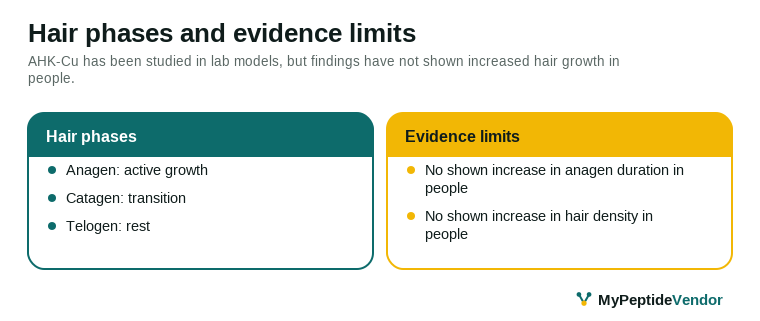
Hair grows in repeating phases. Anagen is active growth, catagen is a transition, and telogen is rest. AHK-Cu has been studied in ex vivo and in vitro cell models 2, and these findings have not been shown to increase anagen duration or hair density in people. 2
Most hair evidence is preclinical. Pyo et al. studied human hair follicles ex vivo, meaning outside the body, and dermal papilla cells in vitro, meaning in a lab. Those models can show biological activity; they cannot tell us whether a scalp product changes someone’s hairline or shedding. 2
Use this chart
Free to reuse with a link back:
What makes it different
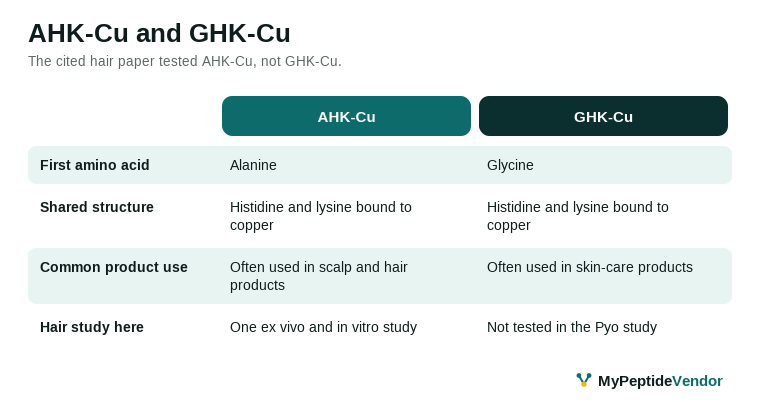
AHK-Cu differs from GHK-Cu at the first amino acid: AHK-Cu starts with alanine, while GHK-Cu starts with glycine. Both are copper-binding tripeptides. The Pyo hair study tested AHK-Cu, not GHK-Cu, so it does not establish that one peptide is better for hair. 2
Those product uses do not prove that either peptide treats hair loss or improves skin in people. The AHK-Cu hair study did not compare the two peptides. 2
Claims about Wnt, VEGF, or DHT pathways need careful wording. Wnt is a cell-signaling system involved in tissue development; VEGF is a signal associated with blood-vessel growth; and DHT is a hormone linked to some forms of patterned hair loss. Pyo et al. reported cell-growth and cell-death findings, but did not establish that AHK-Cu changes these pathways in people. 2
How does it work?
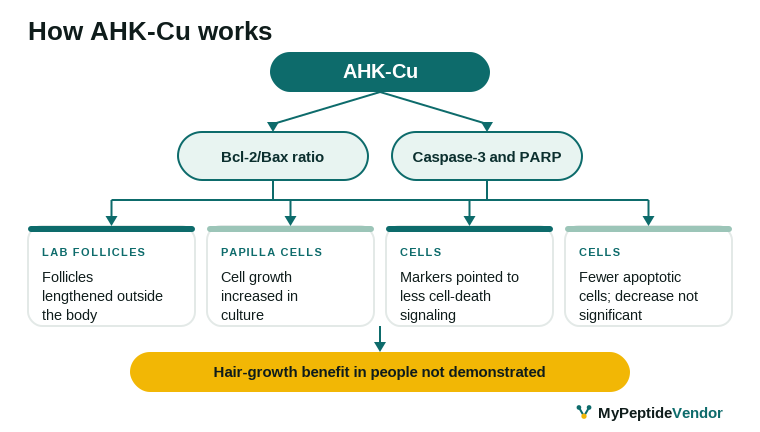
In plain terms, researchers tested whether AHK-Cu could help follicles lengthen and support the cells around them. In the lab, it stimulated elongation of human hair follicles kept outside the body and increased proliferation of cultured dermal papilla cells, which help regulate follicle growth. The tested range was 10^-12 to 10^-9 M. 2
At 10^-9 M, AHK-Cu raised the Bcl-2/Bax ratio and lowered cleaved caspase-3 and PARP. In plain language, those markers point toward less cell-death signaling. A separate test found fewer apoptotic cells, but that decrease was not statistically significant. These cell findings do not demonstrate thicker hair or less shedding in people. 2
A product labeled 1% cannot be matched directly to the study’s molar concentrations from the percentage alone. The peptide form, full formula, and amount reaching the scalp affect exposure; no human study establishes that 1% is an effective concentration. 2
Use this chart
Free to reuse with a link back:
What the clinical evidence actually shows

The main hair paper is Pyo et al., “The effect of tripeptide-copper complex on human hair growth in vitro,” published in 2007. It reports ex vivo follicle elongation and in vitro dermal papilla cell findings. It gives no participant count, treatment duration, or human hair-count result. 2
ClinicalTrials.gov lists 1 registered AHK-Cu study: NCT07888595, an enrolling-by-invitation Early Phase 1 study titled “Systemic and Topical Geroprotective Rejuvenation Assessed by START/REST Aging Clocks.” It concerns aging clocks, not hair growth. The listing does not establish a hair dose or hair result. 3
There is no human hair-growth result or confirmed time to visible change in this evidence. A claim that users should expect results after a set number of months is not supported by the hair study or the registered aging-clock study. 23
The evidence ladder is short: one ex vivo and in vitro hair study offers preliminary biological findings, while the registered Early Phase 1 study is not a hair-efficacy trial. 23
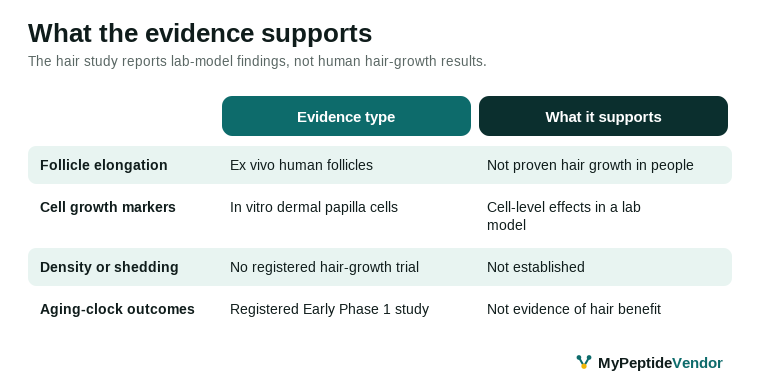
| Claim or question | Evidence type | What it supports |
|---|---|---|
| Follicle elongation | Ex vivo human follicles | A finding outside the body, not proven hair growth in people |
| Cell growth and survival markers | In vitro dermal papilla cells | Cell-level effects in a lab model |
| Hair density or reduced shedding | No registered hair-growth trial | Not established |
| Aging-clock outcomes | Registered Early Phase 1 study | Not evidence of hair benefit |
Use this chart
Free to reuse with a link back:
Typical dosing

There is no established human AHK-Cu dose for hair, whether topical or injectable. The 10^-12 to 10^-9 M range in Pyo et al. describes experimental concentrations in lab models. It is not a scalp application instruction or an injection schedule. 2
For a finished topical scalp product, follow its label. A practical routine is to shampoo and condition as usual, then apply a leave-on serum to the scalp if the product instructions call for it. A rinse-off shampoo or conditioner is used as directed on its own label; do not assume that mixing products, using extra serum, or applying it with microneedling improves results.
No study confirms when a user should expect a visible change. You can take baseline photos in consistent lighting and compare them later, but that tracks your own appearance; it is not a validated AHK-Cu timeline. If hair loss is progressing, ask a clinician about possible causes and treatments with human evidence.
Online vial schedules are not a substitute for human dosing research. The published hair experiment tested molar concentrations in models, not a daily microgram dose for people. 2
Side effects: what to actually expect
There is no human AHK-Cu hair-trial or product-label percentage to quote for irritation, allergy, or other side effects. Pyo et al. studied cells and follicles, not adverse-event rates in people, and the registered study is not a hair-safety trial. No reported percentage does not mean the risk is zero. 23
With a topical product, stop using it and rinse the area if you develop persistent burning, redness, itching, rash, or swelling. Get urgent care for trouble breathing, facial or throat swelling, or a rapidly worsening reaction. These are general safety steps, not measured AHK-Cu event rates.
Copper is essential, but excess copper can be harmful. The amount that enters the body from a scalp product has not been established here. If you have Wilson’s disease, another copper-metabolism disorder, or a medical reason to limit copper, ask a clinician before use. Do not try to manage copper exposure by changing an unapproved injection dose.
Regulatory & access status in the US
AHK-Cu's status on the 503A/503B bulk substances lists is not documented in the FDA list 1. That uncertainty is not evidence that a vial is approved or suitable for compounding. 1
Buyers may encounter finished topical products and vials marked “research use only.” They are not interchangeable: a research-only vial is not a human-use medicine. Check a topical product’s ingredient list for Copper Tripeptide-3, its stated concentration, batch number, and storage instructions. Ask whether a batch-specific certificate of analysis (COA) is available and whether an independent lab performed the testing. A COA may help check identity or purity; it cannot prove hair benefit.
Can you inject AHK-Cu? No. There is no approved human injection product or established injection dose. Injection can introduce contamination, infection, or tissue injury; sterile technique and bacteriostatic water do not turn a research-only product into an approved medicine.
Prefer a clearly labeled finished topical product over a research-only vial intended for laboratory use. Treat a missing ingredient list, unstated concentration, absent batch identification, or claim that a research vial is ready for self-injection as a warning sign. No testing document can establish that the product will regrow hair.
Research-grade AHK-Cu is available from Certified-Pep. Sold for laboratory research only, not for human use. Affiliate link
How it compares with its closest alternative
AHK-Cu and GHK-Cu differ by one amino acid, but the cited AHK-Cu hair paper does not compare them head to head. 2
| Feature | AHK-Cu | GHK-Cu |
|---|---|---|
| First amino acid | Alanine | Glycine |
| Shared structure | Histidine and lysine bound to copper | Histidine and lysine bound to copper |
| Common product use | Often used in scalp and hair products | Often used in skin-care products |
| Hair research discussed here | One ex vivo and in vitro hair study | Not tested in the Pyo study |
| What can be concluded | Preliminary cell and follicle findings | No head-to-head result against AHK-Cu |
There is no human head-to-head trial here showing that AHK-Cu works better than GHK-Cu for hair, or that either should replace a treatment with human hair-loss evidence. A one-amino-acid structural difference does not establish different clinical results. 2
Use this chart
Free to reuse with a link back:
Where to Buy AHK-Cu for Research
Certified-Pep
US-made research peptides with batch-specific lab reports (COA) and a QR code on every vial.
- Independent laboratory testing (Vanguard Laboratory)
- Made in the USA, ships in 1-2 business days
- Research use only, not for human or veterinary use
Affiliate disclosure: we may earn a commission if you order through the link above. AHK-Cu is not approved by the FDA for human use.
Frequently asked questions
What is ahk-Cu peptide good for?
It is studied for possible effects on hair follicles and is used in scalp-care products. The available hair findings come from follicles outside the body and cultured cells, so a benefit for hair growth in people has not been demonstrated. 2
What is the difference between AHK-Cu and GHK-Cu?
AHK-Cu has alanine as its first amino acid; GHK-Cu has glycine. AHK-Cu is more commonly positioned in scalp products and GHK-Cu in skin-care products, but the cited hair study does not compare their clinical effects. 2
Can you inject ahk-Cu peptide?
No. AHK-Cu injection is not approved for human use, and there is no established human injection dose. A research-only label means the vial is not a self-injection product.
Where can I buy AHK copper peptide?
Look for a finished topical scalp product with Copper Tripeptide-3 on its ingredient list, a stated concentration, batch identification, and storage directions. Ask the seller for a batch-specific COA, but remember that product testing cannot show that it will improve hair.
References
- FDA: Certain bulk drug substances for use in compounding that may present significant safety risks
- Pyo et al. The effect of tripeptide-copper complex on human hair growth in vitro. Arch Pharm Res. 2007.
- ClinicalTrials.gov: 1 registered studies (search: AHK-Cu)
Written by the MyPeptideVendor editorial team from the FDA label, peer-reviewed studies and ClinicalTrials.gov records listed above, fact-checked line by line and reviewed 2026-11-12.
Cite this page
MyPeptideVendor Editorial Team. ahk cu: Hair Evidence, Dosing & Safety. MyPeptideVendor. Updated November 12, 2026. https://mypeptidevendor.com/peptides/ahk-cu/MyPeptideVendor Editorial Team. (2026, November 12). ahk cu: Hair Evidence, Dosing & Safety. MyPeptideVendor. https://mypeptidevendor.com/peptides/ahk-cu/Related peptides
Argireline (Acetyl Hexapeptide-3)
Not approvedA small 4-week trial found wrinkle improvements, but lasting effects, ideal concentration, and Argireline-specific side-effect rates remain unknown.
Learn moreAHK (Tripeptide-3)
Not establishedAHK-Cu is a copper tripeptide used as a cosmetic ingredient, but human hair-growth benefit and a proven scalp dose remain unestablished.
Learn moreBronchogen
Research UseBronchogen is an experimental four-amino-acid peptide with preclinical lung findings, but no established human dose, safety profile, or treatment benefit.
Learn more