Fraternine: Evidence, Dose & FDA Status
Wasp-venom-derived peptide
Brand names: No approved brand name is established in the cited evidence.
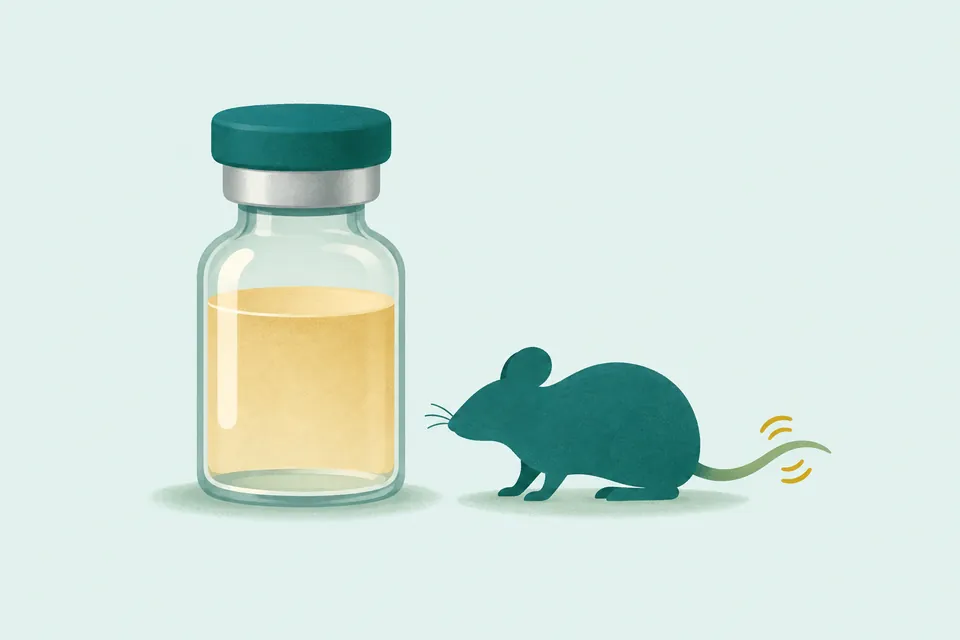
Fraternine is a peptide isolated from venom of the social wasp Parachartergus fraternus 3. Researchers tested it in mice with Parkinson-like brain damage, not as a treatment in people.
The parent peptide’s 2020 mouse study used 10 μg per animal and reported changes in movement tests and dopamine-related neurons 3. Related peptides have been studied in mice, while an amyloid study explored fraternine-10 in laboratory and computer work 4.
Key takeaways
- The 2020 mouse study used 10 μg of fraternine per animal; this is not a human dose 3.
- Parkinson-related results come from 6-OHDA mouse models, with no human efficacy data reported in these studies 2,3.
- Fra-10 and fra-14 improved motor coordination in mice, but most tested peptides were toxic at the doses applied 2.
- Only higher-dose fra-24 increased TH-positive neuron counts and reduced cortical TNF-α in the analogue study 2.
- The 2025 amyloid study included 200-nanosecond simulations, but its in-vivo results did not show improvement 4.
Fraternine at a glance
- Class
- Wasp-venom-derived peptide
- Mechanism
- Exact molecular target is not established; mouse studies report protection of dopamine-related neurons in the substantia nigra.
- FDA Status
- No FDA-approved fraternine product or human label is established in the cited evidence.
- Brand names
- No approved brand name is established in the cited evidence.
- Administration
- No approved human route; the parent-peptide mouse study reports 10 μg per animal.
- Typical Dose
- No human dose; 10 μg per animal was used in the 2020 mouse study.
- Half-life
- Not established in the cited studies.
- Primary Uses
- Experimental research on Parkinson-like motor changes; not an established treatment.
What is it?

Fraternine is a peptide isolated from venom of the social wasp Parachartergus fraternus 3. Researchers separated components of the venom and identified an active fraction as a novel peptide. They then tested the peptide in a mouse model of Parkinsonism. A venom origin describes where the molecule was found; it does not establish that it is safe or effective as a medicine.
The main fraternine research concerns damage to dopamine pathways in mice. Researchers used 6-hydroxydopamine, usually shortened to 6-OHDA, to create a Parkinson-like lesion and then measured movement and brain-cell markers 2,3. This model can test selected effects under controlled conditions. It does not reproduce every feature or the full course of Parkinson’s disease in a person.
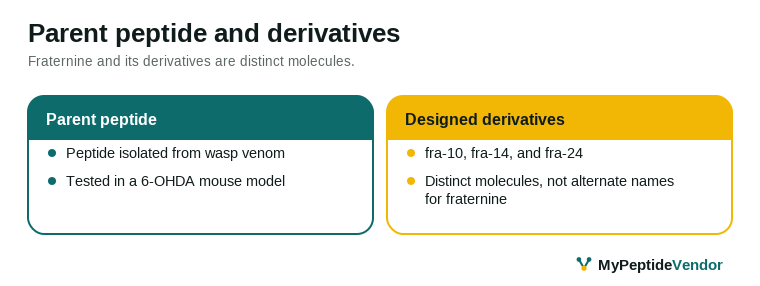
Three synthetic derivatives inspired by fraternine are called fra-10, fra-14, and fra-24 2. They are distinct molecules, not alternate names for the parent peptide. A separate line of research tested fraternine-10 against amyloid-beta fibrils, which are protein structures associated with Alzheimer’s research 4.
No human efficacy data are reported in the cited fraternine research 2–4. The Parkinson-related findings come from animal experiments, and the amyloid work includes laboratory testing and computer simulations as well as in-vivo research. No human dose, treatment schedule, or patient outcome has been established.
It helps to keep the names straight. “Fraternine” refers to the parent peptide identified in wasp venom, while fra-10, fra-14, and fra-24 refer to designed derivatives evaluated in a later mouse study 2,3. Fraternine-10 in the amyloid paper is a bioinspired peptide; that study does not establish that it is an approved drug or a treatment for Alzheimer’s disease 4.
Use this chart
Free to reuse with a link back:
What makes it different
Fraternine’s distinguishing feature is its origin as a wasp-venom peptide and its early testing in a Parkinson-like mouse model 3. The research question is whether it can protect dopamine-related neurons and change measured movement in mice. That is not the same as showing symptom relief or slower disease progression in people.
The parent peptide’s reported Parkinson-model dose was 10 μg per animal 3. Treated mice stayed on a rotating rod longer than lesioned mice, showed fewer apomorphine-induced rotations, and had less loss of dopamine-related neurons in the substantia nigra. The published abstract reports these directions of change, but does not give numerical differences in seconds, rotation counts, or neuron counts 3.
The derivatives did not show one consistent pattern. Fra-10 and fra-14 improved motor coordination compared with lesioned animals, while the study reports that most of the tested peptides were toxic at the doses applied 2. The report does not specify the type of toxicity or a numeric toxicity threshold. Only higher-dose fra-24 was reported to increase TH-positive neuron counts and reduce cortical TNF-α 2.
The evidence also depends on the question being asked. Parkinson-related findings come from 6-OHDA mouse experiments, while the amyloid work includes computer simulations and laboratory experiments 2–4. The amyloid paper’s in-vivo results did not show improvement, so its binding and anti-aggregation findings are not evidence of an Alzheimer’s treatment effect 4.
One useful distinction is between a marker and a patient outcome. TH-positive cells are used to identify dopamine-producing neurons, and a change in their count in a mouse brain is not a measure of how a person walks, functions, or feels 2,3. The fraternine papers do not report patient scores or clinical measures.
There is also no established human dosing method to compare with the animal experiments 2,3. The mouse dose of 10 μg per animal cannot be converted into a recommended amount for a person, because the cited studies do not establish human exposure, safety, or an effective schedule.
How does it work?

In plain terms, researchers are testing whether fraternine helps dopamine-producing brain cells survive damage and supports movement in mice. Those cells are found in a brain region called the substantia nigra, which helps control movement 2,3. The studies report protective effects in that region, but they do not establish the exact molecular steps by which the parent peptide might produce them.
In the 6-OHDA model, a chemical lesion damages dopamine pathways. Researchers then use tests such as the rotarod, an apomorphine rotation test, and staining for TH-positive cells to look for changes 3. TH means tyrosine hydroxylase, an enzyme used as a marker for dopamine-producing neurons. A higher count of TH-positive cells in an animal experiment may indicate less damage; it does not by itself show restored function in a person.
The rotarod measures how long a mouse can stay on a rotating rod. A longer time suggests better coordination on that test. Apomorphine-induced rotation measures turning behavior after a drug challenge in mice with an uneven brain lesion. Fewer rotations indicate a change in that animal response, not a direct estimate of walking ability or daily function in a patient 3.
The 2020 fraternine study reported a longer rotarod time and fewer apomorphine-induced rotations at 10 μg per animal, along with inhibition of dopaminergic neuronal loss in the substantia nigra 3. The study abstract does not provide the numerical change in rotarod time, rotation count, or neuron count. These results support further animal research, not a claim that fraternine restores dopamine signaling in people.
The direct molecular target of fraternine has not been established in these studies 2,3. They do not show that it binds a specific human receptor, restores normal dopamine signaling in people, or slows clinical progression. Those mechanisms and outcomes have not been demonstrated in humans.
The analogue study measured inflammatory signals in the cortex: TNF-α, IL-6, and IL-1β 2. Only higher-dose fra-24 was reported to lower TNF-α. The study does not report the same reduction for the parent peptide, and its abstract does not establish a consistent lowering of IL-6 or IL-1β. These are mouse findings, not proof that fraternine is an anti-inflammatory treatment.
The amyloid research asks a separate question from the Parkinson’s studies. In 200-nanosecond molecular-dynamics simulations, fraternine-10 and Octovespin interacted with Aβ(17–42) fibrils throughout the simulation 4. Laboratory data for fraternine-10 also indicated an anti-aggregation effect, but the in-vivo results did not show improvement. Computer binding and laboratory findings do not establish that a peptide reaches the human brain or changes Alzheimer’s symptoms.
What the clinical evidence actually shows

There are no human clinical results to report from the cited fraternine research 2–4. The Parkinson-related studies used 6-OHDA-lesioned mice; the amyloid paper included simulations, laboratory work, and in-vivo research. The publication abstracts do not state sample sizes or treatment durations for the studies summarized here 2–4. They also do not provide numerical effect sizes for the parent peptide’s rotarod, rotation, or neuron-count outcomes.
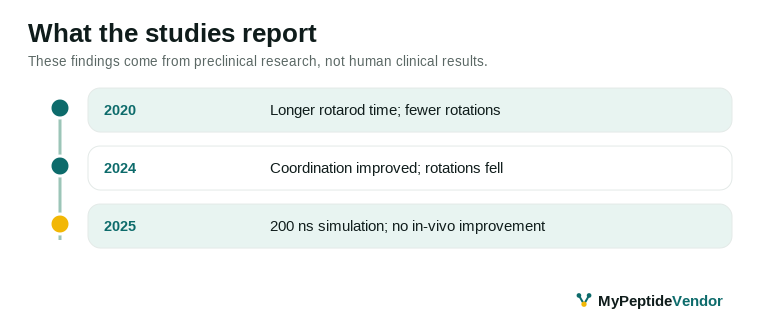
The 2020 paper, Fraternine, a Novel Wasp Peptide, Protects against Motor Impairments in 6-OHDA Model of Parkinsonism, tested the parent peptide in mice 3. At 10 μg per animal, the treated group remained on the rotarod longer than the lesioned group. Fraternine also decreased apomorphine-induced rotations and inhibited dopaminergic neuronal loss in the substantia nigra. The abstract describes these directions of effect but does not give corresponding numerical changes 3.
The 2024 paper, New fraternine analogues: Evaluation of the antiparkinsonian effect in the model of Parkinson’s disease, tested fra-10, fra-14, and fra-24 in 6-OHDA-lesioned mice 2. Fra-10 and fra-14 improved motor coordination compared with lesioned animals. All three analogues reduced the intensity of lesion-induced rotations in the apomorphine test. Most of the tested peptides were toxic at the doses applied, but the abstract does not specify the type of toxicity or a numeric threshold. Only higher-dose fra-24 increased TH-positive neuron counts and reduced cortical TNF-α 2.
The analogue paper also measured TNF-α, IL-6, and IL-1β in the cortex 2. Its reported positive cytokine result was specific: higher-dose fra-24 reduced TNF-α. The abstract does not give a percentage reduction or a numerical cytokine concentration, and it does not report that the parent peptide reduced TNF-α. The measured cytokines are biological markers in mice, not clinical outcomes.
The 2025 paper, Evaluation of the Ability of Wasp Venom Bioinspired Peptides (Fraternine-10 and Octovespin) in the Disaggregation and Anti-Aggregation of Amyloid-β Fibrils, studied a different disease-related target 4. Its molecular-dynamics simulations ran for 200 ns, or 0.2 microseconds, and found that both peptides interacted with Aβ(17–42) fibrils throughout the simulation. The paper reported laboratory anti-aggregation findings for fraternine-10, but its in-vivo data did not show improvement 4. It did not establish clinical benefit for Alzheimer’s disease.
The simulation is evidence about modeled molecular interactions, not a treatment trial 4. A peptide remaining in contact with a fibril in a computer model does not show that it can reach the brain after administration, alter disease in a living person, or improve memory. The lack of improvement in the study’s in-vivo work makes those distinctions especially relevant.
These papers do not establish a human dose, a clinically meaningful effect size, or how long a person would need treatment 2–4. They also do not answer whether fraternine can be safely combined with levodopa or other Parkinson’s medicines. Those questions require human research that is not reported here.
| Study | Evidence type | Main question | Human results |
|---|---|---|---|
| Biolchi et al., 2020 | Mouse in vivo | Fraternine in a 6-OHDA Parkinsonism model; movement tests and TH-positive neurons | None reported |
| Mayer et al., 2024 | Mouse in vivo | Fra-10, fra-14, and fra-24; movement, neuron counts, and cortical cytokines | None reported |
| de Oliveira Só et al., 2025 | In silico, laboratory, and in-vivo work | Fraternine-10 and Octovespin with Aβ(17–42) fibrils | None reported |
The research timeline remains preclinical: the parent peptide was reported in a Parkinson-like mouse model in 2020, the analogue paper appeared in 2024, and the amyloid study appeared in 2025 2–4. These publication years do not represent clinical-trial phases or years of treatment.
Use this chart
Free to reuse with a link back:
Typical dosing
Human dose: none has been established. The only specific dose for the parent peptide reported in the cited Parkinson research is 10 μg per animal in the 2020 mouse study 3. That is an experimental animal dose, not a starting dose or recommendation for a person.
Do not scale the mouse amount to a person by body weight. The cited research does not establish how much fraternine reaches a human brain, how quickly it is cleared, or what exposure would be safe 2–4. There is no human dosing interval, treatment duration, or approved route of administration in these studies.
Analogue doses: the 2024 paper tested fra-10, fra-14, and fra-24 at experimental doses, but the abstract does not state numeric dose ranges 2. The finding that most tested peptides were toxic at the doses applied is a reason not to infer a safe schedule from the movement results.
There is no approved product label with fraternine dosing instructions established in the cited evidence 1–4. An online dose presented as a human protocol is not supported by the animal dose or analogue findings 2,3. Anyone considering a product described as fraternine should discuss it with a clinician rather than self-dose.
A clinician can help review the intended use, product claims, and possible interaction concerns, but there is no human interaction study to guide fraternine use with Parkinson’s medicines 2,3. The 10 μg-per-animal experiment cannot answer whether a human amount would be effective or safe.
Side effects: what to actually expect
No human side-effect rates are established because the cited research does not report human trials of fraternine 2–4. There is no supported percentage for headache, fatigue, nausea, injection-site reactions, or allergic reactions. Those symptoms should not be presented as known common effects of fraternine.
The clearest safety finding comes from the analogue study: most of the tested peptides were toxic at the doses applied in mice 2. The report does not specify the type of toxicity or a numeric threshold. It also does not provide the percentage of animals affected at each dose, so it cannot give a human likelihood or a safe-dose estimate.
Fra-10 and fra-14 improved motor coordination in a comparison with lesioned mice, while the same study reported toxicity among most tested peptides at the doses applied 2. A favorable result on a movement test does not establish safety. The report does not identify which exact doses were toxic or describe a toxicity rate.
The parent-peptide study reported movement and neuron outcomes, not a quantified human safety profile 3. It cannot establish the risk of adverse effects in people, including people taking Parkinson’s medicines. Human allergy risk, long-term safety, and drug interactions have not been established in these studies 2–4.
For a person who has already used a product marketed as fraternine, the practical next step is to tell a clinician what was taken and when. There is no validated human adverse-effect checklist or known reaction rate in the cited studies 2–4, so new or worsening symptoms should not be dismissed as expected effects.
Regulatory & access status in the US
The cited studies report preclinical research rather than a human product label or human efficacy trial 2–4. No FDA-approved fraternine product or approved human dosing instructions are established in this evidence 1–4. A seller’s claim about purity or research grade does not establish FDA approval or safety for human use.
FDA’s Category 2 page concerns bulk drug substances nominated for compounding under sections 503A or 503B that may present significant safety risks 1. Category 2 is a risk designation for substances on that list; it is not an approval category. That distinction matters because a compounding-list designation does not mean that FDA has approved a treatment.
The FDA material does not provide a fraternine-specific regulatory determination 1. Do not assume that fraternine, fra-10, fra-14, or fra-24 are either included on or cleared by the compounding list. Check the current FDA page by each exact substance name before relying on a compounding claim; a status for one peptide would not automatically establish the status of its derivatives 1.
Being absent from a particular compounding list would not, by itself, make a peptide FDA-approved or establish that it may lawfully be compounded for a particular use 1. The Category 2 page describes nominated bulk substances that may present significant safety risks; it is not a general approval list for research chemicals or peptide products.
For someone with Parkinson’s disease, discuss any proposed peptide product with a neurologist or pharmacist before taking it. Do not replace prescribed treatment or change a medicine based on mouse findings 2,3. A clinician can help distinguish an experimental research claim from evidence that applies to patient care.
Access check: verify the current FDA listing and ask whether a product is being offered for research or for human treatment 1. The mouse experiment used 10 μg per animal, and the analogue study reported toxicity among most tested peptides at the doses applied 2,3. Neither finding supplies a human regimen.
How it compares to its closest alternative
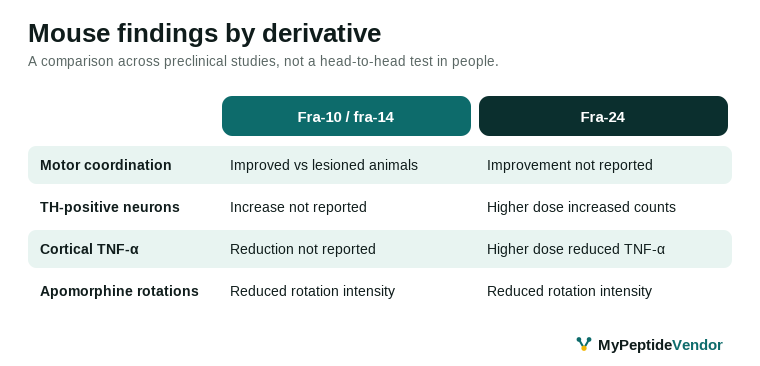
The closest alternatives are fra-10, fra-14, and fra-24 because researchers tested them as fraternine-inspired derivatives in the same Parkinson-like mouse model 2. The parent peptide’s findings come from a separate 2020 mouse study 3. This is a comparison across preclinical studies, not a head-to-head test in people.
“Not reported” means the study abstract does not describe that finding; it does not prove that no effect exists.
| Peptide | Motor coordination | TH-positive neurons | Cortical TNF-α | Toxicity | Apomorphine rotations |
|---|---|---|---|---|---|
| Fraternine | Longer rotarod time than lesioned mice | Inhibited dopaminergic neuronal loss | Not reported | Human safety not established | Fewer rotations reported |
| Fra-10 | Improved versus lesioned animals | Increase not reported | Reduction not reported | Most tested peptides were toxic at applied doses; type not specified | Reduced rotation intensity |
| Fra-14 | Improved versus lesioned animals | Increase not reported | Reduction not reported | Most tested peptides were toxic at applied doses; type not specified | Reduced rotation intensity |
| Fra-24 | Coordination improvement not reported | Higher dose increased counts | Higher dose reduced TNF-α | Most tested peptides were toxic at applied doses; type not specified | Reduced rotation intensity |
The parent-peptide row reflects the 2020 study, and the derivative rows reflect the 2024 study 2,3. Fra-24’s neuron and TNF-α findings do not establish clinical benefit, and the toxicity finding does not identify a safe dose.
For the amyloid question, fraternine-10 was studied alongside Octovespin rather than as a Parkinson’s alternative 4. The 200-nanosecond simulation and laboratory findings support further research, but the in-vivo results did not show improvement. Neither peptide is established as an Alzheimer’s treatment.
There is no clear “best” option from these comparisons. Fra-10 and fra-14 had motor-coordination findings, while fra-24 had the reported TH-positive neuron and TNF-α findings; most tested peptides were toxic at the applied doses 2. The studies do not establish a usable human benefit-risk balance.
Questions to take to a clinician or use when checking a product claim:
- Is the claim based on a human study, or on the 6-OHDA mouse model used in the Parkinson research 2,3?
- Does the proposed product name specify the parent peptide or a derivative such as fra-10, fra-14, or fra-24 2?
- What human dose and safety evidence supports the proposed use? The cited research establishes no human dose 2–4.
- Has the exact substance name been checked against FDA’s current compounding information, and is the seller describing research use or human treatment 1?
Use this chart
Free to reuse with a link back:
Frequently asked questions
Has fraternine been tested in people?
The cited studies report mouse, laboratory, and computer research, not a human efficacy trial 2–4. No clinical-trial phase or patient outcome is reported.
Can fraternine treat Parkinson’s disease?
It has not been shown to treat Parkinson’s disease in people 2,3. The parent peptide’s movement and neuron findings came from a 6-OHDA mouse experiment using 10 μg per animal 3.
What dose of fraternine do researchers use?
The parent-peptide mouse study reports 10 μg per animal 3. No human dose or standard schedule has been established, so that amount is not personal dosing guidance.
What side effects have been reported?
No human side-effect percentages are available 2–4. The analogue study reports that most tested peptides were toxic at the doses applied in mice, but it does not specify the toxicity type or a numeric threshold 2.
Is fraternine FDA-approved or available by prescription?
The cited evidence does not establish an FDA-approved fraternine product or human label 1–4. FDA’s Category 2 page describes potential safety risks for nominated bulk substances; it is not an approval list, and it does not provide a fraternine-specific determination 1.
Does fraternine have evidence for Alzheimer’s disease?
Fraternine-10 interacted with Aβ(17–42) fibrils during 200-nanosecond simulations, and laboratory findings suggested anti-aggregation activity 4. The in-vivo results did not show improvement, so these findings do not establish an Alzheimer’s treatment effect.
References
- FDA: Certain bulk drug substances for use in compounding that may present significant safety risks
- Mayer et al. New fraternine analogues: Evaluation of the antiparkinsonian effect in the model of Parkinson's disease. Neuropeptides. 2024.
- Biolchi et al. Fraternine, a Novel Wasp Peptide, Protects against Motor Impairments in 6-OHDA Model of Parkinsonism. Toxins (Basel). 2020.
- de Oliveira Só et al. Evaluation of the Ability of Wasp Venom Bioinspired Peptides (Fraternine-10 and Octovespin) in the Disaggregation and Anti-Aggregation of Amyloid-β Fibrils. Proteins. 2025.
Written by the MyPeptideVendor editorial team from the FDA label, peer-reviewed studies and ClinicalTrials.gov records listed above, fact-checked line by line and reviewed 2026-11-12.
Cite this page
MyPeptideVendor Editorial Team. Fraternine: Evidence, Dose & FDA Status. MyPeptideVendor. Updated November 12, 2026. https://mypeptidevendor.com/peptides/fraternine/MyPeptideVendor Editorial Team. (2026, November 12). Fraternine: Evidence, Dose & FDA Status. MyPeptideVendor. https://mypeptidevendor.com/peptides/fraternine/Related peptides
Argireline (Acetyl Hexapeptide-3)
Not approvedA small 4-week trial found wrinkle improvements, but lasting effects, ideal concentration, and Argireline-specific side-effect rates remain unknown.
Learn moreAHK-Cu
Not approvedAHK-Cu has early lab findings related to hair follicles, but human hair benefits, safe dosing, and side-effect rates are not established.
Learn moreAHK (Tripeptide-3)
Not establishedAHK-Cu is a copper tripeptide used as a cosmetic ingredient, but human hair-growth benefit and a proven scalp dose remain unestablished.
Learn more