Adamax Dosage 5mg: Safety & Vial Guide
No approved human Adamax dose exists; vial math can explain concentration, but it cannot confirm identity, safety, or a suitable injection schedule.
Quickstart highlights for Adamax dosage 5mg
No approved human Adamax dosage for a 5 mg vial is established. A vial strength is the total amount on the label, not a recommended dose.
No source cited here establishes the ingredients of a particular vial or provides dedicated human Adamax trial data.
- Dose: No approved or validated human Adamax dose is established. Do not treat the vial’s total 5 mg as a personal dose.
- Identity: The name Adamax does not establish one chemical structure or blend. Ask for a batch-specific certificate of analysis (CoA) and check whether its batch number matches the vial.
- Vial math: Adding 2.5 mL to a 5 mg vial gives 2 mg/mL. This is a concentration calculation, not a dosing recommendation.
- Evidence: No dedicated human Adamax trial data or reliable Adamax-specific side-effect frequencies are established here.
- Regulatory context: FDA Category 2 is an interim compounding-policy category for nominated bulk substances that may present significant safety risks; it is not drug approval 1.
Key takeaways
- No FDA-approved Adamax dose, label titration schedule, or established human cycle length exists.
- For arithmetic only, 5 mg in 2.5 mL gives 2 mg/mL; at that concentration, 2 mg equals 100 U-100 units.
- No source here verifies Adamax-specific storage temperatures or a beyond-use period.
- A batch-specific CoA can help identify what a vendor says it tested, but it does not prove a product is sterile or suitable for injection.
- AdaMax is used as a computing optimizer in machine-learning studies 2-9, not as a peptide dosing or treatment method.
Dosing schedule
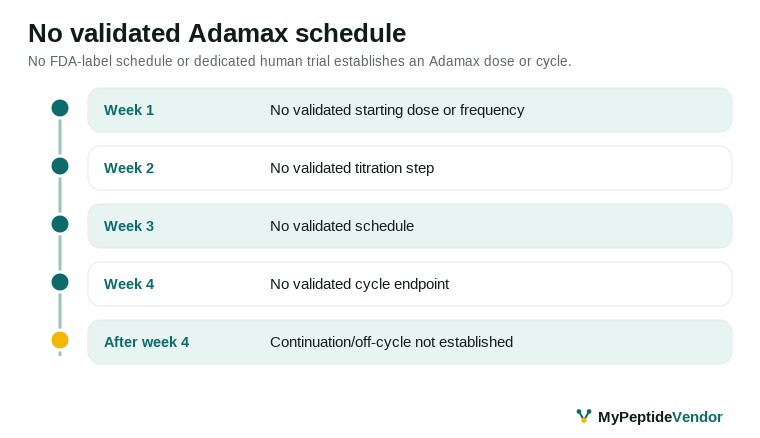
Adamax is not an FDA-approved medicine with an FDA label titration schedule, and no dedicated human trial establishes a dose, titration, or cycle. When a medicine is approved, its titration should follow its FDA label or relevant clinical-trial evidence. That standard cannot supply an Adamax schedule because neither is established here.
No validated amount or frequency is established for any week. It is not a dosing plan. The U-100 column is deliberately blank rather than turning unverified online protocols into syringe instructions.
| Week | Dose (mg) | Dose (mcg) | U-100 units | Frequency and cycle status |
|---|---|---|---|---|
| 1 | Not established | Not established | Not established | No validated starting dose or frequency |
| 2 | Not established | Not established | Not established | No validated titration step |
| 3 | Not established | Not established | Not established | No validated schedule |
| 4 | Not established | Not established | Not established | No validated cycle endpoint |
| After week 4 | Not established | Not established | Not established | No established continuation or off-cycle period |
Different online schedules cannot be checked against dedicated Adamax trial evidence because no such trial data are established here.
Use this chart
Free to reuse with a link back:
Syringe Unit Conversion Table
Units to draw on a U-100 insulin syringe (100 units = 1 mL) from a 5 mg vial. Find your dose, then read the column for the water you added. Every number is calculated, not estimated.
| Dose | 1 mL water 5 mg/mL · 1 unit = 50 mcg | 2 mL water 2.5 mg/mL · 1 unit = 25 mcg | 2.5 mL water 2 mg/mL · 1 unit = 20 mcg |
|---|---|---|---|
| 50 mcg | 1 · 100 doses | 2 · 100 doses | 2.5 · 100 doses |
| 100 mcg | 2 · 50 doses | 4 · 50 doses | 5 · 50 doses |
| 200 mcg | 4 · 25 doses | 8 · 25 doses | 10 · 25 doses |
| 250 mcg | 5 · 20 doses | 10 · 20 doses | 12.5 · 20 doses |
| 300 mcg | 6 · 16 doses | 12 · 16 doses | 15 · 16 doses |
| 500 mcg | 10 · 10 doses | 20 · 10 doses | 25 · 10 doses |
| 750 mcg | 15 · 6 doses | 30 · 6 doses | 37.5 · 6 doses |
| 1 mg | 20 · 5 doses | 40 · 5 doses | 50 · 5 doses |
| 1.5 mg | 30 · 3 doses | 60 · 3 doses | 75 · 3 doses |
| 1.7 mg | 34 · 2 doses | 68 · 2 doses | 85 · 2 doses |
| 2 mg | 40 · 2 doses | 80 · 2 doses | 100 · 2 doses |
| 2.4 mg | 48 · 2 doses | 96 · 2 doses | over 100 |
| 2.5 mg | 50 · 2 doses | 100 · 2 doses | over 100 |
| 3 mg | 60 · 1 doses | over 100 | over 100 |
| 4 mg | 80 · 1 doses | over 100 | over 100 |
| 5 mg | 100 · 1 doses | over 100 | over 100 |
Adamax 5 mg Vial Dosage Calculator
Shows the exact insulin-syringe units to draw. Pre-loaded with the 5 mg vial; change any value to match yours.
Total volume of your syringe?
How much mg is in the vial?
How much bacteriostatic water are you adding?
Dose per injection?
Educational tool only. Concentration = vial ÷ water; units = dose ÷ concentration × 100 (U-100 syringe). Confirm every dose with your prescriber. Different vial or peptide? Use the peptide calculator.
MYPEPTIDEVENDORAffiliate link · we may earn a commission.
Reconstitution steps
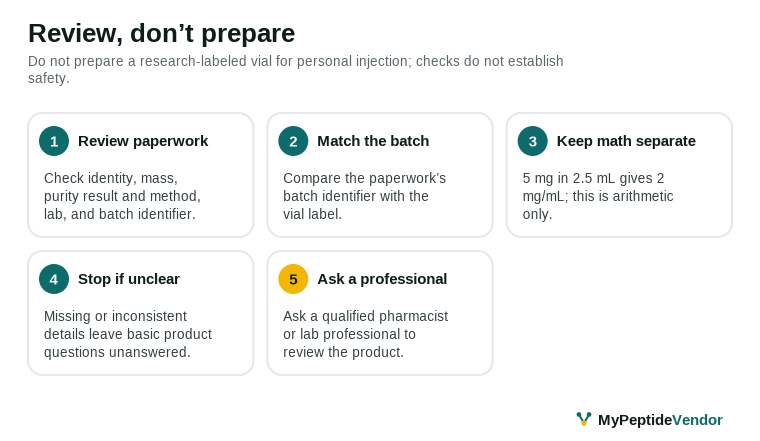
- Do not prepare a research-labeled vial for personal injection. A powder’s appearance and label do not verify its identity, sterility, or suitability for human use.
- Review the paperwork before handling. Check the stated sequence or chemical identity, measured mass, purity result and test method, testing laboratory, and batch identifier. Compare the batch identifier with the vial label.
- Understand the dilution arithmetic only. If the contents are 5 mg and the volume added is 2.5 mL, the resulting concentration is 2 mg/mL. That calculation does not recommend a diluent, preparation method, route, or dose.
- Stop if details are missing or inconsistent. A mismatched batch number, unclear identity, or absent testing method leaves basic product questions unanswered. Ask a qualified pharmacist or laboratory professional to review the exact product.
A CoA reports testing information; it does not by itself prove sterility, FDA approval, or safety for injection. A purity result alone cannot answer those questions.
Use this chart
Free to reuse with a link back:
Supplies needed for a full vial
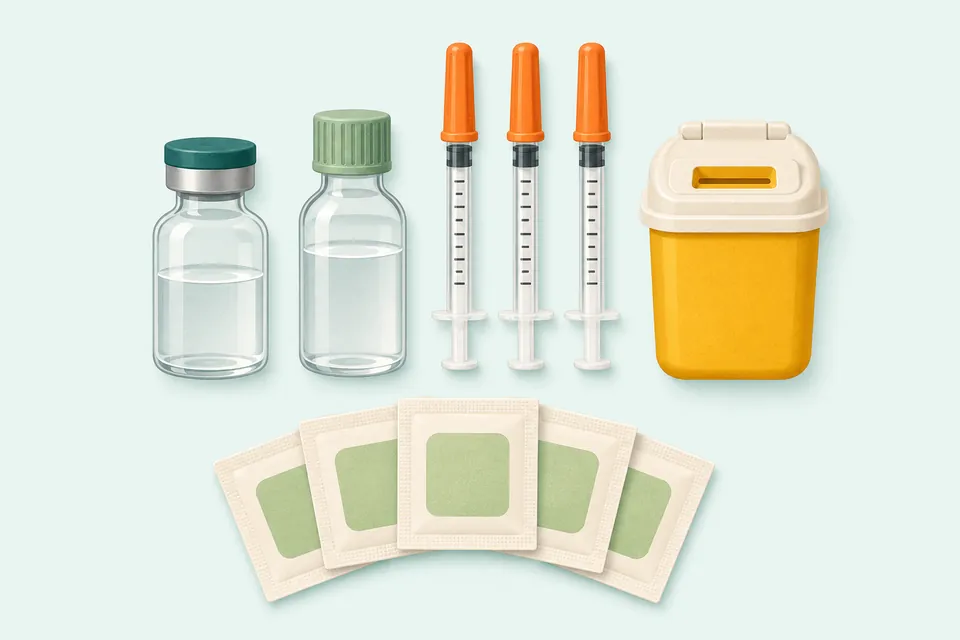
For personal human use, the appropriate quantity of injection supplies is none: do not reconstitute or inject an unverified research-labeled vial. No validated Adamax protocol establishes a human-use diluent, route, syringe, or number of injections.
For the concentration calculation only, the inputs are one 5 mg vial and 2.5 mL of liquid, producing 2 mg/mL. This is arithmetic, not a preparation instruction. A qualified laboratory should follow its own validated procedure and select supplies for that procedure rather than using an online human dosing guide.
Protocol overview & cycle notes

No approved human dose, titration period, cycle length, or off-cycle interval is established for Adamax. A multiweek plan would therefore be an unsupported schedule, not a clinical protocol. No dedicated human trial data establish safety or benefit for a particular Adamax formulation.
The product name is not enough to answer what is in a vial. Adamax is used as a trade name for products described as Semax-related analogues, but vendor composition may differ. The available primary sources do not establish the identity of any Adamax product. Request the exact batch’s CoA and compare its identifier with the vial before drawing conclusions about the stated contents.
Claims about brain-derived neurotrophic factor (BDNF), vasopressin activity, cognition, or improved blood-brain barrier passage are not established for a product identified only as Adamax. No Adamax-specific human or animal evidence is established for BDNF, vasopressin, cognition, or blood-brain barrier claims. Evidence about a related peptide, or a proposed chemical modification, cannot establish the effects of a particular vial.
The spelling also causes confusion: AdaMax is the name of a computing optimizer in the studies listed here. Those studies use it in machine-learning models for stroke classification, skin cancer, indoor surfaces, renal disease, mine gas, radiation complications, home energy, and ECG classification; they do not test a peptide 2-9.
The FDA Category 2 page describes potential significant safety risks identified while reviewing nominated bulk substances for compounding under interim policies 1. That category is not an approval designation. The page alone does not determine the legal status of every product or formulation sold as Adamax.
The evidence status for commonly repeated claims is limited:
| Claim | Evidence status for commonly repeated claims |
|---|---|
| BDNF effect | No Adamax-specific evidence established |
| Vasopressin activity | No Adamax-specific evidence established |
| Greater blood-brain barrier passage | No Adamax-specific evidence established |
| Cognitive benefit | No dedicated human Adamax trial data established |
Storage & handling

Storage or stability figures are not established for any Adamax product 1-9. Do not assume that a temperature range or use period given for another peptide applies to this vial. Ask the responsible supplier, pharmacy, or laboratory for product- and batch-specific stability instructions.
Keep the vial in its original packaging while you seek clarification. Do not use a vial with a damaged seal, missing batch information, uncertain storage history, or a label that conflicts with its CoA. Refrigeration cannot confirm identity, sterility, or stability when those details are unknown.
Injection & tracking tips
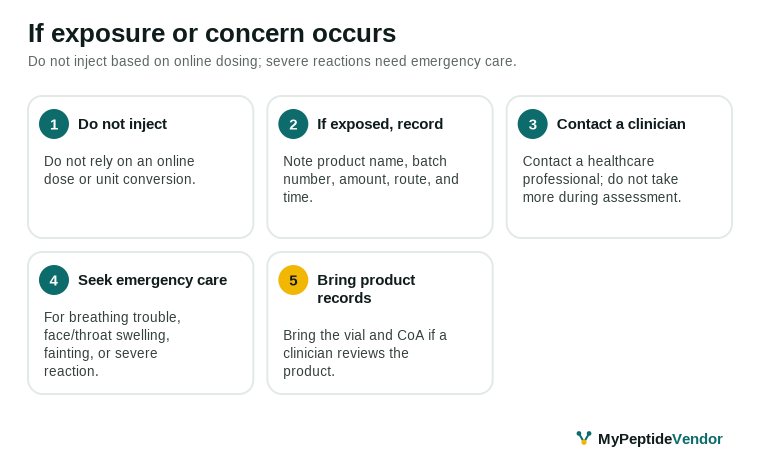
Do not inject Adamax based on an online dose or unit conversion. Syringe units measure volume, not the identity or safety of the substance; correct arithmetic cannot confirm what is in a vial.
If exposure has already occurred, write down the product name, batch number, amount, route, and time, then contact a healthcare professional. Do not take more while a possible reaction or product-identity concern is being assessed. Seek emergency care for trouble breathing, swelling of the face or throat, fainting, or another severe reaction.
If a clinician reviews the product, bring the vial and CoA rather than relying on a remembered trade name. A matching batch identifier and clear testing methods make the paperwork easier to assess, but they do not prove that the material is fit for injection.
Use this chart
Free to reuse with a link back:
Safety & side effects
No reliable Adamax-specific human side-effect frequencies are established here. Without a confirmed composition and dedicated human trials, a percentage for any reaction cannot be given. An unknown frequency does not mean a reaction is rare or absent.
Do not self-use an unverified research-labeled product. Safety is also not established for children, pregnancy, or breastfeeding, or for people taking prescription medicines or managing a health condition. Ask a licensed clinician or pharmacist to review the exact product and your health history rather than relying on a general peptide schedule.
In the United States, FDA Category 2 refers to bulk substances that the agency has identified as potentially presenting significant safety risks during its interim compounding-policy review 1. It is not FDA approval, and it does not by itself settle whether a particular product can legally be obtained or compounded. Rules vary by jurisdiction; check the relevant regulator or a qualified local professional.
This page is educational, not a prescription or a substitute for medical care. Do not use the vial calculation as an instruction to dose yourself.
Frequently asked questions
What is Adamax, and is every 5 mg vial the same?
Adamax is a trade name used for products described as Semax-related analogues, but the name does not establish one shared composition. The contents of a particular vial are not verified 1-9. Check the batch-specific CoA and match its batch identifier to the vial.
What is the correct Adamax dosage for a 5 mg vial?
No approved human dose or validated schedule is established. The cited primary sources do not provide a dedicated Adamax human trial or dosing protocol. Do not treat the vial’s total amount as a personal dose.
How many units is 2 mg from a 5 mg vial?
For arithmetic only, 5 mg in 2.5 mL gives 2 mg/mL, and 2 mg equals 100 U-100 units. This conversion does not confirm the product’s identity or recommend an injection.
Can I reconstitute Adamax with bacteriostatic water?
No human-use preparation method is established for an unspecified Adamax product. Do not prepare it for self-injection. Ask a qualified professional to assess the exact product and its validated handling instructions.
What should I check on an Adamax CoA?
Check the stated sequence or chemical identity, measured mass, purity result and method, testing laboratory, and batch identifier against the vial label. A CoA does not establish sterility, FDA approval, or safety for injection.
Does FDA Category 2 status mean Adamax is approved or illegal?
No. Category 2 identifies nominated bulk substances that may present significant safety risks in the FDA’s interim compounding policies 1; it is not an approval designation. It does not settle the legal status of every product or jurisdiction.
Are the AdaMax research papers about the peptide?
No. The papers use AdaMax as a computing optimizer in machine-learning research, not as a peptide treatment 2-9. They do not establish an Adamax dose or human side-effect rate.
Where can I source Adamax, and is it legal?
The product name alone cannot verify a supplier or legal status. Rules differ by country and may depend on the exact substance and intended use. Check the relevant regulator and ask a qualified local professional before obtaining or compounding it.
References
- FDA: Certain bulk drug substances for use in compounding that may present significant safety risks
- Uppal et al. Enhancing accuracy in brain stroke detection: Multi-layer perceptron with Adadelta, RMSProp and AdaMax optimizers. Front Bioeng Biotechnol. 2023.
- Umapathi et al. Effective skin cancer classification by modified and optimized inception-ResNet-V2 model. Sci Rep. 2025.
- Demirtaş et al. Indoor surface classification for mobile robots. PeerJ Comput Sci. 2024.
- Badawy et al. A two-stage renal disease classification based on transfer learning with hyperparameters optimization. Front Med (Lausanne). 2023.
- Liang et al. Mine Gas Concentration Forecasting Model Based on an Optimized BiGRU Network. ACS Omega. 2020.
- Lee et al. Using meta-analysis and CNN-NLP to review and classify the medical literature for normal tissue complication probability in head and neck cancer. Radiat Oncol. 2024.
- Nutakki et al. Optimizing home energy management: Robust and efficient solutions powered by attention networks. Heliyon. 2024.
- Alqahtani et al. Leveraging electrocardiography signals for deep learning-driven cardiovascular disease classification model. Heliyon. 2024.
Written by the MyPeptideVendor editorial team from the FDA label, peer-reviewed studies and ClinicalTrials.gov records listed above, fact-checked line by line and reviewed 2026-11-12.
Cite this page
MyPeptideVendor Editorial Team. Adamax Dosage 5mg: Safety & Vial Guide. MyPeptideVendor. Updated November 12, 2026. https://mypeptidevendor.com/protocols/adamax-dosing-5mg/MyPeptideVendor Editorial Team. (2026, November 12). Adamax Dosage 5mg: Safety & Vial Guide. MyPeptideVendor. https://mypeptidevendor.com/protocols/adamax-dosing-5mg/