Semax: Evidence, Dosing & US Status
Synthetic neuroactive peptide
Brand names: Semax; no FDA-approved US product.

Semax is a synthetic peptide modeled on a short part of adrenocorticotropic hormone (ACTH), with the sequence MEHFPGP. Developed in Russia, it has been studied in stroke recovery and brain research, but it is not FDA-approved in the United States 467.
The clearest clinical report followed 110 people after ischemic stroke for 5 months. It used 6,000 mcg per day during treatment courses and reported changes in a blood marker and functional recovery, but did not give a numerical treatment-effect size 7.
Key takeaways
- Gusev and colleagues studied 110 people after ischemic stroke for 5 months; the report did not give a numerical treatment-effect size 7.
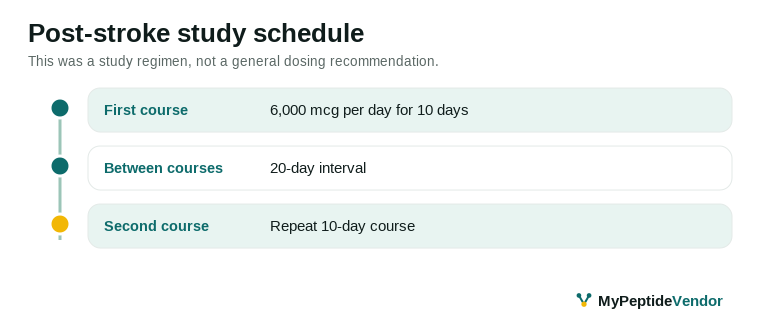
- The study regimen was 6,000 mcg per day for 10 days, repeated for 2 courses with a 20-day interval 7.
- Blood BDNF rose with Semax regardless of whether rehabilitation began at about 89 or 214 days after stroke 7.
- No Semax-specific adverse-event percentages or ADHD treatment results are reported in the cited clinical evidence 47.
- Semax is not FDA-approved in the United States; the FDA bulk-substance page does not confirm a Semax compounding pathway 14.
Semax at a glance
- Class
- Synthetic neuroactive peptide; ACTH 4–10 analog
- Mechanism
- A proposed BDNF-related effect; the full mechanism is not established.
- FDA Status
- Not FDA-approved in the United States.
- Brand names
- Semax; no FDA-approved US product.
- Administration
- The post-stroke report gives a daily dose but does not identify the route.
- Typical Dose
- One post-stroke study used 6,000 mcg/day for 10 days, repeated twice with a 20-day interval; this is not a general dosing recommendation.
- Half-life
- A clinically established human half-life is not reported in the cited clinical study.
- Primary Uses
- Studied in post-stroke recovery; focus, ADHD, and healthy-adult cognitive benefits are not established.
What is it?

Semax is a laboratory-made peptide modeled on the ACTH 4–10 fragment. Its seven amino acids are methionine, glutamic acid, histidine, phenylalanine, proline, glycine, and proline; the sequence is written as MEHFPGP. Russian clinical literature describes Semax use in ischemic-stroke treatment, and a Russian study examined it during rehabilitation 67.
Semax is often called a nootropic, a broad term for a substance intended to affect thinking or attention. That label can imply benefits beyond the clinical record. The clearest human study in the cited evidence involved patients recovering from ischemic stroke, not healthy people seeking sharper concentration 7.
Semax should also be distinguished from chemically modified products, such as N-acetyl Semax. A structural change can alter a peptide’s behavior, so a result for Semax does not automatically apply to a modified version. The post-stroke report describes Semax itself 7.
The research base includes a human stroke-recovery report, animal research on brain ischemia, and reviews that discuss possible neuroprotective effects 467. These evidence types answer different questions: an observation in stroke patients does not establish a benefit for routine focus, memory, or ADHD.
What makes it different
Semax is an ACTH-fragment analog studied for effects on the nervous system rather than as a hormone-replacement treatment. A 2018 human report examined functional recovery after ischemic stroke 7, while animal research described gene-transcription changes in rat focal ischemia 6.
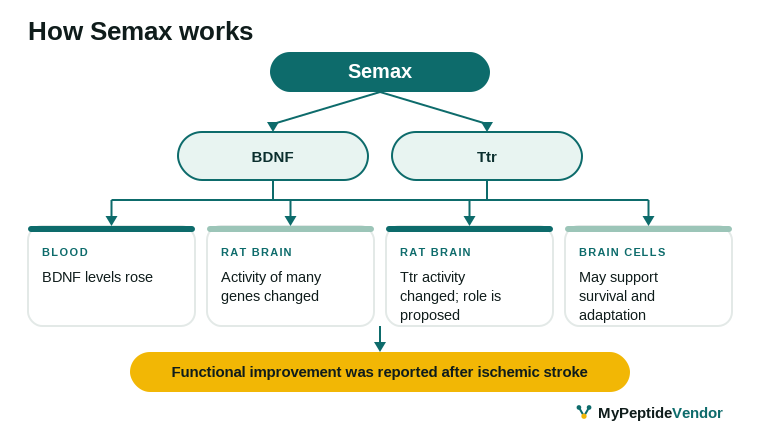
The distinction between a measured marker and a patient benefit matters. In the stroke study, plasma BDNF increased with Semax, and the authors also reported functional improvement. The report did not give numerical score changes, so the size of the functional difference cannot be calculated from its results 7.
Evidence outside stroke is much thinner. A 2026 review describes non-approved peptides as having limited clinical evidence and lacking long-term safety data; it does not establish Semax as a treatment for healthy aging or everyday cognitive enhancement 4. Another 2026 review discusses neuroactive peptides and states that clinical trials are lacking in its orthopaedic context 2.
Russian clinical use is not the same as a large, independently replicated trial record. The cited human evidence does not show whether findings from people recovering from stroke apply to healthy adults who want help with concentration or memory 247.
How does it work?
In plain terms, researchers are asking whether Semax changes signals that help brain cells survive and adapt. One candidate is brain-derived neurotrophic factor (BDNF), a protein linked to nerve-cell health and plasticity. In the post-stroke study, plasma BDNF rose in people receiving Semax, but a change in a blood marker does not prove better thinking in people without stroke 7.
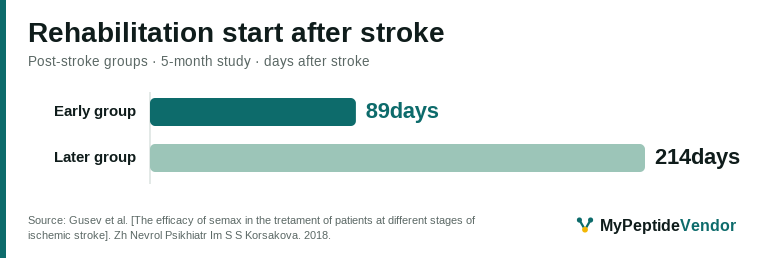
The BDNF rise was reported regardless of rehabilitation timing. The early-rehabilitation group began at 89 ± 9 days after stroke; the later group began at 214 ± 22 days. BDNF levels correlated with Barthel Index scores, which measure everyday function, but the report did not provide a numerical score change attributable to Semax 7.
Animal findings suggest that Semax may affect more than one biological pathway. A review of rat focal-ischemia research describes changes in the activity of many genes, including Ttr 6. The same review discusses transthyretin (Ttr) as a possible mediator of neuroprotection; this is a proposed explanation, not an established mechanism in people 6.
Peptides face general delivery problems: enzymes can break them down, and the blood-brain barrier can limit access to brain tissue. Those challenges are recognized for peptide-based approaches, but they do not tell us how much Semax reaches the human brain after a particular dose or route 9. The clinical report gives a daily amount but does not identify its administration route 7.
A 2008 review also describes Semax as an antistress factor that may increase resistance to emotional stress. It does not provide a Semax treatment trial with a patient count, duration, or numerical outcome 5. Dopamine and serotonin effects are not established by the human findings described here; the demonstrated mechanism remains uncertain 67.
Use this chart
Free to reuse with a link back:
What the clinical evidence actually shows

The most detailed human report is Gusev and colleagues’ 2018 study of 110 people after ischemic stroke: 43 men and 67 women, with a mean age of 58.0 ± 9.7 years. Participants were followed for 5 months, with groups receiving or not receiving Semax alongside rehabilitation 7.
Rehabilitation began at an average of 89 ± 9 days in the early group and 214 ± 22 days in the later group. The Semax regimen was 6,000 mcg per day for 10 days, followed by a second 10-day course after a 20-day break. The report does not give subgroup sizes, a placebo design, or numerical treatment-effect sizes 7.
Semax was associated with increased plasma BDNF regardless of rehabilitation timing; the report says levels remained high during the study. The authors also reported faster functional improvement and better final Barthel Index scores with Semax. Because they did not give the score changes or percentage improvement, readers cannot tell how large the difference was or what it meant for an individual patient 7.
The study reported a positive relationship between BDNF and Barthel scores. In groups not receiving Semax, higher BDNF was associated with earlier rehabilitation; the relationship between BDNF and Barthel scores also varied with rehabilitation timing. These associations do not show that BDNF itself caused recovery 7.
In animal research, Semax changed the activity of many genes in rat brain under focal ischemia. Vyunova and colleagues highlighted Ttr and proposed that transthyretin might help mediate neuroprotection. The idea is based on animal research and remains a hypothesis, rather than a confirmed pathway in humans 6.
Sudakov and colleagues’ 2008 review described Semax as an antistress factor that may increase resistance to emotional stress. It did not report a treatment trial with a patient count, study duration, or measured effect size 5. Reviews published in 2026 discuss possible neuroprotective applications of Semax and broader evidence gaps for non-approved peptides, including limited clinical evidence and missing long-term safety data 24.
No ADHD treatment trial is reported in the cited evidence. The post-stroke results also do not establish that Semax improves focus or memory in healthy adults; those are separate questions that require direct clinical testing 247.
Gusev’s 2018 study included 110 stroke patients followed for 5 months; the other claims below come from animal research, reviews, or an absence of reported clinical testing 24567.
| Claim | Study type and scale | What the evidence supports |
|---|---|---|
| Stroke recovery | Human report; 110 patients; 5 months | Reported functional improvement, without numerical effect size |
| BDNF increase | Blood marker measured in the post-stroke study | Human observation; not proof of cognitive benefit outside stroke |
| Neuroprotection | Rat ischemia research and a proposed Ttr pathway | Preclinical, hypothesis-generating evidence |
| Focus in healthy adults | No healthy-adult clinical result established | Benefit remains unproven |
| ADHD | No ADHD treatment trial reported | Effectiveness and safety remain unestablished |
Use this chart
Free to reuse with a link back:
Typical dosing

There is no FDA-approved Semax label that provides a US product dose; the cited 2018 report offers a study regimen, not a general dosing recommendation 7. Its schedule was 6,000 mcg per day for 10 days, repeated for 2 courses with a 20-day interval 7.
That regimen was studied alongside rehabilitation after ischemic stroke. It does not establish a suitable amount or schedule for healthy adults, people with ADHD, or other conditions. Nor does it show that a different formulation delivers the same exposure 7.
The clinical report does not name the administration route. It therefore cannot establish whether intranasal or subcutaneous dosing was used, how either route compares with the study regimen, or whether one route can be converted to another by a simple dose calculation 7.
The post-stroke schedule is the only numeric human regimen described in the cited clinical report; it should not be treated as equivalent to an unverified clinic or compounded schedule 7.
| Setting | Reported amount | How to interpret it |
|---|---|---|
| Post-stroke study | 6,000 mcg/day for 10 days; 2 courses; 20-day interval | One study protocol, not a general prescribing recommendation |
| Clinic or compounded product | No verified standard range in the cited evidence | Route, concentration, and exposure cannot be assumed to match the study |
Use this chart
Free to reuse with a link back:
Side effects: what to actually expect
The human post-stroke report does not provide Semax-specific adverse-event percentages, a detailed side-effect table, or the number of participants who stopped treatment because of an adverse event 7. It does not support a percentage estimate for nasal irritation, headache, sleep changes, or another individual effect.
Missing event rates do not mean there were no risks. A 2026 review describes long-term safety data as lacking for non-approved peptides, and systematic validation remains limited 4. The cited clinical report does not establish which Semax effects are most common, whether risk differs by route, or how risk changes with repeated courses 47.
Who should not take Semax? The cited clinical and review reports do not provide a Semax-specific contraindication list or name groups with established safety exclusions 47. Pregnancy, nursing, age, health conditions, allergies, and current medicines are reasonable topics to review with a licensed clinician. This is a general caution checklist, not a confirmed list of Semax contraindications.
Before considering a product sold as Semax, ask a clinician to review its identity, concentration, intended route, and source. The study regimen was used in a defined post-stroke setting; it does not establish the safety or quality of products obtained from unverified sellers 7.
Regulatory & access status in the US (as of 2026)
Semax is not FDA-approved in the United States. Russian clinical literature describes Semax use in ischemic-stroke treatment, including a study of patients receiving rehabilitation, but that clinical report is not itself a regulatory approval document 67.
The FDA maintains a category for bulk drug substances nominated for compounding that may present significant safety risks. The FDA page’s displayed information does not confirm Semax’s listing or establish that Semax is eligible for compounding under sections 503A or 503B 1. A category review is also not the same as FDA approval of a finished medicine 1.
No FDA-approved Semax product or confirmed US retail pathway is established by the cited regulatory information 14. If a pharmacy or seller claims it can provide Semax, verify the current FDA bulk-substance information and applicable state requirements rather than relying on the claim alone. FDA compounding information can change, so check the current listing before making an access decision 1.
“Research use only” labeling does not establish that a product is authorized for human treatment. The clinical report’s treatment regimen also says nothing about the identity, sterility, or quality of products sold outside the study setting 7.
Research-grade Semax is available from American Peptides (SEMAX, from $65.00); code MYPEPTIDEVENDOR takes 15% off. Sold for laboratory research only, not for human use. Affiliate link
How it compares with its closest alternative
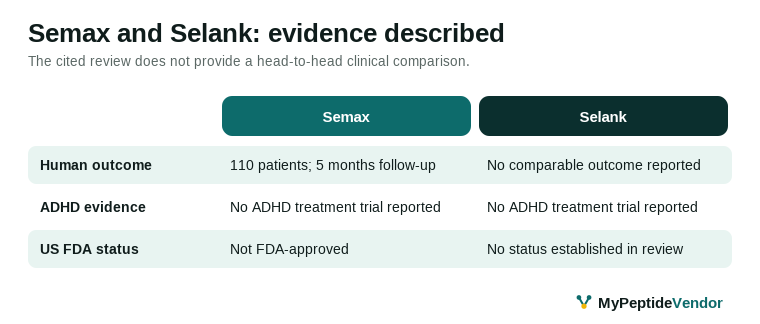
Selank is a practical comparison because a 2026 review groups it with Semax among neuroactive peptides. That review does not provide a head-to-head clinical comparison, matched dose data, or evidence that one is better for focus 2.
The 110-patient stroke finding applies to Semax and cannot establish that it is superior to Selank for a different goal, such as attention 27.
| Feature | Semax | Selank |
|---|---|---|
| Human outcome described | Post-stroke report with 110 patients and 5 months of follow-up | No comparable patient count or clinical outcome reported in the cited review |
| Research discussed | BDNF, stroke recovery, and possible neuroprotection | Identified as a neuroactive peptide; no specific clinical outcome established here |
| ADHD evidence | No ADHD treatment trial reported | No ADHD treatment trial reported |
| US FDA status | Not FDA-approved | No FDA-approved status established in the cited review |
For either peptide, the cited evidence does not establish effectiveness or comparative safety for focus in people without stroke 247.
Use this chart
Free to reuse with a link back:
Where to Buy Semax for Research
American Peptides
SEMAX · from $65.00
US-made research peptides, every lot third-party tested with a lot-matched COA.
15% offMYPEPTIDEVENDOR at checkout
- ≥99% purity verified by HPLC + mass spec, endotoxin tested
- Ships tracked from Louisiana, free shipping over $300
- 15% off your first order with code MYPEPTIDEVENDOR
Certified-Pep
US-made research peptides with batch-specific lab reports (COA) and a QR code on every vial.
- Independent laboratory testing (Vanguard Laboratory)
- Made in the USA, ships in 1-2 business days
- Research use only, not for human or veterinary use
Affiliate disclosure: we may earn a commission if you order through the link above. Semax is not approved by the FDA for human use.
Frequently asked questions
What is Semax peptide good for?
Its clearest human research is in rehabilitation after ischemic stroke, not routine cognitive enhancement 7. A 2008 review also discusses Semax in relation to emotional-stress resistance, but gives no measured treatment result 5.
Who should not take Semax?
There is no established Semax-specific list of people who must avoid it in the cited reports 47. Anyone considering it should first discuss pregnancy or nursing, age, health conditions, allergies, and current medicines with a clinician; these are general safety questions, not confirmed exclusions.
References
- FDA: Certain bulk drug substances for use in compounding that may present significant safety risks
- Rahman et al. Therapeutic Peptides in Orthopaedics: Applications, Challenges, and Future Directions. J Am Acad Orthop Surg Glob Res Rev. 2026.
- Tarasov et al. Pharmacological Aspects of Neuro-Immune Interactions. Curr Pharm Des. 2018.
- Mavrych et al. Therapeutic peptides in gerontology: mechanisms and applications for healthy aging. Front Aging. 2026.
- Sudakov et al. [Evolution of the stress concept]. Vestn Ross Akad Med Nauk. 2008.
- Vyunova et al. [POSSIBLE ROLE OF TRANSTHYRETIN IN THE BIOLOGICAL MECHANISM OF THE REGULATORY PEPTIDE NEUROPROTECTION.]. Mol Gen Mikrobiol Virusol. 2016.
- Gusev et al. [The efficacy of semax in the tretament of patients at different stages of ischemic stroke]. Zh Nevrol Psikhiatr Im S S Korsakova. 2018.
- Willis et al. Synthetic Peptides in Pharmacy Compounding: Analysis of PCAC Recommendations and Industry Safety Standards. Int J Pharm Compd. 2026.
- Giri et al. Modulation of neuropathological pathways by bioactive peptides and proteins/polypeptides: Targeting oxidative stress in neurodegenerative diseases. Neuropeptides. 2025.
Written by the MyPeptideVendor editorial team from the FDA label, peer-reviewed studies and ClinicalTrials.gov records listed above, fact-checked line by line and reviewed 2026-11-12.
Cite this page
MyPeptideVendor Editorial Team. Semax: Evidence, Dosing & US Status. MyPeptideVendor. Updated November 12, 2026. https://mypeptidevendor.com/peptides/semax/MyPeptideVendor Editorial Team. (2026, November 12). Semax: Evidence, Dosing & US Status. MyPeptideVendor. https://mypeptidevendor.com/peptides/semax/Related peptides
Selank
Not approvedSelank has been studied for anxiety, but small trials leave its dose, side-effect rates, and long-term safety uncertain.
Learn moreCerebrolysin
Not approvedCerebrolysin is an injectable brain-derived mixture used in some countries, but its benefits remain uncertain and it is not FDA-approved in the United States.
Learn morePinealon
Research UsePinealon is a short peptide studied for brain and circadian effects, but human evidence does not establish a dose, benefit, or safety profile.
Learn more