Tirzepatide: Dosage, Benefits & FDA Status
Dual GIP/GLP-1 receptor agonist
Brand names: Mounjaro and Zepbound
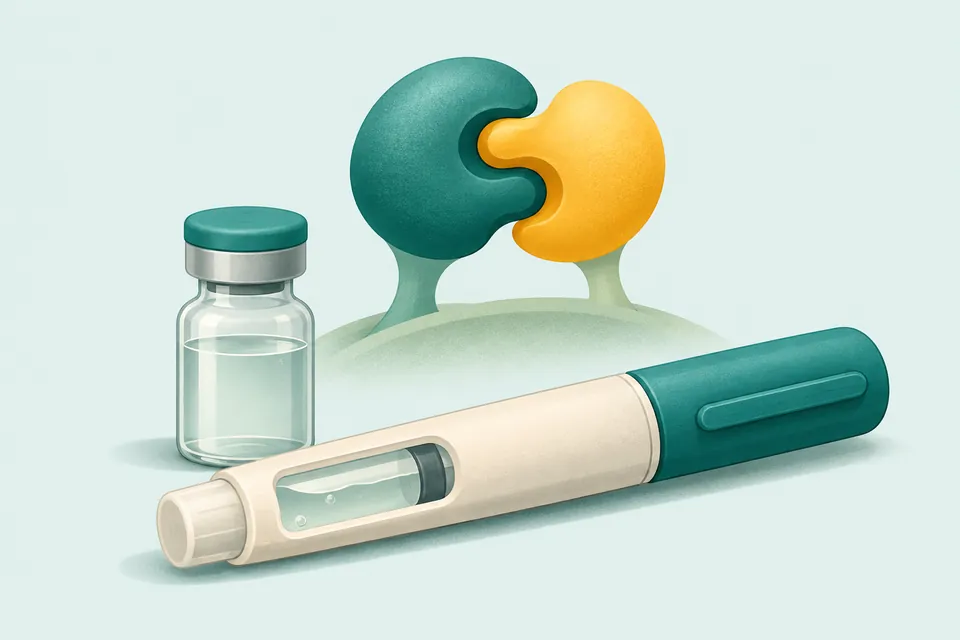
Tirzepatide is a prescription medicine that activates two hormone receptors, GIP and GLP-1, to help lower blood sugar and reduce appetite 1. It is marketed under the names Mounjaro and Zepbound; Zepbound is labeled for chronic weight management and moderate-to-severe obstructive sleep apnea in adults with obesity 1.
Zepbound is injected under the skin once a week, starting at 2.5 mg for 4 weeks before dose increases 1. Trials show meaningful average weight loss, but nausea and other digestive effects are common, and participants who stopped treatment in SURMOUNT-4 regained weight on average 1,11.
Key takeaways
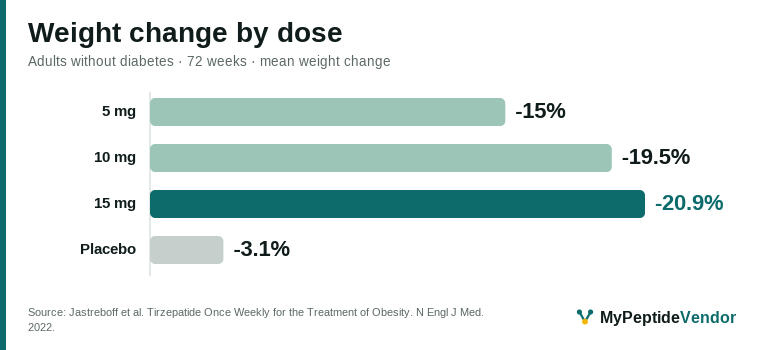
- In SURMOUNT-1, average weight change at 72 weeks ranged from -15.0% with 5 mg to -20.9% with 15 mg weekly 6.
- The Zepbound label starts at 2.5 mg once weekly for 4 weeks; that dose is for treatment initiation, not maintenance 1.
- Nausea occurred in 25% to 29% of Zepbound-treated participants in pooled weight trials, compared with 8% on placebo 1.
- In SURMOUNT-4, participants switched to placebo regained an average 14.0% of body weight over 52 weeks, while those continuing treatment lost a further 5.5% 11.
- Tirzepatide carries a boxed warning about thyroid C-cell tumors seen in rats; whether this risk applies to people is unknown 1.
Tirzepatide at a glance
- Class
- Dual GIP and GLP-1 receptor agonist
- Mechanism
- Activates GIP and GLP-1 receptors; affects appetite, calorie intake, stomach emptying, insulin release, and glucagon
- FDA Status
- Zepbound is FDA-approved for chronic weight management and moderate-to-severe obstructive sleep apnea with obesity
- Brand names
- Mounjaro and Zepbound
- Administration
- Subcutaneous injection once weekly
- Typical Dose
- Zepbound starts at 2.5 mg weekly for 4 weeks, then increases by 2.5 mg no more often than every 4 weeks
- Half-life
- About 5 to 6 days
- Primary Uses
- Type 2 diabetes, chronic weight management, and moderate-to-severe obstructive sleep apnea with obesity
What is it?

Tirzepatide is a prescription peptide medicine that activates two receptors: glucose-dependent insulinotropic polypeptide (GIP) and glucagon-like peptide-1 (GLP-1) 1. A receptor is a cell’s receiving point for a signal. Tirzepatide acts like both gut hormones at those receiving points, so it is called a dual agonist 1.
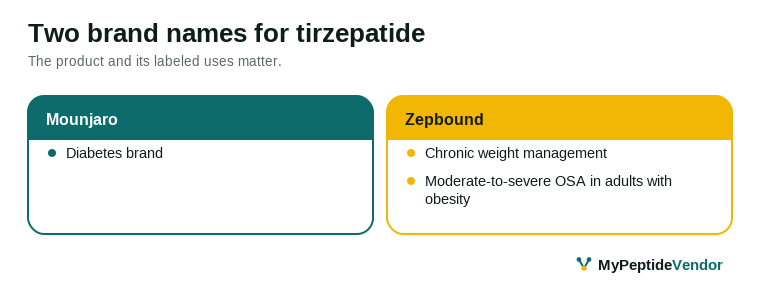
The active medicine is marketed under the names Mounjaro and Zepbound. Mounjaro is the diabetes brand; Zepbound is labeled for chronic weight management and for moderate-to-severe obstructive sleep apnea (OSA) in adults with obesity 1. The product and indication matter: Zepbound’s label says not to use it with another tirzepatide-containing product or another GLP-1 receptor agonist 1.
Tirzepatide is not insulin and does not replace insulin when insulin is needed. Its effect on insulin release depends partly on blood glucose levels, but combining it with insulin or a sulfonylurea can still raise the chance of low blood sugar 1.
Use this chart
Free to reuse with a link back:
What makes it different
Many familiar medicines in this treatment family activate the GLP-1 receptor. Tirzepatide activates both the GIP and GLP-1 receptors 1. That is the main pharmacologic difference; it does not mean every person will lose more weight or have fewer side effects on tirzepatide.
In a network meta-analysis of 28 randomized trials involving 23,622 adults with type 2 diabetes, tirzepatide 15 mg had the largest estimated HbA1c reduction versus placebo: 1.96 percentage points 5. Tirzepatide doses of 5 mg, 10 mg, and 15 mg also had greater estimated weight reduction than semaglutide doses of 0.5 mg, 1 mg, and 2 mg, respectively 5. These comparisons combine results across trials; they are not a direct head-to-head trial of every dose.
Zepbound has labeled uses for chronic weight management and moderate-to-severe OSA in adults with obesity 1. Tirzepatide is also marketed as Mounjaro for type 2 diabetes. Approval for one product or condition should not be taken to mean every brand, dose, or use has the same label.
For OSA, tirzepatide has been studied both in adults not using positive airway pressure (PAP) at baseline and in adults already using PAP 7. The trials do not establish that every patient can stop PAP or other sleep-apnea care after starting tirzepatide; treatment decisions belong with the sleep clinician 7.
How does it work?
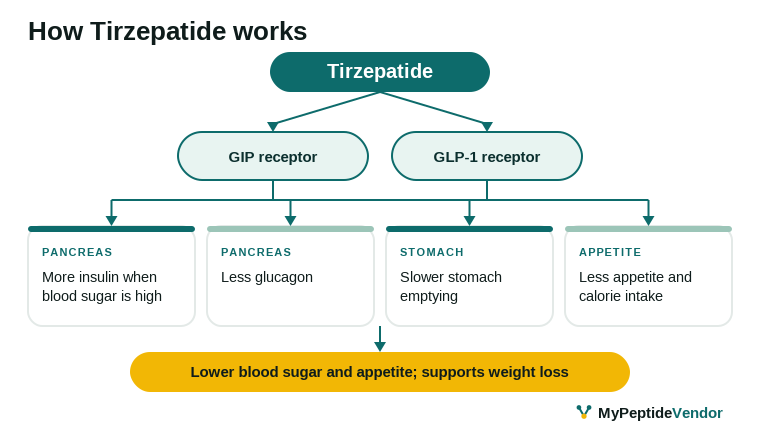
In plain terms, tirzepatide can reduce appetite and calorie intake, slow how quickly the stomach empties, and help the body lower blood glucose 1. These effects can support weight loss and improve glucose control, but the amount of change varies from person to person 1,6.
More technically, tirzepatide activates GIP and GLP-1 receptors. It increases insulin release when glucose is high and reduces glucagon, a hormone that raises blood glucose 1. It also improved insulin sensitivity in a study after 28 weeks of treatment 1. Insulin release is glucose-dependent, but that does not eliminate the risk of hypoglycemia, especially when tirzepatide is combined with insulin or a sulfonylurea 1.
Tirzepatide slows stomach emptying. This effect is strongest after the first dose and becomes smaller with continued dosing 1. Slower emptying can change the absorption of some pills. The label advises monitoring certain oral medicines with a narrow therapeutic range, such as warfarin, and taking extra contraceptive precautions with oral hormonal birth control 1.
A fatty-acid component helps tirzepatide bind to albumin, a protein in blood, and stay in the body longer 1. Its half-life is about 5 to 6 days, which supports once-weekly injections 1.
Use this chart
Free to reuse with a link back:
What the clinical evidence actually shows: and what we don't know yet

Weight loss in SURMOUNT-1
SURMOUNT-1 was a phase 3 trial of 2,539 adults with obesity, or overweight plus a weight-related condition, who did not have diabetes 6. Participants received weekly tirzepatide at 5 mg, 10 mg, or 15 mg, or placebo, for 72 weeks. The study included a dose-escalation period of up to 20 weeks, plus lifestyle counseling 6. Average starting weight was 104.8 kg, or about 231 lb 6.
At week 72, mean weight change was -15.0% with 5 mg, -19.5% with 10 mg, and -20.9% with 15 mg, compared with -3.1% with placebo 6. At the trial’s average starting weight of about 231 lb, a 20.9% reduction works out to roughly 48 lb; this is a translation of the group average, not an individual forecast 6. At least 5% weight loss occurred in 85% to 91% of participants taking tirzepatide, compared with 35% on placebo 6.
A 20-lb loss is about 8.6% of the 231-lb average starting weight in SURMOUNT-1 6. The report gives average weight changes at week 72 but does not report the percentage of participants who had reached exactly 20 lb of loss at each earlier week 6. There is no reliable trial-based week to promise for reaching that threshold. Starting weight, dose, tolerability, and individual response all affect the timeline.
Longer-term weight and diabetes risk
A 3-year analysis of SURMOUNT-1 focused on 1,032 participants who had obesity and prediabetes 8. Participants received their assigned dose or placebo for 176 weeks, followed by 17 weeks off treatment 8. At week 176, mean weight change was -12.3% with 5 mg, -18.7% with 10 mg, and -19.7% with 15 mg, compared with -1.3% with placebo 8. These results are from the subgroup with prediabetes, not a separate estimate for every person with obesity.
During the 176-week treatment period, type 2 diabetes was diagnosed in 1.3% of participants assigned tirzepatide and 13.3% assigned placebo 8. After the 17-week off-treatment period, the corresponding proportions were 2.4% and 13.7% 8. The study supports continued benefit during treatment; it does not show that weight or diabetes-risk benefits last indefinitely after stopping 8.
What happens after stopping: SURMOUNT-4
SURMOUNT-4 had a 36-week open-label lead-in followed by a 52-week randomized period 11. The 783 adults entering the lead-in received a maximum tolerated weekly dose of 10 mg or 15 mg; 670 who completed the lead-in were then assigned to continue tirzepatide or switch to placebo 11. Participants lost a mean 20.9% during the lead-in 11.
From week 36 to week 88, participants switched to placebo regained an average 14.0% of body weight, while those who continued tirzepatide lost another 5.5% 11. Across the full 88 weeks, average weight change was -9.9% in the placebo-switch group and -25.3% in the continued-treatment group 11. This trial shows that stopping was followed by substantial regain on average; it cannot predict exactly how much one person will regain 11.
Blood sugar and semaglutide comparisons
A network meta-analysis of 28 randomized trials and 23,622 adults with type 2 diabetes estimated HbA1c reductions versus placebo of 1.60 percentage points with tirzepatide 5 mg, 1.84 points with 10 mg, and 1.96 points with 15 mg 5. In the analysis, tirzepatide 15 mg had the largest estimated reduction; all three tirzepatide doses were comparable with semaglutide 2 mg for HbA1c, and the analysis found greater estimated weight reduction with tirzepatide at the compared doses 5. Because results were combined across trials, differences in trial populations and study designs matter.
SURPASS-PEDS adds evidence for young people with type 2 diabetes, although it does not establish an FDA-approved pediatric indication 4. This phase 3 trial enrolled 99 participants aged 10 to under 18 and followed the double-blind treatment period for 30 weeks 4. Mean HbA1c fell by 2.23 percentage points in the pooled tirzepatide groups and rose by 0.05 points with placebo, an estimated treatment difference of -2.28 points 4. BMI changed by -7.4% with 5 mg and -11.2% with 10 mg, compared with -0.4% with placebo 4.
Sleep apnea: SURMOUNT-OSA
SURMOUNT-OSA included two phase 3 trials lasting 52 weeks: one enrolled adults not using PAP at baseline, and the other enrolled adults already using PAP 7. Average starting apnea-hypopnea index (AHI), which counts breathing pauses and shallow-breathing events per hour of sleep, was 51.5 events per hour in the first trial and 49.5 in the second 7.
At week 52, AHI fell by 25.3 events per hour with tirzepatide and 5.3 with placebo in the first trial, a treatment difference of 20.0 events per hour 7. In the second trial, AHI fell by 29.3 events per hour with tirzepatide and 5.5 with placebo, a treatment difference of 23.8 events per hour 7. Those are group averages; they do not mean OSA resolved for every participant 7.
What is still unknown
It has not been established that tirzepatide prevents heart attacks, strokes, or death. A 2025 review reported that cardiovascular outcome trials were still ongoing and that cardiovascular benefit from dual GIP/GLP-1 receptor activation remained uncertain 10. Changes in weight, blood sugar, blood pressure, or cholesterol-related measures are not the same as proof of fewer cardiovascular events 10.
Muscle changes are another open question. A post-hoc MRI analysis of SURPASS-3 examined thigh muscle volume and muscle fat infiltration at week 52; 296 participants enrolled in the MRI substudy, and 246 had a valid week-52 scan 9. The analysis does not provide a simple estimate of how much muscle a typical person will lose during weight treatment, or which approach best preserves strength for each patient 9.
The best treatment duration, the effects of stopping after several years, and the weight course after a gradual dose reduction have not been established. SURMOUNT-4 measured regain over 52 weeks after a switch to placebo, but it did not test every taper plan or every length of time off treatment 11.
| Trial point | What the study reports | How to read it |
|---|---|---|
| Week 20 | No exact percentage reaching 20 lb is reported. | A precise early milestone cannot be calculated from the reported outcome. |
| Week 36 | SURMOUNT-4 participants completing the lead-in had lost a mean 20.9%. | This was a selected group who completed lead-in treatment at a maximum tolerated dose of 10 mg or 15 mg. |
| Week 72 | SURMOUNT-1 mean loss was 15.0%, 19.5%, and 20.9% at 5 mg, 10 mg, and 15 mg. | At the trial’s 231-lb average starting weight, these equal about 35 lb, 45 lb, and 48 lb, respectively. |
| Week 176 | In participants with prediabetes, mean loss was 12.3%, 18.7%, and 19.7% at 5 mg, 10 mg, and 15 mg. | These longer-term results apply to the prediabetes subgroup. |
Use this chart
Free to reuse with a link back:
Use this chart
Free to reuse with a link back:
Typical dosing

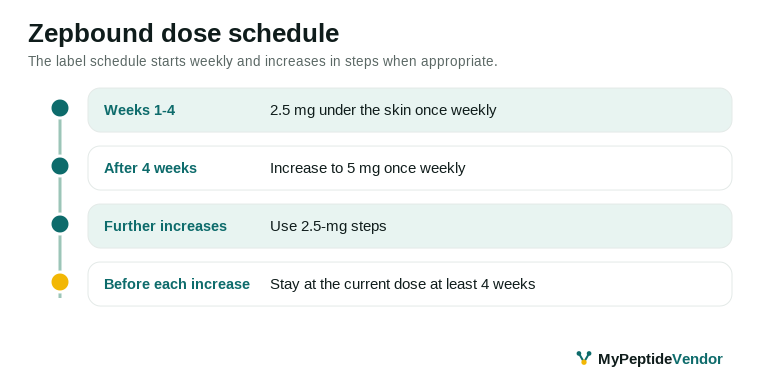
The schedule below is the Zepbound label schedule. The starting dose is 2.5 mg injected under the skin once weekly for 4 weeks 1. After that, the dose increases to 5 mg weekly; further increases are in 2.5-mg steps, with at least 4 weeks at the current dose before each increase 1. The 2.5-mg dose is for starting treatment, not maintenance 1.
| Use | Label maintenance doses | Maximum |
|---|---|---|
| Weight reduction and long-term maintenance | 5 mg, 10 mg, or 15 mg once weekly | 15 mg once weekly |
| Moderate-to-severe obstructive sleep apnea with obesity | 10 mg or 15 mg once weekly | 15 mg once weekly |
| Type 2 diabetes evidence in the meta-analysis | 5 mg, 10 mg, or 15 mg once weekly | The trial comparison included doses through 15 mg weekly |
Dose increases are not automatic. The prescriber considers response and tolerability, and the Zepbound label allows a lower maintenance dose when a higher dose is not tolerated 1. Weight-loss trials used 5 mg, 10 mg, or 15 mg once weekly after dose escalation 6.
Inject into the abdomen or thigh, or have another person inject into the back of the upper arm; rotate injection sites 1. The injection can be given at any time of day, with or without meals 1. Follow the instructions for the specific pen or vial supplied, and never share a KwikPen with another person, even if the needle is changed 1.
Missed dose
If a dose is missed, inject it as soon as possible within 4 days (96 hours) of the scheduled dose 1. If more than 4 days have passed, skip that dose and take the next dose on the regular day 1. A weekly injection day may be changed if at least 3 days (72 hours) separate the doses 1. Do not take an extra dose to make up for a missed one.
Storage and disposal
Keep unopened single-dose pens and vials refrigerated at 36°F to 46°F. They can be stored at room temperature up to 86°F for a total of 21 days; discard them after that room-temperature period 1. Do not freeze the medicine, and protect it from heat and light 1.
For an opened multi-dose vial or KwikPen, the label says to discard it after 30 days from first use, after 30 days at room temperature, or after 4 weekly doses, as applicable, even if medicine remains 1. Use a new needle and syringe for each vial dose, and follow the device instructions for disposal 1.
Use this chart
Free to reuse with a link back:
Side effects: what to actually expect
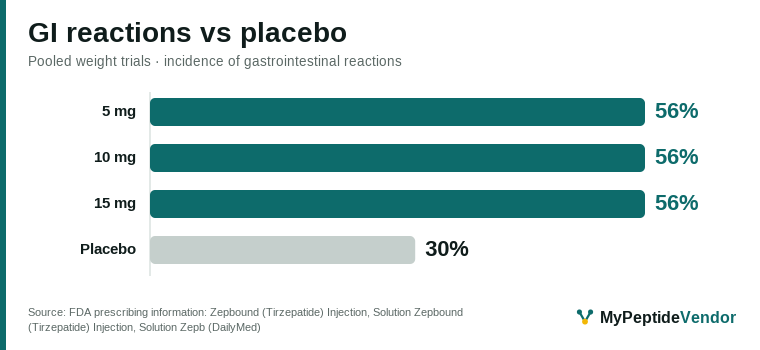
Digestive symptoms are the most common trade-off. In pooled weight trials, gastrointestinal reactions occurred in 56% of participants at each of the 5-mg, 10-mg, and 15-mg doses, compared with 30% on placebo 1. Nausea, vomiting, and diarrhea were most likely during dose escalation and generally decreased over time 1. Some symptoms can still be severe or persistent.
| Effect | Tirzepatide groups | Placebo | What to watch for |
|---|---|---|---|
| Nausea | 25% to 29% | 8% | Often occurs during dose increases; call the prescriber for severe or persistent symptoms. |
| Diarrhea | 19% to 23% | 8% | Ongoing diarrhea can cause dehydration. |
| Vomiting | 8% to 13% | 2% | Get medical advice if fluids will not stay down. |
| Constipation | 11% to 17% | 5% | Report severe or persistent symptoms. |
| Abdominal pain | 9% to 10% | 5% | Severe, lasting pain (especially pain that reaches the back) needs urgent assessment. |
| Hair loss | 4% to 5% by dose; reported more often in women | 1% | Hair loss was associated with weight reduction in the trials. |
| Injection-site reactions | 6% to 8% | 2% | Rotate sites and seek help for signs of a serious allergy. |
Across the pooled weight trials, 4.8% to 6.7% of participants stopped treatment because of adverse reactions, compared with 3.4% on placebo 1. Digestive symptoms were the main reason, and many people who stopped did so during the first months of treatment 1.
Less common problems that need attention
Gallstones were reported in 1.1% of tirzepatide-treated participants and 1.0% of placebo participants; gallbladder inflammation occurred in 0.7% and 0.2%, respectively 1. These events were associated with weight reduction 1. New or worsening upper-right abdominal pain, fever, or yellowing of the skin or eyes warrants prompt medical advice.
Acute pancreatitis was confirmed in 0.2% of participants in the pooled weight trials in both the tirzepatide and placebo groups 1. If severe, persistent abdominal pain develops, especially pain that radiates to the back, stop the medicine and seek medical advice; nausea or vomiting may or may not occur 1.
Low blood sugar becomes more likely when tirzepatide is used with insulin or a sulfonylurea. In a trial of people with type 2 diabetes and overweight or obesity, glucose below 54 mg/dL occurred in 4.2% of participants taking tirzepatide and 1.3% taking placebo 1. Among tirzepatide-treated participants, the rate was 10.3% with a sulfonylurea and 2.1% without one 1. A prescriber may need to reduce insulin or sulfonylurea doses 1.
Persistent vomiting or diarrhea can cause dehydration and, in some cases, kidney injury 1. Get medical advice for ongoing inability to drink, reduced urination, faintness, or worsening weakness. Swelling of the face or throat, trouble breathing, or another sign of a severe allergic reaction needs emergency care 1.
Boxed warning and urgent symptoms
Tirzepatide caused thyroid C-cell tumors in rats; whether it causes these tumors, including medullary thyroid carcinoma (MTC), in people is unknown 1. It is contraindicated for anyone with a personal or family history of MTC or with multiple endocrine neoplasia syndrome type 2 (MEN 2) 1. Report a neck lump, persistent hoarseness, trouble swallowing, or difficulty breathing 1. Routine calcitonin testing or thyroid ultrasound has uncertain value for early detection in people taking Zepbound 1.
Tell the anesthesia or procedure team about tirzepatide before planned surgery or deep sedation. Delayed stomach emptying has been linked to reports of aspiration during anesthesia or deep sedation 1. People with a history of diabetic retinopathy should report vision changes, because rapid improvement in blood glucose can temporarily worsen retinopathy 1.
Regulatory and access status in the US
As of 2026, Zepbound is FDA-approved for chronic weight management in adults with obesity, or overweight plus at least one weight-related condition, and for moderate-to-severe OSA in adults with obesity 1. Tirzepatide is also marketed as Mounjaro for type 2 diabetes. These are prescription medicines.
Insurance coverage is not the same as FDA approval. The amount a patient pays depends on the product, plan, deductible, pharmacy, and eligibility for any current manufacturer savings offer. There is no single normal out-of-pocket price that applies to everyone; ask the insurer and pharmacy for the current cost of the exact product and dose. Savings offers can change, so check their current terms before relying on a quoted discount.
Compounded tirzepatide is not FDA-approved. FDA says compounded GLP-1 medicines do not receive premarket review for safety, effectiveness, or quality, and should be used only when a patient’s medical need cannot be met by an FDA-approved drug 2. FDA has reported concerns including dosing errors, adverse-event reports, shipping or storage problems, and fraudulent labels 2. A lower advertised price does not show that a product is equivalent to an FDA-approved medicine.
Pregnancy changes the risk-benefit balance. Weight loss is not recommended during pregnancy, and the Zepbound label says to stop treatment when pregnancy is recognized 1. Human pregnancy data are insufficient to assess drug-related risks; animal studies found fetal growth effects and abnormalities at some exposures 1.
Tirzepatide can reduce the effectiveness of oral hormonal contraceptives because it delays stomach emptying. The label advises switching to a non-oral method or adding a barrier method for 4 weeks after starting and for 4 weeks after each dose increase 1. The effect on stomach emptying is greatest after the first dose and diminishes over time 1.
For breastfeeding, a single-dose study in 11 lactating adults found tirzepatide undetectable in most milk samples; the total amount detected in the remaining samples was less than 0.02% of the maternal dose 1. Effects on a breastfed infant and on milk production have not been studied adequately 1. Discuss the choice with a clinician who can weigh the mother’s treatment need and the infant’s interests 1.
Zepbound’s safety and effectiveness have not been established in pediatric patients 1. Separately, SURPASS-PEDS found lower HbA1c and BMI in a 30-week trial of 99 participants aged 10 to under 18 with type 2 diabetes; that study is evidence, not an FDA-approved pediatric Zepbound indication 4. In weight-reduction studies, 226 treated participants were 65 or older and 13 were 75 or older, with no overall safety or effectiveness difference seen between older and younger adults 1.
Tirzepatide can affect absorption of oral medicines because it delays stomach emptying. Extra monitoring may be needed for medicines that require a narrow blood concentration range, such as warfarin 1. When treatment starts, the prescriber may consider reducing insulin or a sulfonylurea to lower hypoglycemia risk 1. Tell the care team about all medicines, especially oral contraceptives, insulin, sulfonylureas, and medicines where a small change in blood level matters 1.
For cardiovascular questions, do not assume that improved blood sugar or weight proves prevention of heart attack, stroke, or death. A review reported that tirzepatide cardiovascular outcome trials were ongoing and that cardiovascular benefit remained uncertain 10.
If you and a clinician decide it fits, one option is HumeCare: online GLP-1 weight-loss program with a licensed US provider (US only). Affiliate link
Tirzepatide vs. semaglutide: closest alternative
Semaglutide is a close alternative for adults with type 2 diabetes: the network meta-analysis compared once-weekly subcutaneous semaglutide and tirzepatide at specified maintenance doses 5. Tirzepatide activates both GIP and GLP-1 receptors, while semaglutide is a GLP-1 receptor agonist 1,5. The comparison below concerns diabetes trial doses, not every product or obesity-treatment dose.
| Feature | Tirzepatide | Semaglutide |
|---|---|---|
| Receptor activity | GIP and GLP-1 receptor agonist | GLP-1 receptor agonist |
| HbA1c change versus placebo in the meta-analysis | -1.60% at 5 mg; -1.84% at 10 mg; -1.96% at 15 mg | -1.09% at 0.5 mg; -1.39% at 1 mg; -1.59% at 2 mg |
| Estimated weight change versus placebo in type 2 diabetes trials | About -5.27 kg at 5 mg to -9.57 kg at 15 mg | About -2.52 kg at 0.5 mg to -4.97 kg at 2 mg |
| Overall comparison | Each studied tirzepatide dose had greater estimated weight reduction than the corresponding semaglutide dose in the analysis. | Effects depended on dose and trial population. |
| Injection frequency in the compared trials | Once weekly | Once weekly |
| US brands and uses | Mounjaro for type 2 diabetes; Zepbound for weight management and OSA with obesity | Ozempic is a semaglutide product; the meta-analysis compared semaglutide diabetes doses, not every Ozempic or weight-management use. |
| Cost | Depends on product, insurance, pharmacy, and current savings eligibility. | Depends on product, insurance, pharmacy, and current savings eligibility. |
For adults with type 2 diabetes, the analysis estimated larger average HbA1c and weight effects with tirzepatide at the compared doses 5. That does not make it the better choice for every person. Side effects, other medical conditions, access, cost, and the indication being treated can change the decision. Both medicines increased gastrointestinal adverse events compared with placebo, but the analysis does not establish a simple head-to-head difference in side-effect rates for every dose 5.
Where to Get Tirzepatide Legally
Through your own doctor
The FDA-approved product needs a prescription. Your doctor decides whether it fits your health history and insurance may cover part of the cost.
HumeCare
Online GLP-1 weight-loss program with a licensed US provider.
- Short online assessment reviewed by a licensed provider
- If prescribed, medication ships to your door
- Ongoing support to adjust your plan
Gala
Online GLP-1 program with a licensed US provider.
- Online health questionnaire, reviewed by a licensed provider
- If prescribed, medication is shipped to your door
- Ongoing check-ins to adjust your plan
Affiliate disclosure: we may earn a commission if you sign up through the link above. It never changes what we write.
Ranked in our guides
Frequently asked questions
How long does it take to lose 20 lbs on tirzepatide?
There is no single week when a person should expect to reach 20 lb. In SURMOUNT-1, 20 lb was about 8.6% of the average starting weight of 231 lb, and the report gives average weight change at week 72 rather than the share reaching that target at earlier weeks 6. SURMOUNT-4 participants who completed a 36-week lead-in had lost 20.9% on average, but they were taking a maximum tolerated dose of 10 mg or 15 mg 11.
Which is better, Ozempic or tirzepatide?
It depends on the condition, dose, side effects, coverage, and the specific semaglutide product. In a network analysis of adults with type 2 diabetes, tirzepatide had greater estimated weight reduction than corresponding semaglutide doses, and tirzepatide 15 mg had the largest estimated HbA1c reduction 5. This was an indirect comparison across trials, not proof that tirzepatide is best for every person or every indication.
What are the negative side effects of taking tirzepatide?
Nausea, diarrhea, vomiting, and constipation are common; pooled weight trials reported nausea in 25% to 29% of treated participants and vomiting in 8% to 13% 1. Less common but serious concerns include pancreatitis, gallbladder disease, dehydration-related kidney injury, low blood sugar with insulin or sulfonylureas, and severe allergic reactions 1. Seek urgent care for severe persistent abdominal pain, trouble breathing, or signs of a serious allergic reaction.
How much does tirzepatide normally cost?
There is no single normal out-of-pocket price because cost depends on the brand, dose, insurance coverage, pharmacy, and any current savings offer. Ask the insurer and pharmacy for the current price of the exact product and prescription. FDA warns that compounded versions are not FDA-approved and are not reviewed for safety, effectiveness, or quality before marketing 2.
References
- FDA prescribing information: Zepbound (Tirzepatide) Injection, Solution Zepbound (Tirzepatide) Injection, Solution Zepb (DailyMed)
- FDA: Concerns with unapproved GLP-1 drugs used for weight loss
- FDA: Certain bulk drug substances for use in compounding that may present significant safety risks
- Hannon et al. Efficacy and safety of tirzepatide in children and adolescents with type 2 diabetes (SURPASS-PEDS): a randomised, double-blind, placebo-controlled, phase 3 trial. Lancet. 2025.
- Karagiannis et al. Subcutaneously administered tirzepatide vs semaglutide for adults with type 2 diabetes: a systematic review and network meta-analysis of randomised controlled trials. Diabetologia. 2024.
- Jastreboff et al. Tirzepatide Once Weekly for the Treatment of Obesity. N Engl J Med. 2022.
- Malhotra et al. Tirzepatide for the Treatment of Obstructive Sleep Apnea and Obesity. N Engl J Med. 2024.
- Jastreboff et al. Tirzepatide for Obesity Treatment and Diabetes Prevention. N Engl J Med. 2025.
- Sattar et al. Tirzepatide and muscle composition changes in people with type 2 diabetes (SURPASS-3 MRI): a post-hoc analysis of a randomised, open-label, parallel-group, phase 3 trial. Lancet Diabetes Endocrinol. 2025.
- Sumithran et al. Cardiovascular effects of tirzepatide. J Endocrinol. 2025.
- Aronne et al. Continued Treatment With Tirzepatide for Maintenance of Weight Reduction in Adults With Obesity: The SURMOUNT-4 Randomized Clinical Trial. JAMA. 2024.
- ClinicalTrials.gov: 334 registered studies (search: Tirzepatide)
Written by the MyPeptideVendor editorial team from the FDA label, peer-reviewed studies and ClinicalTrials.gov records listed above, fact-checked line by line and reviewed 2026-11-12.
Cite this page
MyPeptideVendor Editorial Team. Tirzepatide: Dosage, Benefits & FDA Status. MyPeptideVendor. Updated November 12, 2026. https://mypeptidevendor.com/peptides/tirzepatide/MyPeptideVendor Editorial Team. (2026, November 12). Tirzepatide: Dosage, Benefits & FDA Status. MyPeptideVendor. https://mypeptidevendor.com/peptides/tirzepatide/Related peptides
5-Amino-1MQ
Not approved5-Amino-1MQ is a small molecule, not a peptide; its human benefits, dose, side effects, and long-term safety are not established.
Learn moreAdipotide (FTPP)
Not approvedAdipotide is an experimental fat-vessel-targeting peptide with animal findings, kidney concerns, and no established human dose or benefit.
Learn moreAOD-9604
Not approvedAOD-9604 was studied for obesity, but available evidence does not establish meaningful weight loss, a standard dose, or FDA approval.
Learn more