Cagrilintide: Evidence, Dosing & FDA Status
Amylin analogue
Brand names: Cagrilintide; CagriSema is the cagrilintide–semaglutide combination
Cagrilintide is a long-acting amylin analogue studied as a once-weekly injection under the skin for weight management 10. It is not a GLP-1 drug 59. FDA says cagrilintide has not been found safe and effective for any condition, and it cannot be used in compounding under federal law 1.
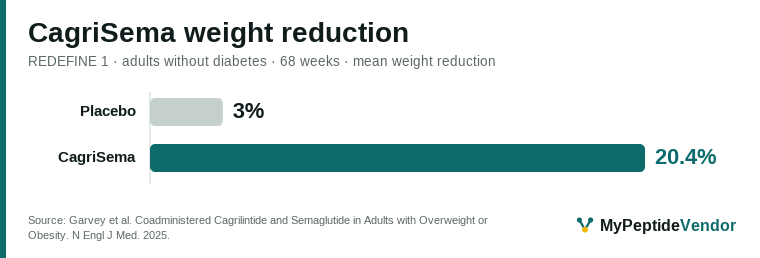
The largest weight-loss results so far are for CagriSema, which combines cagrilintide 2.4 mg with semaglutide 2.4 mg once weekly 4. In a 68-week trial, adults without diabetes lost an average of 20.4% of their starting weight with the combination, compared with 3.0% with placebo 4. That result is for the combination, not cagrilintide alone.
Key takeaways
- In a 26-week phase 2 trial, cagrilintide doses from 0.3 to 4.5 mg weekly produced mean weight reductions of 6.0% to 10.8%, compared with 3.0% with placebo in the trial’s product-estimand analysis 10.
- CagriSema combines cagrilintide 2.4 mg and semaglutide 2.4 mg; in the 68-week REDEFINE 1 trial, mean weight change was -20.4% versus -3.0% with placebo 4.
- In the 68-week REDEFINE 2 trial in adults with type 2 diabetes, CagriSema mean weight change was -13.7% versus -3.4% with placebo 7.
- Gastrointestinal adverse events affected 79.6% of CagriSema participants in REDEFINE 1 and 72.5% in REDEFINE 2 47.
- FDA says cagrilintide cannot be used in compounding under federal law, and the drug has not been found safe and effective for any condition 1.
Cagrilintide at a glance
- Class
- Long-acting amylin analogue
- Mechanism
- Acts through the amylin pathway; it is not a GLP-1 receptor agonist
- FDA Status
- FDA says it has not been found safe and effective for any condition; it cannot be used in compounding
- Brand names
- Cagrilintide; CagriSema is the cagrilintide–semaglutide combination
- Administration
- Once-weekly subcutaneous injection in clinical trials
- Typical Dose
- No approved dose; trials studied 0.3–4.5 mg weekly alone and 2.4 mg weekly in CagriSema
- Half-life
- Long-acting; an exact half-life is not established in the cited trial summaries
- Primary Uses
- Investigational weight management; CagriSema has also been studied in adults with type 2 diabetes
What is it?

Cagrilintide is a lab-made, long-acting version of amylin, a hormone released by pancreatic beta cells alongside insulin after a meal 9. Researchers are studying it as a medicine for weight management, given once weekly by injection under the skin 10. FDA says cagrilintide has not been found safe and effective for any condition, and it cannot be used in compounding under federal law 1.
Amylin is one of the body’s meal signals. It helps slow the movement of food from the stomach, limits the release of glucagon after eating, and sends fullness signals to the brain 9. Glucagon can prompt the liver to release glucose into the blood. Satiety means the feeling of fullness that helps bring a meal to an end.
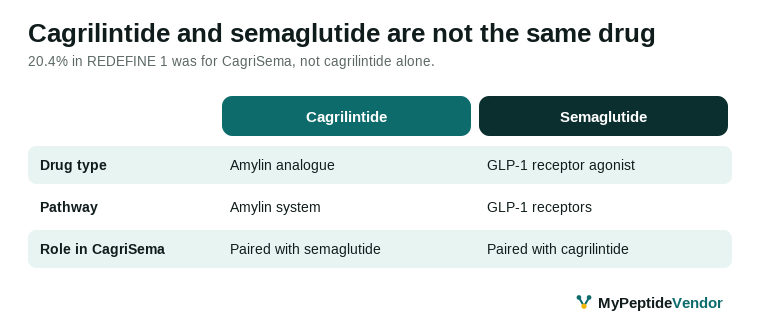
Cagrilintide is not semaglutide, and it is not a GLP-1 receptor agonist. Semaglutide activates GLP-1 receptors; cagrilintide is designed to act through the amylin system 59. That distinction matters when reading results: a weight-loss result for semaglutide or CagriSema does not tell us what cagrilintide alone will do.
CagriSema is the name used for cagrilintide combined with semaglutide. In the phase 3 trials, the combination used 2.4 mg of each medicine once weekly 47. The purpose is to pair amylin-related signals with semaglutide’s GLP-1 pathway, rather than rely on one appetite-control pathway alone 5.
What makes it different
Cagrilintide targets a different hormone system from semaglutide. Semaglutide is a GLP-1 receptor agonist, while cagrilintide is an amylin analogue 59. The difference is not just a new name for the same drug action: the two medicines engage distinct receptor pathways that can both affect appetite and food intake.
Amylin and GLP-1 have some overlapping effects, including changes in appetite and digestion, but they are not interchangeable signals 9. Researchers tested cagrilintide alone and alongside semaglutide to see whether working on both pathways would increase weight loss 410. A stronger combined effect is a research rationale, not proof that every person will respond better.
The combination must be kept separate from the single drug in any comparison. REDEFINE 1 reported 20.4% mean weight loss with CagriSema after 68 weeks, but that group received both cagrilintide and semaglutide 4. It would be inaccurate to describe that 20.4% result as the effect of cagrilintide alone.
A second difference is access. FDA says cagrilintide has not been found safe and effective for any condition and cannot be used in compounding under federal law 1. An online vial or powder sold for “research” is not the same as a regulated prescription product or a clinical trial supply.
Use this chart
Free to reuse with a link back:
How does it work?
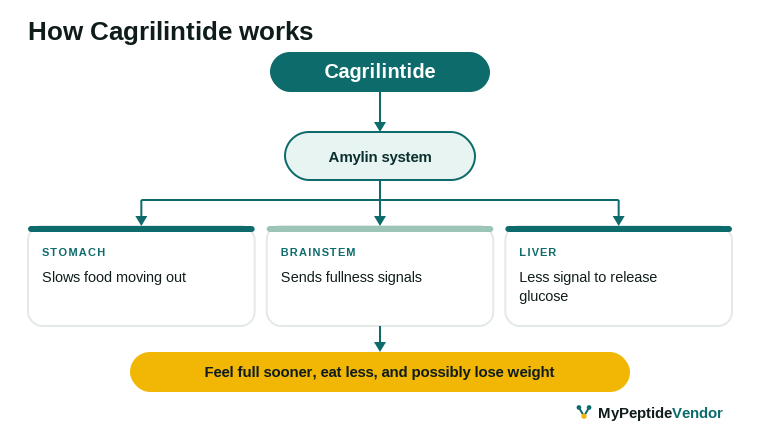
In plain language, cagrilintide is designed to make a person feel full sooner and remain satisfied after eating. It imitates amylin, a hormone that helps signal the brain that food has been eaten 9. If that signal leads someone to eat less over time, body weight may fall; trial averages cannot predict an individual person’s result.
More technically, amylin signals affect stomach emptying, glucagon release and appetite circuits in the brainstem 9. Slower gastric emptying means food moves out of the stomach more gradually. Lower glucagon release after a meal can reduce one of the signals that tells the liver to put glucose into the bloodstream 9.
Semaglutide works at GLP-1 receptors and affects appetite and glucose regulation through that separate pathway 5. CagriSema pairs semaglutide 2.4 mg with cagrilintide 2.4 mg once weekly 47. The aim is complementary activity: GLP-1 and amylin signals may both contribute to appetite reduction, but the combination can also bring more digestive symptoms.
One unanswered question is why cagrilintide alone showed less vomiting than semaglutide or liraglutide in a 2024 meta-analysis 8. That result does not prove that cagrilintide is a better choice for people who cannot tolerate GLP-1 medicines. A registered phase 1 study is examining cagrilintide tolerability in people who stopped or could not tolerate GLP-1 receptor agonists because of gastrointestinal effects; its registration is not a trial result 11.
Use this chart
Free to reuse with a link back:
What the clinical evidence actually shows

The evidence includes a 26-week phase 2 dose-finding trial of cagrilintide alone and 68-week phase 3 trials of CagriSema 4710. The combination trials were much larger and longer than the early cagrilintide-alone study. They also enrolled different populations, so their average weight changes should not be treated as a direct comparison between people with and without diabetes.
Phase 2: cagrilintide alone
Lau and colleagues’ 2021 phase 2 trial randomized 906 adults without diabetes: 706 received one of five cagrilintide doses, 99 received liraglutide, and 101 received placebo 10. Participants had a body-mass index (BMI) of at least 30, or a BMI of at least 27 with hypertension or dyslipidaemia 10. Treatment lasted 26 weeks, followed by 6 weeks without treatment; cagrilintide doses ranged from 0.3 to 4.5 mg once weekly, with dose escalation over as many as 6 weeks 10.
In the trial’s product-estimand analysis, which assumes participants remained adherent to treatment, mean weight reductions across the cagrilintide dose groups ranged from 6.0% to 10.8%, compared with 3.0% with placebo 10. The estimated advantage over placebo ranged from 3.0 to 7.8 percentage points 10. For a person starting at 100 kg, a 6.0% reduction is 6 kg and a 10.8% reduction is 10.8 kg; those are illustrations of the group averages, not a forecast for an individual.
The trial tested 0.3, 0.6, 1.2, 2.4 and 4.5 mg weekly, but the reported headline result gives the 6.0%–10.8% range across those dose groups rather than a separate weight-loss percentage for each dose 10. The result therefore does not establish that one particular dose will produce a specific amount of weight loss for a particular person.
The study also reported permanent treatment discontinuation in 73 participants, or 10%, across treatment groups; 30 participants, or 4%, discontinued mainly because of adverse events 10. Those figures cover the study’s treatment groups, not just cagrilintide, and should not be read as an estimate of what would happen in routine use.
Phase 3: REDEFINE 1, adults without diabetes
REDEFINE 1 was a 68-week phase 3a trial in adults without diabetes who had obesity, or overweight plus at least one obesity-related complication 4. The trial randomized 3,417 people to CagriSema, semaglutide alone, cagrilintide alone or placebo, with lifestyle intervention for every group 4. The groups included 2,108 participants assigned to CagriSema and 705 assigned to placebo; 302 participants were assigned to each single-drug arm 4.
At week 68, estimated mean body-weight change was -20.4% with CagriSema and -3.0% with placebo, a difference of -17.3 percentage points (95% confidence interval -18.1 to -16.6) 4. For a person starting at 100 kg, a 20.4% reduction equals about 20.4 kg. Participants receiving CagriSema were also more likely than placebo participants to reach weight reductions of at least 5%, 20%, 25% and 30%; each comparison had P<0.001 4.
The REDEFINE 1 abstract reports the combination and placebo weight-change results, but not detailed week-68 weight-change results for the semaglutide-alone or cagrilintide-alone arms 4. That leaves an important gap: the headline result does not show exactly how much each single medicine contributed to the combination’s effect or how much extra benefit came from using them together.
Phase 3: REDEFINE 2, adults with type 2 diabetes
REDEFINE 2 enrolled adults with overweight or obesity and type 2 diabetes. Participants had a BMI of at least 27 and an HbA1c of 7% to 10% at entry; HbA1c is a blood test that reflects average glucose over time 7. A total of 1,206 people were randomized, with 904 assigned to CagriSema and 302 to placebo, alongside lifestyle intervention for 68 weeks 7.
At week 68, mean weight change was -13.7% with CagriSema and -3.4% with placebo, a difference of -10.4 percentage points (95% confidence interval -11.2 to -9.5) 7. A 13.7% reduction would equal 13.7 kg for a person starting at 100 kg. The share of participants reaching an HbA1c of 6.5% or less was 73.5% with CagriSema and 15.9% with placebo 7.
The -20.4% result in REDEFINE 1 and -13.7% result in REDEFINE 2 are not a head-to-head test of the same population 47. REDEFINE 1 enrolled people without diabetes, while REDEFINE 2 required type 2 diabetes and an entry HbA1c between 7% and 10% 47. Both trials found greater average weight loss with CagriSema than placebo, but the trials do not establish why the mean reduction differed between them.
What a meta-analysis adds
A 2024 meta-analysis combined results from 3 randomized trials involving 430 participants and assessed outcomes over 20–32 weeks 8. Compared with semaglutide 2.4 mg weekly, CagriSema produced an additional 9.07 percentage points of weight loss (95% confidence interval -11.91 to -6.23) 8. That is a substantial estimated difference, but the analysis showed high variation between studies (I²=96%) and had a much smaller total sample than the phase 3 trials 8.
For cagrilintide alone, the same meta-analysis found no statistically significant difference in percentage weight loss compared with semaglutide or liraglutide: the estimated mean difference was -1.83 percentage points, with P=0.11 8. In plain terms, the pooled data did not establish that cagrilintide alone produced more weight loss than those medicines. The analysis did find significantly less vomiting with cagrilintide than with semaglutide or liraglutide, and significantly more gastrointestinal events and vomiting with CagriSema than with semaglutide alone 8. It does not explain why those differences occurred or show which treatment a specific person would tolerate better.
Trial numbers at a glance
The following results come from different populations, doses and study designs; they are useful for orientation, not as a direct ranking of treatments 47810.
- Phase 2 cagrilintide alone: 906 participants; 26 weeks of treatment; 0.3–4.5 mg weekly; mean reduction of 6.0%–10.8% across cagrilintide groups versus 3.0% with placebo in the product-estimand analysis 10.
- REDEFINE 1, without diabetes: 3,417 participants; 68 weeks; CagriSema mean change of -20.4% versus -3.0% with placebo; estimated difference of -17.3 percentage points 4.
- REDEFINE 2, with type 2 diabetes: 1,206 participants; 68 weeks; CagriSema mean change of -13.7% versus -3.4% with placebo; estimated difference of -10.4 percentage points 7.
- Meta-analysis comparison: Across 3 trials and 430 participants, CagriSema had 9.07 percentage points more weight loss than semaglutide 2.4 mg over 20–32 weeks 8.
What we still do not know
The trials do not establish how long weight loss would be maintained after treatment stops, or whether the 68-week results would continue over several years. They also do not identify a single dose that is best for every patient, since dose response, tolerance and health conditions vary; the phase 2 study tested five weekly cagrilintide doses over 26 weeks 10.
The comparison between people with and without diabetes needs care. REDEFINE 1 enrolled adults without diabetes with obesity or overweight plus a complication, while REDEFINE 2 enrolled adults with type 2 diabetes, BMI of at least 27 and HbA1c of 7%–10% 47. The trials show weight reduction in both groups, but do not explain which population would have the greater response under identical conditions.
It is also not known whether cagrilintide would be a suitable option for people who stopped a GLP-1 drug because of nausea or vomiting. The meta-analysis found less vomiting with cagrilintide alone than with semaglutide or liraglutide, but that comparison does not establish safety or tolerability in people with a documented history of GLP-1 intolerance 8. A phase 1 study is registered to examine tolerability in that group, and its results are not yet provided by the registry entry 11.
The trial entry criteria describe who researchers studied, not who will qualify for a future prescription. REDEFINE 1 used BMI thresholds of at least 30, or at least 27 with an obesity-related complication; REDEFINE 2 required BMI of at least 27 plus type 2 diabetes 47. Any future prescribing criteria would depend on the eventual regulatory decision and product label.
Use this chart
Free to reuse with a link back:
Typical dosing

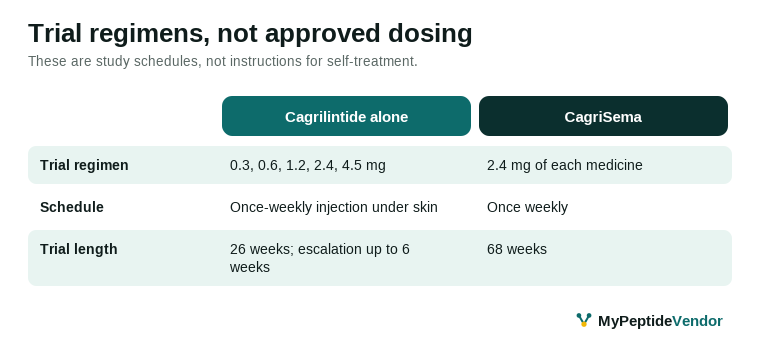
There is no approved cagrilintide dose for routine treatment. The doses below are trial regimens, not instructions for self-treatment. Lau and colleagues studied once-weekly subcutaneous cagrilintide at 0.3, 0.6, 1.2, 2.4 and 4.5 mg, with dose escalation over as many as 6 weeks during a 26-week treatment period 10.
REDEFINE 1 and REDEFINE 2 tested CagriSema with cagrilintide 2.4 mg plus semaglutide 2.4 mg once weekly 47. Each phase 3 trial lasted 68 weeks 47. These research doses do not create an approved dosing schedule or justify combining medicines outside a monitored clinical trial.
Do not use an online dose chart to calculate a personal dose or attempt to assemble CagriSema from separate products. FDA says cagrilintide cannot be used in compounding under federal law 1. A dose-escalation schedule in a trial is designed for that study’s participants and monitoring plan, not for unsupervised use.
Use this chart
Free to reuse with a link back:
Side effects: what to actually expect
Digestive symptoms are the clearest tolerability issue reported in the CagriSema trials. In REDEFINE 1, gastrointestinal adverse events affected 79.6% of participants taking CagriSema and 39.9% taking placebo over 68 weeks 4. Put simply, about 8 in 10 people in the combination group and about 4 in 10 in the placebo group reported at least one gastrointestinal event. Events included nausea, vomiting, diarrhea, constipation and abdominal pain, and were mainly transient and mild to moderate 4.
In REDEFINE 2, gastrointestinal adverse events were reported by 72.5% of participants taking CagriSema and 34.4% taking placebo during 68 weeks 7. Most were described as transient and mild or moderate 7. These percentages are for grouped gastrointestinal events; they are not the separate rates for nausea, vomiting or constipation.
The 2024 meta-analysis found gastrointestinal events and vomiting significantly more often with CagriSema than with semaglutide alone 8. It found vomiting significantly less often with cagrilintide alone than with semaglutide or liraglutide 8. The analysis included 430 people across 3 trials, so its finding does not prove that a person with nausea on a GLP-1 medicine will have fewer symptoms on cagrilintide 8.
The cagrilintide-alone evidence is not large enough to describe every uncommon or long-term safety risk. The phase 2 study followed treatment for 26 weeks and then had a 6-week follow-up without treatment 10. A short study cannot settle what may happen with years of use, and an average symptom rate cannot tell one person whether a drug will be tolerable.
If cagrilintide is studied in a clinical trial, the trial team should explain what symptoms to report and how safety will be monitored. Do not treat a lower vomiting rate in a meta-analysis as proof that cagrilintide is safe for someone with severe digestive disease or a prior serious medicine reaction; that specific conclusion has not been established by the cited trials 810.
Regulatory & access status in the US (as of 2026)
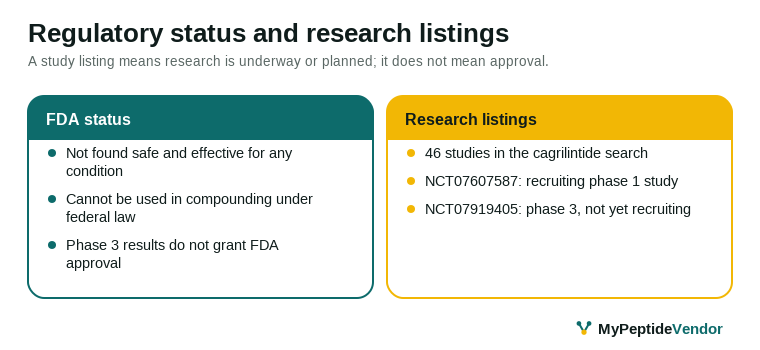
As of 2026, FDA has not found cagrilintide safe and effective for any condition, and it cannot be used in compounding under federal law 1. Investigational status is supported only by the trial registrations and trial publications 471011. CagriSema is also being studied in clinical trials; a phase 3 result does not itself grant FDA approval or make a medicine prescribable 47.
FDA states that cagrilintide cannot be used in compounding under federal law and has not been found safe and effective for any condition 1. Compounded drugs are not FDA-approved, so the agency does not review them for safety, effectiveness or quality before marketing; FDA says they should be used only when a patient’s medical needs cannot be met by an FDA-approved drug 1. That general compounding guidance does not make a compounded cagrilintide product lawful.
ClinicalTrials.gov lists 46 studies in its cagrilintide search, including NCT07607587, a recruiting phase 1 study of cagrilintide tolerability in participants who cannot tolerate GLP-1 medicines because of gastrointestinal adverse events 11. NCT07919405, a phase 3 study of CagriSema and high blood pressure in people with obesity, was listed as not yet recruiting 11. A study listing means research is planned or underway; it does not mean the medicine is approved or available by prescription.
How to avoid unsafe products: Be wary of a seller offering cagrilintide directly to consumers, describing it as “for research purposes” while providing human dosing directions, claiming an unapproved drug is the same as an FDA-approved medicine, or shipping without a prescription and clinician screening 1. FDA warns that unapproved drugs have not undergone its review for safety, effectiveness and quality 1.
- Ask a licensed clinician about FDA-approved options that fit your health history. FDA recommends obtaining a prescription from a doctor and filling it at a state-licensed pharmacy 1.
- Use FDA’s BeSafeRx resources to check online pharmacies. A seller that does not require a prescription or does not make a licensed clinician available for questions is a warning sign 1.
- Do not use a product marked “research use only” or “not for human consumption” as a personal medicine. FDA warns against unapproved drugs sold to consumers with directions for human use 1.
- Do not use a product with damaged packaging, unclear instructions or a questionable pharmacy label; contact a licensed pharmacist or clinician instead 1.
For treatment now, a clinician can discuss medicines with an FDA-approved product and indication rather than trying to source an investigational peptide. FDA recommends talking with a doctor about medicines and using state-licensed pharmacies 1.
Use this chart
Free to reuse with a link back:
Research-grade Cagrilintide is available from Certified-Pep. Sold for laboratory research only, not for human use. Affiliate link
How it compares to its closest alternatives
Weight-loss figures for cagrilintide alone, semaglutide, CagriSema and tirzepatide come from trials in different populations and do not provide a head-to-head ranking 467810.
| Treatment | Mechanism | Trial or evidence period | Weight result | Key side effects | Approval status |
|---|---|---|---|---|---|
| Cagrilintide alone | Amylin analogue; not a GLP-1 agonist | Phase 2; 26 weeks | 6.0%–10.8% mean reduction across 0.3–4.5 mg weekly doses, versus 3.0% with placebo in the product-estimand analysis | Meta-analysis found less vomiting than with semaglutide or liraglutide | Investigational; FDA says it has not been found safe and effective for any condition |
| Semaglutide 2.4 mg | GLP-1 receptor agonist | Weight-management benchmark summarized in a review | About 15%–17% in the review’s summary | Digestive effects are a tolerability concern; the cited comparison does not provide a matched event percentage | Approved medicine; indication depends on the product |
| CagriSema | Cagrilintide plus semaglutide; amylin and GLP-1 pathways | Phase 3a; 68 weeks | -20.4% versus -3.0% with placebo without diabetes; -13.7% versus -3.4% with type 2 diabetes | Gastrointestinal events: 79.6% versus 39.9% with placebo in REDEFINE 1; 72.5% versus 34.4% in REDEFINE 2 | Investigational; clinical trials reported |
| Tirzepatide | Dual GLP-1/GIP receptor agonist | Weight-loss benchmark summarized in a review | Up to 22.5% at the highest doses in the review’s summary | Digestive tolerability is relevant; the cited review benchmark does not provide a matching event percentage | Approved medicine; indication depends on the product |
For a simple scale example, losing 15% of a 100 kg starting weight equals 15 kg, while losing 20% equals 20 kg, a 5 kg difference. This is arithmetic to make percentages easier to picture, not a prediction for any individual.
The most direct pooled comparison in the cited evidence found 9.07 percentage points more weight loss with CagriSema than with semaglutide 2.4 mg over 20–32 weeks, while cagrilintide alone was not significantly different from semaglutide or liraglutide 8. The longer phase 3 trials compared CagriSema with placebo, not with tirzepatide 47.
Review benchmarks place semaglutide at about 15%–17% weight loss and tirzepatide at up to 22.5%, but those figures come from separate evidence and should not be compared as if participants had been randomized in one common trial 6. In practical terms, CagriSema’s phase 3 results are substantial, but a direct comparison against tirzepatide is needed to establish which produces more weight loss in a matched population.
Where to Get Cagrilintide Legally
Through your own doctor
Ask your doctor whether this treatment is appropriate and which licensed pharmacy can supply it.
Certified-Pep
US-made research peptides with batch-specific lab reports (COA) and a QR code on every vial.
- Independent laboratory testing (Vanguard Laboratory)
- Made in the USA, ships in 1-2 business days
- Research use only, not for human or veterinary use
HumeCare
Online GLP-1 weight-loss program with a licensed US provider.
- Short online assessment reviewed by a licensed provider
- If prescribed, medication ships to your door
- Ongoing support to adjust your plan
Affiliate disclosure: we may earn a commission if you sign up through the link above. It never changes what we write.
Ranked in our guides
Frequently asked questions
Is cagrilintide better than semaglutide?
For cagrilintide alone, current pooled evidence does not show a statistically significant weight-loss advantage over semaglutide or liraglutide; the estimated difference was -1.83 percentage points with P=0.11 8. CagriSema did show greater weight loss than semaglutide in a 20–32-week meta-analysis, but that result is for the two-drug combination, not cagrilintide by itself 8.
What is cagrilintide peptide used for?
It is being investigated for weight management, both as a single medicine and with semaglutide 410. CagriSema has also been studied in adults with type 2 diabetes 7. FDA says cagrilintide has not been found safe and effective for any condition 1.
Does cagrilintide really work?
The phase 2 trial supports a weight-loss effect: cagrilintide groups had mean reductions of 6.0%–10.8% over 26 weeks, compared with 3.0% with placebo in the product-estimand analysis 10. That trial result does not establish an approved dose, long-term benefit or the amount any one person would lose.
References
- FDA: Concerns with unapproved GLP-1 drugs used for weight loss
- FDA: Certain bulk drug substances for use in compounding that may present significant safety risks
- Yao et al. Comparative effectiveness of GLP-1 receptor agonists on glycaemic control, body weight, and lipid profile for type 2 diabetes: systematic review and network meta-analysis. BMJ. 2024.
- Garvey et al. Coadministered Cagrilintide and Semaglutide in Adults with Overweight or Obesity. N Engl J Med. 2025.
- Son et al. Novel GLP-1-based Medications for Type 2 Diabetes and Obesity. Endocr Rev. 2026.
- Rubio-Herrera et al. Weight management treatment in obesity. Med Clin (Barc). 2025.
- Davies et al. Cagrilintide-Semaglutide in Adults with Overweight or Obesity and Type 2 Diabetes. N Engl J Med. 2025.
- Dutta et al. Efficacy and Safety of Cagrilintide Alone and in Combination with Semaglutide (Cagrisema) as Anti-Obesity Medications: A Systematic Review and Meta-Analysis. Indian J Endocrinol Metab. 2024.
- Eržen et al. Amylin, Another Important Neuroendocrine Hormone for the Treatment of Diabesity. Int J Mol Sci. 2024.
- Lau et al. Once-weekly cagrilintide for weight management in people with overweight and obesity: a multicentre, randomised, double-blind, placebo-controlled and active-controlled, dose-finding phase 2 trial. Lancet. 2021.
- ClinicalTrials.gov: 46 registered studies (search: Cagrilintide)
Written by the MyPeptideVendor editorial team from the FDA label, peer-reviewed studies and ClinicalTrials.gov records listed above, fact-checked line by line and reviewed 2026-11-12.
Cite this page
MyPeptideVendor Editorial Team. Cagrilintide: Evidence, Dosing & FDA Status. MyPeptideVendor. Updated November 12, 2026. https://mypeptidevendor.com/peptides/cagrilintide/MyPeptideVendor Editorial Team. (2026, November 12). Cagrilintide: Evidence, Dosing & FDA Status. MyPeptideVendor. https://mypeptidevendor.com/peptides/cagrilintide/Related peptides
5-Amino-1MQ
Not approved5-Amino-1MQ is a small molecule, not a peptide; its human benefits, dose, side effects, and long-term safety are not established.
Learn moreAdipotide (FTPP)
Not approvedAdipotide is an experimental fat-vessel-targeting peptide with animal findings, kidney concerns, and no established human dose or benefit.
Learn moreAOD-9604
Not approvedAOD-9604 was studied for obesity, but available evidence does not establish meaningful weight loss, a standard dose, or FDA approval.
Learn more