Cagrilintide Dosage 10mg: Trial Data & Safety
Cagrilintide is not FDA-approved; a 10 mg vial is not a dose, and trial schedules do not establish a safe home-use protocol.
Quickstart Highlights for a 10 mg Vial
There is no FDA-approved cagrilintide dosage for a 10 mg vial. Cagrilintide has been studied as a once-weekly injection, but it is investigational, and FDA says it has not been found safe and effective for any condition and cannot be used in compounding under federal law 1.
The 26-week phase 2 study assigned participants to weekly target-dose groups from 0.3 mg to 4.5 mg and allowed up to 6 weeks for dose escalation 10. Those research details do not create an approved home schedule, mixing recipe, or syringe measurement for an unverified vial.
- No approved dose: FDA has not approved cagrilintide for any condition, and FDA says it has not been found safe and effective for any condition 1.
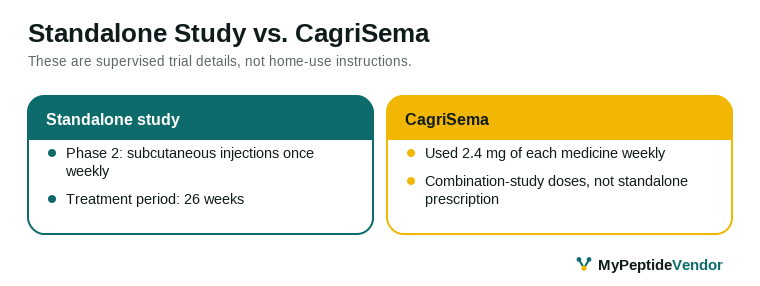
- Trial route and timing: The phase 2 study used subcutaneous injections once weekly for a 26-week treatment period 10. That describes a supervised research study, not a home-use direction.
- Trial doses: The 2021 dose-finding study investigated 0.3 mg, 0.6 mg, 1.2 mg, 2.4 mg, and 4.5 mg weekly target-dose groups 10.
- Escalation detail: The phase 2 study included up to 6 weeks of dose escalation, but the exact dose assigned in each escalation week is not specified in the trial report 10.
- Not the same as CagriSema: Phase 3 CagriSema studies used cagrilintide 2.4 mg plus semaglutide 2.4 mg weekly; those are combination-study doses, not a standalone prescription 46.
- FDA warning: FDA warns consumers not to buy products labeled for research use or not for human consumption when they are sold for human use, because their quality is unknown and they may be harmful 1.
Use this chart
Free to reuse with a link back:
Key takeaways
- Cagrilintide has no FDA-approved human dose or FDA-approved product 1.
- The phase 2 trial studied weekly target-dose groups of 0.3 mg, 0.6 mg, 1.2 mg, 2.4 mg, and 4.5 mg 10.
- The phase 2 trial allowed up to 6 weeks for escalation but does not establish a complete week-by-week ladder in the trial report 10.
- A 10 mg vial does not establish its contents, sterility, concentration, or a safe dose; FDA warns against research-labeled products sold for human use 1.
- Cagrilintide monotherapy study NCT07220759 is listed as Phase 3 and active, not recruiting, not completed 11.
Dosing Schedule: Trial Doses, Not a Home Protocol

The 2021 phase 2 trial was a 26-week dose-finding study. It tested five once-weekly target-dose groups and allowed up to 6 weeks for dose escalation 10. Its report does not supply a complete dose-by-week ladder for each group, so exact weekly steps cannot be filled in without inventing details.
The table lists the study’s reported target-dose groups. The mcg equivalents are unit conversions of the trial doses. No U-100 syringe units are given because no validated concentration or FDA-approved home-use product exists 1.
| Study period or target group | Dose in mg | Dose in mcg | U-100 units | What the study establishes |
|---|---|---|---|---|
| Escalation period | Exact weekly doses not specified | Not specified | Not provided | Escalation lasted up to 6 weeks. |
| Weekly target-dose group | 0.3 mg | 300 mcg | Not provided | One randomized target-dose group. |
| Weekly target-dose group | 0.6 mg | 600 mcg | Not provided | One randomized target-dose group. |
| Weekly target-dose group | 1.2 mg | 1,200 mcg | Not provided | One randomized target-dose group. |
| Weekly target-dose group | 2.4 mg | 2,400 mcg | Not provided | One randomized target-dose group. |
| Weekly target-dose group | 4.5 mg | 4,500 mcg | Not provided | One randomized target-dose group. |
About the often-posted 0.25 mg to 2.4 mg ladder: A 0.25 mg start followed by increases every 4 weeks is not the schedule documented in the 2021 cagrilintide phase 2 trial 10. That trial tested target doses beginning at 0.3 mg, allowed up to 6 weeks of escalation, and does not establish the exact weekly steps. There is no FDA-approved cagrilintide label that specifies a 0.25 mg start or a 2.4 mg maintenance dose 1.
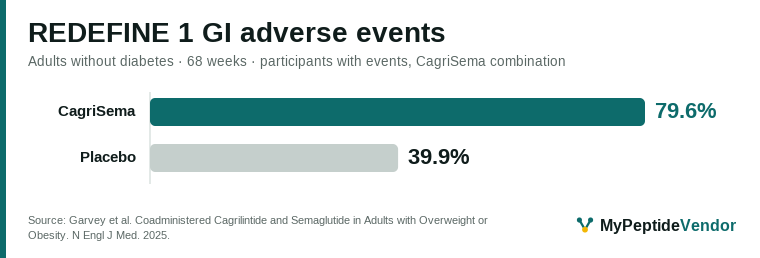
Why dose escalation was included: The study design included gradual escalation while investigators assessed safety and tolerability 10. Gastrointestinal effects are a relevant concern: in the phase 3 combination trial REDEFINE 1, gastrointestinal adverse events affected 79.6% of participants receiving CagriSema and 39.9% receiving placebo 4. Those percentages concern the combination, not standalone cagrilintide, and do not prove a particular escalation schedule prevents symptoms.
Missed or delayed doses: The phase 2 trial report does not address missed, delayed, paused, or restarted doses 10. There is no FDA-approved cagrilintide label with missed-dose directions 1. Do not double a dose or guess when to restart; a clinical-trial participant should contact the study team.
Syringe Unit Conversion Table
Units to draw on a U-100 insulin syringe (100 units = 1 mL) from a 10 mg vial. Find your dose, then read the column for the water you added. Every number is calculated, not estimated.
| Dose | 1 mL water 10 mg/mL · 1 unit = 100 mcg | 2 mL water 5 mg/mL · 1 unit = 50 mcg | 2.5 mL water 4 mg/mL · 1 unit = 40 mcg |
|---|---|---|---|
| 50 mcg | 0.5 · 200 doses | 1 · 200 doses | 1.25 · 200 doses |
| 100 mcg | 1 · 100 doses | 2 · 100 doses | 2.5 · 100 doses |
| 200 mcg | 2 · 50 doses | 4 · 50 doses | 5 · 50 doses |
| 250 mcg | 2.5 · 40 doses | 5 · 40 doses | 6.25 · 40 doses |
| 300 mcg | 3 · 33 doses | 6 · 33 doses | 7.5 · 33 doses |
| 500 mcg | 5 · 20 doses | 10 · 20 doses | 12.5 · 20 doses |
| 750 mcg | 7.5 · 13 doses | 15 · 13 doses | 18.75 · 13 doses |
| 1 mg | 10 · 10 doses | 20 · 10 doses | 25 · 10 doses |
| 1.5 mg | 15 · 6 doses | 30 · 6 doses | 37.5 · 6 doses |
| 1.7 mg | 17 · 5 doses | 34 · 5 doses | 42.5 · 5 doses |
| 2 mg | 20 · 5 doses | 40 · 5 doses | 50 · 5 doses |
| 2.4 mg | 24 · 4 doses | 48 · 4 doses | 60 · 4 doses |
| 2.5 mg | 25 · 4 doses | 50 · 4 doses | 62.5 · 4 doses |
| 3 mg | 30 · 3 doses | 60 · 3 doses | 75 · 3 doses |
| 4 mg | 40 · 2 doses | 80 · 2 doses | 100 · 2 doses |
| 5 mg | 50 · 2 doses | 100 · 2 doses | over 100 |
| 7.5 mg | 75 · 1 doses | over 100 | over 100 |
| 10 mg | 100 · 1 doses | over 100 | over 100 |
Cagrilintide 10 mg Vial Dosage Calculator
Shows the exact insulin-syringe units to draw. Pre-loaded with the 10 mg vial; change any value to match yours.
Total volume of your syringe?
How much mg is in the vial?
How much bacteriostatic water are you adding?
Dose per injection?
Educational tool only. Concentration = vial ÷ water; units = dose ÷ concentration × 100 (U-100 syringe). Confirm every dose with your prescriber. Different vial or peptide? Use the peptide calculator.
Affiliate link · we may earn a commission.
What the Evidence Shows
Use this chart
Free to reuse with a link back:
Use this chart
Free to reuse with a link back:
Reconstitution Steps: No Validated Home Mixing Recipe
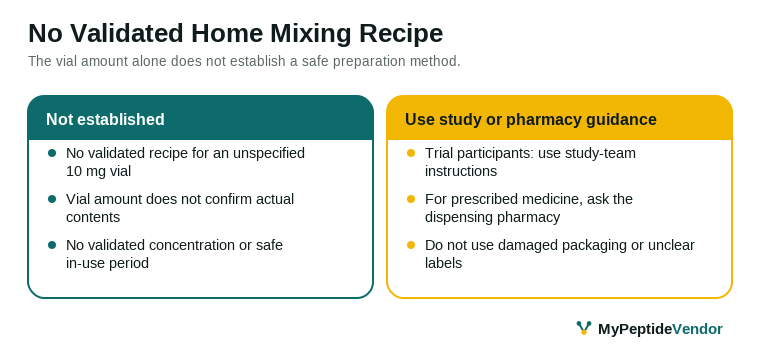
No validated reconstitution instructions are established for an unspecified 10 mg research vial. The vial amount alone cannot confirm the actual contents, sterility, diluent compatibility, final concentration, or safe in-use period. FDA warns that research-labeled products sold directly to consumers for human use may be of unknown quality and harmful 1.
For that reason, this page does not prescribe a volume of bacteriostatic water, a resulting concentration, or a syringe draw. Those details would turn an unapproved, unverified vial into an apparent self-injection protocol. Arithmetic cannot verify a product's identity, concentration, or safety 1.
- Do not prepare a research-labeled vial for self-injection; FDA warns consumers against purchasing these products for human use 1.
- If you are enrolled in a clinical trial, use only the study team’s preparation instructions and supplies; the phase 2 trial was conducted at 57 sites under a controlled research design 10.
- If a clinician has prescribed a legally dispensed medicine, ask the dispensing pharmacy for product-specific preparation instructions rather than using a generic online formula 1.
- If a vial arrives with damaged packaging, unclear instructions, or a questionable label, do not use it; FDA identifies those conditions as consumer warning signs 1.
Use this chart
Free to reuse with a link back:
Supplies Needed for a Full Vial
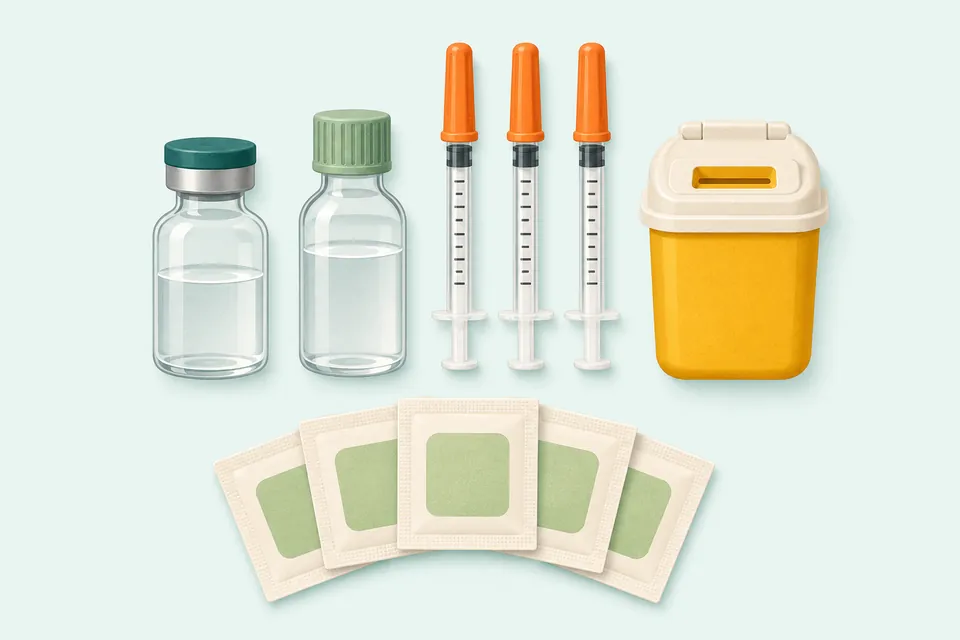
There is no safe home supply list or recommended number of injections for a 10 mg cagrilintide vial. The stated vial amount does not establish how many verified doses it contains, because the actual product identity, concentration, sterility, and intended dose are not confirmed by the words “10 mg.” FDA says cagrilintide cannot be used in compounding under federal law 1.
- Research vial: Do not use a research-labeled vial for self-injection; FDA warns that such products sold for human use may have unknown quality 1.
- Diluent and syringes: No quantity is recommended here because there is no validated home mixing or dose instruction for the vial 1.
- Clinical trial supplies: Trial participants should use the supplies and training provided by the study team; the phase 2 study was conducted at clinical sites and was not an unsupervised home protocol 10.
- Prescription supplies: For a prescribed medicine, get the exact equipment and instructions from the licensed dispensing pharmacy 1.
A 10 mg vial is a container claim, not a single-dose direction. Do not infer dose count by dividing the vial amount by a study dose: that arithmetic does not verify the vial’s contents or establish safe human use 1.
Protocol Overview & Cycle Notes

Cagrilintide is an investigational long-acting amylin analog studied for weight management 910. In the 2021 phase 2 trial, adults without diabetes received once-weekly study treatment for 26 weeks, followed by 6 weeks without treatment 10. That study period is not an approved treatment cycle or a recommendation to continue treatment for a set duration.
Across the phase 2 cagrilintide dose groups, mean weight reductions at week 26 ranged from 6.0% to 10.8%, compared with 3.0% with placebo under the trial-product analysis 10. The reported results do not map each percentage to an individual dose, so they cannot predict the result of a particular dose or person 10.
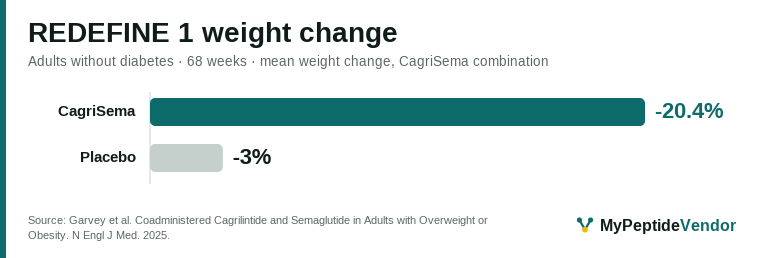
REDEFINE 1 randomized 3,417 adults without diabetes for 68 weeks. The groups included 2,108 receiving CagriSema, 302 receiving semaglutide, 302 receiving cagrilintide, and 705 receiving placebo 4. Mean weight change was −20.4% with CagriSema and −3.0% with placebo; the cagrilintide-alone weight change is not given in 4. The combination result must not be presented as a cagrilintide-only result.
CagriSema is not another name for standalone cagrilintide. It combines cagrilintide with semaglutide, and REDEFINE 1 used 2.4 mg of each medicine once weekly 4. In REDEFINE 2, a trial of adults with type 2 diabetes, 1,206 participants were randomized and the combination group received 2.4 mg of each medicine weekly for 68 weeks 6. Weight change was −13.7% with CagriSema and −3.4% with placebo; the model-estimated difference was −10.4 percentage points (crude means differ by 10.3) 6. Those combination findings do not set a standalone dose.
The diabetes population matters when comparing results. REDEFINE 2 enrolled adults with type 2 diabetes and reported a 68-week combination result of −13.7%, while REDEFINE 1 enrolled adults without diabetes and reported −20.4% with CagriSema over 68 weeks 46. Different populations and trial designs mean those results are not a direct test of one dose against another.
A 2024 meta-analysis found that cagrilintide 2.4 mg had a −1.83% mean percentage-weight difference versus semaglutide or liraglutide, which was not statistically significant (P=0.11) 8. The analysis also found significantly less vomiting with cagrilintide than with those comparators 8. It does not establish that cagrilintide is free of vomiting risk or that people should combine or switch medicines without clinical supervision.
A 2026 network meta-analysis estimated that CagriSema reduced weight by 14.8% versus lifestyle modification at one year 7. This is a combination estimate, not a cagrilintide-monotherapy result. It should not be directly compared with the 26-week phase 2 cagrilintide range because the treatment, comparator, duration, and analysis differ 710.
Current monotherapy study status: ClinicalTrials.gov lists NCT07220759, a cagrilintide monotherapy study in people with overweight or obesity and type 2 diabetes, as Phase 3 and active, not recruiting 11. That registry status does not mean the study is completed. A separate Phase 1 study, NCT07607587, is listed as recruiting and evaluates cagrilintide tolerability in people who could not tolerate GLP-1 receptor agonist therapy because of gastrointestinal adverse events 11. Recruiting status is not evidence that the treatment has been shown safe for that group.
Compounding and product status: FDA states that cagrilintide cannot be used in compounding under federal law and has not been found safe and effective for any condition 1. FDA's category 2 bulk-substances page 2 does not confirm whether cagrilintide is listed in category 2; its status cannot be established from that page. Do not treat a bulk-substance listing question as permission to compound or use cagrilintide; FDA’s stated position on cagrilintide is that it cannot be used in compounding 1.
Buying and legality: FDA advises patients to obtain a prescription from a doctor and use a state-licensed pharmacy when a compounded medicine is appropriate for a medical need 1. FDA also says cagrilintide cannot be used in compounding under federal law 1. Be wary of sellers that bypass clinician screening, claim a research product is equivalent to an approved medicine, offer implausibly low prices, or send damaged packaging or unclear directions 1.
Storage & Handling
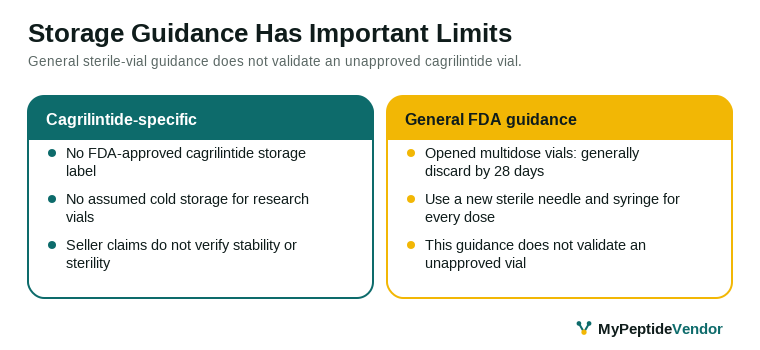
There is no FDA-approved cagrilintide product label that provides consumer storage instructions 1. Do not assume an unspecified research vial should be frozen or refrigerated, or that it remains usable for a particular number of days after mixing. A seller’s generic storage statement does not establish the product’s stability or sterility.
FDA warns that injectable GLP-1 medicines requiring refrigeration may have quality problems if they arrive warm or without adequate refrigeration during shipping 1. That warning does not supply a cagrilintide-specific storage range or validate storage instructions for a research vial. If a legally dispensed medicine arrives outside the pharmacy’s stated conditions, contact the dispensing pharmacy before using it 1.
FDA generally recommends discarding opened multidose sterile medication vials within 28 days after first use, because contamination risk increases after that point; it also advises using a new sterile needle and syringe for every dose 1. This general guidance does not validate an unapproved cagrilintide vial or make it suitable for human use.
Keep any investigational product within the study team’s control and follow the trial’s written handling directions. The phase 2 research period included 26 weeks of treatment and a 6-week follow-up, but those study timeframes do not establish a storage life for a vial 10.
Use this chart
Free to reuse with a link back:
Injection & Tracking Tips
This page does not give injection steps for cagrilintide because there is no FDA-approved cagrilintide medicine or home-use label 1. If you are enrolled in a study, follow its training and protocol; the phase 2 trial was conducted across 57 clinical sites, not as a do-it-yourself program 10. If you have a prescription for another medicine, follow that product’s pharmacy instructions rather than applying cagrilintide trial doses to it.
For a clinician or study-team discussion, record the product name, dispensing source, lot information, timing, and any symptoms. FDA encourages patients and health professionals to report adverse events or quality problems through MedWatch 1. A record can help the clinician assess what happened, but it cannot verify an unapproved product’s identity or strength.
Do not use online syringe conversions to compensate for an unknown concentration. FDA has received reports of serious dosing errors with compounded semaglutide, including errors in measuring and calculating doses 1. Those reports concern semaglutide, not cagrilintide, but they show why unverified vial math can create avoidable risk.
Do not combine standalone cagrilintide with semaglutide or another weight-loss medicine on your own. CagriSema was studied as a defined combination in clinical trials, including 2.4 mg of each medicine once weekly in REDEFINE 1 and REDEFINE 2 46. Those trial doses are not instructions for mixing separate products or creating a personal regimen.
Safety & Side Effects
Standalone cagrilintide rates for nausea, vomiting, and diarrhea are not reported in the phase 2 trial summary 10. Gastrointestinal events are reported for CagriSema: in the 68-week REDEFINE 1 trial, they affected 79.6% of participants receiving the combination and 39.9% receiving placebo 4. In REDEFINE 2, they affected 72.5% receiving CagriSema and 34.4% receiving placebo 6. Most were described as transient and mild to moderate, but those frequencies apply to the combination, not cagrilintide alone 46.
The 2024 meta-analysis found significantly less vomiting with cagrilintide than with semaglutide or liraglutide, but gives no standalone cagrilintide vomiting frequency 8. “Lower than a comparator” does not mean “no risk.” Persistent vomiting, inability to keep fluids down, severe abdominal pain, or signs of dehydration warrant prompt medical assessment.
Standalone cagrilintide frequencies for gallstones and injection-site reactions are not reported in the available trial data. The absence of a reported percentage is not proof that either event cannot occur. Discuss new or severe abdominal symptoms, a painful or worsening injection-site reaction, or any other concerning change with a clinician.
Medication interactions have not been characterized in an FDA-approved cagrilintide label because no such label exists 1. Before discussing an investigational medicine with a clinician or study team, disclose all prescription medicines, nonprescription medicines, and supplements. Do not add cagrilintide to semaglutide or another weight-loss drug on your own; CagriSema is a defined investigational combination tested under clinical-trial protocols 46.
FDA says cagrilintide has not been found safe and effective for any condition and cannot be used in compounding under federal law 1. FDA also warns that research-labeled products sold for human use may have unknown quality and may be harmful 1. Avoid a seller that skips clinician screening, makes false claims of equivalence to an FDA-approved product, or supplies damaged packaging or unclear instructions 1.
Frequently asked questions
What is the cagrilintide dosage for a 10 mg vial?
There is no FDA-approved dose for a 10 mg cagrilintide vial 1. The phase 2 study tested weekly target-dose groups from 0.3 mg to 4.5 mg, with up to 6 weeks of escalation, but that research does not establish a home-use schedule 10.
Does a 10 mg vial mean one 10 mg dose?
No. The vial label’s stated amount is not a recommended dose or proof of a verified concentration. FDA has not approved cagrilintide for human use 1.
How much bacteriostatic water should I add, and how many U-100 units should I inject?
No validated mixing volume or syringe-unit instruction is established for an unspecified 10 mg research vial. Mixing calculations cannot confirm its identity, concentration, or sterility, and FDA warns against research-labeled products sold for human use 1.
What dose schedule did the 26-week cagrilintide trial use?
The phase 2 study tested weekly target-dose groups of 0.3 mg, 0.6 mg, 1.2 mg, 2.4 mg, and 4.5 mg, with escalation lasting up to 6 weeks 10. The report does not specify the exact dose assigned in each escalation week, so a complete week-by-week ladder cannot be confirmed 10.
Is cagrilintide monotherapy Phase 3 finished?
ClinicalTrials.gov lists NCT07220759 as a Phase 3 cagrilintide monotherapy study with an active, not recruiting status 11. That status does not mean the study is completed.
Is cagrilintide FDA-approved or legally compoundable?
Cagrilintide is not FDA-approved, and FDA says it cannot be used in compounding under federal law 1. FDA also warns that research-labeled products sold for human use may have unknown quality and may be harmful 1.
Is cagrilintide the same as CagriSema?
No. Cagrilintide is the standalone investigational medicine; CagriSema combines it with semaglutide 46. The phase 3 combination trials used 2.4 mg of each medicine weekly, which is not a standalone cagrilintide instruction 46.
What should I do if I miss a cagrilintide dose?
The phase 2 trial report does not provide a missed-dose schedule 10. Do not double a dose or guess when to restart; if you are in a clinical trial, contact its study team.
Are nausea, vomiting, diarrhea, or gallstones common with cagrilintide alone?
Standalone frequencies for those individual events are not reported in the phase 2 trial summary 10. Gastrointestinal adverse events affected 79.6% of CagriSema participants in REDEFINE 1 and 72.5% in REDEFINE 2, but those figures are for the combination, not cagrilintide alone 46.
References
- FDA: Concerns with unapproved GLP-1 drugs used for weight loss
- FDA: Certain bulk drug substances for use in compounding that may present significant safety risks
- Yao et al. Comparative effectiveness of GLP-1 receptor agonists on glycaemic control, body weight, and lipid profile for type 2 diabetes: systematic review and network meta-analysis. BMJ. 2024.
- Garvey et al. Coadministered Cagrilintide and Semaglutide in Adults with Overweight or Obesity. N Engl J Med. 2025.
- Rubio-Herrera et al. Weight management treatment in obesity. Med Clin (Barc). 2025.
- Davies et al. Cagrilintide-Semaglutide in Adults with Overweight or Obesity and Type 2 Diabetes. N Engl J Med. 2025.
- Nong et al. Comparative effects of drugs for adults with overweight or obesity: systematic review and network meta-analysis. BMJ. 2026.
- Dutta et al. Efficacy and Safety of Cagrilintide Alone and in Combination with Semaglutide (Cagrisema) as Anti-Obesity Medications: A Systematic Review and Meta-Analysis. Indian J Endocrinol Metab. 2024.
- Eržen et al. Amylin, Another Important Neuroendocrine Hormone for the Treatment of Diabesity. Int J Mol Sci. 2024.
- Lau et al. Once-weekly cagrilintide for weight management in people with overweight and obesity: a multicentre, randomised, double-blind, placebo-controlled and active-controlled, dose-finding phase 2 trial. Lancet. 2021.
- ClinicalTrials.gov: 46 registered studies (search: Cagrilintide)
Written by the MyPeptideVendor editorial team from the FDA label, peer-reviewed studies and ClinicalTrials.gov records listed above, fact-checked line by line and reviewed 2026-11-12.
Cite this page
MyPeptideVendor Editorial Team. Cagrilintide Dosage 10mg: Trial Data & Safety. MyPeptideVendor. Updated November 12, 2026. https://mypeptidevendor.com/protocols/cagrilintide-dosing-10mg/MyPeptideVendor Editorial Team. (2026, November 12). Cagrilintide Dosage 10mg: Trial Data & Safety. MyPeptideVendor. https://mypeptidevendor.com/protocols/cagrilintide-dosing-10mg/Related protocols
5-Amino-1MQ 50 mg
Not approvedNo approved human dose exists; this guide separates 50 mg vial math from dosing advice and explains evidence, handling, and safety limits.
View protocolAICAR 50 mg
Research UseAICAR has no approved human dose or validated injection schedule; a 50 mg vial does not establish a safe dose, dilution, or cycle.
View protocolAOD-9604 10 mg
Not approvedAOD-9604 is not FDA-approved, and no validated human subcutaneous dose, titration schedule, or cycle is established.
View protocol