Longevity Performance Obesity Research: Evidence & Safety
Unidentified peptide/research blend
Brand names: Longevity & Obesity Research Blend; exact formulation unknown

longevity performance obesity research is a broad product-style name, not a confirmed peptide or established treatment. The exact ingredients, dose, and route are unknown, and the named blend is not FDA-approved.
There is no product-specific human trial result or side-effect percentage to support a treatment claim. Ask a healthcare provider before using any product or joining a research study.
Key takeaways
- The product name does not identify an exact compound, so its dose, route, and risks cannot be confirmed.
- No human dose or product-specific clinical result is established for this blend.
- AMPK and sirtuin claims do not show that a product changes weight, performance, or lifespan.
- FDA says unapproved versions of GLP-1 drugs are not reviewed for safety, effectiveness, or quality before marketing 1.
- FDA's Category 2 list concerns specific bulk substances; the blend's unknown ingredients prevent a substance-by-substance check 2.
Longevity & Obesity Research Blend at a glance
- Class
- Unidentified peptide/research blend
- Mechanism
- Unknown for this product; AMPK and sirtuin claims are unverified
- FDA Status
- Not approved
- Brand names
- Longevity & Obesity Research Blend; exact formulation unknown
- Administration
- No verified route or product instructions
- Typical Dose
- No established human dose
- Half-life
- Unknown
- Primary Uses
- No established medical use
What is it?

“Longevity & Obesity Research Blend” does not identify one specific drug or peptide. Without a complete ingredient list and concentration, it is not possible to tell whether a vial contains one substance, several substances, or something else. No human dose or approved medical use is established for the named blend.
The phrase “research use only” is a label, not proof that a product is safe for people. FDA has warned companies about certain unapproved GLP-1 drugs sold with research-use or not-for-human-consumption wording while also being marketed for human use; that warning names specific GLP-1 drugs and does not identify this blend 1.
Obesity can raise health risks, while appropriate weight management may improve some obesity-related health measures. That general relationship does not show that this blend reduces weight or extends life. A clinician can help weigh the possible benefits and risks of weight change for an individual, especially when illness, age, or other health conditions are involved.
What makes it different
The main difference is the missing product identity. A defined medicine has a known active ingredient and a specific label; this name supplies no verifiable ingredient, strength, trial dose, or product-specific side-effect rate. A seller’s suggested amount would not establish a clinical dose.
Some marketing uses terms such as AMPK or sirtuins. AMPK is a cell system that helps sense energy status, and sirtuins are proteins involved in cell regulation. Naming those pathways does not prove that a product changes them in people, or that any change improves body weight, physical performance, or lifespan.
Weight change also needs context. Weight loss that is planned with medical guidance is not the same as unexplained weight loss, which can signal a health problem. This product has not been shown to make either type of weight change safer or to increase longevity.
How does it work

There is no verified mechanism for this specific blend because its active ingredient is unknown. In plain terms, the label does not let a reader identify what substance would act on the body. Claims about AMPK, sirtuins, or other pathways cannot fill that gap without a defined ingredient and human evidence.
No human result establishes that this blend changes weight, athletic performance, or lifespan. It also has not been established that any claimed pathway effect translates into a meaningful health outcome. A biological theory is not a treatment result.
There is no established way to convert an animal-study dose or a seller’s protocol into a human dose for this unidentified product. The dose, route, and schedule would need to be tested for the exact formulation before they could be treated as clinical guidance.
What the clinical evidence actually shows

Product-specific trials: The name alone does not identify a compound or formulation that can be matched reliably to a human trial. No product-specific human trial result, participant count, treatment duration, or measured weight change is established here. That means there are no supported clinical numbers for expected weight loss, performance gains, or longer life.
Mechanism and lifespan: Human evidence that this product activates AMPK or sirtuins in a way that changes weight, performance, or lifespan has not been established. Long-term effects have not been established either. A short-term change in a laboratory marker, even if one were reported, would not by itself prove longer life.
What we do not know: The exact ingredient, purity, concentration, dose, route, interactions, and long-term safety are unknown. Without those details, it is also not possible to determine whether a registered trial of a particular compound applies to the product being offered. Search ClinicalTrials.gov by the exact ingredient and formulation, then check any study identifier against its registry entry and published report.
Evidence strength: Product-specific clinical evidence cannot be graded without an identified formulation and verifiable trial. FDA notices provide regulatory warnings about certain unapproved GLP-1 products, not evidence that this blend works or is safe 1. FDA’s Category 2 page identifies particular bulk substances that may present significant safety risks; an unknown ingredient list prevents a meaningful check for this product 2. Seller or clinic claims are not clinical proof unless they can be tied to a defined ingredient and verifiable human study.
Typical dosing
Human dose: No verified label dose or human trial range is established for this blend. Do not treat a seller’s suggested amount as a clinical dose, and do not infer a human dose from a different peptide or product.
Research participation: A dose in a legitimate study applies only to the exact product and protocol named in that study. Ask the study team and your healthcare provider to confirm the ingredient, route, schedule, and monitoring plan before participating. Do not use a research protocol as personal dosing advice.
Side effects: what to actually expect
No product-specific human side-effect percentage is established, so there is no reliable rate to quote for nausea, fatigue, low blood sugar, or other symptoms. That absence of data does not mean the product is safe. Unknown ingredients and strength also make interactions and overdose risks difficult to assess.
FDA has received reports of nausea, vomiting, diarrhea, abdominal pain, and constipation with compounded semaglutide or tirzepatide, including reports of dosing errors with compounded injectable semaglutide and doses beyond labeling with either drug 1. As of May 31, 2026, FDA had received 990 adverse-event reports associated with compounded semaglutide and more than 730 associated with compounded tirzepatide 1. Those are report counts, not percentages, and they concern different drugs, not this unidentified blend.
FDA notes that adverse-event reports do not always establish that the drug caused the event 1. For this blend, serious risks, common symptoms, and medication interactions have not been characterized in people. Consult a healthcare provider before any use or research participation; seek medical care for severe or unexpected symptoms.
Regulatory & access status in the US (as of 2026)
The named blend is not FDA-approved, and its name does not establish whether a seller is offering a compounded drug, a research chemical, or another product. FDA says unapproved versions of GLP-1 drugs such as semaglutide and tirzepatide are not reviewed for safety, effectiveness, or quality before marketing 1. That FDA notice addresses those GLP-1 drugs; it does not assess this unidentified blend.
FDA says compounded drugs should be used only when a patient’s medical needs cannot be met by an FDA-approved drug 1. FDA also states that retatrutide and cagrilintide cannot be used in compounding under federal law 1. These rules concern named GLP-1-related substances and do not establish the legal status of every product sold under this blend name.
FDA places certain bulk drug substances that may present significant safety risks in Category 2 2. Because this blend’s ingredients are not confirmed, no one can determine from its name alone whether a listed substance is present. Request the full ingredient names and concentrations, then ask a pharmacist or clinician to review them.
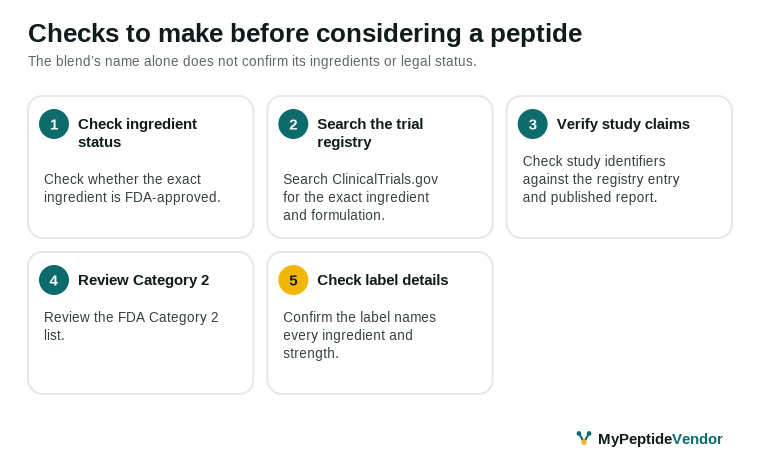
Before considering any peptide, check whether the exact ingredient is FDA-approved, search ClinicalTrials.gov for that ingredient and formulation, verify publication identifiers against the actual study, review the FDA Category 2 list, and confirm that the label names every ingredient and strength. Guaranteed results, missing side-effect information, unsupported study claims, or “research only” wording paired with human dosing directions are reasons to pause. FDA warns consumers not to purchase certain unapproved products falsely labeled for research use and sold for human use 1.
Use this chart
Free to reuse with a link back:
How it compares to its closest alternative
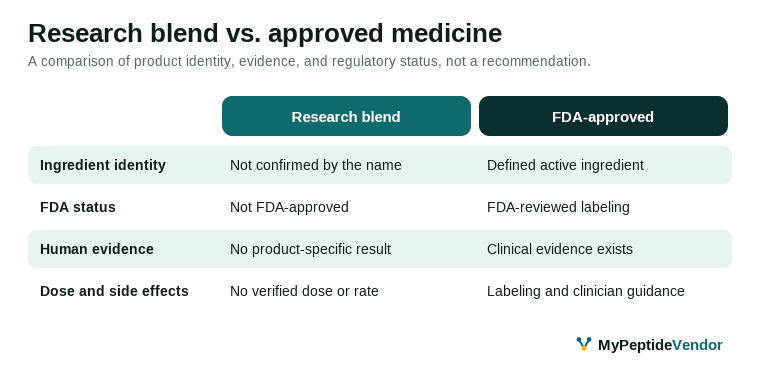
The closest established comparison is a defined, FDA-approved obesity medicine such as a semaglutide or tirzepatide product. These products have identified active ingredients and FDA-reviewed labeling; the named blend does not. FDA cautions that unapproved versions of GLP-1 drugs are not reviewed for safety, effectiveness, or quality, and that compounded drugs are not FDA-approved 1. This comparison describes evidence and regulatory status, not a recommendation to use either option.
| Feature | Longevity & Obesity Research Blend | FDA-approved semaglutide or tirzepatide product |
|---|---|---|
| Ingredient identity | Not confirmed by the name | Defined active ingredient |
| FDA status | Not FDA-approved | FDA-reviewed labeling for the approved product |
| Human evidence | No product-specific clinical result established | Clinical evidence and prescribing information exist for approved products |
| Dose and side effects | No verified human dose or product-specific rate | Use the product labeling and clinician guidance |
| Compounded versions | Cannot be classified without the ingredients | Compounded drugs are not FDA-approved and should be reserved for needs approved drugs cannot meet |
Use this chart
Free to reuse with a link back:
Medical disclaimer
This profile is for general education, not diagnosis or treatment. An unidentified product with no established human dose cannot be judged safe or appropriate from its name. Consult a healthcare provider before any use or research participation.
Frequently asked questions
Is Longevity & Obesity Research Blend FDA-approved?
No. The name does not identify a confirmed active ingredient or an FDA-approved medicine. FDA’s notice about unapproved GLP-1 products addresses specific drugs, not this unidentified blend 1.
What is the exact compound in the blend?
The product name alone does not identify an exact compound. Ask the seller for a complete ingredient list, concentration, and product labeling; a clinician or pharmacist can help review them.
Is there a human trial for this product?
A trial cannot be matched reliably from the name alone because the formulation is not defined. Search ClinicalTrials.gov using the exact ingredient and formulation, and verify any study number in the registry.
Can this blend activate AMPK or sirtuins and extend lifespan?
That has not been established in people for this product. Even a demonstrated change in a cell pathway would not, on its own, show improved weight, performance, or lifespan.
Is a product labeled “research use only” safe to use?
That wording does not prove a product is safe or suitable for people. FDA has warned about certain unapproved drugs marketed with research-use wording and human-use directions 1. Ask a healthcare provider before considering any product or research participation.
References
- FDA: Concerns with unapproved GLP-1 drugs used for weight loss
- FDA: Certain bulk drug substances for use in compounding that may present significant safety risks
Written by the MyPeptideVendor editorial team from the FDA label, peer-reviewed studies and ClinicalTrials.gov records listed above, fact-checked line by line and reviewed 2026-11-12.
Cite this page
MyPeptideVendor Editorial Team. longevity performance obesity research: Evidence & Safety. MyPeptideVendor. Updated November 12, 2026. https://mypeptidevendor.com/peptides/longevity-performance-obesity-research/MyPeptideVendor Editorial Team. (2026, November 12). longevity performance obesity research: Evidence & Safety. MyPeptideVendor. https://mypeptidevendor.com/peptides/longevity-performance-obesity-research/Related peptides
5-Amino-1MQ
Not approved5-Amino-1MQ is a small molecule, not a peptide; its human benefits, dose, side effects, and long-term safety are not established.
Learn moreAdipotide (FTPP)
Not approvedAdipotide is an experimental fat-vessel-targeting peptide with animal findings, kidney concerns, and no established human dose or benefit.
Learn moreAOD-9604
Not approvedAOD-9604 was studied for obesity, but available evidence does not establish meaningful weight loss, a standard dose, or FDA approval.
Learn more