Semaglutide: Weight Loss, Dosing & FDA Status
GLP-1 receptor agonist
Brand names: Ozempic, Wegovy, Wegovy HD.

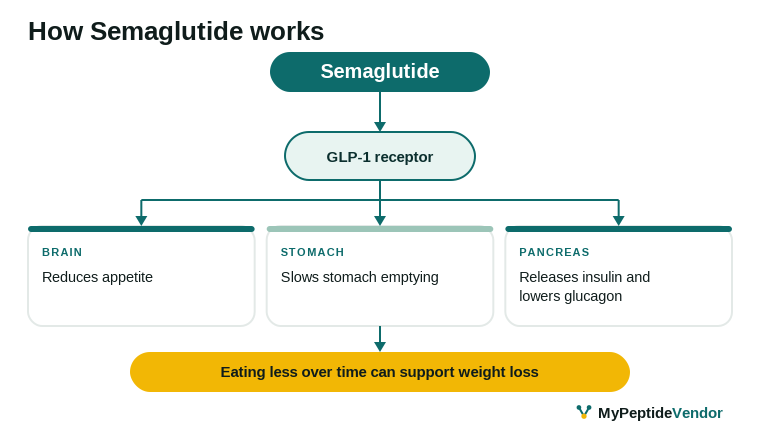
Semaglutide is a prescription medicine that activates GLP-1 receptors, reduces appetite, and slows stomach emptying 1.
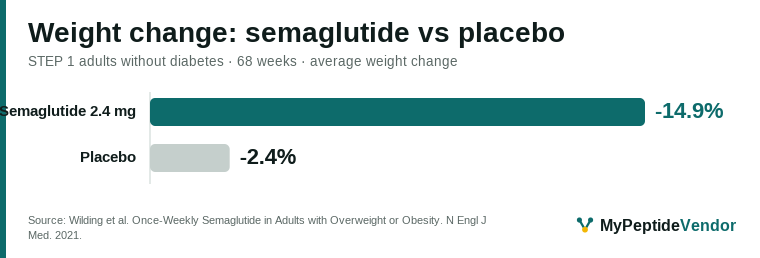
In STEP 1, adults with overweight or obesity and no diabetes lost an average of 14.9% of their starting weight over 68 weeks with weekly semaglutide 2.4 mg and lifestyle support 9. The ingredient is sold under different brand names, and each product has its own approved uses and instructions.
Key takeaways
- In STEP 1, average weight change was -14.9% at 68 weeks; for a 200 lb starting weight, that is about 30 lb 9.
- Wegovy injection starts at 0.25 mg weekly and reaches its usual adult weight-management maintenance dose after 16 weeks of gradual increases 1.
- Nausea affected 44% of adults taking Wegovy 2.4 mg in weight-loss trials, compared with 16% taking placebo 1.
- In the STEP 1 extension, participants regained an average 11.6 percentage points of lost weight during the year after treatment stopped 7.
- FDA says compounded versions are not reviewed for safety, effectiveness, or quality before marketing 2.
Semaglutide at a glance
- Class
- GLP-1 receptor agonist
- Mechanism
- Activates GLP-1 receptors, reduces appetite and calorie intake, slows gastric emptying, and affects glucose-dependent insulin and glucagon release.
- FDA Status
- Wegovy is FDA-approved for specified weight, cardiovascular-risk, and MASH uses; Ozempic is a separate semaglutide brand used in type 2 diabetes care.
- Brand names
- Ozempic, Wegovy, Wegovy HD.
- Administration
- Wegovy injection is given under the skin once weekly; Wegovy tablets are taken once daily.
- Typical Dose
- Wegovy injection starts at 0.25 mg weekly; usual adult weight-management maintenance is 2.4 mg weekly, with a 7.2 mg option for eligible adults.
- Half-life
- About 1 week; semaglutide can remain in circulation for about 5 to 7 weeks after the last dose.
- Primary Uses
- Wegovy has labeled uses for weight reduction, cardiovascular-risk reduction in certain adults, and specified noncirrhotic MASH with liver fibrosis.
What is it?

Semaglutide is a long-acting medicine in the glucagon-like peptide-1 receptor agonist class (GLP-1 receptor agonist). It is a peptide drug, but approved semaglutide products are prescription medicines, not supplements 1.
Ozempic and Wegovy contain the same active ingredient, but they are different brands with different approved uses and dosing instructions. Ozempic is used in type 2 diabetes care; a clinical trial describes 1.0 mg weekly as the semaglutide dose approved for diabetes treatment at the time of that study 4. Wegovy has separate weight-management and other labeled uses 1. A prescription for one brand should not be treated as interchangeable with a prescription for another.
Wegovy injection is approved with a reduced-calorie diet and increased physical activity to reduce excess weight and maintain weight reduction in adults with obesity, adults with overweight and at least one weight-related condition, and adolescents aged 12 years or older with obesity 1. The adolescent indication applies to Wegovy injection, not every semaglutide product or dose 1.
Wegovy injection also has FDA-approved uses to reduce major cardiovascular events in adults with established cardiovascular disease and overweight or obesity, and to treat noncirrhotic metabolic dysfunction-associated steatohepatitis (MASH) with moderate to advanced liver fibrosis in adults 1. The MASH indication has accelerated approval based on improvement in MASH and fibrosis; continued approval may depend on confirmation of clinical benefit 1.
Wegovy tablets are approved for adult weight reduction and cardiovascular-risk reduction in the labeled populations 1. Wegovy HD is the 7.2 mg weekly injection option for adult weight reduction; it is not a starting dose 1. Injection and tablet schedules are different, so do not transfer doses between formulations without a prescriber's instructions 1.
Using Wegovy tablets or injection with another semaglutide product or another GLP-1 receptor agonist is not recommended 1. That includes combining Ozempic and Wegovy; a clinician should guide any switch rather than having a patient overlap products or convert doses by guesswork.
What makes it different
Semaglutide has evidence for weight reduction and for fewer major cardiovascular events in a defined group of adults. In SELECT, 17,604 adults with established cardiovascular disease and overweight or obesity, but no diabetes, were followed for a mean of 39.8 months 5. Cardiovascular death, nonfatal heart attack, or nonfatal stroke occurred in 6.5% of those assigned semaglutide and 8.0% assigned placebo; the hazard ratio was 0.80 5. That is a relative reduction in risk for the trial population, not a guarantee for an individual.
In STEP 1, 86.4% of participants lost at least 5% of starting weight, 69.1% lost at least 10%, and 50.5% lost at least 15% by week 68 9. For someone starting at 200 lb, a 10% loss is 20 lb. These results describe a group after more than a year of treatment and do not establish when a particular person will reach a target.
Semaglutide is not a short course with a predictable end point. In the STEP 1 extension, people regained an average 11.6 percentage points of body weight during the year after treatment ended 7. That finding does not mean everyone regains the same amount, but it makes long-term weight maintenance part of the treatment decision.
Results differ across populations. STEP 1 enrolled adults with overweight or obesity without diabetes and found an average 14.9% weight reduction at 68 weeks 9. STEP 2 enrolled adults with type 2 diabetes and overweight or obesity; average loss with semaglutide 2.4 mg was 9.6% at 68 weeks 4. Those were separate trials, so the difference does not prove that diabetes alone caused the smaller average loss.
Wegovy HD offers an option above the usual 2.4 mg maintenance dose for selected adults, but a higher dose does not guarantee a particular result. In STEP UP, adults without diabetes lost an average 18.7% with 7.2 mg and 15.6% with 2.4 mg at 72 weeks 11. The label allows eligible adults who tolerate 2.4 mg for at least 4 weeks and need additional weight reduction to increase to 7.2 mg weekly 1.
How does it work
In plain terms, semaglutide can make hunger feel less strong and fullness arrive sooner. It also slows the movement of food out of the stomach. For many people, that means eating less over time, which can support weight loss 1.
More technically, semaglutide activates the GLP-1 receptor, a target of the body's natural GLP-1 hormone. The molecule has 94% sequence homology with human GLP-1 1. GLP-1 receptors are present in brain areas involved in appetite regulation, and animal studies show semaglutide activity in some of those areas 1. The exact mechanism behind cardiovascular risk reduction and the full mechanism in human MASH are not established 1.
Semaglutide also helps the pancreas release insulin and reduce glucagon when blood sugar is high 1. Because those effects depend on glucose levels, low blood sugar is a particular concern when semaglutide is combined with insulin or a sulfonylurea such as glipizide 1.
Slower stomach emptying helps explain both fullness and some unwanted effects. It can cause nausea and may affect how quickly some oral medicines are absorbed 1. Tell the prescriber about medicines that need close blood-level or laboratory monitoring. Tell the anesthesiologist and procedure team about semaglutide before planned general anesthesia or deep sedation because aspiration has been reported with GLP-1 medicines 1.
Use this chart
Free to reuse with a link back:
What the clinical evidence actually shows

STEP 1 enrolled 1,961 adults with obesity, or overweight plus a weight-related condition, without diabetes. Participants received semaglutide 2.4 mg once weekly or placebo, alongside lifestyle support, for 68 weeks 9. Average weight change was -14.9% with semaglutide and -2.4% with placebo 9. For a person starting at 200 lb, a 14.9% reduction is about 30 lb. That is a group average, not an individual forecast.
STEP 1 offers a benchmark for a 20 lb goal. At 200 lb, losing 20 lb equals 10% of starting weight; by week 68, 69.1% of semaglutide participants had reached at least that percentage 9. The trial result does not provide a dependable date for when one person will reach 20 lb.
The first months include dose increases, so the final trial average should not be applied to the first few weeks. STEP 1 used a 16-week dose-escalation period before the 2.4 mg maintenance dose 9. The published STEP 1 summary reports the week-68 result, not dependable average losses at weeks 4, 12, or 24 9. Early changes can vary with dose tolerance, starting weight, eating patterns, and other health factors.
STEP 1's reported average and the point at which 69.1% of participants reached at least 10% loss were measured at week 68 9. The trial summary does not give reliable week-specific averages for the earlier points below 9.
| Time | Trial evidence | Example for a 200 lb starting weight |
|---|---|---|
| Week 4 | No dependable average reported | No trial-based estimate |
| Week 12 | No dependable average reported | No trial-based estimate |
| Week 24 | No dependable average reported | No trial-based estimate |
| Week 68 | Average weight change: -14.9% | About 30 lb average loss |
STEP 2 studied 1,210 adults with type 2 diabetes and overweight or obesity. After 68 weeks, average weight change was -9.6% with semaglutide 2.4 mg and -3.4% with placebo 4. At least 5% weight loss occurred in 68.8% of participants receiving 2.4 mg and 28.5% receiving placebo 4. The average loss was smaller than in STEP 1, which enrolled participants without diabetes 4,9.
STEP 4 tested continued treatment after participants reached the maintenance dose. After a 20-week semaglutide run-in, 803 participants were randomized: 535 continued semaglutide and 268 switched to placebo, with lifestyle support in both groups 8. From week 20 to week 68, those who continued lost a further 7.9% on average, while those switched to placebo gained 6.9% 8. This supports ongoing treatment for maintaining trial weight loss, but does not predict the exact course for every person who stops.
The STEP 1 extension followed 327 participants after the original 68-week trial. Extension participants had lost an average 17.3% by week 68; by week 120, they had regained 11.6 percentage points, leaving a net loss of 5.6% from their starting weight 7. The extension was exploratory and included a subset of the original study, but it quantifies average regain after treatment and lifestyle support ended.
SELECT studied 17,604 adults with established cardiovascular disease and overweight or obesity, without diabetes 5. Over a mean follow-up of 39.8 months, the primary outcome occurred in 6.5% assigned semaglutide and 8.0% assigned placebo; the hazard ratio was 0.80 5. These findings apply to the high-risk group enrolled in SELECT and support the Wegovy cardiovascular-risk indication for adults who meet the labeled criteria 1,5.
SURMOUNT-5 directly compared semaglutide with tirzepatide in 751 adults with obesity but without type 2 diabetes. Participants received their maximum tolerated weekly dose for 72 weeks; average weight change was -13.7% with semaglutide and -20.2% with tirzepatide 6. For a 200 lb starting weight, those group averages equal about 27 lb and 40 lb, respectively. The study was open-label, and the average difference does not mean tirzepatide will work better for every individual 6.
STEP UP studied 1,407 adults with obesity but without diabetes, randomized to semaglutide 7.2 mg, 2.4 mg, or placebo for 72 weeks 11. Average weight change was -18.7% with 7.2 mg and -15.6% with 2.4 mg 11. The higher dose is an option for selected adults, not a starting dose 1.
What remains unknown: trials cannot tell someone exactly how many pounds they will lose in the first 4 to 12 weeks, whether a particular dose will be tolerable, or how long treatment will be needed. Withdrawal studies show average regain after stopping, but do not establish a taper that prevents regain for everyone 7,8. Individual long-term results also depend on continued treatment, tolerability, and the health conditions being treated.
Use this chart
Free to reuse with a link back:
Use this chart
Free to reuse with a link back:
Typical dosing

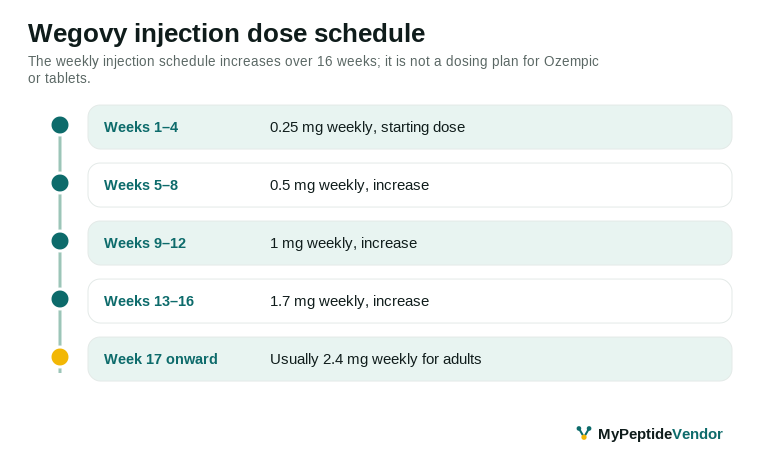
The following weekly schedule is for Wegovy injection, not a dosing plan for Ozempic or an unapproved compounded product. Wegovy injection is given under the skin on the same day each week, at any time of day, with or without meals; approved injection sites are the abdomen, thigh, or upper arm 1. Rotate injection sites between doses 1.
For adult weight reduction, the usual recommended Wegovy injection maintenance dose is 2.4 mg weekly. The label also allows 1.7 mg weekly based on response and tolerability; adults who tolerate 2.4 mg for at least 4 weeks and need additional weight reduction may increase to 7.2 mg weekly 1. For cardiovascular-risk reduction, maintenance options are 2.4 mg, which is recommended, or 1.7 mg weekly 1.
The injection increases in steps over 16 weeks to reduce gastrointestinal reactions. If a patient cannot tolerate a dose during escalation, the prescriber may delay the next increase for 4 weeks 1.
| Weeks | Wegovy injection dose | Label stage |
|---|---|---|
| 1–4 | 0.25 mg once weekly | Starting dose |
| 5–8 | 0.5 mg once weekly | Increase |
| 9–12 | 1 mg once weekly | Increase |
| 13–16 | 1.7 mg once weekly | Increase |
| Week 17 onward | Usually 2.4 mg weekly for adult weight reduction | Maintenance |
Wegovy tablets have a separate daily schedule: 1.5 mg once daily for 30 days, then 4 mg daily for 30 days, 9 mg daily for 30 days, and 25 mg daily from day 91 onward 1. Take the tablet in the morning on an empty stomach with up to 4 ounces of water; swallow it whole and wait at least 30 minutes before food, drinks, or other oral medicines 1. If a tablet dose is missed, skip it and take the next dose the following day 1.
For a missed Wegovy injection, take the dose as soon as possible if the next scheduled dose is more than 2 days away. If the next dose is less than 2 days away, skip the missed injection and resume on the regular day 1. After 2 or more consecutive missed doses, the prescriber may restart at a lower dose and repeat escalation to reduce gastrointestinal reactions 1.
Do not speed up dose increases or take extra medicine to try to lose weight faster. FDA has received reports of dosing errors with compounded injectable products, including errors when patients measured doses from vials and when clinicians calculated doses 2. A prescriber should review any dose change, product switch, or prolonged interruption.
Use this chart
Free to reuse with a link back:
Side effects: what to actually expect
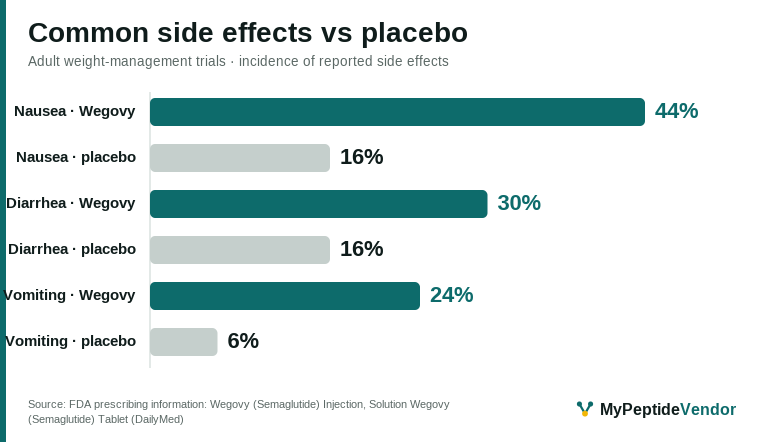
Nausea, diarrhea, vomiting, and constipation are the main day-to-day side effects, particularly during dose increases. In adult weight-management trials of Wegovy injection 2.4 mg, nausea occurred in 44% of participants versus 16% with placebo; diarrhea in 30% versus 16%; vomiting in 24% versus 6%; and constipation in 24% versus 11% 1. In STEP 1, nausea and diarrhea, the most common adverse events, were typically transient and mild-to-moderate 9; severe gastrointestinal reactions occurred in 4. 1% of Wegovy injection-treated adults versus 0.9% of placebo-treated adults 1.
Other trial effects included abdominal pain in 20% versus 10%, headache in 14% versus 10%, fatigue in 11% versus 5%, and dizziness in 8% versus 4% with Wegovy and placebo, respectively 1. Permanent discontinuation because of adverse reactions occurred in 6.8% of adults taking Wegovy and 3.2% taking placebo 1. Nausea, vomiting, and diarrhea were the most common reasons for stopping 1.
Smaller meals and eating slowly may make nausea easier to manage; avoid foods that clearly worsen symptoms. If vomiting or diarrhea makes it hard to keep fluids down, contact the prescriber, since dehydration can contribute to kidney injury 1. A dose increase can be delayed when the current step is not tolerated 1. Persistent or severe symptoms deserve medical advice even when mild nausea is common.
The Wegovy label warns about pancreatitis, gallbladder disease, dehydration-related kidney injury, severe gastrointestinal reactions, serious allergy, diabetic retinopathy complications, increased heart rate, and aspiration during general anesthesia or deep sedation 1. Severe breathing problems or a serious allergic reaction need emergency care 1.
| Warning sign | Action |
|---|---|
| Severe or persistent abdominal pain, sometimes spreading to the back, with or without vomiting | Stop the medicine and seek urgent medical assessment for possible pancreatitis. |
| Upper-right abdominal pain, fever, or yellowing of the skin or eyes | Contact a clinician promptly; gallbladder disease may need evaluation. |
| Repeated vomiting or diarrhea, very little urine, faintness, or inability to keep fluids down | Seek medical advice promptly because dehydration can injure the kidneys. |
| A neck lump, persistent hoarseness, trouble swallowing, or trouble breathing | Contact a clinician promptly; these can be symptoms of a thyroid tumor. |
| Sudden vision changes or worsening eyesight, especially with diabetes | Contact the prescriber or an eye-care clinician promptly. |
| Face, lip, tongue, or throat swelling, or trouble breathing | Seek emergency care for a possible serious allergic reaction. |
The boxed warning concerns thyroid C-cell tumors seen in rodents. Whether semaglutide causes these tumors in humans is unknown 1. Wegovy is contraindicated for people with a personal or family history of medullary thyroid carcinoma (MTC) or with multiple endocrine neoplasia syndrome type 2 (MEN 2) 1. Routine calcitonin testing or thyroid ultrasound has uncertain value for early detection 1.
Low blood sugar risk rises when semaglutide is combined with insulin or an insulin secretagogue such as a sulfonylurea 1. A prescriber may reduce the insulin or sulfonylurea dose and should review blood glucose before and during treatment in people with diabetes 1. Metformin was among the medicines for which interaction testing found no clinically significant pharmacokinetic difference, but diabetes treatment and glucose levels still need clinical review 1.
Semaglutide delays stomach emptying and may affect absorption of some oral medicines 1. The label advises closer clinical or laboratory monitoring for oral medicines with a narrow therapeutic range or medicines that require monitoring; in an interaction study, levothyroxine exposure increased by 33% with oral semaglutide 1. Give the prescriber a complete medication list, including medicines that need blood sugar or laboratory monitoring 1.
Tell the anesthesiologist and surgeon about semaglutide before any planned procedure involving general anesthesia or deep sedation. Aspiration has been reported in people taking GLP-1 receptor agonists 1. The care team should decide the medication and fasting plan; do not stop semaglutide on your own before a procedure.
For weight reduction or cardiovascular-risk reduction, stop Wegovy when pregnancy is recognized and discuss next steps with the prescriber 1. The label advises stopping at least 2 months before a planned pregnancy because semaglutide remains in the body for weeks 1. Weight loss offers no benefit during pregnancy and may pose fetal risk 1. Anyone who could become pregnant should discuss pregnancy planning with the prescriber; the label does not specify a particular contraception method 1.
Breastfeeding guidance depends on the formulation. Breastfeeding is not recommended during Wegovy tablet treatment; for Wegovy injection, there are no data on semaglutide in human milk or its effects on a breastfed infant, so the patient and clinician should weigh the medicine's need against possible infant risks 1.
Regulatory & access status in the US (as of 2026)
Wegovy injection is FDA-approved for specified weight-management uses in adults and adolescents aged 12 years or older with obesity, cardiovascular-risk reduction in certain adults, and noncirrhotic MASH with moderate to advanced fibrosis in adults 1. Wegovy tablets are approved for adult weight reduction and cardiovascular-risk reduction in the labeled populations 1. Ozempic is a separate semaglutide brand used in type 2 diabetes care; its approved uses and dose instructions are not the same as Wegovy's.
Wegovy HD is the 7.2 mg weekly injection option for adult weight reduction, subject to the label's escalation conditions 1. Pediatric weight-management use is established for Wegovy injection in patients aged 12 years or older with obesity; the 7.2 mg adult dose is not the labeled pediatric maintenance dose 1. The Wegovy label reports no clinically significant pharmacokinetic differences by age, including in adults aged 65 years and older 1.
Approved semaglutide products are prescription medicines. Retail cost and insurance coverage vary by plan, product, indication, and pharmacy; ask the insurer whether the exact product and diagnosis are covered, whether prior authorization is required, and what the out-of-pocket cost will be.
Storage depends on the exact product and presentation, so follow its package instructions and ask the pharmacist if they are unclear. Do not use an injection if the solution is not clear, colorless, and free of particles 1. Never share a Wegovy FlexTouch pen, even if the needle is changed; use an appropriate sharps container for used needles 1.
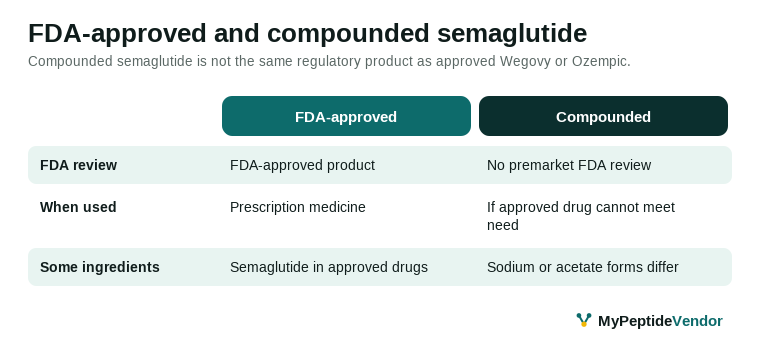
Compounded semaglutide is not the same regulatory product as FDA-approved Wegovy or Ozempic. FDA does not review compounded drugs for safety, effectiveness, or quality before they are marketed, and says compounding should be used only when an approved drug cannot meet a patient's medical need 2. Compounded products do not have the same premarket FDA review as approved products 2.
FDA has received reports of dosing errors with compounded injectable semaglutide, including errors from measuring a dose out of a vial and from dose calculations 2. FDA has also identified products using semaglutide sodium or semaglutide acetate; these are different active ingredients from the semaglutide in approved drugs, and FDA says it does not know whether they have the same chemical and pharmacologic properties 2.
Before using a compounded product, ask the prescriber why an approved medicine cannot meet the medical need, confirm that the pharmacy is state-licensed, and get clear instructions for the exact concentration and dose measurement 2. FDA lists claims that a compounded drug is the same as an approved drug, unusually deep discounts, no screening and prescription from a licensed doctor, and no clinician available for questions as warning signs 2. Damaged packaging, unclear directions, or an injectable product that arrives warm or without adequate refrigeration are also reasons to pause and contact the prescriber or pharmacy 2.
FDA recommends a new sterile needle and syringe for every dose from a multi-dose compounded vial and says to discard such a vial within 28 days after first use, even if medicine remains 2. Those instructions address FDA's warning about compounded GLP-1 products; follow the approved product's own instructions for its pen or syringe.
Use this chart
Free to reuse with a link back:
If you and a clinician decide it fits, one option is HumeCare: online GLP-1 weight-loss program with a licensed US provider (US only). Affiliate link
How it compares to its closest alternative
Tirzepatide is the closest alternative in a direct obesity trial. Semaglutide activates GLP-1 receptors, while tirzepatide acts on GIP and GLP-1 receptors 1,6. The comparison below separates brand indications and dosing; the head-to-head weight figures come from SURMOUNT-5, which enrolled adults with obesity but without type 2 diabetes 6.
| Product | FDA-approved indication or role | Weight dose or maximum-dose distinction | Age and other distinctions |
|---|---|---|---|
| Ozempic (semaglutide) | Separate semaglutide brand used in type 2 diabetes care. | Uses its own diabetes product dosing; it is not the Wegovy-labeled weight-management regimen. | Do not combine with Wegovy or use Wegovy doses as a substitute. |
| Wegovy (semaglutide) | Weight reduction; cardiovascular-risk reduction in certain adults; accelerated approval for specified noncirrhotic MASH in adults. | Usual adult weight-management maintenance is 2.4 mg weekly; 1.7 mg may be selected based on response and tolerability. | Injection weight-management use includes adolescents aged 12 years or older with obesity; MASH use is for adults. |
| Wegovy HD (semaglutide) | Higher-dose Wegovy injection for adult weight reduction. | Maximum labeled weekly weight-reduction dose is 7.2 mg for eligible adults. | The 7.2 mg option is for adults, not the pediatric maintenance dose. |
| Tirzepatide | Direct obesity-trial alternative; its product labeling is separate from semaglutide's. | SURMOUNT-5 used maximum tolerated weekly doses of 10 mg or 15 mg. | The comparison enrolled adults with obesity but without type 2 diabetes. |
In SURMOUNT-5, average weight change at week 72 was -20.2% with tirzepatide and -13.7% with semaglutide among 751 randomized participants 6. For a 200 lb starting weight, those averages are about 40 lb and 27 lb. The trial's open-label design and group averages do not establish which medicine will suit a particular person better 6.
Semaglutide remains an effective weight-loss option for many people: STEP 1 found an average 14.9% reduction at 68 weeks, while the direct comparison found an average 13.7% reduction with semaglutide at week 72 6,9. Tirzepatide had a larger average reduction in SURMOUNT-5, but treatment choice also depends on medical history, side effects, access, and the indication being treated 6.
Frequently asked questions
These answers distinguish trial averages from personal predictions; STEP 1 measured its primary weight results after 68 weeks 9.
Where to Get Semaglutide Legally
Through your own doctor
The FDA-approved product needs a prescription. Your doctor decides whether it fits your health history and insurance may cover part of the cost.
HumeCare
Online GLP-1 weight-loss program with a licensed US provider.
- Short online assessment reviewed by a licensed provider
- If prescribed, medication ships to your door
- Ongoing support to adjust your plan
HumeCare Orals
Prefer a pill? Oral GLP-1 program with a licensed US provider.
- No injections: oral option if your provider approves it
- Online assessment, no clinic visit
- Shipped to your door if prescribed
Affiliate disclosure: we may earn a commission if you sign up through the link above. It never changes what we write.
Ranked in our guides
Frequently asked questions
How fast can I lose 20 lbs on semaglutide?
There is no reliable timeline for an individual. In STEP 1, 69.1% of participants had lost at least 10% of their starting weight by week 68 9. For someone starting at 200 lb, 20 lb is 10%, but that trial result does not say when a particular person will reach it.
What is the difference between semaglutide and Ozempic?
Semaglutide is the active drug; Ozempic is one brand that contains it. Wegovy is another semaglutide brand with separate weight-management and other FDA-approved uses 1, so the brand labels and dose schedules are not interchangeable.
What is the downside of semaglutide?
Stomach and bowel symptoms are common: in Wegovy weight-loss trials, 44% of adults reported nausea and 24% reported vomiting 1. Other concerns include gallbladder problems, dehydration-related kidney injury, pancreatitis, low blood sugar with some diabetes medicines, and weight regain after stopping 1,7. The human risk of thyroid C-cell tumors is unknown, but a personal or family history of MTC or MEN 2 rules out Wegovy 1.
Is semaglutide still good for weight loss?
Yes, trial results support semaglutide as a weight-loss treatment. STEP 1 found an average 14.9% loss at 68 weeks, while SURMOUNT-5 found 13.7% with semaglutide at 72 weeks; tirzepatide averaged 20.2% in that direct comparison 6,9. Those are group averages, not a forecast for one person.
References
- FDA prescribing information: Wegovy (Semaglutide) Injection, Solution Wegovy (Semaglutide) Tablet (DailyMed)
- FDA: Concerns with unapproved GLP-1 drugs used for weight loss
- FDA: Certain bulk drug substances for use in compounding that may present significant safety risks
- Davies et al. Semaglutide 2·4 mg once a week in adults with overweight or obesity, and type 2 diabetes (STEP 2): a randomised, double-blind, double-dummy, placebo-controlled, phase 3 trial. Lancet. 2021.
- Lincoff et al. Semaglutide and Cardiovascular Outcomes in Obesity without Diabetes. N Engl J Med. 2023.
- Aronne et al. Tirzepatide as Compared with Semaglutide for the Treatment of Obesity. N Engl J Med. 2025.
- Wilding et al. Weight regain and cardiometabolic effects after withdrawal of semaglutide: The STEP 1 trial extension. Diabetes Obes Metab. 2022.
- Rubino et al. Effect of Continued Weekly Subcutaneous Semaglutide vs Placebo on Weight Loss Maintenance in Adults With Overweight or Obesity: The STEP 4 Randomized Clinical Trial. JAMA. 2021.
- Wilding et al. Once-Weekly Semaglutide in Adults with Overweight or Obesity. N Engl J Med. 2021.
- Moiz et al. Long-Term Efficacy and Safety of Once-Weekly Semaglutide for Weight Loss in Patients Without Diabetes: A Systematic Review and Meta-Analysis of Randomized Controlled Trials. Am J Cardiol. 2024.
- Wharton et al. Once-weekly semaglutide 7·2 mg in adults with obesity (STEP UP): a randomised, controlled, phase 3b trial. Lancet Diabetes Endocrinol. 2025.
- ClinicalTrials.gov: 832 registered studies (search: Semaglutide)
Written by the MyPeptideVendor editorial team from the FDA label, peer-reviewed studies and ClinicalTrials.gov records listed above, fact-checked line by line and reviewed 2026-11-12.
Cite this page
MyPeptideVendor Editorial Team. semaglutide: Weight Loss, Dosing & FDA Status. MyPeptideVendor. Updated November 12, 2026. https://mypeptidevendor.com/peptides/semaglutide/MyPeptideVendor Editorial Team. (2026, November 12). semaglutide: Weight Loss, Dosing & FDA Status. MyPeptideVendor. https://mypeptidevendor.com/peptides/semaglutide/Related peptides
5-Amino-1MQ
Not approved5-Amino-1MQ is a small molecule, not a peptide; its human benefits, dose, side effects, and long-term safety are not established.
Learn moreAdipotide (FTPP)
Not approvedAdipotide is an experimental fat-vessel-targeting peptide with animal findings, kidney concerns, and no established human dose or benefit.
Learn moreAOD-9604
Not approvedAOD-9604 was studied for obesity, but available evidence does not establish meaningful weight loss, a standard dose, or FDA approval.
Learn more