CJC-1295: Evidence, Dosing & Safety
GHRH analog
Brand names: No FDA-approved brand name.

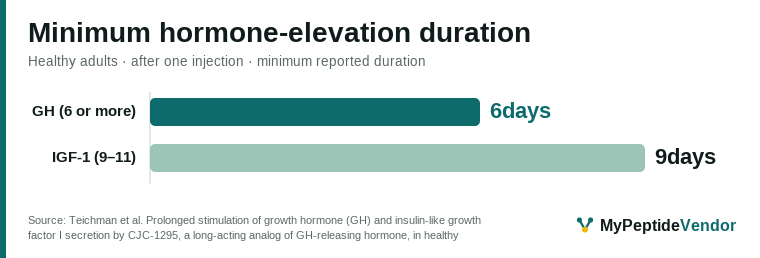
CJC-1295 is a synthetic growth hormone-releasing hormone (GHRH) analog that signals the pituitary to release growth hormone (GH). In a human trial, one injection raised mean GH 2- to 10-fold for at least 6 days 2.
That hormone response is not proof of muscle gain, fat loss, better sleep, or longer life. CJC-1295 has no FDA-approved product or label dose, and long-term safety has not been established 57.
Key takeaways
- A single dose raised mean GH 2- to 10-fold for 6 or more days in healthy adults 2.
- Mean IGF-1 rose 1.5- to 3-fold for 9–11 days after one injection 2.
- The human trials tested doses including 30 and 60 micrograms per kilogram; these were research doses, not a recommended regimen 2.
- ClinicalTrials.gov lists one registered CJC-1295 study, a terminated Phase 2 trial in people with HIV and visceral obesity 10.
- FDA approval, long-term safety, and benefits such as fat loss or faster recovery have not been established 25.
CJC-1295 at a glance
- Class
- Synthetic GHRH analog
- Mechanism
- Signals the pituitary to release GH; the human trial also measured higher IGF-1.
- FDA Status
- Not FDA-approved; no approved product label or dose.
- Brand names
- No FDA-approved brand name.
- Administration
- Subcutaneous injection in the human trial.
- Typical Dose
- No approved dose; trial doses included 30 or 60 micrograms/kg.
- Half-life
- Estimated 5.8–8.1 days for the long-acting form studied.
- Primary Uses
- No approved use; body composition, recovery, sleep, and aging claims are not established in CJC-1295 human trials.
What is it?

CJC-1295 is a lab-made peptide designed to copy part of the body’s GHRH signal. GHRH tells the pituitary gland, a small gland at the base of the brain, to release GH. CJC-1295 is described as a GH-RH analogue 8.
The human research examined a long-acting form of CJC-1295. Its estimated half-life was 5.8–8.1 days 2. In plain terms, the measured compound remained in the body for days rather than being cleared in minutes.
“CJC-1295 without DAC” appears as a product label, but the 2006 trial 2 studied CJC-1295 only; it does not address the composition of products sold under “CJC-1295 without DAC” labels. The claim that those products clear within a few hours has not been established in the human CJC-1295 trial 2.
CJC-1295 has no FDA-approved medical use 5. People discuss it for body composition, workout recovery, sleep, and healthy aging, but raising GH or IGF-1 does not prove improvement in any of those outcomes 257. The strongest human evidence is a change in hormone levels, not a demonstrated change in how people look, feel, or function.
Claims versus human evidence
The human trial measured GH and IGF-1, not muscle size, fat mass, sleep, or recovery 2. Measured hormone effects are distinguished from outcomes that remain unproven 235710.
| Claim | Strongest evidence | What can be concluded |
|---|---|---|
| Raises GH and IGF-1 | Randomized, placebo-controlled human trials | Observed for days after injection in healthy adults. |
| Builds muscle | No CJC-1295 human muscle-outcome result is reported | Not established in people. |
| Reduces body fat | The registered HIV visceral-obesity study was terminated; no results are reported | Weight or fat loss is not established. |
| Improves recovery | Reviews describe interest in peptides for sports use, with limited clinical evidence | No CJC-1295 recovery benefit is established in a human trial. |
| Improves sleep | The human study did not report a sleep outcome | Not established. |
| Supports healthy aging | A review identifies CJC-1295 as a GH-modulating peptide but notes major evidence gaps for nonapproved peptides | No proven anti-aging or longevity benefit. |
| Raises testosterone | The human trial measured GH and IGF-1, not testosterone | Effect on testosterone is unknown. |
What makes it different
The main feature that separates studied CJC-1295 from a short-acting GHRH signal is duration. After one injection, GH rose for at least 6 days, and IGF-1 stayed higher for 9–11 days 2. After multiple injections, IGF-1 remained above baseline for as long as 28 days 2.
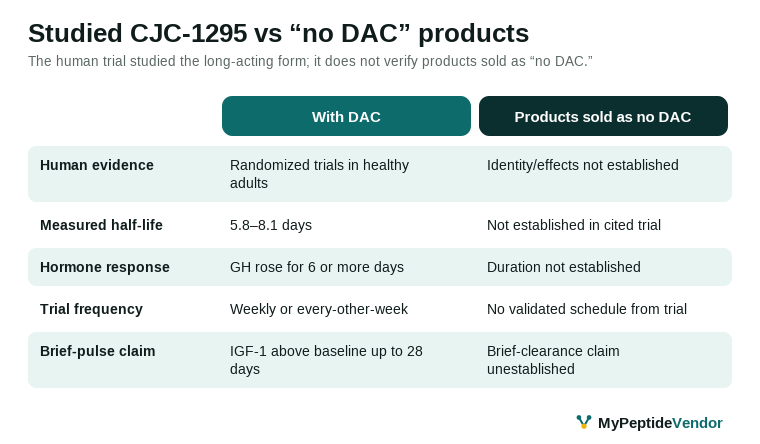
DAC means Drug Affinity Complex. “With DAC” is used to distinguish the long-acting version studied in the human trial from products sold as “no DAC.” The trial measured a 5.8–8.1-day half-life and included weekly or every-other-week injections 2. Those findings do not verify the ingredients, clearance time, or dosing schedule of products marketed as “no DAC.”
The measured response also does not fit a simple claim that the DAC form produces only a brief GH pulse. GH is naturally released in bursts, but the trial found prolonged average GH and IGF-1 responses after injection, including higher IGF-1 for up to 28 days after repeated doses 2. The trial did not establish that this longer signal is better or safer.
CJC-1295 is often paired in marketing with ipamorelin. The proposed rationale is that the peptides act through different pathways: CJC-1295 mimics the GHRH signal, while ipamorelin is a growth hormone secretagogue that acts through a separate ghrelin-related pathway 45. That mechanism-based rationale is not proof that the combination works better in people.
A review reports improved maximum tetanic tension with CJC-1295 plus ipamorelin in mice with glucocorticoid-induced muscle loss 3. That is an animal finding, not evidence that the stack builds muscle or improves recovery in people. Reviews describe no clinical trials establishing a useful combined dose, lasting benefit, or long-term safety 34.
DAC and no-DAC labels
| Feature | CJC-1295 with DAC | Products sold as “no DAC” |
|---|---|---|
| Human evidence | Studied in healthy adults in randomized trials | The 2006 trial does not establish identity or human effects of products sold as 'no DAC'. |
| Measured half-life | 5.8–8.1 days for the studied compound | Not established by the CJC-1295 trial |
| Observed hormone response | GH rose for 6 or more days; IGF-1 rose for 9–11 days after one dose | No comparable response duration is established in the cited trial |
| Trial frequency | Repeated doses included weekly or every-other-week schedules | No validated schedule can be stated from the cited trial |
| Claim of a brief pulse | Multiple doses left mean IGF-1 above baseline for up to 28 days | Brief clearance claims have not been established in the human trial |
Use this chart
Free to reuse with a link back:
How does it work?
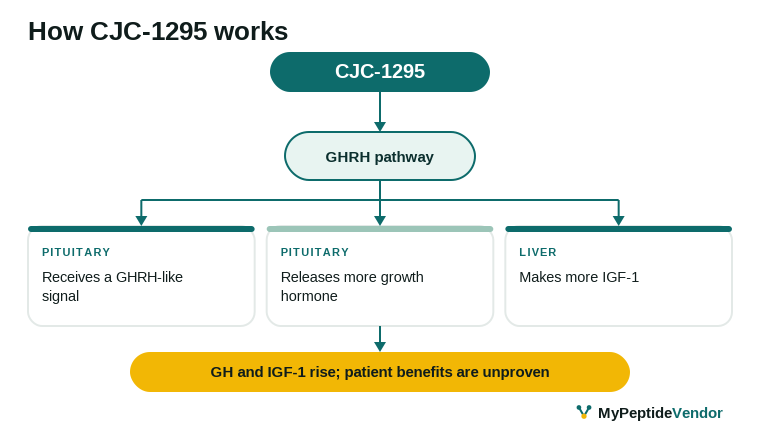
In plain words, CJC-1295 gives the pituitary a signal to release more GH. GH then acts on the body and prompts tissues, including the liver, to make insulin-like growth factor 1 (IGF-1). In the human trial, both GH and IGF-1 increased after CJC-1295 2.
In technical terms, CJC-1295 is a GHRH analog. It acts through the pathway natural GHRH uses to signal the pituitary. The long-acting form studied in people produced a sustained hormone response, with an estimated half-life of 5.8–8.1 days 2.
Ipamorelin works through a separate route. It is a secretagogue, meaning it prompts hormone release, and reviews describe it as acting through the ghrelin-receptor pathway 45. A GHRH-like signal and a secretagogue signal could complement each other in theory. The reported finding in mice does not establish better results in people 3.
A blood test showing higher GH or IGF-1 answers a narrow question: whether the hormone level changed. It does not answer whether someone gains muscle, loses fat, sleeps better, heals faster, or lives longer. The 2006 human study focused on hormone concentrations and short-term safety, not those outcomes 2.
Use this chart
Free to reuse with a link back:
What the clinical evidence actually shows

The key human evidence is Teichman and colleagues’ 2006 study. It included two randomized, placebo-controlled, double-blind, ascending-dose trials lasting 28 and 49 days 2. Participants were healthy adults ages 21–61, and CJC-1295 was given by subcutaneous injection 2. The abstract of the 2006 trial 2 does not report the total number of participants, so n cannot be reliably stated.
The first trial tested single injections. After one dose, mean plasma GH rose 2- to 10-fold for 6 or more days. Mean IGF-1 rose 1.5- to 3-fold for 9–11 days 2. These are hormone changes, not percentages of fat lost or muscle gained.
The second trial used two or three injections on weekly or every-other-week schedules 2. After multiple doses, mean IGF-1 remained above baseline for as long as 28 days, and researchers reported evidence of a cumulative effect 2. The study did not show whether that longer response improved health or caused harm over months or years.
The trial highlighted doses of 30 or 60 micrograms per kilogram 2. A dose stated per kilogram changes with body weight; it is a research measure, not a ready-made personal dose. The trial authors reported no serious adverse reactions and described the tested doses as generally well tolerated, but the abstract does not give percentages for common side effects 2.
What the trial measured
The 2006 Teichman trials 2 assessed their study design and reported main results.
| Study feature | Reported result |
|---|---|
| Design | Two randomized, placebo-controlled, double-blind, ascending-dose trials |
| Participants | Healthy adults ages 21–61; the abstract does not report n |
| Duration | One study lasted 28 days and the other 49 days |
| Dose and route | Trial doses included 30 or 60 micrograms/kg by subcutaneous injection |
| Single-dose GH | Mean GH rose 2- to 10-fold for 6 or more days |
| Single-dose IGF-1 | Mean IGF-1 rose 1.5- to 3-fold for 9–11 days |
| Multiple-dose finding | Mean IGF-1 stayed above baseline for up to 28 days |
| Serious adverse reactions | None were reported in the trial |
What the registered obesity study tells us
ClinicalTrials.gov lists one registered CJC-1295 study: NCT00267527, a Phase 2 study in people with HIV and visceral obesity. Its status is terminated 10. The entry does not give a reason for termination or report results 10. It therefore cannot be used to claim that CJC-1295 reduced abdominal fat or improved outcomes in that group.
What remains unknown
No human CJC-1295 trial establishes muscle gain, fat loss, improved sleep, faster injury recovery, or longer life 2357. The human trial measured GH and IGF-1, not testosterone 2. The effect on testosterone is therefore unknown, not proven absent.
Evidence in women is also very limited. No CJC-1295 trial result in perimenopausal or menopausal women has been reported, and the healthy-adult trial has not established an effect on menopause symptoms or body composition 27.
There is no direct human comparison between CJC-1295 and sermorelin in the cited literature. Reviews discuss both among GHRH-related peptides, but that does not show that they have the same duration, benefit, or safety profile 45.
Long-term safety is unresolved. The human trials lasted 28 and 49 days, while reviews describe limited human safety data for unapproved peptides 25. No testing interval or stopping threshold is established in the trial or reviews 29.
Use this chart
Free to reuse with a link back:
Typical dosing

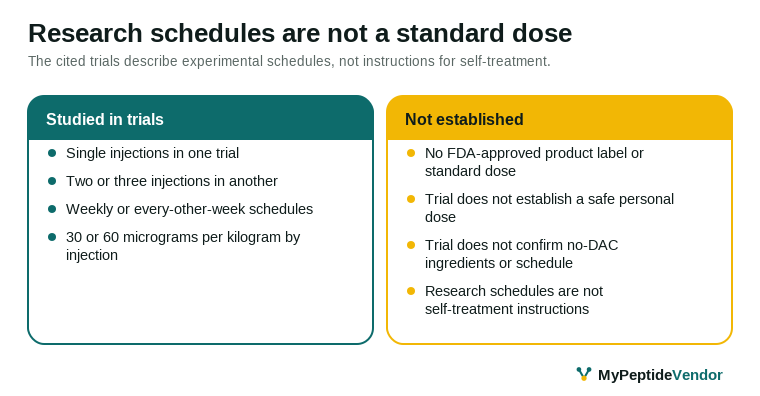
There is no FDA-approved CJC-1295 product label or standard dose 5. The human research used single injections in one trial and two or three injections in another, given weekly or every other week 2. These were experimental schedules, not instructions for self-treatment.
The study highlighted 30 and 60 micrograms per kilogram by subcutaneous injection 2. For scale, the amount per kilogram changes with body weight; it does not mean the same fixed amount suits everyone. The trial does not establish how to convert its research regimen into a safe personal dose.
The long-acting compound had an estimated half-life of 5.8–8.1 days, and the trials included weekly or every-other-week dosing 2. Those results explain why researchers could study those intervals; they do not establish a routine schedule for use outside a trial.
For products sold as “no DAC,” the cited human trial does not confirm the active ingredient, claimed clearance time, or dosing frequency 2. The same uncertainty applies to a CJC-1295 and ipamorelin blend: reviews describe interest in the combination but do not establish a clinical regimen for people 34.
A vial label or online protocol cannot replace an approved prescribing label. Product identity and contents may be uncertain in an unregulated supply chain, where mislabeling and contamination are reported concerns 9.
Use this chart
Free to reuse with a link back:
Side effects: what to actually expect
The 2006 trial reported no serious adverse reactions, but it does not provide percentages for common side effects 2. There is no reliable trial percentage to quote here for headache, flushing, injection-site reactions, or other specific symptoms. “No serious reactions reported” does not show that rare, delayed, or long-term harms cannot occur.
The clearest measured biological effect is a rise in GH and IGF-1. After multiple injections, mean IGF-1 stayed above baseline for up to 28 days 2. The study did not establish a safe long-term IGF-1 target for unsupervised use or define how long it is safe to maintain that elevation.
A review of peptide use in sport and bodybuilding identifies potential concerns across peptide use, including cardiovascular strain, insulin resistance, dyslipidemia, and psychiatric instability 9. These are class and use-context concerns, not CJC-1295-specific event rates. The review does not provide percentages for those outcomes or establish how often they occur with CJC-1295 alone 9.
Risk may be harder to predict when people use doses or combinations outside controlled trials. The review notes that bodybuilding protocols may involve supraphysiological dosing or combinations unlike controlled research regimens 9. The short CJC-1295 studies cannot settle the safety of those patterns 29.
People with concerns involving blood sugar, cardiovascular health, or mental health should discuss the risks with a qualified clinician before considering a hormone-active peptide. This is a cautious approach, not a list of groups proven unsafe in CJC-1295 trials: those trials involved healthy adults and do not establish safety for people with significant chronic illness 29. The cited evidence also does not establish safety in pregnancy or breastfeeding.
Monitoring to discuss with a clinician
These checks relate to the hormone and metabolic concerns described in the human study and review; they are not a validated CJC-1295 monitoring protocol 29.
- Discuss baseline and follow-up IGF-1 testing, since the trial found prolonged IGF-1 elevation after repeated injections 2.
- Discuss fasting glucose or HbA1c because insulin resistance is a potential concern raised in the peptide-use review 9.
- Discuss a lipid panel because dyslipidemia is also identified as a potential concern 9.
- Keep a symptom record, including mood changes and cardiovascular symptoms, and review it with a clinician; no validated CJC-1295 symptom score is established 29.
No testing interval or numeric stopping threshold is established in the trial or reviews 29. A clinician should interpret laboratory results rather than use them to set a self-directed dose.
Regulatory & access status in the US
CJC-1295 is not FDA-approved as a drug, and there is no approved product label or labeled dose 5. FDA’s interim Category 2 policy describes bulk substances that may present significant safety risks in compounding 1. CJC-1295 is not listed among the FDA Category 2 substances 1.
That distinction matters: a general FDA policy about potentially risky bulk substances is not the same as approval of a finished CJC-1295 medicine. A vendor’s claim that a peptide is “compounded” or “prescription grade” does not establish FDA approval, a tested indication, or a validated dose 15.
CJC-1295 is relevant to sport anti-doping because analytical methods have included it among prohibited peptide hormones 8. A published method used immunoaffinity purification and liquid chromatography-mass spectrometry for a panel that included CJC-1295; the method achieved low-picogram-per-milliliter detection limits in urine for the panel 8. That laboratory capability does not mean every sample or test will have the same result. A review also notes expanded anti-doping detection technologies for peptide drugs 9.
US status checklist
- FDA approval: CJC-1295 has no FDA-approved drug product or labeled indication 5.
- Compounding policy: FDA Category 2 is a policy category for bulk substances that may present significant safety risks; CJC-1295’s placement cannot be confirmed from the Category 2 entries in source 1.
- Sport: CJC-1295 appears in published analytical work on prohibited peptide hormones; anti-doping methods can measure peptides at very low urine concentrations 8.
- Online sales: A “research use” label does not prove that a product contains the stated peptide or is suitable for people; mislabeling and contamination are reported supply-chain concerns 9.
How to check a vendor’s claims
No certificate turns an unapproved peptide into an FDA-approved medicine. If assessing a vendor, ask for a recent certificate of analysis (COA) from an independent laboratory. Check for identity and purity testing tied to the specific lot, and confirm that the lot number on the report matches the vial.
A report that gives only a generic purity percentage may not answer whether the vial contains the labeled peptide. Even a lot-specific COA cannot by itself establish sterile manufacturing, clinical safety, or that the product will produce the claimed effects. Mislabeling and contamination have been reported in the unregulated peptide supply chain 9.
Be cautious of claims that promise a specific amount of fat loss, muscle gain, improved sleep, or an anti-aging benefit. The human CJC-1295 research measured hormone changes, not those outcomes 2. An online testimonial or a polished label cannot fill that evidence gap.
Research-grade CJC-1295 is available from Certified-Pep Hulk Bundle. Sold for laboratory research only, not for human use. Affiliate link
How it compares with its closest alternative
Sermorelin is a close comparison because reviews discuss it alongside CJC-1295 as a GHRH-related peptide 45. No direct human head-to-head trial of CJC-1295 versus sermorelin is reported in 245. It cannot show that one works better, lasts longer, or causes fewer side effects.
CJC-1295 and sermorelin have been discussed in the literature 245, but no human head-to-head comparison between them is reported.
| Feature | CJC-1295 | Sermorelin |
|---|---|---|
| Relationship to GHRH | Described as a synthetic GHRH analog | Discussed as a GHRH-related peptide in reviews |
| Human evidence here | Randomized trials measured GH and IGF-1 changes | No head-to-head comparison with CJC-1295 is reported |
| Measured duration | Estimated half-life of 5.8–8.1 days for the studied long-acting form | No comparable head-to-head duration result is reported |
| Proven benefit for body composition | Not established by the cited human trial | No direct comparison establishes a benefit |
| FDA status | Not FDA-approved | Sources do not report a current FDA-approved sermorelin product or indication; FDA status is not established by these reviews. |
| Known advantage over the other | None established in a human head-to-head trial | None established in a human head-to-head trial |
For goals such as fat loss, recovery, sleep, or healthy aging, the available comparison does not support choosing one over the other. CJC-1295 has measured hormone effects in healthy adults, but a hormone response is not a proven patient benefit 245.
Where to Buy CJC-1295 for Research
Certified-Pep Hulk Bundle
CJC-1295 / ipamorelin research bundle with batch-specific COAs.
- CJC-1295 (no DAC) + ipamorelin blend
- Independent testing, QR code on every vial
- Ships from the US in 1-2 business days
American Peptides
CJC-1295 (NO DAC) · from $110.00
US-made research peptides, every lot third-party tested with a lot-matched COA.
15% offMYPEPTIDEVENDOR at checkout
- ≥99% purity verified by HPLC + mass spec, endotoxin tested
- Ships tracked from Louisiana, free shipping over $300
- 15% off your first order with code MYPEPTIDEVENDOR
Affiliate disclosure: we may earn a commission if you order through the link above. CJC-1295 is not approved by the FDA for human use.
Ranked in our guides
Frequently asked questions
What does CJC-1295 actually do?
It gives the pituitary a GHRH-like signal, which can raise GH and IGF-1. The 2006 human trial measured those hormone changes, not a visible change in muscle, body fat, or sleep 2.
Does CJC-1295 affect testosterone?
The effect is unknown. The human trial tracked GH and IGF-1 but did not measure testosterone 2.
What are the downsides of CJC-1295?
There is no approved product dose, and long-term safety has not been established 5. A review raises potential concerns including cardiovascular strain, insulin resistance, lipid changes, and psychiatric instability; it also describes mislabeling and contamination risks in the unregulated supply chain 9.
Is Sermorelin the same as CJC-1295?
No. Reviews discuss both as GHRH-related peptides, but they are not the same compound 45. No head-to-head human trial in the cited literature establishes which is safer or more effective.
How often is CJC-1295 taken?
There is no approved schedule. In human research, repeated injections were given weekly or every other week, but those were experimental study schedules rather than general dosing instructions 2.
References
- FDA: Certain bulk drug substances for use in compounding that may present significant safety risks
- Teichman et al. Prolonged stimulation of growth hormone (GH) and insulin-like growth factor I secretion by CJC-1295, a long-acting analog of GH-releasing hormone, in healthy adults. J Clin Endocrinol Metab. 2006.
- Mayfield et al. Injectable Peptide Therapy: A Primer for Orthopaedic and Sports Medicine Physicians. Am J Sports Med. 2026.
- Rahman et al. Therapeutic Peptides in Orthopaedics: Applications, Challenges, and Future Directions. J Am Acad Orthop Surg Glob Res Rev. 2026.
- Mendias et al. Safety and Efficacy of Approved and Unapproved Peptide Therapies for Musculoskeletal Injuries and Athletic Performance. Sports Med. 2026.
- Renke et al. Therapeutic Peptides in Aesthetic, Metabolic and Endocrine Conditions: Effects, Safety, Clinical Applications, and Future Perspectives. Int J Mol Sci. 2026.
- Mavrych et al. Therapeutic peptides in gerontology: mechanisms and applications for healthy aging. Front Aging. 2026.
- Thomas et al. Immunoaffinity purification of peptide hormones prior to liquid chromatography-mass spectrometry in doping controls. Methods. 2012.
- Coutinho et al. A new era of doping? Use of peptide and peptide-analog drugs in recreational and professional sport and bodybuilding: a critical review. J Sports Med Phys Fitness. 2026.
- ClinicalTrials.gov: 1 registered studies (search: CJC-1295)
Written by the MyPeptideVendor editorial team from the FDA label, peer-reviewed studies and ClinicalTrials.gov records listed above, fact-checked line by line and reviewed 2026-11-12.
Cite this page
MyPeptideVendor Editorial Team. CJC-1295: Evidence, Dosing & Safety. MyPeptideVendor. Updated November 12, 2026. https://mypeptidevendor.com/peptides/cjc-1295/MyPeptideVendor Editorial Team. (2026, November 12). CJC-1295: Evidence, Dosing & Safety. MyPeptideVendor. https://mypeptidevendor.com/peptides/cjc-1295/Related peptides
Follistatin-315
Research UseFollistatin-315 binds activin and is proposed to affect myostatin, but injectable peptide benefits, doses, and risks are not established in controlled human trials.
Learn moreGonadorelin
Not approvedGonadorelin signals the pituitary to release LH and FSH; US Factrel is 50 mcg/mL and labeled for animals, not people. [1]
Learn moreHexarelin
Research UseHexarelin can stimulate growth hormone release, but human evidence does not establish a dose or prove benefits for muscle, fat loss, recovery, or energy.
Learn more