Ghrp 2 Dosage 10mg: Vial Math & Safety
No approved human treatment dose is established; this guide explains 10 mg vial math, diagnostic use, handling, and known safety limits.
Quickstart highlights for a 10 mg vial
There is no established human treatment dose or week-by-week titration schedule for a 10 mg GHRP-2 vial 234. The 10 mg figure describes the vial’s contents, not a recommended amount to take.
Pralmorelin, another name for GHRP-2, is described for diagnostic use in Japan 45. That supervised test is different from a treatment schedule, and the calculations below are for understanding concentration, not medical advice.
- Dose: No human treatment dose, titration schedule, or maximum daily amount is established for GHRP-2 234. Do not treat the full 10 mg vial as a single dose.
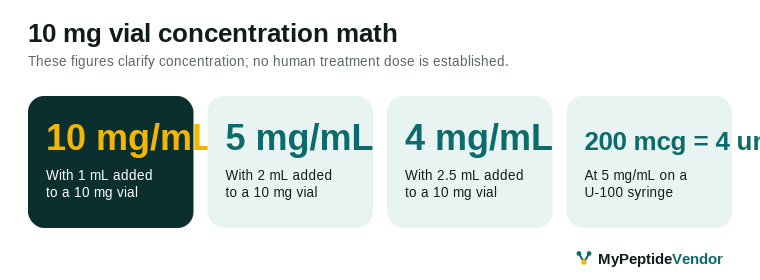
- Vial math: Adding 2 mL to a 10 mg vial gives 5 mg/mL. At that concentration, 200 mcg equals 4 U-100 units; this is arithmetic, not dosing advice.
- Other 10 mg dilutions: Adding 1 mL gives 10 mg/mL, and adding 2.5 mL gives 4 mg/mL. Those different concentrations change the syringe marking for the same amount.
- Diagnostic use: Pralmorelin is described for GH-deficiency testing in Japan 456. A diagnostic test result is not a treatment target.
- Storage: Use the pharmacy’s labeled storage instructions and beyond-use date. A universal post-mixing discard window is not established 235.
U-100 means 100 units per 1 mL. These calculations help interpret a concentration label; they cannot establish product identity, sterility, a safe dose, or whether use is appropriate.
Use this chart
Free to reuse with a link back:
Key takeaways
- No approved human treatment dose or titration schedule is established for GHRP-2 234.
- A 10 mg vial with 2 mL of diluent has a concentration of 5 mg/mL; at that concentration, 200 mcg corresponds to 4 U-100 units.
- Pralmorelin is described for diagnostic use in Japan, not as a general treatment protocol 456.
- The reported diagnostic GH cutoffs of 15.0 µg/L and 9 (written as g/L in one review) refer to different comparisons 56.
- No universal discard period or reliable frequency for side effects is established in the cited sources 235.
Dosing schedule: no human treatment titration is established

No human treatment dose or week-by-week schedule is established for GHRP-2 234. Human evidence describes GH-stimulating activity and diagnostic testing, but does not establish a repeated therapeutic schedule 256. It is not medical advice.
The diagnostic GH cutoffs discussed below must not be converted into injection amounts. They are measured laboratory responses during a supervised test, not target doses for home use 56.
| Week | Dose per injection (mg) | Dose per injection (mcg) | U-100 units | What is established |
|---|---|---|---|---|
| 1 | Not established | Not established | Not established | No validated starting dose. |
| 2 | Not established | Not established | Not established | No validated increase. |
| 3 | Not established | Not established | Not established | No evidence-based titration step. |
| 4 | Not established | Not established | Not established | No established maintenance dose. |
| 5–8 | Not established | Not established | Not established | No treatment phase or cycle length established. |
| 9–12 | Not established | Not established | Not established | No validated long-term schedule. |
The vial math below is included to clarify concentration only. For 5 mg vials, only concentration arithmetic is given; no syringe-unit conversions are provided. For 10 mg vials, the U-100 figures are 1 unit per 100 mcg at 1 mL, 1 unit per 50 mcg at 2 mL, and 1 unit per 40 mcg at 2.5 mL.
| Vial contents | Diluent volume | Concentration | U-100 reference |
|---|---|---|---|
| 5 mg | 2 mL | 2.5 mg/mL | Not provided |
| 5 mg | 2.5 mL | 2 mg/mL | Not provided |
| 5 mg | 5 mL | 1 mg/mL | Not provided |
| 10 mg | 1 mL | 10 mg/mL | 100 mcg = 1 unit; 200 mcg = 2 units; 300 mcg = 3 units |
| 10 mg | 2 mL | 5 mg/mL | 100 mcg = 2 units; 200 mcg = 4 units; 300 mcg = 6 units |
| 10 mg | 2.5 mL | 4 mg/mL | 100 mcg = 2.5 units; 200 mcg = 5 units; 300 mcg = 7.5 units |
As simple content arithmetic, a 10 mg vial contains fifty 200 mcg portions or about thirty-three 300 mcg portions before preparation loss or liquid left in the vial. Those counts do not establish a recommended dose or schedule. A 5 mg vial contains half as much total peptide as a 10 mg vial, while its concentration depends on the amount of diluent.
Syringe Unit Conversion Table
Units to draw on a U-100 insulin syringe (100 units = 1 mL) from a 10 mg vial. Find your dose, then read the column for the water you added. Every number is calculated, not estimated.
| Dose | 1 mL water 10 mg/mL · 1 unit = 100 mcg | 2 mL water 5 mg/mL · 1 unit = 50 mcg | 2.5 mL water 4 mg/mL · 1 unit = 40 mcg |
|---|---|---|---|
| 50 mcg | 0.5 · 200 doses | 1 · 200 doses | 1.25 · 200 doses |
| 100 mcg | 1 · 100 doses | 2 · 100 doses | 2.5 · 100 doses |
| 200 mcg | 2 · 50 doses | 4 · 50 doses | 5 · 50 doses |
| 250 mcg | 2.5 · 40 doses | 5 · 40 doses | 6.25 · 40 doses |
| 300 mcg | 3 · 33 doses | 6 · 33 doses | 7.5 · 33 doses |
| 500 mcg | 5 · 20 doses | 10 · 20 doses | 12.5 · 20 doses |
| 750 mcg | 7.5 · 13 doses | 15 · 13 doses | 18.75 · 13 doses |
| 1 mg | 10 · 10 doses | 20 · 10 doses | 25 · 10 doses |
| 1.5 mg | 15 · 6 doses | 30 · 6 doses | 37.5 · 6 doses |
| 1.7 mg | 17 · 5 doses | 34 · 5 doses | 42.5 · 5 doses |
| 2 mg | 20 · 5 doses | 40 · 5 doses | 50 · 5 doses |
| 2.4 mg | 24 · 4 doses | 48 · 4 doses | 60 · 4 doses |
| 2.5 mg | 25 · 4 doses | 50 · 4 doses | 62.5 · 4 doses |
| 3 mg | 30 · 3 doses | 60 · 3 doses | 75 · 3 doses |
| 4 mg | 40 · 2 doses | 80 · 2 doses | 100 · 2 doses |
| 5 mg | 50 · 2 doses | 100 · 2 doses | over 100 |
| 7.5 mg | 75 · 1 doses | over 100 | over 100 |
| 10 mg | 100 · 1 doses | over 100 | over 100 |
GHRP-2 10 mg Vial Dosage Calculator
Shows the exact insulin-syringe units to draw. Pre-loaded with the 10 mg vial; change any value to match yours.
Total volume of your syringe?
How much mg is in the vial?
How much bacteriostatic water are you adding?
Dose per injection?
Educational tool only. Concentration = vial ÷ water; units = dose ÷ concentration × 100 (U-100 syringe). Confirm every dose with your prescriber. Different vial or peptide? Use the peptide calculator.
Affiliate link · we may earn a commission.
Reconstitution steps
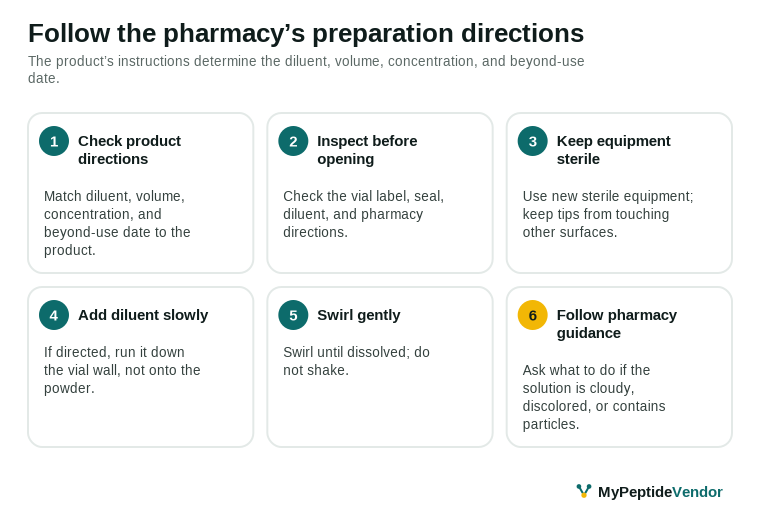
Only follow preparation directions from the dispensing pharmacy for a product prescribed to you. The amount and type of diluent, final concentration, and beyond-use date must match that product’s instructions; changing the liquid volume changes the concentration.
- Check the vial label, seal, diluent, and pharmacy directions before opening anything. Do not use a vial with a damaged seal, unclear identity, or visible damage.
- Use new sterile equipment and clean the vial stopper as directed. Keep the needle and syringe tip from touching hands, counters, or other surfaces.
- If the pharmacy directs you to add diluent, send it slowly down the inside wall of the vial rather than directly onto the powder.
- Swirl gently until the powder dissolves. Do not shake the vial. Ask the pharmacy what to do if the solution remains cloudy, discolored, or contains particles.
- Write the preparation date on the vial only if the pharmacy directs you to do so. Follow its storage instructions and discard the product at the labeled beyond-use date.
Use this chart
Free to reuse with a link back:
Supplies needed for one full vial
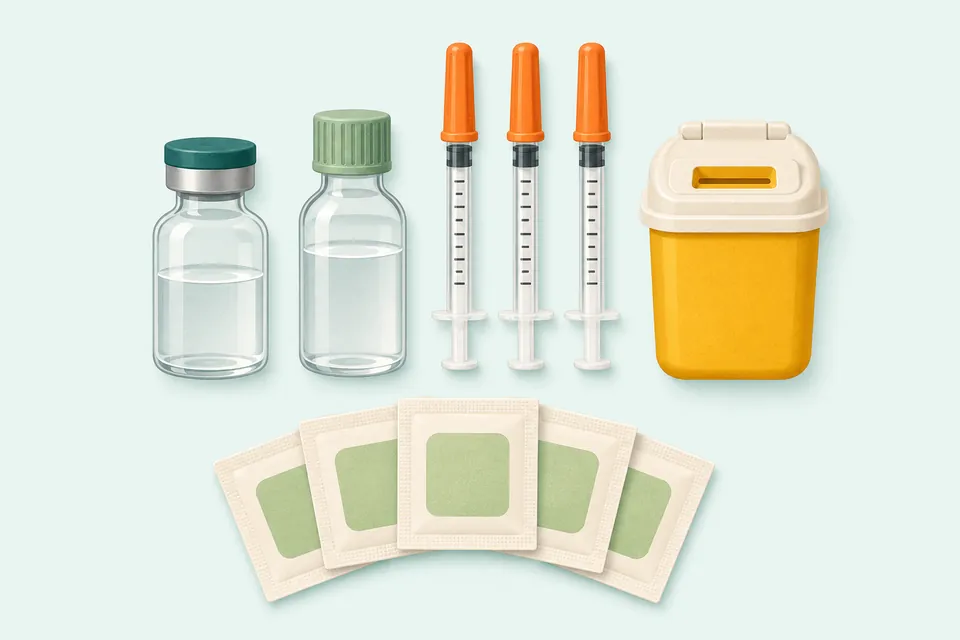
For a 10 mg vial, the pharmacy’s instructions determine the required supplies and diluent volume. The quantities below describe one illustrative 2 mL preparation for concentration math, not a universal preparation instruction.
- 1 correctly labeled 10 mg vial.
- 2 mL of the pharmacy-specified diluent, only if the pharmacy’s directions call for that volume.
- 1 sterile transfer syringe and needle if the pharmacy instructs you to add the diluent yourself.
- 1 new sterile injection syringe for each prescribed injection; the number needed cannot be calculated without a clinician’s prescribed schedule.
- At least 2 alcohol swabs for one preparation and one injection, with additional swabs as directed by the pharmacy or clinician.
- 1 puncture-resistant sharps container for used needles and syringes.
Do not substitute tap water, a different diluent, or previously used equipment. Concentration arithmetic cannot verify sterility, identity, or suitability for a person.
Protocol overview and cycle notes

GHRP-2 activates the growth hormone secretagogue receptor (GHS-R), also called the ghrelin receptor 247. Receptor signaling stimulates growth hormone (GH) release from the pituitary 7; GH then acts through the insulin-like growth factor 1 (IGF-1) axis 2. A hormone response explains the mechanism, but it does not prove a lasting health benefit.
GHRP activity has been described after intravenous, subcutaneous, intranasal, and oral administration 2. Pralmorelin has also been discussed in buccal and depot formats 5. Those routes do not have interchangeable absorption or safety, and their description does not establish a self-treatment schedule.
In Japan, the GHRP-2 stimulation test is described as a convenient and safe alternative to the insulin tolerance test (ITT), which international guidance treats as the diagnostic gold standard 6. Clinicians administer the stimulus and measure the GH response; they interpret the result in the context of the person’s health and other findings. This supervised diagnostic procedure is not a treatment cycle.
The reported cutoffs answer different diagnostic questions. One review gives a peak GH threshold of 15.0 µg/L for distinguishing people with GH deficiency from healthy controls 5. Another review reports a peak GH cutoff of 9 for severe adult GH deficiency during the GHRP-2 test, with the unit printed as g/L 6. These thresholds are not interchangeable and are not targets for self-testing or treatment.
No cycle length, off-cycle period, weekly dose increase, or maximum daily treatment amount is established for GHRP-2 234. A review says clinical efficacy data for growth hormone secretagogues in body composition and hypogonadism remain lacking 3. A GH response alone does not demonstrate fat loss, muscle gain, or improved recovery 235.
Repeated exposure may not produce an identical GH response. A review describes partial desensitization, with greater reduction during continuous infusion and less during intermittent administration, but does not establish a therapeutic schedule or a reliable symptom checklist for reduced response 2. GH-releasing activity also varies with age in the review, while another review describes GH increases in healthy subjects regardless of gender or obesity status 25. Those pooled findings cannot predict an individual response.
Pralmorelin is described as having diagnostic use in Japan 45. The FDA’s category 2 page concerns certain bulk substances identified as presenting potential safety risks in compounding, but it does not establish a GHRP-2 treatment indication or dose 1. Check the product’s legal status and eligibility with a licensed pharmacy or the relevant regulator before relying on a compounded supply.
Storage and handling
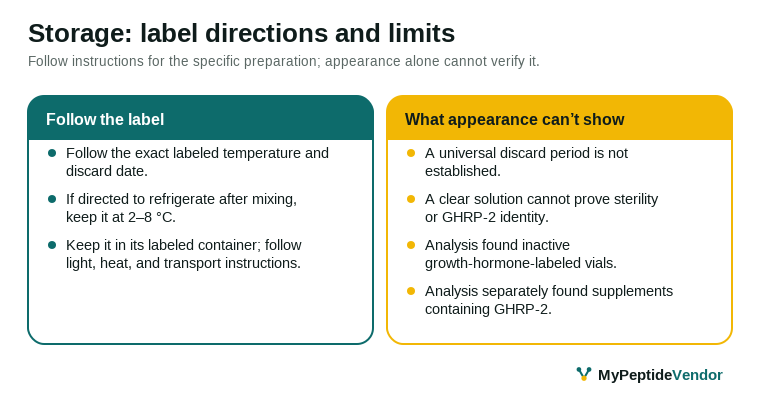
For a pharmacy-dispensed product, follow the exact storage temperature and discard date on its label. If the pharmacy directs refrigeration after reconstitution, keep it at 2–8 °C. A universal discard period for every GHRP-2 preparation is not established 235; the pharmacy’s beyond-use date is the applicable date for that specific preparation.
Keep the vial in its labeled container and follow the pharmacy’s instructions about light, heat, and transport. Do not use it past the labeled date or when the seal, label, or solution raises concern. A clear solution cannot prove that a vial is sterile or contains GHRP-2.
Product authenticity is a real concern: an analysis reported growth-hormone-labeled injection vials with no pharmacologically active content, and separately reported nutritional supplements containing GHRP-2 9. Ask a licensed pharmacist about the supply chain and available identity, purity, and sterility documentation. A seller’s certificate or a vial’s appearance alone cannot verify those qualities.
Use this chart
Free to reuse with a link back:
Injection and tracking tips
Use an injectable product only when it was prescribed for you and supplied with patient-specific directions. U-100 means 100 units equal 1 mL; the vial conversions above describe concentration, not dose instructions. Match the syringe scale and dilution to the actual pharmacy label.
Do not reuse or share needles, syringes, or other injection supplies. Record the product name, dispensing pharmacy, lot number, preparation date, storage conditions, and any symptoms so a clinician or pharmacist can review the details.
Pause and contact the pharmacy before using a vial with a broken seal, inconsistent label, unexpected appearance, or unclear supply chain. The analysis of non-approved products found both inactive growth-hormone-labeled vials and supplements containing GHRP-2, which are distinct findings 9.
Safety and side effects
Reliable frequencies for side effects of repeated GHRP-2 treatment have not been established 235. Changes in cortisol or prolactin after GHRP-2 cannot be quantified, so no rate or clinically meaningful change in either hormone can be stated 235. Missing frequency data do not prove that an effect cannot occur.
Ghrelin signaling is associated with food intake, and pralmorelin is described as mimicking ghrelin’s actions 5. Appetite change is therefore a reasonable concern to raise with a clinician, but a reliable rate or size of effect is not established here. Whether cortisol or prolactin changes occur after GHRP-2 exposure is not established 235.
Partial desensitization is described with prolonged exposure, especially continuous infusion, but no validated monitoring interval or self-check is established 2. The review of adult GH deficiency says it remains unestablished whether GH therapy directly reduces mortality 6. GH stimulation should not be assumed to improve lifespan or body composition.
Contraindications and drug interactions for GHRP-2 are not established 234. Tell a licensed clinician about diabetes, pituitary or other endocrine disease, pregnancy, and all medicines before a GH-stimulating test or treatment. A cachexia review includes GHRP-2 among possible approaches to wasting but says evidence-based recommendations are unavailable for some options 8.
Seek urgent care for trouble breathing, swelling of the face or throat, fainting, severe chest symptoms, or a rapidly worsening reaction after an injection. Contact a clinician promptly after a suspected preparation error, sterility concern, or persistent new symptom.
Sources
- U.S. Food and Drug Administration. Certain bulk drug substances for use in compounding that may present significant safety risks. Category 2 under sections 503A and 503B of the Federal Food, Drug, and Cosmetic Act.
- Ghigo E, et al. Growth hormone-releasing peptides. Eur J Endocrinol. 1997.
- Sinha A, et al. Beyond the androgen receptor: the role of growth hormone secretagogues in the modern management of body composition in hypogonadal males. Transl Androl Urol. 2020.
- Vodnik M, et al. Ghrelin receptor ligands reaching clinical trials: from peptides to peptidomimetics; from agonists to antagonists. Horm Metab Res. 2016.
- Pralmorelin: GHRP 2, GPA 748, growth hormone-releasing peptide 2, KP-102 D, KP-102 LN. Drugs R D. 2004.
- Fukuda I, et al. Adult growth hormone deficiency: current concepts. Neurol Med Chir (Tokyo). 2014.
- Chen C, et al. Growth hormone secretagogue actions on the pituitary gland: multiple receptors for multiple ligands? Clin Exp Pharmacol Physiol. 2000.
- Celichowska M, et al. Pharmacotherapy in cachexia: a review of endocrine abnormalities and steroid pharmacotherapy. J Pain Palliat Care Pharmacother. 2022.
- Kohler M, et al. Confiscated black market products and nutritional supplements with non-approved ingredients analyzed in the Cologne Doping Control Laboratory 2009. Drug Test Anal. 2010.
Frequently asked questions
What is a typical GHRP-2 dose from a 10 mg vial?
No human treatment dose is established for GHRP-2 in the cited reviews 234. The 10 mg amount is the vial’s total content, not a dose for one administration. Japanese pralmorelin use is described for diagnosis, not as a general treatment schedule 46.
How many doses are in a 10 mg vial?
There is no established treatment dose from which to set a recommended dose count 234. As arithmetic only, 10 mg contains fifty 200 mcg portions or about thirty-three 300 mcg portions; neither count recommends a dose or schedule.
Does GHRP-2 need to be injected more than once a day?
No repeated therapeutic schedule is established in the cited reviews 234. Partial desensitization is described with prolonged exposure, but that finding does not establish that multiple daily injections are effective or safe 2.
Is GHRP-2 approved in Japan?
Pralmorelin is described as having diagnostic use in Japan for assessment of GH deficiency 456. Diagnostic use does not establish approval for general treatment or self-directed use.
Can GHRP-2 improve muscle or body composition?
GHRP-2 can stimulate GH release, but a hormone response does not by itself prove a meaningful change in muscle or fat 27. A review says clinical efficacy data for secretagogues in body composition and hypogonadism remain lacking 3.
Can I tell whether an online GHRP-2 vial is genuine?
A label or clear solution cannot establish identity or sterility. An analysis reported inactive growth-hormone-labeled vials and, separately, nutritional supplements containing GHRP-2 9. Ask a licensed pharmacist about the supply chain and appropriate product testing.
References
- FDA: Certain bulk drug substances for use in compounding that may present significant safety risks
- Ghigo et al. Growth hormone-releasing peptides. Eur J Endocrinol. 1997.
- Sinha et al. Beyond the androgen receptor: the role of growth hormone secretagogues in the modern management of body composition in hypogonadal males. Transl Androl Urol. 2020.
- Vodnik et al. Ghrelin Receptor Ligands Reaching Clinical Trials: From Peptides to Peptidomimetics; from Agonists to Antagonists. Horm Metab Res. 2016.
- Pralmorelin: GHRP 2, GPA 748, growth hormone-releasing peptide 2, KP-102 D, KP-102 LN, KP-102D, KP-102LN. Drugs R D. 2004.
- Fukuda et al. Adult growth hormone deficiency: current concepts. Neurol Med Chir (Tokyo). 2014.
- Chen et al. Growth hormone secretagogue actions on the pituitary gland: multiple receptors for multiple ligands? Clin Exp Pharmacol Physiol. 2000.
- Celichowska et al. Pharmacotherapy in Cachexia: A Review of Endocrine Abnormalities and Steroid Pharmacotherapy. J Pain Palliat Care Pharmacother. 2022.
- Kohler et al. Confiscated black market products and nutritional supplements with non-approved ingredients analyzed in the Cologne Doping Control Laboratory 2009. Drug Test Anal. 2010.
Written by the MyPeptideVendor editorial team from the FDA label, peer-reviewed studies and ClinicalTrials.gov records listed above, fact-checked line by line and reviewed 2026-11-12.
Cite this page
MyPeptideVendor Editorial Team. ghrp 2 dosage 10mg: Vial Math & Safety. MyPeptideVendor. Updated November 12, 2026. https://mypeptidevendor.com/protocols/ghrp-2-dosing-10mg/MyPeptideVendor Editorial Team. (2026, November 12). ghrp 2 dosage 10mg: Vial Math & Safety. MyPeptideVendor. https://mypeptidevendor.com/protocols/ghrp-2-dosing-10mg/Related protocols
CJC-1295 DAC 2 mg
Research UseA 2 mg vial is not an approved human dose; this guide covers the evidence gap, vial math, and safety questions to review with a clinician.
View protocolCJC-1295 DAC 5 mg
Research UseNo approved human dose exists for CJC-1295 DAC; this guide explains 5 mg vial math, research limits, monitoring, and safety questions.
View protocolCJC-1295 No DAC 5 mg
Not approvedNo approved human dose exists for CJC-1295 No DAC; this guide explains 5 mg vial math, evidence limits, and safety questions to raise with a clinician.
View protocol