Cjc 1295 Nodac Dosage 5mg: Protocol & Safety
No approved human dose exists for CJC-1295 No DAC; this guide explains 5 mg vial math, evidence limits, and safety questions to raise with a clinician.
Quickstart highlights for cjc 1295 nodac dosage 5mg
For a 5 mg CJC-1295 No DAC vial, no approved human dose or validated week-by-week titration schedule is established. The 5 mg figure is the stated amount in the vial, not a dose for a person.
CJC-1295 is a growth-hormone-releasing hormone analogue (GHRH analogue); ipamorelin is a growth hormone secretagogue (GHS), a different type of peptide 3. The review describes no regulatory approval for physique- or performance-related indications and highlights uncertainty about unregulated products 3. This page explains the math and risks; it is not an instruction to inject a research product.
- No established human dose: CJC-1295 No DAC lacks regulatory approval for physique- or performance-related indications 3. No validated human titration schedule for a 5 mg vial is established.
- Vial amount is not a dose: 5 mg describes the stated peptide amount in the vial. It does not show how much a person should use.
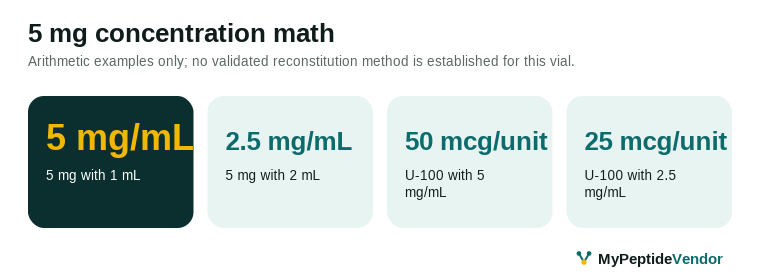
- Water volume changes concentration: Adding 1 mL to 5 mg gives 5 mg/mL; adding 2 mL gives 2.5 mg/mL. Those are arithmetic examples, not directions to prepare or use the product.
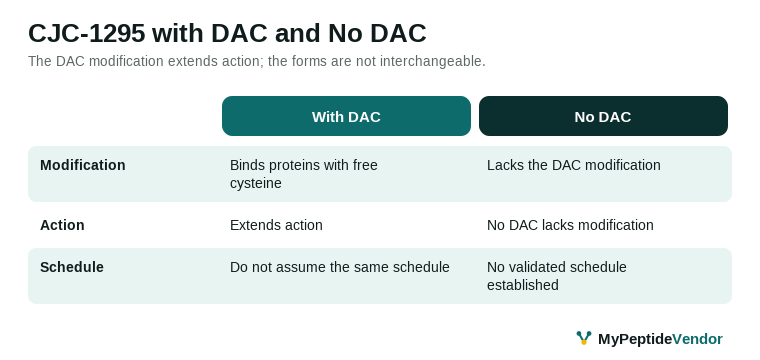
- DAC and No DAC are different forms: The DAC modification binds CJC-1295 to plasma proteins containing free cysteine and extends its action 2. Do not transfer a schedule from one form to the other.
- A blend is not a single-peptide vial: A vial labeled CJC-1295 No DAC plus ipamorelin contains two claimed ingredients. A stated 1:1 mass ratio does not establish identity, purity, or a tested human dose.
- Side-effect rates are unknown: A review describes reported hormone, glucose, fluid-retention, muscle or joint, and injection-site concerns, but gives no dependable frequency for a particular No DAC vial 3.
Key takeaways
- No approved human dose or validated titration schedule is established for a 5 mg CJC-1295 No DAC vial.
- Adding 1 mL gives a nominal 5 mg/mL concentration; at U-100, 1 unit represents 50 mcg.
- Adding 2 mL gives a nominal 2.5 mg/mL concentration; at U-100, 1 unit represents 25 mcg.
- CJC-1295 DAC binds plasma proteins containing free cysteine 2.
- Reported safety concerns include endocrine and glucose changes, fluid retention, muscle or joint symptoms, and injection-site reactions, with no dependable frequency estimates for this vial 3.
Dosing schedule for a 5 mg CJC-1295 No DAC vial

When a molecule has an approved label, its titration should follow that label or the relevant clinical-trial schedule. CJC-1295 No DAC has no approved human titration schedule for this use; the review describes no regulatory approval for physique- or performance-related indications 3. Human research does not establish a week-by-week dose for this 5 mg vial.
The review describes commonly encountered self-administration practices, but those practices are not the same as a validated dose or a clinical-trial protocol 3. The conversion values that follow are math only, not recommendations.
| Period | Dose in mg | Dose in mcg | U-100 units | What is established |
|---|---|---|---|---|
| Week 1 | Not established | Not established | Not established | No validated starting dose |
| Week 2 | Not established | Not established | Not established | No validated increase |
| Week 3 | Not established | Not established | Not established | No validated increase |
| Week 4 | Not established | Not established | Not established | No validated target dose |
| Weeks 5–8 | Not established | Not established | Not established | No validated maintenance schedule |
| Weeks 9–12 | Not established | Not established | Not established | No validated cycle duration |
| After week 12 | Not established | Not established | Not established | No evidence-based break or restart plan |
For concentration math only, 5 mg in 1 mL is 5 mg/mL, or 5,000 mcg/mL. On a U-100 syringe, that concentration equals 50 mcg per unit; for example, 100 mcg corresponds to 2 units. With 2 mL, 5 mg is 2.5 mg/mL, or 2,500 mcg/mL; 1 unit equals 25 mcg and 100 mcg corresponds to 4 units.
Online dose figures can differ because they may refer to different molecules, vial strengths, diluent volumes, or schedules. They may also include arithmetic mistakes. For example, with 5 mg in 2 mL, 6 U-100 units equal 0.06 mL; at 2.5 mg/mL, that volume contains 0.15 mg, or 150 mcg, not 0.3 mg. This correction is only a unit calculation; it does not establish that either amount is an appropriate human dose.
Reported community numbers are not interchangeable with trial evidence. The review discusses online self-administration patterns across several growth-hormone-axis peptides, while also noting uncertainty about dose, product composition, and combinations 3. It does not establish a validated No DAC dose for a 5 mg vial. The 10 mg injection in the equine study was used to assess detection, not to set a human dosing schedule 2.
A dose used in a study of CJC-1295 with DAC would not establish a No DAC dose, and a dose for CJC-1295 alone would not establish a dose for a CJC-1295/ipamorelin blend. The blend’s claimed 1:1 ratio means equal stated masses, not that the combination has been tested as a human regimen. No human trial of the combined No DAC/ipamorelin blend is described in the cited review 3.
Syringe Unit Conversion Table
Units to draw on a U-100 insulin syringe (100 units = 1 mL) from a 5 mg vial. Find your dose, then read the column for the water you added. Every number is calculated, not estimated.
| Dose | 1 mL water 5 mg/mL · 1 unit = 50 mcg | 2 mL water 2.5 mg/mL · 1 unit = 25 mcg | 2.5 mL water 2 mg/mL · 1 unit = 20 mcg |
|---|---|---|---|
| 50 mcg | 1 · 100 doses | 2 · 100 doses | 2.5 · 100 doses |
| 100 mcg | 2 · 50 doses | 4 · 50 doses | 5 · 50 doses |
| 200 mcg | 4 · 25 doses | 8 · 25 doses | 10 · 25 doses |
| 250 mcg | 5 · 20 doses | 10 · 20 doses | 12.5 · 20 doses |
| 300 mcg | 6 · 16 doses | 12 · 16 doses | 15 · 16 doses |
| 500 mcg | 10 · 10 doses | 20 · 10 doses | 25 · 10 doses |
| 750 mcg | 15 · 6 doses | 30 · 6 doses | 37.5 · 6 doses |
| 1 mg | 20 · 5 doses | 40 · 5 doses | 50 · 5 doses |
| 1.5 mg | 30 · 3 doses | 60 · 3 doses | 75 · 3 doses |
| 1.7 mg | 34 · 2 doses | 68 · 2 doses | 85 · 2 doses |
| 2 mg | 40 · 2 doses | 80 · 2 doses | 100 · 2 doses |
| 2.4 mg | 48 · 2 doses | 96 · 2 doses | over 100 |
| 2.5 mg | 50 · 2 doses | 100 · 2 doses | over 100 |
| 3 mg | 60 · 1 doses | over 100 | over 100 |
| 4 mg | 80 · 1 doses | over 100 | over 100 |
| 5 mg | 100 · 1 doses | over 100 | over 100 |
CJC-1295 No DAC 5 mg Vial Dosage Calculator
Shows the exact insulin-syringe units to draw. Pre-loaded with the 5 mg vial; change any value to match yours.
Total volume of your syringe?
How much mg is in the vial?
How much bacteriostatic water are you adding?
Dose per injection?
Educational tool only. Concentration = vial ÷ water; units = dose ÷ concentration × 100 (U-100 syringe). Confirm every dose with your prescriber. Different vial or peptide? Use the peptide calculator.
Affiliate link · we may earn a commission.
Reconstitution steps and 5 mg concentration math
The concentration examples below explain arithmetic only. A 5 mg vial plus 1 mL has a nominal concentration of 5 mg/mL; plus 2 mL, it has a nominal concentration of 2.5 mg/mL. At U-100, which marks 100 units per mL, those concentrations correspond to 50 mcg per unit and 25 mcg per unit, respectively. No validated reconstitution method or post-mixing shelf life is established for this specific vial.
- Identify the exact product. Confirm whether the label says CJC-1295 No DAC alone or names a blend. A 5 mg single-peptide vial is not the same as a vial labeled 5 mg/5 mg.
- Check the batch paperwork. Look for a lot-matched certificate of analysis (COA), laboratory name, test date, lot number, identity result, and purity result. A document with a different lot number does not verify the vial in hand.
- Confirm the diluent and volume with a licensed dispensing pharmacist. Bacteriostatic water and a particular volume should not be assumed suitable for an unapproved product. Product-specific preparation and beyond-use dates depend on the pharmacy’s instructions.
- If the product was lawfully dispensed for human use, follow its written directions. Do not transfer steps from a DAC product, another manufacturer, or a blend to a different vial.
- Inspect the product before use. A broken seal, visible particles, cloudiness, or unexplained color change warrants stopping and contacting the dispensing pharmacy. Clear appearance cannot confirm sterility, identity, or strength.
- Record the preparation date only as directed. A date written on a vial does not extend its tested stability period.
If a pharmacist has directed a preparation, ask them to confirm the amount of water, final concentration, storage conditions, and discard date before handling the vial. The examples of 1 mL and 2 mL above do not select a preparation volume for any specific product.
A combined vial needs separate attention to the amount of each ingredient. If a verified blend contains equal masses of CJC-1295 No DAC and ipamorelin, a draw contains both peptides; the user cannot adjust the amount of one without changing the amount of the other. If the ratio is inaccurate or undocumented, the quantity of each ingredient in a draw is unknown.
Use this chart
Free to reuse with a link back:
Supplies needed for one full 5 mg vial
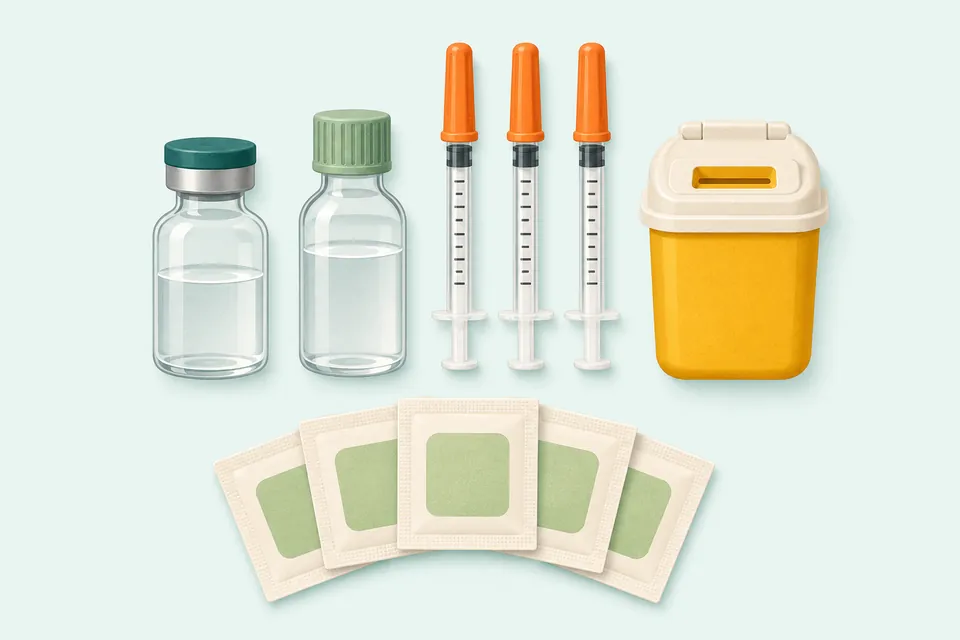
The quantities below are a checklist for a pharmacy-directed preparation, not a recommendation to inject a research-use product. The number of administration syringes cannot be specified without a prescribed schedule, and no validated schedule is established for this vial.
- One vial: one vial of the specifically identified product, with a readable lot number.
- Diluent: one pharmacy-approved container; the type and volume must come from the dispensing instructions, not from a generic online protocol.
- One sterile transfer syringe and needle: for the instructed diluent transfer, if the pharmacy directs the user to prepare it.
- One new sterile syringe and needle per administration: never reuse or share either item. The total quantity depends on the prescriber’s directions.
- Antiseptic wipes: use for the vial stopper and skin as directed by the dispensing pharmacy.
- One sharps container: for used needles and syringes, with disposal according to local rules.
- One set of product-specific written instructions: including route, storage, and discard date for any product dispensed for human use.
A research-use-only label does not make a vial suitable for human injection. The review describes uncertain composition, dose, and stacking practices in unregulated supply chains 3.
Protocol overview, DAC comparison, and cycle notes
CJC-1295 is a GHRH analogue, while ipamorelin is a growth hormone secretagogue; they are different peptides with different signaling roles 3. CJC-1295 is intended to influence growth-hormone signaling, but combining it with ipamorelin does not prove added benefit. A 1:1 blend label describes a claimed mass ratio, not a clinically established ratio or dose.
DAC stands for Drug Affinity Complex. The DAC modification lets CJC-1295 bind plasma proteins that contain free cysteine, extending its action compared with a typical GHRH analogue 2. No DAC lacks that modification. These forms are not interchangeable, and a longer-acting form should not be given the same schedule by assumption.
The equine detection study developed an ELISA that detected CJC-1295 protein conjugates in horse plasma at concentrations as low as 12.5 pg/mL after a 10 mg subcutaneous dose of CJC-1295 2. The study concerned horses and detection, not a human dose or human detection window. Athletes subject to anti-doping rules should be aware that CJC-1295 has been detected by ELISA in equine plasma 2.
The review describes CJC-1295 with and without DAC, ipamorelin, and sermorelin among peptides affecting the GH-IGF-1 axis, while stressing uneven evidence and uncertainty in unregulated use 3. It does not establish a validated No DAC dose, cycle length, required break, or restart schedule for a 5 mg vial. A fixed cycle followed by a fixed break would imply evidence that is not established; absence of a schedule does not prove continuous use is safe.
Sermorelin is also listed as a GHRH analogue, while ipamorelin is a GHS 3. The review does not provide a head-to-head human trial showing that sermorelin or CJC-1295 is more effective or safer. Shared drug class does not make doses interchangeable.
Regulatory and evidence status: The review states that these peptides lack regulatory approval for physique- or performance-related indications 3. FDA Category 2 describes certain bulk substances that may present significant safety risks when considered for compounding 1. FDA's Category 2 listing is not FDA approval 1.
In the United States, “research use only” describes the stated intended use on a product label; it is not a prescription for human treatment. A non-prescribed vial should not be treated as a quality-controlled medicine. If a clinic or pharmacy offers a human-use product, ask who prescribed it, which licensed pharmacy dispensed it, and what product-specific monitoring and follow-up are planned.
Use this chart
Free to reuse with a link back:
Storage and handling

No validated post-reconstitution shelf life is established for this specific 5 mg No DAC vial. Do not assume a commonly repeated number of days or weeks applies. If a licensed pharmacy dispensed the product for human use, follow the exact storage directions and discard date printed on that pharmacy’s label.
Keep the product in its original labeled container, away from children and pets. Do not freeze, warm, or move a prepared product between storage conditions unless the dispensing pharmacy directs you to do so. A solution can look clear and still have uncertain strength or sterility.
Check the seal, lot number, product name, and pharmacy label each time you handle the vial. The review identifies uncertainty about composition and dose in unregulated peptide supply chains 3. A COA may document a claimed batch result, but it does not by itself prove that the vial matches the sample or that an injectable product is sterile.
For a pharmacy-dispensed product, keep a written record of the lot number, preparation date, and pharmacy discard date. That record can help a pharmacist investigate a reaction; it does not extend the product’s shelf life.
Injection and tracking tips
This page does not provide a self-injection plan for research-use CJC-1295. If a clinician prescribed a lawful product, ask the prescriber or pharmacist to demonstrate the exact route, syringe, site, and disposal method. A technique used for another peptide may not apply to this product.
For a prescribed injectable, use only the route on its label. A clinician may approve common subcutaneous sites such as the abdomen or outer thigh, depending on the product and person. Rotate sites, and do not inject through skin that is irritated, bruised, infected, or damaged.
Timing around meals and bedtime has not been established as a proven No DAC schedule. Claims that this vial must be used at bedtime or a fixed number of hours after food should not be presented as trial-backed instructions. Follow the product-specific directions from the prescriber rather than adding fasting rules or changing timing on your own.
Keep a dated record of the product name, lot, prescribed amount, administration time, site, symptoms, and missed doses. Do not double a later amount after a missed dose; ask the prescriber or pharmacist for instructions specific to the prescription.
Ask a clinician whether baseline and follow-up laboratory checks are appropriate. The review identifies dysglycaemia and reported prolactin and cortisol elevations among concerns for peptides affecting the GH-IGF-1 axis 3. No validated monitoring interval or target is established for this vial.
| Marker to discuss | Why it may matter | What is not established |
|---|---|---|
| IGF-1 | It can help a clinician assess growth-hormone-axis activity. | No target value, expected change, or testing interval is established for this vial. |
| Fasting glucose and HbA1c | Dysglycaemia is among the metabolic concerns described in the review. | No testing frequency or dose-adjustment rule is established. |
| Prolactin | Prolactin elevation is among reported endocrine concerns. | No incidence rate or action threshold is established for this product. |
| Cortisol | Cortisol elevation is among reported endocrine concerns. | No monitoring interval or dose-adjustment rule is established. |
Laboratory results need clinical interpretation alongside symptoms, medical history, and other medicines. Do not raise a dose to chase an IGF-1 value; no validated target or titration threshold is established for this vial.
Safety, side effects, and who should avoid unsupervised use
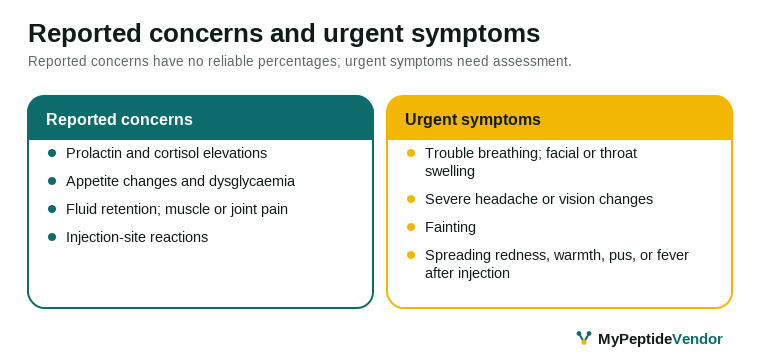
The review lists reported prolactin and cortisol elevations, appetite changes, dysglycaemia, fluid retention, muscle pain, joint pain, and injection-site reactions across performance-enhancing peptides that affect the GH-IGF-1 axis 3. It does not provide reliable percentages for each effect or establish how often they occur with a specific No DAC vial. A numeric frequency cannot be stated honestly.
Stop using a product and contact a clinician for new or worsening swelling, persistent joint or muscle pain, unusual thirst or urination, or a marked change in glucose readings. Seek urgent care for trouble breathing, facial or throat swelling, severe headache, vision changes, fainting, or spreading redness, warmth, pus, or fever after an injection. These symptoms need assessment; they do not prove the peptide caused them.
People with diabetes or abnormal glucose, a pituitary disorder, active cancer, pregnancy, or breastfeeding should not self-start a peptide that may affect growth-hormone signaling. The review discusses endocrine and metabolic concerns and biologically plausible but unproven mitogenic concerns 3; it does not quantify cancer risk or prove that CJC-1295 causes cancer. A clinician must assess individual risks rather than treating this list as a complete formal contraindication list.
Before any prescribed use, disclose all medicines, hormones, supplements, and other peptides. The review notes uncertainty about dose and stacking practices in unregulated supply chains 3. Do not combine CJC-1295 with ipamorelin or another growth-hormone-axis compound unless a qualified prescriber has reviewed the exact products and reason for use.
Ask a vendor or prescriber for the product’s full name, whether it contains DAC, the stated amount of each peptide, a lot-matched COA, identity and purity results, sterility testing where relevant, dispensing pharmacy, and written storage directions. A purity result alone does not prove that an injectable product is sterile or correctly dosed.
FDA Category 2 applies to certain bulk substances that may present significant safety risks in compounding 1. It is not a general safety rating for every peptide, and FDA’s Category 2 listing does not establish CJC-1295’s listing status 1. Ask a licensed pharmacist or regulator about the exact product rather than relying on terms such as “research grade” or “third-party tested.”
Use this chart
Free to reuse with a link back:
Frequently asked questions
What is the dosage for a 5 mg vial of CJC-1295 No DAC?
No approved human dose or validated titration schedule is established for a 5 mg CJC-1295 No DAC vial. The 5 mg amount describes the vial’s stated contents, not a recommended dose. Ask a licensed clinician and pharmacist about the exact product and its legal status.
How many units are in 100 mcg after reconstitution?
It depends on the water volume. With 1 mL added to a 5 mg vial, 100 mcg is 2 U-100 units; with 2 mL, it is 4 U-100 units. These are concentration conversions, not dosing advice.
What should I do if I miss a dose?
No missed-dose rule is established for this product. Do not double a later amount; contact the prescriber or pharmacist if it was prescribed.
Can CJC-1295 No DAC help with weight loss?
A reliable weight-loss benefit or human dose for that purpose is not established here. The review describes uncertainty around unapproved physique- and performance-related use 3.
Is CJC-1295 No DAC used for bodybuilding?
Some products are marketed for physique or performance use, but those indications lack regulatory approval 3. The equine study detected CJC-1295 protein conjugates in horse plasma; it does not establish human detection windows 2.
How is CJC-1295 No DAC different from CJC-1295 DAC?
The DAC modification binds CJC-1295 to plasma proteins containing free cysteine and extends its action 2. No DAC lacks that modification, so the two forms should not be treated as having the same dosing interval.
How does CJC-1295 compare with sermorelin?
Both are listed as GHRH analogues in the review 3. No head-to-head human trial in the review establishes that one is safer or more effective, and their doses should not be assumed interchangeable.
Is a CJC-1295 No DAC and ipamorelin blend the same as separate vials?
No. A blend places both peptides in one vial, while separate vials keep the products physically distinct. A claimed 1:1 mass ratio does not establish the blend’s contents or a tested human regimen; the review describes uncertainty around combination use 3.
How long should a cycle last, and do I need a break?
No validated cycle length, required break, or restart schedule is established for this 5 mg No DAC vial. A fixed cycle would imply evidence that is not established.
How long does it take to see an IGF-1 change?
A reliable timeline for a measurable IGF-1 change with this vial is not established. Do not use an assumed timeline or target to raise a dose; ask a clinician when testing is appropriate and how to interpret the result.
Does bacteriostatic water make a vial safe to use?
No. Diluent does not verify a vial’s identity, purity, sterility, strength, or suitability for human use. Follow product-specific directions from a licensed dispensing pharmacy, including its discard date.
References
- FDA: Certain bulk drug substances for use in compounding that may present significant safety risks
- Timms et al. Detection of CJC-1295 in Equine Plasma by ELISA. Drug Test Anal. 2026.
- Dominikowski et al. The emerging landscape of performance-enhancing peptides modulating GH-IGF1 axis: bridging the gap between clinical evidence and patient self-administration. Front Endocrinol (Lausanne). 2026.
Written by the MyPeptideVendor editorial team from the FDA label, peer-reviewed studies and ClinicalTrials.gov records listed above, fact-checked line by line and reviewed 2026-11-12.
Cite this page
MyPeptideVendor Editorial Team. cjc 1295 nodac dosage 5mg: Protocol & Safety. MyPeptideVendor. Updated November 12, 2026. https://mypeptidevendor.com/protocols/cjc-1295-nodac-dosing-5mg/MyPeptideVendor Editorial Team. (2026, November 12). cjc 1295 nodac dosage 5mg: Protocol & Safety. MyPeptideVendor. https://mypeptidevendor.com/protocols/cjc-1295-nodac-dosing-5mg/Related protocols
CJC-1295 DAC 2 mg
Research UseA 2 mg vial is not an approved human dose; this guide covers the evidence gap, vial math, and safety questions to review with a clinician.
View protocolCJC-1295 DAC 5 mg
Research UseNo approved human dose exists for CJC-1295 DAC; this guide explains 5 mg vial math, research limits, monitoring, and safety questions.
View protocolGHRP-2 10 mg
Research UseNo approved human treatment dose is established; this guide explains 10 mg vial math, diagnostic use, handling, and known safety limits.
View protocol