Hexarelin: Evidence, Dosing & FDA Status
Growth hormone-releasing peptide
Brand names: Also called examorelin.

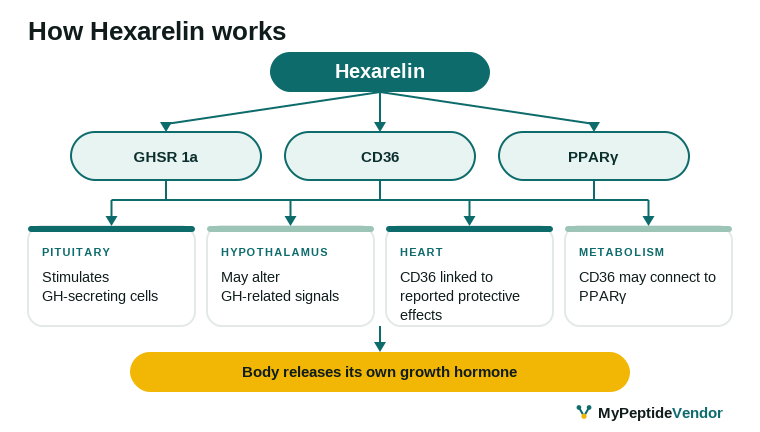
Hexarelin is a synthetic growth hormone secretagogue: it signals the body to release growth hormone (GH) by activating the growth hormone secretagogue receptor, GHSR 1a 34. It prompts release of the body’s own GH rather than supplying GH directly, as an injection does 37.
Human research has examined GH responses, while cardiac findings include animal and cell studies 469. The evidence does not establish a hexarelin-specific human dose, or a measurable amount of muscle gain, fat loss, faster recovery, or increased energy 46789.
Key takeaways
- Hexarelin acts at GHSR 1a; CD36 is linked to reported heart effects that may not depend on GH release alone 4.
- GH release has been reported after 4 routes: intravenous, subcutaneous, intranasal, and oral 8.
- In people with obesity, GH responses to hexarelin were greater than those to GHRH but lower than responses in lean people 6.
- A review of growth hormone secretagogues raises concern about increased blood glucose from reduced insulin sensitivity, but gives no hexarelin-specific rate 7.
- No validated hexarelin dose range or hexarelin-specific clinical side-effect percentages are established 146789.
Hexarelin at a glance
- Class
- Synthetic growth hormone-releasing peptide (GHRP)
- Mechanism
- Stimulates GH release through GHSR 1a; CD36 is linked to reported cardiovascular effects.
- FDA Status
- Not FDA-approved for use as a treatment.
- Brand names
- Also called examorelin.
- Administration
- GH release has been reported after intravenous, subcutaneous, intranasal, and oral administration.
- Typical Dose
- No validated hexarelin dose range is established in the available evidence.
- Half-life
- A dependable human half-life is not established in the available evidence.
- Primary Uses
- No established clinical use is demonstrated; research includes GH responses and possible cardiovascular effects.
What is it?

Hexarelin, also called examorelin, is a synthetic growth hormone-releasing peptide (GHRP) 3. GHRPs stimulate GH secretion in animals and humans, and hexarelin belongs to the same peptide family as GHRP-6 and GHRP-2 38.
Its main hormone target is GHSR 1a, the growth hormone secretagogue receptor also activated by the natural hormone ghrelin 4. GHRP binding has also been reported in tissues outside the hypothalamus and pituitary, including the heart and blood vessels 9. Receptor binding outside the brain is a reason researchers have studied possible effects beyond GH release; it is not proof of a treatment benefit 49.
Hexarelin is not the same as a GH injection. A GH injection supplies the hormone, while hexarelin stimulates the body’s own release system 37. Secretagogues can promote pulsatile GH release subject to negative feedback, but that difference does not prove that they are safer or more useful for a particular health goal 7.
Claims about muscle gain, fat loss, exercise recovery, and energy often extend from the known roles of GH or findings about secretagogues as a group. A review discusses possible lean-mass effects for GHSs in some settings, but does not give hexarelin-specific human measurements for muscle, fat, recovery, or energy 7. A rise in GH after a dose is a hormone response, not evidence that someone gained muscle or lost fat.
What makes it different
Compared with natural ghrelin, hexarelin is described as more chemically stable and functionally more potent 4. That comparison concerns the compounds’ properties; it does not establish that hexarelin produces better health outcomes in people 4.
Hexarelin has been studied through more than one receptor pathway. GHSR 1a is associated with its GH-releasing action, while CD36, a separate receptor, is linked to reported cardioprotective effects 4. This matters because some experimental heart effects may not depend on GH release alone 49.
A proposed metabolic pathway connects CD36 activation with PPARγ, a regulator involved in metabolism 5. This pathway has been discussed in relation to lipid handling and energy metabolism, but it does not establish that hexarelin treats diabetes, obesity, or heart disease in people 5.
GHRP studies describe dose-related GH release after intravenous, subcutaneous, intranasal, and oral administration 8. The routes have not been shown to be interchangeable or equally safe, and a route used in research does not verify that an online product will absorb as expected 8.
GHRPs as a group can show partial desensitization, with more reported during continuous infusion and less during intermittent administration 3. That finding does not establish whether tolerance develops with a particular hexarelin schedule, how quickly it might occur, or whether it reverses after stopping 3.
A dependable human half-life and a dosing interval based on it are not established 346789. Without that information, a claimed timing schedule should not be treated as a clinically validated regimen.
How does it work?
In plain words, hexarelin acts like a signal asking the body to release GH. It activates GHSR 1a, a receptor in the ghrelin system, and stimulates GH-secreting cells 34. The hormone comes from the body rather than from a GH injection.
The full signaling pathway is not settled. GHRPs appear to act at both the pituitary and hypothalamus; proposed explanations include changes in somatostatin activity, interaction with growth hormone-releasing hormone (GHRH), or other hypothalamic signals 38. How much each pathway contributes to an individual’s response to hexarelin is not known.
GH release normally sits within a feedback system. GHSs can promote pulsatile GH release subject to negative feedback, unlike direct GH administration 7. That distinction does not eliminate concern about effects on blood glucose or other hormones 79.
Some proposed heart effects involve signaling outside the pituitary GH pathway. Hexarelin’s reported cardioprotective effects have been linked to CD36, and GHRP-family binding has been found in human cardiovascular tissue 49. These are experimental findings, not proof that hexarelin prevents or treats heart disease.
Use this chart
Free to reuse with a link back:
What the clinical evidence actually shows

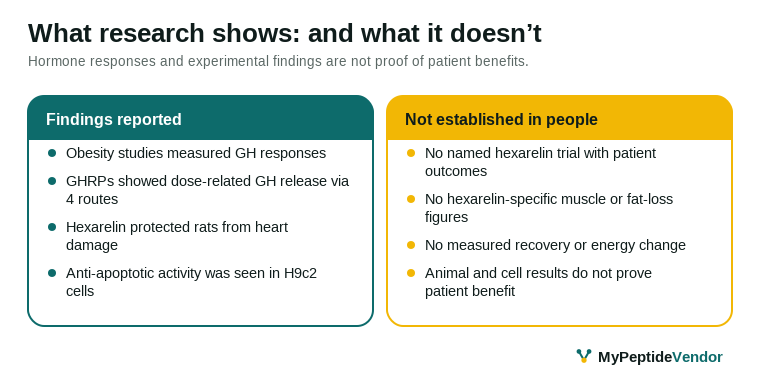
The evidence falls into human GH-response research, reviews of secretagogues as a class, and cardiovascular experiments. These evidence types answer different questions. The clinical reviews do not report a named hexarelin trial with participant count, treatment duration, and numerical patient outcomes for muscle, fat loss, recovery, or energy 46789.
Human GH-response research
In people with obesity, hexarelin and GHRP-6 produced GH responses greater than those evoked by GHRH, but the responses remained lower than those observed in lean people 6. This is a hormone-response result; it does not show that participants lost weight, gained muscle, or felt more energetic 6.
The obesity review describes combined GHRH and GHRP-6 administration as the strongest GH-releasing stimulus discussed for people with obesity, while still less effective than in lean subjects 6. It does not provide a hexarelin-specific participant count, treatment duration, dose, or body-composition result for that comparison 6.
GHRP reviews report reproducible, dose-related GH release after 4 routes: intravenous, subcutaneous, intranasal, and oral 8. That finding does not establish a dose for a vial sold online or show that the routes produce equivalent exposure 8.
Muscle, fat, recovery, and energy
A review of GHSs discusses possible class-level effects, including increased lean mass in some groups such as people with wasting conditions or obesity 7. It also reports that few long-term, rigorously controlled studies have examined GHS efficacy and safety 7. Those broad findings do not prove that hexarelin builds muscle in healthy adults.
The reviews do not give hexarelin-specific human figures for muscle gain, fat loss, strength, exercise recovery, or energy 46789. A higher GH measurement after a dose is a laboratory result, not a measured change in body composition or daily function.
Cardiovascular findings
Cardiovascular research includes animal studies, cell experiments, and reports of direct heart effects; it does not establish hexarelin as a standard heart treatment 49. Hexarelin protected against ischemia-induced myocardial damage in aged and GH-deficient rats, and showed anti-apoptotic activity in H9c2 cells 9. These findings do not establish a benefit in patients.
Muccioli and colleagues reported the highest binding of a labeled GHRP-family ligand in human ventricles, followed by atria and several vascular tissues 9. They also reported anti-apoptotic activity in H9c2 cells 9. Tissue binding and cell activity do not demonstrate improved survival or heart function in people.
Hexarelin’s cardiovascular findings include animal and cell models as well as tissue binding 49. Animal doses, sample sizes, and study durations for hexarelin's reported effects are not specified 49.
| Model | Reported observation | What the finding means |
|---|---|---|
| Aged rats | Protection from ischemia-induced myocardial damage | An animal result, not proof of a human treatment effect. |
| GH-deficient rats | Protection from ischemia-induced myocardial damage | Consistent with possible effects beyond raising GH. |
| H9c2 cardiomyocyte cell line | Anti-apoptotic activity | A cell finding, not a patient outcome. |
| Human cardiovascular tissue | Highest reported binding in ventricles among the sampled tissues | Binding does not establish clinical benefit. |
How strong is the evidence?
- Cell and animal findings: show possible cardiovascular mechanisms, including CD36-related effects, but do not establish the size of a human benefit 49.
- Human GH-response research: shows GH stimulation and a lower response in people with obesity than in lean people 6.
- Secretagogue-class reviews: discuss possible lean-mass effects in some groups, while reporting few long-term, rigorously controlled studies 7.
- Long-term clinical outcomes: do not establish hexarelin’s effects on muscle gain, fat loss, recovery, energy, or long-term disease risk 4789.
No named hexarelin trial is reported with a participant count, treatment duration, and numerical clinical outcome for these proposed benefits 46789. There are no trial figures here that support a specific amount of muscle gained, fat lost, or energy improved.
A human time-to-results estimate is not established. GH responses have been studied, but the evidence does not give a dependable timeline for muscle, fat, recovery, or energy outcomes 678. A short-term hormone response cannot predict when a practical benefit will appear, or whether one will appear.
Whether repeated hexarelin use causes clinically meaningful tolerance has not been established. Partial desensitization is reported for GHRPs as a group, especially during continuous infusion, but that does not quantify tolerance with a particular hexarelin dose or schedule 3.
Menopausal use has not been established in the clinical evidence discussed here. The human research described focuses on GH responses, while other work includes cardiovascular or animal research; it does not provide menopause-specific treatment results 679.
Use this chart
Free to reuse with a link back:
Typical dosing

No validated hexarelin dose range is established in the available evidence 8. GHRP research describes dose-related GH release, but does not provide a trial-backed hexarelin regimen that can be transferred to a research-use vial 8.
For that reason, there is no evidence-based typical dose to give for self-administration. A dose used in a study depends on its formulation, route, and monitoring; it does not validate a product sold online or show that the product is suitable for human use.
Research describes intravenous, subcutaneous, intranasal, and oral routes for GHRPs 8. That does not show that these routes deliver equal amounts or have equal safety. A route printed on a vial or product page cannot establish that its formulation is appropriate for that route.
Timing and cycling advice are not established. Partial desensitization has been reported for GHRPs, particularly during continuous infusion, but this does not establish a hexarelin schedule that avoids tolerance 3.
For a vendor-sourced vial, the label alone cannot verify identity, purity, sterility, or dose accuracy. A product review should check whether any test report identifies the finished batch and addresses the contents actually being used. No test report can establish clinical benefit or turn an unapproved product into an approved medicine.
Side effects: what to actually expect
No hexarelin-specific percentage rates for side effects are established in the clinical reviews 46789. There is no supported trial percentage here for headache, nausea, swelling, or another symptom.
For GHSs as a group, a clinical review describes available studies as generally well tolerated, while raising concern that blood glucose may increase as insulin sensitivity falls 7. It gives no hexarelin-specific glucose change or percentage rate 7. The review also reports that few long-term, rigorous studies have examined safety 7.
Reduced insulin sensitivity is a practical concern because it can worsen blood sugar control 7. Someone with diabetes or prediabetes should discuss drugs that affect the GH axis with a clinician rather than assume that a secretagogue has no metabolic effects. The review does not quantify this risk specifically for hexarelin 7.
Water retention is a generally recognized possible concern with increased GH activity, but a hexarelin-specific incidence or measured rate is not established. Swelling or rapid unexplained weight change should not be treated as proof that the peptide is working.
GHRP-family compounds can affect hormones beyond GH, including prolactin and ACTH/cortisol 9. A hexarelin-specific frequency for these changes is not established 9. Hormone stimulation does not by itself prove pituitary damage; long-term effects of repeated exposure remain uncertain 79.
Cardioprotective findings in animals and cells do not establish cardiovascular safety in people using hexarelin outside a controlled study 49. An experimental benefit in one setting cannot rule out unwanted effects in another.
Regulatory & access status in the US (as of 2026)
Hexarelin is not an FDA-approved treatment for muscle gain, fat loss, aging, or another medical use. FDA’s bulk-substance compounding framework addresses substances proposed for compounding and potential safety concerns; it does not establish an approved hexarelin prescription product or a hexarelin dosing label 1.
Products sold as “research use” are not established as medicines for human use. A vendor’s wording does not verify identity, purity, sterility, or dose accuracy, and a research-use vial is not equivalent to an FDA-approved medication.
Sport eligibility is separate from FDA approval. Athletes subject to testing should check current anti-doping and league rules before exposure; the rules that apply depend on the sport and governing organization.
A practical product-check list includes verifying the stated peptide identity, batch-specific purity information, sterility information, concentration, and dose measurement. Check whether any testing report applies to the finished vial rather than only a raw ingredient. These checks can flag unanswered quality questions, but they cannot establish safety or benefit for human use.
How it compares to its closest alternative
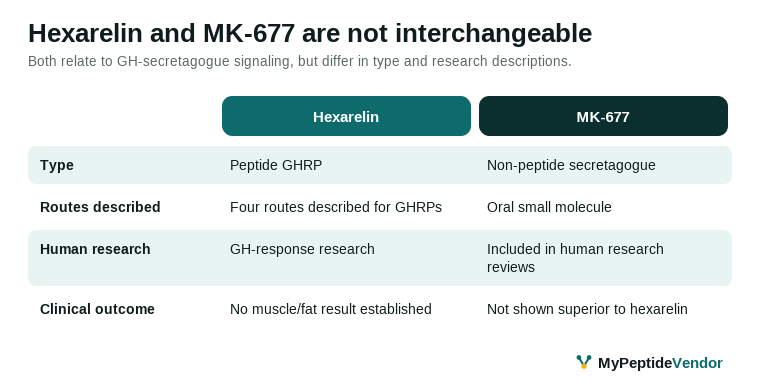
Hexarelin, GHRP-6, GHRP-2, ghrelin, and MK-677 are related to GH-secretagogue signaling, but they are not interchangeable. GHRPs are peptides, while MK-677 is a non-peptide secretagogue; ghrelin is the natural ligand for GHSR 1a 348.
| Compound | Receptor or pathway | Routes described | Human evidence level |
|---|---|---|---|
| Hexarelin | GHSR 1a; CD36 is linked to reported cardiac effects | Intravenous, subcutaneous, intranasal, oral | GH-response research; no established human muscle or fat-loss result. |
| GHRP-6 | GHRP receptor system; GH-release effects can interact with GHRH | GHRP routes are described across the class | One of the first GHRPs studied extensively in humans; obesity GH response discussed alongside hexarelin. |
| GHRP-2 | GHRP receptor system | GHRP routes are described across the class | Human research history is described; no superior clinical outcome is established. |
| Ghrelin | Natural ligand for GHSR 1a | Not compared route by route here | Cardiovascular research is discussed; no direct clinical comparison with hexarelin is established. |
| MK-677 (ibutamoren) | Non-peptide growth hormone secretagogue | Oral small molecule | Included in reviews of human secretagogue research; not shown to be superior to hexarelin. |
Hexarelin and sermorelin signal through different pathways: hexarelin is a GHRP, while sermorelin is a GHRH analog. GHRPs and GHRH have no structural homology, and their combination can produce a stronger GH response in research 38. A stronger hormone response in a particular setting does not establish better patient outcomes.
No head-to-head trial establishes that hexarelin is better than ipamorelin. No direct evidence establishes that it is better than sermorelin for muscle, fat loss, function, or safety. The same caution applies to GHRP-6, GHRP-2, ghrelin, and MK-677: differences in mechanism do not establish a clinical winner.
Use this chart
Free to reuse with a link back:
Ranked in our guides
Frequently asked questions
Is Hexarelin better than Ipamorelin?
No head-to-head hexarelin–ipamorelin trial establishes that one is better. There is no direct evidence showing superior muscle, fat-loss, or safety outcomes with either peptide.
Does Hexarelin increase muscle mass?
Hexarelin-specific human evidence has not established increased muscle mass. A review discusses possible lean-mass effects for growth hormone secretagogues as a group, but those findings do not prove that hexarelin builds muscle 7.
Is Hexarelin better than Sermorelin?
No direct comparison establishes better clinical results with hexarelin than with sermorelin. They signal through different pathways, and a difference in GH response alone would not prove better muscle, fat-loss, or safety outcomes.
References
- FDA: Certain bulk drug substances for use in compounding that may present significant safety risks
- Kolovou et al. We are ageing. Biomed Res Int. 2014.
- Ghigo et al. Growth hormone-releasing peptides. Eur J Endocrinol. 1997.
- Mao et al. The cardiovascular action of hexarelin. J Geriatr Cardiol. 2014.
- Maréchal et al. The CD36-PPARγ Pathway in Metabolic Disorders. Int J Mol Sci. 2018.
- Scacchi et al. Growth hormone in obesity. Int J Obes Relat Metab Disord. 1999.
- Sigalos et al. The Safety and Efficacy of Growth Hormone Secretagogues. Sex Med Rev. 2018.
- Camanni et al. Growth hormone-releasing peptides and their analogs. Front Neuroendocrinol. 1998.
- Muccioli et al. Growth hormone-releasing peptides and the cardiovascular system. Ann Endocrinol (Paris). 2000.
Written by the MyPeptideVendor editorial team from the FDA label, peer-reviewed studies and ClinicalTrials.gov records listed above, fact-checked line by line and reviewed 2026-11-12.
Cite this page
MyPeptideVendor Editorial Team. hexarelin: Evidence, Dosing & FDA Status. MyPeptideVendor. Updated November 12, 2026. https://mypeptidevendor.com/peptides/hexarelin/MyPeptideVendor Editorial Team. (2026, November 12). hexarelin: Evidence, Dosing & FDA Status. MyPeptideVendor. https://mypeptidevendor.com/peptides/hexarelin/Related peptides
CJC-1295
Not approvedCJC-1295 raises GH and IGF-1 in a short human trial, but benefits, long-term safety, and a standard dose remain unproven.
Learn moreFollistatin-315
Research UseFollistatin-315 binds activin and is proposed to affect myostatin, but injectable peptide benefits, doses, and risks are not established in controlled human trials.
Learn moreGonadorelin
Not approvedGonadorelin signals the pituitary to release LH and FSH; US Factrel is 50 mcg/mL and labeled for animals, not people. [1]
Learn more