Cardiogen Dosage 20mg: Protocol & Safety
No approved human dose or validated cycle exists for Cardiogen peptide; its published findings are preclinical, not a dosing protocol.
Quickstart highlights for Cardiogen 20mg
No human dose is established for Cardiogen dosage 20mg: the peptide studies do not set a human amount, route, schedule, or cycle length 56. A 20 mg vial describes the amount in the container, not a proven dose.
Cardiogen peptide is not CardioGen-82. CardioGen-82 is an FDA-labeled rubidium-82 generator for producing a radioactive PET imaging agent; its label does not apply to peptide vials 1.
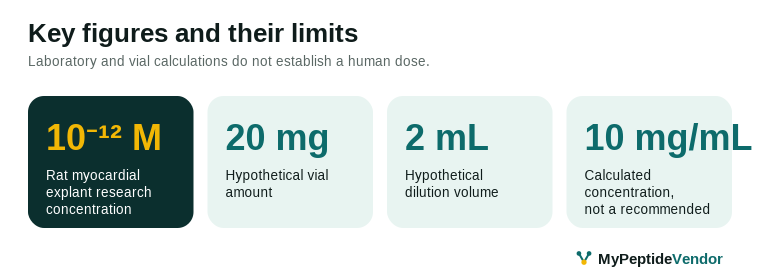
- Human dose: None is established. The available peptide findings are from rat myocardial tissue culture and a rat tumor model, not human dose-finding research 56.
- Research concentration: Chalisova and colleagues tested 10⁻¹² M in rat myocardial explants; this is a laboratory concentration, not a syringe dose 6.
- Tumor-related finding: Cardiogen was associated with dose-dependent growth inhibition in rats with M-1 sarcoma, alongside hemorrhagic necrosis and increased tumor-cell apoptosis 5.
- Vial arithmetic: A hypothetical 2 mL dilution of a 20 mg vial gives 10 mg/mL. That is a calculation, not a recommended preparation or dose.
- Regulatory distinction: CardioGen-82 is a different, FDA-labeled rubidium-82 generator for PET imaging; its prescribing information is not a peptide protocol 1.
- Storage and safety: The cited peptide studies do not validate a storage temperature, mixed-vial stability period, human adverse-event rate, or safe drug combinations 56.
The word “protocol” can suggest a tested treatment plan. Here, no clinical titration plan exists for the peptide. A vial calculation cannot establish the product’s identity, sterility, safety, or effectiveness.
Use this chart
Free to reuse with a link back:
Key takeaways
- No approved human dose, titration schedule, or cycle length is established for the Cardiogen peptide 568.
- A rat myocardial explant study tested Cardiogen at 10⁻¹² M and reported increased cell proliferation and reduced p53 protein expression 6.
- A rat sarcoma study reported dose-dependent tumor-growth inhibition, hemorrhagic necrosis, and increased tumor-cell apoptosis 5.
- For arithmetic only, adding 2 mL to a 20 mg vial gives 10 mg/mL; the supplied conversion table equates 200 mcg with 2 U-100 units at that dilution.
- No cited peptide study verifies storage temperature, 28-day stability, human side-effect frequency, or safe use with other peptides 568.
Dosing schedule: no human schedule established
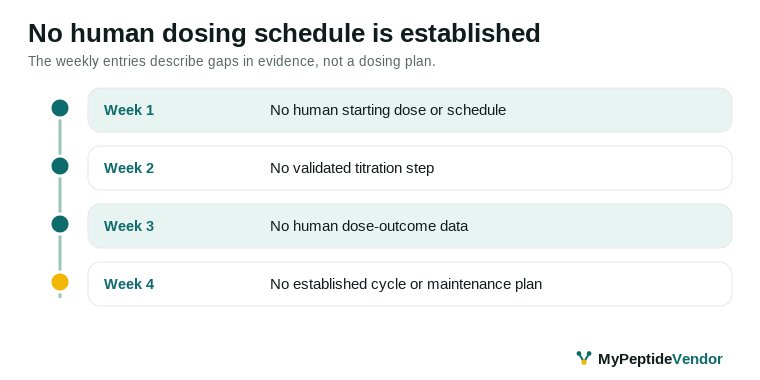
Chalisova et al. 6 and Levdik et al. 5 are laboratory and animal studies, so they do not establish a human titration schedule. The animal and tissue-culture studies do not establish a human dose, frequency, route, treatment duration, or maintenance plan 56. The ClinicalTrials.gov search results do not identify a registered trial of Cardiogen peptide dosing 8.
The table separates what is known from what is not. “Not established” is not a low-dose recommendation. The research concentration of 10⁻¹² M cannot be converted into a human syringe dose from the reported information 6.
| Week | Dose (mg) | Dose (mcg) | U-100 units | What is known |
|---|---|---|---|---|
| Week 1 | Not established | Not established | Not established | No human starting dose or schedule |
| Week 2 | Not established | Not established | Not established | No validated titration step |
| Week 3 | Not established | Not established | Not established | No human dose-outcome data |
| Week 4 | Not established | Not established | Not established | No established cycle or maintenance plan |
There is no evidence-based basis here to increase a dose from week to week, choose a daily or intermittent schedule, or repeat a course after a set break. A dose used in an animal experiment is not automatically suitable for a person. Likewise, the in-vitro concentration does not tell you how much peptide to inject, how often to use it, or how it behaves after injection 56.
For vial arithmetic only, the supplied conversion table lists 200 mcg as 0.2 mg and 2 U-100 units when a 20 mg vial is mixed with 2 mL. It also lists 500 mcg as 0.5 mg and 5 U-100 units at that dilution. These examples describe volume conversion only; neither amount is a Cardiogen dose established in people.
CardioGen-82’s FDA dosage instructions concern an intravenous radioactive PET agent measured by body weight. They must not be transferred to a Cardiogen peptide vial 1.
Use this chart
Free to reuse with a link back:
Syringe Unit Conversion Table
Units to draw on a U-100 insulin syringe (100 units = 1 mL) from a 20 mg vial. Find your dose, then read the column for the water you added. Every number is calculated, not estimated.
| Dose | 1 mL water 20 mg/mL · 1 unit = 200 mcg | 2 mL water 10 mg/mL · 1 unit = 100 mcg | 2.5 mL water 8 mg/mL · 1 unit = 80 mcg |
|---|---|---|---|
| 50 mcg | 0.25 · 400 doses | 0.5 · 400 doses | 0.62 · 400 doses |
| 100 mcg | 0.5 · 200 doses | 1 · 200 doses | 1.25 · 200 doses |
| 200 mcg | 1 · 100 doses | 2 · 100 doses | 2.5 · 100 doses |
| 250 mcg | 1.25 · 80 doses | 2.5 · 80 doses | 3.12 · 80 doses |
| 300 mcg | 1.5 · 66 doses | 3 · 66 doses | 3.75 · 66 doses |
| 500 mcg | 2.5 · 40 doses | 5 · 40 doses | 6.25 · 40 doses |
| 750 mcg | 3.75 · 26 doses | 7.5 · 26 doses | 9.38 · 26 doses |
| 1 mg | 5 · 20 doses | 10 · 20 doses | 12.5 · 20 doses |
| 1.5 mg | 7.5 · 13 doses | 15 · 13 doses | 18.75 · 13 doses |
| 1.7 mg | 8.5 · 11 doses | 17 · 11 doses | 21.25 · 11 doses |
| 2 mg | 10 · 10 doses | 20 · 10 doses | 25 · 10 doses |
| 2.4 mg | 12 · 8 doses | 24 · 8 doses | 30 · 8 doses |
| 2.5 mg | 12.5 · 8 doses | 25 · 8 doses | 31.25 · 8 doses |
| 3 mg | 15 · 6 doses | 30 · 6 doses | 37.5 · 6 doses |
| 4 mg | 20 · 5 doses | 40 · 5 doses | 50 · 5 doses |
| 5 mg | 25 · 4 doses | 50 · 4 doses | 62.5 · 4 doses |
| 7.5 mg | 37.5 · 2 doses | 75 · 2 doses | 93.75 · 2 doses |
| 10 mg | 50 · 2 doses | 100 · 2 doses | over 100 |
| 12.5 mg | 62.5 · 1 doses | over 100 | over 100 |
| 15 mg | 75 · 1 doses | over 100 | over 100 |
Cardiogen 20 mg Vial Dosage Calculator
Shows the exact insulin-syringe units to draw. Pre-loaded with the 20 mg vial; change any value to match yours.
Total volume of your syringe?
How much mg is in the vial?
How much bacteriostatic water are you adding?
Dose per injection?
Educational tool only. Concentration = vial ÷ water; units = dose ÷ concentration × 100 (U-100 syringe). Confirm every dose with your prescriber. Different vial or peptide? Use the peptide calculator.
Affiliate link · we may earn a commission.
Reconstitution steps
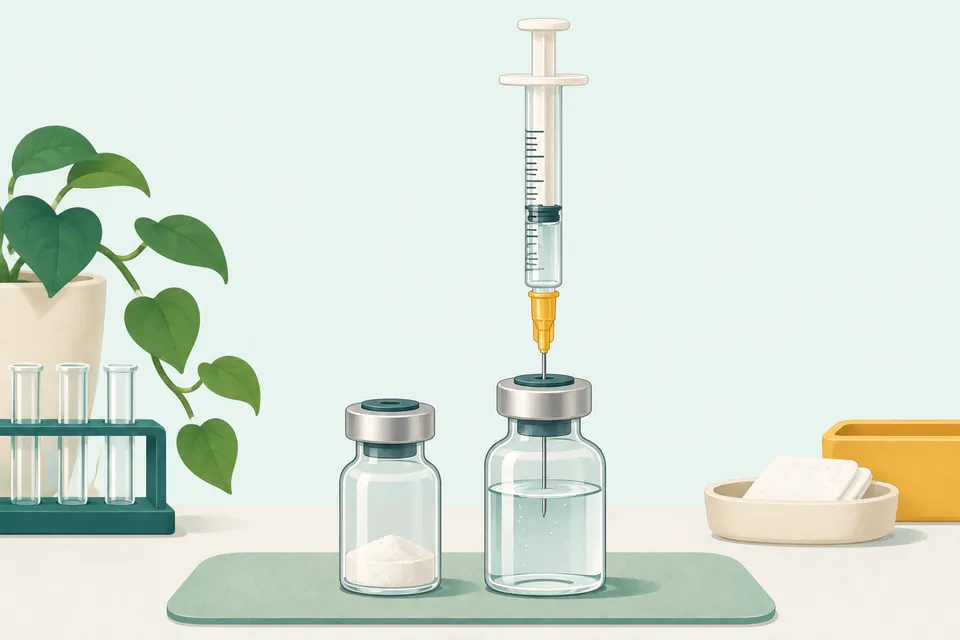
No peptide-specific prescribing information among the cited research validates bacteriostatic water, a reconstitution volume, or a beyond-use period for Cardiogen 56. The arithmetic below is not a recommendation to prepare or inject a research product. Before handling any vial intended for human use, a licensed clinician or pharmacist must confirm the exact product and its directions.
- Read the complete vial label and packaging. Confirm the exact product name, amount, manufacturer, lot identifier, seal, and written storage directions. Do not use a vial with a missing lot number, damaged seal, unclear identity, or visible contamination.
- For concentration arithmetic only, 20 mg plus 2 mL gives a nominal concentration of 10 mg/mL. The supplied U-100 conversion table lists 100 mcg per unit at that concentration.
- Do not assume bacteriostatic water is compatible or appropriate. No cited Cardiogen peptide study establishes a diluent, sterile preparation method, or route for human use 56.
- Do not use appearance as a quality test. A clear liquid cannot confirm peptide identity, concentration, sterility, or freedom from contaminants.
- Do not assign a 28-day use period based on a general rule. Stability after mixing has not been established for this peptide preparation.
If a clinician has prescribed a regulated sterile medicine, follow that medicine’s specific label and the dispensing pharmacist’s directions. Adding liquid to a research vial does not make the contents an approved or validated injectable medicine.
Supplies needed for a full vial
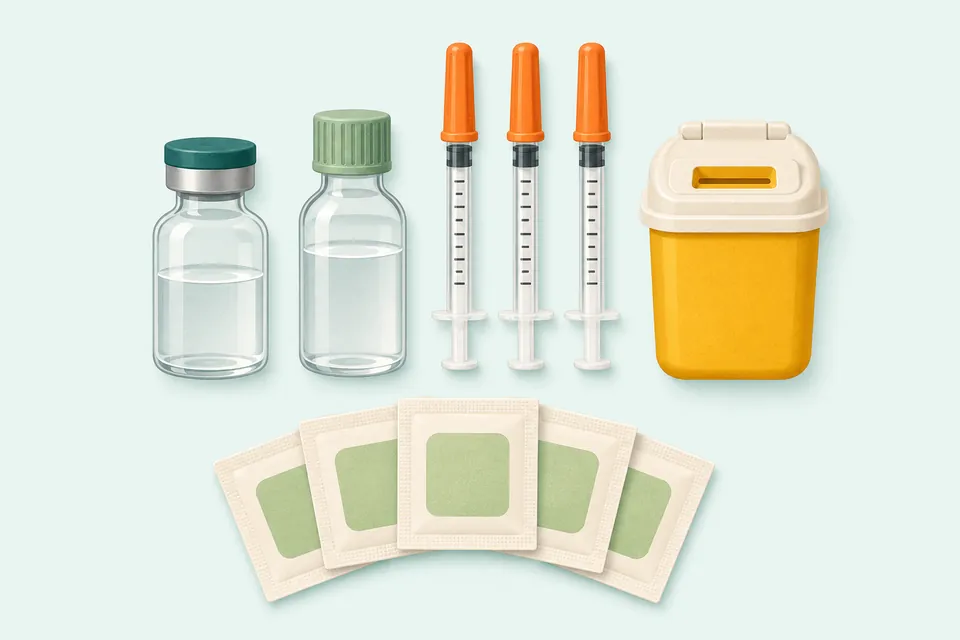
A complete injection supply list cannot be responsibly calculated because no human Cardiogen dose, route, or schedule is established 568. A full 20 mg vial might represent very different numbers of administrations depending on an unvalidated dose, so a fixed syringe or swab count would imply a protocol that does not exist.
- Vial: One 20 mg vial is the package size discussed here; the amount in the vial is not a dosing instruction.
- Diluent: No cited peptide-specific source validates a diluent or volume. Do not treat bacteriostatic water as approved for this product.
- Measuring device: The conversion examples use a U-100 scale, where 100 units equal 1 mL. A calculated mark does not prove a safe dose or appropriate route.
- Single-use sterile supplies: A clinician would determine whether any sterile syringes, needles, swabs, or other supplies are appropriate. A quantity for a full vial cannot be set without a valid clinical schedule.
- Product records: Keep the original label, lot number, packaging, and any lot-specific testing document for a pharmacist or clinician to review.
A certificate of analysis (COA) is only useful for identity review when it clearly matches the vial’s lot and describes the tests performed. A general report, seller statement, or attractive label does not by itself verify the vial’s contents or sterility.
Protocol overview and cycle notes
Cardiogen is described in the research as a synthetic tetrapeptide. The amino-acid sequence of the Cardiogen peptide, a synthetic tetrapeptide, is not reported in the abstract of the study by Chalisova and colleagues 6. Sequence and product identity should therefore be confirmed from reliable, lot-specific documentation rather than inferred from a product name.
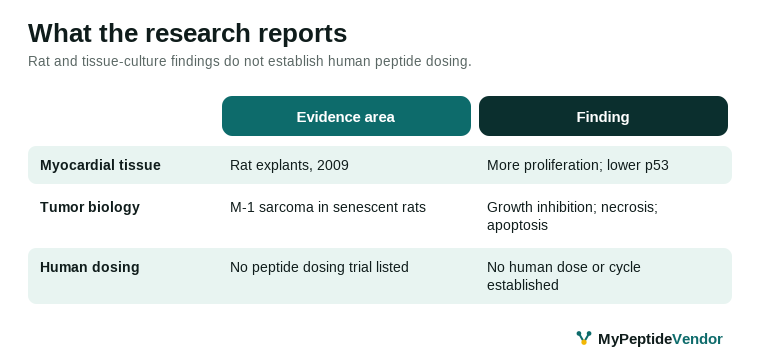
Chalisova et al. 6 reported increased proliferation and reduced p53 protein expression in rat myocardial explants. The specific experimental result is narrower: rat myocardial explants exposed to 10⁻¹² M Cardiogen showed increased cell proliferation, and immunohistochemical testing found reduced p53 protein expression 6. This does not establish that the peptide enters human heart cells, binds a particular DNA sequence, repairs a human heart, or improves a clinical outcome.
The 10⁻¹² M value is a molar concentration in a tissue-culture experiment. It is not a mass dose such as milligrams or micrograms. Converting it to a syringe amount would require information about the experimental preparation and human exposure that the study does not provide 6.
Levdik and colleagues studied transplanted M-1 sarcoma in senescent rats. They reported dose-dependent inhibition of tumor growth associated with hemorrhagic necrosis and stimulation of tumor-cell apoptosis 5. This animal finding does not show what happens in people with cancer, and it does not prove that Cardiogen treats or causes cancer. It is a reason for people with active cancer or a cancer history to seek an oncologist’s advice before considering exposure.
ClinicalTrials.gov lists four records for the search term Cardiogen, but they are not a registered human dosing trial of the AEDR peptide. The records include studies about genistein and heart failure inflammation, cardiovascular genetics, a sinus venosus defect, and strontium after CardioGen-82 PET imaging 8. A name match or a trial involving the imaging product is not evidence of peptide use in people.
| Topic | Evidence type | What the evidence reports |
|---|---|---|
| Myocardial tissue | Rat explants, 2009 | Increased cell proliferation and reduced p53 protein expression at 10⁻¹² M. |
| Tumor biology | M-1 sarcoma in senescent rats, 2009 | Dose-dependent tumor-growth inhibition, hemorrhagic necrosis, and increased apoptosis. |
| Human peptide dosing | No peptide dosing trial among the listed registry results | No human dose, cycle, benefit, or adverse-event rate is established. |
| CardioGen-82 | FDA-labeled radiopharmaceutical generator | A separate PET imaging product, not a Cardiogen peptide. |
There is no supported cycle length, off-cycle interval, or number of courses per year for the Cardiogen peptide in the cited evidence 568. Published tissue and animal findings cannot resolve which of the many proposed schedules is safe or effective in humans. No schedule should be presented as a standard just because it is easy to measure from a vial.
Stacking Cardiogen with another bioregulator or a recovery peptide has not been evaluated in the cited research. There are no cited combination data that establish safety with BPC-157, TB-500, another peptide, a prescription heart medicine, or a supplement 56. Combining products adds uncertainty and can make it harder to identify the cause if a reaction occurs.
Route and timing are also unresolved. The cited peptide studies do not establish human oral, sublingual, or injectable use, nor do they show that morning or evening dosing is better 56. Do not infer a route from a seller listing or from CardioGen-82’s intravenous imaging directions 1.
Research-only status matters because product quality and biological evidence are separate questions. A third-party report may help assess a specific lot if it verifies identity and relevant purity or contamination tests, but it cannot establish that the product is safe or effective in people. A mismatched lot number, missing test methods, unclear manufacturer, or label that confuses the peptide with CardioGen-82 are reasons to stop and ask a pharmacist to review the product.
Use this chart
Free to reuse with a link back:
Storage and handling
No cited peptide-specific study sets a storage temperature for the dry vial or proves stability after reconstitution 56. Refrigeration, freezing, room-temperature storage, and a 28-day use period should not be treated as verified directions for this peptide without reliable instructions for the exact product and lot.
Check the original manufacturer’s label and obtain lot-specific handling information before any use is considered. If the storage history is unknown, the label is missing, or the seller cannot identify the lot, do not assume that chilling the vial restores its quality. A visible change is not the only sign of a problem, and an unchanged appearance does not prove stability.
Keep the vial in its original packaging and away from medicines intended for routine use so it cannot be mistaken for a prescribed product. Do not use it beyond a seller’s claimed date unless a qualified pharmacist can assess valid stability information for that exact preparation.
The FDA’s storage directions for CardioGen-82 apply to a radioactive generator, not the Cardiogen peptide 1. The shared name does not make the products or their storage requirements interchangeable.
Injection and tracking tips
This page does not recommend injecting Cardiogen. The cited evidence does not establish a human injection route, dose, or peptide-specific injection technique 568. A solution that looks clear can still have uncertain identity, concentration, or sterility.
If a clinician or pharmacist reviews a product, bring the vial, packaging, lot number, storage information, and any lot-specific testing report. Read the name exactly as printed: CardioGen-82 refers to the rubidium-82 PET imaging generator, not the peptide 1. Do not pause or replace prescribed heart treatment to make room for an unapproved research compound.
No human evidence cited here favors morning or evening use. A symptom diary or wearable heart-rate measurement may help describe how you feel, but it cannot confirm that a research peptide is working or safe. Do not use self-tracking instead of medical care for heart symptoms.
Chest pain, fainting, severe shortness of breath, or a new sustained racing or irregular heartbeat calls for prompt medical assessment. Do not wait for a pattern in a tracking log before seeking care.
Safety and side effects
No human side-effect frequencies are established for Cardiogen peptide in the cited evidence. The rat studies do not provide a human adverse-event rate or long-term safety profile 56. An absent frequency estimate is not evidence that side effects are rare or absent.
The M-1 sarcoma experiment reported a tumor-related effect in rats: dose-dependent growth inhibition with hemorrhagic necrosis and increased tumor-cell apoptosis 5. This cannot predict a person’s cancer risk or response. Anyone with active cancer, a past cancer diagnosis, or an ongoing cancer evaluation should discuss the finding with an oncologist before considering exposure.
No peptide-specific contraindication list or drug-interaction study is established in the cited research 568. Pregnancy or breastfeeding, active heart disease, a known arrhythmia, recent cardiac symptoms, cancer history, and prescription medicine use are sensible reasons to pause and seek clinician review when safety data are missing. These are precautions, not proof that a particular harm or interaction has been demonstrated.
There is no established human side-effect frequency to compare with common medicines. The FDA label for CardioGen-82 discusses risks tied to radiation exposure and pharmacologic stress testing; those risks concern the PET product and do not describe peptide adverse effects 1.
Stop point: Do not proceed with a research vial if its identity or storage history cannot be verified, or if a qualified clinician cannot review your health conditions and medicines. A pharmacist or physician can help identify regulated options when treatment is needed.
Frequently asked questions
Is Cardiogen peptide the same as CardioGen-82?
No. CardioGen-82 is a rubidium-82 generator used to produce a radioactive PET imaging agent, while Cardiogen peptide is a separate product 1. The imaging product’s dose and handling instructions do not apply to a peptide vial.
Is there a human Cardiogen peptide dose or clinical trial?
No human peptide dose is established in the cited evidence. The four ClinicalTrials.gov records returned for Cardiogen do not identify a human dosing trial of the peptide 8.
What does Cardiogen do to heart cells?
In rat myocardial explants, Cardiogen at 10⁻¹² M was associated with increased cell proliferation and lower p53 protein expression 6. That laboratory result does not show that it improves heart function in people.
Does the rat tumor study mean people with cancer should avoid Cardiogen?
The rat study cannot establish what happens in people, but it reported tumor-growth inhibition, hemorrhagic necrosis, and increased apoptosis in M-1 sarcoma 5. Anyone with cancer or a cancer history should discuss this finding with an oncologist before considering exposure.
How much bacteriostatic water goes into a 20 mg vial?
No cited peptide-specific label validates bacteriostatic water or a reconstitution volume. As arithmetic only, 2 mL added to 20 mg gives 10 mg/mL; that does not establish that the diluent is suitable or that the vial is safe to inject.
Can a mixed Cardiogen vial be used for 28 days?
A 28-day use period has not been validated for this peptide. Ask a pharmacist to review reliable storage and stability information for the exact product and lot.
References
- FDA prescribing information: Cardiogen-82 (Rubidium Chloride Rb-82) Injection, Solution (DailyMed)
- FDA: Certain bulk drug substances for use in compounding that may present significant safety risks
- Zöllei et al. [Extracorporeal membrane oxygenation in intensive care unit]. Orv Hetil. 2021.
- Ahmadi et al. Rubidium-82 generator yield and efficiency for PET perfusion imaging: Comparison of two clinical systems. J Nucl Cardiol. 2020.
- Levdik et al. Tumor-modifying effect of cardiogen peptide on M-1 sarcoma in senescent rats. Bull Exp Biol Med. 2009.
- Chalisova et al. [The effect of the amino acids and cardiogen on the development of myocard tissue culture from young and old rats]. Adv Gerontol. 2009.
- Blazsó et al. [Cardiomyopathy and ion channel diseases registry: the Szeged CardioGen Registry]. Orv Hetil. 2017.
- ClinicalTrials.gov: 4 registered studies (search: Cardiogen)
Written by the MyPeptideVendor editorial team from the FDA label, peer-reviewed studies and ClinicalTrials.gov records listed above, fact-checked line by line and reviewed 2026-11-12.
Cite this page
MyPeptideVendor Editorial Team. cardiogen dosage 20mg: Protocol & Safety. MyPeptideVendor. Updated November 12, 2026. https://mypeptidevendor.com/protocols/cardiogen-dosing-20mg/MyPeptideVendor Editorial Team. (2026, November 12). cardiogen dosage 20mg: Protocol & Safety. MyPeptideVendor. https://mypeptidevendor.com/protocols/cardiogen-dosing-20mg/Related protocols
Chonluten 20 mg
Research UseNo human Chonluten dose or titration schedule is established; the cited research tested cells, not people.
View protocolCortagen 20 mg
Research UseCortagen has no established human dose; this guide explains 20 mg vial math and the limits of the animal and laboratory evidence.
View protocolCrystagen 20 mg
Research UseNo approved human dose or validated vial instructions are established; the 20 mg label states vial content, not a treatment schedule.
View protocol