Aod 9604 Dosage 10mg: Vial Math & Safety
AOD-9604 is not FDA-approved, and no validated human subcutaneous dose, titration schedule, or cycle is established.
Quickstart highlights for AOD-9604 10 mg
AOD-9604 dosage for a 10 mg vial is not established for human use: AOD-9604 is not FDA-approved, and the clinical-development reviews do not establish a human subcutaneous dose or titration plan 457. A 10 mg vial states the amount in the container; it does not define a dose or treatment course.
AOD-9604 is described as a human growth hormone fragment developed as a potential obesity treatment 7. By February 2002, phase IIa trials were underway 5. A 2006 review reported that only rimonabant among the obesity candidates it discussed had completed phase III 7. Those milestones do not establish an approved treatment or a usable injection protocol.
- What the vial means: A 10 mg vial states the total amount of peptide in the container. It does not establish a single dose, a daily schedule, or the length of a treatment course.
- Approval and dose: AOD-9604 is described as an unapproved peptide 4. There is no FDA-approved human dose or validated subcutaneous titration schedule in the clinical-development reviews 57.
- Range often repeated online: Online protocols commonly claim 250–500 mcg per day, an unsourced figure that has not been established as a human subcutaneous regimen. It is not a prescription or a trial-backed schedule.
- Mixing arithmetic: If a dispensing pharmacy specifically directs 2 mL of diluent for a 10 mg vial, the concentration is 5 mg/mL, or 5,000 mcg/mL. At this concentration, each U-100 unit equals 50 mcg.
- Storage window: FDA generally recommends discarding a multidose sterile medication vial within 28 days after first use because contamination risk increases afterward 1. This is general vial guidance, not proof that AOD-9604 remains stable for 28 days.
- Research status: AOD-9604 was in obesity-drug development, but the development reviews do not establish a successful approved treatment course 57.
There is no AOD-9604 FDA label to guide dose escalation. The schedule below distinguishes unsupported community claims from established evidence; it is not an instruction to inject a research product.
Key takeaways
- AOD-9604 is not FDA-approved, and no validated human subcutaneous dose or titration schedule is established 457.
- Online protocols commonly claim 250–500 mcg per day, but the clinical-development reviews do not verify that range as a human subcutaneous regimen 57.
- For vial arithmetic only, adding 2 mL to a 10 mg vial gives 5 mg/mL; at that concentration, 250 mcg equals 5 U-100 units and 500 mcg equals 10 units.
- FDA generally recommends discarding a multidose sterile medication vial within 28 days after first use because contamination risk increases after that point 1.
- Rigorous human safety data for unapproved peptides are scarce, and serious harm is possible 4.
Dosing schedule: no validated titration
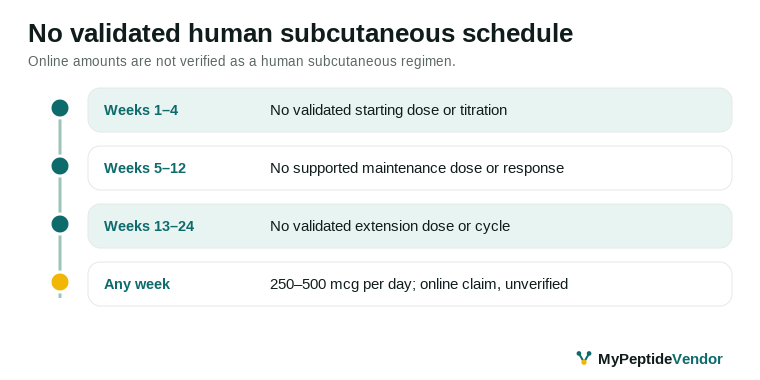
No FDA label or clinical-development review establishes a human subcutaneous titration schedule for AOD-9604 457. Because AOD-9604 is not FDA-approved, there is no labeled starting dose or maintenance dose. A schedule that assigns a dose to each week would imply evidence that is not established.
Online protocols commonly claim 250–500 mcg per day. The clinical-development reviews do not verify that range as a human subcutaneous regimen 57. The mg and unit values in the table are vial arithmetic only, using a 10 mg vial mixed with exactly 2 mL (5 mg/mL).
The table separates commonly repeated online amounts from clinical evidence; the clinical-development reviews do not verify a human subcutaneous dose or titration schedule 57.
| Week | Dose (mg) | Dose (mcg) | U-100 units | Evidence status |
|---|---|---|---|---|
| Weeks 1–4 | Not established | Not established | Not assigned | No validated human subcutaneous starting dose or titration step |
| Weeks 5–12 | Not established | Not established | Not assigned | No supported maintenance dose or treatment response |
| Weeks 13–24 | Not established | Not established | Not assigned | No validated extension dose, cycle, or off-cycle plan |
| Any week: online claim, not a validated schedule | 0.25–0.5 mg | 250–500 mcg | 5–10 units | Vial arithmetic only at 5 mg/mL; not a clinical dose recommendation |
At 10 mg in 2 mL (5 mg/mL), 250 mcg equals 5 U-100 units and 500 mcg equals 10 units. A 10 mg vial contains enough peptide for 40 theoretical 250 mcg amounts or 20 theoretical 500 mcg amounts. These are calculations, not evidence that either amount is safe or effective.
The development reviews do not verify a 500 mcg phase II dose or a visceral-fat result at that dose 57. They also do not establish that doses above 500 mcg bring no added benefit. Terms such as “upper limit,” “maintenance dose,” and “supra-therapeutic” should not be presented as clinical facts when no validated human subcutaneous regimen has been established.
Dosing should not be scaled by body weight, body-fat percentage, or target weight without evidence that supports the calculation. The clinical-development reviews describe the trials conducted to date 57, but they do not establish a weight-based AOD-9604 dose. A 10 mg vial is a container size, not a signal to use the entire vial over a set number of days.
Use this chart
Free to reuse with a link back:
Syringe Unit Conversion Table
Units to draw on a U-100 insulin syringe (100 units = 1 mL) from a 10 mg vial. Find your dose, then read the column for the water you added. Every number is calculated, not estimated.
| Dose | 1 mL water 10 mg/mL · 1 unit = 100 mcg | 2 mL water 5 mg/mL · 1 unit = 50 mcg | 2.5 mL water 4 mg/mL · 1 unit = 40 mcg |
|---|---|---|---|
| 50 mcg | 0.5 · 200 doses | 1 · 200 doses | 1.25 · 200 doses |
| 100 mcg | 1 · 100 doses | 2 · 100 doses | 2.5 · 100 doses |
| 200 mcg | 2 · 50 doses | 4 · 50 doses | 5 · 50 doses |
| 250 mcg | 2.5 · 40 doses | 5 · 40 doses | 6.25 · 40 doses |
| 300 mcg | 3 · 33 doses | 6 · 33 doses | 7.5 · 33 doses |
| 500 mcg | 5 · 20 doses | 10 · 20 doses | 12.5 · 20 doses |
| 750 mcg | 7.5 · 13 doses | 15 · 13 doses | 18.75 · 13 doses |
| 1 mg | 10 · 10 doses | 20 · 10 doses | 25 · 10 doses |
| 1.5 mg | 15 · 6 doses | 30 · 6 doses | 37.5 · 6 doses |
| 1.7 mg | 17 · 5 doses | 34 · 5 doses | 42.5 · 5 doses |
| 2 mg | 20 · 5 doses | 40 · 5 doses | 50 · 5 doses |
| 2.4 mg | 24 · 4 doses | 48 · 4 doses | 60 · 4 doses |
| 2.5 mg | 25 · 4 doses | 50 · 4 doses | 62.5 · 4 doses |
| 3 mg | 30 · 3 doses | 60 · 3 doses | 75 · 3 doses |
| 4 mg | 40 · 2 doses | 80 · 2 doses | 100 · 2 doses |
| 5 mg | 50 · 2 doses | 100 · 2 doses | over 100 |
| 7.5 mg | 75 · 1 doses | over 100 | over 100 |
| 10 mg | 100 · 1 doses | over 100 | over 100 |
AOD-9604 10 mg Vial Dosage Calculator
Shows the exact insulin-syringe units to draw. Pre-loaded with the 10 mg vial; change any value to match yours.
Total volume of your syringe?
How much mg is in the vial?
How much bacteriostatic water are you adding?
Dose per injection?
Educational tool only. Concentration = vial ÷ water; units = dose ÷ concentration × 100 (U-100 syringe). Confirm every dose with your prescriber. Different vial or peptide? Use the peptide calculator.
MYPEPTIDEVENDORAffiliate link · we may earn a commission.
Reconstitution steps and concentration math
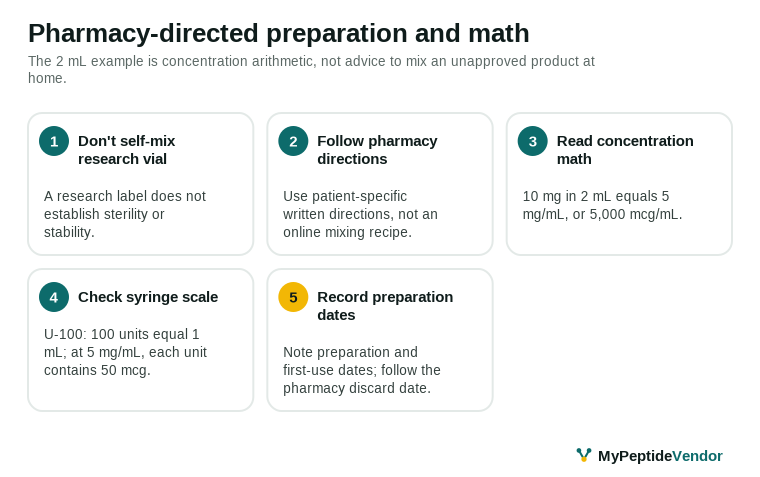
Do not mix a vial labeled for research use for self-injection. AOD-9604 is not FDA-approved, and a label alone does not establish identity, sterility, concentration, or stability 4. If a clinician and pharmacy provide a patient-specific preparation, follow that pharmacy’s written directions rather than using an online mixing recipe.
- Confirm the product instructions. Ask the dispensing pharmacy to confirm the product name, total amount, diluent, diluent volume, route, storage requirements, and discard date. A 10 mg vial label by itself does not identify a suitable diluent or mixing volume.
- Use only pharmacy-directed diluent and volume. The example below assumes exactly 2 mL added to a 10 mg vial. This is a concentration example, not advice to reconstitute an unapproved product at home.
- Read the concentration correctly. Under that example, 10 mg in 2 mL equals 5 mg/mL, or 5,000 mcg/mL. On a U-100 syringe, 100 units equal 1 mL, so each unit at this concentration contains 50 mcg.
- Verify the syringe scale. U-100 describes a syringe calibrated so that 100 units equal 1 mL. A unit mark measures liquid volume; it does not represent the same drug amount at every concentration.
- Record dates and directions. Write down the preparation date and first-use date if a pharmacy has prepared the medication. FDA’s general multidose-vial guidance recommends discarding a sterile multidose vial within 28 days after first use because contamination risk increases 1. The pharmacy may set an earlier discard date.
Do not transfer the 2 mL example to a different vial size, diluent volume, concentration, or syringe type. Changing the amount of liquid changes the concentration and changes how much drug corresponds to a syringe marking.
“Bacteriostatic water” is often named in online mixing instructions, but the correct diluent for a particular product depends on the pharmacy’s preparation and instructions. Do not assume that bacteriostatic water is appropriate for every AOD-9604 product or that it makes a research-labeled vial suitable for injection.
Use this chart
Free to reuse with a link back:
Supplies needed for one full 10 mg vial
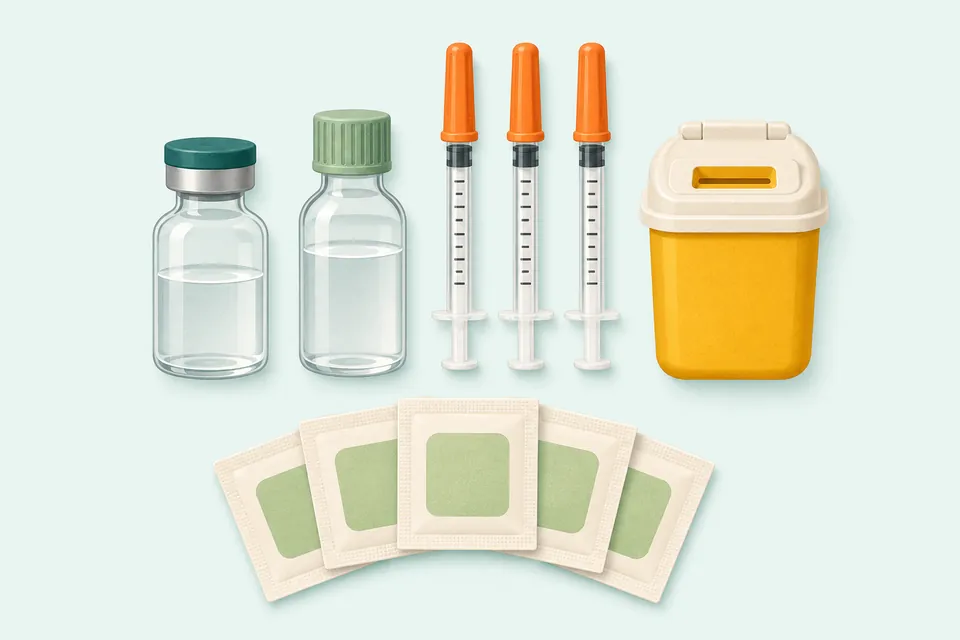
There is no appropriate do-it-yourself supply list for injecting an unapproved research vial. If a prescriber and pharmacy provide a patient-specific sterile preparation, ask them to specify the supplies and quantities. The quantities below are illustrative arithmetic for a 10 mg vial mixed with 2 mL and a hypothetical 500 mcg daily amount; they are not a recommendation to use AOD-9604.
- One 10 mg vial: The amount named on the container, not a recommended course.
- 2 mL of pharmacy-directed diluent: This amount is only for the stated concentration example. Use it only if the dispensing pharmacy directs it.
- 20 U-100 syringes: A 500 mcg amount would equal 10 units at 5 mg/mL, and the vial contains 20 theoretical amounts of 500 mcg. The pharmacy must confirm the syringe and directions before use.
- Alcohol swabs: Follow the pharmacy’s directions for vial access and skin preparation. The exact number depends on the pharmacy’s instructions and how often the vial is accessed.
- One sharps container: Use a puncture-resistant container for used needles and follow local disposal rules.
At the same concentration, a theoretical 250 mcg amount equals 5 units and the vial contains 40 such amounts. A once-daily 40-day arithmetic example exceeds the general 28-day post-first-use window FDA recommends for multidose sterile medication vials 1. Do not use vial arithmetic to extend a product’s beyond-use date.
FDA advises that compounded drugs should be used only when a patient’s medical needs cannot be met by an FDA-approved drug, and that patients obtain a prescription and use a state-licensed pharmacy 1. That FDA page addresses compounded GLP-1 medicines. It does not establish that AOD-9604 is eligible for compounding or that any specific AOD-9604 vial is safe.
Protocol overview and cycle notes
AOD-9604 is a human growth hormone fragment developed as a possible obesity treatment 7. A review reported phase IIa trials underway by February 2002 5. A 2006 review of obesity medicines in development reported that only rimonabant among its candidates had completed phase III 7. Those milestones describe development history; they do not establish an approved product, a current treatment course, or a subcutaneous protocol.
Some descriptions call AOD-9604 a 16-amino-acid fragment. This naming difference does not supply evidence for a dose or an injection route.
No established human subcutaneous cycle of 8–24 weeks, or required off-cycle rest period, is supported by the clinical-development reviews 57. A cycle length repeated in online protocols should not be presented as a trial-backed instruction. The reviews also do not establish a reliable amount of fat or body weight lost with a particular subcutaneous dose.
Reported human development information does not specify administration routes, and the clinical-development reviews do not validate subcutaneous dosing or show that exposure from one route can be converted to another 57. A subcutaneous community protocol is not the same as a trial-tested injection schedule.
Route evidence
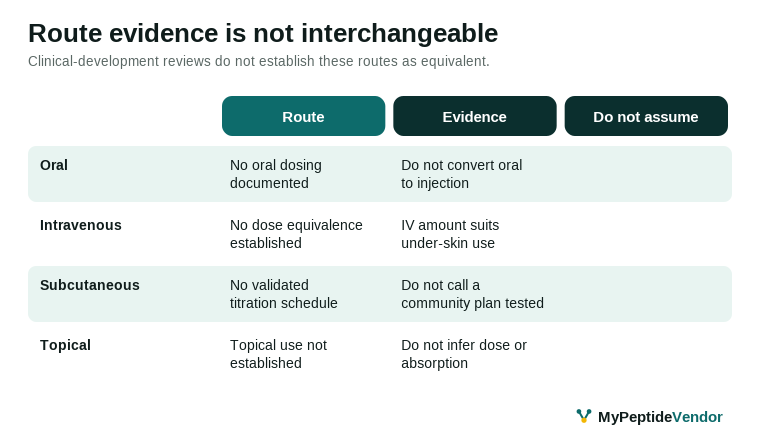
Routes must not be treated as interchangeable. The clinical-development reviews do not establish a human subcutaneous dose or exposure that can be converted from another route 57.
| Route | Evidence boundary | What not to assume |
|---|---|---|
| Oral | Human development information does not document oral dosing. | Do not convert an oral amount into an injection amount. |
| Intravenous | The reviews do not establish a dose equivalence with another route. | Do not infer that an IV amount is suitable under the skin. |
| Subcutaneous | No validated human subcutaneous titration schedule is established in the clinical-development reviews. | Do not call a community injection plan trial-tested. |
| Topical | The clinical-development reviews do not establish topical use. | Do not infer a topical dose or absorption from an injection. |
Fast-morning, fasted subcutaneous use is commonly asserted online, but the clinical-development reviews do not establish that timing as a treatment rule 57. They also do not establish a required interval before food, coffee, exercise, or another peptide. There is no evidence-based timing instruction to use in place of a prescriber’s directions.
The same evidence gap applies to combining AOD-9604 with other peptides or weight-loss medicines. The reviews do not establish a safe combination schedule or interaction profile for such combinations 3457. A clinician needs to review the full medication list instead of relying on a general online “stack.”
Use this chart
Free to reuse with a link back:
Storage and handling
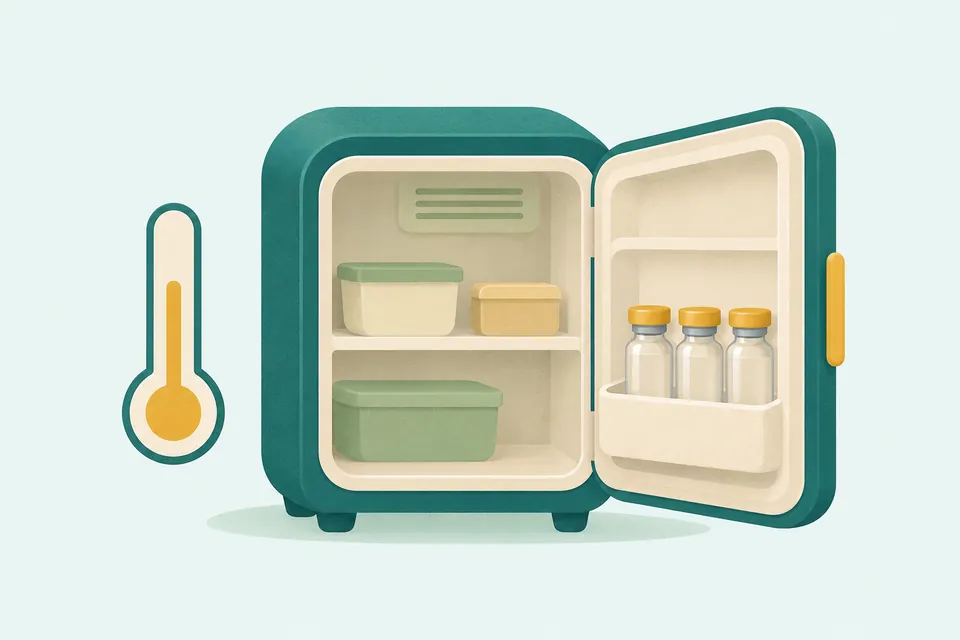
Use the storage instructions on the pharmacy label because AOD-9604-specific stability after mixing is not established in the clinical-development reviews 57. Do not assume that a storage rule for a different peptide or formulation applies to this vial.
FDA generally recommends that multidose sterile medication vials be used within 28 days after first use because contamination risk increases after that time; FDA advises discarding the vial even if medication remains 1. This is general multidose-vial advice, not an AOD-9604 stability test or proof that every preparation remains potent for 28 days.
Use a new sterile needle and syringe for each dose 1. If a pharmacy-prepared injectable arrives warm, damaged, or without clear storage instructions, contact the dispensing pharmacy before using it. FDA warns that improper shipping and uncertain quality can create risks for injectable medicines 1.
Do not use a vial with an unclear concentration, damaged packaging, missing pharmacy information, or no written patient-specific directions. FDA explains that unapproved drugs do not undergo its review for safety, effectiveness, and quality before marketing 1.
Do not combine leftovers from separate vials or transfer liquid into a new container. A product’s appearance cannot confirm its identity, sterility, concentration, or stability. Ask the dispensing pharmacy to resolve any mismatch between the label, packaging, and written instructions before using the product.
Injection and tracking tips

A validated human subcutaneous AOD-9604 protocol is not established in the clinical-development reviews 57. If a clinician has prescribed a lawful patient-specific preparation, ask the prescribing clinician or dispensing pharmacist to demonstrate its use and verify the exact amount in both drug units and syringe units.
Before any clinician-directed dose, confirm the vial concentration, syringe calibration, route, intended amount, and written schedule with the pharmacy. FDA has received reports of dosing errors involving compounded semaglutide, including errors when patients or clinicians measured the wrong amount 1. That warning concerns semaglutide, not AOD-9604, but it shows why a concentration and syringe marking must be checked rather than guessed.
Keep a dated record of the product label, pharmacy, written directions, first-use date, and any symptoms. A log records what happened; it cannot prove that a peptide caused a change or that a dose is effective. If a product seems mislabeled or causes an unexpected reaction, contact the prescriber and pharmacy. FDA accepts medication problem reports through MedWatch 1.
Do not assume that exercise after dosing improves fat loss. The clinical-development reviews do not establish an exercise interval or a benefit from pairing a workout with a subcutaneous dose 57. Track exercise and meals separately if a clinician is monitoring body weight or waist measurements, so those factors are not mistaken for a drug effect.
Athlete and testing checklist
- AOD-9604 is discussed in anti-doping analytical research, including methods aimed at detecting it in human blood or urine with chromatographic and mass-spectrometric approaches 6.
- The analytical review does not provide a dependable number of days that AOD-9604 remains detectable after stopping 6. Do not rely on an assumed washout period.
- Check the current rules of the relevant sport and anti-doping organization before any exposure. The analytical review addresses detection methods, not a current ruling for every athlete or governing body 6.
- Tell a sports physician about any product exposure. A “research” label does not establish the vial’s identity, purity, or testing outcome.
Safety, side effects, and regulatory status
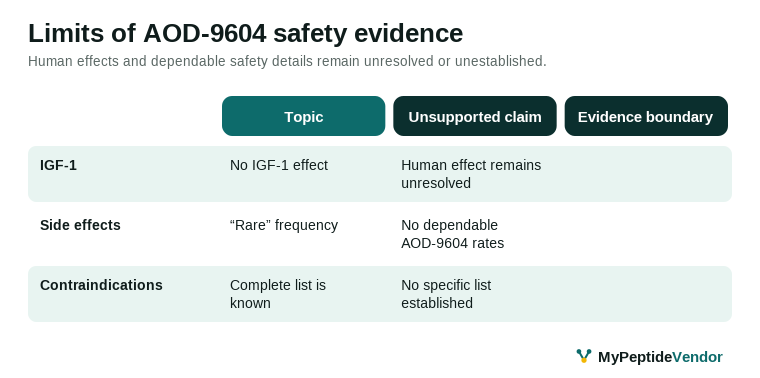
AOD-9604 is described as an unapproved peptide 4; it is not an FDA-approved drug. Rigorous human safety data for unapproved peptides are scarce, and serious harm is possible 4. The clinical-development reviews do not provide dependable AOD-9604-specific side-effect frequencies, a complete contraindication list, or a validated monitoring plan 457. A percentage or frequency such as “rare” would overstate what is known.
No AOD-9604-specific contraindication list is established in these reviews 457. Before considering an experimental peptide, a clinician should review medical conditions, allergies, pregnancy status, and current medicines. Do not infer safety in diabetes, cancer, heart disease, pregnancy, or when combining AOD-9604 with another weight-loss drug; the reviews do not establish those safety claims 34.
IGF-1 claims need caution. A 2026 orthopaedic review groups AOD-9604 with growth hormone secretagogues described as activating IGF-1 signaling 3. Whether AOD-9604 changes IGF-1 levels in humans is unresolved; a blanket statement that it has “no IGF-1 effect” is not established by that review 3.
FDA states that compounded drugs are not FDA-approved and are not reviewed by the agency for safety, effectiveness, or quality before marketing 1. Its cited compounding guidance concerns GLP-1 medicines and does not establish AOD-9604-specific compounding eligibility. Ask a prescriber and state-licensed pharmacy whether a particular preparation is legally available and appropriate. An online seller’s claim is not proof of quality or legal status.
For compounded medicines, FDA advises that use should be limited to situations where an FDA-approved drug cannot meet the patient’s medical need, and that patients obtain a prescription and use a state-licensed pharmacy 1. Because that guidance is about GLP-1 drugs, it does not answer whether a specific AOD-9604 preparation can lawfully be compounded. Ask the prescriber what approved alternatives exist and why a compounded product is being considered.
Claim check
| Claim | What the evidence supports |
|---|---|
| “500 mcg was the phase II dose for visceral-fat loss.” | The development reviews confirm historical clinical development but do not establish that dose or a visceral-fat effect size. |
| “AOD-9604 has no effect on IGF-1.” | A 2026 review groups it with compounds described as activating IGF-1 signaling; the human IGF-1 effect remains unresolved. |
| “Safety is proven in 900 or more participants.” | The 2026 safety review says rigorous human safety data for unapproved peptides are scarce and serious harm is possible; it does not verify that participant count for AOD-9604. |
Development timeline
- By February 2002, phase IIa trials were underway, according to a 2004 development review 5.
- A 2006 obesity-drug review described AOD-9604 as a human growth hormone fragment in development and reported that only rimonabant among the candidates it reviewed had completed phase III 7.
- Two 2026 reviews discuss AOD-9604 among unapproved peptides and emphasize limited clinical evidence or scarce rigorous human safety data 34.
Use this chart
Free to reuse with a link back:
Questions for a prescriber or pharmacist
- What evidence supports the proposed route and amount? The development reviews do not establish a human subcutaneous titration schedule 57.
- Is the exact preparation available through a legal pharmacy pathway, and is a prescription required? FDA advises prescriptions and state-licensed pharmacies for compounded GLP-1 medicines, but that guidance does not settle AOD-9604 eligibility 1.
- What are the labeled concentration, diluent, storage conditions, and discard date? FDA’s general multidose-vial guidance uses a 28-day post-first-use period unless product-specific directions call for an earlier discard 1.
- Who should be contacted if the label, shipment, or product appearance seems wrong? FDA cautions that unapproved products do not receive premarket review for quality 1.
- Could use create a sports-testing issue? AOD-9604 has been discussed in analytical doping-control research, but the review gives no reliable detection window 6.
- What evidence supports the proposed treatment goal? The development reviews do not establish a reliable weight-loss or fat-loss amount for a human subcutaneous dose 57.
Frequently asked questions
What is a typical AOD-9604 dose?
There is no FDA-approved human dose or established subcutaneous schedule 457. Online protocols commonly claim 250–500 mcg per day, but the clinical-development reviews do not validate that range as an injection regimen 57.
How do you mix a 10 mg AOD-9604 vial?
Do not prepare a research-labeled vial for human injection. For concentration math only, 10 mg plus exactly 2 mL yields 5 mg/mL; the correct diluent, mixing method, and storage instructions must come from a dispensing pharmacy.
How many U-100 units is 250 mcg from a 10 mg vial?
At 10 mg in 2 mL (5 mg/mL), 250 mcg equals 5 U-100 units. That is a volume conversion only, not a recommendation to use that amount.
Should AOD-9604 be taken in the morning while fasted?
The clinical-development reviews do not establish a morning, fasting, meal-spacing, or exercise-timing rule for AOD-9604 57. An online timing claim should not be treated as a proven way to improve results.
How long should an AOD-9604 cycle last?
The development reviews do not establish a personal cycle length, an 8–24-week course, or a required rest period 57. Historical trial-development dates describe research progress, not a self-treatment schedule.
What side effects does AOD-9604 cause, and how often?
Reliable AOD-9604-specific side-effect frequencies are not established in the cited clinical-development reviews 457. A 2026 safety review says rigorous human safety data for unapproved peptides are scarce and serious harm is possible 4.
Is AOD-9604 FDA-approved or legally compoundable?
AOD-9604 is described as an unapproved peptide 4, and it is not an FDA-approved drug. FDA’s compounding guidance cited here addresses GLP-1 drugs and does not determine whether a particular AOD-9604 preparation may be compounded 1.
Can AOD-9604 be detected in sports drug testing?
AOD-9604 has been discussed in analytical doping-control research involving detection in blood or urine 6. That review does not give a dependable number of days it remains detectable.
Does AOD-9604 raise IGF-1?
The human effect is unresolved. A 2026 review groups AOD-9604 with compounds described as activating IGF-1 signaling, so a guaranteed absence of IGF-1 effects is not established 3.
References
- FDA: Concerns with unapproved GLP-1 drugs used for weight loss
- FDA: Certain bulk drug substances for use in compounding that may present significant safety risks
- Rahman et al. Therapeutic Peptides in Orthopaedics: Applications, Challenges, and Future Directions. J Am Acad Orthop Surg Glob Res Rev. 2026.
- Mendias et al. Safety and Efficacy of Approved and Unapproved Peptide Therapies for Musculoskeletal Injuries and Athletic Performance. Sports Med. 2026.
- Wilding et al. AOD-9604 Metabolic. Curr Opin Investig Drugs. 2004.
- Thevis et al. Analytical approaches for the detection of emerging therapeutics and non-approved drugs in human doping controls. J Pharm Biomed Anal. 2014.
- Halford et al. Obesity drugs in clinical development. Curr Opin Investig Drugs. 2006.
Written by the MyPeptideVendor editorial team from the FDA label, peer-reviewed studies and ClinicalTrials.gov records listed above, fact-checked line by line and reviewed 2026-11-12.
Cite this page
MyPeptideVendor Editorial Team. aod 9604 dosage 10mg: Vial Math & Safety. MyPeptideVendor. Updated November 12, 2026. https://mypeptidevendor.com/protocols/aod-9604-dosing-10mg/MyPeptideVendor Editorial Team. (2026, November 12). aod 9604 dosage 10mg: Vial Math & Safety. MyPeptideVendor. https://mypeptidevendor.com/protocols/aod-9604-dosing-10mg/Related protocols
5-Amino-1MQ 50 mg
Not approvedNo approved human dose exists; this guide separates 50 mg vial math from dosing advice and explains evidence, handling, and safety limits.
View protocolAICAR 50 mg
Research UseAICAR has no approved human dose or validated injection schedule; a 50 mg vial does not establish a safe dose, dilution, or cycle.
View protocolCagrilintide 10 mg
Not approvedCagrilintide is not FDA-approved; a 10 mg vial is not a dose, and trial schedules do not establish a safe home-use protocol.
View protocol