5-Amino-1MQ: Evidence, Dosing & Safety
Small-molecule NNMT inhibitor
Brand names: No established FDA-approved brand name

5 amino 1mq is a small-molecule inhibitor of nicotinamide N-methyltransferase (NNMT), not a peptide. It is studied for possible effects on fat-cell metabolism, but a biological effect is not proof of weight loss in people.
No human dose or injection schedule is established. Human effectiveness, side effects, drug interactions, and long-term safety also remain unknown; avoid treating seller instructions as medical guidance.
Key takeaways
- 5-Amino-1MQ is a small molecule, not an amino-acid-chain peptide.
- The proposed mechanism involves NNMT, 1-MNA, NAD+, and SAM, but a human weight-loss benefit is not established.
- No human dose, injection frequency, or treatment cycle is established.
- There are no reliable human side-effect percentages or long-term safety estimates.
- FDA compounding guidance recommends a prescription and a state-licensed pharmacy when a compounded drug is medically needed 1.
5-Amino-1MQ at a glance
- Class
- Small-molecule NNMT inhibitor
- Mechanism
- NNMT inhibition; proposed changes in 1-MNA, NAD+, and SAM
- FDA Status
- No FDA-approved product status is established here
- Brand names
- No established FDA-approved brand name
- Administration
- No established human route
- Typical Dose
- No established human dose or schedule
- Half-life
- Not established in humans
- Primary Uses
- No established human medical use
What is it?

5-Amino-1MQ, also called 5-amino-1-methylquinolinium, is a small molecule studied as an inhibitor of NNMT. It is not a peptide: peptides are chains of amino acids, while 5-Amino-1MQ belongs to a different chemical class.
NNMT is an enzyme involved in cellular metabolism. Researchers have studied its activity in fat cells because altering that activity may change how cells handle certain metabolic compounds. That idea does not establish that taking 5-Amino-1MQ reduces body fat in a person.
A product marked “research use only” is not a substitute for a prescription medicine or a clinical trial.
What makes it different
5-Amino-1MQ is discussed as a way to affect an enzyme inside cells, rather than as a peptide hormone. A different mechanism does not mean a treatment works better or carries less risk.
Laboratory activity and clinical benefit are separate questions. A compound can affect an enzyme in a cell experiment without producing meaningful weight loss, smaller waist measurements, or better health in people. There is no established human comparison showing that 5-Amino-1MQ works better than tesamorelin or another treatment.
Claims about aging reversal, mental clarity, energy, or selective belly-fat loss are not established human outcomes. No dependable human timeframe or percentage change can be given for these claims.
How does it work?
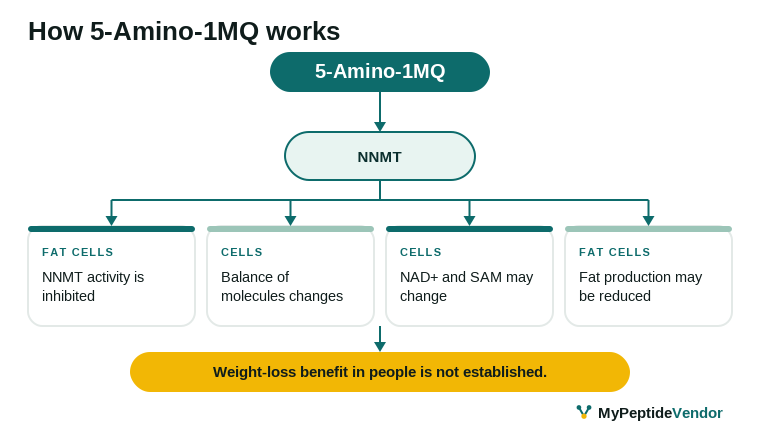
In plain language, the theory is that blocking NNMT changes the balance of molecules used by cells.
NAD+ helps cells carry out energy-related reactions. SAM supplies chemical groups used in many cell processes. In cell studies, changes in these molecules may accompany reduced fat production, but that does not show that a person will burn stored belly fat or feel more energetic.
A cell-level change is not the same as weight loss. Human studies would need to measure outcomes such as body weight, waist size, blood tests, and side effects over a defined period. A reliable human result for those outcomes has not been established.
Use this chart
Free to reuse with a link back:
What the clinical evidence actually shows

No human trial name, participant count, treatment duration, or numeric weight-loss result can be provided as a confirmed clinical finding.
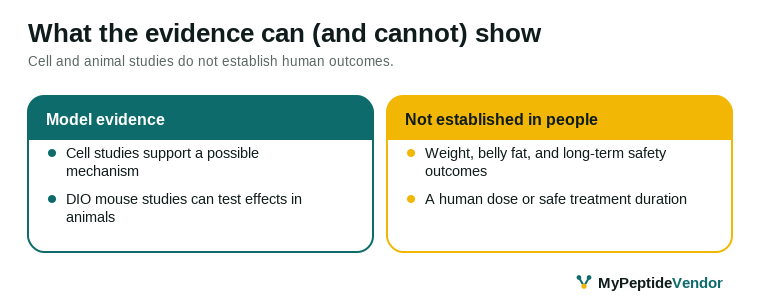
Cell studies can test whether a compound changes a process in a dish. Animal studies can test effects in a living organism. Neither tells us how much weight a person might lose, whether the change would be mostly fat, or how often unwanted effects would occur.
Those models cannot establish human effectiveness, a human dose, or a safe treatment duration.
Evidence-strength ladder: cell studies support a possible mechanism; DIO mouse studies can test effects in animals; human trials are needed to measure benefit and risk in people. No completed human outcome data is established here for weight, belly fat, or long-term safety.
There is also no established human evidence for a time to effect, a durable result after stopping, or a plan for monitoring months or years of use. Drug interactions and long-term risks remain unknown.
Claim versus evidence: fat loss and changes in fat-cell metabolism are research questions, not proven human benefits. Claims of improved energy, cognitive clarity, or reversal of aging are not established outcomes. The distinction matters: a plausible pathway is not proof of a clinical result.
Use this chart
Free to reuse with a link back:
Typical dosing

Human dose: no dose, route, injection frequency, or treatment cycle is established. There is no approved product label providing instructions for human use.
No animal dose or schedule is provided here as a dosing recommendation. Animal dosing cannot be converted directly into a personal human regimen, and a dose expressed per kilogram is not enough to establish a safe human dose.
Daily capsules, injections, or cycling schedules advertised online are not validated human instructions. Ask a licensed prescriber about any proposed use rather than relying on seller directions or a “research use” label.
Side effects: what to actually expect
No human trial or approved product label provides a side-effect rate for 5-Amino-1MQ. There are no reliable percentages for nausea, headache, injection-site pain, appetite changes, or other symptoms; their frequency and severity in people are unknown.
Drug interactions and long-term risks are also unknown. A proposed effect on one enzyme does not establish that the compound is safe throughout the body. Before considering any unapproved product, have a licensed prescriber review your medicines, supplements, and health conditions.
Get medical help for a severe or unexpected reaction. A lack of complaints on a seller’s website is not proof of safety, particularly when a product has not undergone the same premarket review as an FDA-approved drug.
Regulatory & access status in the US (as of 2026)
The FDA page on unapproved GLP-1 drugs explains that compounded drugs are not FDA-approved and are not reviewed for safety, effectiveness, or quality before marketing; it also says they should be used only when a patient’s medical needs cannot be met by an FDA-approved drug 1. That page addresses GLP-1 drugs, not 5-Amino-1MQ.
FDA’s bulk-substance page describes category 2 for substances that may present significant safety risks 2. That general process does not establish the status, quality, or safety of a particular 5-Amino-1MQ product.
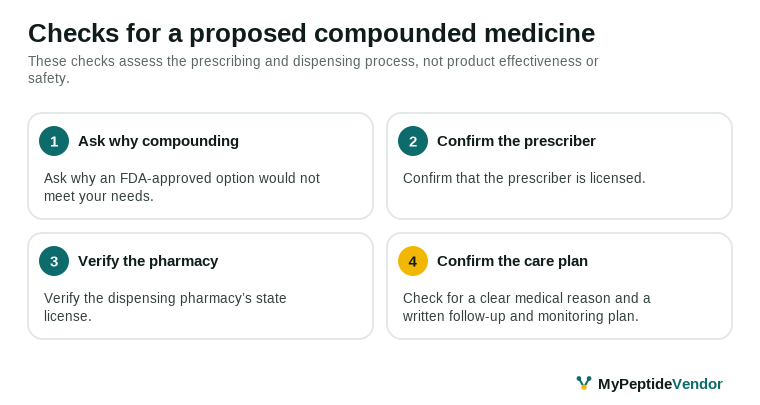
If a clinician proposes a compounded medicine, ask why an FDA-approved option would not meet your needs, confirm that the prescriber is licensed, and verify the dispensing pharmacy’s state license. FDA lists no screening or prescription, no licensed clinician available for questions, misleading claims, suspicious pharmacy details, and damaged packaging as online-purchase warning signs 1.
Safety checklist: confirm a licensed prescriber, a state-licensed pharmacy, a clear medical reason for compounding, and a written follow-up and monitoring plan. These checks do not prove a product is effective or safe; they help you assess the prescribing and dispensing process.
Use this chart
Free to reuse with a link back:
Research-grade 5-Amino-1MQ is available from American Peptides (5-AMINO-1MQ, from $80.00); code MYPEPTIDEVENDOR takes 15% off. Sold for laboratory research only, not for human use. Affiliate link
How it compares to its closest alternative
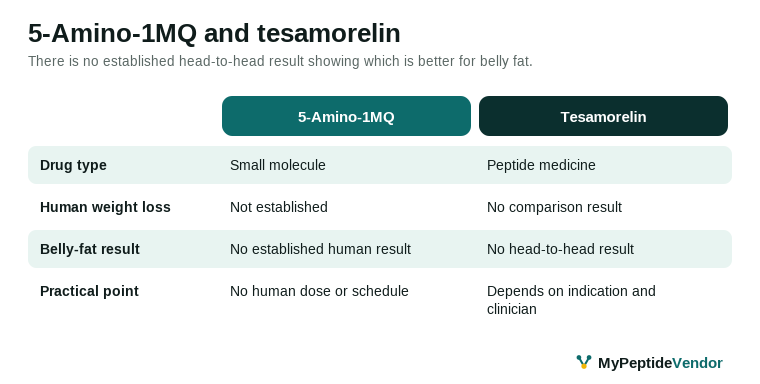
Tesamorelin is a commonly discussed comparison for body-composition goals, but it is a peptide medicine with a different proposed pathway. 5-Amino-1MQ is a small molecule studied for NNMT inhibition. There is no established head-to-head result showing which is better for belly fat.
| Feature | 5-Amino-1MQ | Tesamorelin |
|---|---|---|
| Drug type | Small molecule | Peptide medicine |
| Proposed pathway | NNMT inhibition | Growth-hormone-releasing hormone pathway |
| Human weight-loss evidence | Not established | Not established by a comparison with 5-Amino-1MQ |
| Belly-fat comparison | No established human result | No head-to-head result establishing superiority |
| Practical point | No established human dose or schedule | Use depends on the medicine’s indication and a clinician’s assessment |
Use this chart
Free to reuse with a link back:
Where to Buy 5-Amino-1MQ for Research
American Peptides
5-AMINO-1MQ · from $80.00
US-made research peptides, every lot third-party tested with a lot-matched COA.
15% offMYPEPTIDEVENDOR at checkout
- ≥99% purity verified by HPLC + mass spec, endotoxin tested
- Ships tracked from Louisiana, free shipping over $300
- 15% off your first order with code MYPEPTIDEVENDOR
Certified-Pep
US-made research peptides with batch-specific lab reports (COA) and a QR code on every vial.
- Independent laboratory testing (Vanguard Laboratory)
- Made in the USA, ships in 1-2 business days
- Research use only, not for human or veterinary use
Affiliate disclosure: we may earn a commission if you order through the link above. 5-Amino-1MQ is not approved by the FDA for human use.
Ranked in our guides
Frequently asked questions
What does 5-Amino-1MQ do?
It is studied for its effect on NNMT, an enzyme involved in cellular metabolism. The proposed aim is to change fat-cell metabolism, but a weight-loss benefit in people has not been established.
How long does 5-Amino-1MQ take to work?
No human evidence establishes that it works or how quickly a response might occur. Claims such as “a few weeks” are not a validated human timeframe.
What is the best peptide for belly fat loss?
There is no single peptide established as best for everyone’s belly fat. 5-Amino-1MQ is not a peptide, and no human comparison shows it reduces abdominal fat better than tesamorelin or another treatment.
How often should you inject 5-Amino-1MQ?
No human injection frequency has been established. Do not use seller directions or an animal regimen to set your own schedule; discuss any proposed use with a licensed prescriber.
References
- FDA: Concerns with unapproved GLP-1 drugs used for weight loss
- FDA: Certain bulk drug substances for use in compounding that may present significant safety risks
Written by the MyPeptideVendor editorial team from the FDA label, peer-reviewed studies and ClinicalTrials.gov records listed above, fact-checked line by line and reviewed 2026-11-12.
Cite this page
MyPeptideVendor Editorial Team. 5 amino 1mq: Evidence, Dosing & Safety. MyPeptideVendor. Updated November 12, 2026. https://mypeptidevendor.com/peptides/5-amino-1mq/MyPeptideVendor Editorial Team. (2026, November 12). 5 amino 1mq: Evidence, Dosing & Safety. MyPeptideVendor. https://mypeptidevendor.com/peptides/5-amino-1mq/Related peptides
Adipotide (FTPP)
Not approvedAdipotide is an experimental fat-vessel-targeting peptide with animal findings, kidney concerns, and no established human dose or benefit.
Learn moreAOD-9604
Not approvedAOD-9604 was studied for obesity, but available evidence does not establish meaningful weight loss, a standard dose, or FDA approval.
Learn moreCagrilintide
Not approvedCagrilintide is an investigational weekly amylin analogue; FDA says it has not been found safe and effective for any condition.
Learn more