Retatrutide Dosage 30mg: Trial Data & Safety
No FDA-approved retatrutide dose or validated preparation instructions exist for a 30 mg vial; this guide reviews trial data and safety limits.
Quickstart Highlights for Retatrutide Dosage 30mg
There is no approved retatrutide dosage for a 30 mg vial: retatrutide is investigational, and the FDA says it cannot be used in compounding under federal law 1. A vial’s stated amount does not establish its identity, concentration, sterility, or suitability for injection.
Clinical trials studied once-weekly retatrutide at doses from 0.5 mg to 12 mg, but those studies do not validate self-dosing or syringe-unit conversions for an online vial 45. This page reviews trial findings and safety concerns; it does not provide instructions to mix or inject the product.
- Approval: Retatrutide is under clinical development, is not FDA-approved, and cannot be used in compounding under federal law 13.
- What it targets: Retatrutide activates GIP, GLP-1, and glucagon receptors; the phase 2 obesity and diabetes trials used once-weekly injections 45.
- What trials tested: The phase 2 obesity trial included 1 mg, 4 mg, 8 mg, and 12 mg groups. Starting-dose arms differed within the 4 mg and 8 mg groups 4.
- What a 30 mg label means: It states a claimed total amount, not a validated dose or concentration. It does not establish how much to draw into a syringe.
- What this guide does not provide: It does not give mixing steps, an injection calendar, or U-100 conversions for an unapproved product of unverified quality 1.
Retatrutide's half-life is not reported in the trial data 45. They report once-weekly study injections, which is not a consumer dosing instruction 45.
A licensed clinician can discuss approved treatment options and review medical history, current medicines, and symptoms. FDA guidance says patients should obtain prescriptions from doctors and fill them at state-licensed pharmacies; retatrutide itself is not an FDA-approved prescription medicine 1.
Key takeaways
- Retatrutide activates GIP, GLP-1, and glucagon receptors; the cited phase 2 trials studied once-weekly injections 45.
- The phase 2 obesity trial tested 1 mg, 4 mg, 8 mg, and 12 mg groups, with different starting-dose arms for some targets 4.
- At 24 weeks, average weight change ranged from −7.2% to −17.5% in retatrutide groups, compared with −1.6% with placebo 4.
- The FDA says retatrutide cannot be used in compounding under federal law and warns about research-labeled products sold for human use 1.
- No approved human dose, vial mixing method, U-100 conversion, or missed-dose rule exists for a 30 mg retatrutide vial 145.
Dosing Schedule: What the Retatrutide Trials Studied

The phase 2 obesity study tested the research arms below, but its summary does not provide a complete week-by-week escalation calendar for each arm 4. Research arms listed below are trial groups, not a home dosing schedule. Syringe units are not provided because there is no approved product label or validated concentration for an online 30 mg vial 14.
| Study group | Starting dose reported | Assigned dose or target | Timing reported | U-100 units |
|---|---|---|---|---|
| Phase 2 obesity, fixed-dose arm | Not stated; fixed 1 mg arm | 1 mg weekly | Once weekly for 48 weeks | Not established for an online vial |
| Phase 2 obesity, 4 mg target | 2 mg or 4 mg | 4 mg weekly | Once weekly for 48 weeks; exact escalation weeks are not stated in the trial summary | Not established for an online vial |
| Phase 2 obesity, 8 mg target | 2 mg or 4 mg | 8 mg weekly | Once weekly for 48 weeks; exact escalation weeks are not stated in the trial summary | Not established for an online vial |
| Phase 2 obesity, 12 mg target | 2 mg | 12 mg weekly | Once weekly for 48 weeks; exact escalation weeks are not stated in the trial summary | Not established for an online vial |
| Phase 2 type 2 diabetes | Selected escalation arms started at 2 mg; one 4 mg arm had no escalation | 0.5 mg, 4 mg, 8 mg, or 12 mg maintenance groups | Once-weekly study treatment; the summary does not provide a general home calendar | Not established for an online vial |
| TRANSCEND-T2D-1 phase 3 | Not stated in the study summary | 4 mg, 9 mg, or 12 mg weekly | Once-weekly study treatment over 40 weeks | Not established for an online vial |
The 2 mg, 4 mg, 8 mg, and 12 mg figures are trial doses, not a recommended titration path for a 30 mg vial 4. The obesity study included 2 mg-start and 4 mg-start arms for the 4 mg and 8 mg targets; the 12 mg group started at 2 mg 4.
The phase 2 report says gastrointestinal events were partially mitigated with a 2 mg starting dose compared with a 4 mg starting dose, but it does not quantify the difference in event rates 4. It does not support a claim that starting at 4 mg nearly doubles those effects 4.
A 6 mg step is not listed as a phase 2 dose arm in the obesity or type 2 diabetes trial summaries 45. A 9 mg dose was tested in TRANSCEND-T2D-1 alongside 4 mg and 12 mg 8.
Syringe Unit Conversion Table
Units to draw on a U-100 insulin syringe (100 units = 1 mL) from a 30 mg vial. Find your dose, then read the column for the water you added. Every number is calculated, not estimated.
| Dose | 2 mL water 15 mg/mL · 1 unit = 150 mcg | 2.5 mL water 12 mg/mL · 1 unit = 120 mcg | 3 mL water 10 mg/mL · 1 unit = 100 mcg |
|---|---|---|---|
| 50 mcg | 0.33 · 600 doses | 0.42 · 600 doses | 0.5 · 600 doses |
| 100 mcg | 0.67 · 300 doses | 0.83 · 300 doses | 1 · 300 doses |
| 200 mcg | 1.33 · 150 doses | 1.67 · 150 doses | 2 · 150 doses |
| 250 mcg | 1.67 · 120 doses | 2.08 · 120 doses | 2.5 · 120 doses |
| 300 mcg | 2 · 100 doses | 2.5 · 100 doses | 3 · 100 doses |
| 500 mcg | 3.33 · 60 doses | 4.17 · 60 doses | 5 · 60 doses |
| 750 mcg | 5 · 40 doses | 6.25 · 40 doses | 7.5 · 40 doses |
| 1 mg | 6.67 · 30 doses | 8.33 · 30 doses | 10 · 30 doses |
| 1.5 mg | 10 · 20 doses | 12.5 · 20 doses | 15 · 20 doses |
| 1.7 mg | 11.33 · 17 doses | 14.17 · 17 doses | 17 · 17 doses |
| 2 mg | 13.33 · 15 doses | 16.67 · 15 doses | 20 · 15 doses |
| 2.4 mg | 16 · 12 doses | 20 · 12 doses | 24 · 12 doses |
| 2.5 mg | 16.67 · 12 doses | 20.83 · 12 doses | 25 · 12 doses |
| 3 mg | 20 · 10 doses | 25 · 10 doses | 30 · 10 doses |
| 4 mg | 26.67 · 7 doses | 33.33 · 7 doses | 40 · 7 doses |
| 5 mg | 33.33 · 6 doses | 41.67 · 6 doses | 50 · 6 doses |
| 7.5 mg | 50 · 4 doses | 62.5 · 4 doses | 75 · 4 doses |
| 10 mg | 66.67 · 3 doses | 83.33 · 3 doses | 100 · 3 doses |
| 12.5 mg | 83.33 · 2 doses | over 100 | over 100 |
| 15 mg | 100 · 2 doses | over 100 | over 100 |
Retatrutide 30 mg Vial Dosage Calculator
Shows the exact insulin-syringe units to draw. Pre-loaded with the 30 mg vial; change any value to match yours.
Total volume of your syringe?
How much mg is in the vial?
How much bacteriostatic water are you adding?
Dose per injection?
Educational tool only. Concentration = vial ÷ water; units = dose ÷ concentration × 100 (U-100 syringe). Confirm every dose with your prescriber. Different vial or peptide? Use the peptide calculator.
Affiliate link · we may earn a commission.
What the Evidence Shows
Use this chart
Free to reuse with a link back:
Reconstitution Steps: Why Mixing Instructions Are Not Provided
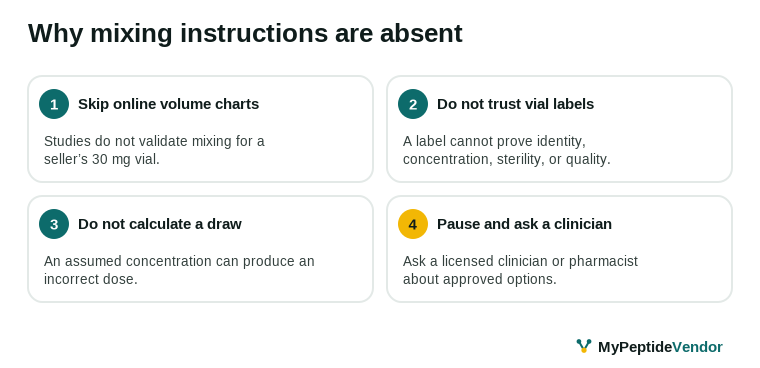
- Do not choose a diluent volume from an online chart. The cited studies do not validate a mixing method for a seller’s 30 mg vial 145.
- Do not assume the stated vial amount proves the contents. A label or vial appearance cannot establish identity, concentration, sterility, or quality 1.
- Do not calculate a syringe draw for human use. An incorrect assumed concentration can produce an incorrect dose. FDA has received reports of dosing errors with compounded injectable semaglutide products 1.
- Pause and speak with a licensed clinician or pharmacist. Ask about approved options and report unclear labeling, damaged packaging, or missing instructions 1.
No cited human trial documents reconstitution of an online 30 mg vial with 2 mL, 2.5 mL, or 3 mL of diluent 145. Arithmetic using a chosen volume cannot verify sterility, stability, or whether a vial contains what its label claims.
FDA warns that retatrutide products labeled “for research purposes” or “not for human consumption” have been sold directly to consumers with human dosing instructions. The agency says those products may be of unknown quality and harmful 1. A seller’s conversion chart does not prove that a vial is suitable for injection.
Use this chart
Free to reuse with a link back:
Supplies Needed for a Full 30 mg Vial
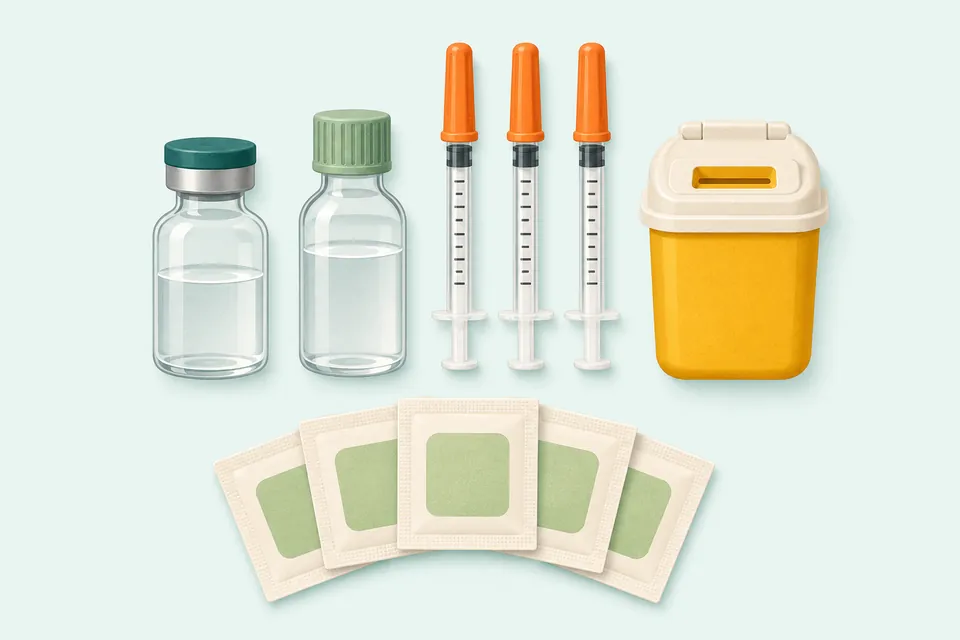
No quantities of syringes, needles, diluent, or swabs are listed for using a full 30 mg vial. A shopping list would imply a validated preparation and injection method for this unapproved product, and no such method is established 145.
Published trial summaries do not describe a consumer supply kit or the number of injection supplies for a retail-style 30 mg vial 45. FDA identifies missing instructions, damaged packaging, and lack of access to a licensed clinician as warning signs when buying medicines online 1.
FDA advises patients to obtain prescription medicines from a doctor and fill prescriptions at a state-licensed pharmacy 1. Because retatrutide cannot be used in compounding under federal law, a seller describing a retatrutide vial as a compounded prescription product warrants particular caution 1.
Protocol Overview and Cycle Notes

Retatrutide is a triple receptor agonist that acts at GIP, GLP-1, and glucagon receptors; phase 2 trials administered it by once-weekly injection 45. It is not FDA-approved, and the cited studies do not establish a consumer cycle, a safe off-period, or a restart plan after missed weeks 145.
The phase 2 obesity trial enrolled 338 adults with a body-mass index (BMI) of 30 or higher, or a BMI from 27 to under 30 with at least one weight-related condition 4. Its primary weight endpoint was at 24 weeks, with additional results at 48 weeks 4. These group averages do not predict an individual result.
At 24 weeks, mean weight change was −7.2% in the 1 mg group, −12.9% in the combined 4 mg groups, −17.3% in the combined 8 mg groups, and −17.5% in the 12 mg group, compared with −1.6% with placebo 4.
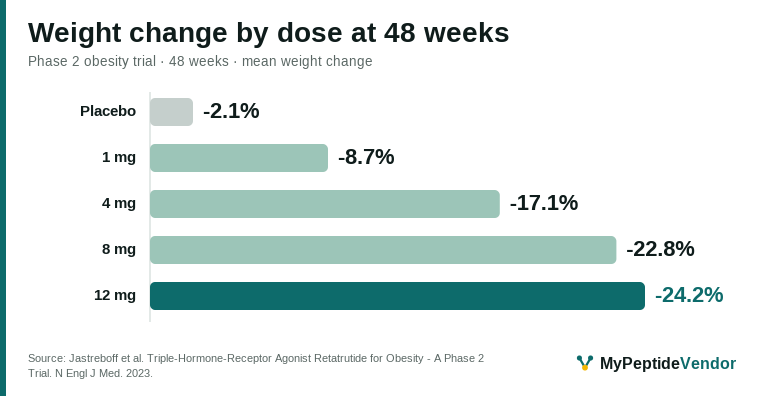
At 48 weeks, mean weight change was −8.7% with 1 mg, −17.1% with 4 mg, −22.8% with 8 mg, and −24.2% with 12 mg, compared with −2.1% with placebo 4. The reported results end at 48 weeks, so these findings do not establish what happens to weight after stopping retatrutide 4.
The phase 2 type 2 diabetes trial enrolled adults with glycated hemoglobin (HbA1c) from 7.0% to 10.5% and BMI from 25 to 50 kg/m² 5. It tested retatrutide maintenance groups of 0.5 mg, 4 mg, 8 mg, and 12 mg, along with dulaglutide and placebo 5. Those eligibility criteria and research doses do not establish an appropriate dose for a person using an online vial.
TRANSCEND-T2D-1 was a 40-week phase 3 trial of 537 adults with type 2 diabetes inadequately controlled by diet and exercise alone; mean baseline HbA1c was 7.9% 8. Participants received 4 mg, 9 mg, 12 mg, or placebo once weekly. Mean weight change was −11.5%, −13.9%, and −15.3% in the retatrutide groups, compared with −2.6% with placebo 8. Those findings come from a diabetes trial, not a validated 30 mg vial protocol.
ClinicalTrials.gov lists 34 registered retatrutide studies, including TRIUMPH-Outcomes (NCT06383390) and TRANSCEND-T2D-2 versus semaglutide (NCT06260722), both listed as active, not recruiting 11. Registration does not mean retatrutide is approved 111.
A meta-analysis of GLP-1-based therapies reported a pooled 5.21% reduction in liver fat content after a median of 24 weeks, with retatrutide showing the most evident treatment effect in that analysis 9. The pooled result covers multiple therapies; it is not a retatrutide-specific estimate or an approval for liver disease 9.
Storage and Handling
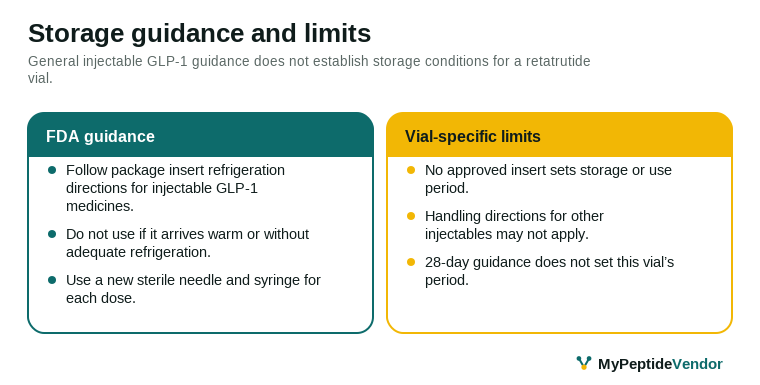
No FDA-approved retatrutide package insert establishes storage conditions or a beyond-use period for a consumer 30 mg vial 1. Do not assume that handling directions for another injectable medicine apply to retatrutide.
FDA says injectable GLP-1 medicines should be refrigerated as directed by their package inserts and advises patients not to use injectable GLP-1 products that arrive warm or without adequate refrigeration because quality may be affected 1. This general warning does not provide a validated storage method for an unapproved retatrutide vial 1.
For multidose sterile medication vials, FDA generally recommends use within 28 days after first use because contamination risk increases; it advises discarding the vial within 28 days even if medicine remains 1. That general guidance does not make an unapproved retatrutide product safe or establish its usable period 1.
FDA advises using a new sterile needle and syringe for each dose from a multidose vial to reduce contamination risk 1. If an injectable GLP-1 product arrives warm or without adequate refrigeration, FDA recommends not using it 1.
Use this chart
Free to reuse with a link back:
Injection and Tracking Tips
No self-injection steps, site-rotation instructions, or injection schedule are provided for this vial because there is no approved retatrutide product label or validated 30 mg presentation to follow 1. The phase 2 trials used injections under research protocols, but their summaries do not establish directions for an online product 45.
If enrolled in a legitimate clinical trial, follow the study team’s training and written instructions. Record questions and symptoms for that team, and do not change a study dose without contacting them.
Before using any injectable medicine supplied by a pharmacy, confirm the medicine name, concentration, prescribed dose, route, and pharmacy contact details with the prescriber or pharmacist. FDA lists missing instructions, damaged packaging, label spelling errors, and no licensed doctor available for follow-up as warning signs 1.
Check whether an online service requires screening and a prescription from a licensed clinician, identifies a state-licensed pharmacy, and provides a clinician who can answer questions after delivery 1. FDA also identifies claims that a product is the same as an approved drug and unusually low prices as reasons for caution 1.
Safety and Side Effects
Gastrointestinal effects were the most common adverse events in the phase 2 obesity trial; they were dose-related and mostly mild to moderate 4. A systematic review also found gastrointestinal effects were the most commonly reported adverse effects across the included retatrutide trials 7. The cited summaries do not provide reliable per-dose rates for nausea, vomiting, diarrhea, or constipation 47.
The phase 2 obesity trial reported that a 2 mg starting dose partially mitigated gastrointestinal events compared with a 4 mg start, but the summary does not quantify the difference 4. A separate meta-analysis found no statistically significant overall adverse-event difference between retatrutide and placebo (relative risk 1.11; P=0.24) 10. That pooled comparison does not mean side effects are absent or that an unknown-quality vial is safe 110.
In the phase 2 obesity trial, dose-dependent increases in heart rate peaked at 24 weeks and declined afterward 4. In TRANSCEND-T2D-1, the most frequent adverse events were generally mild-to-moderate gastrointestinal events that subsided over time; adverse-event-related treatment discontinuation was 2% to 5% with retatrutide and 0% with placebo 8. The trial reported no severe hypoglycemia 8.
Seek urgent medical care for severe or persistent symptoms such as repeated vomiting, inability to keep fluids down, severe abdominal pain, fainting, or signs of an allergic reaction. FDA has received adverse-event reports, some serious, for compounded semaglutide and tirzepatide, including nausea, vomiting, diarrhea, abdominal pain, and constipation; some reports relate to dosing errors or doses beyond the approved label 1. Those reports concern those compounded products, not retatrutide 1.
Discuss medical history, current medicines, and treatment goals with a licensed clinician before considering a weight-loss medicine. Retatrutide is not FDA-approved, and its safety and effectiveness have not been established for general consumer use 1.
Evidence status: Retatrutide is investigational and cannot be used in compounding under federal law 1. ClinicalTrials.gov lists 34 registered studies, including cardiovascular and kidney outcomes research and a comparison with semaglutide 11. Those registrations do not establish a completed long-term safety record or regulatory approval 111.
Frequently asked questions
What is the starting dose of retatrutide?
There is no FDA-approved starting dose. In the phase 2 obesity trial, groups assigned to 4 mg and 8 mg targets started at 2 mg or 4 mg, while the 12 mg group started at 2 mg; the 1 mg group was a fixed-dose arm 4. These research arms are not instructions for using an online vial.
How much weight did people lose in the retatrutide obesity trial?
At 48 weeks, mean weight change ranged from −8.7% in the 1 mg group to −24.2% in the 12 mg group; the placebo group changed by −2.1% 4. These are group averages from a phase 2 trial, not a prediction for an individual.
How much water should I mix with a 30 mg retatrutide vial?
No cited human trial validates a reconstitution volume for an online 30 mg vial 145. Do not choose a volume from a seller’s chart: the vial’s identity, concentration, sterility, and suitability for injection cannot be confirmed from arithmetic.
Can I use a U-100 conversion chart for a 30 mg vial?
A conversion chart cannot confirm the vial’s contents, concentration, sterility, or suitability for injection. FDA warns that retatrutide products labeled for research or not for human consumption have been sold directly to consumers and may be of unknown quality 1.
What should I do after missing a dose or stopping for several weeks?
No approved retatrutide label establishes missed-dose or restart instructions, and the cited trial summaries do not give a general rule for a gap of several weeks 45. Do not double a dose or restart from an online chart; contact the study team if enrolled in a trial, or speak with a licensed clinician.
Is retatrutide FDA-approved or legally compounded?
No. The FDA says retatrutide is not an FDA-approved medicine and cannot be used in compounding under federal law 1. A telehealth or pharmacy label does not change that status.
How can I check an online medicine seller?
Ask whether the service requires clinician screening and a prescription, identifies a state-licensed pharmacy, and provides a licensed clinician for follow-up 1. Claims that a product is the same as an approved medicine, unusually low prices, damaged packaging, missing instructions, or unclear pharmacy details are warning signs 1.
References
- FDA: Concerns with unapproved GLP-1 drugs used for weight loss
- FDA: Certain bulk drug substances for use in compounding that may present significant safety risks
- Katsi et al. Retatrutide-A Game Changer in Obesity Pharmacotherapy. Biomolecules. 2025.
- Jastreboff et al. Triple-Hormone-Receptor Agonist Retatrutide for Obesity - A Phase 2 Trial. N Engl J Med. 2023.
- Rosenstock et al. Retatrutide, a GIP, GLP-1 and glucagon receptor agonist, for people with type 2 diabetes: a randomised, double-blind, placebo and active-controlled, parallel-group, phase 2 trial conducted in the USA. Lancet. 2023.
- Drucker et al. Efficacy and Safety of GLP-1 Medicines for Type 2 Diabetes and Obesity. Diabetes Care. 2024.
- Misra et al. Efficacy and safety of retatrutide for the treatment of obesity: a systematic review of clinical trials. J Basic Clin Physiol Pharmacol. 2025.
- Bajaj et al. Efficacy and safety of retatrutide, a GIP, GLP-1, and glucagon receptor agonist, in people with type 2 diabetes and inadequate glycaemic control with diet and exercise (TRANSCEND-T2D-1): a double-blind, randomised, phase 3 trial. Lancet. 2026.
- Wang et al. Efficacy of GLP-1-based Therapies on Metabolic Dysfunction-associated Steatotic Liver Disease and Metabolic Dysfunction-associated Steatohepatitis: A Systematic Review and Meta-analysis. J Clin Endocrinol Metab. 2025.
- Abdrabou Abouelmagd et al. Efficacy and safety of retatrutide, a novel GLP-1, GIP, and glucagon receptor agonist for obesity treatment: a systematic review and meta-analysis of randomized controlled trials. Proc (Bayl Univ Med Cent). 2025.
- ClinicalTrials.gov: 34 registered studies (search: Retatrutide)
Written by the MyPeptideVendor editorial team from the FDA label, peer-reviewed studies and ClinicalTrials.gov records listed above, fact-checked line by line and reviewed 2026-11-12.
Cite this page
MyPeptideVendor Editorial Team. Retatrutide Dosage 30mg: Trial Data & Safety. MyPeptideVendor. Updated November 12, 2026. https://mypeptidevendor.com/protocols/retatrutide-dosing-30mg/MyPeptideVendor Editorial Team. (2026, November 12). Retatrutide Dosage 30mg: Trial Data & Safety. MyPeptideVendor. https://mypeptidevendor.com/protocols/retatrutide-dosing-30mg/Related protocols
5-Amino-1MQ 50 mg
Not approvedNo approved human dose exists; this guide separates 50 mg vial math from dosing advice and explains evidence, handling, and safety limits.
View protocolAICAR 50 mg
Research UseAICAR has no approved human dose or validated injection schedule; a 50 mg vial does not establish a safe dose, dilution, or cycle.
View protocolAOD-9604 10 mg
Not approvedAOD-9604 is not FDA-approved, and no validated human subcutaneous dose, titration schedule, or cycle is established.
View protocol