Peptides for Muscle Growth: Evidence & Safety
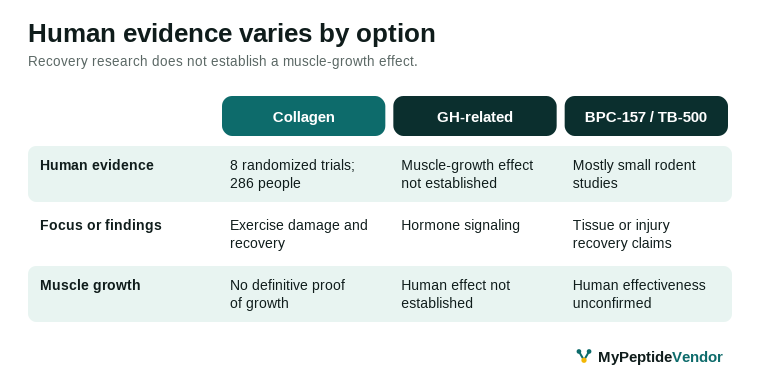
Human evidence for muscle gain is limited: collagen has exercise-related research, while popular hormone and injury peptides lack proven muscle-building results.
Peptides for muscle growth have limited human evidence, and no peptide is FDA-approved specifically to build muscle in healthy adults. Oral collagen has been studied with exercise, but an 8-trial review focused on muscle damage, soreness, and recovery, not a dependable increase in muscle size 9.
Growth hormone secretagogues can change hormone signals, but that does not prove they build useful muscle. Acute hormone rises after resistance training do not appear to be directly correlated with muscle growth 3. Training, nutrition, and sleep still do the main work.
Key takeaways
- An 8-trial review included 286 participants and examined collagen for exercise-related muscle damage and recovery 9.
- Acute hormone elevations after resistance training do not appear to be directly correlated with muscle growth 3.
- BPC-157 studies reviewed were mostly small rodent studies, and its effectiveness in humans remains unconfirmed 6.
- In a 2-month trial of 19 natural bodybuilders, lean mass increased significantly only in the Western-diet group 7.
- FDA compounding policies and FDA approval of a finished drug are different regulatory matters 1.
What peptide therapy for muscle growth means
Peptides are short chains of amino acids. Proteins are also amino-acid chains, but are generally longer and fold into more complex structures. Anabolic steroids are different: they are steroid hormones or related drugs, not amino-acid chains. That chemical difference does not show that peptides are safer or more effective.
“Peptide therapy” can mean very different things: oral collagen, a prescription medicine, a compounded injection, or a product sold for research. Those forms are not interchangeable. A medicine approved for one condition is not automatically approved to increase muscle, and a compounded preparation is not an FDA-approved finished drug.
Muscle growth requires repeated resistance training and enough food and recovery to support adaptation. Hypertrophy can occur in the relative absence of muscle damage, although whether damage contributes to long-term growth is debated 4. Soreness is not a dependable measure of a productive workout.
How these peptides are thought to work
Growth hormone secretagogues aim to prompt the pituitary gland to release growth hormone. Growth hormone can affect insulin-like growth factor 1 (IGF-1), a hormone involved in growth and tissue repair. That proposed pathway does not prove a muscle benefit: a change in hormone levels is not the same as a measured change in strength or muscle size 3.
Sermorelin and CJC-1295 are growth hormone-releasing hormone (GHRH) analogs. They act on a signal that prompts growth hormone release. Ipamorelin is a growth hormone-releasing peptide (GHRP) that works through a different receptor pathway. Using two signals together may sound plausible, but a plausible mechanism is not clinical evidence of a greater muscle gain.
MK-677, also called ibutamoren, is an oral growth hormone secretagogue, not technically a peptide. BPC-157 and TB-500 are marketed for tissue or injury recovery, a different goal from increasing muscle size. Even if a treatment sped healing, that alone would not show that it builds muscle.
Acute resistance-training hormone elevations do not appear to be directly correlated with muscle growth 3. This weakens the simple claim that a bigger short-lived growth hormone pulse must produce bigger muscles. A changed lab result cannot stand in for a measured training outcome.
Main options and the best human evidence

Collagen peptides with resistance training. An integrative review included 8 randomized human trials and 286 participants, assessing muscle damage, soreness, fatigue, and recovery after exercise 9. The review describes possible help with exercise-related muscle stress, but its varied studies do not establish a predictable increase in muscle size. Collagen is taken orally; it is not a growth hormone injection.
Sermorelin. Sermorelin is a GHRH analog intended to prompt the body’s own growth hormone release. Sermorelin has not been shown to produce a muscle-gain effect in humans. Raising a hormone signal is not proof of greater muscle growth, and acute training-related hormone elevations do not appear to track directly with hypertrophy 3.
Ipamorelin. Ipamorelin acts on a growth hormone-releasing pathway. A quantified human muscle-growth result for ipamorelin is not established here. Claims about larger muscles or better performance should not be treated as proven just because a compound can affect hormone signaling.
CJC-1295. CJC-1295 is a GHRH analog marketed to affect growth hormone release. A human muscle-gain effect is not established here. Nor is there an established muscle-growth result for combining CJC-1295 with ipamorelin; two proposed mechanisms do not prove synergy.
MK-677 (ibutamoren). MK-677 is an oral secretagogue, not a peptide. The evidence discussed here does not establish a human muscle-growth effect for it. Popularity or a change in a hormone marker is not proof of muscle gain.
BPC-157 and TB-500. A review of BPC-157 found positive results in the studies it examined, but most were small rodent studies, and effectiveness in humans remains unconfirmed 6. Human evidence that TB-500 builds muscle or improves injury recovery is not established. Neither should be treated as a proven muscle builder.
Evidence snapshot. Collagen has randomized human studies for exercise-related muscle damage and recovery, not definitive proof of muscle growth 9. For sermorelin, ipamorelin, CJC-1295, and MK-677, evidence of a muscle-growth effect in humans has not been established. Most BPC-157 studies are small rodent studies, and efficacy in humans is unconfirmed 6.
Use this chart
Free to reuse with a link back:
FDA-approved, compounded, and research-only

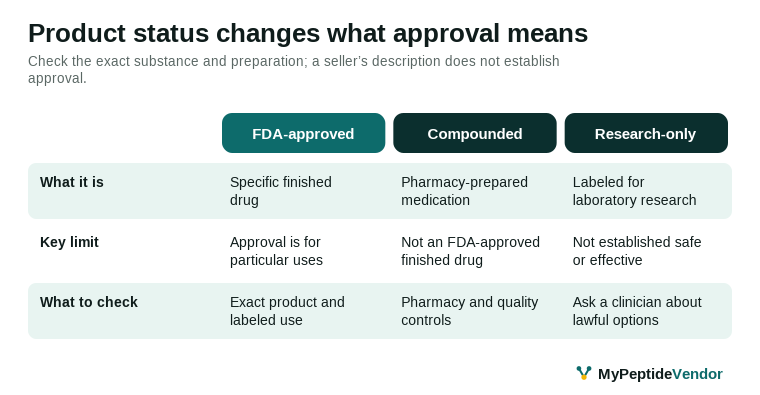
FDA approval applies to a specific finished drug and its labeled uses; it does not approve every preparation of an ingredient or every use. Compounding is a separate pathway. FDA places some nominated bulk drug substances in Category 2 when it identifies potential significant safety risks 1.
| Status | What it means | What to check |
|---|---|---|
| FDA-approved drug | A specific finished drug has FDA approval for particular uses. That does not mean it is approved to build muscle. | Check the exact product, labeled use, and prescribing information with a clinician. |
| Compounded drug | A pharmacy prepares a medication under applicable compounding rules. It is not an FDA-approved finished drug. | Ask why compounding is needed, which pharmacy prepares it, and what quality controls apply. Check current FDA information for the exact ingredient. |
| Research-only product | A product labeled for laboratory research is not established as safe or effective for personal treatment. | Do not use a research-labeled product as a medication. Ask a clinician about lawful, appropriate treatment options. |
Ask the prescriber and pharmacist to verify the current status of the exact substance and preparation. FDA category listings and compounding policies should be checked for the exact substance; a seller’s product description does not establish approval.
Use this chart
Free to reuse with a link back:
How to choose by goal
- If you want muscle gain: start with progressive resistance training and adequate food. A short-term hormone rise after a workout is not a reliable proxy for hypertrophy 3.
- If you want help with exercise-related soreness or recovery: collagen has human trial research on muscle damage and recovery, but that is not the same as proof of muscle growth 9.
- If you have an injury: get a diagnosis before considering a product promoted for healing. BPC-157 evidence is mostly from small rodent models, and its effectiveness in humans remains unconfirmed 6.
- If you compete: check the current World Anti-Doping Agency (WADA) list and your league’s rules before using a hormone-related product. A prescription does not automatically confirm eligibility.
Before agreeing to treatment, ask what outcome will be tracked, how long a trial would last, what would count as no benefit, and what alternatives exist. A proposed CJC-1295 and ipamorelin combination deserves the same questions as either drug on its own; a combined mechanism is not proof of a better result.
Costs: what affects the total

There is no single reliable price for peptide care. The total can include the consultation, follow-up visits, laboratory tests, pharmacy preparation, shipping, and refills. Approved medicines and compounded preparations can involve different costs and oversight, so ask for the expected total rather than comparing vial prices alone.
Safety, side effects, and monitoring
Risk depends on the exact substance, dose, route, product quality, and your health. For growth hormone-related treatments, discuss glucose changes and insulin resistance, as well as fatigue and insomnia. An injectable product can also cause pain, redness, or swelling at the injection site. The likelihood and severity of these effects are not established for every product marketed for muscle growth.
Ask whether fasting glucose, HbA1c, or IGF-1 testing fits your health history and proposed treatment. Agree on follow-up and warning signs before starting. Marked changes in thirst or urination, a severe reaction, or worsening symptoms call for prompt medical advice rather than continued self-treatment.
Peptides are not automatically safer than anabolic steroids. Anabolic-androgenic steroids can produce supraphysiologic muscle hypertrophy and are associated with side effects 3. That does not establish that performance-marketed peptides are safe; long-term safety for many such products is not established, and risks differ by substance.
Diet can also change body-composition results. In a randomized study of 19 natural bodybuilders followed for 2 months, body fat fell in the ketogenic-diet group, while lean mass increased significantly only in the Western-diet group 7. This was a diet study, not a peptide trial, but it shows why nutrition can complicate claims about muscle or body-fat changes.
Sports rules and testing
Drug-tested athletes should check the current WADA prohibited list and their league or federation rules before using a hormone-related product. A product’s name, marketing, or prescription does not by itself confirm that it is permitted in competition. Ask a team physician or anti-doping contact to check the exact ingredient.
Do not rely on stopping a product shortly before a test as a safeguard. Testing and detection depend on the substance, and an athlete should confirm the rules before use rather than trying to estimate a washout period after starting.
How to get started through telehealth or a clinic
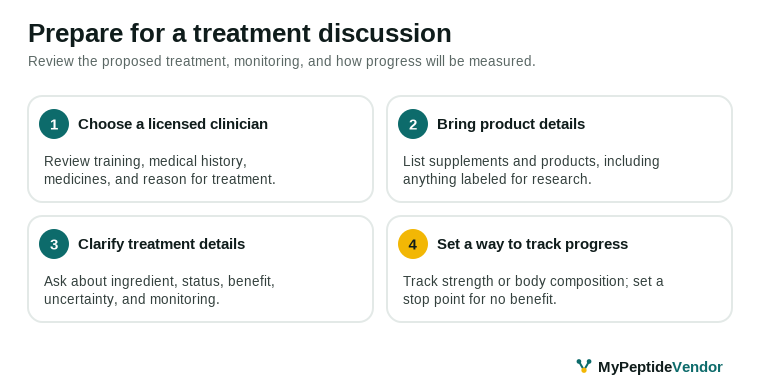
Start with a licensed clinician who can review your training, medical history, medicines, and reason for considering treatment. Telehealth can work for an initial discussion if the clinician can arrange any needed examination, testing, and follow-up. An in-person sports medicine or endocrinology visit may be more useful when an injury or hormone disorder needs assessment.
Bring a list of supplements and products you use, including anything labeled for research. Ask for the exact ingredient, route, regulatory status, expected benefit, uncertainties, monitoring plan, and total cost. A seller’s suggested schedule is not a substitute for an individualized prescription.
Before using a product, decide how progress will be measured and when treatment will stop if it is not helping. A muscle-focused plan should track a real outcome, such as strength or a defined body-composition measure, rather than relying only on a hormone result 3.
Use this chart
Free to reuse with a link back:
Buyer's guides
Frequently asked questions
Which peptides are best for muscle growth?
No peptide has established itself as the best muscle-building choice for healthy adults. Collagen is the option here with randomized human research tied to exercise, but those trials focused on damage and recovery rather than proving a dependable increase in muscle size 9.
What is the downside of taking peptides?
The main drawbacks are uncertain benefit, limited long-term safety information, and the possibility of metabolic or injection-related problems. For growth hormone-related products, discuss glucose regulation, fatigue, and sleep changes with a clinician before use.
Is a peptide safer than a steroid?
There is no class-wide answer. Steroids can cause supraphysiologic muscle growth and have known adverse effects 3, while safety is not established for many performance-marketed peptides. Compare the specific substances and risks with a clinician rather than assuming one category is safer.
What are the top 5 best peptides?
There is no evidence-based top-five list of proven muscle builders. Collagen has human exercise-recovery research 9; sermorelin, ipamorelin, and CJC-1295 lack established muscle-growth results here; MK-677 is not technically a peptide; and BPC-157 remains unconfirmed in humans 6.
References
- FDA: Certain bulk drug substances for use in compounding that may present significant safety risks
- Saunders et al. β-alanine supplementation to improve exercise capacity and performance: a systematic review and meta-analysis. Br J Sports Med. 2017.
- Fink et al. The role of hormones in muscle hypertrophy. Phys Sportsmed. 2018.
- Schoenfeld et al. Does exercise-induced muscle damage play a role in skeletal muscle hypertrophy? J Strength Cond Res. 2012.
- Abrego-Guandique et al. The impact of exercise on mitochondrial biogenesis in skeletal muscle: A systematic review and meta-analysis of randomized trials. Biomol Concepts. 2025.
- Gwyer et al. Gastric pentadecapeptide body protection compound BPC 157 and its role in accelerating musculoskeletal soft tissue healing. Cell Tissue Res. 2019.
- Paoli et al. Effects of Two Months of Very Low Carbohydrate Ketogenic Diet on Body Composition, Muscle Strength, Muscle Area, and Blood Parameters in Competitive Natural Body Builders. Nutrients. 2021.
- Sadowski et al. The impact of N-acetylcysteine on lactate, biomarkers of oxidative stress, immune response, and muscle damage: A systematic review and meta-analysis. J Cell Mol Med. 2024.
- Inacio et al. The Effects of Collagen Peptides as a Dietary Supplement on Muscle Damage Recovery and Fatigue Responses: An Integrative Review. Nutrients. 2024.
- Andrade-Souza et al. Exercise twice-a-day potentiates markers of mitochondrial biogenesis in men. FASEB J. 2020.
- Woodhead et al. Mitochondrial-derived peptides and exercise. Biochim Biophys Acta Gen Subj. 2021.
- ClinicalTrials.gov: 399 registered studies (search: Athletic Performance)
Written by the MyPeptideVendor editorial team from the FDA label, peer-reviewed studies and ClinicalTrials.gov records listed above, fact-checked line by line and reviewed 2026-11-12.
Cite this page
MyPeptideVendor Editorial Team. Peptides for Muscle Growth: Evidence & Safety. MyPeptideVendor. Updated November 12, 2026. https://mypeptidevendor.com/treatment/athletic-performance/MyPeptideVendor Editorial Team. (2026, November 12). Peptides for Muscle Growth: Evidence & Safety. MyPeptideVendor. https://mypeptidevendor.com/treatment/athletic-performance/