Peptides for Hormone Optimization: Evidence & Safety
Most peptides marketed for hormone optimization lack established human evidence for this goal; compare the options, risks, and supervised next steps.

Peptides for hormone optimization are compounds marketed to change hormone signals, but most do not have established human evidence for improving hormone-related symptoms. Peptides are chains of amino acids that can act as signaling molecules; a plausible mechanism does not prove that a product works for a person.
For women in perimenopause or menopause, fatigue, sleep changes, weight shifts, and mood symptoms can have several causes. A clinical assessment should come before a peptide, especially when a proposed treatment changes growth-hormone signaling and may also affect insulin-like growth factor 1 (IGF-1) 11.
Key takeaways
- Ghrelin is a 28-amino-acid hormone that activates the growth hormone secretagogue receptor, a target for some growth-hormone-releasing compounds 35.
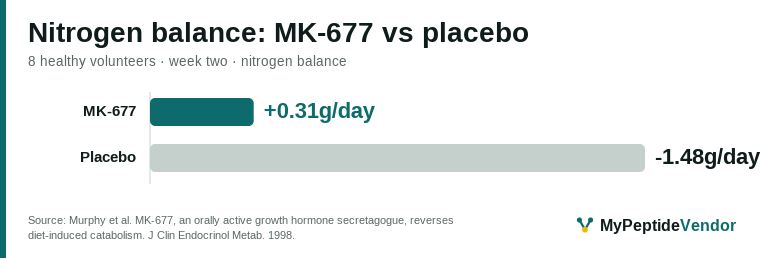
- In 8 calorie-restricted healthy adults, week-two nitrogen balance was +0.31 g/day with MK-677 versus -1.48 g/day with placebo 11.
- A 12-week trial in 102 women with central obesity found a 1.1 kg weight reduction with high-dose green tea extract, about 2.4 lb 9.
- FDA Category 2 identifies bulk substances that may present significant safety risks in compounding 1.
- A ClinicalTrials.gov search for “Hormone Optimization” returned 1,248 studies, a broad count that does not show how many test a particular peptide 12.
Peptides for hormone optimization
CJC-1295
Not approvedCJC-1295 raises GH and IGF-1 in a short human trial, but benefits, long-term safety, and a standard dose remain unproven.
Learn moreFollistatin-315
Research UseFollistatin-315 binds activin and is proposed to affect myostatin, but injectable peptide benefits, doses, and risks are not established in controlled human trials.
Learn moreGonadorelin
Not approvedGonadorelin signals the pituitary to release LH and FSH; US Factrel is 50 mcg/mL and labeled for animals, not people. [1]
Learn moreHexarelin
Research UseHexarelin can stimulate growth hormone release, but human evidence does not establish a dose or prove benefits for muscle, fat loss, recovery, or energy.
Learn morePEG-MGF
Research UsePEG-MGF is a pegylated mechano growth factor named as an IGF-1 analogue, but human muscle benefit and safe dosing have not been established.
Learn moreSermorelin
Not approvedsermorelin prompts pituitary growth hormone release, but adult anti-aging benefits and long-term safety remain uncertain.
Learn moreEnclomiphene
Not approvedEnclomiphene can raise the body’s testosterone signals and may preserve sperm production, but its dose and long-term safety remain uncertain.
Learn moreHGH
FDA-ApprovedHGH is a prescription protein hormone for specific growth disorders and deficiencies, not an established treatment for aging or athletic performance.
Learn moreIpamorelin
Not approvedipamorelin stimulates growth hormone release, but human evidence has not established benefits for fat loss, muscle gain, sleep, or sports recovery.
Learn moreHCG
FDA-ApprovedhCG signals the testes to make testosterone and may support sperm production; its role depends on the cause of low testosterone and fertility goals.
Learn moreWhat peptide therapy for hormone optimization means
Peptides are short chains of amino acids, the same building blocks used to make proteins. Many act as signals between cells. Ghrelin, for example, is a 28-amino-acid hormone and the natural ligand of the growth hormone secretagogue receptor (GHSR) 35. A synthetic peptide may copy, block, or alter a natural signal, but that does not make it an approved treatment.
“Hormone optimization” is a marketing phrase, not one diagnosis with one standard treatment. Low energy, changes in sleep, irregular periods, low libido, and weight changes can have different causes. Menopause, thyroid disease, anemia, medication effects, sleep problems, and changes in nutrition or activity may call for different evaluations and care.
Peptide therapy can refer to an FDA-approved peptide medicine used for its labeled condition, a compounded preparation, or a product sold as “research use only.” Those are not interchangeable. MK-677 is often grouped with peptides in wellness marketing, but it is a nonpeptide, orally active growth hormone secretagogue 11.
The first step is to define the symptom and the condition being considered. A single hormone test does not diagnose every cause of fatigue, weight change, or menstrual symptoms. Treatment aimed at raising one hormone may miss the cause, and may affect other systems as well.
How these compounds are supposed to work
A peptide can bind to a receptor or affect a signaling pathway. Growth hormone secretagogues are intended to prompt the body to release growth hormone rather than supply growth hormone itself. Ghrelin is the natural ligand for GHSR, and the receptor is a target for compounds described as ghrelin-like secretagogues 35. That connection explains a proposed mechanism; it does not prove that a product improves body composition, sleep, or menopause symptoms.
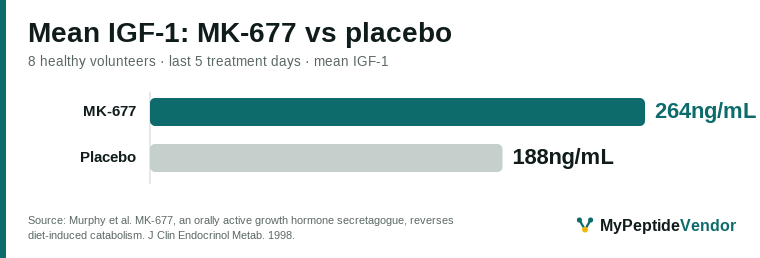
Growth hormone can stimulate production of IGF-1 in the liver and other tissues. In a small trial, MK-677 increased mean IGF-1 during treatment compared with placebo. After a single dose, peak growth hormone was 55.9 micrograms per liter; after a week of daily dosing, it was 22.6 micrograms per liter 11. The trial involved 8 healthy volunteers under calorie restriction, not a representative group of women seeking menopause care.
Ghrelin signaling also relates to appetite and energy regulation, so changing this pathway could have effects beyond growth hormone 357. A product’s proposed target is not necessarily its only effect. Claims that a compound changes one hormone without affecting appetite, glucose regulation, or other body systems need human testing.
Midlife muscle change also has more than one possible cause. Research on glucocorticoid-related muscle loss describes increased protein breakdown, increased FOXO, atrogin-1, and MuRF-1 activity, and reduced mTOR/S6K1 signaling; changes in IGF-1 and myostatin may also contribute 4. This biology helps explain muscle loss in some illnesses and medication exposures. It does not show that an unapproved peptide reverses ordinary age-related changes.
Hormone levels change with age, menstrual-cycle timing, illness, and medicines. A clinician needs the result, symptoms, timing, and medical history together. There is no single “optimization” panel that establishes a need for every peptide or predicts who will benefit.
Popular peptides and related compounds
The compounds below are often promoted for recovery, metabolism, cognition, or reproductive health. For hormone optimization, a human randomized controlled trial (RCT) result is not established for most of them. The most concrete human trial result in this group is for MK-677, which is not a peptide and was studied for short-term nitrogen balance during calorie restriction 11.
BPC-157
BPC-157 is promoted for tissue repair and gut health. A human RCT result for hormone optimization, a clinical dose, and a treatment timeline are not established. A proposed repair effect would not show that it corrects estrogen, thyroid, or reproductive hormone problems.
TB-500
TB-500 is marketed for recovery, but a human RCT result for hormone optimization is not established. Claims about injury recovery or hormone balance should not be treated as clinical outcomes without controlled human evidence.
KPV
KPV is discussed as an inflammation-related peptide. A human RCT result showing that it changes hormone levels or improves hormone-related symptoms is not established. A proposed effect on inflammation does not demonstrate a benefit for menopause, thyroid function, or reproductive health.
MOTS-c
MOTS-c is a mitochondrial-derived peptide discussed in research on metabolism. A human RCT result, clinical dose, and treatment timeline for hormone optimization are not established. Research interest in a metabolic pathway is not evidence that an injectable product treats a hormone disorder.
AOD-9604
AOD-9604 is marketed for weight management, but a human RCT result for hormone optimization is not established. Weight change by itself would not show that a hormone disorder had been corrected.
Ipamorelin
Ipamorelin is promoted as a growth hormone secretagogue. Ghrelin and GHSR biology helps explain the receptor target used in this class 35, but a human RCT result for ipamorelin as hormone optimization is not established. A receptor mechanism is not proof of a meaningful clinical benefit.
CJC-1295
CJC-1295 is promoted as a growth-hormone-releasing hormone analog and is sometimes paired with ipamorelin. A human RCT result, dose, and safety estimate for hormone optimization are not established. Claims about a combined effect need controlled human trials of the actual combination.
Sermorelin
Sermorelin is described as a growth-hormone-releasing hormone analog. A human RCT result for using it to optimize hormones in otherwise healthy adults or treat perimenopause symptoms is not established. A proposed effect on growth hormone does not establish a medical indication.
Semax
Semax is discussed for cognitive effects rather than as an established hormone treatment. A human RCT result for hormone optimization is not established, and claims about focus or mood should not be confused with correction of a hormone disorder.
Epitalon
A human RCT result for Epitalon as hormone optimization is not established. Claims about aging or hormone balance do not establish a safe long-term treatment plan.
Kisspeptin
A human RCT result establishing that kisspeptin improves fertility, libido, or menopause symptoms in women is not established. Anyone who is pregnant or breastfeeding should seek specialist advice before using a research product.
GHK-Cu
GHK-Cu is a copper-binding peptide promoted mainly for skin and hair uses, not as an established hormone therapy. A human RCT result for hormone optimization is not established; skin or hair claims do not demonstrate a hormone effect.
MK-677 (ibutamoren): a related nonpeptide
MK-677 is an orally active, nonpeptide growth hormone secretagogue, not a peptide 11. In a randomized crossover trial, 8 healthy volunteers took 25 mg daily during the last 7 days of calorie restriction. During week two, nitrogen balance was +0.31 g/day with MK-677 versus -1.48 g/day with placebo, a difference of 1.79 g/day 11. Nitrogen balance compares nitrogen intake with nitrogen loss; it is an indirect measure of protein balance, not a direct measure of muscle gained.
After one dose, the peak growth-hormone response was 55.9 micrograms per liter; after a week of daily dosing, it was 22.6 micrograms per liter 11. Mean IGF-1 in the last 5 treatment days was 264 ng/mL with MK-677 versus 188 ng/mL with placebo 11. These findings show short-term hormone changes in a small study. They do not establish long-term safety, weight loss, or benefit for women in perimenopause or menopause.
A nonpeptide option studied in women
Green tea extract containing 856.8 mg/day of epigallocatechin gallate (EGCG) was studied in one 12-week randomized, double-blind trial of 102 women with central obesity 9. Mean weight changed from 76.8 to 75.7 kg, a reduction of 1.1 kg, or about 2.4 lb for someone starting near 169 lb 9. Ghrelin decreased and adiponectin increased in the treatment group 9. This single trial does not establish EGCG as a general treatment for hormone imbalance or menopause symptoms.
FDA-approved, compounded, and research-only products

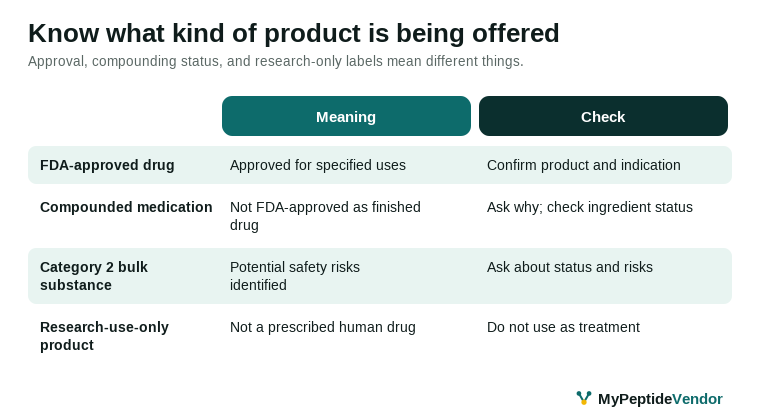
FDA Category 2 substances are bulk substances identified as potentially presenting significant safety risks in compounding 1. FDA compounding categories describe nominated bulk substances in the agency’s interim framework; they are not ratings of whether a treatment works.
| Type or category | What it means | What to check |
|---|---|---|
| FDA-approved drug | A specific product has FDA approval for specified uses and carries approved labeling. | Confirm the exact product and indication. Approval of one peptide medicine does not approve other peptides or uses. |
| Compounded medication | A pharmacy prepares a medication for an individual or other permitted use under applicable compounding rules. A compounded drug is not FDA-approved as a finished product. | Ask why compounding is needed, which pharmacy prepares it, and whether the ingredient is eligible under current FDA policies. |
| Category 2 bulk substance | FDA has identified potential significant safety risks for the nominated substance. | Ask the prescriber to explain the ingredient’s status and the safety concerns before considering any preparation. |
| Research-use-only product | The product is not sold as a prescribed human drug. A “research use only” label does not establish that it is made or tested for human use. | Do not use it as treatment. A label does not verify dose, purity, sterility, or patient-specific medical oversight. |
The compounds commonly marketed for hormone optimization in this guide should not be assumed to have FDA approval for that purpose. A drug may have a different approved indication, and that does not establish approval for menopause, fertility, anti-aging, or general “optimization.” Verify the exact product and intended use with the prescriber and pharmacist.
Compounded drugs do not undergo FDA review and approval for safety, effectiveness, and quality before marketing in the way FDA-approved drugs do. Compounding can serve a medical need when an appropriate approved product does not meet a patient’s needs, but it does not turn a research chemical into an approved medicine.
A “research use only” label is a serious warning, not a quality mark. When a seller offers such a product for human injection or ingestion, the buyer cannot assume there is verified human dosing, a clinical prescriber, or the protections of an FDA-approved drug. A certificate of analysis alone does not establish that a product is sterile, correctly dosed, or suitable for a particular person.
Use this chart
Free to reuse with a link back:
If you and a clinician decide it fits, one option is Elevated Health TRT: online testosterone therapy program with a licensed US provider (US only). Affiliate link
Evidence grades for the named compounds

A short MK-677 study in 8 healthy adults 11 and an EGCG trial in 102 women with central obesity 9 do not establish a hormone-optimization treatment for women. The table summarizes the human RCT status for the goal discussed on this page and the regulatory point to verify for each compound.
| Compound | Human RCT evidence for hormone optimization | FDA status for this goal | Main caveat |
|---|---|---|---|
| BPC-157 | Not established | No FDA-approved hormone-optimization indication identified | Repair claims do not establish hormone effects. |
| TB-500 | Not established | No FDA-approved hormone-optimization indication identified | Human benefit and dosing are not established. |
| KPV | Not established | No FDA-approved hormone-optimization indication identified | Proposed anti-inflammatory action is not clinical proof. |
| MOTS-c | Not established | No FDA-approved hormone-optimization indication identified | No clinical dose for this goal is established. |
| AOD-9604 | Not established | No FDA-approved hormone-optimization indication identified | Weight claims do not establish hormonal correction. |
| Ipamorelin | Not established | No FDA-approved hormone-optimization indication identified | GHSR-related biology does not prove patient benefit. |
| CJC-1295 | Not established | No FDA-approved hormone-optimization indication identified | Combination claims need controlled human trials. |
| Sermorelin | Not established | No FDA-approved hormone-optimization indication identified | A proposed growth-hormone effect does not establish an indication. |
| Semax | Not established | No FDA-approved hormone-optimization indication identified | Cognitive claims do not establish hormone benefit. |
| Epitalon | Not established | No FDA-approved hormone-optimization indication identified | Hormone-related benefit and long-term safety are not established. |
| Kisspeptin | Not established | No FDA-approved hormone-optimization indication identified | Human benefit and safety for this goal are not established. |
| GHK-Cu | Not established | No FDA-approved hormone-optimization indication identified | Skin or hair claims do not establish hormone effects. |
| MK-677 | Small short-term RCT, not a hormone-optimization trial | No FDA-approved hormone-optimization indication identified | Nonpeptide; small study and short dosing period. |
A ClinicalTrials.gov search for “Hormone Optimization” returned 1,248 registered studies 12. That search count is not a count of peptide trials; it can include unrelated studies, and a registered study may be completed, ongoing, or not yet recruiting. Search the exact compound and condition, then check the study design, participants, outcomes, and status.
Use this chart
Free to reuse with a link back:
Use this chart
Free to reuse with a link back:
How to choose a safer, evidence-led approach
Start with the symptom, not a peptide name. A clinician evaluating persistent fatigue may review sleep, medications, nutrition, mood, and relevant medical causes before discussing hormone treatment. Hot flashes or menstrual changes in perimenopause need a different assessment from unexplained weight gain or low libido.
Ask what diagnosis the proposed treatment is meant to address, which human study supports it, and what result would count as success. If the rationale rests only on a receptor mechanism, animal research, testimonials, or a promise to “balance hormones,” the benefit for you is uncertain. ClinicalTrials.gov can help you check whether a study exists, but registration alone does not prove that a treatment works 12.
For women in perimenopause or menopause, discuss cycle changes, pregnancy possibility, contraception, fertility plans, and whether established menopause care fits the symptoms. A peptide should not replace an evaluation of bleeding changes, hot flashes, sleep disruption, or other symptoms. The EGCG trial involved women with central obesity and measured outcomes over 12 weeks; it did not test treatment of menopause symptoms 9.
Be especially cautious with growth-hormone secretagogues if you have diabetes, a history of cancer, or a hormone-sensitive condition. A short trial found increased IGF-1 during MK-677 use, but it does not settle the risks for people with those conditions or for longer use 11. Ask the clinician managing your condition to review the exact product and the reason for using it.
Do not start a research product while pregnant, breastfeeding, or trying to conceive without specialist advice. Safety in these situations has not been established for the research products discussed here. A compound’s proposed reproductive effects do not prove that self-treatment will improve fertility.
A practical decision path
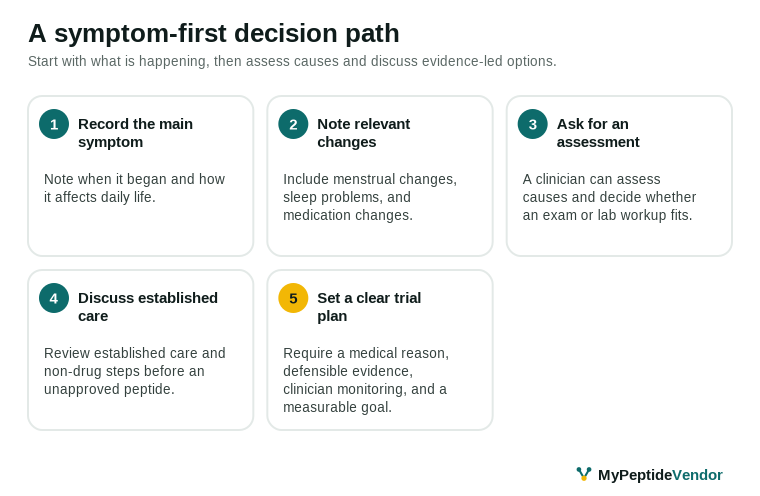
- Write down the main symptom and when it began. Note menstrual changes, sleep problems, medication changes, and the effect on daily life.
- Ask a clinician to assess possible causes and decide whether an examination or laboratory workup is appropriate.
- Discuss established care and non-drug steps before an unapproved peptide. One nonpeptide option studied in women was EGCG in a single 12-week trial, not a general treatment recommendation 9.
- Consider a peptide only if there is a clear medical reason, a defensible evidence case, and a clinician who can monitor the treatment.
- Agree in advance on a measurable goal, follow-up date, stopping rules, and what symptoms require prompt medical review.
Questions to ask before agreeing
- What diagnosis or measurable symptom is this treatment intended to address?
- Is the exact product FDA-approved for this use, compounded, or labeled for research only?
- What human study supports the expected benefit, and how similar were its participants to me?
- What side effects, interactions, and stopping rules should I know?
- Who will review symptoms and test results, and when is the follow-up visit?
Use this chart
Free to reuse with a link back:
Costs and what affects them

There is no standard price for peptide therapy established by the evidence discussed here. A clinic’s total charge may depend on the consultation, laboratory work, pharmacy preparation, product and route, follow-up visits, and whether insurance covers any part of the evaluation.
Ask for an itemized estimate that separates the clinician’s fee, tests, medication, and follow-up. Compare what is included rather than comparing vial prices alone. A low price from a seller without a prescriber, clear dosing instructions, or a verifiable pharmacy is not equivalent to clinician-managed care.
Cost does not establish quality or effectiveness. Before paying, ask who prescribes the product, who dispenses it, how it is stored, and what follow-up is included. If a seller cannot answer those questions, do not treat a low price as evidence that the product is safe.
Safety, monitoring, and supply-chain checks
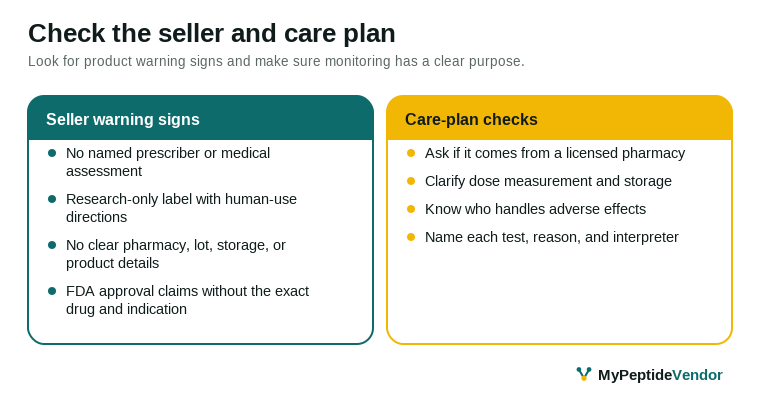
Potential harms include effects from the active substance, an incorrect dose, contamination, and a delay in diagnosing the actual cause of symptoms. A label, vial appearance, or seller’s purity claim cannot confirm the contents. Ask whether the medication comes from a licensed pharmacy, how the dose is measured, how it is stored, and who handles adverse effects.
For a growth-hormone secretagogue, a clinician may consider baseline and follow-up IGF-1, fasting glucose, HbA1c, lipids, thyroid markers, and reproductive hormones such as LH, FSH, and estradiol when relevant. The appropriate tests depend on the patient and the treatment; no single panel makes an unapproved product safe. MK-677 increased IGF-1 in a short study, but the trial’s 8-person design does not set a monitoring schedule for other compounds or for women 11.
Do not assume that a normal baseline result removes risk. A monitoring plan should name the test, the reason for ordering it, who will interpret it, and what result would lead to a dose change or stopping treatment. If a clinic offers a growth-hormone product without discussing glucose and IGF-1, ask why those measures are not relevant to your case.
Glucocorticoids can promote muscle protein breakdown through FOXO, atrogin-1, and MuRF-1 pathways while inhibiting mTOR/S6K1 signaling 4. This biology helps explain why muscle loss can have different causes, but it does not justify treating unexplained weakness with a growth-hormone product. A clinician should consider illness, medication effects, and nutrition before attributing muscle change to hormones.
Use this red-flag checklist before considering an online seller:
- No named prescriber or no medical assessment before purchase.
- A “research use only” label paired with instructions for human injection or ingestion.
- No clear pharmacy identity, lot information, storage instructions, or way to verify the product’s dose and contents.
- Claims of FDA approval without naming the exact approved drug and indication.
- Promises to cure disease, reverse aging, or balance every hormone without explaining evidence and risks.
FDA Category 2 identifies nominated bulk substances that may present significant safety risks in compounding 1. If a product is described as research-only, do not assume it carries the safeguards of an FDA-approved prescription drug. A certificate of analysis does not by itself establish sterility, correct dosing, or suitability for a particular patient.
Use this chart
Free to reuse with a link back:
How to get started: telehealth or an in-person clinic
A sound first visit should cover your symptoms, health history, medication list, goals, and relevant examination or testing. Telehealth can be useful when the clinician is licensed where you live and can arrange appropriate follow-up. An in-person clinic may be preferable when an examination or local testing is needed. Either setting should provide physician-led care, not an automatic peptide bundle.
Before an appointment, write down the symptoms you want addressed, when they began, and any treatments you have tried. Bring a medication list and relevant medical history, including diabetes, cancer, hormone-sensitive conditions, pregnancy plans, or breastfeeding. These details can change whether a growth-hormone or reproductive signaling drug is appropriate.
Before leaving the consultation, make sure you know the exact product, intended dose and route, who dispenses it, how progress will be measured, which symptoms need a call, and when the plan will be reviewed. If a clinic cannot explain the product’s regulatory status or discourages you from involving your usual clinician, pause before starting.
Ask the clinician to document the reason for treatment and the plan if the target symptom does not improve. A trial should have a defined review point and a stopping plan, not an open-ended promise of “optimization.” If the evidence is limited, that uncertainty should be part of the decision.
Plain-language glossary
- GHSR: Growth hormone secretagogue receptor, the receptor activated by ghrelin 35.
- Growth hormone secretagogue: A substance intended to prompt the body to release growth hormone rather than provide the hormone directly.
- IGF-1: Insulin-like growth factor 1, a signal influenced by growth hormone; MK-677 increased average IGF-1 during a short trial 11.
- Nitrogen balance: Nitrogen intake compared with nitrogen loss, used as an indirect measure of protein balance in the MK-677 trial 11.
- FDA Category 2: A compounding category for nominated bulk substances FDA has identified as potentially presenting significant safety risks 1.
Dosing protocols
CJC-1295 DAC 2 mg
Research UseA 2 mg vial is not an approved human dose; this guide covers the evidence gap, vial math, and safety questions to review with a clinician.
View protocolCJC-1295 DAC 5 mg
Research UseNo approved human dose exists for CJC-1295 DAC; this guide explains 5 mg vial math, research limits, monitoring, and safety questions.
View protocolCJC-1295 No DAC 5 mg
Not approvedNo approved human dose exists for CJC-1295 No DAC; this guide explains 5 mg vial math, evidence limits, and safety questions to raise with a clinician.
View protocolGHRP-2 10 mg
Research UseNo approved human treatment dose is established; this guide explains 10 mg vial math, diagnostic use, handling, and known safety limits.
View protocolGHRP-6 5 mg
Research UseGHRP-6 has no established human dose or cycle; this guide separates syringe arithmetic from clinical evidence and safety limits.
View protocolHGH 191AA 10 IU
FDA-ApprovedA 10 IU vial is the total container amount, not a daily dose; adult somatropin requires a prescription, confirmed GHD, and clinician monitoring.
View protocolhMG 75 IU
FDA-ApprovedA 75 IU hMG vial states its total hormone activity, not a standard injection dose; use a clinician’s product-specific plan.
View protocolIGF-1 LR3 1 mg
Research UseIGF-1 LR3 has no approved human dose or validated injection protocol; online dose reports and syringe conversions do not establish safe use.
View protocolKisspeptin 10 mg
Research UseA 10 mg vial does not establish a human dose; this guide explains the math, research limits, monitoring, and safety concerns.
View protocolMGF 5 mg
Research UseA 5 mg vial is a stated quantity of material, not a human dose; no MGF or PEG-MGF dose is established in the cited literature.
View protocolTesamorelin 10 mg
Not approvedA 10 mg vial is not an FDA-labeled tesamorelin product; see trial dosing, conversion math, handling limits, and safety guidance for supervised care.
View protocolTesamorelin 20 mg
FDA-ApprovedTesamorelin is prescription-only for HIV-associated lipodystrophy, but a 20 mg vial is not an FDA-labeled Egrifta product.
View protocolWhere to Get Hormone Optimization Treatment Legally
Through your own doctor
Ask your doctor whether this treatment is appropriate and which licensed pharmacy can supply it.
Elevated Health TRT
Online testosterone therapy program with a licensed US provider.
- At-home lab testing and online provider review
- Treatment plan only if your levels and history fit
- Ongoing monitoring of your levels
Brightmeds TRT
Male testosterone therapy with a licensed US provider.
- Lab testing and online provider review
- Treatment only if your levels fit
- Ongoing monitoring
Affiliate disclosure: we may earn a commission if you sign up through the link above. It never changes what we write.
Frequently asked questions
What peptides help with hormone imbalance?
There is no single peptide shown to correct “hormone imbalance” as a general condition. Ghrelin and GHSR explain how some growth-hormone secretagogues are designed to work 35, but that mechanism does not establish a treatment benefit. A clinician should identify the specific diagnosis before discussing a peptide.
What peptide does Jennifer Aniston use?
Celebrity claims do not establish a product’s dose, safety, or benefit, and they are not a substitute for a medical assessment.
What are the big 3 peptides?
There is no medical standard called “the big 3 peptides.
What happens if a woman takes peptides?
The effect depends on the exact substance, dose, product quality, and the person’s health. A compound intended to change growth-hormone signaling may also change IGF-1; a short MK-677 study found higher IGF-1 during treatment 11. For many marketed products, benefits and risks for hormone optimization are not established, and pregnancy or breastfeeding calls for specialist advice.
How long do peptides take to work?
There is no reliable general timeline because compounds and intended outcomes differ. The MK-677 study measured hormone and nitrogen-balance changes during 7 days of dosing in 8 healthy volunteers, which does not prove a lasting clinical benefit 11. Ask the prescriber to define a measurable goal and review date before treatment.
Can women use peptides during perimenopause or menopause?
A peptide is not an established substitute for assessing hot flashes, menstrual changes, sleep problems, or other symptoms. The women’s EGCG trial lasted 12 weeks and enrolled women with central obesity; it did not test menopause treatment 9. Discuss symptoms, pregnancy possibility, and medical history with a clinician.
Are peptides safe for women with diabetes or a cancer history?
Safety depends on the exact compound and the person’s condition. The short MK-677 trial found higher IGF-1 in healthy volunteers, but it does not establish safety for women with diabetes or a cancer history 11. Ask the clinician managing your condition to review the proposed product before use.
References
- FDA: Certain bulk drug substances for use in compounding that may present significant safety risks
- Osna et al. Pathogenesis of Alcohol-Associated Liver Disease. J Clin Exp Hepatol. 2022.
- Müller et al. Ghrelin. Mol Metab. 2015.
- Schakman et al. Glucocorticoid-induced skeletal muscle atrophy. Int J Biochem Cell Biol. 2013.
- Mao et al. The Pathologic Roles and Therapeutic Implications of Ghrelin/GHSR System in Mental Disorders. Depress Anxiety. 2024.
- Refardt et al. New insights on diagnosis and treatment of AVP deficiency. Rev Endocr Metab Disord. 2024.
- Yanagi et al. The Homeostatic Force of Ghrelin. Cell Metab. 2018.
- Tian et al. Ghrelin system in Alzheimer's disease. Curr Opin Neurobiol. 2023.
- Chen et al. Therapeutic effect of high-dose green tea extract on weight reduction: A randomized, double-blind, placebo-controlled clinical trial. Clin Nutr. 2016.
- Amitani et al. The Role of Ghrelin and Ghrelin Signaling in Aging. Int J Mol Sci. 2017.
- Murphy et al. MK-677, an orally active growth hormone secretagogue, reverses diet-induced catabolism. J Clin Endocrinol Metab. 1998.
- ClinicalTrials.gov: 1248 registered studies (search: Hormone Optimization)
Written by the MyPeptideVendor editorial team from the FDA label, peer-reviewed studies and ClinicalTrials.gov records listed above, fact-checked line by line and reviewed 2026-11-12.
Cite this page
MyPeptideVendor Editorial Team. Peptides for Hormone Optimization: Evidence & Safety. MyPeptideVendor. Updated November 12, 2026. https://mypeptidevendor.com/treatment/hormone-optimization/MyPeptideVendor Editorial Team. (2026, November 12). Peptides for Hormone Optimization: Evidence & Safety. MyPeptideVendor. https://mypeptidevendor.com/treatment/hormone-optimization/