Kisspeptin Dosage 10mg: Protocol & Safety
A 10 mg vial does not establish a human dose; this guide explains the math, research limits, monitoring, and safety concerns.
Quickstart Highlights for a Kisspeptin 10 mg Vial
Kisspeptin dosage 10mg has no FDA-approved human schedule or validated week-by-week titration plan. A vial containing 10 mg is a product amount, not a recommended dose.
The dose examples below show arithmetic only; they are not treatment instructions. Do not inject a product labeled for research use. Ask a licensed prescriber to assess your symptoms, medicines, lab results, and treatment options before considering any hormone-active product.
- No approved human schedule: No FDA-approved dose label or validated self-injection titration plan is established for kisspeptin. Do not interpret online schedules as medical guidance.
- What the peptide does: The KISS1 gene encodes kisspeptin. Kisspeptin binds KISS1R, also called GPR54, on gonadotropin-releasing hormone (GnRH) neurons and helps regulate reproductive hormone signaling 6.
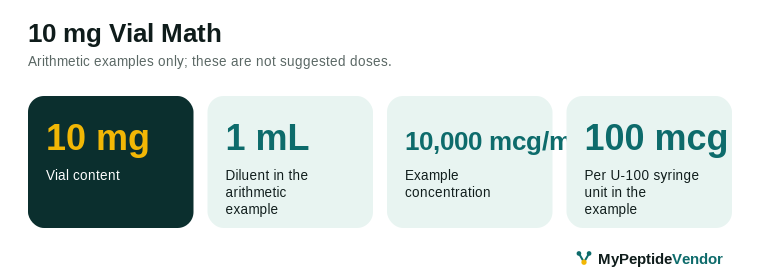
- Vial math, not a dose recommendation: A 10 mg vial contains 10,000 mcg. If 1 mL is added for an arithmetic example, the concentration is 10 mg/mL, or 10,000 mcg/mL; on a U-100 syringe, 1 unit corresponds to 100 mcg.
- Research is not a consumer protocol: George et al. studied intravenous kisspeptin-10 in men, not a routine subcutaneous plan for consumers 11. Research registry entries include two hypogonadotropic-condition studies, but neither listing creates a general self-treatment schedule 10.
- Storage depends on the exact product: A universal mixed-product discard window has not been established. Use only product-specific pharmacy directions; if those directions are missing, do not guess.
Key takeaways
- A 10 mg vial contains 10,000 mcg, but that amount does not establish a safe dose, frequency, or course.
- With the 1 mL math example, the concentration is 10 mg/mL and 100 mcg equals 1 unit on a U-100 syringe.
- No approved human dose or validated titration schedule exists for self-injection; the table gives no week-by-week treatment dose.
- George et al. studied intravenous kisspeptin-10 in men, while two registry entries concern hypogonadotropic conditions and different research protocols 1011.
- A universal storage temperature and discard window for reconstituted kisspeptin have not been established; follow product-specific pharmacy instructions.
Kisspeptin Dosing Schedule and 10 mg Vial Math
No FDA-approved human dose, label-based titration schedule, or validated self-injection schedule exists for kisspeptin. The week rows below therefore do not assign a dose or frequency. The final rows are arithmetic examples only, not suggested doses. George et al. The registry lists a prolonged pulsatile study and a subcutaneous study in different hypogonadotropic patient groups 10.
The calculations use a 10 mg vial reconstituted with 1 mL of diluent, giving 10 mg/mL (10,000 mcg/mL) and 100 mcg per U-100 unit. Doses-per-vial figures are theoretical arithmetic; they do not account for liquid left behind, sterile handling, or a product-specific discard date.
| Week or example | Dose (mg) | Dose (mcg) | U-100 units | Frequency | Theoretical portions per vial |
|---|---|---|---|---|---|
| Week 1 | Not established | Not established | Not established | No validated schedule | Not applicable |
| Week 2 | Not established | Not established | Not established | No validated schedule | Not applicable |
| Week 3 | Not established | Not established | Not established | No validated schedule | Not applicable |
| Week 4 | Not established | Not established | Not established | No validated schedule | Not applicable |
| Math example only | 0.05 mg | 50 mcg | 0.5 units | Not established | 200 |
| Math example only | 0.1 mg | 100 mcg | 1 unit | Not established | 100 |
| Math example only | 0.2 mg | 200 mcg | 2 units | Not established | 50 |
The vial counts are arithmetic: 10 mg divided into 0.05 mg, 0.1 mg, or 0.2 mg portions gives 200, 100, or 50 portions. Those counts do not show that any portion is safe, effective, or suitable for injection. They also do not establish how long a mixed vial remains usable.
ClinicalTrials.gov lists NCT04648969 as a completed Phase 2 study of prolonged pulsatile kisspeptin administration in hypogonadotropic hypogonadism. NCT05896293 is listed as a recruiting Phase 2 study of subcutaneous kisspeptin in idiopathic hypogonadotropic hypogonadism 10. Those entries concern specific study populations and protocols, not a standard dose for a 10 mg vial.
The registry also lists kisspeptin-related entries alongside studies in polyendocrine metabolic ovarian syndrome, male body composition and exercise, adolescent polycystic ovary syndrome, and inherited reproductive disorders 10. A registry listing or study status does not show that a product is approved, that results are established, or that a research protocol is suitable for self-treatment.
Do not increase a dose, add injections, or extend a cycle because a symptom or lab value has not changed. No validated response threshold or general timeframe for self-directed use is established. A prescriber should determine whether testing or treatment is appropriate for the reason you are considering kisspeptin.
Use this chart
Free to reuse with a link back:
Syringe Unit Conversion Table
Units to draw on a U-100 insulin syringe (100 units = 1 mL) from a 10 mg vial. Find your dose, then read the column for the water you added. Every number is calculated, not estimated.
| Dose | 1 mL water 10 mg/mL · 1 unit = 100 mcg | 2 mL water 5 mg/mL · 1 unit = 50 mcg | 2.5 mL water 4 mg/mL · 1 unit = 40 mcg |
|---|---|---|---|
| 50 mcg | 0.5 · 200 doses | 1 · 200 doses | 1.25 · 200 doses |
| 100 mcg | 1 · 100 doses | 2 · 100 doses | 2.5 · 100 doses |
| 200 mcg | 2 · 50 doses | 4 · 50 doses | 5 · 50 doses |
| 250 mcg | 2.5 · 40 doses | 5 · 40 doses | 6.25 · 40 doses |
| 300 mcg | 3 · 33 doses | 6 · 33 doses | 7.5 · 33 doses |
| 500 mcg | 5 · 20 doses | 10 · 20 doses | 12.5 · 20 doses |
| 750 mcg | 7.5 · 13 doses | 15 · 13 doses | 18.75 · 13 doses |
| 1 mg | 10 · 10 doses | 20 · 10 doses | 25 · 10 doses |
| 1.5 mg | 15 · 6 doses | 30 · 6 doses | 37.5 · 6 doses |
| 1.7 mg | 17 · 5 doses | 34 · 5 doses | 42.5 · 5 doses |
| 2 mg | 20 · 5 doses | 40 · 5 doses | 50 · 5 doses |
| 2.4 mg | 24 · 4 doses | 48 · 4 doses | 60 · 4 doses |
| 2.5 mg | 25 · 4 doses | 50 · 4 doses | 62.5 · 4 doses |
| 3 mg | 30 · 3 doses | 60 · 3 doses | 75 · 3 doses |
| 4 mg | 40 · 2 doses | 80 · 2 doses | 100 · 2 doses |
| 5 mg | 50 · 2 doses | 100 · 2 doses | over 100 |
| 7.5 mg | 75 · 1 doses | over 100 | over 100 |
| 10 mg | 100 · 1 doses | over 100 | over 100 |
Kisspeptin 10 mg Vial Dosage Calculator
Shows the exact insulin-syringe units to draw. Pre-loaded with the 10 mg vial; change any value to match yours.
Total volume of your syringe?
How much mg is in the vial?
How much bacteriostatic water are you adding?
Dose per injection?
Educational tool only. Concentration = vial ÷ water; units = dose ÷ concentration × 100 (U-100 syringe). Confirm every dose with your prescriber. Different vial or peptide? Use the peptide calculator.
MYPEPTIDEVENDORAffiliate link · we may earn a commission.
Reconstitution Steps
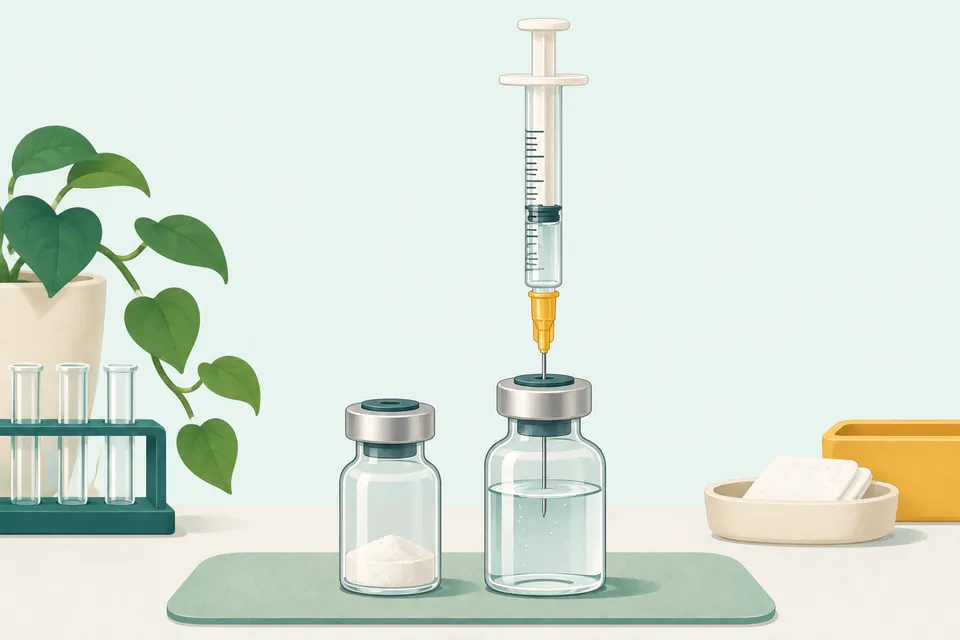
Do not prepare or inject a research-labeled vial for personal use. The steps below explain why a pharmacy’s exact directions matter; they are not instructions for turning a research product into an injectable medicine. A pharmacy-dispensed product should have patient-specific directions for diluent, volume, preparation, storage, and discard date.
- Confirm the product and directions. Check the pharmacy label, vial identity, amount, and the diluent and volume prescribed for that product. A 10 mg marking alone does not tell you what liquid to use or how long a prepared product remains usable.
- Keep the concentration example separate from treatment. For arithmetic only, 10 mg combined with 1 mL gives 10 mg/mL, or 10,000 mcg/mL. Use that volume only if the dispensing pharmacy specifically directs it for the exact product.
- Prepare a clean work area. Wash and dry your hands. If a pharmacy has prescribed preparation, use the sterile equipment and method it specifies, and ask the pharmacist to demonstrate the process if anything is unclear.
- Clean the stopper as directed. A pharmacy may direct you to swab the vial stopper and let it dry before access. Follow the directions for the specific product rather than assuming that a particular diluent or technique is appropriate.
- Mix only as directed. Do not shake or swirl unless the pharmacy’s directions specify how to mix the product. If the pharmacy directs mixing, follow its method and do not use a vial with unexpected particles, discoloration, damage, or unclear labeling.
- Record the date and discard date. Write down the preparation date and the pharmacy’s stated discard date. If no discard date or storage direction is provided, contact the pharmacy before using the product.
A U-100 syringe has 100 units per mL. With the 1 mL arithmetic example, 1 unit corresponds to 100 mcg; a different concentration changes the amount represented by the same syringe mark. Check the syringe type and the pharmacy label rather than relying on a remembered conversion.
Supplies Needed for One Full 10 mg Vial
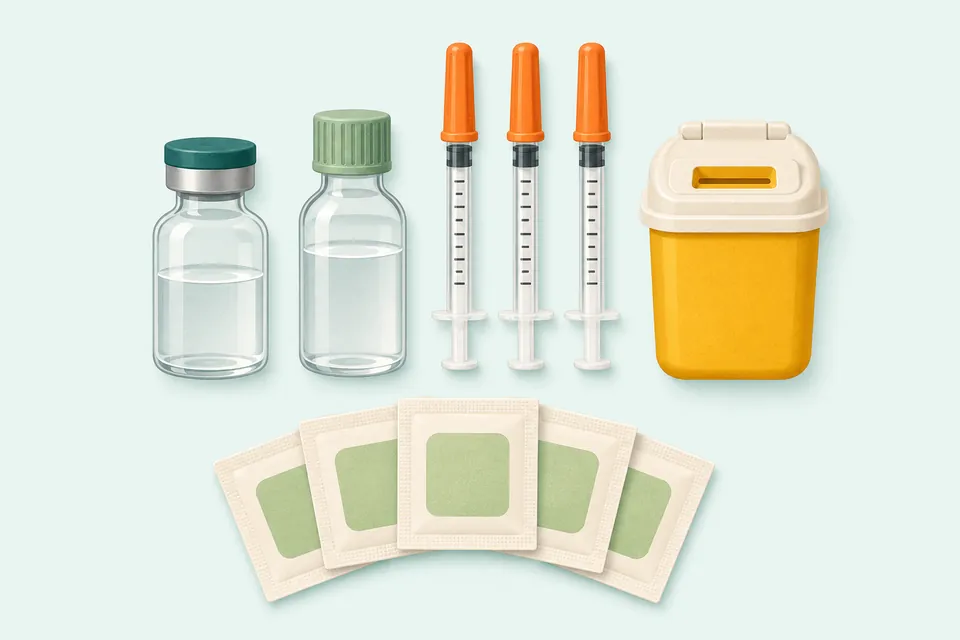
No evidence-based full-vial course can be calculated because a human dose, frequency, and duration have not been established. The quantities below describe safe planning questions for a pharmacy-directed product; they are not a recommendation to use or finish a vial.
- 1 vial: A product dispensed by a licensed pharmacy with clear patient-specific instructions. A research-labeled vial is not a substitute for a prescription product.
- Diluent and volume: Use only the diluent and quantity specified by the dispensing pharmacy. The 1 mL example gives 10 mg/mL as arithmetic, not a universal mixing instruction.
- 1 new sterile syringe and needle for each prescribed injection: The total number cannot be set without a clinician’s prescription. Never reuse or share a syringe or needle.
- Alcohol swabs: If directed for the product, plan a fresh swab for each vial access and a separate swab for each injection site. The total depends on the prescribed use.
- 1 sharps container: Put used needles and syringes directly into an appropriate sharps container.
- Product-specific storage: Use the temperature and discard date supplied by the pharmacy. A refrigerator or a particular number of days cannot be assumed for every kisspeptin product.
Theoretical portions per vial can exceed the period a prepared product may safely be stored. For example, the 100-portion arithmetic count at 100 mcg per portion does not mean that one vial can safely be used for 100 administrations.
Protocol Overview and Cycle Notes

Kisspeptin is a signaling peptide encoded by the KISS1 gene. It binds KISS1R, also called GPR54, on GnRH neurons and stimulates activity in the reproductive hormone system 6. GnRH signals the pituitary, which releases luteinizing hormone (LH) and follicle-stimulating hormone (FSH); these hormones then act on the gonads. Kisspeptin therefore acts upstream in the hypothalamic-pituitary-gonadal (HPG) axis 6.
The reproductive system uses different signaling patterns. Arcuate kisspeptin neurons are key parts of the GnRH pulse generator. Preoptic kisspeptin neurons are involved in surge generation in female rodents and possibly other species 9. The surge-generator role of preoptic kisspeptin neurons was described in female rodents 9; this does not establish effects of an injected product in people.
Energy balance can affect this system. Metabolic factors and energy reserves tightly regulate kisspeptin synthesis and release 8. Functional hypothalamic amenorrhea can be associated with stress, reduced calorie intake, excessive exercise, or a combination of these factors 5. If menstrual periods stop or become irregular, a clinician should assess these possible causes rather than assuming that a peptide is the answer.
That route and study population do not match a community-style subcutaneous schedule. The study does not establish a consumer dose, injection interval, course length, or post-cycle therapy (PCT) plan.
Two registry entries concern kisspeptin in hypogonadotropic hypogonadism: NCT04648969 is a prolonged pulsatile administration study, listed as completed Phase 2; NCT05896293 is a subcutaneous study in idiopathic hypogonadotropic hypogonadism, listed as recruiting Phase 2 10. The registry also contains entries on other topics, including PCOS, PMOS, male body composition and exercise, and inherited reproductive disorders 10. A study listing does not by itself establish efficacy or a dosing recommendation.
Claims about libido, mood, or sexual arousal need careful limits. A review discusses possible roles for kisspeptin in sexual and emotional brain processing, including research across species 3. That does not set a reliable onset time, prove that an injection will improve symptoms, or establish a treatment dose for an individual.
Bloodwork to discuss with a prescriber: Ask whether baseline LH and FSH are appropriate before any hormone-related treatment. Depending on the clinical question, a prescriber may also check testosterone or estradiol. Follow-up timing should be chosen by the clinician; there is no established universal week-by-week monitoring plan for self-directed kisspeptin use.
Claim-versus-evidence check: Every-other-day dosing has not been shown to be required to prevent receptor desensitization. A fixed libido onset within a few weeks is also not established by the review evidence 3. Claims that kisspeptin is a proven PCT treatment after testosterone or anabolic-androgenic steroid use are not supported by the listed hypogonadism studies 10.
| Claim | Evidence status | Practical verdict |
|---|---|---|
| Studied by George et al. | Not a subcutaneous consumer schedule | |
| Whether every-other-day dosing prevents receptor desensitization is unclear. | Not established by the cited primary sources | Do not treat as a proven rule |
| A predictable libido or mood response occurs within a set number of weeks | Not established by the review | No reliable personal onset time is known |
| Kisspeptin is proven for PCT after androgen use | Not established by the listed trials | Do not use an online PCT schedule as evidence |
Storage and Handling
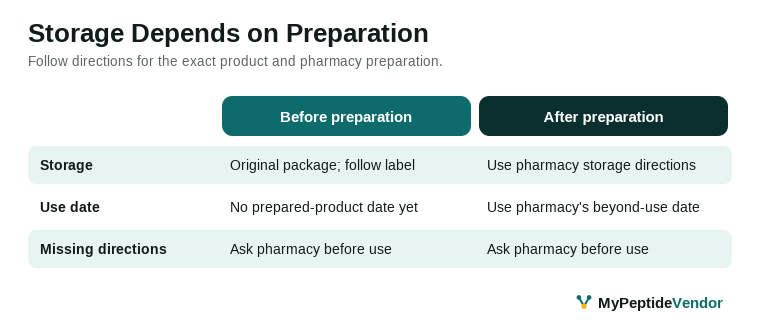
A single safe temperature and discard period cannot be applied to every kisspeptin product. The correct instructions depend on the exact formulation, container, and pharmacy preparation. Appearance alone cannot confirm a product’s sterility or strength.
- Before preparation: Keep the product in its original packaging and follow the specific storage directions on the pharmacy label. Do not assume that room temperature or refrigeration is correct for every vial.
- After preparation: Follow the exact temperature and beyond-use date provided by the dispensing pharmacy. If those details are missing, ask the pharmacy before use.
- Do not extend a discard date: Do not use a product past its stated date or after storage outside its directions. Do not freeze or expose it to heat unless the product instructions say to do so.
- Keep it secure: Store medicines away from children and pets. Do not share a vial, syringe, or needle.
Online claims of a 14-day or 28-day window do not establish a safe discard date for a different formulation. If a research-labeled vial has been mixed without validated storage and discard directions, do not inject it. Ask a pharmacist how to dispose of it safely.
Use this chart
Free to reuse with a link back:
Injection and Tracking Tips
Do not inject a product labeled for research use. If a clinician prescribes a pharmacy-prepared product, ask the pharmacist to demonstrate the route, dose volume, and technique for that exact product. Concentration and syringe type determine the amount represented by a syringe mark.
- Wash your hands and prepare a clean work surface before handling the vial or syringe.
- Use a new sterile syringe and needle for each prescribed injection. Never reuse or share them, and do not leave a used needle attached to a vial.
- Wipe the vial stopper with an alcohol swab before each access if directed, and let it dry. Use a separate swab for the injection site if directed, and let that dry too.
- Use only the injection site and method taught by your clinician. Rotate sites as instructed rather than repeatedly using one small area.
- Place the used syringe and needle directly into an approved sharps container. Do not put loose needles in household trash.
Keep a dated record of the prescribed dose, time, site, missed doses, and new symptoms. If a clinician orders tests, record the dates and results for LH, FSH, testosterone, or estradiol. Do not raise a dose because a symptom or lab result has not changed; no self-treatment response threshold has been established.
A short, organized log can help a clinician compare symptoms with lab results. Record menstrual changes, new breast symptoms, mood changes, and injection-site problems when relevant. Bring the product label and a current medicine list to the appointment.
Safety, Side Effects, and When to Get Medical Advice
No approved human product label or reliable side-effect frequency table for kisspeptin is established here. A percentage cannot be given for headache, nausea, flushing, injection-site reactions, mood effects, or other symptoms. Lack of a frequency estimate does not prove that a reaction cannot occur.
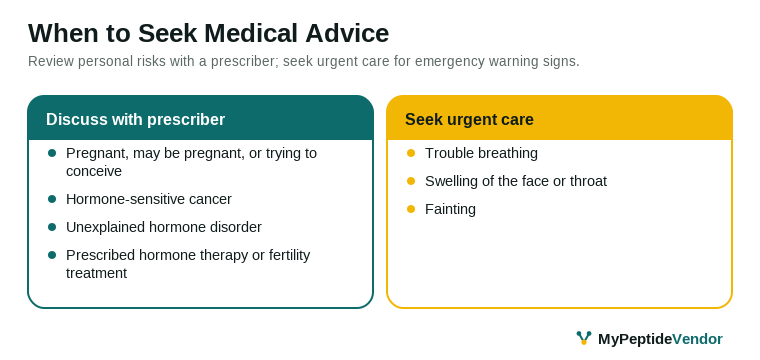
Discuss kisspeptin with a prescriber before any use if you are pregnant, may be pregnant, trying to conceive, have a hormone-sensitive cancer, have an unexplained hormone disorder, or use prescribed hormone therapy or fertility treatment. These situations need individual medical review; they are not a claim that an approved kisspeptin label lists formal contraindications.
Do not use kisspeptin as PCT after testosterone or anabolic steroid use. The cited registry entries do not establish that kisspeptin restores LH, FSH, or testosterone after androgen-related suppression 10. Persistent symptoms or a low testosterone result after androgen use calls for medical assessment, not an unverified online protocol.
Functional hypothalamic amenorrhea can be linked to stress, low calorie intake, excessive exercise, or a combination of these factors 5. A clinician can assess those causes and related risks before considering treatment. Do not assume that a hormone-active product addresses the underlying problem.
Contact a clinician about a concerning new symptom after a prescribed injection. Seek urgent care for trouble breathing, swelling of the face or throat, or fainting. These are general emergency warning signs, not kisspeptin-specific event rates.
This page is educational, not medical advice or a prescription. A licensed prescriber should review your medical history, medicines, symptoms, lab results, and the exact product before any hormone intervention.
Use this chart
Free to reuse with a link back:
Frequently asked questions
How soon does kisspeptin work?
There is no reliable onset time for self-injection from a 10 mg vial. A review discusses possible sexual and emotional brain roles, but it does not establish a predictable timeline for an individual 3.
Can kisspeptin be used for PCT after testosterone or steroids?
The cited clinical registry entries do not establish kisspeptin as post-cycle therapy after testosterone or anabolic steroid use 10. Ask a clinician to assess symptoms and hormone levels instead of following an online PCT schedule.
Is kisspeptin legal to buy or inject in the United States?
The answer can depend on the specific product and how it is made, marketed, and dispensed. FDA category listings concern particular bulk substances and do not, by themselves, answer whether a specific product may legally be possessed or injected 1. Ask a pharmacist or attorney about the product and your situation.
Can kisspeptin be stacked with hCG or Clomid?
The cited studies do not establish the safety or benefit of combining kisspeptin with human chorionic gonadotropin (hCG) or clomiphene (Clomid). A prescriber should review the treatment goal, hormone tests, and other medicines before considering a combination.
What does kisspeptin do in the reproductive hormone system?
Kisspeptin is encoded by KISS1 and signals through KISS1R, also called GPR54, on GnRH neurons 6. That pathway helps regulate reproductive hormone signaling, but it does not show that a research vial will treat a particular symptom.
Which blood tests should I ask about?
Ask whether LH and FSH are appropriate for your symptoms and treatment question. A clinician may also consider testosterone or estradiol and should choose when to repeat tests.
References
- FDA: Certain bulk drug substances for use in compounding that may present significant safety risks
- Fuqua et al. History of Puberty: Normal and Precocious. Horm Res Paediatr. 2022.
- Comninos et al. Emerging Roles of Kisspeptin in Sexual and Emotional Brain Processing. Neuroendocrinology. 2018.
- Spaziani et al. Hypothalamo-Pituitary axis and puberty. Mol Cell Endocrinol. 2021.
- Meczekalski et al. Stress, kisspeptin, and functional hypothalamic amenorrhea. Curr Opin Pharmacol. 2022.
- Roseweir et al. Kisspeptin antagonists. Adv Exp Med Biol. 2013.
- Neely et al. Precocious puberty. Curr Opin Obstet Gynecol. 2014.
- Navarro et al. Metabolic regulation of kisspeptin - the link between energy balance and reproduction. Nat Rev Endocrinol. 2020.
- Herbison et al. Control of puberty onset and fertility by gonadotropin-releasing hormone neurons. Nat Rev Endocrinol. 2016.
- ClinicalTrials.gov: 45 registered studies (search: Kisspeptin)
Written by the MyPeptideVendor editorial team from the FDA label, peer-reviewed studies and ClinicalTrials.gov records listed above, fact-checked line by line and reviewed 2026-11-12.
Cite this page
MyPeptideVendor Editorial Team. Kisspeptin Dosage 10mg: Protocol & Safety. MyPeptideVendor. Updated November 12, 2026. https://mypeptidevendor.com/protocols/kisspeptin-dosing-10mg/MyPeptideVendor Editorial Team. (2026, November 12). Kisspeptin Dosage 10mg: Protocol & Safety. MyPeptideVendor. https://mypeptidevendor.com/protocols/kisspeptin-dosing-10mg/Related protocols
CJC-1295 DAC 2 mg
Research UseA 2 mg vial is not an approved human dose; this guide covers the evidence gap, vial math, and safety questions to review with a clinician.
View protocolCJC-1295 DAC 5 mg
Research UseNo approved human dose exists for CJC-1295 DAC; this guide explains 5 mg vial math, research limits, monitoring, and safety questions.
View protocolCJC-1295 No DAC 5 mg
Not approvedNo approved human dose exists for CJC-1295 No DAC; this guide explains 5 mg vial math, evidence limits, and safety questions to raise with a clinician.
View protocol