Cjc 1295 Dac Dosage 5mg: Protocol & Safety
No approved human dose exists for CJC-1295 DAC; this guide explains 5 mg vial math, research limits, monitoring, and safety questions.
Quickstart Highlights for a 5 mg Vial
There is no approved human CJC-1295 DAC dose for a 5 mg vial, and no validated week-by-week titration schedule for physique or performance use 3. A vial’s 5 mg strength describes the amount in the vial, not an amount that a person should inject.
DAC changes how the peptide binds to plasma proteins, but that does not establish a safe dose, injection interval, or cycle 2. Conversion arithmetic can explain syringe volume; it cannot establish a dose. Any prescribed dose must come from a qualified prescriber and be confirmed by the dispensing pharmacist.
- Dose status: No approved human dose or validated titration schedule exists for CJC-1295 DAC used for physique or performance purposes 3.
- Product identity: Check whether the vial says DAC, no-DAC, or lists more than one ingredient. Do not substitute one product’s schedule for another; DAC changes plasma-protein binding 2.
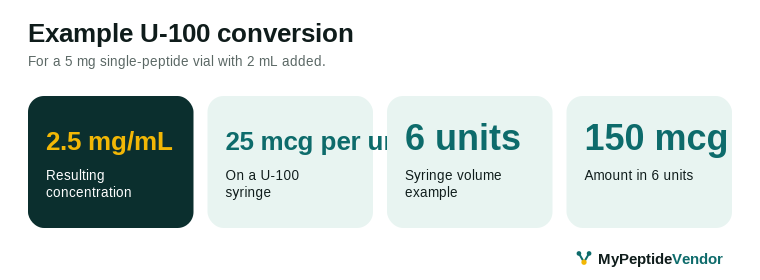
- Concentration example: A 5 mg single-peptide vial with 2 mL added has a concentration of 2.5 mg/mL. On a U-100 syringe, that is 25 mcg per unit.
- Unit check: At that concentration, 6 units contain 150 mcg. Syringe units measure volume, so the amount of peptide per unit changes when the concentration changes.
- Reported effects: A review lists prolactin and cortisol elevations, dysglycemia, fluid retention, muscle or joint pain, and injection-site reactions among reported effects in this drug class 3. It does not provide dependable CJC-1295 DAC-specific frequencies.
- Get product-specific directions: Ask the prescriber and dispensing pharmacist to confirm the product, diluent, concentration, storage instructions, and any written dose before use.
Read the full label for the ingredient names and the amount of each ingredient before doing any conversion. For a blend, track each ingredient separately; the label determines whether the vial contains 5 mg total or a different amount.
Use this chart
Free to reuse with a link back:
Key takeaways
- CJC-1295 has no approved human dose for physique or performance use, and the reviewed literature does not establish a fixed titration plan 3.
- A 5 mg vial diluted with 2 mL has a concentration of 2.5 mg/mL; on a U-100 syringe, 4 units equal 100 mcg.
- At 2.5 mg/mL, 6 U-100 units contain 150 mcg, not 300 mcg.
- Reported concerns include prolactin and cortisol elevations, dysglycemia, fluid retention, muscle or joint pain, and injection-site reactions; reliable CJC-1295 DAC event rates are not available 3.
- An ELISA detected CJC-1295 conjugates in equine plasma down to 12.5 pg/mL after a 10 mg equine dose; this does not establish human drug-test detection 2.
Dosing Schedule and U-100 Conversion Arithmetic

CJC-1295 is not an FDA-approved treatment for physique or performance use, and a validated fixed-dose human titration schedule is not established 3. The review describes unregulated self-administration but also identifies uncertainty about dose, product composition, and combinations 3. The week-by-week table therefore does not assign an injection dose.
For this research-only compound, no approved human dose exists. A starting dose, dose increase, maintenance amount, or cycle length has not been established for either DAC or no-DAC CJC-1295 3. The human dose and interval must not be inferred from a vial size or a syringe marking.
No week-by-week dose is established 3. No units are assigned because there is no prescribed amount to convert 3.
| Week | Dose (mg) | Dose (mcg) | U-100 units | What is established |
|---|---|---|---|---|
| 1 | Not established | Not established | Not assigned | No approved starting dose |
| 2 | Not established | Not established | Not assigned | No validated titration step |
| 3 | Not established | Not established | Not assigned | No validated titration step |
| 4 | Not established | Not established | Not assigned | No established dose or test-based adjustment |
| 5 | Not established | Not established | Not assigned | No established maintenance dose |
| 6 | Not established | Not established | Not assigned | No validated fixed-dose plan |
| 7 | Not established | Not established | Not assigned | No validated fixed-dose plan |
| 8 | Not established | Not established | Not assigned | Do not extend a cycle automatically |
The following arithmetic applies to a 5 mg single-peptide vial and a U-100 insulin syringe, where 100 units equal 1 mL. Use only the row matching the actual final concentration on the pharmacy label.
| Diluent added | Concentration | 50 mcg | 100 mcg | 200 mcg | 300 mcg | 1,000 mcg (1 mg) | 2,000 mcg (2 mg) |
|---|---|---|---|---|---|---|---|
| 1 mL | 5 mg/mL | 1 unit | 2 units | 4 units | 6 units | 20 units | 40 units |
| 2 mL | 2.5 mg/mL | 2 units | 4 units | 8 units | 12 units | 40 units | 80 units |
| 2.5 mL | 2 mg/mL | 2.5 units | 5 units | 10 units | 15 units | 50 units | 100 units |
Worked math check: With 2 mL added to 5 mg, the concentration is 2.5 mg/mL. Six U-100 units equal 0.06 mL, which contains 0.15 mg, or 150 mcg. A claim that 6 units delivers 0.3 mg at this dilution is twice the correct amount.
DAC and no-DAC math: The arithmetic is the same for a 5 mg DAC vial and a 5 mg no-DAC vial when each has the same final volume and concentration. That does not make their duration or dosing schedules interchangeable; DAC provides plasma-protein binding 2.
Blend math: Read the ingredient amounts on the label and calculate each ingredient separately. If the label confirms 5 mg of each ingredient and the final volume is 2 mL, 4 units contain 100 mcg of each ingredient, or 200 mcg combined. This is a conditional arithmetic example, not a claim that every 5 mg blend has that composition.
Conversion arithmetic cannot establish a dose. Any prescribed dose must come from a qualified prescriber and be confirmed by the dispensing pharmacist.
Syringe Unit Conversion Table
Units to draw on a U-100 insulin syringe (100 units = 1 mL) from a 5 mg vial. Find your dose, then read the column for the water you added. Every number is calculated, not estimated.
| Dose | 1 mL water 5 mg/mL · 1 unit = 50 mcg | 2 mL water 2.5 mg/mL · 1 unit = 25 mcg | 2.5 mL water 2 mg/mL · 1 unit = 20 mcg |
|---|---|---|---|
| 50 mcg | 1 · 100 doses | 2 · 100 doses | 2.5 · 100 doses |
| 100 mcg | 2 · 50 doses | 4 · 50 doses | 5 · 50 doses |
| 200 mcg | 4 · 25 doses | 8 · 25 doses | 10 · 25 doses |
| 250 mcg | 5 · 20 doses | 10 · 20 doses | 12.5 · 20 doses |
| 300 mcg | 6 · 16 doses | 12 · 16 doses | 15 · 16 doses |
| 500 mcg | 10 · 10 doses | 20 · 10 doses | 25 · 10 doses |
| 750 mcg | 15 · 6 doses | 30 · 6 doses | 37.5 · 6 doses |
| 1 mg | 20 · 5 doses | 40 · 5 doses | 50 · 5 doses |
| 1.5 mg | 30 · 3 doses | 60 · 3 doses | 75 · 3 doses |
| 1.7 mg | 34 · 2 doses | 68 · 2 doses | 85 · 2 doses |
| 2 mg | 40 · 2 doses | 80 · 2 doses | 100 · 2 doses |
| 2.4 mg | 48 · 2 doses | 96 · 2 doses | over 100 |
| 2.5 mg | 50 · 2 doses | 100 · 2 doses | over 100 |
| 3 mg | 60 · 1 doses | over 100 | over 100 |
| 4 mg | 80 · 1 doses | over 100 | over 100 |
| 5 mg | 100 · 1 doses | over 100 | over 100 |
CJC-1295 DAC 5 mg Vial Dosage Calculator
Shows the exact insulin-syringe units to draw. Pre-loaded with the 5 mg vial; change any value to match yours.
Total volume of your syringe?
How much mg is in the vial?
How much bacteriostatic water are you adding?
Dose per injection?
Educational tool only. Concentration = vial ÷ water; units = dose ÷ concentration × 100 (U-100 syringe). Confirm every dose with your prescriber. Different vial or peptide? Use the peptide calculator.
Affiliate link · we may earn a commission.
Reconstitution Steps
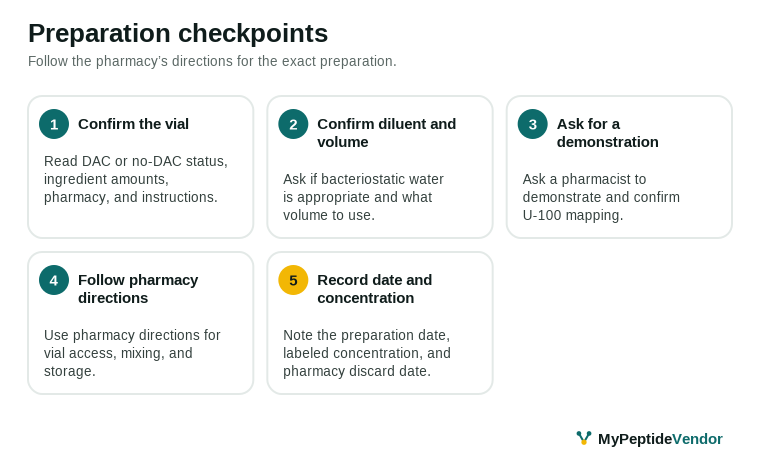
- Confirm the vial first. Read the label for DAC or no-DAC status, the amount of each ingredient, the pharmacy name, and the product-specific instructions. A blend requires separate tracking for each ingredient.
- Confirm the diluent and volume. Ask the dispensing pharmacy whether bacteriostatic water is appropriate and what volume to use. A 5 mg vial can produce different concentrations depending on the volume added, since the concentration equals 5 mg divided by the total volume.
- Ask for a demonstration. Have a pharmacist or clinician show the preparation method and confirm how a written dose maps to the exact U-100 syringe being used. Do not use a syringe-unit conversion from a different concentration.
- Follow sterile handling directions. Use the pharmacy’s instructions for vial access, mixing, and storage. Do not shake or handle the vial in a way that conflicts with those directions.
- Record the dates and concentration. Write down the preparation date, labeled concentration, and pharmacy discard date. If any direction is missing or unclear, stop and ask the pharmacy before proceeding.
Bacteriostatic water is not a universal instruction for every peptide vial. The correct diluent, added volume, and method depend on the specific preparation and pharmacy directions; a 5 mg strength alone does not supply those details.
Use this chart
Free to reuse with a link back:
Supplies Needed for One Full Vial
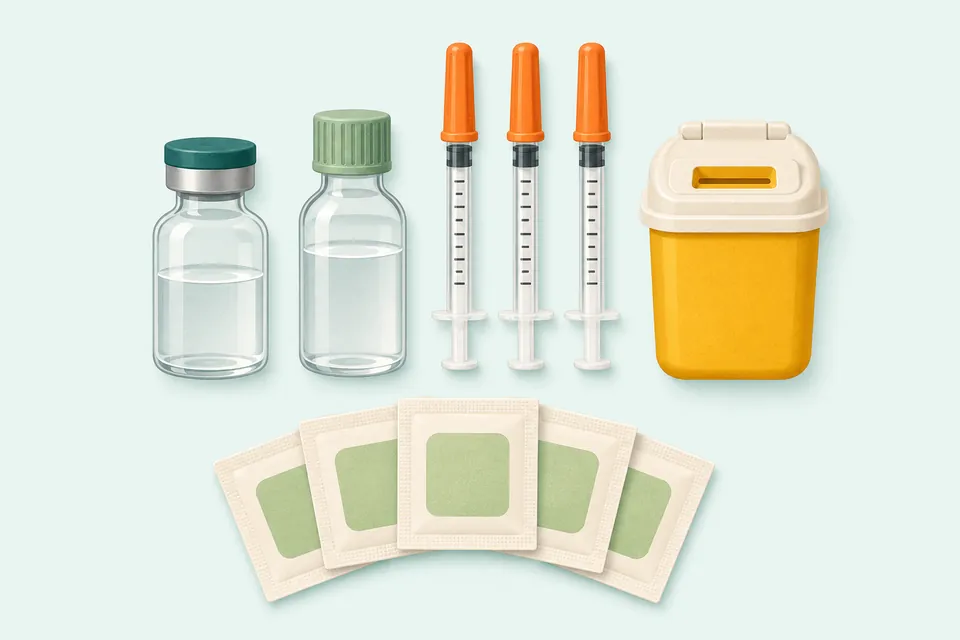
Prepare supplies only after the prescriber and dispensing pharmacy have confirmed the product and directions. The number of injection supplies for a full vial depends on the prescribed dose and schedule, neither of which is established for CJC-1295 DAC.
- 1 labeled 5 mg vial of the prescribed product, with the DAC status and ingredient amounts clear on the label.
- 1 container of pharmacy-specified diluent in the type and volume directed for that preparation.
- 1 new sterile syringe per prescribed injection. The total number cannot be calculated without a clinician-written frequency.
- Alcohol prep pads in the quantity directed during pharmacy or clinical training, including any needed for vial access and injection preparation.
- 1 sharps container for used needles and syringes.
- 1 medication log for the written dose, concentration, time, site, symptoms, and missed doses.
Ask the pharmacy how many syringes and prep supplies to obtain for the actual prescription. The amount remaining in a vial does not set the number of safe injections or extend the pharmacy-assigned discard date.
Protocol Overview and Cycle Notes

CJC-1295 is a growth hormone-releasing hormone analog (GHRH analog). The DAC form binds plasma proteins containing free cysteine residues, which gives it a different exposure profile from a short-acting peptide 2. That mechanism does not prove that a weekly or twice-weekly schedule is safe or effective.
No approved cycle length, off-cycle break, or fixed human titration schedule for physique or performance use is established 3. The review describes self-administration patterns but stresses uncertainty around dose, product composition, and stacking in unregulated supply chains 3. Do not start, increase, repeat, or restart a cycle from an online schedule.
Claims that DAC has a particular human half-life or that a fixed weekly dose is validated should be treated cautiously. The detection study describes plasma-protein conjugation and an equine test; it does not compare weekly and twice-weekly human schedules 2. Those schedules have not been shown here to produce equivalent exposure or risk.
Practical monitoring discussion: Ask a clinician whether IGF-1, fasting glucose, prolactin, and cortisol testing fits your history and symptoms. The review reports endocrine and metabolic concerns that make those tests relevant to a clinical discussion 3. No validated testing timeline for CJC-1295 has been established, so the timing of baseline and follow-up testing is left to the clinician 3.
No universal IGF-1 result is established as an automatic trigger to lower or stop a CJC-1295 DAC dose. A clinician should interpret the value against the laboratory’s age-adjusted range, symptoms, history, and other results. Do not use an online cutoff to make a dose change.
Ipamorelin versus sermorelin: Ipamorelin is a growth hormone secretagogue (GHS), while sermorelin is a GHRH analog; they act through different signaling pathways 3. CJC-1295 is also a GHRH analog, and the DAC form adds plasma-protein binding 2. The review does not establish that ipamorelin or sermorelin is safer or more effective in a head-to-head comparison 3.
Missed dose: No evidence-based missed-dose rule is established for CJC-1295 DAC. Ask the prescriber or pharmacist what to do with the specific product; do not double the next dose or shorten the interval to make up for a missed injection.
Storage and Handling
Follow the dispensing pharmacy’s storage instructions and beyond-use date for the exact vial. A universal shelf life after reconstitution cannot be assigned because preparations, diluents, containers, and handling conditions can differ.
Keep the vial in its labeled container and follow the pharmacy’s directions for temperature and light exposure. Refrigeration or bacteriostatic water does not establish that every preparation remains usable for the same period.
Do not use a vial with a damaged seal, an appearance that differs from the pharmacy’s description, or an uncertain storage history. Contact the pharmacist before using a product with any of those concerns.
Injection and Tracking Tips
Use only the route, site, amount, and frequency written by the prescriber for the exact product. No meal or bedtime timing rule has been established for CJC-1295 DAC 3. The review does not establish that fasting, bedtime dosing, or a particular interval after eating improves outcomes 3.
Do not transfer timing advice from a no-DAC or combination protocol to a DAC vial without product-specific directions. A change in meal time or bedtime does not justify doubling a dose or compressing the interval.
Keep a dated record of the prescribed amount, concentration, injection time and site, symptoms, and missed doses. Note new swelling, muscle or joint pain, unusual thirst, changes in urination, or other symptoms for the clinician to review; these concerns overlap with effects described in the review 3.
Check that the syringe is U-100 before using a unit conversion. At 2.5 mg/mL, 4 units represent 100 mcg; at 5 mg/mL, 4 units represent 200 mcg. The same unit marking can represent twice as much peptide at the higher concentration.
Safety, Side Effects, and Regulatory Notes
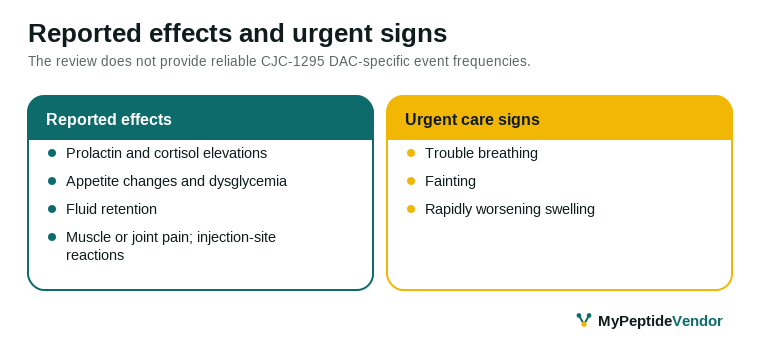
A review lists prolactin and cortisol elevations, appetite changes, dysglycemia, fluid retention, muscle or joint pain, and injection-site reactions among adverse effects reported across peptides that affect the GH-IGF-1 axis 3. It does not provide reliable CJC-1295 DAC-specific event frequencies, so percentages cannot be stated. Uncertainty about product composition and dose also makes individual risk harder to predict 3.
Seek urgent medical care for severe symptoms such as trouble breathing, fainting, or rapidly worsening swelling. Contact a clinician promptly about persistent swelling, new numbness or tingling, marked thirst or urination changes, worsening muscle or joint pain, or another symptom that begins after exposure. These symptoms need assessment; they are not estimates of how often a reaction occurs.
The available review does not provide a formal CJC-1295 DAC contraindication list 3. Before considering a GH-axis peptide, discuss diabetes or high blood sugar, pituitary or other hormone conditions, cancer history, pregnancy, breastfeeding, and all medicines and supplements with a clinician. The review describes mitogenic concerns as biologically plausible but unproven 3.
Category 2 status is a compounding-policy concern; it is not the same as FDA approval, and it does not by itself answer whether every particular preparation may be prescribed or compounded. Ask a licensed pharmacist or prescriber about the current status of the specific preparation and do not treat online availability as proof of approval.
Testing evidence has a clear limit. Timms and colleagues developed an ELISA that detected CJC-1295 protein conjugates in equine plasma at concentrations as low as 12.5 pg/mL and demonstrated detection after a 10 mg equine dose 2. This does not establish human test sensitivity, a human detection window, or detection by every sport-testing method. Anyone subject to testing should ask the relevant testing organization rather than treating the equine result as a human guarantee.
Discuss any exposure with a licensed clinician before use; this page is not a prescription. The review describes uncertainty in unregulated supply chains involving product composition, dose, and stacking practices 3. If the product lacks clear pharmacy directions or a pharmacist who can answer questions, do not guess at its concentration or handling.
Use this chart
Free to reuse with a link back:
Frequently asked questions
What is the usual CJC-1295 DAC dose for a 5 mg vial?
There is no approved human dose or validated fixed-dose schedule for physique or performance use 3. Vial strength does not establish an amount or interval; ask a qualified prescriber about the specific product.
How many units is 100 mcg from a 5 mg vial?
It depends on the final concentration. On a U-100 syringe, 100 mcg is 2 units at 5 mg/mL, 4 units at 2.5 mg/mL, or 5 units at 2 mg/mL. Confirm the labeled concentration with the pharmacist.
How do I convert a 5 mg/5 mg blend?
Use the label to track each ingredient separately. If the label confirms 5 mg of each ingredient in a final volume of 2 mL, 4 U-100 units contain 100 mcg of each ingredient, or 200 mcg combined.
Should CJC-1295 DAC be injected before bed or away from meals?
No meal or bedtime timing rule has been established for CJC-1295 DAC 3. Follow product-specific directions from the prescriber instead of borrowing timing advice from a no-DAC protocol.
How long should a CJC-1295 DAC cycle last, and how long should the break be?
A validated cycle length and off-cycle break for physique or performance use have not been established 3. Do not extend or repeat a schedule without clinician review.
Which labs should be discussed with a clinician?
Ask whether IGF-1, fasting glucose, prolactin, and cortisol testing is appropriate because reported concerns include GH-axis effects, dysglycemia, and prolactin or cortisol elevations 3. The clinician should set the timing; no validated testing week or automatic IGF-1 dose-change cutoff is established.
What should I do if I miss a dose?
There is no established CJC-1295 DAC missed-dose rule. Contact the prescriber or pharmacist for product-specific advice, and do not double the next dose unless they direct you to.
Can a drug test detect CJC-1295 DAC?
An ELISA detected CJC-1295 conjugates in equine plasma down to 12.5 pg/mL after a 10 mg equine dose 2. That does not establish human detection, a human detection window, or sport-testing outcomes.
Is CJC-1295 DAC legal to compound in the United States?
FDA places CJC-1295 in Category 2 under interim compounding policies for nominated bulk drug substances that may present significant safety risks 1. That status does not answer every question about a particular preparation; ask a licensed pharmacist or prescriber about current rules and the product.
How does ipamorelin differ from sermorelin?
Ipamorelin is a growth hormone secretagogue, while sermorelin is a GHRH analog 3. They are different compounds, and the review does not establish a head-to-head advantage or a substitute dose.
How long does reconstituted CJC-1295 DAC last?
There is no universal shelf life that applies to every preparation. Follow the pharmacy’s storage directions and discard date for the exact vial.
References
- FDA: Certain bulk drug substances for use in compounding that may present significant safety risks
- Timms et al. Detection of CJC-1295 in Equine Plasma by ELISA. Drug Test Anal. 2026.
- Dominikowski et al. The emerging landscape of performance-enhancing peptides modulating GH-IGF1 axis: bridging the gap between clinical evidence and patient self-administration. Front Endocrinol (Lausanne). 2026.
Written by the MyPeptideVendor editorial team from the FDA label, peer-reviewed studies and ClinicalTrials.gov records listed above, fact-checked line by line and reviewed 2026-11-12.
Cite this page
MyPeptideVendor Editorial Team. cjc 1295 dac dosage 5mg: Protocol & Safety. MyPeptideVendor. Updated November 12, 2026. https://mypeptidevendor.com/protocols/cjc-1295-dac-dosing-5mg/MyPeptideVendor Editorial Team. (2026, November 12). cjc 1295 dac dosage 5mg: Protocol & Safety. MyPeptideVendor. https://mypeptidevendor.com/protocols/cjc-1295-dac-dosing-5mg/Related protocols
CJC-1295 No DAC 5 mg
Not approvedNo approved human dose exists for CJC-1295 No DAC; this guide explains 5 mg vial math, evidence limits, and safety questions to raise with a clinician.
View protocolGHRP-2 10 mg
Research UseNo approved human treatment dose is established; this guide explains 10 mg vial math, diagnostic use, handling, and known safety limits.
View protocolGHRP-6 5 mg
Research UseGHRP-6 has no established human dose or cycle; this guide separates syringe arithmetic from clinical evidence and safety limits.
View protocol