Igf 1 lr3 Dosage 1mg: Protocol & Safety
IGF-1 LR3 has no approved human dose or validated injection protocol; online dose reports and syringe conversions do not establish safe use.
Quickstart Highlights for IGF-1 LR3 Dosage 1mg
An IGF-1 LR3 1 mg vial has no established human dose, titration schedule, or validated injection protocol. Online dosing amounts for IGF-1 LR3 are not documented, and no human trial establishes any daily amount as safe or effective.
IGF-1 LR3 is a research compound, not an approved treatment for muscle gain or performance 9. This page is educational, not medical advice, and does not recommend injecting a research-use product. If you have used it, tell a clinician what product, amount, route, and time were involved.
- No approved human dose: IGF-1 LR3 has no FDA-approved label for physique or performance use, and its appropriate dose remains uncertain 9.
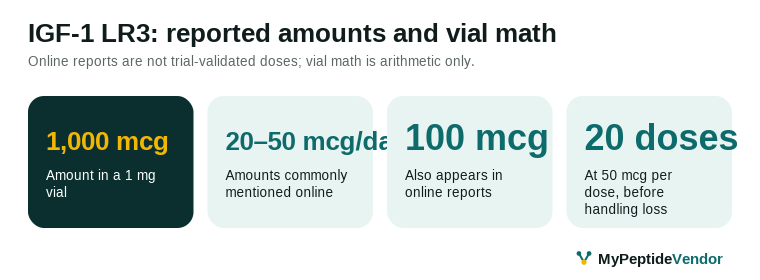
- Reported online amounts: Online protocols commonly mention 20–50 mcg per day; 100 mcg also appears. These are reports of use, not trial-validated doses.
- Vial math: A 1 mg vial contains 1,000 mcg. At 50 mcg per dose, the arithmetic gives 20 doses before any handling loss.
- Animal evidence: Growth-restricted fetal sheep received an average 1.17 µg/kg/hour for 1 week, without a body-weight improvement 2. This was fetal research, not adult dosing guidance.
- Preparation and storage: No validated human-use reconstitution method or consumer-vial stability period is established 9.
- Regulatory caution: FDA’s category 2 policy covers certain nominated bulk substances that may present significant safety risks in compounding 1. It does not establish that a research vial is approved or suitable for human use.
Use this chart
Free to reuse with a link back:
Key takeaways
- No approved human dose or evidence-based titration schedule exists for IGF-1 LR3 9.
- Online protocols report 20–50 mcg daily, with 100 mcg also appearing; these figures are not validated human doses.
- At 1 mg/mL, 50 mcg is 5 U-100 units; this is volume arithmetic, not a safe-dose recommendation.
- A 1-week infusion did not improve body weight in growth-restricted fetal sheep 2.
- Human side-effect rates and reliable storage limits for reconstituted IGF-1 LR3 are unknown 9.
IGF-1 LR3 Dosing Schedule for a 1 mg Vial

No FDA label or human trial establishes a titration schedule for IGF-1 LR3. The amounts below are reported online patterns, not a treatment plan or recommendation. The unit examples assume a final concentration of 1 mg/mL; syringe units are volume conversions only. No human trial establishes the amounts as safe or effective 9.
| Period | Reported amount per day | Amount in mg | U-100 units at 1 mg/mL | Meaning |
|---|---|---|---|---|
| Weeks 1–2 | 20 mcg | 0.02 mg | Not listed | Online-reported amount; not a validated starting dose |
| Weeks 3–4 | 50 mcg | 0.05 mg | 5 units | Online-reported amount; not trial validated |
| Weeks 5–8 | 50 mcg | 0.05 mg | 5 units | Continuing this amount does not establish safety |
| Unspecified online protocols | 100 mcg | 0.1 mg | 10 units | Reported online; no human dose or safety finding supports escalation |
U-100 means 100 units per 1 mL. At 1 mg/mL, 50 mcg corresponds to 5 units and 100 mcg corresponds to 10 units. These calculations do not confirm a vial’s identity, sterility, potency, or suitability for injection.
Do not convert fetal infusion rates into adult injection doses. Growth-restricted fetal sheep received about 1.17 µg/kg/hour, while a prior study in normal fetal sheep used 6.6 µg/kg/hour; these were fetal infusion experiments, not human subcutaneous schedules 2.
Syringe Unit Conversion Table
Units to draw on a U-100 insulin syringe (100 units = 1 mL) from a 1 mg vial. Find your dose, then read the column for the water you added. Every number is calculated, not estimated.
| Dose | 1 mL water 1 mg/mL · 1 unit = 10 mcg | 2 mL water 0.5 mg/mL · 1 unit = 5 mcg | 2.5 mL water 0.4 mg/mL · 1 unit = 4 mcg |
|---|---|---|---|
| 50 mcg | 5 · 20 doses | 10 · 20 doses | 12.5 · 20 doses |
| 100 mcg | 10 · 10 doses | 20 · 10 doses | 25 · 10 doses |
| 200 mcg | 20 · 5 doses | 40 · 5 doses | 50 · 5 doses |
| 250 mcg | 25 · 4 doses | 50 · 4 doses | 62.5 · 4 doses |
| 300 mcg | 30 · 3 doses | 60 · 3 doses | 75 · 3 doses |
| 500 mcg | 50 · 2 doses | 100 · 2 doses | over 100 |
| 750 mcg | 75 · 1 doses | over 100 | over 100 |
| 1 mg | 100 · 1 doses | over 100 | over 100 |
IGF-1 LR3 1 mg Vial Dosage Calculator
Shows the exact insulin-syringe units to draw. Pre-loaded with the 1 mg vial; change any value to match yours.
Total volume of your syringe?
How much mg is in the vial?
How much bacteriostatic water are you adding?
Dose per injection?
Educational tool only. Concentration = vial ÷ water; units = dose ÷ concentration × 100 (U-100 syringe). Confirm every dose with your prescriber. Different vial or peptide? Use the peptide calculator.
MYPEPTIDEVENDORAffiliate link · we may earn a commission.
Reconstitution Steps for an IGF-1 LR3 1 mg Vial
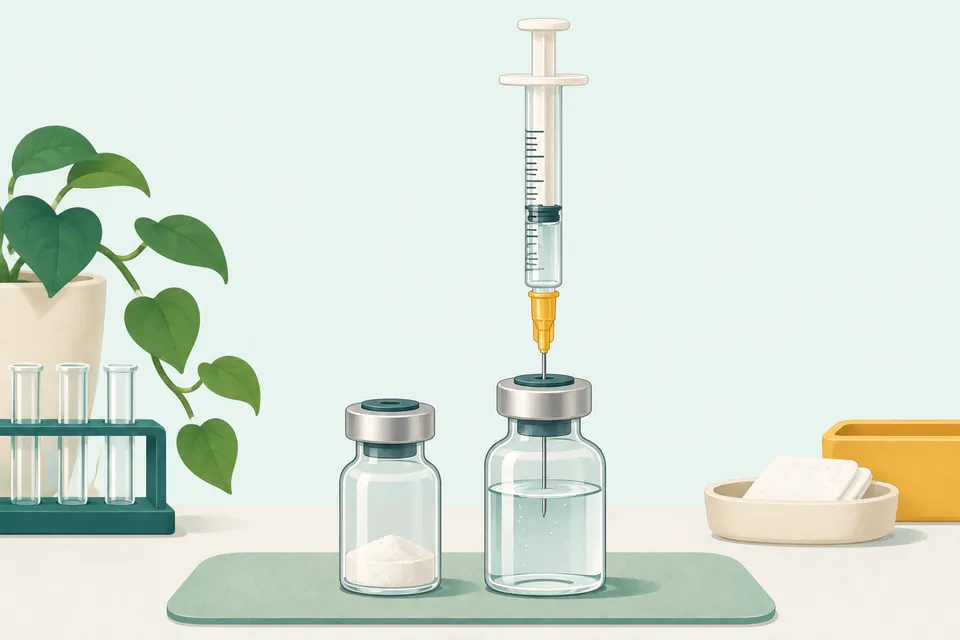
No validated human-use method for reconstituting IGF-1 LR3 is established. Because the product is not an approved human medicine, the numbered points below explain the limits of the information; they are not mixing instructions.
- Check the product status. A vial marked 1 mg does not prove that its contents are sterile, accurately labeled, or intended for injection.
- Recognize the conflicting approaches. No human-use method establishes which solvent is suitable for a particular vial.
- Do not combine or improvise solvents. The two approaches are not interchangeable by assumption. Compatibility, concentration after mixing, and stability have not been established for a particular research vial.
- Use pharmacy instructions only for a prescribed product. Ask the dispensing pharmacist for product-specific directions. Do not inject a research-use vial.
The concentration arithmetic changes with final liquid volume, even though the vial contains the same 1 mg. These are math examples, not preparation directions. A larger liquid volume makes each dose occupy more syringe volume.
| Final liquid volume | Concentration | 50 mcg example | 100 mcg example |
|---|---|---|---|
| 1 mL | 1 mg/mL (1,000 mcg/mL) | 5 units | 10 units |
| 2 mL | 0.5 mg/mL (500 mcg/mL) | 10 units | 20 units |
| 2.5 mL | 0.4 mg/mL (400 mcg/mL) | 12.5 units | 25 units |
The volume shown is arithmetic only and does not establish that bacteriostatic water or any other solvent is appropriate. Syringe math cannot establish sterility or storage life.
Supplies Needed for 4–16 Weeks
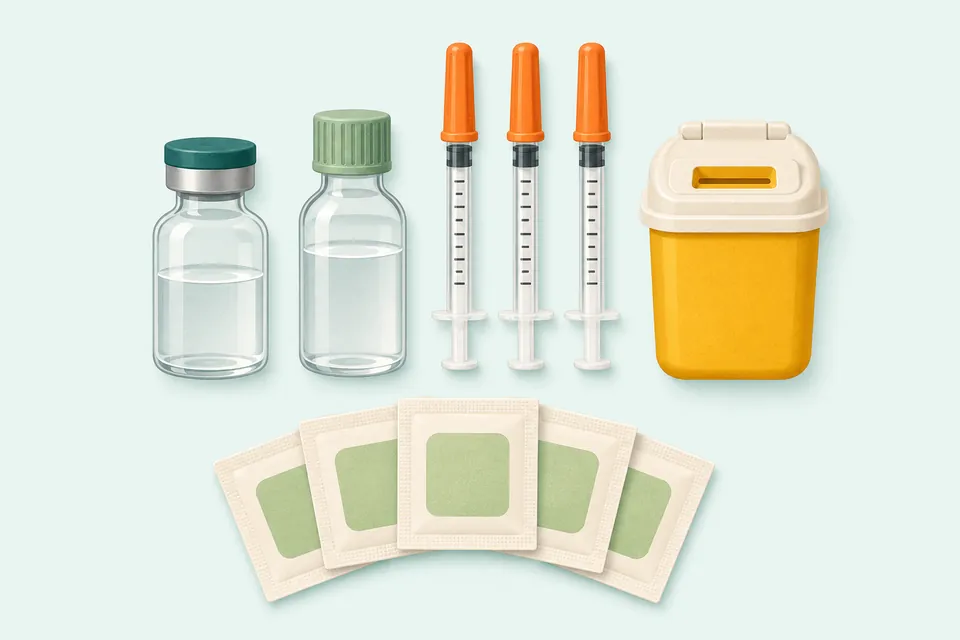
No injection supply list is recommended because no human-use schedule or validated preparation method exists 9. A count of syringes, swabs, and diluent would make an unapproved injection plan easier to carry out without establishing that the product is safe.
For a 4-, 8-, 12-, or 16-week plan, the recommended quantities of IGF-1 LR3 vials, U-100 syringes, bacteriostatic water, and alcohol swabs are therefore not established. Do not use a supply list as a substitute for a prescription or pharmacy instructions.
- If a clinician is assessing an exposure: Keep the vial, packaging, and any certificate or product paperwork so the clinician can review the exact item.
- If a licensed pharmacy dispensed a medicine: Use only the supplies and quantities specified by that pharmacy.
- Sharps safety: If a needle has already been used, place it in an approved sharps container and follow local disposal guidance.
Protocol Overview & Cycle Notes
IGF-1 LR3 is an IGF-1 analog with low affinity for IGF-binding proteins and high affinity for the IGF-1 receptor, as described in fetal research 2. No human evidence establishes muscle gain, performance benefit, a safe cycle length, or a required off-cycle interval 9.
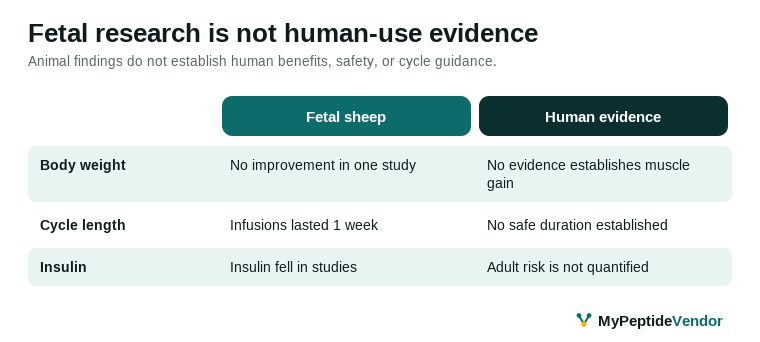
In growth-restricted fetal sheep, a 1-week infusion at about 1.17 µg/kg/hour did not improve body weight compared with vehicle 2. In a separate 1-week fetal-sheep study, heart, adrenal gland, and spleen weights were higher and skeletal-muscle myoblast proliferation increased, but overall fetal weight was not statistically different between groups 7. These are animal results, not evidence of muscle gain in people.
The sheep findings also do not show a simple growth effect. In the study reporting organ and muscle-cell changes, amino-acid uptake and circulating amino-acid levels were lower in the treated fetuses 7. The growth-restricted fetal-sheep study also found lower circulating amino acids after treatment 2.
Metabolic effects are a concern in the animal data. A 1-week infusion in late-gestation fetal sheep lowered insulin and glucose-stimulated insulin secretion, and the reduction persisted in isolated fetal islets, suggesting an intrinsic islet effect 8. A separate acute fetal-sheep infusion lowered plasma insulin, with insulin during a glucose challenge 66% lower than in controls 4. These results do not quantify the risk in adults.
No human evidence establishes a safe cycle duration or a required break between cycles 9. Online schedules lasting several weeks should not be treated as medically validated. A vial’s strength alone cannot show that a particular schedule is safe.
FDA’s category 2 framework concerns certain bulk drug substances nominated for compounding and identifies potential significant safety risks 1. That broad policy should not be read as proof that every peptide is listed, or that an online research vial is FDA-approved. The 2026 review describes the lack of regulatory approval for physique- or performance-related use of these peptides 9. Athletes subject to testing should check current rules with their sport’s governing body before exposure; anti-doping status can depend on the applicable organization and rules.
Use this chart
Free to reuse with a link back:
Storage & Handling
A validated temperature and use-by period for reconstituted IGF-1 LR3 are not established. No reliable refrigerated or frozen temperature can be recommended for a research vial, whether it is lyophilized or mixed.
Refrigeration, freezing, or freezing aliquots may affect a particular product differently. No human-use stability timeline or freeze-thaw allowance for a consumer vial is established. Do not assume that another peptide’s storage instructions apply.
If a licensed pharmacy dispenses a legitimate product, follow its product-specific label and ask the pharmacist about temperature excursions, light exposure, appearance changes, and discard timing. Do not use a vial with uncertain identity, sterility, or storage history.
Injection & Tracking Tips
This page does not recommend injecting IGF-1 LR3. Human dosing and administration safety are not established 9. Fetal-sheep studies found reduced insulin levels and glucose-stimulated insulin secretion 8.
- Before exposure: Do not use a research vial as a medicine. If exposure has already occurred, keep the packaging and write down the product name, amount, route, and time.
- Food and glucose: Keep a fast-acting carbohydrate available if exposure has occurred, and seek medical advice for possible low blood sugar. This is a precaution, not a proven prevention method.
- Tracking: Record symptoms, their timing, any glucose readings already taken, and other medicines or substances used. No validated IGF-1 LR3 testing schedule or monitoring panel is established.
- Stop: Do not take another amount while waiting for medical advice if concerning symptoms develop.
Shaking, sweating, hunger, dizziness, confusion, or unusual weakness can occur with low blood sugar. If someone is awake and able to swallow, a fast-acting carbohydrate may be appropriate while they seek urgent medical guidance. Call emergency services for seizure, fainting, severe confusion, or inability to swallow. Do not give food or drink to someone who cannot swallow safely.
Safety & Side Effects
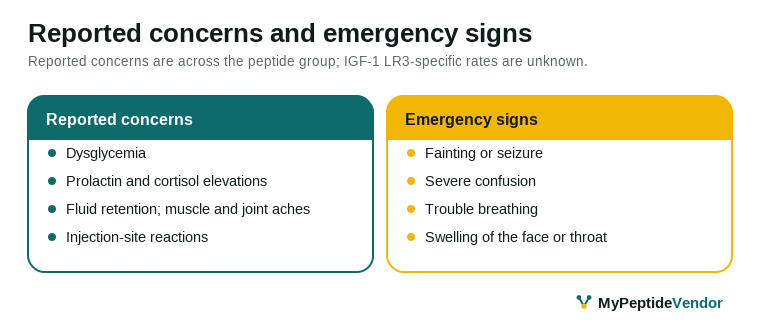
Reliable human side-effect frequencies for IGF-1 LR3 are unknown 9. The 2026 review lists reported adverse effects across performance-enhancing peptides that affect the GH–IGF-1 system, but does not provide dependable IGF-1 LR3-specific rates 9.
- Endocrine and metabolic: Dysglycemia is among the reported concerns 9. Fetal-sheep studies found lower insulin and reduced glucose-stimulated insulin secretion after LR3 infusion 8; those results do not establish how often human effects occur.
- Hormones: Prolactin and cortisol elevations appear among reported concerns across this peptide group 9. Whether IGF-1 LR3 causes either change in people, and how often, is unknown.
- Fluid and musculoskeletal: Fluid retention, muscle aches, and joint aches are reported in the review’s broader discussion 9. Reliable IGF-1 LR3-specific rates are unavailable.
- Injection site: Injection-site reactions are also reported across the group 9. The risk from a product with uncertain sterility cannot be estimated from fetal studies.
Seek emergency care for fainting, seizure, severe confusion, trouble breathing, or swelling of the face or throat. Contact a clinician promptly for new symptoms after exposure. No human data support a numerical estimate of risk or a safe dose 9.
Use this chart
Free to reuse with a link back:
Frequently asked questions
What is a typical IGF-1 LR3 dose?
No typical human dose is established. Online protocols report 20–50 mcg daily, with 100 mcg also appearing, but no human trial validates these amounts as safe or effective.
How do you reconstitute a 1 mg vial of IGF-1 LR3?
There is no validated human-use reconstitution method 9. Online instructions reportedly differ between bacteriostatic water alone and dilute acetic acid followed by bacteriostatic water; neither approach is established as appropriate for a particular research vial.
How many U-100 units is 50 mcg of IGF-1 LR3?
At 1 mg/mL, 50 mcg corresponds to 5 U-100 units. That is a volume conversion, not a dose recommendation or a safety check.
Can reconstituted IGF-1 LR3 be refrigerated or frozen?
A validated storage temperature, stability period, and freeze-thaw allowance for a human-use product are not established 9. Follow product-specific directions from a licensed pharmacy; do not assume another peptide’s storage rules apply.
What should I do if I feel hypoglycemic after using IGF-1 LR3?
Stop using the product and seek urgent medical guidance for shaking, sweating, dizziness, or confusion. Call emergency services for fainting, seizure, severe confusion, or inability to swallow; do not give food or drink to someone who cannot swallow safely. Fetal-sheep studies found altered insulin and glucose responses, but do not establish human risk 8.
Is IGF-1 LR3 approved for muscle growth or performance?
No approval for physique- or performance-related use is established, and human muscle-gain benefit has not been shown 9. Fetal-sheep findings are not proof of benefit in people 7. Athletes should check current rules with their sport’s governing body.
References
- FDA: Certain bulk drug substances for use in compounding that may present significant safety risks
- White et al. IGF-1 LR3 does not promote growth in late-gestation growth-restricted fetal sheep. Am J Physiol Endocrinol Metab. 2025.
- Lu et al. Recombinant expression of IGF-1 and LR3 IGF-1 fused with xylanase in Pichia pastoris. Appl Microbiol Biotechnol. 2023.
- White et al. Attenuated glucose-stimulated insulin secretion during an acute IGF-1 LR3 infusion into fetal sheep does not persist in isolated islets. J Dev Orig Health Dis. 2023.
- Yavuz et al. Revolutionary decellularized Alstroemeria stem-based nerve conduit integrated with GelMA and controlled IGF-1 LR3 release for enhanced rat sciatic nerve regeneration. Int J Biol Macromol. 2025.
- Jonker et al. Coronary vascular growth matches IGF-1-stimulated cardiac growth in fetal sheep. FASEB J. 2020.
- Stremming et al. IGF-1 infusion to fetal sheep increases organ growth but not by stimulating nutrient transfer to the fetus. Am J Physiol Endocrinol Metab. 2021.
- White et al. Reduced glucose-stimulated insulin secretion following a 1-wk IGF-1 infusion in late gestation fetal sheep is due to an intrinsic islet defect. Am J Physiol Endocrinol Metab. 2021.
- Dominikowski et al. The emerging landscape of performance-enhancing peptides modulating GH-IGF1 axis: bridging the gap between clinical evidence and patient self-administration. Front Endocrinol (Lausanne). 2026.
Written by the MyPeptideVendor editorial team from the FDA label, peer-reviewed studies and ClinicalTrials.gov records listed above, fact-checked line by line and reviewed 2026-11-12.
Cite this page
MyPeptideVendor Editorial Team. igf 1 lr3 dosage 1mg: Protocol & Safety. MyPeptideVendor. Updated November 12, 2026. https://mypeptidevendor.com/protocols/igf-1-lr3-dosing-1mg/MyPeptideVendor Editorial Team. (2026, November 12). igf 1 lr3 dosage 1mg: Protocol & Safety. MyPeptideVendor. https://mypeptidevendor.com/protocols/igf-1-lr3-dosing-1mg/Related protocols
CJC-1295 DAC 2 mg
Research UseA 2 mg vial is not an approved human dose; this guide covers the evidence gap, vial math, and safety questions to review with a clinician.
View protocolCJC-1295 DAC 5 mg
Research UseNo approved human dose exists for CJC-1295 DAC; this guide explains 5 mg vial math, research limits, monitoring, and safety questions.
View protocolCJC-1295 No DAC 5 mg
Not approvedNo approved human dose exists for CJC-1295 No DAC; this guide explains 5 mg vial math, evidence limits, and safety questions to raise with a clinician.
View protocol