PT-141: Uses, Dose & FDA Status
Melanocortin receptor agonist
Brand names: Vyleesi; generic name: bremelanotide

PT 141 is bremelanotide, a synthetic peptide that activates melanocortin receptors involved in sexual response 35. In the United States, the prescription product Vyleesi is approved for acquired, generalized hypoactive sexual desire disorder (HSDD) in premenopausal women.
The approved product is an on-demand injection taken about 45 minutes before anticipated sexual activity. Research in men, and use of nasal, intravenous, compounded, or gray-market products, does not have the same established status as Vyleesi 238.
Key takeaways
- Vyleesi was FDA-approved in 2019 for acquired, generalized HSDD in premenopausal women; it is not approved for men or every cause of low desire.
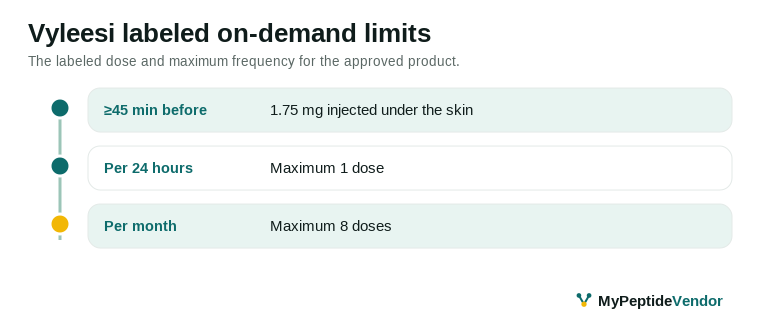
- The labeled Vyleesi dose is 1.75 mg under the skin at least 45 minutes before sex, with a limit of 1 dose in 24 hours and 8 doses per month.
- Four completed registered studies include 2 Phase 3 trials in premenopausal women with HSDD 9.
- Nausea was reported by about 40% of Vyleesi trial participants, compared with about 1% receiving placebo.
- PT 141 acts through central melanocortin receptors, while Viagra and Cialis affect the blood-flow pathway involved in erections 35.
PT-141 at a glance
- Class
- Melanocortin receptor agonist; synthetic peptide
- Mechanism
- Activates melanocortin receptors in the central nervous system, with MC4R a leading receptor of interest
- FDA Status
- FDA-approved as Vyleesi for acquired, generalized HSDD in premenopausal women
- Brand names
- Vyleesi; generic name: bremelanotide
- Administration
- On-demand subcutaneous injection, about 45 minutes before anticipated sexual activity
- Typical Dose
- 1.75 mg under the skin per dose; no more than 1 dose in 24 hours or 8 doses per month
- Half-life
- Not established in the cited clinical summaries
- Primary Uses
- FDA-approved treatment of acquired, generalized HSDD in premenopausal women; male use is outside the approved indication
What is it?

PT 141 is the development name commonly used for bremelanotide, a synthetic peptide related to the melanocortin family 36. Its approved US medicine is Vyleesi. A prescription product with standardized instructions is not the same as a vial marketed online as “research PT 141.”
MT-II is a cyclic, shortened melanocortin analog 6. MT-II grew out of research on melanocortin peptides that included tanning-related work with melanotan I. The shared chemical family does not make PT 141, MT-II, and melanotan products interchangeable 6.
The approved indication is narrow: acquired, generalized HSDD in premenopausal women. “Acquired” means low desire began after a period without that problem. “Generalized” means the change is not limited to one partner or situation. HSDD involves distress, too; a difference in desire that does not trouble the person is not, by itself, the same clinical condition.
Vyleesi is not approved to treat erectile dysfunction, relationship difficulties, pain during sex, or every change in libido. A clinician may consider whether illness, another medicine, mood, pain, or relationship concerns better explain the symptoms. Men have been studied, but treatment in men is outside the approved indication 35.
Melanocortin receptors affect more than sexual response. The wider system is involved in skin pigmentation and other body functions 6. That biology is relevant to the risk of skin darkening, but it does not make the approved sexual-health product a tanning medicine.
What makes it different
The main difference is where it acts. Bremelanotide activates melanocortin receptors in the central nervous system, including pathways involved in sexual response 35. Sildenafil (Viagra) and tadalafil (Cialis) are phosphodiesterase-5 (PDE5) inhibitors. They support the blood-flow process involved in erection rather than directly activating sexual desire 5.
That difference matters when the main concern is wanting sex rather than getting or keeping an erection. A person can have low desire with normal erectile function, erectile difficulty with preserved desire, or both. A brain-acting medicine and a blood-flow medicine target different parts of sexual response; neither mechanism explains every case.
PT 141 also has a different blood-pressure profile from the classic PDE5 concern. A 2007 review reported that melanocortin agonists were not associated with the hypotension observed with PDE5 inhibitors 5. That does not mean bremelanotide has no cardiovascular effects: Vyleesi can temporarily raise blood pressure. A clinician should review blood-pressure and cardiovascular history before treatment.
There is a route-history wrinkle. Palatin developed PT 141 as a nasal spray and had completed a Phase IIb erectile-dysfunction trial by September 2003 2. The approved Vyleesi product is injected under the skin. The route changed during development, and no safe dose conversion between nasal and injected routes has been established 2. Whether route changes onset or side-effect rates is not established here.
Bremelanotide is notable because a 2007 review described it as the only melanocortin agent clinically studied in both men and women 5. That research history does not mean evidence is equally strong for both sexes. It also does not tell us why some men may respond more than others.
Do not assume that the research into IV PT 141 makes it a standard erectile-dysfunction treatment. A 2025 review covering literature through October 2024 discussed IV PT 141 alongside PnPP-19, L-arginine, and L-citrulline, and concluded that larger trials are needed 8. An IV preparation is not the same as the approved under-the-skin Vyleesi product.
How does it work?
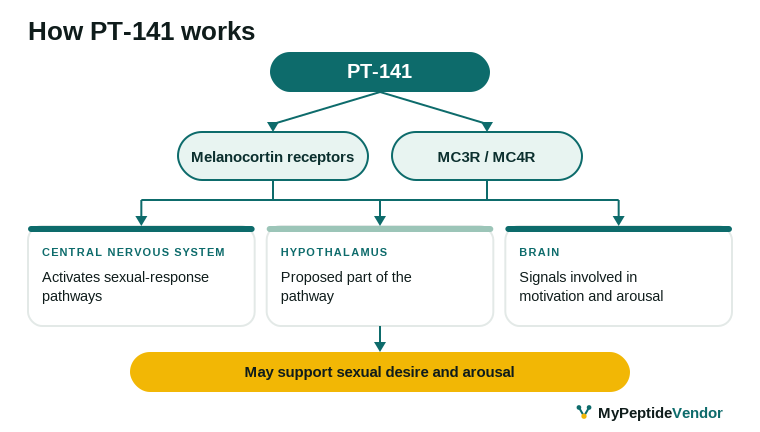
In plain words, PT 141 acts on brain signals involved in sexual motivation and arousal. It does not work by directly widening blood vessels in the penis. Technically, it is a melanocortin receptor agonist: it activates receptors that pass signals between cells 35.
PT-141 acts at melanocortin receptors that include MC3R and MC4R 3. Researchers have not settled how much each receptor contributes. The hypothalamus, a brain region involved in many body functions, is one proposed part of the sexual-response pathway 35.
Animal experiments found erections after PT 141 administration, and rat experiments showed activation of hypothalamic neurons 3. Those findings helped motivate human research. They do not establish how often a person will respond, how large the effect will be, or which dose is right for an individual.
In early human work, systemic PT 141 produced a rapid, dose-dependent increase in erectile activity in normal men and men with erectile dysfunction 3. “Dose-dependent” means the observed response tended to increase as the dose increased. The report does not provide doses, participant counts, response percentages, or a numerical effect size, so it cannot give a man a dependable estimate of his chance of benefit.
PT 141’s central mechanism differs from PDE5 inhibition, but different pathways do not automatically make a combination safe. A 2025 review says larger trials are needed to establish safety, dosing, and possible combined effects with existing erectile-dysfunction treatments 8.
Use this chart
Free to reuse with a link back:
What the clinical evidence actually shows

The clinical record includes early male erectile-dysfunction research, trials in women with HSDD or female sexual arousal disorder (FSAD), and a later review of intravenous use 2389. The best-established use is the approved subcutaneous product for the specific premenopausal-women indication. Evidence for men, IV treatment, and unapproved formulations is not equivalent.
Molinoff and colleagues reported a rapid, dose-related increase in erectile activity after systemic PT 141 in normal men and men with erectile dysfunction 3. The report gives no sample size, dose range, follow-up period, response rate, or numerical effect size. It suggests a possible effect, but it is not enough information to estimate an individual man’s odds of benefit.
Palatin’s nasal-spray program reached a Phase IIb erectile-dysfunction trial that was completed in September 2003. In February 2004, the company planned to begin Phase III trials in early 2005 2. Those historical plans do not establish that the nasal product became an approved treatment, and they do not supply a dose conversion to the later injection.
The ClinicalTrials.gov registry entries do not give participant counts, durations, or efficacy results 9. They identify four completed studies by phase and population:
| Study ID | Phase and population | Status |
|---|---|---|
| NCT02333071 | Phase 3; premenopausal women with HSDD | Completed |
| NCT02338960 | Phase 3; premenopausal women with HSDD | Completed |
| NCT01382719 | Phase 2; premenopausal women with FSAD and/or HSDD | Completed |
| NCT00425256 | Phase 2; women with FSAD | Completed |
The two Phase 3 registrations show that bremelanotide was tested in premenopausal women with HSDD; the two Phase 2 registrations cover FSAD and/or HSDD 9. Without participant numbers, trial duration, and placebo-adjusted results, those entries cannot show how large the benefit was or how it compares across studies.
Phase II data support melanocortin-based therapy for erectile dysfunction, and preliminary data suggest a role for desire and arousal in women 5. It also identified bremelanotide as the only melanocortin agent then clinically studied in both sexes 5. That is a historical account of development, not a head-to-head comparison with current treatments.
A 2025 narrative review examined intravenous PT 141 alongside PnPP-19, L-arginine, and L-citrulline, using literature available through October 2024 8. It described PT 141’s central activity as distinct from PDE5 inhibitors, but concluded that large-scale trials are needed to establish safety, useful dosing, and possible treatment combinations 8.
Important unanswered questions include the best dose and route for men, how long an effect lasts in different people, and which patient features predict response. Response rates and effect sizes are not reported for the male study 3. The registry details listed here do not supply the trial enrollment, durations, or numerical results needed to judge the size of benefit in women 9.
Typical dosing

The labeled Vyleesi dose is 1.75 mg injected under the skin at least 45 minutes before anticipated sexual activity. It is an on-demand medicine, not a daily libido supplement. The labeled limit is 1 dose in 24 hours and 8 doses per month.
Use the approved product’s instructions and the prescriber’s directions. The 1.75 mg dose applies to Vyleesi; it is not a dosing guide for a nasal spray, an IV preparation, or a vial with an uncertain concentration. Palatin’s early program used a nasal spray, while the approved product is an injection 2. No safe dose conversion between nasal and injected routes is established in the cited evidence 2.
For men, the cited studies report a rapid, dose-dependent increase in erectile activity but do not establish a typical male dose 3. The IV review likewise says larger trials are needed to establish dosing 8. No typical male dose or safe home IV dose is established 38.
Do not take an extra dose because the first one seems slow, and do not copy a dose from a forum or clinic advertisement. If treatment is not helping, ask the prescriber to reassess whether it remains useful. Before a visit, note when the change in desire began, whether it happens in all situations, and how much distress it causes. Bring a list of medicines and supplements, and ask what effects should prompt a call.
Use this chart
Free to reuse with a link back:
Side effects: what to actually expect
Nausea is the most common side effect reported with Vyleesi. It occurred in about 40% of treated trial participants, compared with about 1% receiving placebo. Put another way, roughly 4 in 10 treated participants reported nausea. For many people it was short-lived, but severe or persistent nausea is a reason to contact the prescriber.
Other trial-reported effects included flushing, headache, vomiting, and injection-site reactions. Reported rates were about 20% for flushing, 11% for headache, 5% for vomiting, and 13% for injection-site reactions. These percentages describe trial participants; they cannot predict exactly what one person will experience.
Bremelanotide can temporarily raise blood pressure and slow heart rate after a dose. The change generally peaks within a few hours and then eases. The medicine is not suitable for everyone with cardiovascular disease or uncontrolled high blood pressure; a prescriber should review that history rather than assume a central mechanism removes heart and blood-vessel concerns.
Skin darkening, or hyperpigmentation, is linked to melanocortin biology more generally 6. Because melanocortin biology is also connected with pigmentation 6, tell a clinician about a new or changing mole or patch rather than assuming it is a harmless tan.
These trial rates describe the approved medicine, not an unverified vial. An unclear concentration can lead to a dosing mistake, and an unverified product may have uncertain identity, strength, or cleanliness. FDA says certain bulk substances proposed for compounding may present significant safety risks 1. A 2026 review says novel, unapproved peptides need more study before they can be used safely in humans 4.
The skin-darkening rate is also trial-reported; the blood-pressure change is a label safety finding rather than a common symptom percentage.
| Effect | Approximate reported rate | What to expect |
|---|---|---|
| Nausea | 40% treated; 1% placebo | Most common; can be temporary |
| Flushing | 20% | Warmth or facial redness |
| Injection-site reactions | 13% | Local reaction where injected |
| Headache | 11% | Reported during treatment |
| Vomiting | 5% | Reported in clinical trials |
| Skin darkening | About 1% | May not fully resolve after stopping |
| Temporary blood-pressure increase | No percentage stated here | Can occur after a dose; review cardiovascular history with the prescriber |
Do not combine PT 141 with sildenafil, tadalafil, or another erectile-dysfunction medicine unless a clinician specifically advises it. The review of IV PT 141 says large trials are still needed to establish safety and possible combined effects 8. It does not provide a reliable combination dose or quantify the blood-pressure effect of taking both.
Regulatory & access status in the US (as of 2026)
Bremelanotide is FDA-approved as Vyleesi for acquired, generalized HSDD in premenopausal women 49. The approval applies to that product and indication. It does not approve PT 141 for erectile dysfunction in men, postmenopausal low desire, tanning, or general sexual enhancement.
Vyleesi is a prescription medicine. Access should begin with a licensed clinician who can assess symptoms, review medicines and health history, and decide whether the approved indication fits. Low desire can have more than one cause, and a prescription does not replace checking for those causes.
A compounded medicine is not the same as an FDA-approved product. Compounding may be permitted under specific circumstances, but that does not make every peptide formulation quality-tested, appropriate, or lawful to sell. FDA identifies certain bulk substances proposed for compounding as potentially presenting significant safety risks 1. That page does not establish that every PT 141 preparation is on its list. Check current FDA information and ask a pharmacist about the exact ingredient and dispensing pharmacy.
Red flags include a seller that requires no prescription, does not identify a licensed dispensing pharmacy, provides no clear concentration or lot number, or gives vague injection instructions. A certificate of analysis alone does not make a product FDA-approved or prove that it is suitable for injection. Do not inject a vial if its identity, concentration, or instructions are unclear. Unapproved peptides need more human safety research 4.
Before requesting a prescription, ask: “Does my history fit acquired, generalized HSDD?” “Could a medicine or health condition explain the change?” “What effects should make me stop and call?” “How will we decide whether treatment is helping?” and “Am I receiving the approved Vyleesi product?” Those questions keep the discussion focused on diagnosis and safe use rather than a seller’s product claim.
Research-grade PT-141 is available from American Peptides (PT-141, from $60.00); code MYPEPTIDEVENDOR takes 15% off. Sold for laboratory research only, not for human use. Affiliate link
How it compares to its closest alternative
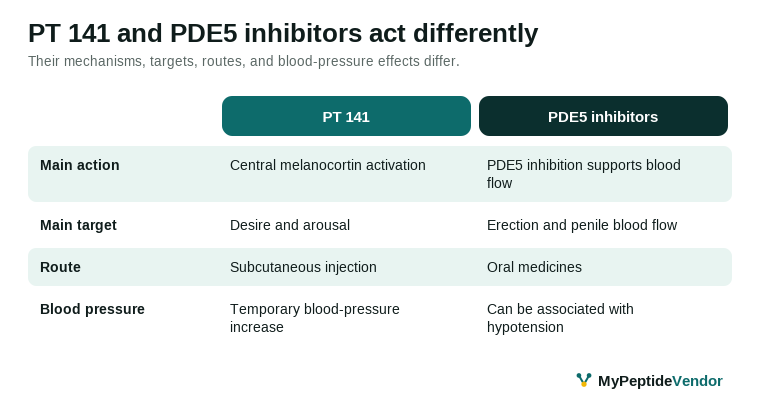
Sildenafil and tadalafil are common comparisons because they treat erectile dysfunction, but they act through a different pathway from PT 141 35. The table compares their broad mechanisms and use; it does not mean the medicines should be combined.
| Feature | PT 141 / bremelanotide | Sildenafil / tadalafil |
|---|---|---|
| Main action | Activates melanocortin receptors in the central nervous system; MC4R is a leading receptor of interest | Inhibits PDE5 and supports the blood-flow pathway involved in erection |
| Main target | Central sexual-response signaling, including desire and arousal | Erection mechanics and penile blood flow; not direct treatment for desire |
| FDA status | Vyleesi is approved for acquired, generalized HSDD in premenopausal women | Prescription treatments for erectile dysfunction; not approved as low-desire treatments |
| Route | Subcutaneous injection for the approved product | Oral medicines |
| Timing | At least 45 minutes before anticipated sexual activity | Timing depends on the drug and formulation; follow the prescription |
| Blood-pressure issue | Can temporarily increase blood pressure; a 2007 review did not associate melanocortin agonists with PDE5-related hypotension | PDE5 inhibitors can be associated with hypotension |
| Evidence in men | Early work reported rapid, dose-related erectile activity, but did not provide a response rate or effect size | Established prescription options for erectile dysfunction; they do not directly address low desire |
A central medicine may be relevant when the concern is desire, while a PDE5 inhibitor may be relevant when the concern is erection. Some people have both concerns, but current evidence does not establish a reliable rule for combining these drugs or predict who will respond to PT 141 8. A clinician can help identify which problem needs attention first.
Use this chart
Free to reuse with a link back:
Where to Buy PT-141 for Research
American Peptides
PT-141 · from $60.00
US-made research peptides, every lot third-party tested with a lot-matched COA.
15% offMYPEPTIDEVENDOR at checkout
- ≥99% purity verified by HPLC + mass spec, endotoxin tested
- Ships tracked from Louisiana, free shipping over $300
- 15% off your first order with code MYPEPTIDEVENDOR
Certified-Pep
US-made research peptides with batch-specific lab reports (COA) and a QR code on every vial.
- Independent laboratory testing (Vanguard Laboratory)
- Made in the USA, ships in 1-2 business days
- Research use only, not for human or veterinary use
Affiliate disclosure: we may earn a commission if you order through the link above. PT-141 is not approved by the FDA for human use.
Ranked in our guides
Frequently asked questions
How long does PT 141 take to work?
The Vyleesi injection is taken at least 45 minutes before anticipated sexual activity. That is a dosing instruction, not a promise that every person will notice an effect at the same time. Early male research described a rapid response but did not provide enough detail to predict an individual onset 3.
Is PT 141 legal in the United States?
Bremelanotide is available by prescription as Vyleesi for its approved indication in premenopausal women with acquired, generalized HSDD. That approval does not make every online PT 141 vial an FDA-approved medicine or establish that an unapproved vial is safe to inject. Ask a licensed clinician and pharmacist about the exact product.
Can men use PT 141?
Men were included in early research, which reported increased erectile activity after PT 141 3. Vyleesi (bremelanotide) is indicated for premenopausal women with acquired, generalized hypoactive sexual desire disorder, and is not approved for men. Male use is outside that indication, and the available research description does not establish a dependable response rate or standard male dose 3.
What are alternatives for low libido?
The right option depends on why desire has changed, so a clinician may review medicines, health conditions, mood, pain, and relationship context. Sildenafil and tadalafil target the erection-related blood-flow pathway rather than desire 5. Vyleesi is a prescription option only for people who fit its specific approved indication.
Can PT 141 be taken with Viagra or Cialis?
Do not combine them without a prescriber’s advice. PT 141 and PDE5 inhibitors act through different pathways, and a review of IV PT 141 says larger trials are still needed to establish safety and possible combined effects 8. A safe combination dose has not yet been established, and larger trials are needed 8.
Does PT 141 cause tanning or change moles?
Skin darkening has been reported with bremelanotide, but the cited clinical information does not establish how often moles change or whether pigment changes will fully resolve. MT-I was studied for tanning, while MT-II was studied in connection with erectile dysfunction 6. Ask a clinician to assess any new or changing spot.
Is a compounded or research PT 141 vial the same as Vyleesi?
No. Vyleesi is the approved prescription product; a research-labeled or compounded vial is not automatically approved or interchangeable. FDA warns that certain bulk substances proposed for compounding may present significant safety risks 1, and unapproved peptides need more safety study before human use 4.
References
- FDA: Certain bulk drug substances for use in compounding that may present significant safety risks
- Hedlund et al. PT-141 Palatin. Curr Opin Investig Drugs. 2004.
- Molinoff et al. PT-141: a melanocortin agonist for the treatment of sexual dysfunction. Ann N Y Acad Sci. 2003.
- Renke et al. Therapeutic Peptides in Aesthetic, Metabolic and Endocrine Conditions: Effects, Safety, Clinical Applications, and Future Perspectives. Int J Mol Sci. 2026.
- Shadiack et al. Melanocortins in the treatment of male and female sexual dysfunction. Curr Top Med Chem. 2007.
- Hadley et al. Melanocortin peptide therapeutics: historical milestones, clinical studies and commercialization. Peptides. 2006.
- Bayés et al. Gateways to clinical trials. Methods Find Exp Clin Pharmacol. 2004.
- Ila et al. Intravenous peptides and amino acids for erectile dysfunction: a narrative review of current applications and future directions. Expert Opin Pharmacother. 2025.
- ClinicalTrials.gov: 4 registered studies (search: PT-141)
Written by the MyPeptideVendor editorial team from the FDA label, peer-reviewed studies and ClinicalTrials.gov records listed above, fact-checked line by line and reviewed 2026-11-12.
Cite this page
MyPeptideVendor Editorial Team. PT 141: Uses, Dose & FDA Status. MyPeptideVendor. Updated November 12, 2026. https://mypeptidevendor.com/peptides/pt-141/MyPeptideVendor Editorial Team. (2026, November 12). PT 141: Uses, Dose & FDA Status. MyPeptideVendor. https://mypeptidevendor.com/peptides/pt-141/Related peptides
Melanostatin DM
Research UseMelanostatin DM blocks alpha-MSH-related darkening in a nonhuman melanocyte assay, but human dosing, effects, and safety are not established.
Learn moreMelanotan 1 (MT-1)
Not approvedMT-1 is a synthetic α-MSH analog studied with UV exposure; three small phase 1 trials found increased tanning, but did not establish long-term safety.
Learn moreMelanotan 2 (MT-2)
Not approvedMelanotan 2 can stimulate pigment, but it has no FDA-approved use, established tanning dose or proven human fat-loss benefit.
Learn more