Oxytocin Peptide: Uses, Evidence & Safety
Peptide hormone
Brand names: No brand name is specified in the cited FDA prescribing information.
Oxytocin peptide is a nine-amino-acid hormone made in the hypothalamus and released by the posterior pituitary. Its established medical role is to stimulate uterine contractions during medically indicated labor and help prevent or control bleeding after birth 13.
In the United States, synthetic oxytocin injection is used in obstetric care, while intranasal oxytocin has been tested in small research studies. One stress experiment used 24 IU in 37 men; that single research dose is not a routine treatment or a self-use recommendation 6.
Key takeaways
- The FDA-labeled injection is used for medically indicated labor induction or augmentation and postpartum uterine bleeding, not elective labor induction 1.
- The WHO recommendation described in a 2025 review is 10 IU by intramuscular or intravenous injection to prevent postpartum hemorrhage 3.
- A 2026 review of 13 trials and 8,961 women found that 4–10 IU was associated with 6–7 fewer cases of blood loss of at least 1,000 mL per 1,000 women than no oxytocin 5.
- A stress study gave 24 IU intranasally once to 37 men, 50 minutes before a laboratory stress test; it did not establish a repeat schedule 6.
- There is no evidence-based frequency for self-administered intranasal oxytocin, and a research-use label does not establish that a product is approved or suitable for human use 26.
Oxytocin at a glance
- Class
- Nine-amino-acid peptide hormone.
- Mechanism
- Activates receptors that make uterine muscle contract; it also triggers milk ejection and is being studied for effects on social information and stress.
- FDA Status
- Synthetic injection has FDA-labeled obstetric uses; intranasal research use is not an indication in the injection label.
- Brand names
- No brand name is specified in the cited FDA prescribing information.
- Administration
- Obstetric care uses intravenous infusion or intramuscular injection; intranasal administration has been used in research.
- Typical Dose
- Labor infusion starts at 1–2 mU/min; WHO-recommended postpartum hemorrhage prevention is 10 IU IM or IV; one stress study used 24 IU intranasally.
- Half-life
- The cited prescribing information does not give a half-life; it states that uterine stimulation wanes after the infusion is stopped.
- Primary Uses
- Medically indicated labor induction or augmentation and prevention or control of postpartum uterine bleeding.
What is it?

Oxytocin is a small peptide hormone made mainly by nerve cells in the hypothalamus and released into the bloodstream by the posterior pituitary. It has nine amino acids. It acts as a circulating hormone in the body and as a signaling molecule in the brain 1.
Its clearest medical effects are reproductive. Oxytocin makes the uterus contract, especially near the end of pregnancy and just after delivery. It also helps move milk from the milk-producing glands toward the nipple during breastfeeding. That is milk ejection, not milk production 1.
The hospital medicine is synthetic oxytocin injection. A nasal spray, powder, or vial sold for laboratory work is not automatically interchangeable with that medicine. A product name or peptide sequence alone does not show that a product is sterile, accurately measured, or suitable for use in a person 12.
Oxytocin is often called a “love hormone,” but that label promises more than clinical evidence can support. Human research has examined stress responses and social judgments, but a laboratory result does not show that taking oxytocin reliably creates trust, affection, or a lasting bond 67.
What makes it different
Oxytocin has a direct, clinically useful effect on uterine muscle. During labor, clinicians can adjust or stop an intravenous infusion if contractions become too strong or the fetal heart rate becomes concerning. That ability to control the infusion is part of safe obstetric use 1.
Its effects outside obstetric care are less settled. A small randomized study found a stress-related effect in men under a particular laboratory setup, but it did not test oxytocin as treatment for an anxiety disorder or as a way to improve everyday relationships 6.
It is not a daily wellness medicine with an established home schedule. The FDA prescribing information gives monitored hospital dosing for obstetric indications, while the intranasal stress study tested one dose before one task 16. No evidence-based adult frequency for intranasal use outside research is established here.
Oxytocin is not an established weight-loss, metabolic, anti-inflammatory, or sports-recovery treatment. The human clinical evidence described here does not establish those benefits 167. A finding about a hormone level or a stress response is not proof of a meaningful health benefit.
Its social effects may depend on context rather than simply making a person feel warmer toward everyone. That result is not a prediction of how a particular person will act outside the experiment.
How does it work?
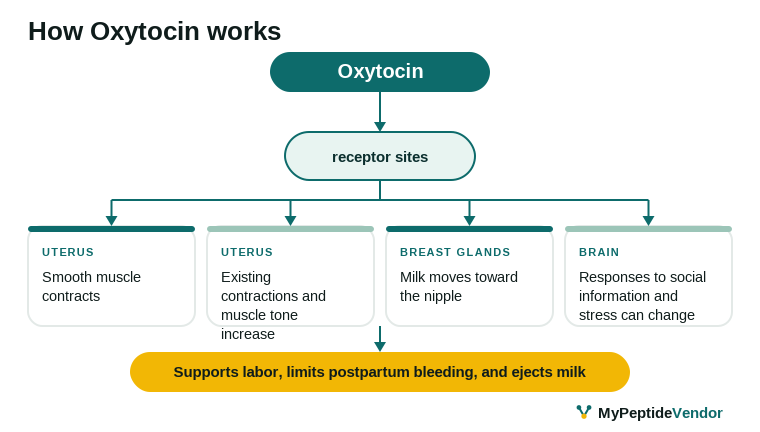
In plain terms, oxytocin attaches to receptor sites on certain cells and tells them to respond. In the uterus, that signal makes smooth muscle contract. The uterus becomes especially responsive near the end of pregnancy, so oxytocin can increase the frequency of existing contractions and raise uterine muscle tone 1.
During labor, contractions help move the baby through the birth canal. After delivery, the uterus tightens around blood vessels where the placenta was attached, helping limit bleeding. This is why clinicians use oxytocin to induce or strengthen labor when medically indicated and to prevent or control postpartum uterine bleeding 13.
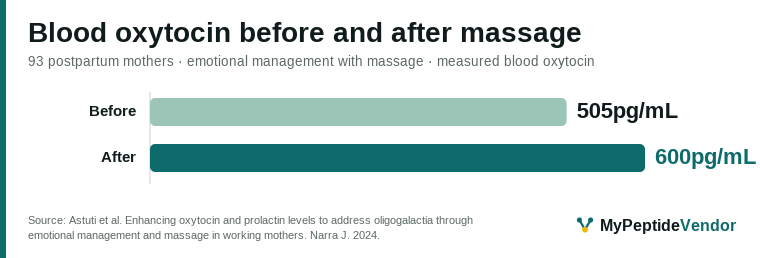
During breastfeeding, oxytocin contracts cells around the milk-producing glands and pushes milk toward the nipple. In a 2024 study of 93 postpartum mothers, the group receiving emotional management with massage had a measured rise in blood oxytocin from 505.0 to 600.0 pg/mL. That was a support-and-massage intervention, not a drug-dose trial, so the change in blood level is not a dosing guide 7.
In the brain, oxytocin can affect how people respond to social information and stress. A 2003 experiment found the lowest cortisol and anxiety responses when intranasal oxytocin was paired with support from a friend during a laboratory stress task 6. That does not show that a nasal dose will reliably reduce stress in daily life.
Researchers also debate whether oxytocin delivered through the nose reaches the brain in amounts that reliably cause a meaningful effect. A nasal route and a behavioral change observed in a study do not, by themselves, prove how much drug reached the brain or which pathway caused the change 67.
Use this chart
Free to reuse with a link back:
What the clinical evidence actually shows

Preventing postpartum hemorrhage: A 2025 Cochrane network meta-analysis included 122 trials and 121,931 women across 48 countries. It describes the World Health Organization recommendation for prevention as 10 IU of oxytocin by intramuscular or intravenous injection 3. That is care around birth, not a dose for general hormone or wellness use.
A 2026 dose-response review pooled 13 trials involving 8,961 women after vaginal birth; study doses ranged from 2.5 to 80 IU. Compared with no oxytocin, doses of 4–10 IU were associated with 6–7 fewer cases of blood loss of at least 1,000 mL per 1,000 women. To picture the scale, the review estimated 19 such cases per 1,000 women without oxytocin. The 4–10 IU range was also associated with 10–12 fewer women per 100 needing additional uterotonic medicine 5.
The dose-response pattern was J-shaped, not “more is always better.” The review found the best overall balance in the 4–10 IU range after vaginal birth. At 20 IU, the risk of severe blood loss was probably reduced (moderate certainty), but at higher doses the benefit may diminish (low certainty) 5. The review found no dose-response relationship for blood transfusion; the findings should not automatically be applied to every birth setting 5.
Treating established postpartum hemorrhage: A 2014 Cochrane review included 10 randomized trials with 4,052 participants. In 2 trials involving 1,787 women, 800 mcg of sublingual misoprostol was compared with oxytocin infusion. The primary outcomes did not differ, but additional blood loss of at least 1,000 mL was more likely with misoprostol; vomiting and shivering were also more frequent 10. This comparison does not support substituting or combining medicines without an obstetric team.
Oxytocin during active labor: A 2025 meta-analysis of 15 randomized trials included 5,734 patients. Stopping oxytocin during active labor rather than continuing it was associated with a lower cesarean delivery risk: relative risk 0.80, with a 95% confidence interval of 0.66–0.97. Discontinuation was also associated with lower risks of uterine tachysystole and a nonreassuring fetal heart-rate tracing. The prediction interval for cesarean risk crossed no effect, so results may vary between settings and patients 4. This is a clinician-managed labor decision, not a reason to alter an infusion without the care team.
Stress and social support: In the Heinrichs 2003 randomized study, 37 healthy men received either 24 IU of intranasal oxytocin or placebo 50 minutes before the Trier Social Stress Test. Participants also either received support from a best friend or prepared without that support. The combination of oxytocin and social support produced the lowest cortisol concentrations, increased calmness, and decreased anxiety during the stress task 6. This was a one-time experiment, not a repeat-dose study or a trial of anxiety treatment.
Social judgments and sex differences: This does not mean oxytocin makes men distrustful in ordinary life. It shows that the observed response depended on sex and on whether the social information was positive or negative.
Massage and measured hormone levels: Astuti and colleagues studied 93 postpartum mothers assigned to three support groups. In the group receiving emotional management with oxytocin massage, mean measured oxytocin rose from 505.0 to 600.0 pg/mL, while prolactin rose from 191.0 to 233.0 ng/mL. Those changes do not establish a medicinal dose, prove an increase in milk production, or tell a person how often to use oxytocin medicine 7.
What remains unknown: There is no evidence-based schedule for adult intranasal use outside clinical research in the studies described here. The 24 IU stress experiment does not establish a safe repeat interval or show that repeated nasal use reliably improves bonding, trust, or anxiety 6. The social-judgment findings do not predict an individual response, and evidence for oxytocin as a general social treatment remains uncertain 7.
Evidence differs by claim: labor and postpartum bleeding are established clinical uses, while research on stress and social behavior is limited and context-specific. The evidence for metabolic or recovery benefits is not established by the human studies described here 13456710.
| Claim or use | What the evidence supports | What it does not establish |
|---|---|---|
| Medically indicated labor induction or augmentation | FDA-labeled obstetric use, with intravenous dosing adjusted to uterine response and clinical monitoring. | A reason to induce labor electively or to use oxytocin without obstetric care. |
| Prevention of postpartum hemorrhage | WHO recommendation of 10 IU IM or IV; dose-response evidence favors 4–10 IU after vaginal birth. | A general-purpose dose for people who are not receiving birth care. |
| Treatment of postpartum hemorrhage | Oxytocin is used to produce uterine contractions and control postpartum bleeding. | A comparative certainty grade; the cited 2014 review does not report one for this treatment comparison. |
| Social bonding or trust in adults | Small human studies examine social responses, but findings depend on the task and context. | A reliable treatment for bonding, trust, or relationship problems. |
| Stress response | One study in 37 men found the lowest cortisol and anxiety responses when oxytocin was paired with support from a friend. | Reliable stress relief for the general population or an established repeat schedule. |
| Men’s responses to social cues | A predictable behavioral effect in everyday settings. | |
| Metabolic, anti-inflammatory, or athletic-recovery benefits | No established benefit for these uses is shown by the cited human clinical evidence. | A supported treatment claim for weight, inflammation, or recovery. |
Use this chart
Free to reuse with a link back:
Typical dosing

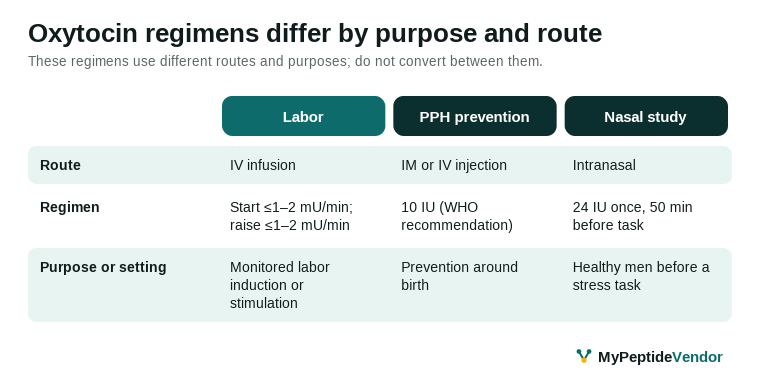
Labor induction or augmentation, FDA-labeled use: The prescribing information specifies intravenous infusion for induction or stimulation of labor. The starting rate is no more than 1–2 mU/min, with increases of no more than 1–2 mU/min until an appropriate contraction pattern is reached. Clinicians monitor contractions, uterine resting tone, and fetal heart rate, and stop the infusion if uterine activity becomes excessive or fetal distress occurs 1.
Postpartum hemorrhage prevention: The WHO recommendation described in the 2025 review is 10 IU by intramuscular or intravenous injection 3. A 2026 dose-response review found the strongest overall balance in the 4–10 IU range after vaginal birth 5. This is a birth-care dose, not a self-administration instruction.
Postpartum bleeding control, FDA label: The label describes 10–40 units added to 1,000 mL of a nonhydrating diluent and infused at a rate needed to control uterine atony. It also describes 10 units intramuscularly after delivery of the placenta 1. These are clinician-managed regimens, not home-use directions.
Intranasal research: The Heinrichs study gave 24 IU once, 50 minutes before the Trier Social Stress Test, to healthy men. That protocol does not establish an approved dose, an effective dose for bonding, or a safe repeat interval 6. No evidence-based frequency for nonprescribed intranasal use is established.
Do not convert between IU, mU/min, and nasal spray actuations. Labor dosing is a rate over time, while postpartum regimens and research nasal doses use different routes and purposes 136.
Use this chart
Free to reuse with a link back:
Side effects: what to actually expect
The FDA prescribing information lists nausea and vomiting among reported maternal reactions, but it does not give percentages for these effects. It also lists allergic reaction, heart-rhythm problems, pelvic hematoma, and postpartum hemorrhage. Listing an event does not mean it is common, and the label does not provide a rate for each one 1.
The Heinrichs intranasal study involved 37 men and reports stress and anxiety outcomes, but its summary does not provide side-effect percentages. A single-dose experiment of that size cannot establish how often side effects occur with repeated use or with products sold outside a clinical study 6.
The most serious known risks involve excessive uterine stimulation during obstetric use. Strong or prolonged contractions can reduce oxygen delivery to the fetus and may lead to uterine rupture, fetal heart-rate abnormalities, fetal injury, or fetal death. Labor use therefore requires clinical monitoring 1.
Oxytocin also has an antidiuretic effect, which can cause the body to retain water. The FDA label reports severe water intoxication, including convulsions and coma, after slow infusion over 24 hours. It warns that large infusions of 40–50 mU/min for long periods can cause this complication 1.
Clinicians also consider interactions and anesthesia. The label reports severe hypertension when oxytocin was given 3–4 hours after a vasoconstrictor used with caudal anesthesia, and it describes cardiovascular effects with cyclopropane anesthesia 1. These obstetric label data do not establish the risk profile of a nonprescribed nasal spray or research vial.
No reliable side-effect percentages for self-administered intranasal oxytocin are established in the cited human study. With an unverified product, the concentration, purity, and route may also be uncertain, so a seller’s description cannot provide a dependable personal risk estimate 126.
Regulatory & access status in the US (as of 2026)
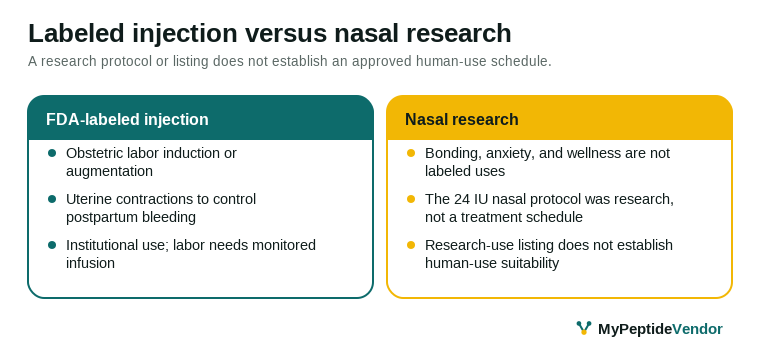
As of the label provided, synthetic oxytocin injection has FDA-labeled obstetric uses, including medically indicated labor induction or augmentation and producing uterine contractions to control postpartum bleeding 1. The prescribing information says the available information is inadequate to define the benefit-risk balance for elective labor induction 1.
The FDA-listed injection is supplied for institutional use, and labor administration requires controlled infusion and clinical monitoring 1. Intranasal oxytocin for bonding, anxiety, or general wellness is not an indication in that injection label. The 24 IU nasal dose in the Heinrichs study was a research protocol, not an FDA-labeled treatment schedule 16.
“Research use only” does not mean approved for human dosing. A laboratory listing does not establish that a product is sterile, accurately dosed, clinically tested, or suitable for injection or nasal use. FDA describes a category 2 process for certain bulk drug substances nominated for compounding when potential significant safety risks have been identified; that general framework does not establish the category or approval status of a particular oxytocin product 2.
A compounded or research-grade product should not be treated as interchangeable with the FDA-labeled injection. The cited FDA information does not establish that a research-grade oxytocin product is approved for self-use. People who need oxytocin for labor or postpartum bleeding should receive it through obstetric care 12.
Buying a peptide listed for laboratory research does not make it a prescription medicine or confirm that it can lawfully be used as one. The FDA information cited here does not determine the legal status of every seller or product, so do not assume that an online listing is a safe or authorized route for human use 12.
Use this chart
Free to reuse with a link back:
Research-grade Oxytocin is available from American Peptides (OXYTOCIN LIQUID SPRAY, from $90.00); code MYPEPTIDEVENDOR takes 15% off. Sold for laboratory research only, not for human use. Affiliate link
How it compares to its closest alternative
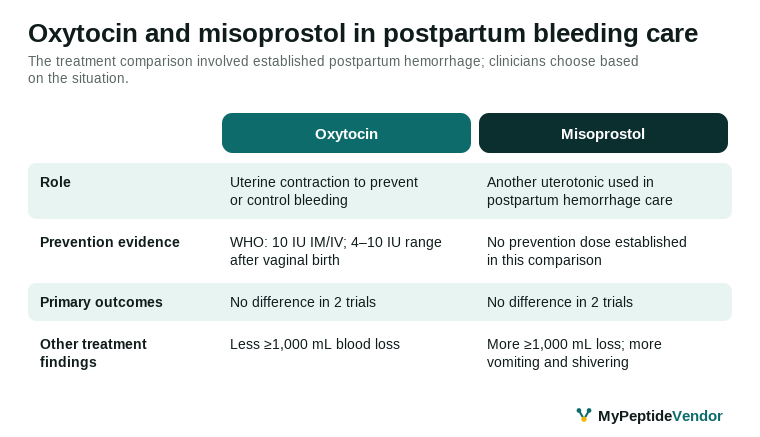
For postpartum hemorrhage, a practical comparison is oxytocin versus misoprostol, another uterotonic medicine. Prevention evidence comes from the WHO recommendation and dose-response review; treatment evidence comes from a Cochrane comparison involving women with established primary postpartum hemorrhage 3510.
| Feature | Oxytocin | Misoprostol |
|---|---|---|
| Main role in this comparison | Used to contract the uterus to prevent or control postpartum bleeding. | Another uterotonic used in postpartum hemorrhage care. |
| Prevention dose or evidence | WHO recommendation: 10 IU IM or IV; the dose-response review found a favorable range of 4–10 IU after vaginal birth. | The cited treatment comparison does not establish a prevention dose for this comparison. |
| Treatment comparison | Oxytocin infusion was compared with sublingual misoprostol in trials of established primary postpartum hemorrhage. | In 2 trials with 1,787 women, 800 mcg sublingual misoprostol and oxytocin infusion did not differ on the primary outcomes reported. |
| Reported trade-off | Requires injection or infusion; labor use needs close monitoring. | In the treatment comparison, additional blood loss of at least 1,000 mL was more likely, and vomiting and shivering were more frequent. |
| Who chooses | An obstetric clinician, based on the situation and response. | An obstetric clinician, based on the situation, availability, and response. |
This comparison does not make either medicine right for every birth or hemorrhage. Route, cause of bleeding, prior prevention, clinical setting, and response affect treatment choice. Postpartum hemorrhage requires urgent obstetric assessment rather than self-treatment 310.
Use this chart
Free to reuse with a link back:
Where to Buy Oxytocin for Research
American Peptides
OXYTOCIN LIQUID SPRAY · from $90.00
US-made research peptides, every lot third-party tested with a lot-matched COA.
15% offMYPEPTIDEVENDOR at checkout
- ≥99% purity verified by HPLC + mass spec, endotoxin tested
- Ships tracked from Louisiana, free shipping over $300
- 15% off your first order with code MYPEPTIDEVENDOR
Certified-Pep
US-made research peptides with batch-specific lab reports (COA) and a QR code on every vial.
- Independent laboratory testing (Vanguard Laboratory)
- Made in the USA, ships in 1-2 business days
- Research use only, not for human or veterinary use
Affiliate disclosure: we may earn a commission if you order through the link above. Oxytocin is not approved by the FDA for human use.
Ranked in our guides
Frequently asked questions
What are oxytocin peptides used for?
In clinical care, synthetic oxytocin injection is used to start or strengthen labor when medically indicated and to help prevent or control postpartum uterine bleeding 13. Intranasal oxytocin has been studied for stress and social responses, but that research does not establish it as a routine bonding or anxiety treatment 67.
How often should I take oxytocin peptide?
There is no evidence-based self-use frequency for intranasal oxytocin. The 24 IU dose in the Heinrichs study was given once before a laboratory stress test, not as a repeat schedule 6. Obstetric injection is managed by clinicians according to the medical situation and response 1.
Does the oxytocin peptide really work?
Yes for specific obstetric effects: oxytocin stimulates uterine contractions, and evidence supports its use to prevent postpartum hemorrhage 135. Whether it reliably improves adult bonding, trust, or anxiety is not established; the human stress evidence includes a small, context-specific study 67.
What would happen if a guy took oxytocin?
There is no predictable everyday response established for men. In one experiment, 37 healthy men received 24 IU intranasally before a stress test; the lowest cortisol and anxiety responses occurred when oxytocin was paired with support from a friend 6. Another social-judgment study found that men showed greater amygdala response to criticizing individuals and later rated their faces as less likable, but that does not predict an individual man’s response outside the experiment 7.
References
- FDA prescribing information: Oxytocin Injection, Solution (DailyMed)
- FDA: Certain bulk drug substances for use in compounding that may present significant safety risks
- Gallos et al. Uterotonic agents for preventing postpartum haemorrhage: a network meta-analysis. Cochrane Database Syst Rev. 2025.
- Whitley et al. Reduced risk of cesarean delivery with oxytocin discontinuation in active labor: a systematic review and meta-analysis. Am J Obstet Gynecol. 2025.
- Hébert et al. Prophylactic oxytocin dose following vaginal birth to prevent postpartum hemorrhage: a systematic review and dose-response meta-analysis. Am J Obstet Gynecol. 2026.
- Heinrichs et al. Social support and oxytocin interact to suppress cortisol and subjective responses to psychosocial stress. Biol Psychiatry. 2003.
- Astuti et al. Enhancing oxytocin and prolactin levels to address oligogalactia through emotional management and massage in working mothers. Narra J. 2024.
- Amaral et al. Prophylactic strategies for prevention of postpartum haemorrhage in caesarean delivery: a systematic review and Bayesian network meta-analysis of randomised controlled trials. Lancet Glob Health. 2025.
- Varian et al. Microbial lysate upregulates host oxytocin. Brain Behav Immun. 2017.
- Mousa et al. Treatment for primary postpartum haemorrhage. Cochrane Database Syst Rev. 2014.
- ClinicalTrials.gov: 1417 registered studies (search: Oxytocin)
Written by the MyPeptideVendor editorial team from the FDA label, peer-reviewed studies and ClinicalTrials.gov records listed above, fact-checked line by line and reviewed 2026-11-12.
Cite this page
MyPeptideVendor Editorial Team. Oxytocin Peptide: Uses, Evidence & Safety. MyPeptideVendor. Updated November 12, 2026. https://mypeptidevendor.com/peptides/oxytocin/MyPeptideVendor Editorial Team. (2026, November 12). Oxytocin Peptide: Uses, Evidence & Safety. MyPeptideVendor. https://mypeptidevendor.com/peptides/oxytocin/Related peptides
Melanostatin DM
Research UseMelanostatin DM blocks alpha-MSH-related darkening in a nonhuman melanocyte assay, but human dosing, effects, and safety are not established.
Learn moreMelanotan 1 (MT-1)
Not approvedMT-1 is a synthetic α-MSH analog studied with UV exposure; three small phase 1 trials found increased tanning, but did not establish long-term safety.
Learn morePT-141
FDA-ApprovedPT 141 is bremelanotide, a brain-acting peptide approved as Vyleesi for acquired, generalized HSDD in premenopausal women.
Learn more