Melanotan 1 mt1: Evidence, Risks & Status
Melanocortin peptide
Brand names: Melanotan 1, MT-1, and afamelanotide refer to the same active molecule.

Melanotan 1 (MT-1) is a synthetic 13-amino-acid analog of α-melanocyte-stimulating hormone (α-MSH), studied in people alongside ultraviolet (UV) exposure 34. Afamelanotide is another name for the same molecule; one study describes it as an orphan drug used for erythropoietic protoporphyria (EPP), but does not state FDA approval 3.
The human tanning evidence comes from 3 small phase 1 trials, with treatment schedules lasting from 10 days to 4 weeks 4. Research-labeled MT-1 is not an approved tanning treatment, and “research use only” means it is not intended for human consumption.
Key takeaways
- MT-1 has 13 amino acids, with norleucine at position 4 and D-phenylalanine at position 7 in place of the α-MSH residues 3.
- In the first phase 1 study, 3 of 4 MT-1 recipients tanned after a 10-day course and UV-B exposure 4.
- Trial doses were 0.08 or 0.16 mg/kg per day; these were experimental regimens, not personal-use instructions 4.
- The trials reported minor nausea and temporary facial flushing, but did not give percentages for either effect 4.
- Afamelanotide is described as an orphan drug used for EPP; the available clinical paper does not establish FDA approval status 3.
Melanotan 1 (MT-1) at a glance
- Class
- Synthetic melanocortin peptide; α-MSH analog
- Mechanism
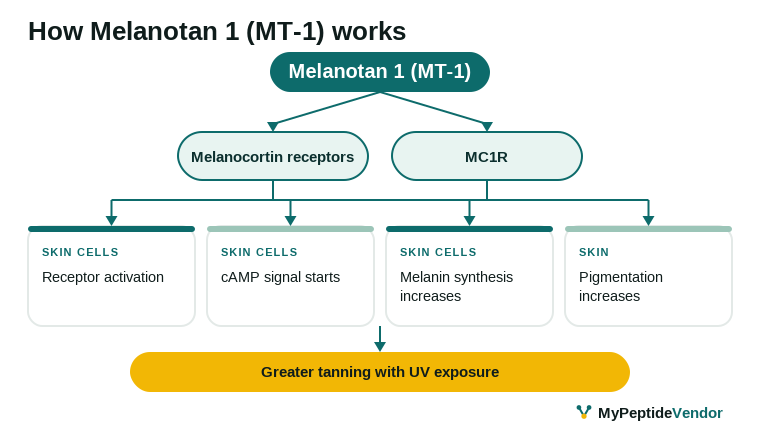
- MC1R activation can raise cAMP signaling in pigment-producing cells and support melanin synthesis.
- FDA Status
- Not approved as a tanning treatment; the cited EPP paper does not state FDA approval status.
- Brand names
- Melanotan 1, MT-1, and afamelanotide refer to the same active molecule.
- Administration
- Human tanning trials used subcutaneous injections with UV-B light or sunlight.
- Typical Dose
- Phase 1 trial regimens: 0.08–0.16 mg/kg per day; not personal-use guidance.
- Half-life
- Not reported in the cited human tanning trials.
- Primary Uses
- Studied with UV exposure for tanning; afamelanotide is described as an orphan drug used for EPP.
What is it?

MT-1 is a synthetic 13-amino-acid version of α-MSH, a peptide involved in pigmentation 3. It differs at 2 positions: norleucine replaces methionine at position 4, and D-phenylalanine replaces L-phenylalanine at position 7 3. The chemical name used in the research literature is [Nle4-D-Phe7]α-MSH 2.
MT-1 and afamelanotide name the same active molecule, but the name alone does not tell you what kind of product you have 3. A research vial is not the same as a regulated drug product. A “research use only, not for human consumption” notice means the material is presented for laboratory research, not for injection or self-treatment.
Those identifiers do not establish a vial’s identity or purity; the cited human and analytical studies do not report either value for a commercial vial.
What makes it different
MT-1 differs from natural α-MSH by 2 amino-acid substitutions 3. Afamelanotide is not a separate peptide; it is another name for MT-1 3. The practical distinction is between the active molecule and a particular product’s formulation, quality controls, and regulatory status.
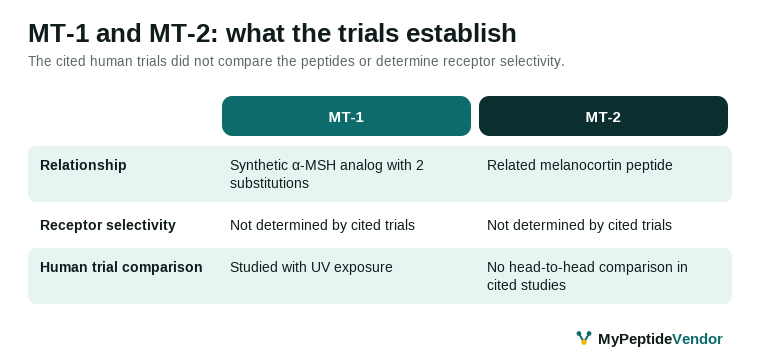
MT-2 is a related melanocortin peptide, but the cited human trial 4 did not compare MT-1 with MT-2 or measure their receptor binding. Claims that MT-1 selectively targets MC1R while MT-2 acts more broadly cannot be confirmed from these clinical results. Receptor selectivity should not be treated as settled without comparative affinity data.
Purity claims such as “99%” need a method and a lot-specific report. High-performance liquid chromatography (HPLC) separates compounds in a sample; mass spectrometry can help identify molecular mass and structure. Neither result by itself proves that a vial is sterile, free of endotoxin, or suitable for human use.
Surendran et al. developed an HPLC assay for MT-1 in biological matrices, not a commercial-vial purity test 2. The method used a C8 column and detection at 214 nm; its calibration was linear from 100 to 1,000 ng/mL, with coefficients of variation typically within 8.7% above 100 ng/mL 2. These figures describe the assay, not a purity guarantee for a product.
For a research peptide, look for an independent, lot-matched certificate of analysis (COA), identity testing by mass spectrometry, purity results with the HPLC method stated, and separate sterility and endotoxin results when relevant. The stability study found degradation under UV light and heat, but it did not validate a storage temperature, reconstitution method, or post-reconstitution use period for research vials 3. Follow the product’s documented handling instructions; do not assume a generic -20°C storage claim is a validated shelf life.
How does it work
In plain terms, MT-1 can tell pigment-producing skin cells to make more melanin. It acts on melanocortin receptors; melanocortin-1 receptor (MC1R) is closely linked to pigment production. When MC1R activates, it can start a cell signal involving cyclic adenosine monophosphate (cAMP), which supports melanin synthesis.
Melanin includes eumelanin, a brown-black pigment. In one human trial, MT-1 plus sunlight produced greater tanning than sunlight alone, but the trials did not measure receptor binding, cAMP levels, or which receptor caused the effect 4. The clinical results therefore do not prove that MT-1 acts only through MC1R.
Use this chart
Free to reuse with a link back:
What the clinical evidence actually shows

Dorr et al. reported 3 phase 1 trials in people, pairing MT-1 with UV-B light or sunlight 4. The studies were small and short, and they assessed pigmentation and short-term safety rather than long-term skin-cancer risk.
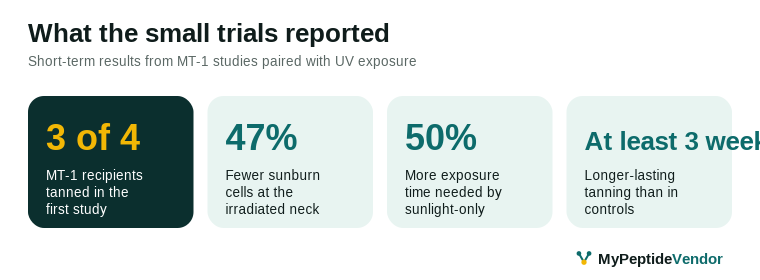
In the first study, 4 people received 0.08 mg/kg per day by subcutaneous injection for 10 days, and 4 received saline 4. Participants then received neck UV-B exposure at 3 times the minimal erythema dose (MED), the dose used to produce visible redness 4. Three of the 4 MT-1 recipients tanned, and the irradiated neck site had 47% fewer sunburn cells 4.
The second study included 12 people who received 0.16 mg/kg per day for 10 days 4. Seven received UV-B at 0.25–0.75 MED on a buttock site during treatment; 5 received it after treatment 4. More skin sites darkened at the higher dose, but the report does not give the proportion of participants who tanned 4.
The third study randomized 8 people to sunlight alone or sunlight plus 0.16 mg/kg of MT-1, given 5 days per week for 4 weeks 4. Tanning was greater in the MT-1 group and lasted at least 3 weeks longer than in controls. The sunlight-only group needed 50% more exposure time to reach equivalent tanning 4. This small result does not establish a safe way to tan.
Two other papers address measurement and stability, not tanning outcomes. Surendran et al. tested an analytical assay and its use in a cell-transport model 2. Chawathe et al. identified 14 degradation products after testing afamelanotide under acidic, basic, neutral, and oxidative conditions, UV light, and 60°C heat 3. That stress study does not determine the shelf life of a specific vial.
It remains unknown how long-term MT-1 exposure affects skin-cancer risk, how responses vary by skin type, and whether use without UV exposure produces a reliable effect. These trials also cannot give a dependable timeline or estimate uncommon harms 4.
The studies answer different questions and have different limits 234.
| Study | Design and participants | Duration or method | Main result | Key limitation |
|---|---|---|---|---|
| Dorr et al. | Three phase 1 human trials; groups of 8, 12, and 8 | MT-1 paired with UV-B or sunlight; schedules up to 4 weeks | 3 of 4 in the first MT-1 group tanned; 47% fewer sunburn cells at the irradiated neck site | Small groups and short follow-up; no long-term risk estimate |
| Surendran et al. | Assay development and cell-transport model | HPLC separation in 8 minutes | Linear range of 100–1,000 ng/mL; typical CV no greater than 8.7% above 100 ng/mL | Not a treatment trial or commercial-vial purity test |
| Chawathe et al. | Laboratory stability analysis of afamelanotide | Acid, base, neutral, oxidative, UV, and 60°C stress | 14 degradation products identified | Does not set storage life for an individual vial |
Use this chart
Free to reuse with a link back:
Typical dosing

There is no established MT-1 schedule for cosmetic tanning. In the phase 1 trials, researchers used 0.08 or 0.16 mg/kg per day; one schedule lasted 10 days, and another used treatment 5 days per week for 4 weeks 4. These are study regimens, not instructions for personal use.
The trials paired injections with planned UV exposure, so they do not show that MT-1 makes UV exposure safe 4. The EPP use described for afamelanotide is a different clinical context and does not provide a tanning dose 3.
Side effects: what to actually expect
Across the 3 phase 1 trials, researchers described MT-1 effects as minor nausea and temporary facial flushing 4. They did not report percentages, so the chance of either effect cannot be calculated from the published trial summary 4.
The report found no pathologic changes at UV-B- or sun-exposed sites in the participants 4. That short follow-up does not rule out rare problems or effects that take years to appear. Rates of mole or nevus changes, lasting pigment changes, and skin cancer were not established by these trials 4.
A COA showing a purity result does not prove sterility. For laboratory assessment, check whether the COA matches the lot and whether it reports identity, purity, methods, and separate sterility or endotoxin testing where relevant.
Regulatory & access status in the US (as of 2026)
The cited clinical paper describes afamelanotide as an orphan drug used for EPP, but it does not state that the drug is FDA-approved 3. The FDA page cited here describes Category 2 bulk substances nominated for compounding that may present significant safety risks; it is not, by itself, a list of drug approvals 1. Afamelanotide's FDA approval status is not established in 3, and 1 does not list it.
A “research use only” label is not FDA approval and does not authorize human use. It also does not settle whether buying or possessing a specific product is lawful in every circumstance. The FDA explains that Category 2 concerns potential safety risks for bulk substances proposed for compounding; check the current FDA information and applicable rules rather than treating a research label as legal permission 1.
Afamelanotide and MT-1 share the same active molecule, but a research product is not automatically equivalent to a regulated drug product 3. Before accepting a laboratory reagent, check for a lot-matched COA, independent identity and purity tests, sterility and endotoxin information when relevant, and clear disclosure of regulatory status.
Chawathe et al. found degradation under UV light and at 60°C, among other stress conditions 3. That supports protecting material from light and excessive heat, but does not validate a specific -20°C storage rule, reconstitution solvent, or beyond-use interval for a research vial 3.
Research-grade Melanotan 1 (MT-1) is available from American Peptides (MELANOTAN-1, from $55.00); code MYPEPTIDEVENDOR takes 15% off. Sold for laboratory research only, not for human use. Affiliate link
How it compares with its closest alternative
MT-1 and afamelanotide refer to the same active molecule, while MT-1 differs from α-MSH at 2 amino-acid positions 3. The cited human trials do not compare MT-1 with MT-2 or determine receptor selectivity 4.
| Name | Relationship | Receptor evidence | Use or status established by cited sources |
|---|---|---|---|
| MT-1 | Synthetic α-MSH analog with norleucine and D-phenylalanine substitutions | Human trials measured tanning with UV exposure, not receptor selectivity | Studied with UV exposure |
| Afamelanotide | Same active molecule as MT-1 | Not compared with MT-2 in the cited human trials | Described as an orphan drug used for EPP |
| MT-2 | Related melanocortin peptide | Comparative receptor selectivity is not established by the cited trials | No head-to-head comparison in the cited human studies |
| α-MSH | Natural peptide that MT-1 is modeled on | MT-1 changes 2 residues from the α-MSH sequence | Reference molecule for the structural comparison |
Use this chart
Free to reuse with a link back:
Where to Buy Melanotan 1 (MT-1) for Research
American Peptides
MELANOTAN-1 · from $55.00
US-made research peptides, every lot third-party tested with a lot-matched COA.
15% offMYPEPTIDEVENDOR at checkout
- ≥99% purity verified by HPLC + mass spec, endotoxin tested
- Ships tracked from Louisiana, free shipping over $300
- 15% off your first order with code MYPEPTIDEVENDOR
Affiliate disclosure: we may earn a commission if you order through the link above. Melanotan 1 (MT-1) is not approved by the FDA for human use.
Frequently asked questions
What is melanotan 1 MT1?
It is a synthetic 13-amino-acid α-MSH analog with norleucine and D-phenylalanine substitutions 3. Afamelanotide is another name for the same molecule 3.
Which peptide is better, MT1 or MT2?
There is no evidence-based winner for tanning because the cited human MT-1 trials did not compare it with MT-2 4. They also do not establish which peptide is safer or more receptor-selective.
How quickly does Melanotan 1 work?
The first phase 1 study assessed tanning after 10 days of treatment followed by UV-B exposure; 3 of 4 MT-1 recipients tanned 4. That small trial does not predict an individual response time.
How long after taking MT1 should you tan?
The trials do not establish a safe personal interval between MT-1 and UV exposure 4. Their UV schedules were controlled parts of experimental protocols, not guidance for self-use.
References
- FDA: Certain bulk drug substances for use in compounding that may present significant safety risks
- Surendran et al. High-performance liquid chromatographic assay for Melanotan-1 ([Nle4-DPhe7]alpha-melanocyte-stimulating hormone) in biological matrices. J Chromatogr B Biomed Appl. 1995.
- Chawathe et al. Investigation of the stability profile of therapeutic α-MSH analogue: Insights from liquid chromatography-high resolution mass spectrometry analysis of afamelanotide. J Pharm Biomed Anal. 2026.
- Dorr et al. Effects of a superpotent melanotropic peptide in combination with solar UV radiation on tanning of the skin in human volunteers. Arch Dermatol. 2004.
Written by the MyPeptideVendor editorial team from the FDA label, peer-reviewed studies and ClinicalTrials.gov records listed above, fact-checked line by line and reviewed 2026-11-12.
Cite this page
MyPeptideVendor Editorial Team. melanotan 1 mt1: Evidence, Risks & Status. MyPeptideVendor. Updated November 12, 2026. https://mypeptidevendor.com/peptides/melanotan-1-mt1/MyPeptideVendor Editorial Team. (2026, November 12). melanotan 1 mt1: Evidence, Risks & Status. MyPeptideVendor. https://mypeptidevendor.com/peptides/melanotan-1-mt1/Related peptides
Melanostatin DM
Research UseMelanostatin DM blocks alpha-MSH-related darkening in a nonhuman melanocyte assay, but human dosing, effects, and safety are not established.
Learn morePT-141
FDA-ApprovedPT 141 is bremelanotide, a brain-acting peptide approved as Vyleesi for acquired, generalized HSDD in premenopausal women.
Learn moreMelanotan 2 (MT-2)
Not approvedMelanotan 2 can stimulate pigment, but it has no FDA-approved use, established tanning dose or proven human fat-loss benefit.
Learn more