Peptides for Weight Loss: What Actually Works
Prescription peptides such as semaglutide and tirzepatide can reduce weight; unapproved products are not safe substitutes for prescription care.
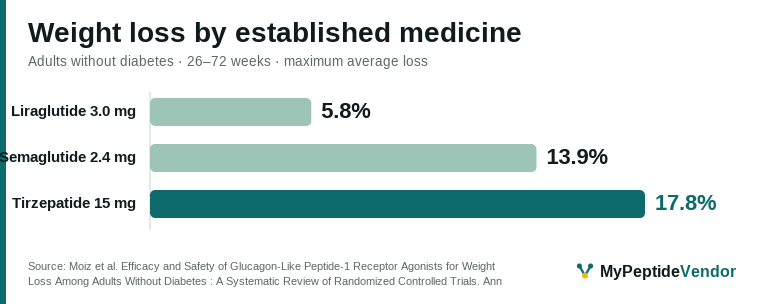
Prescription peptides for weight loss (mainly semaglutide, liraglutide, and tirzepatide) can help reduce body weight when used with lifestyle care. In trials, weight loss reached up to 13.9% with semaglutide over 68 weeks and up to 17.8% with tirzepatide over 72 weeks 9.
“Peptide” describes a kind of molecule, not a guarantee that a product is safe or effective. Products falsely labeled “for research purposes” or “not for human consumption” are of unknown quality and may be harmful 1.
Key takeaways
- Semaglutide 2.4 mg once weekly produced up to 13.9% average weight loss over 68 weeks in adults without diabetes 9.
- Tirzepatide 15 mg once weekly produced up to 17.8% average weight loss over 72 weeks 9.
- In a tirzepatide meta-analysis, 78.22% of participants lost at least 5% of their body weight and 32.28% lost at least 15% 3.
- Nausea, vomiting, diarrhea, and constipation were common; gastrointestinal effects occurred in 47% to 84% of people taking these medicines in trials 9.
- FDA says compounded GLP-1 medicines should be used only when an approved drug cannot meet a patient’s medical need 1.
Peptides for weight loss
5-Amino-1MQ
Not approved5-Amino-1MQ is a small molecule, not a peptide; its human benefits, dose, side effects, and long-term safety are not established.
Learn moreAdipotide (FTPP)
Not approvedAdipotide is an experimental fat-vessel-targeting peptide with animal findings, kidney concerns, and no established human dose or benefit.
Learn moreAOD-9604
Not approvedAOD-9604 was studied for obesity, but available evidence does not establish meaningful weight loss, a standard dose, or FDA approval.
Learn moreCagrilintide
Not approvedCagrilintide is an investigational weekly amylin analogue; FDA says it has not been found safe and effective for any condition.
Learn moreLiraglutide
FDA-Approvedliraglutide is a once-daily prescription injection for type 2 diabetes or chronic weight management, depending on the product and dose.
Learn moreLongevity & Obesity Research Blend
Not approvedThe name does not identify a confirmed ingredient, human dose, or product-specific clinical evidence.
Learn moreSLU-PP-332
Research UseSLU-PP-332 activates exercise-related signals in mice, but human safety, dosing, and fat-loss effects have not been established.
Learn moreTirzepatide
FDA-ApprovedTirzepatide is a once-weekly prescription medicine used for type 2 diabetes, chronic weight management, and obstructive sleep apnea with obesity.
Learn moreSemaglutide
FDA-ApprovedSemaglutide is a prescription medicine with product-specific uses for weight, type 2 diabetes, cardiovascular risk, and liver disease.
Learn moreRetatrutide
Not approvedRetatrutide produced 24.2% mean weight loss at 48 weeks in a phase 2 trial, but it is not FDA-approved or legally sold for human use.
Learn moreEloralintide
Not approvedEloralintide is Lilly’s investigational weekly amylin drug; a 48-week Phase 2 trial found 20.1% weight loss at 9 mg, but it is not FDA-approved.
Learn moreCagriSema
Not approvedCagriSema combines semaglutide and cagrilintide; a 68-week trial found 20.4% average weight loss, but it is not FDA-approved. [3][11]
Learn moreWhat peptide therapy for weight loss means
A peptide is a chain of amino acids, the small building blocks that also make up proteins. Some peptides act as signals between organs. Semaglutide, liraglutide, and tirzepatide are peptide medicines used in weight management and diabetes care 9.
When people use “peptide therapy” to mean weight-loss treatment, they usually mean prescription incretin medicines. Incretins are gut hormones released after eating. The main weight-loss medicines in this group act on the glucagon-like peptide-1 (GLP-1) receptor; tirzepatide also acts on the glucose-dependent insulinotropic polypeptide (GIP) receptor 38.
GLP-1 receptor medicines are the main established peptide class for weight loss because randomized trials have measured changes in body weight over many months. A systematic review of 26 trials found weight loss with liraglutide, semaglutide, tirzepatide, and other agents in adults with overweight or obesity who did not have diabetes 9.
Weight treatment is broader than medicine. Obesity care can include behavioral support, nutrition, physical activity, pharmacotherapy, and metabolic or bariatric procedures 4. Losing 5% to 10% of body weight improved systolic blood pressure by about 3 mm Hg in people with hypertension and may lower HbA1c by 0.6% to 1% in people with type 2 diabetes 4.
Use this chart
Free to reuse with a link back:
Use this chart
Free to reuse with a link back:
How these peptides work
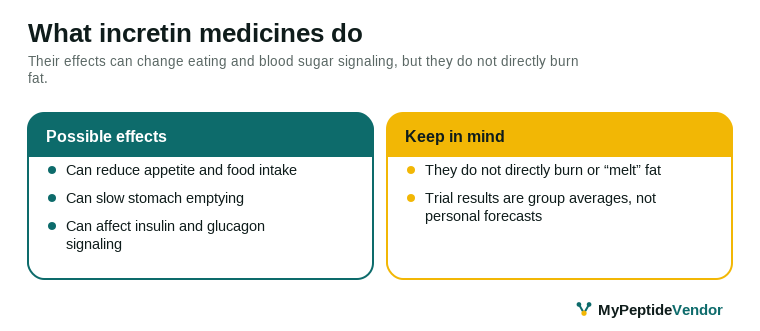
GLP-1 is a gut hormone that helps regulate appetite and blood sugar. Medicines that activate its receptor can reduce appetite and food intake, slow stomach emptying, and affect insulin and glucagon signaling 8. These effects can make eating less feel more manageable; the medicines do not directly burn or “melt” fat.
Semaglutide and liraglutide activate one main receptor, the GLP-1 receptor. Tirzepatide activates both the GIP and GLP-1 receptors, so it is called a dual agonist. Retatrutide activates GIP, GLP-1, and glucagon receptors, so it is called a triple agonist 357.
Some people notice changes in hunger or fullness before they see a large change on the scale. Trial results are group averages, not personal forecasts: in a systematic review, treatment lasted from 16 to 104 weeks, with a median of 43 weeks 9. A person’s response can differ from the average, and side effects can affect how long treatment is continued.
Even a moderate loss can have health benefits. For people with obesity, losing 5% to 10% of body weight improved systolic blood pressure by about 3 mm Hg when hypertension was present and may reduce HbA1c by 0.6% to 1% with type 2 diabetes 4. For someone who weighs 225 pounds, 5% to 10% is about 11 to 23 pounds.
Use this chart
Free to reuse with a link back:
Main peptides used for weight loss
Semaglutide: Wegovy and Ozempic
Wegovy is the semaglutide brand approved for chronic weight management in eligible patients. Ozempic contains the same active ingredient but is approved for type 2 diabetes, not as the weight-management brand. In a systematic review of adults without diabetes, semaglutide 2.4 mg once weekly produced up to 13.9% average weight loss compared with placebo after 68 weeks 9. At a starting weight of 225 pounds, 13.9% would be about 31 pounds; an individual’s result may be higher or lower.
Liraglutide: Saxenda
Saxenda is liraglutide, a GLP-1 receptor agonist approved for chronic weight management in eligible patients. Unlike the weekly medicines, the trial dose was 3.0 mg once daily. The systematic review found up to 5.8% average weight loss compared with placebo after 26 weeks 9, or about 13 pounds for a person starting at 225 pounds.
Tirzepatide: Zepbound and Mounjaro
Zepbound is tirzepatide approved for chronic weight management in eligible patients. Mounjaro contains the same active ingredient but is approved for type 2 diabetes. Tirzepatide activates both GIP and GLP-1 receptors 3. At 15 mg once weekly, the systematic review found up to 17.8% average weight loss compared with placebo after 72 weeks 9. That is about 40 pounds for a person starting at 225 pounds.
How many people reach a weight-loss target?
A meta-analysis of tirzepatide trials found that 78.22% of participants lost at least 5% of body weight, 55.60% lost at least 10%, and 32.28% lost at least 15% 3. Put another way, about 8 in 10 reached 5% loss, while about 3 in 10 reached 15% loss in the pooled trials. These percentages describe trial participants, not a guarantee for an individual.
The same meta-analysis found that tirzepatide 5 mg was associated with 12.47 kg more weight loss than placebo 3. That is about 27 pounds, but the result comes from pooled trial comparisons and should not be treated as a forecast for one patient. A separate review reported weight loss of up to 17.8% for tirzepatide at 15 mg after 72 weeks, up to 13.9% for semaglutide at 2.4 mg after 68 weeks, and up to 5.8% for liraglutide at 3.0 mg after 26 weeks 9.
Newer agents and research-stage options
Retatrutide is a triple agonist that activates GIP, GLP-1, and glucagon receptors. In a systematic review, 12 mg once weekly produced up to 22.1% weight loss after 48 weeks 9, about 50 pounds for a person starting at 225 pounds. Retatrutide is not FDA-approved, and FDA says it cannot be used in compounding under federal law 1. It should not be bought online for self-treatment.
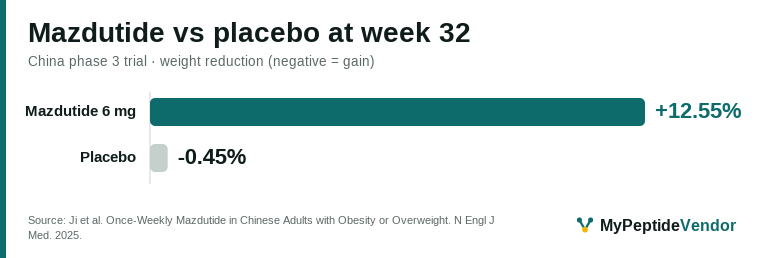
Mazdutide activates GLP-1 and glucagon receptors. In a phase 3 trial in China, the 6-mg group had an average 12.55% weight reduction at week 32, compared with a 0.45% gain in the placebo group 11. At week 32, 82.0% of participants in the 6-mg group and 73.9% in the 4-mg group lost at least 5% 11. These findings do not make mazdutide an FDA-approved U.S. weight-loss treatment.
Leptin, irisin, adropin, and preptin are names that appear in research on body weight and metabolism. A proposed biological role does not show that taking one as a product will cause safe, lasting weight loss. These are not established prescription weight-loss options in the treatment choices described here.
Sermorelin and tesamorelin are also marketed in some settings as “support” peptides. Do not assume that a product marketed for recovery, hormones, or body composition has been shown to produce weight loss. If a clinic proposes one for obesity, ask for the specific human trial evidence, approved indication, and expected change in body weight.
FDA-approved, compounded, and research-only products

FDA approval means a medicine has been reviewed for safety and effectiveness for a specific use. Compounded medicines are not FDA-approved, and FDA does not review them for safety, effectiveness, or quality before they are marketed 1. A prescription and a pharmacy’s professional status do not turn a compounded medicine into an FDA-approved product.
| Medicine or product | Drug class | U.S. weight-loss status | Trial result |
|---|---|---|---|
| Semaglutide (Wegovy) | GLP-1 agonist | FDA-approved for chronic weight management | 2.4 mg weekly; up to 13.9% after 68 weeks |
| Liraglutide (Saxenda) | GLP-1 agonist | FDA-approved for chronic weight management | 3.0 mg daily; up to 5.8% after 26 weeks |
| Tirzepatide (Zepbound) | GIP/GLP-1 dual agonist | FDA-approved for chronic weight management | 15 mg weekly; up to 17.8% after 72 weeks |
| Compounded semaglutide or tirzepatide | Custom-prepared medicine | Not FDA-approved; compounding should be limited to cases where an approved drug cannot meet the patient’s medical need | No FDA-reviewed result for the compounded product |
| Retatrutide | GIP/GLP-1/glucagon triple agonist | Not FDA-approved; cannot be used in compounding under federal law | 12 mg weekly; up to 22.1% after 48 weeks |
| Mazdutide | GLP-1/glucagon dual agonist | Not an FDA-approved U.S. weight-loss treatment; FDA warns about unapproved products sold for human use | 6 mg; 12.55% average loss at week 32 in a China trial |
| Products labeled “for research purposes” | May claim to contain a peptide medicine | Not approved for human use; FDA warns these products are of unknown quality and may be harmful | No established safe or effective self-treatment dose |
Compounding may be appropriate when a prescriber determines that a patient’s medical need cannot be met by an FDA-approved drug, or when an approved medicine is not commercially available 1. It is not the same as buying a lower-cost generic. FDA warns against claims that a compounded drug is the same as an approved medicine 1.
FDA has received reports of dosing errors with compounded injectable semaglutide. Some errors involved patients measuring or giving the wrong dose, and some involved health professionals miscalculating a dose; some reports included hospitalization 1. FDA also warns that semaglutide salt forms, such as semaglutide sodium or acetate, are different active ingredients from the one used in approved products 1.
Do not buy a product labeled “for research purposes” or “not for human consumption” to inject or swallow. FDA has warned companies selling unapproved products that contain semaglutide, tirzepatide, retatrutide, or mazdutide for human use 1. Retatrutide and cagrilintide cannot be used in compounding under federal law 1.
If you and a clinician decide it fits, one option is HumeCare: online GLP-1 weight-loss program with a licensed US provider (US only). Affiliate link
How to choose a treatment
Start with health needs, not the largest percentage in a headline. A review defines overweight as a body mass index (BMI) of 25 or higher and obesity as a BMI of 30 or higher, while also cautioning that BMI alone does not determine a person’s individual risk 4. The same review recommends anti-obesity medicines for nonpregnant patients with obesity or overweight and weight-related health conditions, alongside lifestyle care 4.
| Your situation | What to discuss with a clinician | Evidence to keep in perspective |
|---|---|---|
| BMI 25 to under 30 | Whether a weight-related condition and your full health history support medication as part of care | The trial review included adults with overweight or obesity, with mean BMI values from 30 to 41 kg/m² |
| BMI 30 or higher | Whether a prescription medicine fits with nutrition, activity, and behavioral support | Semaglutide and tirzepatide results came from trials lasting 68 and 72 weeks, respectively |
| Type 2 diabetes | Which brand and indication match your glucose and weight goals; Ozempic and Mounjaro are diabetes brands, while Wegovy and Zepbound are weight-management brands | Incretin medicines can affect appetite and blood sugar regulation |
| Frequent nausea or other digestive symptoms | Whether an incretin medicine is a reasonable choice and how symptoms will be monitored | Gastrointestinal effects were the most common adverse events in the reviewed trials |
| Several medicines or chronic conditions | How a new medicine fits with your current treatment and health history | Medication choice should be part of an individual obesity care plan |
No one option is best for every person. Tirzepatide had the highest reported maximum weight loss (up to 17.8% after 72 weeks) among these established medicines in the systematic review, but that review found no head-to-head randomized trials and reported variation between studies 9. A higher average does not mean it is automatically the right medicine for someone with a particular health history, side-effect concern, or coverage limit.
Ask whether a trial result applies to your situation. For example, the review of semaglutide, liraglutide, and tirzepatide focused on adults without diabetes, and study treatment lasted from 16 to 104 weeks 9. Results from that group may not predict a person’s response when diabetes, other medicines, or a different health condition is present.
Before you agree to treatment, ask: Am I a candidate? Which medicine and indication fit my goals? What weight change should we assess at 6 and 12 months? How will we protect strength and muscle during weight loss? What will the medicine, visits, and follow-up cost? What is the plan if I cannot tolerate it or need to stop?
Costs and what affects the price

There is no dependable price figure to give here because the cost depends on the product, pharmacy, insurance coverage, dose, and clinician follow-up. Some health plans cover a medicine for diabetes but not for weight management, so check the exact indication and benefit before filling a prescription.
Ask for the total out-of-pocket amount, including the medication, clinic or telehealth visits, and any planned monitoring. A very low advertised price is a warning sign if the seller skips a licensed clinician’s screening or prescription 1. Price alone cannot show whether a product is genuine or has been handled correctly.
Compare like with like: an FDA-approved prescription medicine is not interchangeable with a product labeled “for research purposes.” FDA says unapproved GLP-1 products do not undergo its review for safety, effectiveness, or quality before marketing 1.
Safety, side effects, and when to call

Nausea, vomiting, diarrhea, and constipation are the main side effects reported with GLP-1 medicines and related co-agonists. In a systematic review, gastrointestinal events occurred in 47% to 84% of people receiving these medicines, compared with 13% to 63% receiving placebo 9. Most adverse events were gastrointestinal, and treatment discontinuation due to adverse events ranged from 0% to 26% in treatment groups 9.
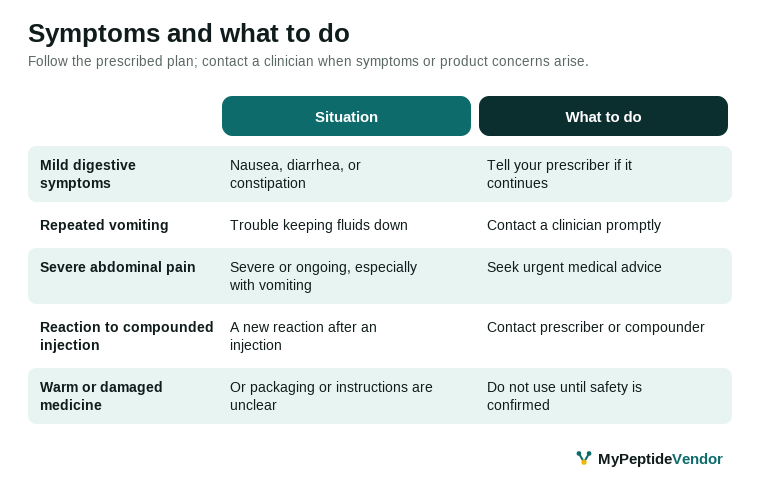
| Symptom or situation | What to do |
|---|---|
| Mild nausea, diarrhea, or constipation | Tell your prescriber if it continues or makes it hard to eat, drink, or manage daily activities; follow the prescribed plan rather than changing the dose yourself. |
| Repeated vomiting or trouble keeping fluids down | Contact a clinician promptly because dehydration can become serious. |
| Severe or ongoing abdominal pain, especially with vomiting | Seek urgent medical advice so a clinician can assess the cause. |
| A new reaction after an injection from a compounded vial | Contact the prescriber or compounder and confirm the product and dose instructions. |
| Medicine arrives warm, with damaged packaging, or without clear instructions | Do not use it until the dispensing pharmacy or prescriber confirms it is safe to use. |
Do not take extra medicine, use doses more often, or increase the amount faster than the prescription directs. FDA has received adverse-event reports involving compounded semaglutide or tirzepatide doses beyond the approved label’s directions, including more medicine per dose or faster increases 1. Clear instructions matter because vials may require a patient to measure a dose.
Retatrutide reviews report that nausea, vomiting, constipation, and diarrhea were more frequent at the highest doses and may have been linked to rapid dose increases or higher starting doses 7. This is a practical reason not to copy a schedule from an online forum or use an unapproved vial.
If you use a compounded injection, get the prescription from a licensed clinician and fill it at a state-licensed pharmacy 1. FDA recommends discarding a multiple-dose vial within 28 days after first use, even if medicine remains, and using a new sterile needle and syringe for each dose 1. FDA also advises against using an injectable GLP-1 product that arrives warm or without adequate refrigeration 1.
Before treatment, tell the prescriber about your conditions and medicines, and ask which symptoms need urgent attention. If you are pregnant, planning pregnancy, or have a significant health concern, discuss that before starting any weight-loss medicine. The specific risks and precautions depend on the product and the person.
Use this chart
Free to reuse with a link back:
How to get started: telehealth or clinic
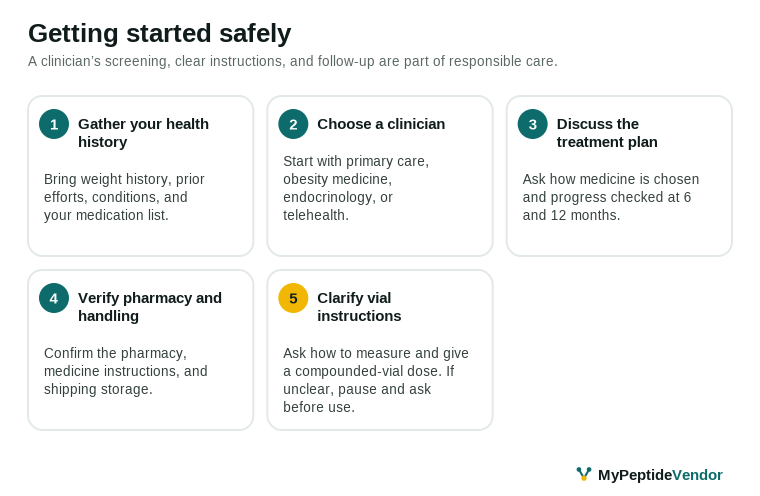
FDA-approved weight-loss medicines require a prescription. FDA recommends that patients obtain a prescription from a doctor and fill it at a state-licensed pharmacy 1. You can start with primary care, an obesity-medicine clinician, an endocrinologist, or a qualified telehealth service.
A responsible telehealth visit includes a medical history, review of current medicines, and a clinician who can answer questions after treatment begins. Avoid a service that sends medicine without a licensed clinician’s screening and prescription, or that offers no way to reach a clinician afterward 1.
Bring your weight history, prior weight-loss efforts, health conditions, and medication list. Ask how the clinician will choose a medicine, what progress to check at 6 and 12 months, and how side effects or a poor response will change the plan. Obesity care can include medication, behavioral support, nutrition, and physical activity rather than relying on injections alone 4.
Before paying, confirm the pharmacy name and address, the medicine’s instructions, and how it will be stored during shipping. FDA lists claims that a compounded drug is identical to an approved product, unusually low prices, damaged packaging, label errors, and no prescription screening as warning signs 1. Do not use products labeled for research or not for human consumption 1.
For compounded vials, ask the prescriber or pharmacist to show you exactly how to measure and give the prescribed amount. FDA has received reports of dosing mistakes with compounded injectable semaglutide, including errors by patients and health professionals 1. If the instructions are unclear, pause and ask before using the product.
Use this chart
Free to reuse with a link back:
Ozempic, Wegovy, Mounjaro, and Zepbound
Ozempic and Wegovy both contain semaglutide, but they are different brands with different approved uses: Ozempic is for type 2 diabetes, and Wegovy is the weight-management brand. Mounjaro and Zepbound both contain tirzepatide; Mounjaro is the diabetes brand, and Zepbound is the weight-management brand.
The word “peptide” is broader than any one brand or medicine. Ask the prescriber which product and indication match your health goal, since the active ingredient alone does not tell you how a particular prescription is being used.
What to expect over 6 to 12 months
Weight change is usually assessed over months, not a few days. In clinical trials, semaglutide was assessed at 68 weeks, tirzepatide at 72 weeks, and liraglutide at 26 weeks 9. These time points are longer than 6 or 12 months, so they do not provide a precise promise for either milestone.
At follow-up, a clinician can review weight, side effects, health measures, and whether the plan remains workable. In the tirzepatide meta-analysis, about 8 in 10 participants reached at least 5% loss and about 3 in 10 reached at least 15% loss 3. Those group results give context, but they cannot predict an individual’s pace or final result.
How much weight a person regains after stopping cannot be predicted from the trial figures above. Before starting, ask how ongoing care will be handled if the medicine is not tolerated, is not covered, or needs to be stopped.
Dosing protocols
5-Amino-1MQ 50 mg
Not approvedNo approved human dose exists; this guide separates 50 mg vial math from dosing advice and explains evidence, handling, and safety limits.
View protocolAICAR 50 mg
Research UseAICAR has no approved human dose or validated injection schedule; a 50 mg vial does not establish a safe dose, dilution, or cycle.
View protocolAOD-9604 10 mg
Not approvedAOD-9604 is not FDA-approved, and no validated human subcutaneous dose, titration schedule, or cycle is established.
View protocolCagrilintide 10 mg
Not approvedCagrilintide is not FDA-approved; a 10 mg vial is not a dose, and trial schedules do not establish a safe home-use protocol.
View protocolL-Carnitine 200 mg
Research UseA 200mg vial is not an established injection dose; human studies reviewed here do not validate a general L-carnitine injection schedule.
View protocolMazdutide 10 mg
Not approvedA 10 mg vial describes its stated total content, not a weekly dose; mazdutide has no FDA-approved US dosing schedule.
View protocolRetatrutide 30 mg
Not approvedNo FDA-approved retatrutide dose or validated preparation instructions exist for a 30 mg vial; this guide reviews trial data and safety limits.
View protocolSemaglutide 20 mg
Not approvedA 20 mg vial states total drug content, not a weekly dose; confirm its concentration and instructions with your prescriber and pharmacy.
View protocolSLU-PP-332 10 mg
Research UseA 10 mg vial is not a human dose: SLU-PP-332 has no approved human use or validated dosing schedule.
View protocolSurvodutide 10 mg
Not approvedA 10 mg survodutide dose has not been studied; obesity trials tested up to 4.8 mg weekly, and a MASH trial tested up to 6.0 mg weekly.
View protocolBuyer's guides
Where to Get Weight Loss Treatment Legally
Through your own doctor
The FDA-approved product needs a prescription. Your doctor decides whether it fits your health history and insurance may cover part of the cost.
HumeCare
Online GLP-1 weight-loss program with a licensed US provider.
- Short online assessment reviewed by a licensed provider
- If prescribed, medication ships to your door
- Ongoing support to adjust your plan
HumeCare Orals
Prefer a pill? Oral GLP-1 program with a licensed US provider.
- No injections: oral option if your provider approves it
- Online assessment, no clinic visit
- Shipped to your door if prescribed
Affiliate disclosure: we may earn a commission if you sign up through the link above. It never changes what we write.
Frequently asked questions
Do peptides really work for weight loss?
Some prescription peptide medicines do. In a systematic review, semaglutide produced up to 13.9% average weight loss after 68 weeks, while tirzepatide produced up to 17.8% after 72 weeks 9. Those findings do not apply to every product marketed as a peptide.
What are the downsides of taking peptides?
For incretin medicines, stomach and bowel symptoms are common; trials reported nausea, vomiting, diarrhea, and constipation 9. Compounded and online research products add quality and dosing concerns, and FDA does not review compounded medicines for safety, effectiveness, or quality before they are marketed 1.
Are peptides the same as Ozempic?
No. A peptide is a type of molecule, while Ozempic is one specific brand of semaglutide. Ozempic is the diabetes brand; Wegovy contains semaglutide and is the weight-management brand.
What peptide is best for weight loss?
There is no best choice for everyone. Tirzepatide had the highest reported average weight loss among the established medicines in one review, up to 17.8% after 72 weeks, but that review did not include head-to-head randomized trials 9. A prescriber should weigh likely benefit against your medical history, tolerability, and access.
References
- FDA: Concerns with unapproved GLP-1 drugs used for weight loss
- FDA: Certain bulk drug substances for use in compounding that may present significant safety risks
- Tan et al. Efficacy and safety of tirzepatide for treatment of overweight or obesity. A systematic review and meta-analysis. Int J Obes (Lond). 2023.
- Elmaleh-Sachs et al. Obesity Management in Adults: A Review. JAMA. 2023.
- Misra et al. Efficacy and safety of retatrutide for the treatment of obesity: a systematic review of clinical trials. J Basic Clin Physiol Pharmacol. 2025.
- Katsi et al. Retatrutide-A Game Changer in Obesity Pharmacotherapy. Biomolecules. 2025.
- Panou et al. Retatrutide in type 2 diabetes mellitus and obesity: an overview. Expert Rev Clin Pharmacol. 2026.
- Nauck et al. Incretin hormones: Their role in health and disease. Diabetes Obes Metab. 2018.
- Moiz et al. Efficacy and Safety of Glucagon-Like Peptide-1 Receptor Agonists for Weight Loss Among Adults Without Diabetes : A Systematic Review of Randomized Controlled Trials. Ann Intern Med. 2025.
- Yerevanian et al. Metformin: Mechanisms in Human Obesity and Weight Loss. Curr Obes Rep. 2019.
- Ji et al. Once-Weekly Mazdutide in Chinese Adults with Obesity or Overweight. N Engl J Med. 2025.
- Popoviciu et al. Emerging Role of GLP-1 Agonists in Obesity: A Comprehensive Review of Randomised Controlled Trials. Int J Mol Sci. 2023.
- ClinicalTrials.gov: 617 registered studies (search: Weight Loss)
Written by the MyPeptideVendor editorial team from the FDA label, peer-reviewed studies and ClinicalTrials.gov records listed above, fact-checked line by line and reviewed 2026-11-12.
Cite this page
MyPeptideVendor Editorial Team. Peptides for Weight Loss: What Actually Works. MyPeptideVendor. Updated November 12, 2026. https://mypeptidevendor.com/treatment/weight-loss/MyPeptideVendor Editorial Team. (2026, November 12). Peptides for Weight Loss: What Actually Works. MyPeptideVendor. https://mypeptidevendor.com/treatment/weight-loss/