L Carnitine Dosage 200mg: Protocol & Safety
A 200mg vial is not an established injection dose; human studies reviewed here do not validate a general L-carnitine injection schedule.
Quickstart Highlights for L-Carnitine Dosage 200mg
There is no established human injection dose for an L-carnitine 200mg vial. The vial’s total amount does not set a dose, a schedule, or a cycle, and the human studies discussed here do not validate self-injection.
Oral research reports modest or mixed results for weight, diabetes markers, and selected other outcomes 3,5-8. The conversion below is arithmetic for a 200mg vial mixed with 2 mL; it is not an instruction to prepare or inject a research product. Oral study amounts do not establish an equivalent injectable dose.
A 200mg vial contains 200 mg in total, not 200 mg per milliliter. The vial amount alone cannot tell you whether a product is sterile, how it should be prepared, or what amount is appropriate for a person.
- Human injection dose: not established for general wellness, weight loss, athletic performance, or diabetes. The trial evidence summarized here is oral, not self-administered injection 3,5-8.
- Oral reference range: These amounts are not injection instructions.
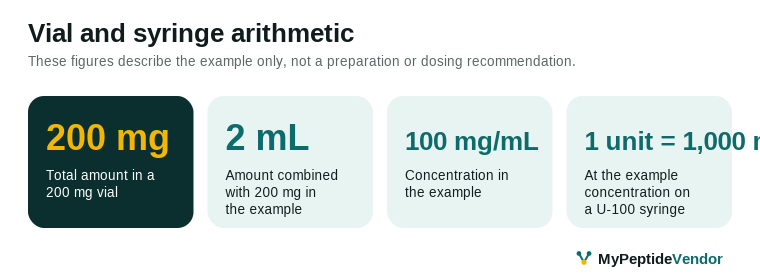
- Vial arithmetic: the supplied example combines 200 mg with 2 mL to produce 100 mg/mL (100,000 mcg/mL). This is a concentration calculation, not a preparation recommendation.
- Syringe scale: a U-100 syringe has 100 units per mL. At the example concentration, 1 unit corresponds to 1,000 mcg. This does not establish an appropriate dose.
- Product status: a vial marked “research use only” is not a prescription medicine approved for human injection. FDA warns that products sold for research but marketed for human use can have unknown quality and may be harmful 1.
Use this chart
Free to reuse with a link back:
Key takeaways
- No FDA-label titration schedule or general human injection dose is established for this 200mg research vial.
- The 2 mL example gives 100 mg/mL; on a U-100 syringe, 1 unit (0.01 mL) equals 1,000 mcg.
- A review of 37 randomized trials found an average 1.21 kg, about 2.7 lb, lower body weight, with the modeled maximum at 2,000 mg/day 3.
- Oral supplementation of 1 to 4 g/day for 12 or 24 weeks raised fasting TMAO in a review of healthy participants 8.
- The standard oral range reported by Examine is 500 to 2,000 mg/day; it is not an injectable dose or an FDA-approved titration plan [Examine].
L-Carnitine 200mg Dosing Schedule

No FDA-label titration schedule applies to a research-use L-carnitine vial for weight loss, exercise, or diabetes. The studies described here examine oral supplementation, not an injectable titration plan 3,5-8. The week-by-week schedule therefore remains unestablished; the last rows show conversion examples only, not suggested doses.
| Week or example | Dose (mg) | Dose (mcg) | U-100 units | Meaning |
|---|---|---|---|---|
| Week 1 | Not established | Not established | Not established | No validated human injection starting dose. |
| Week 2 | Not established | Not established | Not established | No evidence-based dose increase. |
| Week 3 | Not established | Not established | Not established | No injection maintenance dose established. |
| Week 4 | Not established | Not established | Not established | No four-week injection cycle established. |
| Conversion example only | 0.05 mg | 50 mcg | 0.05 units | Arithmetic only; not a dose recommendation. |
| Conversion example only | 0.2 mg | 200 mcg | 0.2 units | Arithmetic only; not a dose recommendation. |
| Conversion example only | 0.5 mg | 500 mcg | 0.5 units | Arithmetic only; not a dose recommendation. |
| Conversion example only | 1 mg | 1,000 mcg | 1.0 unit | Arithmetic only; not a dose recommendation. |
| Conversion example only | 2 mg | 2,000 mcg | 2.0 units | Arithmetic only; not a dose recommendation. |
The conversion examples use the supplied 100 mg/mL concentration and U-100 scale. For example, the table equates 200 mcg with 0.2 units at that concentration. A mathematical conversion cannot confirm the vial’s identity, sterility, suitability for injection, or a clinically appropriate amount.
The usual oral range reported by Examine is 500 to 2,000 mg/day, and the same reference describes study doses from 250 to 6,000 mg/day [Examine]. Those figures describe oral research and supplement use. They do not authorize an injection or provide a safe route-to-route conversion.
Syringe Unit Conversion Table
Units to draw on a U-100 insulin syringe (100 units = 1 mL) from a 200 mg vial. Find your dose, then read the column for the water you added. Every number is calculated, not estimated.
| Dose | 2 mL water 100 mg/mL · 1 unit = 1000 mcg |
|---|---|
| 50 mcg | 0.05 · 4000 doses |
| 100 mcg | 0.1 · 2000 doses |
| 200 mcg | 0.2 · 1000 doses |
| 250 mcg | 0.25 · 800 doses |
| 300 mcg | 0.3 · 666 doses |
| 500 mcg | 0.5 · 400 doses |
| 750 mcg | 0.75 · 266 doses |
| 1 mg | 1 · 200 doses |
| 1.5 mg | 1.5 · 133 doses |
| 1.7 mg | 1.7 · 117 doses |
| 2 mg | 2 · 100 doses |
| 2.4 mg | 2.4 · 83 doses |
| 2.5 mg | 2.5 · 80 doses |
| 3 mg | 3 · 66 doses |
| 4 mg | 4 · 50 doses |
| 5 mg | 5 · 40 doses |
| 7.5 mg | 7.5 · 26 doses |
| 10 mg | 10 · 20 doses |
| 12.5 mg | 12.5 · 16 doses |
| 15 mg | 15 · 13 doses |
L-Carnitine 200 mg Vial Dosage Calculator
Shows the exact insulin-syringe units to draw. Pre-loaded with the 200 mg vial; change any value to match yours.
Total volume of your syringe?
How much mg is in the vial?
How much bacteriostatic water are you adding?
Dose per injection?
Educational tool only. Concentration = vial ÷ water; units = dose ÷ concentration × 100 (U-100 syringe). Confirm every dose with your prescriber. Different vial or peptide? Use the peptide calculator.
Reconstitution Steps for a 200mg Vial
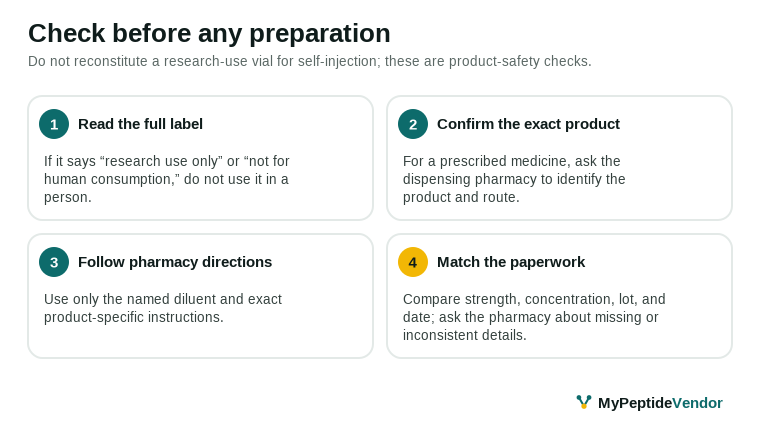
Do not reconstitute a research-use vial for self-injection. The 2 mL example below explains the concentration calculation only; it does not establish a validated diluent, sterile preparation method, or storage period for a product you have purchased.
- Read the full label. If it says “research use only” or “not for human consumption,” do not use the product in a person. FDA warns against unapproved products sold for research but marketed with directions for human use because their quality may be unknown 1.
- Confirm the product with a pharmacist. For a prescribed medicine, ask the dispensing pharmacy to identify the exact product, route, diluent, final concentration, storage conditions, and discard date. Do not substitute instructions from a vendor or another formulation.
- Follow product-specific pharmacy directions. If a pharmacy directs a preparation, use only its named diluent and exact instructions. Do not assume bacteriostatic water or another liquid is suitable.
- Match the paperwork. Compare the vial’s strength, concentration, lot number, and expiration or beyond-use date with the pharmacy label and any lot-specific certificate of analysis (CoA). Stop and ask the pharmacy if details are missing or inconsistent.
- Do not use uncertain product. A broken seal, damaged container, unclear source, or unexplained storage condition calls for a pharmacy or clinician review before use.
As arithmetic, 200 mg divided by 2 mL equals 100 mg/mL. That calculation cannot confirm the actual contents or sterility of a vial. It should not be used as a do-it-yourself preparation method.
Use this chart
Free to reuse with a link back:
Supplies Needed for a Full 200mg Vial
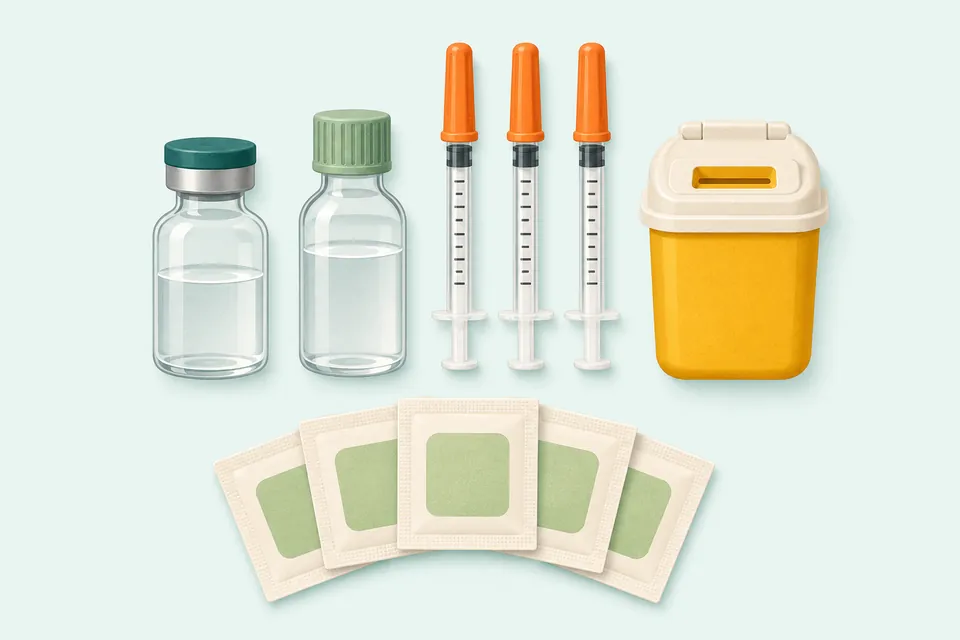
For a research-use vial intended for human injection, the appropriate amount of injection supplies is zero: do not prepare or inject it. A 200mg vial does not tell you whether it is meant to be one dose or multiple doses.
For a licensed pharmacy’s prescribed product, ask the pharmacist to specify supplies for the full vial. The conversion example uses 1 vial and 2 mL of diluent for arithmetic only; use that amount only if the pharmacy’s product-specific directions explicitly call for it. The number of syringes depends on the prescribed schedule, which cannot be determined from vial size alone.
- Product: 1 prescribed vial with a matching pharmacy label and lot information.
- Diluent: only the type and amount named by the dispensing pharmacy; 2 mL is a conversion example, not a universal instruction.
- Needle and syringe: use the equipment and size specified by the pharmacy or clinician. FDA advises a new sterile needle and syringe for each dose of a compounded GLP-1 multi-dose vial 1.
- Disposal: use a sharps container and the disposal instructions provided by the pharmacy or clinician.
Compounded medicines are not FDA-approved, and FDA does not review them for safety, effectiveness, or quality before marketing 1. FDA says compounded drugs should be used only when a patient’s medical needs cannot be met by an FDA-approved drug, with a prescription filled at a state-licensed pharmacy 1.
Protocol Overview, Evidence, and Cycle Notes

The body makes carnitine from the amino acids lysine and methionine, mainly in the liver, kidneys, and brain. Food supplies additional carnitine, especially red meat; poultry, fish, and dairy contain smaller amounts, while plant foods provide little. Carnitine helps move long-chain fatty acids into mitochondria, where cells can use them to produce energy. That role does not prove that extra carnitine improves fat loss or performance in someone who already has enough.
Healthy people generally synthesize enough carnitine. The Food and Nutrition Board concluded that carnitine is not an essential nutrient and set no Dietary Reference Intake (DRI). That finding differs from a diagnosed deficiency or a medical condition that requires clinician-directed care. A vial marked 200mg cannot diagnose deficiency or show that supplementation is needed.
“Carnitine” refers to related forms. L-carnitine is the form used in the weight and type 2 diabetes reviews below. Acetyl-L-carnitine (ALCAR) carries an acetyl group and is often discussed for neurological outcomes. L-carnitine L-tartrate (LCLT) is a tartrate form used in some exercise research. Propionyl-L-carnitine (PLC) is another distinct form studied for clinical outcomes. Results for one form do not establish equal effects for another.
Weight loss: a meta-analysis of 37 randomized controlled trials with 2,292 participants found an average body-weight reduction of 1.21 kg, about 2.7 lb, compared with control. The dose-response model estimated the greatest effect at 2,000 mg/day 3. The average reduction is modest. The analysis does not show that injected L-carnitine causes weight loss.
A separate review of 9 trials with 911 adults found an average 1.33 kg, about 2.9 lb, greater weight reduction with carnitine than with control 6. Its duration analysis found that the size of the weight effect decreased as supplementation continued 6. Taken together, these reviews suggest a modest oral effect, not a dependable injectable weight-loss protocol.
Type 2 diabetes: a dose-response review included 21 randomized trials with 2,041 adults 7. For each 1 g/day of supplementation, its pooled estimates showed a 0.16 percentage-point reduction in HbA1c, a 0.37 kg/m² reduction in body mass index, and a 0.11 mmol/L reduction in LDL cholesterol 7. The largest modeled BMI reduction occurred at 2 g/day; some other metabolic measures changed up to 4 g/day 7. The authors noted substantial variation among trials, so the results need cautious interpretation. They do not support replacing diabetes treatment or using an injection.
Athletic performance: a review of 11 studies in healthy participants included oral doses of 1 to 4 g/day for 12 or 24 weeks 8. It found no muscle-strength improvement after 24 weeks in healthy older women. It reported improved physical effort tolerance and cognitive function in centenarians, but those specific findings do not establish a reliable performance benefit for healthy athletes 8.
Osteoarthritis pain: a review covering 69 trials and 20 supplements listed L-carnitine among 7 supplements with a large short-term pain effect 5. The review found no supplement with a clinically important pain reduction at long-term follow-up 5. That evidence applies to the populations and timeframes studied; it does not establish that L-carnitine treats every type of pain or that injection works.
Neurological and cognitive claims: a review assessed 60 relevant publications and found that reported effects varied by condition 10. Some conditions had more favorable findings, while others showed limited efficacy. A broad review does not prove benefit for a particular person or establish that L-carnitine, ALCAR, LCLT, and PLC are interchangeable.
TMAO and cycle length: in healthy participants, oral L-carnitine at 1 to 4 g/day for 12 or 24 weeks raised fasting trimethylamine-N-oxide (TMAO) 8. The reported increase was not accompanied by changes in the inflammatory or oxidative markers measured in those studies 8. Whether the TMAO increase causes cardiovascular harm, how long it persists after stopping, and whether injection has the same effect have not been established. These studies do not define an injection cycle, washout period, or long-term cardiovascular risk.
Route comparison: the weight, diabetes, osteoarthritis, and prolonged-use findings described here concern oral supplementation 3,5-8. Prescription injectable levocarnitine used under medical care for a defined indication is different from a research-use vial sold online. The cited studies do not test injected L-carnitine for weight loss, athletic performance, or diabetes, and they do not establish that an injected milligram amount is as safe as the same oral amount.
Storage and Handling
Follow the storage and discard directions on a legitimate pharmacy-dispensed product. Conditions depend on the exact formulation, so do not borrow storage advice from another injectable. If a prescribed medicine arrives outside its stated temperature range, contact the dispensing pharmacy before using it.
Do not use an unsealed, damaged, unlabeled, or uncertain-source vial. FDA warns that unapproved products can contain the wrong ingredient, too much or too little active ingredient, or harmful substances 1. A CoA should match the product and lot on the vial, but paperwork alone does not establish sterility or approval for injection.
For a prescribed product, follow the pharmacy’s discard date and handling instructions. FDA’s advice to discard a multi-dose vial within 28 days after first use applies to the compounded GLP-1 products discussed in its guidance, not automatically to every injectable 1. Record the lot number and expiration or beyond-use date. If the label, CoA, and vial do not match, ask the dispensing pharmacy to resolve the difference.
Injection and Tracking Tips
Do not inject a research-use vial. The oral studies summarized here do not validate an injection schedule or establish that an oral dose can be converted directly to an injected dose 3,5-8. If a clinician prescribes an injectable product, follow the pharmacy’s directions for that exact formulation.
Before using a prescribed product, ask the pharmacist to state the dose in milligrams, concentration in mg/mL, volume in mL, route, schedule, and syringe type. Ask for a demonstration with the exact syringe supplied. U-100 markings apply to a U-100 syringe; they are not a universal volume scale.
For clinician-directed treatment, keep a written record of the date, time, prescribed amount, product lot, and any new symptom. If a dose is missed, record it and ask the prescriber what to do rather than doubling the next amount. Contact a clinician about persistent redness, swelling, worsening pain, fever, or a new hard lump at an injection site.
To check a concentration claim, compare the vial label with a lot-specific CoA and ask the dispensing pharmacy to confirm the product. The calculation is mg divided by mg/mL equals mL; on a U-100 syringe, 100 units equal 1 mL. The conversion can reveal a math mismatch, but it cannot verify the vial’s contents, sterility, or suitability for a person.
Safety, Side Effects, and Interactions
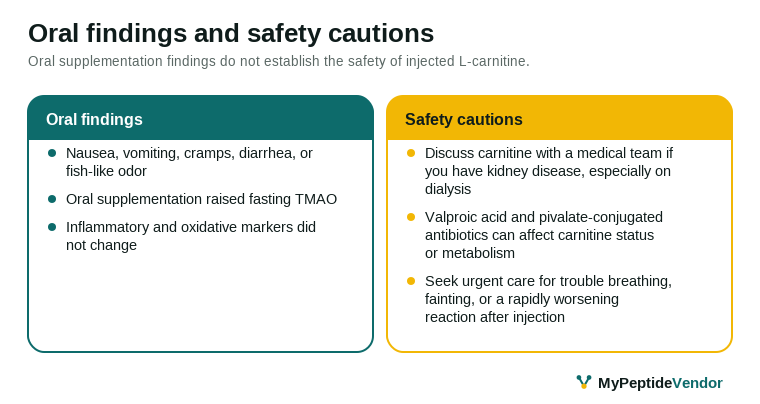
Oral L-carnitine can cause nausea, vomiting, abdominal cramps, diarrhea, or a fish-like body odor. The reviews summarized here do not give dependable frequency estimates for these effects, and the frequency for injected L-carnitine is not established. Tolerating an oral supplement does not prove an injection is safe.
That statement concerns supplementation, not injected product. The oral prolonged-use studies included 1 to 4 g/day for 12 or 24 weeks 8; study doses are not automatically recommendations or evidence of injection safety.
The TMAO finding needs context. Oral supplementation raised fasting TMAO in the reviewed studies, while the measured inflammatory and oxidative markers did not change 8. The available findings do not establish whether the increase causes cardiovascular events or how long it remains after stopping.
People with kidney disease, especially those receiving dialysis, should discuss carnitine with their medical team rather than self-treat. Valproic acid and pivalate-conjugated antibiotics can affect carnitine status or metabolism; ask the prescriber or pharmacist before starting a supplement. Do not stop a prescribed medicine without the prescriber’s advice.
Clinicians assess possible carnitine deficiency through medical history and testing, not by choosing an amount from a vial. Abnormal carnitine status can be assessed using plasma free carnitine, total carnitine, and the acyl-to-free carnitine ratio. A clinician interprets results in context; these values are not self-diagnosis instructions.
Seek urgent care for trouble breathing, fainting, or a rapidly worsening reaction after an injection. Persistent digestive symptoms, an unusual new body odor, or a non-urgent injection-site change still warrants a call to a clinician or pharmacist before another dose.
Use this chart
Free to reuse with a link back:
Frequently asked questions
How many units is a 200mg L-carnitine dose?
The vial contains 200 mg total, but that does not establish a 200mg injection dose. In the 2 mL example, the concentration is 100 mg/mL, and 200 mg equals the full 200 mg vial. No general human injection schedule is established.
Is 200mg of L-carnitine a typical dose?
The oral reference range reported by Examine is 500 to 2,000 mg/day [Examine]. That does not establish 200 mg as an injectable dose; the human studies summarized here do not validate a general L-carnitine injection schedule.
Can I inject L-carnitine for weight loss?
The weight-loss reviews summarized here assessed supplementation rather than injection. Across 37 randomized trials, the average difference was 1.21 kg, about 2.7 lb, in favor of carnitine 3. Do not inject a vial labeled for research use.
Does L-carnitine help athletic performance?
Evidence differs by population and outcome. A review found no muscle-strength improvement in healthy older women after 24 weeks of oral supplementation 8. It does not establish a reliable benefit for every athlete or support an injectable protocol.
Is a 200mg research vial FDA-approved for injection?
A research-use vial is not the same as a prescription medicine. FDA warns that unapproved products marketed for human use can have unknown quality and may be harmful 1. Do not use a research-labeled vial in a person.
Should people with kidney disease or people taking valproate use carnitine?
They should ask a clinician or pharmacist before starting it. Kidney disease and medicines such as valproic acid or pivalate-conjugated antibiotics can affect carnitine status or metabolism. A medical professional can decide whether evaluation or treatment is appropriate.
References
- FDA: Concerns with unapproved GLP-1 drugs used for weight loss
- FDA: Certain bulk drug substances for use in compounding that may present significant safety risks
- Talenezhad et al. Effects of l-carnitine supplementation on weight loss and body composition: A systematic review and meta-analysis of 37 randomized controlled clinical trials with dose-response analysis. Clin Nutr ESPEN. 2020.
- Langer et al. Nutritional interventions for preventing and treating pressure ulcers. Cochrane Database Syst Rev. 2024.
- Liu et al. Dietary supplements for treating osteoarthritis: a systematic review and meta-analysis. Br J Sports Med. 2018.
- Pooyandjoo et al. The effect of (L-)carnitine on weight loss in adults: a systematic review and meta-analysis of randomized controlled trials. Obes Rev. 2016.
- Mirrafiei et al. The Effects of L-Carnitine Supplementation on Weight Loss, Glycemic Control, and Cardiovascular Risk Factors in Patients With Type 2 Diabetes: A Systematic Review and Dose-response Meta-Analysis of Randomized Controlled Trials. Clin Ther. 2024.
- Sawicka et al. The bright and the dark sides of L-carnitine supplementation: a systematic review. J Int Soc Sports Nutr. 2020.
- Showell et al. Antioxidants for female subfertility. Cochrane Database Syst Rev. 2020.
- Wang et al. L-Carnitine in the Treatment of Psychiatric and Neurological Manifestations: A Systematic Review. Nutrients. 2024.
- ClinicalTrials.gov: 412 registered studies (search: L-Carnitine)
Written by the MyPeptideVendor editorial team from the FDA label, peer-reviewed studies and ClinicalTrials.gov records listed above, fact-checked line by line and reviewed 2026-11-12.
Cite this page
MyPeptideVendor Editorial Team. L Carnitine Dosage 200mg: Protocol & Safety. MyPeptideVendor. Updated November 12, 2026. https://mypeptidevendor.com/protocols/l-carnitine-dosing-200mg/MyPeptideVendor Editorial Team. (2026, November 12). L Carnitine Dosage 200mg: Protocol & Safety. MyPeptideVendor. https://mypeptidevendor.com/protocols/l-carnitine-dosing-200mg/Related protocols
5-Amino-1MQ 50 mg
Not approvedNo approved human dose exists; this guide separates 50 mg vial math from dosing advice and explains evidence, handling, and safety limits.
View protocolAICAR 50 mg
Research UseAICAR has no approved human dose or validated injection schedule; a 50 mg vial does not establish a safe dose, dilution, or cycle.
View protocolAOD-9604 10 mg
Not approvedAOD-9604 is not FDA-approved, and no validated human subcutaneous dose, titration schedule, or cycle is established.
View protocol