Peptides for Libido: Evidence, Safety & Options
Vyleesi is an FDA-approved prescription option for some premenopausal women; evidence for other peptides marketed for libido is limited or absent.

Peptides for libido include bremelanotide, the medicine in prescription Vyleesi, and experimental products with much less evidence. Vyleesi is FDA-approved for premenopausal women with acquired, generalized hypoactive sexual desire disorder (HSDD); it is not approved for men or for every cause of low desire 1.
Low desire can relate to health conditions, medication effects, pain, stress, sleep, or relationship concerns. A clinician can help sort through those possibilities before treatment; when Vyleesi is prescribed, its labeled dose is 1.75 mg under the skin at least 45 minutes before anticipated sexual activity 1.
Key takeaways
- Vyleesi is prescribed for a specific diagnosis: acquired, generalized HSDD in premenopausal women 1.
- The Vyleesi dose is 1.75 mg; do not use more than one dose in 24 hours or eight doses in 30 days 1.
- NCT04943068 is a completed Phase 3 study of bremelanotide in premenopausal women with HSDD; its registry entry does not provide a numerical treatment effect 2.
- The six listed ClinicalTrials.gov records 2 include no registered BPC-157 libido trial; the remaining four records are not shown, so the wider absence cannot be confirmed.
- No peptide is proven to replace Viagra or Cialis for erectile dysfunction.
Peptides for sexual wellness
Melanostatin DM
Research UseMelanostatin DM blocks alpha-MSH-related darkening in a nonhuman melanocyte assay, but human dosing, effects, and safety are not established.
Learn moreMelanotan 1 (MT-1)
Not approvedMT-1 is a synthetic α-MSH analog studied with UV exposure; three small phase 1 trials found increased tanning, but did not establish long-term safety.
Learn morePT-141
FDA-ApprovedPT 141 is bremelanotide, a brain-acting peptide approved as Vyleesi for acquired, generalized HSDD in premenopausal women.
Learn moreMelanotan 2 (MT-2)
Not approvedMelanotan 2 can stimulate pigment, but it has no FDA-approved use, established tanning dose or proven human fat-loss benefit.
Learn moreOxytocin
FDA-ApprovedSynthetic oxytocin injection has specific obstetric uses; intranasal research has no established self-use schedule or proven bonding benefit.
Learn moreWhat peptide therapy for libido means
A peptide is a short chain of amino acids, the same building blocks that form proteins. Some peptides act as messengers: they attach to a matching receptor on a cell and change what the cell does. A peptide medicine can copy a natural signal or alter how strongly the body responds to it.
“Peptide therapy” is not one treatment with one effect. Bremelanotide acts on melanocortin receptors, while kisspeptin is involved in reproductive hormone signaling. Products described as growth hormone-releasing hormone (GHRH) or growth hormone-releasing peptides (GHRPs) target a different system.
Different biological actions do not prove that each product improves desire. Low libido is a symptom, not a diagnosis; it can reflect medication effects, pain, mood, a health condition, or relationship circumstances. HSDD is a clinical diagnosis involving persistently low desire that causes distress, rather than simply wanting more sexual activity.
For Vyleesi, the studied population is premenopausal women with HSDD, not everyone who reports a low sex drive. The completed Phase 3 trial NCT04943068 studied premenopausal women with HSDD, with or without decreased arousal 2.
How peptides may affect desire: and how that differs from Viagra
Bremelanotide activates melanocortin receptors, including the melanocortin-4 receptor (MC4R), which is involved in brain signaling. The completed Phase 4 study NCT04179734 examined the MC4R’s role in HSDD 2. That research supports studying this pathway; it does not show that every person with low desire will respond.
Sildenafil (Viagra) and tadalafil (Cialis) are phosphodiesterase type 5 (PDE5) inhibitors. They help support blood flow needed for an erection. They do not directly create sexual desire, so an erection medicine and a desire-focused treatment address different problems.
Bremelanotide acts on central melanocortin signaling rather than directly increasing penile blood flow. It is not “peptide Viagra.” Someone with low desire may not benefit from a medicine aimed at erection-related blood flow, while someone with erectile dysfunction may need an evaluation of vascular health, medication effects, and other causes.
Desire, arousal, and erection are related but distinct. A person may have desire without an erection, an erection without much desire, or difficulty with both. No peptide is proven to replace Viagra or Cialis for erectile dysfunction.
Main peptides discussed for libido
Bremelanotide (PT-141, Vyleesi)
Bremelanotide is the peptide with an FDA-approved libido-related use: Vyleesi is approved for premenopausal women with acquired, generalized HSDD 1. The completed Phase 3 bridging study NCT04943068 evaluated subcutaneous bremelanotide in premenopausal women with HSDD, with or without decreased arousal 2. The registry listing gives the study design and status, not a numerical estimate of benefit 2. Vyleesi is not FDA-approved for men, postmenopausal women, or general sexual enhancement.
The labeled dose is 1.75 mg injected under the skin of the abdomen or thigh at least 45 minutes before anticipated sexual activity. Use no more than one dose in 24 hours and no more than eight doses in 30 days 1. The 45-minute interval is a planning instruction, not a promise that desire will start at that exact time.
Vyleesi is intended for a specific diagnosis, not every dip in desire. A prescriber should consider whether a medical condition, mental health condition, relationship problem, or medication better explains the symptoms 1. Use in men would be off-label. The six listed records 2 include no male HSDD bremelanotide trial.
Kisspeptin
Kisspeptin is a signaling peptide involved in the reproductive hormone pathway. It can prompt gonadotropin-releasing hormone (GnRH) signaling, which then affects pituitary signals involved in reproductive function. The six registered studies listed in 2 include no kisspeptin libido trial. No tested libido dose can be drawn from those six records. For women and men, kisspeptin remains experimental for this goal.
Oxytocin
Oxytocin is a naturally occurring hormone and signaling molecule involved in social and reproductive processes. It is promoted online as a nasal spray or injection for intimacy, but the six listed records 2 include no oxytocin libido trial; the other four records were not provided. A claim that it reliably raises desire goes beyond what those listed records establish.
GHRH and GHRP products
GHRH and GHRPs, including products marketed as CJC-1295 or ipamorelin, are discussed as ways to affect growth-hormone signaling. That is a different pathway from bremelanotide’s melanocortin signaling. The listed ClinicalTrials.gov records 2 do not establish a libido benefit for these products; a change in energy, sleep, or body composition would not by itself prove that desire improved.
BPC-157
BPC-157 is not an established libido treatment. The six listed ClinicalTrials. gov records 2 include no registered BPC-157 libido trial; they list only six of ten registered studies, so the wider absence cannot be confirmed. There is no proven libido dose in the listed records, and an online testimonial does not show that the peptide increases desire or is safe to inject.
Comparison at a glance
The listed registry records include a Phase 3 bremelanotide study in women with HSDD and a Phase 4 study of MC4R’s role in HSDD; they do not establish clinical benefits for the other options in this table 2.
| Option | How it is thought to act | Status for libido | Evidence level |
|---|---|---|---|
| Bremelanotide (Vyleesi) | Melanocortin receptor signaling, including MC4R | FDA-approved prescription for premenopausal women with HSDD | Completed Phase 3 HSDD study; the registry listing does not give a numerical benefit |
| Sildenafil or tadalafil | PDE5 inhibition supports blood flow for an erection | Prescription medicines for erectile dysfunction; not peptides | Targets erection, not desire |
| Kisspeptin | Reproductive hormone signaling through GnRH | No FDA-approved libido use | The six listed records contain no kisspeptin libido trial |
| Oxytocin | Oxytocin receptor signaling | No FDA-approved libido use | The six listed records contain no oxytocin libido trial |
| BPC-157 | Proposed effects vary by product claim | No FDA-approved libido use | The six listed records contain no registered BPC-157 libido trial |
Clinical trials: what is being studied

ClinicalTrials.gov lists studies by phase, population, and status; a completed study listing does not, by itself, show that a treatment worked. ClinicalTrials.gov lists 10 registered studies for this search, but only six are included in 2, so the remaining four are not assessed.
The six listed records cover bremelanotide research in HSDD and in other populations or conditions 2.
| Trial | Phase and status | Population or question |
|---|---|---|
| NCT04943068 | Phase 3; completed | Subcutaneous bremelanotide in premenopausal women with HSDD, with or without decreased arousal |
| NCT04179734 | Phase 4; completed | Role of the melanocortin-4 receptor in HSDD |
| NCT03973047 | Phase 1; completed | Nausea after a single bremelanotide dose alone or with ondansetron in healthy premenopausal women |
| NCT06867835 | Phase 4; completed | Bremelanotide concentration in breast milk after a single dose in lactating women |
| NCT06565611 | Phase 2; active, not recruiting | Bremelanotide given with tirzepatide for obesity |
| NCT05709444 | Phase 2; completed | Bremelanotide study in diabetic kidney disease |
The obesity study NCT06565611 pairs bremelanotide with tirzepatide, a medicine used in weight management; its Phase 2 status does not establish a benefit for libido or obesity 2. NCT05709444 studies diabetic kidney disease rather than sexual desire 2.
These records show bremelanotide research beyond HSDD, including nausea, lactation, obesity, and diabetic kidney disease 2. The registry listings do not provide the outcome details needed to compare benefits across those different conditions.
FDA-approved, compounded, and research-only products

FDA approval applies to a particular product and use, not to every vial sold under the same peptide name. FDA’s Category 2 list identifies certain bulk drug substances as presenting potential significant safety risks when used in compounding; the designation applies to substances named on that list, not automatically to every peptide or every compounded medicine 1.
| Product type | What the status means | What to check |
|---|---|---|
| Vyleesi (bremelanotide) | FDA-approved prescription product for premenopausal women with HSDD | Confirm diagnosis, label fit, health history, dose, and follow-up with the prescriber |
| Compounded bremelanotide or another compounded peptide | Not the same as an FDA-approved finished product; compounded medicines do not receive the same FDA premarket approval | Ask why an approved product is not suitable, which licensed pharmacy will prepare it, and how quality and storage are addressed |
| Research-use or gray-market product | Not an approved prescription treatment for libido | Do not treat a “research use only” label as permission to use it in people |
Compounding can have a legitimate role when a patient needs a medicine that is not commercially available in a suitable form. It does not turn an unapproved peptide into an FDA-approved treatment. Before considering a compounded product, ask the prescriber why an approved option will not work and ask the pharmacy how it handles identity, strength, sterility, and storage.
With a gray-market vial, a buyer may not be able to confirm what is inside, how much active ingredient it contains, whether it is sterile, or how it was stored. FDA’s Category 2 designation is a specific warning about the bulk substances named by the agency, not a blanket claim about every peptide 1.
Research-grade Sexual Wellness is available from American Peptides; code MYPEPTIDEVENDOR takes 15% off. Sold for laboratory research only, not for human use. Affiliate link
How to choose a treatment path
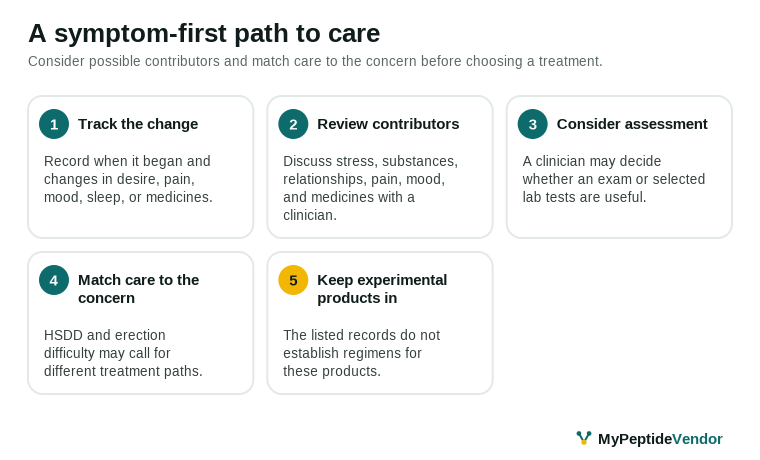
Start with the symptom and when it changed, rather than selecting a peptide from an online product list. A dated record of desire, distress, pain, erection or arousal changes, sleep, mood, and medication changes can help a clinician distinguish a persistent pattern from a short-term change.
- Check common contributors. Review sleep, stress, alcohol or other substances, relationship context, pain, mood, and medicines with a clinician. A new antidepressant or hormone treatment may be relevant, but do not stop a prescribed medicine on your own.
- Consider a focused medical assessment. The clinician may review medical history and sexual symptoms, then decide whether an examination or lab tests are useful. Possible tests include testosterone, estradiol, prolactin, or thyroid-stimulating hormone (TSH), based on symptoms and history; no single panel diagnoses every cause of low desire.
- Match treatment to the problem. For a premenopausal woman with distressing low desire, ask whether symptoms fit HSDD and whether Vyleesi or another established treatment is appropriate. For erection difficulty, ask about erectile-dysfunction options and cardiovascular risk rather than assuming a desire-focused peptide will improve blood flow.
- Leave experimental products for a research setting. 2 lists six of ten registered studies, and none of the six listed is a kisspeptin, oxytocin, or BPC-157 libido trial. These gaps do not establish a treatment regimen for any of those products.
There is no peptide shown to be “better than Viagra” for every person. Viagra and Cialis target erection-related blood flow, while Vyleesi is used for a defined low-desire diagnosis in premenopausal women; those are different treatment goals.
Clinician-visit checklist
- Write down when the change began, whether it happens in every situation, and whether it causes distress.
- Bring a list of prescription medicines, over-the-counter drugs, supplements, and any peptide products already used.
- Ask whether selected tests such as testosterone, estradiol, prolactin, or TSH fit your symptoms; a hormone result should be interpreted alongside your history.
- Ask what improvement would look like, when to follow up, and which side effects should prompt a call.
- Seek urgent care for chest pain, fainting, or severe shortness of breath. A painful erection that lasts several hours is an emergency, especially after an erectile-dysfunction medicine.
Peptide claim versus evidence
- “Works like Viagra.” Not supported as a general claim: PDE5 medicines target erection-related blood flow, while bremelanotide acts on melanocortin signaling.
- “BPC-157 boosts libido.” Not established; the six listed ClinicalTrials.gov records include no registered BPC-157 libido trial, and the remaining four records are not shown 2.
- “Oxytocin reliably increases desire.” The oxytocin evidence reviewed here is limited to six studies, which do not establish this claim 2.
- “Research use only means safe to inject.” False; that wording does not confirm the product’s identity, dose, sterility, or human safety.
Use this chart
Free to reuse with a link back:
What treatment may cost

Reliable dollar prices for Vyleesi prescriptions, clinician visits, lab work, or compounded peptides are not established in the cited records. Total cost can depend on insurance coverage, the clinician’s evaluation and follow-up fees, whether testing is appropriate, pharmacy dispensing, and how many prescribed doses are used.
Ask for the expected total before treatment: consultation, follow-up, medicine, injection supplies, and any tests. A low online price does not confirm that a product is genuine, sterile, correctly dosed, or appropriate for you.
Safety, side effects, and interactions
Vyleesi can cause a temporary rise in blood pressure and a slower heart rate after dosing. It is not appropriate for people with uncontrolled high blood pressure or known cardiovascular disease, so the prescriber should review blood pressure and heart history first 1. Follow the labeled limits of one 1.75 mg dose in 24 hours and no more than eight doses in 30 days 1.
Nausea is a common concern with bremelanotide; nausea was also the subject of the Phase 1 study NCT03973047 2. Flushing, headache, and injection-site reactions can also occur 1. Ask the prescriber what to do if symptoms are severe, persist, or recur after a dose.
Review antidepressants, blood-pressure medicines, hormone therapy, and erectile-dysfunction drugs with a clinician or pharmacist before adding a peptide. Safe combinations of experimental products are not established, and an interaction review depends on the actual medicine, dose, and health history.
Compounded and gray-market products add uncertainty beyond the usual side effects of a known medicine. Ask who prepared the product, whether a licensed pharmacy dispensed it, and how it was stored. FDA’s Category 2 list identifies potential significant safety risks for particular bulk substances it names; check the substance rather than assuming all peptides share one FDA status 1.
Call emergency services for chest pain, fainting, severe shortness of breath, or a serious allergic reaction after a medicine. A prolonged, painful erection is also urgent, particularly after an erectile-dysfunction drug; that warning does not mean bremelanotide is known to cause priapism.
How to get started: telehealth or an in-person clinic
A telehealth clinician can review a sexual and medication history, examine relevant records, and decide whether an in-person examination or testing is needed. An in-person clinic may be a better fit when symptoms include genital pain, new erection changes, abnormal bleeding, or another concern that needs a physical examination.
Before the appointment, note when desire changed, whether the change is situational or persistent, medicines and supplements, major health conditions, sleep and mood changes, and what you have tried. Ask whether the symptoms fit HSDD, whether another cause is more likely, and how the plan will measure benefit and side effects.
If Vyleesi is prescribed, confirm the 1.75 mg dose, injection technique, 45-minute timing, blood-pressure precautions, and monthly dose limit with the prescriber 1. Do not assume a product marketed online as PT-141 is equivalent to prescription Vyleesi.
A practical decision path
- Start with patterns. Review sleep, stress, pain, mood, relationship context, and medication changes before choosing a peptide.
- Check for treatable causes. Discuss whether examination or selected labs, such as testosterone, estradiol, prolactin, or thyroid testing, fit your history.
- Choose a treatment for the symptom. Desire concerns and erection concerns may need different care; Viagra and Cialis address erection-related blood flow, not desire itself.
- Use prescription treatment with follow-up. If Vyleesi fits the diagnosis, ask about the labeled dose, blood-pressure risk, and when to review whether it helps.
- Avoid self-treatment with research products. The six listed records do not establish libido regimens for BPC-157, oxytocin, kisspeptin, or GHRH/GHRP products 2.
Where to Buy Sexual Wellness for Research
American Peptides
US-made research peptides, every lot third-party tested with a lot-matched COA.
15% offMYPEPTIDEVENDOR at checkout
- ≥99% purity verified by HPLC + mass spec, endotoxin tested
- Ships tracked from Louisiana, free shipping over $300
- 15% off your first order with code MYPEPTIDEVENDOR
Certified-Pep
US-made research peptides with batch-specific lab reports (COA) and a QR code on every vial.
- Independent laboratory testing (Vanguard Laboratory)
- Made in the USA, ships in 1-2 business days
- Research use only, not for human or veterinary use
Affiliate disclosure: we may earn a commission if you order through the link above. Sexual Wellness is not approved by the FDA for human use.
Frequently asked questions
Is BPC-157 good for libido?
There is no established clinical evidence here that BPC-157 improves sexual desire. The six listed ClinicalTrials.gov records include no registered BPC-157 libido trial; the remaining four records are not shown, so the wider absence cannot be confirmed 2. No proven libido dose can be recommended.
Which peptide works like Viagra?
No peptide is proven to work like Viagra for erectile dysfunction. Sildenafil supports blood flow for an erection, while bremelanotide acts on melanocortin signaling and has a different approved use.
What peptide is better than Viagra?
There is no peptide shown to be better than Viagra across patients or symptoms. The useful comparison is the problem being treated: erection difficulty and low desire are not the same symptom.
How can I massively boost libido?
There is no safe, proven shortcut that reliably causes a massive increase in desire. A useful first step is to identify changes in medicines, sleep, mood, pain, or health with a clinician, then choose care that matches the cause.
Is PT-141 FDA-approved?
Bremelanotide is the active medicine in Vyleesi, which is FDA-approved for premenopausal women with acquired, generalized HSDD 1. A product sold online as PT-141 is not automatically the same as the approved prescription product.
How soon does Vyleesi work?
The labeled injection timing is at least 45 minutes before anticipated sexual activity 1. That interval is not a guarantee of a response at 45 minutes, and the registry listings in 2 do not state how long an individual effect lasts.
Is peptide therapy for libido safe?
Safety depends on the product, dose, health history, and other medicines. Vyleesi can temporarily raise blood pressure and slow heart rate 1; an unverified product also creates uncertainty about its contents, strength, and preparation.
References
- FDA: Certain bulk drug substances for use in compounding that may present significant safety risks
- ClinicalTrials.gov: 10 registered studies (search: Sexual Wellness)
Written by the MyPeptideVendor editorial team from the FDA label, peer-reviewed studies and ClinicalTrials.gov records listed above, fact-checked line by line and reviewed 2026-11-12.
Cite this page
MyPeptideVendor Editorial Team. Peptides for Libido: Evidence, Safety & Options. MyPeptideVendor. Updated November 12, 2026. https://mypeptidevendor.com/treatment/sexual-wellness/MyPeptideVendor Editorial Team. (2026, November 12). Peptides for Libido: Evidence, Safety & Options. MyPeptideVendor. https://mypeptidevendor.com/treatment/sexual-wellness/