Melanotan 2: Effects, Risks & FDA Status
Synthetic melanocortin peptide
Brand names: No FDA-approved brand name

Melanotan 2 (MT-2) is a synthetic peptide modeled on alpha-melanocyte-stimulating hormone (α-MSH). It can activate pigment-producing cells and increase skin color, but it is not an FDA-approved tanning medicine.
The human evidence is limited: ClinicalTrials.gov lists one recruiting Phase 2 study of MT-II with narrowband UVB for vitiligo (NCT07437560) 5. Mouse studies examine appetite and energy balance, but they do not establish weight loss in people 234.
Key takeaways
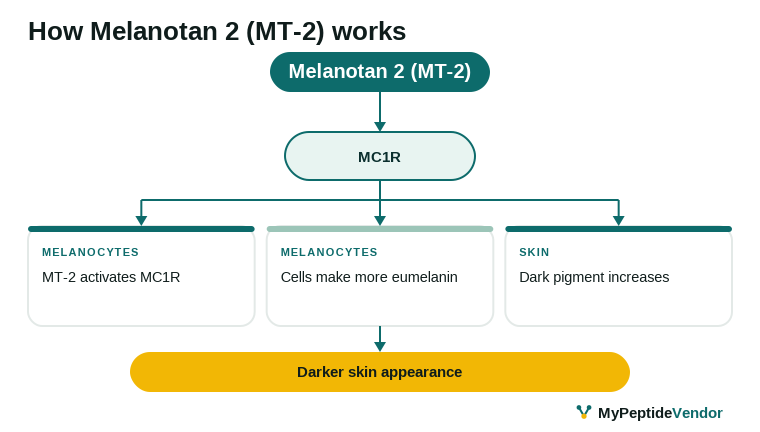
- MT-2 is a synthetic α-MSH analog; activation of MC1R on melanocytes can increase dark eumelanin pigment.
- MT-2 has no FDA-approved use or approved tanning dose.
- Three cited mouse studies examined feeding, obesity or melanocortin responses; none demonstrates human fat loss 234.
- The registry lists NCT07437560 as a recruiting Phase 2 vitiligo study, not a completed proof-of-benefit trial 5.
- Nausea, increased libido and unplanned erections are recognized concerns, but reliable incidence percentages are not established here.
Melanotan 2 (MT-2) at a glance
- Class
- Synthetic melanocortin peptide analog
- Mechanism
- Activates melanocortin receptors; MC1R activation on melanocytes increases eumelanin production.
- FDA Status
- Not FDA-approved for tanning or any other use.
- Brand names
- No FDA-approved brand name
- Administration
- No FDA-approved product or route for consumer use
- Typical Dose
- No established or FDA-approved tanning dose
- Half-life
- No established half-life for tanning use
- Primary Uses
- Unapproved tanning; MT-II is being studied with NB-UVB for stable nonsegmental vitiligo.
What is it?

Melanotan 2 is a lab-made peptide analog of α-MSH, a signaling molecule in the melanocortin system. It is also written as MT-2 or MT-II. Its best-known intended effect is darker skin through increased pigment production.
MT-2 is not the same medicine as afamelanotide. Both relate to melanocortin biology, but they are different compounds. MT-2 has no FDA-approved indication for any use.
A peptide can have a clear biological effect without being a safe or effective treatment. For MT-2, the distinction matters: the pigment mechanism is understood, but a predictable consumer dose, safe duration and long-term safety profile have not been established.
A tan produced by a pigment-stimulating drug is not sunscreen. It does not block the damaging effects of ultraviolet (UV) radiation or make tanning beds safe. Color change should not be taken as evidence that skin is protected.
What makes it different
MT-2 is not a topical cosmetic that colors only the skin surface. It is a peptide intended to act on receptors in the body. Melanocortin receptors are found in more than one biological pathway, which helps explain why effects may extend beyond skin pigment.
MC1R is the main receptor linked to pigment production in melanocytes. Other melanocortin receptors, including MC4R, have roles in appetite and sexual responses. This broader receptor activity is one reason MT-2 has been studied for effects beyond tanning, but receptor activity alone does not prove a useful treatment effect.
MT-2 should also be separated from experimental mouse research. The feeding and obesity studies below used specific mouse strains or brain-directed administration, not an established human weight-management regimen 234. Their results cannot be converted into a consumer dose.
Sunless self-tanner works differently: it changes the appearance of the outer skin rather than asking melanocytes to produce more pigment. UV tanning works through exposure to ultraviolet radiation, which can injure skin. MT-2 adds drug exposure without an approved tanning label or an established safety profile.
Commercial claims that MT-2 is “thermogenic,” anti-inflammatory or a fat-loss product should not be read as proven benefits in people. The cited evidence for feeding or energy balance comes from animal experiments 234.
How does it work?
In plain words: MT-2 can signal pigment-producing skin cells to make more dark pigment. The main skin target is the melanocortin 1 receptor (MC1R), found on melanocytes. When MC1R is activated, the cells can increase production of eumelanin, the brown-black pigment that contributes to a darker appearance.
This is different from saying MT-2 “creates a safe tan.” A change in pigment does not undo UV-related cell damage. If a person also spends time in the sun or uses a tanning bed, the pigment effect does not prevent sunburn or other UV injury.
MT-2 is a synthetic analog of α-MSH, a peptide derived from the larger proopiomelanocortin (POMC) system. The melanocortin system also includes receptors involved in appetite and energy regulation. In one mouse study, MT-2 acted as an MC4R agonist and reduced food intake per body weight in mice with CAPS2 deficiency; wild-type mice did not show that response 2.
That finding does not establish a human appetite treatment. The mouse result depended on a particular genetic model, and the same response was not seen in wild-type animals 2. The study did not establish that a person using MT-2 for tanning will eat less or lose body fat.
The mechanism also cannot tell us how quickly a person would tan, how long the color would last or what amount would be safe. Those are clinical questions that need controlled human studies, not receptor theory alone.
Use this chart
Free to reuse with a link back:
What the clinical evidence actually shows

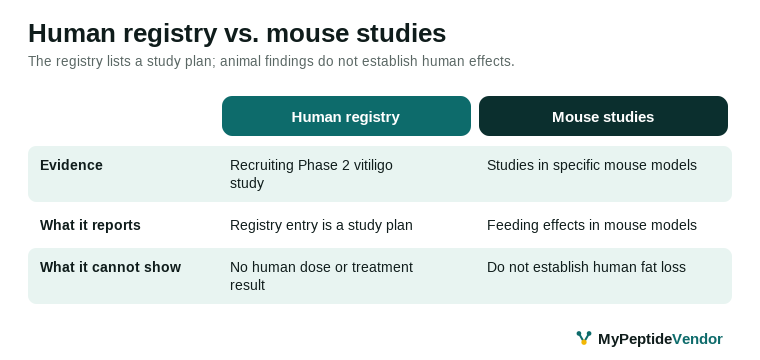
Human trial registry: ClinicalTrials.gov lists NCT07437560, a recruiting Phase 2 study of MT-II as an adjunct to narrowband UVB (NB-UVB) phototherapy for repigmentation in stable nonsegmental vitiligo 5. The registry entry is a study plan, not a result. It does not establish that MT-II works, what dose is best, how long treatment should last or what side-effect rate to expect.
The registry lists one study for the search term “Melanotan 2 (MT-2)” 5. That small registry footprint is not the same as a completed clinical evidence base.
Mouse feeding study: Fujima and colleagues studied mice with CAPS2 deficiency. Low-dose MT-2 reduced food intake per body weight in those mice, while no such effect was observed in wild-type mice 2. The finding concerns appetite in a specific mouse model. It is not a human weight-loss trial and does not show how much body fat a person might lose.
Mouse obesity study: Cui and colleagues studied mice with disrupted Gpr45. Intraventricular MT-2, meaning administration into the brain’s fluid spaces, suppressed adult obesity in those mutant mice 3. This experimental route and genetic model are not comparable to ordinary consumer use. The study does not establish a safe or effective human dose.
Mouse melanocortin-response study: Kublaoui and colleagues examined Sim1 heterozygous mice. These animals had a blunted feeding response to MT-2, while their energy expenditure increased normally in response to the drug 4. That difference shows that response can vary with the biological model; it does not predict an effect in people.
What these studies do not answer: The three mouse papers do not establish human fat loss, a reliable reduction in appetite, or an expected change in body weight 234. They also do not set a tanning schedule. A response observed after brain-directed dosing in mice cannot be used to calculate an injection dose for a person.
Tanning timing and persistence: The listed clinical evidence does not establish how many days of use produce a tan or how long color remains after stopping. It also does not establish whether oral or skin pigmentation from a particular course will fade, persist or recur. A single person's experience, even if carefully described, cannot set a typical timeline.
Melanoma and mole changes: A direct causal link between MT-2 and melanoma has not been established in the clinical evidence cited here. That absence is not proof of safety: the available human evidence is too limited to define long-term skin-cancer risk. Any new, changing, bleeding or non-healing pigmented spot should be assessed by a dermatologist, rather than attributed automatically to a peptide or ignored.
Cortisol and stress hormones: The cited MT-2 studies do not report cortisol outcomes 234. There is not enough evidence here to say that MT-2 raises, lowers or leaves cortisol unchanged.
Evidence-strength ladder: The evidence runs from animal experiments to a registered human study that is recruiting; it does not provide completed human trial results for tanning or weight loss 2345. Animal findings can suggest a biological pathway, but they cannot provide a human benefit estimate. A recruiting trial can show what researchers plan to test, but not whether the treatment works.
Practical reading: The strongest conclusion from the current evidence is a limit, not a promise. There is no established human weight-loss effect, tanning timeline or safe course length in the cited studies. The vitiligo study may add data once results are available, but its registry status alone cannot answer those questions 5.
Use this chart
Free to reuse with a link back:
Typical dosing

There is no FDA-approved MT-2 dose for tanning. No approved product label sets an amount, injection schedule or course length. Doses promoted online or in social media posts are not validated medical instructions.
The registered Phase 2 vitiligo study is testing MT-II with NB-UVB, but its registry listing is not a dosing recommendation for tanning or self-treatment 5. A research protocol, even when a study is recruiting, is designed for supervised research participants and a defined medical question.
Animal doses are not interchangeable with human doses. The cited studies used low-dose MT-2 in a particular mouse model or intraventricular administration in mice 23. Those routes, models and study goals do not support a home-use schedule.
For those reasons, there is no evidence-based answer to “how much should I inject?” or “how many days should I continue?” A claimed dose cannot be judged safe from the fact that a person has used it before or that a seller lists a concentration.
If you have already used MT-2, tell a clinician the form, route and timing as accurately as possible. Keep the packaging if you still have it. If symptoms are severe or a pigmented spot changes, seek medical care rather than taking another dose.
Side effects: what to actually expect
These effects fit its activity across melanocortin pathways, which are not limited to skin pigment. An erection may be unwanted and may occur without sexual stimulation.
Percentages: There is no approved MT-2 label that provides dependable side-effect percentages, and the cited registered vitiligo study is listed as recruiting Phase 2 5. The animal studies do not provide human rates for nausea, libido changes or erections 234. It would be misleading to turn these concerns into a precise percentage without suitable human data.
Skin and moles: Any peptide-associated pigment change can make it harder to track a spot that was already present. MT-2 has not been shown by the cited evidence to cause melanoma, but the available clinical evidence is not enough to rule out long-term risk. A dermatologist should assess a mole that changes in size, shape or color, bleeds, itches persistently or fails to heal.
Mouth pigmentation: How often MT-2 causes oral pigmentation, and how long such changes last, has not been established 2345. New brown or gray patches on the gums, cheeks or other oral tissue deserve examination by a dentist or clinician, particularly if they are growing or changing.
Symptoms that need prompt attention: Stop using the product and seek urgent medical care for chest pain, trouble breathing, fainting, severe weakness or a painful erection that does not resolve. A new or changing mole is not usually an emergency-room problem, but it should be checked promptly by a dermatologist rather than watched for months.
- Nausea: A recognized concern; a reliable MT-2 incidence percentage is not established here.
- Increased libido or spontaneous erections:
- Changing skin or oral pigment: Arrange an examination if a spot is new, growing, bleeding, irregular or not healing.
- Severe symptoms: Stop use and seek urgent care for breathing trouble, chest pain, fainting or severe weakness.
Regulatory & access status in the US
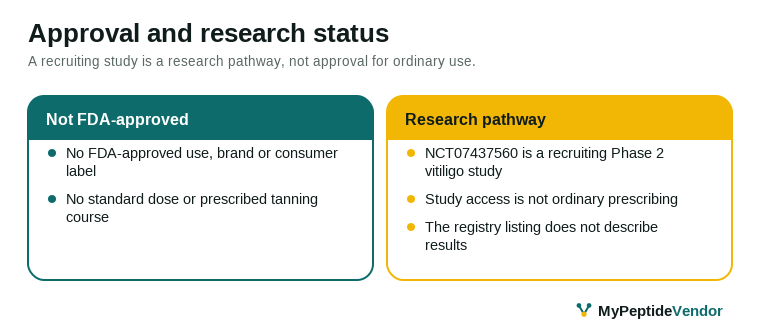
Melanotan 2 is not FDA-approved for tanning or any other use. There is no FDA-approved MT-2 brand, consumer label, standard dose or prescribed tanning course. A product listing or seller claim does not establish FDA review, safe use or reliable contents.
The distinction between research and treatment matters. NCT07437560 is listed as a recruiting Phase 2 study of MT-II with NB-UVB for stable nonsegmental vitiligo 5. A person’s access to an experimental study is not the same as approval for ordinary prescribing. The registered vitiligo study (NCT07437560) is listed as recruiting Phase 2 5; the source does not describe any results.
Do not treat “research use” wording as a safety guarantee. It does not establish that a product is suitable for injection or that its identity, strength and sterility have been verified for an individual consumer. No self-administered dose can be made safe simply by following an online schedule.
FDA's general bulk-substance information addresses safety concerns that can arise when substances are proposed for compounding, but it does not provide an MT-2 dose or an approved consumer indication 1. Compounding status, where applicable, should not be confused with FDA approval of a drug for tanning.
In practical terms, there is no FDA-approved MT-2 treatment to prescribe for a cosmetic tan. For vitiligo, the recruiting study is a research pathway, not proof that MT-II is an established treatment 5.
Use this chart
Free to reuse with a link back:
Research-grade Melanotan 2 (MT-2) is available from American Peptides (MELANOTAN-2, from $55.00); code MYPEPTIDEVENDOR takes 15% off. Sold for laboratory research only, not for human use. Affiliate link
How it compares with its closest alternatives
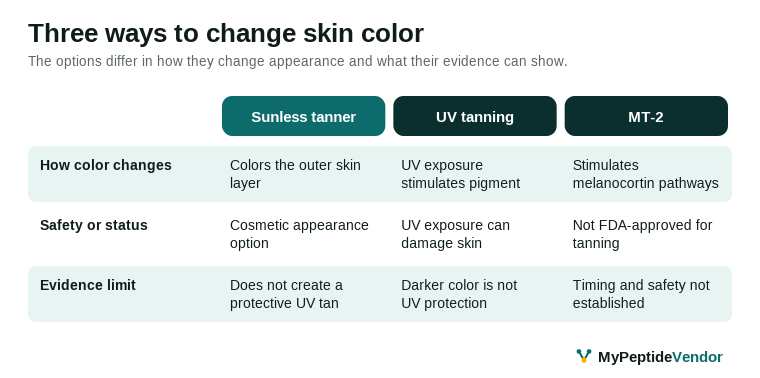
For someone seeking a darker appearance, the practical comparison is between sunless self-tanner, UV tanning and MT-2. The approaches differ in how they change skin color and in the uncertainties they carry. MT-2 is not an approved tanning medicine, while the animal studies do not establish a human tanning schedule 234.
| Option | How it changes appearance | Safety and regulation | What the evidence can say |
|---|---|---|---|
| Sunless self-tanner | Colors the outer layer of skin without requiring a drug to stimulate melanocytes. | A cosmetic appearance option; it does not replace sunscreen or other sun protection. | Can change appearance, but does not create a protective UV tan. |
| Sun exposure or tanning bed | UV exposure can darken skin by stimulating pigment. | UV exposure can damage skin; darker color does not make UV exposure safe. | A tan is not proof that skin is protected from UV injury. |
| Melanotan 2 | Stimulates melanocortin pathways, including MC1R-linked pigment production. | Not FDA-approved for tanning; no approved dose or course length. | Human tanning timing and long-term safety are not established; animal appetite findings do not prove human fat loss. |
For color alone, a sunless self-tanner avoids injecting an unapproved peptide and avoids deliberately using UV radiation to produce a tan. It still does not provide sun protection, so sunscreen and protective clothing remain relevant outdoors.
Use this chart
Free to reuse with a link back:
Four common questions
The study registry describes research for vitiligo, not a general tanning regimen 5.
| Question | Direct answer | Evidence type |
|---|---|---|
| How long does it take to tan from MT-2? | No dependable number of days is established by the cited human evidence. A precise online timeline should not be treated as a clinical expectation. | No established human timing; a recruiting vitiligo trial is not a tanning-timing study. |
| How long should I take MT-2? | There is no evidence-based course length for tanning. The study registry is not a self-use schedule or a recommendation for cosmetic use. | No approved regimen; one recruiting study is testing a different clinical question. |
| Does MT-2 burn fat? | No human fat-loss benefit is established. Reduced feeding or obesity-related effects were reported in particular mouse models, not human weight-loss trials. | Animal studies only. |
| Does MT-2 increase cortisol? | The cited MT-2 studies do not report cortisol measurements, so there is not enough evidence to say whether it raises or lowers cortisol. | No cortisol outcome reported in the cited studies. |
Where to Buy Melanotan 2 (MT-2) for Research
American Peptides
MELANOTAN-2 · from $55.00
US-made research peptides, every lot third-party tested with a lot-matched COA.
15% offMYPEPTIDEVENDOR at checkout
- ≥99% purity verified by HPLC + mass spec, endotoxin tested
- Ships tracked from Louisiana, free shipping over $300
- 15% off your first order with code MYPEPTIDEVENDOR
Certified-Pep
US-made research peptides with batch-specific lab reports (COA) and a QR code on every vial.
- Independent laboratory testing (Vanguard Laboratory)
- Made in the USA, ships in 1-2 business days
- Research use only, not for human or veterinary use
Affiliate disclosure: we may earn a commission if you order through the link above. Melanotan 2 (MT-2) is not approved by the FDA for human use.
Frequently asked questions
How long does it take to tan from Melanotan 2?
There is no well-established number of days. The recruiting study listed in the registry concerns vitiligo repigmentation with NB-UVB, not a schedule for cosmetic tanning 5.
How long should I take Melanotan 2 for?
There is no approved or evidence-based tanning course length. The registered Phase 2 study is a supervised research question, not a personal-use recommendation 5.
References
- FDA: Certain bulk drug substances for use in compounding that may present significant safety risks
- Fujima et al. CAPS2 deficiency induces proopiomelanocortin accumulation in pituitary and affects food intake behavior in mice. Neurosci Lett. 2020.
- Cui et al. Disruption of Gpr45 causes reduced hypothalamic POMC expression and obesity. J Clin Invest. 2016.
- Kublaoui et al. Sim1 haploinsufficiency impairs melanocortin-mediated anorexia and activation of paraventricular nucleus neurons. Mol Endocrinol. 2006.
- ClinicalTrials.gov: 1 registered studies (search: Melanotan 2 (MT-2))
Written by the MyPeptideVendor editorial team from the FDA label, peer-reviewed studies and ClinicalTrials.gov records listed above, fact-checked line by line and reviewed 2026-11-12.
Cite this page
MyPeptideVendor Editorial Team. Melanotan 2: Effects, Risks & FDA Status. MyPeptideVendor. Updated November 12, 2026. https://mypeptidevendor.com/peptides/melanotan-2/MyPeptideVendor Editorial Team. (2026, November 12). Melanotan 2: Effects, Risks & FDA Status. MyPeptideVendor. https://mypeptidevendor.com/peptides/melanotan-2/Related peptides
Melanostatin DM
Research UseMelanostatin DM blocks alpha-MSH-related darkening in a nonhuman melanocyte assay, but human dosing, effects, and safety are not established.
Learn moreMelanotan 1 (MT-1)
Not approvedMT-1 is a synthetic α-MSH analog studied with UV exposure; three small phase 1 trials found increased tanning, but did not establish long-term safety.
Learn morePT-141
FDA-ApprovedPT 141 is bremelanotide, a brain-acting peptide approved as Vyleesi for acquired, generalized HSDD in premenopausal women.
Learn more