Cjc 1295 Dac Dosage 2mg: Protocol & Safety
A 2 mg vial is not an approved human dose; this guide covers the evidence gap, vial math, and safety questions to review with a clinician.
Quickstart Highlights for a 2 mg Vial
No approved human CJC-1295 DAC dosage exists for physique or performance use, and no validated week-by-week titration schedule is established 3. A vial labeled 2 mg states the amount in the vial; it does not set a dose.
CJC-1295 with DAC is a growth hormone-releasing hormone (GHRH) analog. Online protocols are not validated treatment instructions, and a concentration calculation cannot confirm that a product is correctly identified, sterile, or suitable for injection 3.
- Dose: No approved human dose or validated titration schedule is established for physique or performance use 3.
- Vial amount: The 2 mg label describes total vial content, not a recommended injection amount.
- DAC action: DAC chemically crosslinks CJC-1295 to plasma proteins with free cysteine residues, extending exposure 2.
- Animal detection finding: An ELISA detected CJC-1295 conjugates in equine plasma at 12.5 pg/mL after a 10 mg subcutaneous administration in horses 2. Neither number establishes a human dose or testing window.
- Reported safety concerns: A review lists hormonal and metabolic changes, fluid retention, muscle or joint symptoms, and injection-site reactions across GH-axis peptides; it does not give event rates for CJC-1295 DAC 3.
A vial label should state the exact compound and whether it claims to contain DAC. “CJC-1295” by itself may not clarify that distinction. A label or certificate of analysis is not proof that the vial contains the stated compound or is sterile.
Key takeaways
- No approved human dose or validated titration schedule for physique or performance use is established 3.
- DAC chemically crosslinks CJC-1295 to plasma proteins containing free cysteine residues, extending exposure 2.
- The equine detection study used one 10 mg subcutaneous exposure in horses; it did not establish a human dose 2.
- An ELISA detected CJC-1295 conjugates in equine plasma at 12.5 pg/mL; this is not a human detection window 2.
- Reported GH-axis peptide concerns include prolactin and cortisol elevations, dysglycemia, fluid retention, muscle or joint pain, and injection-site reactions; event frequencies are not provided 3.
Dosing Schedule: No Approved Human Titration

CJC-1295 DAC has no approved human dose or validated titration schedule for physique or performance use 3. The review describes unregulated self-administration but does not establish a dose, dose increase, cycle length, or maintenance plan 3. The schedule below is therefore a record of what is not established, not a suggested regimen.
The clinical review does not establish a human CJC-1295 DAC dose schedule 3. U-100 units cannot be assigned to a clinical dose when no dose has been established.
| Week | Dose in mg | Dose in mcg | U-100 units | Evidence status |
|---|---|---|---|---|
| 1 | Not established | Not established | Not applicable | No approved starting dose. |
| 2 | Not established | Not established | Not applicable | No validated titration step. |
| 3 | Not established | Not established | Not applicable | No validated maintenance dose. |
| 4 | Not established | Not established | Not applicable | No established follow-up schedule. |
For arithmetic comparison only, 1 mg twice weekly totals 2 mg per week, while 2 mg once weekly also totals 2 mg per week. Those equal weekly totals do not show that the schedules produce equal drug exposure, IGF-1 response, or risk. No human head-to-head comparison between those schedules is established here.
The equine detection study used a single 10 mg subcutaneous administration in horses 2. That animal exposure is not a human dose and cannot establish a safe schedule for a 2 mg vial.
Syringe Unit Conversion Table
Units to draw on a U-100 insulin syringe (100 units = 1 mL) from a 2 mg vial. Find your dose, then read the column for the water you added. Every number is calculated, not estimated.
| Dose | 1 mL water 2 mg/mL · 1 unit = 20 mcg | 2 mL water 1 mg/mL · 1 unit = 10 mcg | 2.5 mL water 0.8 mg/mL · 1 unit = 8 mcg |
|---|---|---|---|
| 50 mcg | 2.5 · 40 doses | 5 · 40 doses | 6.25 · 40 doses |
| 100 mcg | 5 · 20 doses | 10 · 20 doses | 12.5 · 20 doses |
| 200 mcg | 10 · 10 doses | 20 · 10 doses | 25 · 10 doses |
| 250 mcg | 12.5 · 8 doses | 25 · 8 doses | 31.25 · 8 doses |
| 300 mcg | 15 · 6 doses | 30 · 6 doses | 37.5 · 6 doses |
| 500 mcg | 25 · 4 doses | 50 · 4 doses | 62.5 · 4 doses |
| 750 mcg | 37.5 · 2 doses | 75 · 2 doses | 93.75 · 2 doses |
| 1 mg | 50 · 2 doses | 100 · 2 doses | over 100 |
| 1.5 mg | 75 · 1 doses | over 100 | over 100 |
| 1.7 mg | 85 · 1 doses | over 100 | over 100 |
| 2 mg | 100 · 1 doses | over 100 | over 100 |
CJC-1295 DAC 2 mg Vial Dosage Calculator
Shows the exact insulin-syringe units to draw. Pre-loaded with the 2 mg vial; change any value to match yours.
Total volume of your syringe?
How much mg is in the vial?
How much bacteriostatic water are you adding?
Dose per injection?
Educational tool only. Concentration = vial ÷ water; units = dose ÷ concentration × 100 (U-100 syringe). Confirm every dose with your prescriber. Different vial or peptide? Use the peptide calculator.
Affiliate link · we may earn a commission.
Reconstitution Steps and Vial Math
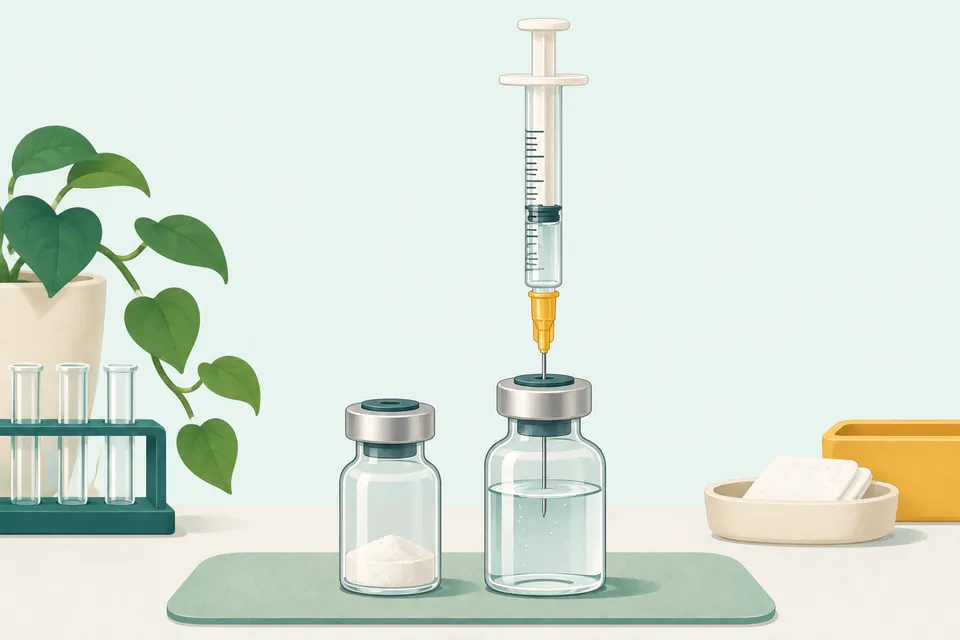
No mixing method can make an unapproved research product into an approved medicine. Product identity, sterility, purity, and suitability for injection cannot be confirmed by measuring diluent or calculating a concentration 3. Arithmetic for a 2 mg vial is shown for calculation only; it is not preparation guidance.
- Read the exact product name. Check whether the label says CJC-1295 with DAC, CJC-1295 without DAC, or names another peptide. “CJC-1295” alone may not resolve the difference.
- Review lot documentation. Compare the label with any lot-specific certificate of analysis. A document does not prove that the vial contents match it.
- Do not infer a dose from vial content. The 2 mg amount is the total stated vial amount, not a dose or a treatment schedule.
- For concentration arithmetic only: adding 1 mL gives 2 mg/mL (2,000 mcg/mL); 2 mL gives 1 mg/mL (1,000 mcg/mL); and 2.5 mL gives 0.8 mg/mL (800 mcg/mL).
- Do not transfer unit marks between dilutions. On a U-100 syringe, 100 units equal 1 mL. At 1 mL added to this 2 mg vial, the listed arithmetic is 20 mcg per unit; at 2 mL, it is 10 mcg per unit; at 2.5 mL, it is 8 mcg per unit.
- Ask a licensed pharmacist or clinician. If a clinician has prescribed a specific sterile medication, use only the preparation directions for that exact dispensed product.
For a 2 mg vial with 1 mL of diluent, the following unit conversions are arithmetic only. They do not endorse any dose. These conversions apply only to a 2 mg vial diluted to 1 mL and measured on a U-100 syringe (20 mcg per unit).
| Amount | U-100 units at 1 mL dilution | Meaning |
|---|---|---|
| 50 mcg | 2.5 units | Arithmetic conversion only |
| 100 mcg | 5 units | Arithmetic conversion only |
| 200 mcg | 10 units | Arithmetic conversion only |
| 250 mcg | 12.5 units | Arithmetic conversion only |
| 300 mcg | 15 units | Arithmetic conversion only |
| 500 mcg | 25 units | Arithmetic conversion only |
| 1,000 mcg (1 mg) | 50 units | Arithmetic conversion only |
| 2,000 mcg (2 mg) | 100 units | Arithmetic conversion only |
A 100-unit U-100 syringe holds 1 mL. A number on a syringe is a volume marking, not a peptide dose; the amount of peptide represented by a unit depends on the vial concentration.
Supplies Needed for a Full 2 mg Vial
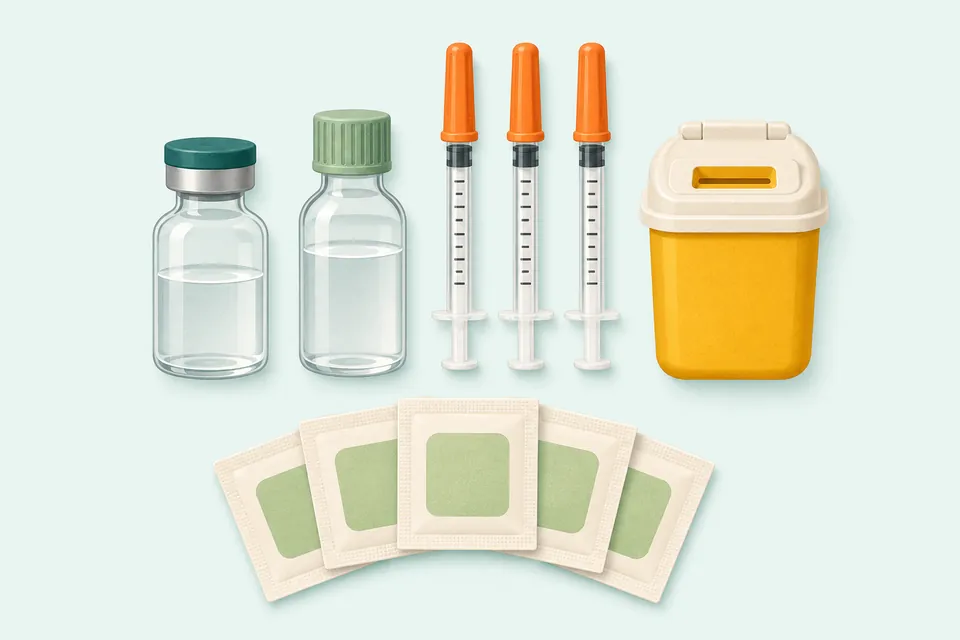
No injection-supply quantities are recommended for using a research vial because no approved human preparation or dosing protocol is established 3. Listing needles and diluent as a shopping list could be mistaken for instructions to inject it.
- For a clinician discussion: one vial label, any lot-specific certificate of analysis, and a written record of the stated compound and DAC status.
- For a product review: one record of the vial’s stated amount, lot number, and any storage directions printed on its packaging.
- For a prescribed sterile medicine: use the supplies and preparation directions provided for that exact product by the dispensing pharmacy.
A “research” label does not establish sterility or suitability for human use. Uncertainty about product composition, dose, and stacking is a recognized concern with unregulated peptide supply chains 3.
Protocol Overview and Cycle Notes
CJC-1295 with DAC is a GHRH analog; ipamorelin and GHRP-2 are growth hormone secretagogues (GHS), which are a separate group 3. DAC chemically crosslinks CJC-1295 to plasma proteins containing free cysteine residues, extending exposure 2. The detection study describes extended exposure but does not provide a numeric human half-life 2.
No validated cycle length, off-cycle duration, or reassessment week is established for CJC-1295 DAC use for physique or performance 3. A fixed period on the peptide followed by a fixed break should not be treated as a proven safety method. If someone has used it, a clinician can choose whether and when to reassess symptoms and laboratory results.
The review describes uncertain dose and stacking practices in unregulated supply chains 3. It does not establish a safe or effective CJC-1295 DAC and ipamorelin combination. Using more than one GH-axis peptide also makes it harder to connect a new symptom or lab change with one compound.
| Feature | CJC-1295 with DAC | CJC-1295 without DAC | Sermorelin or ipamorelin |
|---|---|---|---|
| Group | GHRH analog. | Distinct GHRH analog product. | Sermorelin is a GHRH analog; ipamorelin is a GHS. |
| DAC distinction | DAC chemically crosslinks the peptide to plasma proteins with free cysteine residues. | No DAC is stated in the product name; no interchangeable dose is established. | Sermorelin and ipamorelin are separate peptides from CJC-1295, and lists them as distinct agents. |
| Schedule | No approved physique or performance schedule. | No interchangeable dose with DAC-containing CJC-1295 is established. | No shared dose or schedule is established. |
| Label clue | Look for an explicit “with DAC” or “Drug Affinity Complex” claim; wording cannot verify vial contents. | Look for an explicit “without DAC” claim; wording cannot verify vial contents. | Check the exact compound name; a blend may list multiple peptides. |
| Detection evidence | Equine plasma assay findings are described below. | No comparison is established here. | No comparison is established here. |
An ELISA detected CJC-1295 conjugates in equine plasma at 12.5 pg/mL after a single 10 mg subcutaneous administration in horses 2. That finding shows detection in an animal testing context; it does not establish how long a conjugate could remain detectable in a person.
FDA’s Category 2 framework covers bulk drug substances identified as potentially presenting significant safety risks during compounding review 1. A category listing is not an approval for a drug or an endorsement of human use. Whether a pharmacy may compound a particular substance depends on applicable federal and state requirements; ask a licensed pharmacist about the current status 1.
Storage and Handling
A product-specific storage temperature and shelf life for an unmixed or reconstituted CJC-1295 DAC vial are not established here. Do not assume refrigeration makes an unverified product stable, sterile, or safe to inject.
For a prescribed sterile medicine, follow the storage conditions and beyond-use date printed on that product’s dispensing label. A storage rule for another peptide or product cannot be assumed to apply to CJC-1295 DAC.
Keep the vial in its labeled packaging and away from children. Do not use a vial if its identity, seal, lot information, or condition is unclear. Uncertainty about product composition is a recognized concern with unregulated peptide supply chains 3.
Injection and Tracking Tips
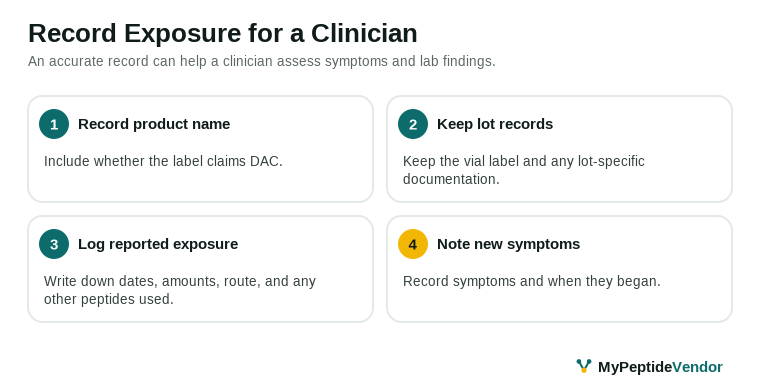
This page does not recommend self-injection of CJC-1295 DAC. If a person has already used a GH-axis peptide, an accurate exposure record can help a clinician assess symptoms and lab findings; the clinical review describes the need for clinicians to interpret these effects 3.
- Record the exact product name and whether the label claims DAC.
- Keep the vial label and any lot-specific documentation.
- Write down reported dates, amounts, route, and any other peptides used.
- Note new symptoms and when they began.
Do not combine compounds in one syringe based on an online protocol. CJC-1295 DAC and ipamorelin belong to different peptide groups, and the review identifies uncertainty around stacking practices in unregulated supply chains 3.
A clinician may consider prolactin, cortisol, and glucose when evaluating possible GH-axis peptide effects, since the review reports prolactin and cortisol elevations and dysglycemia 3. The review does not provide a universal test day, cutoff, or dose-adjustment threshold. Testing time and interpretation should reflect the reported exposure, symptoms, and medical history.
- Prolactin: discuss an abnormal result with a clinician; elevations are among the reported concerns 3.
- Cortisol: ask a clinician to interpret an abnormal result in context; the review gives no stop threshold 3.
- Glucose: discuss abnormal blood sugar findings with a clinician because dysglycemia is reported 3.
Use this chart
Free to reuse with a link back:
Safety and Side Effects
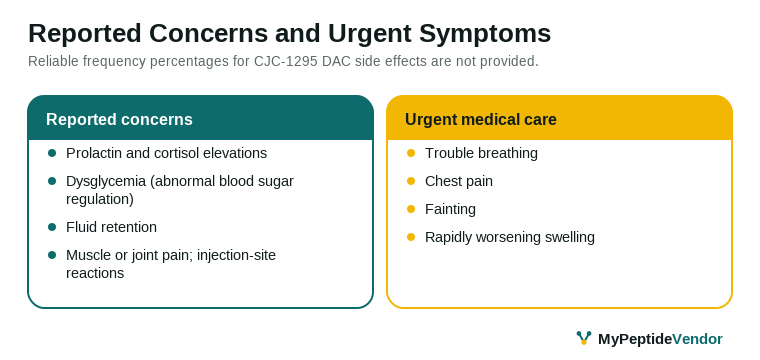
Reliable frequency percentages for CJC-1295 DAC side effects are not provided here. The review lists adverse effects across GH-axis peptides but does not give a rate for each event or establish that every listed event is caused by CJC-1295 DAC 3.
- Hormonal changes: prolactin and cortisol elevations are reported concerns 3.
- Blood sugar changes: dysglycemia (abnormal blood sugar regulation) is reported 3.
- Fluid retention: fluid-retention effects are reported across the peptide group 3.
- Muscle and joint symptoms: myalgia (muscle pain) and arthralgia (joint pain) are reported 3.
- Injection-site reactions: these are reported, but no frequency is given 3.
Seek urgent medical care for trouble breathing, chest pain, fainting, or rapidly worsening swelling. Contact a clinician promptly about persistent swelling, marked changes in thirst or urination, severe muscle or joint pain, or possible hormone-related symptoms. These are general safety precautions, not a complete list of reactions.
FDA’s Category 2 page describes bulk substances that may present significant safety risks during compounding review 1. Category status does not establish that a substance is approved, safe, or suitable for injection. Ask a licensed pharmacist or clinician about the current federal and state requirements that apply to a specific product 1.
Anti-doping detection has been demonstrated in an animal-testing context: an ELISA detected CJC-1295 conjugates in equine plasma at 12.5 pg/mL after a single 10 mg subcutaneous administration in horses 2. The finding does not establish human test sensitivity or the time a conjugate might remain detectable after human exposure 2.
Use this chart
Free to reuse with a link back:
Frequently asked questions
What is the correct CJC-1295 DAC dosage for a 2 mg vial?
No approved human dose or validated schedule for physique or performance use is established 3. The 2 mg figure describes the vial’s stated contents, not an individual dose.
Does 2 mg once weekly work differently from 1 mg twice weekly?
There is no established human head-to-head comparison of those schedules. Each totals 2 mg per week arithmetically, but equal totals do not prove equal exposure, IGF-1 response, or safety.
Can CJC-1295 DAC be stacked with ipamorelin?
Ipamorelin is a growth hormone secretagogue, while CJC-1295 DAC is a GHRH analog 3. The safety and benefit of combining CJC-1295 DAC with ipamorelin are not established 3.
How can I tell whether a vial contains DAC?
Look for an explicit label claim such as “CJC-1295 with DAC” or “Drug Affinity Complex,” and compare it with any lot-specific documentation. Those claims cannot prove the vial’s contents; “CJC-1295” alone may not clarify DAC status.
How long could CJC-1295 DAC be detectable after the last dose?
A human detection window is not established. An ELISA detected conjugates in equine plasma at 12.5 pg/mL after a single 10 mg subcutaneous administration in horses, but that does not determine human testing duration 2.
When should prolactin, cortisol, or glucose be tested?
No validated testing day or universal cutoff is established. A clinician can choose timing based on the reported exposure, symptoms, and medical history; the review identifies these areas as relevant to GH-axis peptide assessment 3.
Is CJC-1295 DAC FDA-approved or available from a compounding pharmacy?
It is not approved for physique or performance use 3. FDA’s Category 2 framework identifies certain bulk substances as potentially presenting significant safety risks during compounding review; pharmacy authority depends on applicable requirements 1.
References
- FDA: Certain bulk drug substances for use in compounding that may present significant safety risks
- Timms et al. Detection of CJC-1295 in Equine Plasma by ELISA. Drug Test Anal. 2026.
- Dominikowski et al. The emerging landscape of performance-enhancing peptides modulating GH-IGF1 axis: bridging the gap between clinical evidence and patient self-administration. Front Endocrinol (Lausanne). 2026.
Written by the MyPeptideVendor editorial team from the FDA label, peer-reviewed studies and ClinicalTrials.gov records listed above, fact-checked line by line and reviewed 2026-11-12.
Cite this page
MyPeptideVendor Editorial Team. cjc 1295 dac dosage 2mg: Protocol & Safety. MyPeptideVendor. Updated November 12, 2026. https://mypeptidevendor.com/protocols/cjc-1295-dac-dosing-2mg/MyPeptideVendor Editorial Team. (2026, November 12). cjc 1295 dac dosage 2mg: Protocol & Safety. MyPeptideVendor. https://mypeptidevendor.com/protocols/cjc-1295-dac-dosing-2mg/Related protocols
CJC-1295 No DAC 5 mg
Not approvedNo approved human dose exists for CJC-1295 No DAC; this guide explains 5 mg vial math, evidence limits, and safety questions to raise with a clinician.
View protocolGHRP-2 10 mg
Research UseNo approved human treatment dose is established; this guide explains 10 mg vial math, diagnostic use, handling, and known safety limits.
View protocolGHRP-6 5 mg
Research UseGHRP-6 has no established human dose or cycle; this guide separates syringe arithmetic from clinical evidence and safety limits.
View protocol