Hgh 191aa Dosage 10iu: Protocol & Safety
A 10 IU vial is the total container amount, not a daily dose; adult somatropin requires a prescription, confirmed GHD, and clinician monitoring.
Quickstart Highlights for a 10 IU Vial
For hgh 191aa dosage 10iu, the key point is that 10 IU describes the vial’s total contents, not a safe daily dose. Adult somatropin is prescription treatment for confirmed growth hormone deficiency (GHD), and a prescriber must set and monitor each person’s dose 2.
Adult GHD replacement is individualized, typically started at a low dose and adjusted according to clinical response, side effects, and IGF-1 levels. These approaches are not interchangeable; your prescriber must choose the appropriate product-specific plan.
- Vial amount: A 10 IU vial contains 10 IU total; the milligram content is stated on the dispensed product's label and should be confirmed by the prescriber or pharmacist 2. It is not a direction to inject 10 IU at once or each day.
- Adult GHD titration: That is a clinical framework, not an individual prescription.
- Label-based dosing: The Cooper adult label starts at no more than 0.04 mg/kg/week and allows increases every 4–8 weeks to a maximum of 0.08 mg/kg/week, depending on tolerance 2. For an 80 kg adult, those limits calculate to about 0.46 mg/day initially and 0.91 mg/day maximum, before the prescriber considers other factors 2.
- Do not use 10 IU/day as a target: That would be about 3.33 mg/day, above the adult label’s 0.08 mg/kg/week maximum for an 80 kg person 2. It also exceeds the review’s usual maintenance ceilings of about 1.5–2 IU/day for ages 40–60 and 2.5–3 IU/day for ages 20–40 1.
- Monitoring matters: A person can have too much GH effect without obvious symptoms, so feeling well is not proof that the dose is appropriate. Ask for an age-adjusted IGF-1 plan and regular clinician review.
Key takeaways
- A 10 IU vial contains 10 IU total; at the label’s 3.33 mg per 10 IU, that is about 3.33 mg total 2.
- The adult GHD article describes a starting dose near 1 IU/day, increasing about 0.5 IU per month, with age-based maintenance ceilings 1.
- The Cooper label starts at no more than 0.04 mg/kg/week and sets a maximum of 0.08 mg/kg/week, with increases every 4–8 weeks 2.
- IGF-1 is the preferred blood marker for detecting too little or too much GH effect; symptoms alone may not reveal an excessive dose.
- Somatropin is not a self-directed bodybuilding or anti-aging drug.
Dosing Schedule for Adult GHD
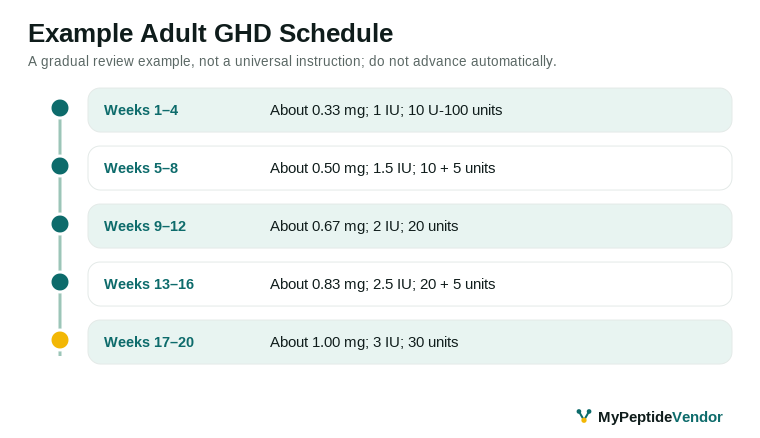
The schedule below reflects the gradual monthly approach described in an adult GHD review, not a universal instruction. The same review gives maintenance ceilings of about 1.5–2 IU/day for men aged 40–60 and 2.5–3 IU/day for men aged 20–40; women may need different doses, and the question needs more study 1. The product label instead bases adult dosing on body weight, tolerance, age-adjusted IGF-1, and clinical response 2. The prescriber must use the applicable lower limit and adjust for age, sex, obesity, and medical history.
For the unit markings below, the vial is mixed with 1 mL, making 10 IU/mL; U-100 syringe markings use only the listed conversions. The label identifies 10 IU as 3.33 mg, so the mass figures are approximate 2. Do not follow the calendar without a prescription and scheduled blood tests.
| Period | Daily dose (mg) | Daily dose (mcg) | Daily dose (IU) | U-100 marking at 1 mL |
|---|---|---|---|---|
| Weeks 1–4 | About 0.33 mg | About 330 mcg | 1 IU | 10 units |
| Weeks 5–8 | About 0.50 mg | About 500 mcg | 1.5 IU | 10 units + 5 units |
| Weeks 9–12 | About 0.67 mg | About 670 mcg | 2 IU | 20 units |
| Weeks 13–16 | About 0.83 mg | About 830 mcg | 2.5 IU | 20 units + 5 units |
| Weeks 17–20 | About 1.00 mg | About 1,000 mcg | 3 IU | 30 units |
Each increase in this example is about 0.5 IU per month 1. Do not advance automatically: the 3 IU row is not appropriate for everyone and may exceed the product label’s weight-based maximum 2. At the label concentration, a 10 IU vial contains ten 1 IU doses or five 2 IU doses; the discard date after mixing may limit how long it can be used 2.
The adult label’s weekly starting and maximum doses are 0.04 and 0.08 mg/kg/week, respectively, with increases at 4–8 week intervals 2. Dosing should account for age, sex, body weight, and clinical response, as determined by the prescribing clinician. Ask the prescriber to reconcile this label schedule with the gradual IU schedule before treatment begins.
Use this chart
Free to reuse with a link back:
Syringe Unit Conversion Table
Units to draw on a U-100 insulin syringe (100 units = 1 mL) from a 10 IU vial. Find your dose, then read the column for the water you added. Every number is calculated, not estimated.
| Dose | 1 mL water 10 IU/mL · 1 unit = 0.1 IU | 2 mL water 5 IU/mL · 1 unit = 0.05 IU | 2.5 mL water 4 IU/mL · 1 unit = 0.04 IU |
|---|---|---|---|
| 0.5 IU | 5 · 20 doses | 10 · 20 doses | 12.5 · 20 doses |
| 1 IU | 10 · 10 doses | 20 · 10 doses | 25 · 10 doses |
| 2 IU | 20 · 5 doses | 40 · 5 doses | 50 · 5 doses |
| 3 IU | 30 · 3 doses | 60 · 3 doses | 75 · 3 doses |
| 4 IU | 40 · 2 doses | 80 · 2 doses | 100 · 2 doses |
| 5 IU | 50 · 2 doses | 100 · 2 doses | 125 · 2 doses |
HGH 191AA 10 IU Vial Dosage Calculator
Shows the exact insulin-syringe units to draw. Pre-loaded with the 10 IU vial; change any value to match yours.
Total volume of your syringe?
How much IU is in the vial?
How much bacteriostatic water are you adding?
Dose per injection?
Educational tool only. Concentration = vial ÷ water; units = dose ÷ concentration × 100 (U-100 syringe). Confirm every dose with your prescriber. Different vial or peptide? Use the peptide calculator.
Reconstitution Steps
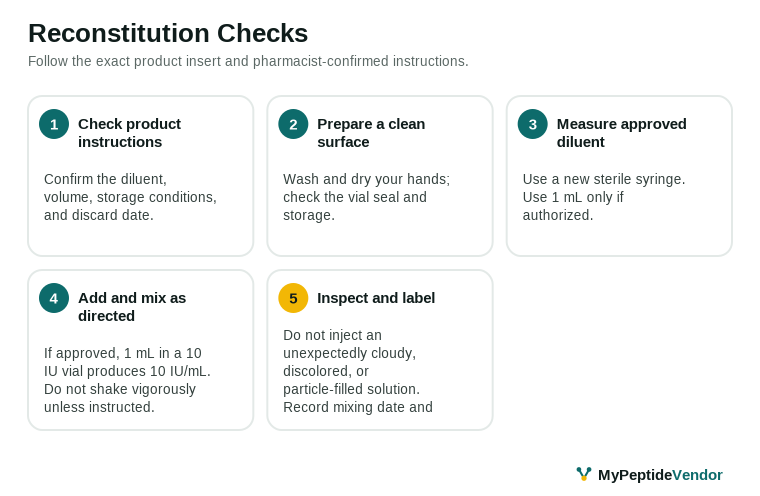
- Read the prescription label and exact product insert before mixing. Confirm the correct diluent, volume, storage conditions, and discard date with the pharmacist; products can have different instructions.
- Wash and dry your hands, then set up a clean work surface. Check that the vial seal is intact and that the product has been stored as directed.
- Clean the stopper with an alcohol swab and let it dry. Use a new sterile syringe to measure only the diluent authorized for that product.
- If the pharmacist confirms that 1 mL is permitted, adding 1 mL to a 10 IU vial produces 10 IU/mL. At that concentration, the listed U-100 markings are 5 units for 0.5 IU, 10 units for 1 IU, 20 units for 2 IU, 30 units for 3 IU, 40 units for 4 IU, and 50 units for 5 IU 2.
- Add the liquid and mix only as the insert directs. Do not shake vigorously unless the instructions specifically require it.
- Inspect the solution against the product directions. Do not inject a solution that is unexpectedly cloudy, discolored, or contains particles; ask a pharmacist what to do.
- Write the mixing date and final concentration on the vial, then store it as the insert directs. Never assume a different brand’s storage period applies.
Use this chart
Free to reuse with a link back:
Supplies Needed for One Full Vial
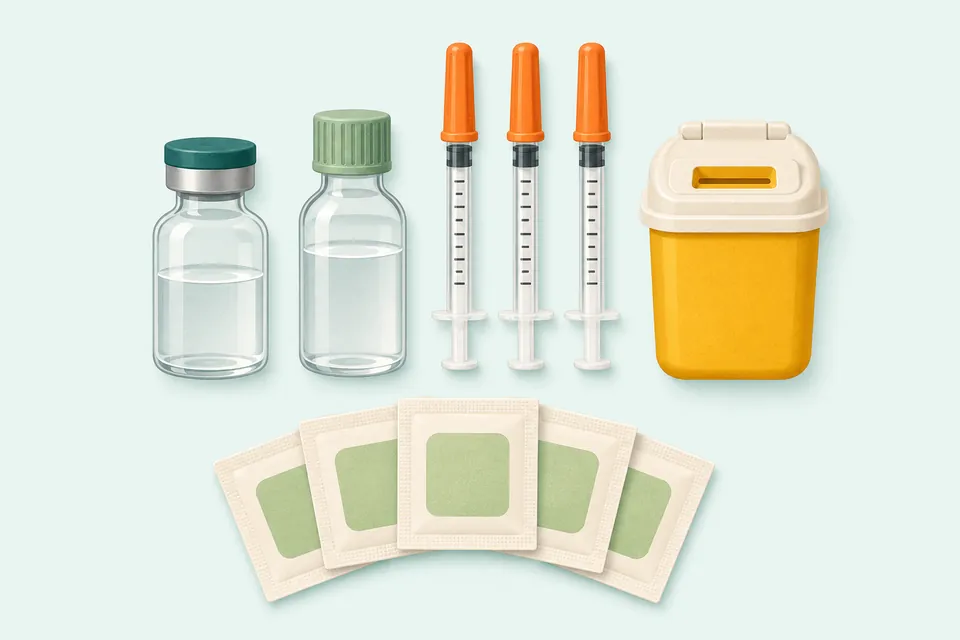
For one 10 IU vial mixed with 1 mL, gather the exact product-approved supplies before preparation. The 1 mL option is for measurement only and should be used only if the pharmacist confirms it is correct for the prescribed product.
- One prescribed 10 IU somatropin vial.
- One measured 1 mL amount of the product-approved diluent, if authorized.
- One sterile syringe and needle for adding diluent.
- One new U-100 syringe and needle for each prescribed injection; never reuse a syringe.
- Alcohol swabs for the vial stopper and injection site.
- One approved puncture-resistant sharps container.
Ask a pharmacist to demonstrate the first preparation and confirm the concentration against the prescription. A syringe scale can be misread if the dilution differs from the one used to calculate the dose.
Protocol Overview & Cycle Notes

Somatropin replaces GH in adults with diagnosed GHD; symptoms such as fatigue or changes in body composition alone do not establish that diagnosis. Adult GHD should be confirmed with an appropriate GH stimulation test, as determined by the prescriber and current clinical guidance. Ask the endocrinologist whether a stimulation test is needed and what other causes of symptoms should be checked.
A short half-life does not justify extra injections or a higher dose.
No approved dose exists for bodybuilding or anti-aging use of somatropin. Online performance-dose claims are not medical dosing guidance, and FDA identifies somatropin bulk substance in Category 2 of its compounding safety review 4. That category flags potential significant safety risks for compounding; it does not establish that any specific online vial is genuine, sterile, or suitable for injection 4.
Changes in energy or body composition have no reliable week-by-week timetable. Ask your prescriber what outcome is being monitored, when it will be reassessed, and what age-adjusted IGF-1 range is appropriate for you. There is no single IGF-1 target that should be applied to every patient.
Before starting, ask about the diagnosis and stimulation-test results, the intended IGF-1 target, and baseline glucose and lipid testing. Also ask which symptoms require a dose hold and how soon to report them. Those decisions depend on your health history and the specific product.
Storage & Handling

Follow the exact package insert for storage before and after mixing. A universal post-mixing use period cannot be assumed because products and presentations may differ; the pharmacist should confirm the discard date for your vial.
Keep the vial away from children and avoid touching the needle or cleaned stopper. Do not use a vial that was frozen, overheated, or stored outside its instructions without pharmacist advice. Put used needles directly into a puncture-resistant sharps container.
Injection & Tracking Tips
The product label describes daily subcutaneous injections, preferably in the evening, with sites in the thigh, buttocks, or abdomen 2. Rotate injection sites regularly to help prevent lipoatrophy (loss of fatty tissue under the skin). A clinician or pharmacist should demonstrate the prescribed injection method before the first dose.
Record the date, prescribed dose, injection site, and any swelling, joint discomfort, tingling, or glucose change. Bring that log and the vial label to follow-up so the clinician can review both your response and the product concentration.
IGF-1 is the preferred marker for GH effect in the adult review. Random GH blood levels can be hard to interpret because GH release varies; a normal-looking single result does not replace the prescriber’s evaluation. Ask when IGF-1 should be checked after a dose change and what result would prompt a reduction.
Safety & Side Effects
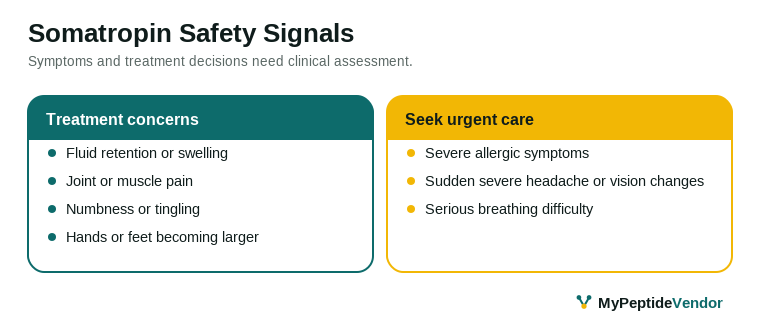
Fluid retention, swelling, joint or muscle pain, and numbness or tingling resembling carpal tunnel symptoms are recognized concerns with somatropin treatment 2. Reliable frequency percentages are not available here, so a precise chance for each effect cannot be stated. Report new or worsening symptoms rather than changing the dose on your own.
Possible GH excess includes acromegaly-type changes, such as hands or feet becoming larger, rings or shoes fitting more tightly, facial changes, or persistent joint symptoms. A high IGF-1 can signal excess effect even when symptoms are absent or subtle 1. The clinician should interpret IGF-1 in its age-adjusted context and decide whether to lower or hold the dose; there is no one numeric reduction trigger for every patient.
Do not start treatment when there is evidence of active neoplastic disease (active cancer). Intracranial lesions must be inactive and antitumor treatment complete before therapy begins; discontinue treatment if tumor growth is evident 2. These conditions require medical assessment, not home dose adjustment.
Somatropin is prescription treatment for approved conditions and requires physician supervision 2. An online listing alone cannot confirm a product’s identity, strength, sterility, or suitability for injection.
Seek urgent care for severe allergic symptoms, sudden severe headache or vision changes, or serious breathing difficulty. Contact the prescriber promptly for persistent swelling, joint pain, or tingling, or for a concerning glucose change.
Use this chart
Free to reuse with a link back:
Frequently asked questions
Is 10 IU of HGH per day safe for a typical adult man?
Do not treat a 10 IU vial as a 10 IU daily prescription. Ten IU is about 3.33 mg, while the adult GHD review gives usual maintenance ceilings of about 1.5–2 IU/day for men aged 40–60 and 2.5–3 IU/day for men aged 20–40 12. Only a prescriber can determine an appropriate dose.
How long does a 10 IU vial last?
By vial contents alone, it provides ten 1 IU doses or five 2 IU doses 2. The actual usable period depends on the product’s storage and discard instructions after mixing, so ask the pharmacist for the specific date.
How many U-100 syringe units equal 1 IU?
With 1 mL added to a 10 IU vial, 1 IU corresponds to 10 U-100 units; with 2 mL, it corresponds to 20 units; with 2.5 mL, it corresponds to 25 units. Use only the dilution confirmed for your product and prescription.
Does somatropin require a prescription and blood tests?
Yes. Adult GHD treatment requires a medical diagnosis and prescription, and the product label calls for confirmation with an appropriate GH stimulation test 2. IGF-1 is the main blood marker for assessing GH effect 1.
Can HGH be used for bodybuilding or anti-aging?
No approved somatropin dose exists for bodybuilding or anti-aging use.
How soon should energy or body composition change?
There is no reliable timeline that applies to everyone. A clinician should assess symptoms and safety alongside IGF-1 results, rather than increasing the dose to pursue a promised week-by-week change 1.
References
Written by the MyPeptideVendor editorial team from the FDA label, peer-reviewed studies and ClinicalTrials.gov records listed above, fact-checked line by line and reviewed 2026-11-12.
Cite this page
MyPeptideVendor Editorial Team. hgh 191aa dosage 10iu: Protocol & Safety. MyPeptideVendor. Updated November 12, 2026. https://mypeptidevendor.com/protocols/hgh-191aa-dosing-10iu/MyPeptideVendor Editorial Team. (2026, November 12). hgh 191aa dosage 10iu: Protocol & Safety. MyPeptideVendor. https://mypeptidevendor.com/protocols/hgh-191aa-dosing-10iu/Related protocols
CJC-1295 DAC 2 mg
Research UseA 2 mg vial is not an approved human dose; this guide covers the evidence gap, vial math, and safety questions to review with a clinician.
View protocolCJC-1295 DAC 5 mg
Research UseNo approved human dose exists for CJC-1295 DAC; this guide explains 5 mg vial math, research limits, monitoring, and safety questions.
View protocolCJC-1295 No DAC 5 mg
Not approvedNo approved human dose exists for CJC-1295 No DAC; this guide explains 5 mg vial math, evidence limits, and safety questions to raise with a clinician.
View protocol