Follistatin-315: Evidence, Dose & Safety
Activin-binding protein
Brand names: No FDA-approved brand name

Follistatin-315 is one of the main forms of follistatin, a protein that binds activin and is studied for its possible effects on myostatin. Its proposed muscle-growth effect has not been proven for injected FST-315 in people.
Human research includes a study of ovarian follicles that measured FST-315 and FST-288 transcripts, not a treatment trial of injections for muscle gain or fat loss 4. There is no established human dose or known side-effect rate for injectable FST-315.
Key takeaways
- Follistatin-288 and FST-315 both help control activin A levels under normal conditions 23.
- Human granulosa cells had about 3 FST-315 transcripts for each FST-288 transcript 4.
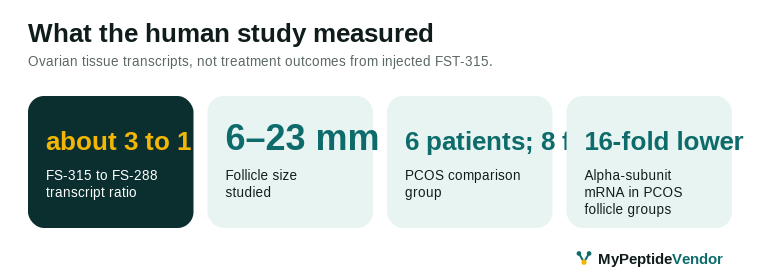
- The follicle study examined follicles 6–23 mm across and found that the transcript ratio did not change with follicle size 4.
- No controlled human trial has established an injectable FST-315 dose, muscle benefit, fat-loss effect, or side-effect rate.
Follistatin-315 at a glance
- Class
- Activin-binding protein; also studied for effects on myostatin
- Mechanism
- Binds activin; blocking myostatin is proposed to reduce a signal that limits muscle growth.
- FDA Status
- Not FDA-approved for human use
- Brand names
- No FDA-approved brand name
- Administration
- No approved human route or injectable product
- Typical Dose
- No established human dose or trial-based range for injectable FST-315
- Half-life
- A clinically established half-life for injected FST-315 is not known
- Primary Uses
- No approved clinical use; investigated in research on activin and ovarian function
What is it?

Follistatin is a protein that binds activin, a signaling molecule involved in regulating cell behavior. Follistatin-288 (FS-288) and follistatin-315 (FS-315) are two main forms; both help control activin A levels under normal conditions 23.
FS-315 is not just a muscle-targeting molecule. In human ovarian granulosa cells, which surround developing eggs, researchers detected transcripts for both FS-315 and FS-288 4. They found about 3 FS-315 transcripts for every 1 FS-288 transcript, and that ratio did not vary with follicle size 4. Transcript counts reflect gene activity; they do not tell us how much protein is present throughout the body or what an injection would do.
These forms are relevant to normal ovarian biology as well as muscle research. Activin, GDF-9, BMP-15, and other related signaling proteins interact in ovarian function and follicle development, and follistatin is part of that regulatory network 3. This is one reason that changing follistatin activity could have effects beyond muscle.
What makes it different
Follistatin can interact with more than one member of the transforming growth factor-beta family of signaling proteins. Activin A has several roles in normal cell function, so its levels are kept in check by binding partners that include both FS-288 and FS-315 2.
The 3-to-1 FS-315-to-FS-288 transcript ratio measured in human granulosa cells is a finding about those cells, not proof that FS-315 is stronger throughout the body or better for building muscle 4. The study examined follicles 6–23 mm in size and found no change in that ratio across the sizes studied 4. It did not compare muscle effects or systemic activity.
FST-344 is a separate label used in some discussions of follistatin, but the human follicle study does not establish whether a product labeled FST-344 is the same material as FST-315, or how either label relates to gene-delivery products 4. A vial label by itself does not demonstrate identity, purity, or human testing.
How does it work?
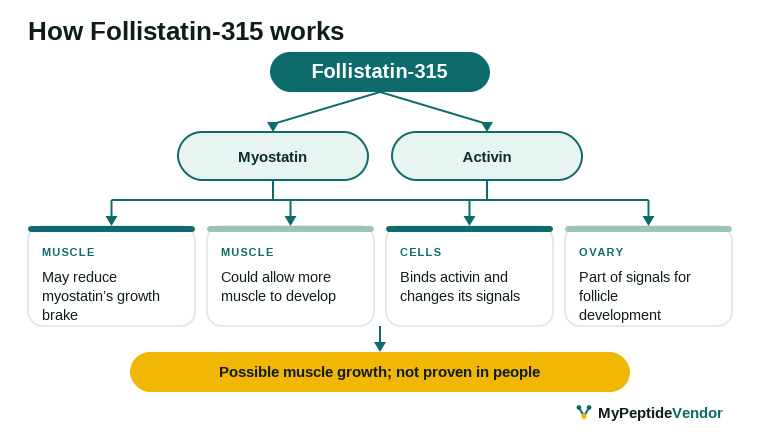
In plain terms, myostatin acts like a brake on muscle growth. Follistatin is proposed to bind myostatin and reduce that braking signal, which could allow more muscle to develop. That proposed mechanism does not prove that injecting FST-315 builds muscle in people.
Follistatin also binds activin. Because activin helps coordinate cell behavior, changing its activity may affect more than muscle 2. In the ovary, follistatin is part of a signaling network involving activin, GDF-9, and BMP-15, which are associated with ovarian function and follicle development 3.
That broader activity raises questions about reproductive hormones, metabolism, and tissue growth. It does not show that an injectable product causes a specific problem in people. Human studies have not established whether blocking activin as well as myostatin changes inflammation or metabolism, or whether it affects tumor biology or tissue growth.
Use this chart
Free to reuse with a link back:
What the clinical evidence actually shows

The most directly relevant human study here is Fujiwara and colleagues’ 2001 granulosa-cell transcript study of follicle aspirates 4. It measured transcripts in follicles 6–23 mm in size; it was not a treatment trial and did not measure muscle gain, fat loss, or effects of injected FST-315 4.
The researchers detected both FS-315 and FS-288 transcripts, with about 3 FS-315 transcripts for each FS-288 transcript; the ratio did not change with follicle size 4. In the polycystic ovary syndrome (PCOS) comparison, 6 patients contributed 8 follicles, while the normal comparison group included 5 normal follicles matched for mean diameter 4. Alpha-subunit mRNA was 16-fold lower in the PCOS follicle groups than in size-matched normal follicles 4. These are measurements of ovarian tissue, not changes caused by taking follistatin.
There is no controlled human trial of injectable FST-315 establishing muscle growth, fat loss, a dose, treatment duration, or adverse-event rates. The human follicle study measured gene transcripts and did not report a treatment duration because participants were not treated with injected FST-315 4. Human evidence from a follicle study cannot establish that an injectable product works or is safe for healthy people.
There is also no controlled human evidence here showing that FST-315 burns fat. No human trial result, participant count, or follow-up period for injectable FST-315 can be reported as an established treatment outcome. Whether injected FST-315 changes muscle mass, fertility, metabolism, or other tissues over time has not been studied in controlled human trials.
Use this chart
Free to reuse with a link back:
Typical dosing

There is no established human dose. No FDA-approved label or controlled human trial provides a dose range or schedule for injectable FST-315. The human follicle study involved tissue sampling, not dosing participants 4.
Vendor instructions are not a clinical dosing standard. A stated vial concentration does not establish the vial’s identity, sterility, strength, or suitability for injection. There is no supported cycle length or treatment duration to give for injectable FST-315.
Side effects: what to actually expect
No percentage can be given for side effects from injectable FST-315 because controlled human trials have not established adverse-event rates. There is no FDA-approved label listing common or serious reactions for this product.
Reproductive effects are a concern to discuss because activin and related growth factors are involved in ovarian function and follicle development 3. The human follicle study measured transcripts; it did not test injections or report effects on menstrual cycles, fertility, or reproductive hormones 4.
Metabolic, tumor-biology, and abnormal tissue-growth effects are also not quantified in people taking injectable FST-315. Activin is involved in regulating cell behavior 2, but that fact does not establish that an injection causes tumors or abnormal growth. Anyone considering an unapproved product should discuss reproductive and metabolic history with a clinician and avoid products with unverified identity or sterility.
Regulatory & access status in the US
Products sold with research-use labeling are not approved for human use, and that label does not establish that a vial is safe to inject.
FDA’s Category 2 page describes bulk substances nominated for compounding that may present significant safety risks 1. FDA's Category 2 list describes bulk substances that may present significant safety risks 1; it does not address whether follistatin-315 is permitted for compounding 1. FDA category status and FDA approval are separate questions; neither a vendor listing nor a research-use label establishes approval.
Athletes subject to drug testing should check the current rules for their sport and competition. A sports prohibition does not establish whether a product is FDA-approved.
There is no evidence-based seller recommendation for a research-labeled vial. Unverified products may not match their stated identity, strength, or sterility, and they are not regulated medications.
How it compares to its closest alternative
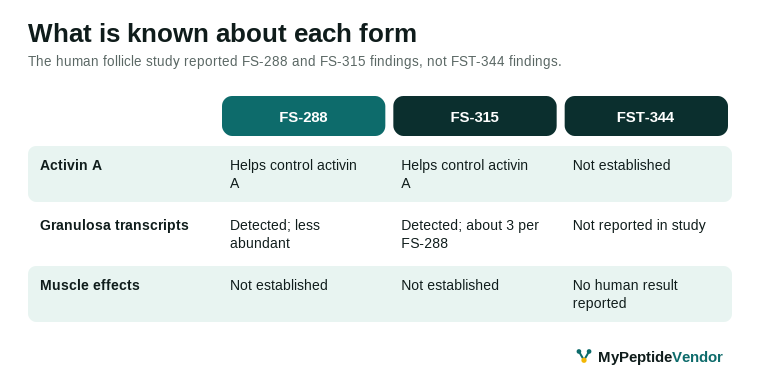
FS-288 is the closest alternative to FS-315 among the two main follistatin forms; both are involved in controlling activin A 23. Human granulosa cells contained transcripts for both forms, with FS-315 more abundant in the study 4. The cited human evidence does not establish that either form is better for muscle growth.
The comparison below separates what is known about FS-288 and FS-315 from what is not established about FST-344; the human follicle study reports findings for FS-288 and FS-315, not FST-344 4.
| Form | What is known | Human evidence |
|---|---|---|
| FS-288 | One of the two main follistatin forms; involved in controlling activin A. | Transcript detected in human granulosa cells; less abundant than FS-315 in the follicle study. |
| FS-315 | One of the two main follistatin forms; involved in controlling activin A. | About 3 transcripts per FS-288 transcript in granulosa cells; the ratio did not vary with follicle size. |
| FST-344 | No available human evidence establishes how this label relates to FS-315 or describes its tissue binding or delivery. | No human muscle, fat-loss, or injection result for FST-344 is reported in the follicle study. |
Use this chart
Free to reuse with a link back:
Ranked in our guides
Frequently asked questions
Does follistatin 344 burn fat?
There is no controlled human evidence here showing that FST-344 reduces body fat. The human follicle study measured ovarian-cell transcripts, not weight or body composition 4. Claims about fat loss from a different form or delivery method do not establish that an injectable FST-315 peptide works.
Where can I buy FLGR242 peptide?
I can’t recommend a seller for FLGR242 or another research peptide. Research-use labeling does not make a product an approved medicine, and the available FDA Category 2 excerpt does not establish whether follistatin is permitted or prohibited for compounding 1.
Do myostatin inhibitors really work?
Changing myostatin signaling is a plausible way to affect muscle growth, but that mechanism does not prove that a particular product works as a treatment. For injectable FST-315, controlled human evidence has not established muscle benefit, an effective dose, or safety.
What is the strongest peptide for muscle growth?
There is no evidence-based ranking of peptides by muscle-building strength. Follistatin is proposed to affect myostatin, but the human follicle study does not show that injected FST-315 increases muscle in healthy people 4.
References
- FDA: Certain bulk drug substances for use in compounding that may present significant safety risks
- Keah et al. A molecular recognition paradigm: promiscuity associated with the ligand-receptor interactions of the activin members of the TGF-beta superfamily. J Mol Recognit. 2005.
- Lin et al. Regulation of ovarian function by the TGF-beta superfamily and follistatin. Reproduction. 2003.
- Fujiwara et al. Dynamics of inhibin subunit and follistatin mRNA during development of normal and polycystic ovary syndrome follicles. J Clin Endocrinol Metab. 2001.
Written by the MyPeptideVendor editorial team from the FDA label, peer-reviewed studies and ClinicalTrials.gov records listed above, fact-checked line by line and reviewed 2026-11-12.
Cite this page
MyPeptideVendor Editorial Team. Follistatin 315: Evidence, Dose & Safety. MyPeptideVendor. Updated November 12, 2026. https://mypeptidevendor.com/peptides/follistatin-315/MyPeptideVendor Editorial Team. (2026, November 12). Follistatin 315: Evidence, Dose & Safety. MyPeptideVendor. https://mypeptidevendor.com/peptides/follistatin-315/Related peptides
CJC-1295
Not approvedCJC-1295 raises GH and IGF-1 in a short human trial, but benefits, long-term safety, and a standard dose remain unproven.
Learn moreGonadorelin
Not approvedGonadorelin signals the pituitary to release LH and FSH; US Factrel is 50 mcg/mL and labeled for animals, not people. [1]
Learn moreHexarelin
Research UseHexarelin can stimulate growth hormone release, but human evidence does not establish a dose or prove benefits for muscle, fat loss, recovery, or energy.
Learn more