Nootropic Peptides: Evidence, Uses & Risks
Nootropic peptides are a marketing category, not one drug class; none has an established FDA-approved indication for cognitive enhancement.

Nootropic peptides are peptides promoted or studied for possible effects on memory, attention, sleep, or other brain functions. “Nootropic peptide” is a marketing category, not a single drug class, and no peptide has an established FDA-approved indication for cognitive enhancement.
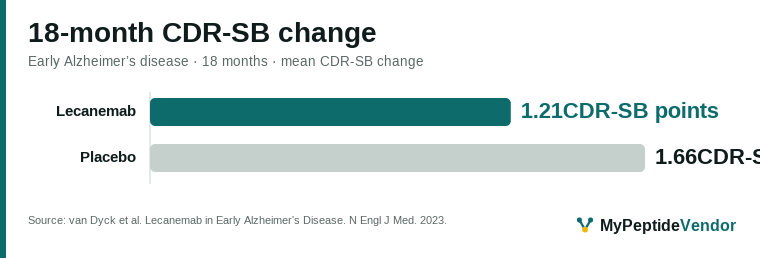
A proposed brain mechanism is not proof of better memory in people. A useful benchmark is a controlled human trial with a defined condition, comparison group, timeframe, and measured outcome, such as the 18-month Alzheimer’s trial design used for lecanemab 2.
Key takeaways
- There is no proven best peptide for the brain; the right care depends on the cause of the cognitive complaint.
- The cognitive-enhancement registry search lists 2 completed Phase 2 studies, neither of which establishes a named peptide as effective 12.
- Lecanemab’s 18-month trial measured change on a clinical scale from 0 to 18, illustrating how cognitive claims can be tested 2.
- Compounding is not FDA approval, and research chemicals are not approved treatments 1.
- Cancer treatment can cause cognitive problems, and clinical reviews describe several medicines studied for those symptoms without establishing a standard of care 56.
Peptides for cognitive enhancement
Semax
Not approvedSemax has limited human evidence after stroke, but benefits for focus, ADHD, and long-term safety remain unestablished.
Learn moreSelank
Not approvedSelank has been studied for anxiety, but small trials leave its dose, side-effect rates, and long-term safety uncertain.
Learn moreCerebrolysin
Not approvedCerebrolysin is an injectable brain-derived mixture used in some countries, but its benefits remain uncertain and it is not FDA-approved in the United States.
Learn morePinealon
Research UsePinealon is a short peptide studied for brain and circadian effects, but human evidence does not establish a dose, benefit, or safety profile.
Learn moreWhat peptide therapy for cognition means
In this setting, peptide therapy means taking a short chain of amino acids because it is claimed to affect brain function. The products grouped under “nootropic peptides” do not share one established medical use or one proven action. Some are discussed for memory or focus; others are promoted for anxiety, stress, sleep, or general brain support.
“Nootropic” describes an intended outcome, such as attention, learning, or memory. It does not identify a drug class or tell you whether a product is an approved medicine, a compounded preparation, or a substance sold for laboratory research. Those categories have different oversight, and none proves that a product works.
Cognition is not one outcome. Remembering a list, staying focused through a meeting, processing information quickly, and feeling mentally alert are different abilities. A treatment claim should name the specific ability it intends to change and how that change will be measured.
For new or worsening forgetfulness, identifying the cause comes before choosing a peptide. Cancer treatment is one recognized cause of cognitive dysfunction, and the risk can be affected by treatment history and age at diagnosis 56. A product marketed for “brain health” cannot be assumed to address the cause of an individual’s symptoms.
Whether these peptides improve cognition in healthy adults is not established. Feeling more alert, sleeping better, and remembering more are separate outcomes; one does not prove the others.
Use this chart
Free to reuse with a link back:
How these peptides are thought to work
Memory and attention rely on several brain systems. Brain-derived neurotrophic factor (BDNF) is a growth signal involved in neuron health and plasticity. Glutamate helps neurons strengthen or weaken connections, acetylcholine supports attention and memory, and gamma-aminobutyric acid (GABA) helps regulate neural activity. These pathways are not interchangeable measures of cognitive benefit.
Some peptide claims refer to BDNF or other growth signals. A change in a growth signal would be a biological finding, not proof that a person learns faster or remembers more. A human trial would need to measure the intended outcome, such as memory performance or a validated clinical scale.
Other proposed targets include neurotransmitter systems. The cholinergic system uses acetylcholine and is relevant to attention and memory; the glutamatergic system uses glutamate and helps regulate synaptic plasticity; the GABAergic system uses GABA to dampen neural activity. A claim that a peptide affects one system does not establish a useful effect in people.
Stress and sleep pathways may affect concentration indirectly. A product claimed to influence stress signaling or sleep might change how rested or calm someone feels, but that is not by itself proof of improved memory. The symptom being treated and the outcome being promised should be kept separate.
Claims that nootropic peptides reliably 'strengthen blood flow' or cause fewer adverse reactions are not established by current human trial evidence. A proposed mechanism, a change in blood flow, and a meaningful improvement in daily functioning are separate claims that require separate evidence.
Main peptides people search for
The most useful evidence number available for comparison is the registry count: the cited ClinicalTrials.gov cognitive-enhancement search lists 2 completed Phase 2 studies, one of Leukine in Alzheimer’s disease and one of D-cycloserine in non-demented older adults 12. Neither study is a trial of the seven peptides below. The count is not a worldwide tally of every study, and it cannot establish that a peptide has no research anywhere.
Semax. Semax is promoted for attention, memory, or neuroprotection, and BDNF signaling is often offered as a possible rationale. That proposed link does not show that taking Semax improves cognition. Best registry evidence number: 0 of the 2 listed cognitive-enhancement studies tested Semax 12. This count is not a total of all human, animal, or cell studies; an evidence-based US cognitive dose is not established.
Selank. Selank is commonly discussed for stress or anxiety-related concerns, with claims involving neurotransmitter and stress pathways. A possible effect on anxiety would not establish better memory or concentration. Best registry evidence number: 0 of the 2 listed cognitive-enhancement studies tested Selank 12. The registry count does not answer whether every reported study abroad or in other databases found benefit.
Dihexa. Dihexa is promoted around synapse formation and growth-factor signaling. A proposed mechanism, or a result in cells or animals, cannot establish a helpful effect in people. Best registry evidence number: 0 of the 2 listed cognitive-enhancement studies tested Dihexa 12. Human cognitive benefit and an evidence-based dose are not established here.
Cerebrolysin. Cerebrolysin is a mixture of small peptides and amino acids, rather than one single peptide. Its use or registration outside the United States would not make it an FDA-approved cognitive enhancer in the United States. Best registry evidence number: 0 of the 2 listed cognitive-enhancement studies tested Cerebrolysin 12. That registry count does not represent every clinical study in other settings.
DSIP. Delta sleep-inducing peptide (DSIP) is discussed in relation to sleep and stress physiology. A sleep-related theory does not establish treatment for insomnia or cognitive impairment. Best registry evidence number: 0 of the 2 listed cognitive-enhancement studies tested DSIP 12. No evidence-based cognitive dose is established.
Pinealon. Pinealon is marketed for brain or age-related support, with claims about cellular regulation. Those claims do not establish improved memory or prevention of cognitive decline in people. Best registry evidence number: 0 of the 2 listed cognitive-enhancement studies tested Pinealon 12.
Epithalon. Epithalon is promoted for aging or circadian-related effects. A claim about aging or sleep timing is not proof of improved cognition. Best registry evidence number: 0 of the 2 listed cognitive-enhancement studies tested Epithalon 12. A safe and effective cognitive dose is not established.
These registry numbers describe the two listed trials, not all research in every country or database 12. Animal or cell findings can help researchers choose what to test next, but they do not show that a product improves everyday thinking in humans. For each named peptide, the cited registry search does not provide a human cognitive outcome or an approved dosing standard.
FDA-approved, compounded, or research-only?

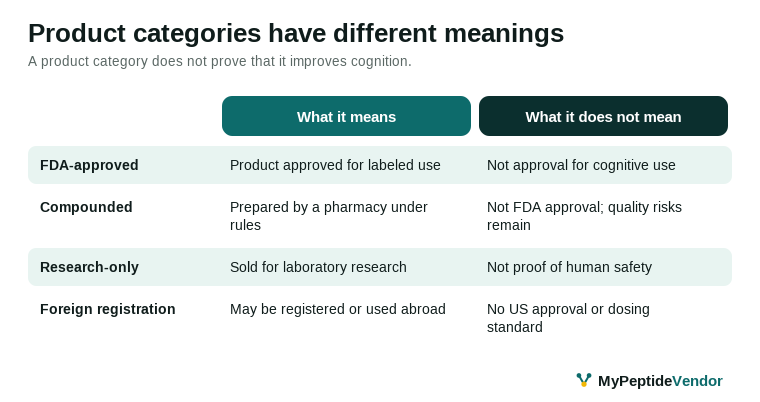
FDA approval applies to a specific drug product for a specific use. Compounding is a separate practice; it does not turn an ingredient into an FDA-approved treatment. FDA identifies some bulk substances nominated for compounding as presenting potential significant safety risks, but that category does not establish efficacy for cognition 1. The table separates product categories; it does not certify any seller or product.
| Category | What it means | What it does not mean |
|---|---|---|
| FDA-approved | A specific product has FDA approval for its labeled use. | Approval for another use does not establish approval for cognitive enhancement. |
| Compounded | A pharmacy prepares a medicine under applicable compounding rules and a prescriber’s order. | Compounding is not FDA approval, and it does not prove efficacy or remove quality risks. |
| Research-only | A product is sold for laboratory research, not as an established human treatment. | A research label does not establish identity, sterility, dose, safety, or suitability for human use. |
| Foreign registration or use | A product may be registered or used in another country. | Foreign status does not create FDA approval or an accepted US dosing standard. |
None of the seven peptides above has an established FDA-approved indication for cognitive enhancement in the United States. Some compounds may be registered or used abroad, but the status depends on the specific product and country. A foreign registration does not establish US approval or prove that the product improves memory.
“Compounded” and “research-only” are not interchangeable. A compounded medicine is prepared by a pharmacy for a patient under applicable rules. A research chemical is sold for laboratory research, not as a patient-specific prescription. Neither label proves that a product works for cognition or guarantees that its contents match a buyer’s expectations.
Ask what the exact product is, who prescribed it, which pharmacy prepared it, and what quality checks apply. FDA’s category 2 information concerns potential safety risks in nominated bulk substances; it is not a list of products proven effective for brain health 1.
Use this chart
Free to reuse with a link back:
Research-grade Cognitive Enhancement is available from American Peptides; code MYPEPTIDEVENDOR takes 15% off. Sold for laboratory research only, not for human use. Affiliate link
How to choose: start with the cause
There is no proven winner for “brain health.” Anxiety-related distraction, poor sleep, a medicine side effect, and progressive memory loss call for different assessments. Before considering an experimental product, write down when the problem began, which tasks are affected, and whether the change is getting worse.
A clinical visit can review the symptom pattern, sleep, mood, current medicines, medical history, and cancer-treatment history. A clinician may decide that testing or a specialist assessment is needed. Choosing a peptide by a promised mechanism, such as “BDNF support,” skips the question of what is causing the symptom.
A strong cognitive trial defines who is studied, what the comparison is, how long treatment lasts, and what outcome counts. In the lecanemab trial for early Alzheimer’s disease, 1,795 participants were assigned in a 1:1 ratio to lecanemab or placebo. Lecanemab was given by IV at 10 mg/kg every 2 weeks, and the primary outcome was change at 18 months on the Clinical Dementia Rating–Sum of Boxes (CDR-SB), a scale from 0 to 18 where higher scores indicate greater impairment 2.
That trial is a benchmark for measurement, not a recommendation to use lecanemab or a peptide. At 18 months, mean CDR-SB change was 1.21 with lecanemab and 1.66 with placebo, a difference of −0.45 points 2. A peptide claim that gives no comparison group, timeframe, or measured outcome provides much less information.
The two completed Phase 2 studies in the cited ClinicalTrials.gov search were NCT01409915, which studied Leukine in Alzheimer’s disease, and NCT01361633, which studied D-cycloserine in non-demented older adults 12. Trial registration alone does not show that a treatment worked, and neither listing establishes a named peptide as a cognitive enhancer.
Before agreeing to a treatment, ask what condition it is meant to address, what result will be measured, when it will be measured, and what would count as no benefit. If the answer is only “supports brain health,” the goal is too vague to assess.
Diet, cancer treatment, and psychiatric risk

Trimethylamine-N-oxide (TMAO) is a gut-microbe metabolite derived from dietary choline and carnitine. TMAO has been linked with cognitive decline in animal and human studies 4. This association does not prove that changing one food prevents dementia, but it is a reason to consider diet and broader health factors rather than assuming a peptide is the answer.
Cognitive problems after childhood cancer treatment need an oncology-informed assessment. Reported risk factors include younger age at diagnosis, cranial irradiation, parenteral or intrathecal methotrexate, and female sex 5. These factors do not predict an individual’s outcome, but they can help a care team decide what history and symptoms to review.
There is no established standard medication for cognitive symptoms caused by cancer therapy. Clinical reviews discuss methylphenidate, modafinil, donepezil, memantine, ginkgo, and erythropoietin, while noting mixed trial results and variable stimulant effects in adults 6. Do not add a peptide during cancer treatment without the oncology prescriber; interaction data for these peptide products are not established.
Brain-directed treatment can also raise psychiatric concerns. A review of anti-amyloid drugs reported that some potent treatments worsened neuropsychiatric symptoms and, in some cases, triggered suicidal ideation 11. This does not show that nootropic peptides cause the same effects. It does support discussing mood history and monitoring behavior when considering treatment aimed at the brain.
Tramiprosate is a separate example of an Alzheimer’s treatment candidate. It is a glycosaminoglycan mimetic designed to interfere with amyloid-beta processes; a review reported Phase II clinical data and described it as apparently well tolerated at that time 3. It is not one of the seven nootropic peptides above, and Phase II findings do not establish it as a proven cognitive enhancer.
Costs: what drives the bill

There is no reliable standard price for nootropic peptide therapy. The total cost depends on the compound, product source, dose and duration, clinician fees, laboratory work, follow-up visits, and whether care is delivered by telehealth or in a clinic. A low price does not confirm purity, sterility, or clinical value.
Ask for an itemized estimate before paying. Separate the visit fee from the product, shipping, testing, and repeat-care costs. A seller who promises a fixed cognitive result or presses you to buy a long course before a medical assessment is giving you a reason to pause.
Safety: benefits and risks are not settled
For products without an established human cognitive dose, the chance of benefit, the right amount, interactions, and long-term effects may all be unknown. Lack of reported harm does not establish long-term safety. This matters when a product is taken for months without a defined outcome or a clinician checking for side effects.
Product source matters. A compounded preparation and a research chemical have different intended uses and oversight. FDA has identified potential significant safety risks among some bulk substances nominated for compounding 1. “Available through a pharmacy” should not be read as “FDA-approved,” and a research-use label does not show that a product is fit for human use.
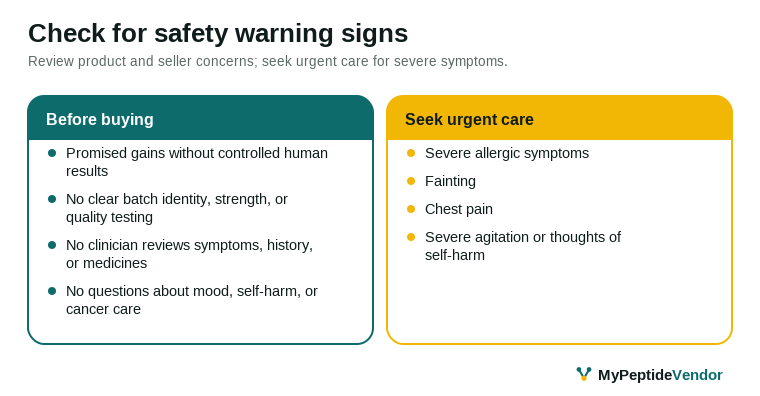
Watch for these warning signs before buying:
- The seller promises a proven increase in memory, focus, or IQ without a controlled human result.
- The batch has no clear identity, strength, or independent quality testing.
- No licensed clinician reviews your symptoms, medical history, or medication list.
- The seller does not ask about mood, suicidal thoughts, cancer treatment, or other relevant health concerns.
- The plan combines several products, making it hard to identify which one caused a benefit or harm.
Do not assume that a peptide is safe to combine with prescription medicines or cancer treatment. Cognitive symptoms may already be treated with medicines such as methylphenidate, modafinil, donepezil, or memantine 6. Interaction data for the named peptides are not established, so a pharmacist or prescriber should review the full medication list before any combination is considered.
Seek urgent care for severe allergic symptoms, fainting, chest pain, severe agitation, or thoughts of self-harm after taking any product. Keep the package and batch information available so a clinician can identify what was used.
Use this chart
Free to reuse with a link back:
How to get started: telehealth or clinic
A telehealth visit can be a reasonable first step if the clinician can assess the complaint, review medicines, and arrange an in-person exam or testing when needed. A clinic visit may be more useful when symptoms are changing quickly, come with neurological signs, or involve complex cancer or neurological care.
Bring a symptom timeline, a current list of medicines and supplements, and relevant treatment history. Ask the clinician to name the suspected cause, explain what evidence supports the proposed treatment, and state what outcome will be measured and when. A recommendation that only says “supports brain health” does not give you a clear way to judge benefit.
Do not choose a starting dose from an online forum or seller’s page. No approved cognitive dose is established for the named peptides. Ask whether the product is FDA-approved, compounded under applicable rules, or intended only for research, and discuss what is unknown before treatment begins.
Agree on a monitoring and stop plan before any experimental treatment. Specify which symptom will be tracked, when it will be reviewed, and what side effect or lack of improvement means stopping. Without a defined measure and review point, it is difficult to tell whether a treatment helped.
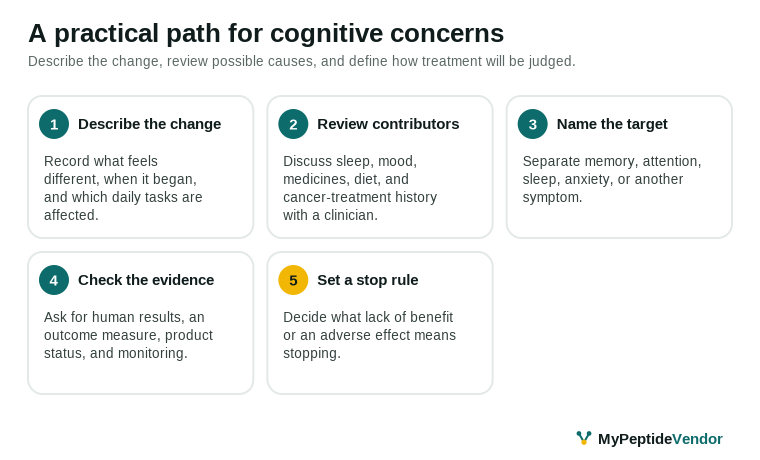
A practical decision path
- Describe the change. Record what feels different, when it began, and which daily tasks are affected.
- Review likely contributors. Discuss sleep, mood, medicines, medical conditions, diet, and cancer-treatment history with a clinician; TMAO has been linked with cognitive decline in animal and human studies 456.
- Name the target. Decide whether the concern is memory, attention, sleep, anxiety, or another symptom; these are not interchangeable outcomes.
- Check the evidence and product category. Ask for human trial results, a measured outcome, product status, and a monitoring plan.
- Set a stop rule. Decide in advance what lack of benefit or an adverse effect means the product should be stopped.
This sequence helps avoid treating a marketing label instead of a diagnosis. It also makes it easier to compare an experimental peptide with care aimed at the condition causing the symptom.
Use this chart
Free to reuse with a link back:
Dosing protocols
Adamax 5 mg
Research UseNo approved human Adamax dose exists; vial math can explain concentration, but it cannot confirm identity, safety, or a suitable injection schedule.
View protocolDSIP 10 mg
Research UseDSIP has no approved human dose; this 10 mg vial guide separates unverified community subcutaneous figures from small, older human IV studies.
View protocolWhere to Buy Cognitive Enhancement for Research
American Peptides
US-made research peptides, every lot third-party tested with a lot-matched COA.
15% offMYPEPTIDEVENDOR at checkout
- ≥99% purity verified by HPLC + mass spec, endotoxin tested
- Ships tracked from Louisiana, free shipping over $300
- 15% off your first order with code MYPEPTIDEVENDOR
Certified-Pep
US-made research peptides with batch-specific lab reports (COA) and a QR code on every vial.
- Independent laboratory testing (Vanguard Laboratory)
- Made in the USA, ships in 1-2 business days
- Research use only, not for human or veterinary use
Affiliate disclosure: we may earn a commission if you order through the link above. Cognitive Enhancement is not approved by the FDA for human use.
Frequently asked questions
What are nootropic peptides?
They are peptides promoted or studied for possible effects on brain functions such as memory, attention, mood, or sleep. “Nootropic peptide” is a marketing category, not one drug class. The cited cognitive-enhancement registry search lists 2 completed Phase 2 studies, but neither establishes one of these named peptides as effective 12.
What peptide is best for the brain?
There is no proven best peptide for the brain. The right care depends on whether the problem is memory, attention, sleep, anxiety, a medicine effect, or another condition. A useful efficacy test is a defined clinical outcome, such as the CDR-SB change measured over 18 months in the lecanemab Alzheimer’s trial 2.
What is the downside of taking peptides?
The main drawbacks are uncertain benefit, no established cognitive dose for many products, limited long-term safety information, and risks from unverified sourcing. Compounded products are not automatically FDA-approved, and research chemicals are not established human treatments 1.
What peptide does Joe Rogan take?
I can’t verify a peptide regimen used by Joe Rogan. Guessing about a person’s medication use would be speculation, and a celebrity claim would not establish safety or benefit for someone else.
References
- FDA: Certain bulk drug substances for use in compounding that may present significant safety risks
- van Dyck et al. Lecanemab in Early Alzheimer's Disease. N Engl J Med. 2023.
- Wright et al. Tramiprosate. Drugs Today (Barc). 2006.
- Buawangpong et al. The role of trimethylamine-N-Oxide in the development of Alzheimer's disease. J Cell Physiol. 2022.
- Castellino et al. Developing interventions for cancer-related cognitive dysfunction in childhood cancer survivors. J Natl Cancer Inst. 2014.
- Karschnia et al. Pharmacologic management of cognitive impairment induced by cancer therapy. Lancet Oncol. 2019.
- Klein et al. Repurposed molecules for antiepileptogenesis: Missing an opportunity to prevent epilepsy? Epilepsia. 2020.
- Singh et al. Tryptamine: A privileged scaffold for the management of Alzheimer's disease. Drug Dev Res. 2023.
- Rehman et al. Neuroendocrinology of ageing. Age Ageing. 2001.
- Ghai et al. Current Strategies and Novel Drug Approaches for Alzheimer Disease. CNS Neurol Disord Drug Targets. 2020.
- Panza et al. Do anti-amyloid-β drugs affect neuropsychiatric status in Alzheimer's disease patients? Ageing Res Rev. 2019.
- ClinicalTrials.gov: 2 registered studies (search: Cognitive Enhancement)
Written by the MyPeptideVendor editorial team from the FDA label, peer-reviewed studies and ClinicalTrials.gov records listed above, fact-checked line by line and reviewed 2026-11-12.
Cite this page
MyPeptideVendor Editorial Team. Nootropic Peptides: Evidence, Uses & Risks. MyPeptideVendor. Updated November 12, 2026. https://mypeptidevendor.com/treatment/cognitive-enhancement/MyPeptideVendor Editorial Team. (2026, November 12). Nootropic Peptides: Evidence, Uses & Risks. MyPeptideVendor. https://mypeptidevendor.com/treatment/cognitive-enhancement/