Cerebrolysin: Evidence, Dosing & US Status
Porcine-derived peptide mixture
Brand names: Cerebrolysin.
Cerebrolysin is a mixture of small peptides and amino acids derived from porcine brain, not one defined peptide molecule 46. It is used for acute ischemic stroke in some countries, and has also been studied for traumatic brain injury and vascular dementia 245.
A 2023 Cochrane review of 7 randomized trials with 1,773 people with acute ischemic stroke found that cerebrolysin did not show a clear reduction in deaths 4. Evidence for memory improvement in healthy people has not been established.
Key takeaways
- Cerebrolysin is a porcine-brain-derived mixture, not a single peptide with a fixed sequence 46.
- The 2023 acute-stroke review included 7 trials and 1,773 participants, including 272 participants in a trial of the similar agent Cortexin 4.
- The vascular-dementia review included 6 trials and 597 participants, with varying treatment regimens and follow-up 5.
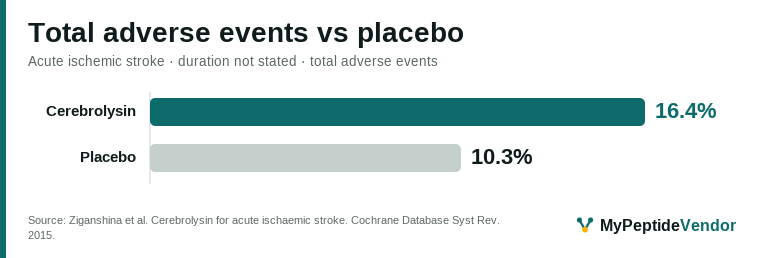
- A 2015 stroke review reported total adverse events of 16.4% with Cerebrolysin and 10.3% with placebo; this was not a count of people with at least one event 7.
- Cerebrolysin is not FDA-approved for a US medical use; online research-use-only listings are not a legitimate medical supply 4.
Cerebrolysin at a glance
- Class
- Porcine-brain-derived mixture of low-molecular-weight peptides and amino acids.
- Mechanism
- Proposed neuroprotective and neurotrophic activity; no single established target explains its effects.
- FDA Status
- Not FDA-approved for a US medical use.
- Brand names
- Cerebrolysin.
- Administration
- Daily intravenous infusion in clinical studies; regimens varied.
- Typical Dose
- No single dose is established by the reviews; doses and treatment durations varied.
- Half-life
- Not established for the mixture as a whole.
- Primary Uses
- Used in some countries for acute ischemic stroke and studied in traumatic brain injury and vascular dementia.
What is it?

Cerebrolysin is a preparation made from porcine (pig) brain. It contains low-molecular-weight peptide fragments and amino acids, rather than one purified substance with a fixed sequence 46. A dose therefore refers to the preparation as a whole, not a known amount of one active peptide.
It is widely used for acute ischemic stroke in Russia, Eastern Europe, China, and other Asian and post-Soviet countries 4. It has also been studied for traumatic brain injury (TBI) and vascular dementia, but those research areas do not establish that it works for every condition tested 25.
The mixture matters when comparing products. A result from a trial of a specific manufactured preparation cannot automatically be applied to an online vial whose composition, batch identity, or sterility has not been verified. The cited reviews do not establish that products sold as research materials match the preparation used in clinical studies 45.
What makes it different
Many medicines described as peptides have a defined amino-acid sequence. Cerebrolysin is an animal-tissue-derived mixture, so it cannot be treated as interchangeable with a single synthetic peptide 46. That also makes it harder to identify which component, if any, accounts for a clinical effect.
Its clinical evidence is concentrated in particular neurological conditions. The Cochrane reviews examined acute ischemic stroke and vascular dementia, not general memory enhancement or brain performance in healthy adults 45.
The FDA’s Category 2 framework concerns certain bulk substances nominated for compounding that may present significant safety risks. A compounding category is not FDA approval, and it does not establish that a substance can be legally prescribed or compounded for a patient 1.
How does it work?
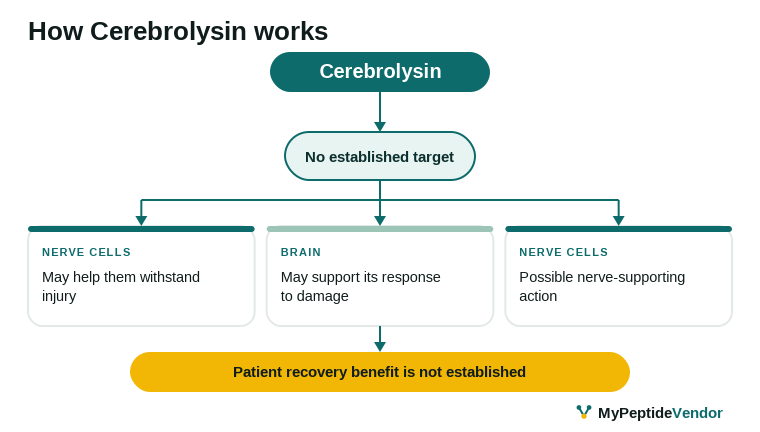
In plain terms, the theory is that Cerebrolysin may help nerve cells withstand injury and support the brain’s response to damage. Researchers describe possible neuroprotective effects 4 and neurotrophic properties 6. Those terms describe proposed biological actions; they do not prove that patients recover better.
The mixture does not have one established target that explains all of its proposed effects 46. The outcomes that matter to patients (survival, independence, and daily function) must be assessed in clinical trials, rather than inferred from a proposed mechanism.
A change on a cognitive test is not the same as becoming more independent after a stroke. The 2016 and 2017 Cochrane reviews noted that the included trials did not report the combined outcome of death or dependence at the end of follow-up 69.
Use this chart
Free to reuse with a link back:
What the clinical evidence actually shows

For acute ischemic stroke, successive Cochrane updates included more trials and participants, but did not establish a clear mortality benefit. The 2015 review included 1 trial with 146 people; the 2016 and 2017 reviews included 6 trials with 1,501 people; the 2020 review included 7 trials with 1,601 people; and the 2023 review included 7 trials with 1,773 people 46789. The 2023 update added 272 participants from a trial of Cortexin, a Cerebrolysin-like agent 4.
In the 2016 review, 46 of 714 people assigned Cerebrolysin died, compared with 47 of 703 assigned placebo. The risk ratio was 0.91, with a 95% confidence interval from 0.61 to 1.35; that result does not show a clear difference 69. The 2020 review also judged that Cerebrolysin probably made little or no difference to all-cause death, with a risk ratio of 0.90 and a 95% confidence interval from 0.61 to 1.32 8.
The 2023 review assessed benefits and harms but did not report a numerical finding for serious adverse events 4. The 2017 review found no statistically significant difference in total serious adverse events: risk ratio 1.16, with a 95% confidence interval from 0.81 to 1.67 9. These figures do not show that every patient faces the same risk.
Trial quality limits confidence. In the 2016 review, 5 studies had high risk of bias from incomplete outcome data, and allocation concealment was unclear in 5 studies 69. The manufacturer supported 3 multicenter studies in that review and 4 in the 2020 review 68. Manufacturer involvement does not by itself invalidate a result, but independent confirmation would help resolve uncertainty.
For vascular dementia, the 2019 Cochrane review included 6 randomized trials and 597 participants. Four trials described participants as having mild-to-moderate dementia, and follow-up ranged from 15 days to 3 years 5. The review assessed cognition, global function, and all-cause mortality; the trials used different doses and treatment durations 5. Any benefit for cognition or overall function is modest or uncertain. This evidence concerns vascular dementia, not memory enhancement in healthy people.
For TBI, a 2025 review reported that neuroprotective research had not produced a viable treatment option to date 2. A 2024 review described ongoing debate about the efficacy and safety of neuroprotective agents, including Cerebrolysin, in stroke rehabilitation 3. These reviews do not establish a dependable benefit for routine brain-injury treatment or rehabilitation.
| Condition | Review | Participants | Comparator or outcomes | Finding and limits |
|---|---|---|---|---|
| Acute ischemic stroke | Cochrane, 2015 | 1 trial; 146 people | Placebo; death and adverse events | No clear difference in deaths; risk of bias was high |
| Acute ischemic stroke | Cochrane, 2016/2017 | 6 trials; 1,501 people | Placebo or no treatment; death and serious adverse events | No clear mortality difference; design limitations affected confidence |
| Acute ischemic stroke | Cochrane, 2020 | 7 trials; 1,601 people | Placebo or no treatment; all-cause death and harms | Probably little or no difference in all-cause death |
| Acute ischemic stroke | Cochrane, 2023 | 7 trials; 1,773 people | Placebo or no treatment; benefits and harms | Includes 272 participants from a Cortexin trial; no verified numerical SAE result stated here |
| Vascular dementia | Cochrane, 2019 | 6 trials; 597 people | Cognition, global function, and mortality | Possible benefit remains uncertain; regimens varied |
Stroke and dementia results are not a direct contradiction: the reviews studied different conditions and outcomes. Stroke reviews focused on outcomes such as death, while the vascular-dementia review assessed cognition and global function 45. Neither establishes a broad, reliable benefit for the brain.
Trial registration shows that research continues, not that treatment works. The ClinicalTrials.gov search lists 43 studies; examples include a recruiting Phase 4 study of prolonged disorders of consciousness (NCT04427241), a completed Phase 3 TBI study combining Cerebrolysin with amantadine (NCT06052787), and a recruiting Phase 1/2 Bell’s palsy study comparing prednisolone with Cerebrolysin (NCT05821075) 10.
Use this chart
Free to reuse with a link back:
Typical dosing

There is no single trial dose or duration that can be presented as a standard regimen from these reviews. In vascular-dementia studies, Cerebrolysin was given by daily intravenous infusion, but doses and treatment durations varied 5. The acute-stroke reviews included treatment started within 48 hours of stroke onset and continued for varying lengths of time 468.
These are descriptions of supervised clinical research, not instructions for self-treatment. The reviewed studies used daily intravenous infusions and do not establish a safe or effective self-administration schedule 5. A possible stroke is an emergency; do not delay urgent assessment while seeking Cerebrolysin 46.
Side effects: what to actually expect
A 2015 Cochrane review reported total adverse events of 16.4% in the Cerebrolysin group versus 10. Total adverse events were 16.4% with Cerebrolysin vs 10.3% with placebo; the denominator is not clearly defined 7. The risk ratio was 1.62, with a wide 95% confidence interval from 0.69 to 3.82 7.
The 2017 review found no statistically significant difference in total serious adverse events: the risk ratio was 1.16, with a 95% confidence interval from 0.81 to 1.67 9. That interval is compatible with different levels of risk, so it cannot be used to predict an individual patient’s outcome.
They also describe clinical study use, not self-injection of a product with uncertain identity or sterility. Ask a clinician to review possible harms before considering any treatment.
Regulatory & access status in the US (as of 2026)
Cerebrolysin is not FDA-approved for a US medical use. It is used for acute ischemic stroke in Russia, Eastern Europe, China, and other Asian and post-Soviet countries 4. Use outside the United States does not mean the medicine is approved for US patients.
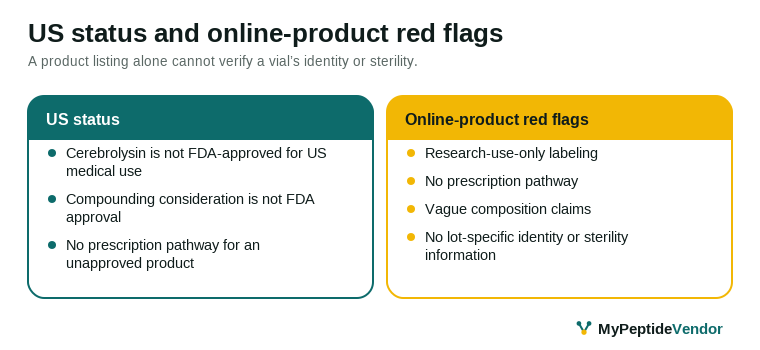
The FDA’s Category 2 framework is an interim policy for certain bulk drug substances nominated for compounding that may present significant safety risks 1. Being considered under a compounding framework is not the same as FDA approval of a finished medicine. It also does not create a prescription pathway for an unapproved product.
In a country where Cerebrolysin is authorized as a medicine, access should be through that country’s lawful medical system and a clinician. In the United States, a website selling a vial as research-use-only material is not a legitimate medical source or a substitute for a prescription and clinical care. A product listing alone cannot verify that a vial matches the preparation used in a clinical trial.
Watch for practical red flags: research-use-only labeling, no prescription pathway, vague composition claims, no lot-specific identity or sterility information, and instructions to self-inject. Do not use an online product to treat stroke, dementia, or brain injury; ask a physician about appropriate care. Call 911 for sudden weakness, facial drooping, or trouble speaking.
Use this chart
Free to reuse with a link back:
Research-grade Cerebrolysin is available from Certified-Pep. Sold for laboratory research only, not for human use. Affiliate link
How it compares to its closest alternative
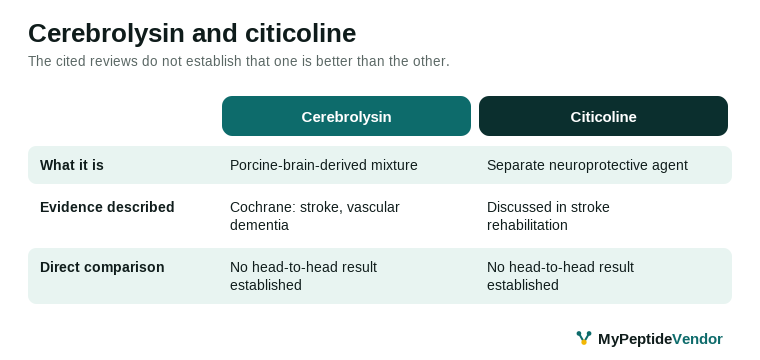
Citicoline is another neuroprotective agent discussed in stroke rehabilitation reviews alongside Cerebrolysin 3. The cited review material does not establish that one is better than the other, so this is a comparison of what is known about their evidence base, not a treatment recommendation.
| Feature | Cerebrolysin | Citicoline |
|---|---|---|
| What it is | Porcine-brain-derived mixture of peptide fragments and amino acids | A separate neuroprotective agent discussed in stroke reviews |
| Evidence described here | Cochrane reviews cover acute stroke and vascular dementia | Discussed as an agent used in stroke neurorehabilitation |
| Direct comparison | No head-to-head result is established in the cited reviews | No head-to-head result is established in the cited reviews |
| Practical point | Trial findings do not establish benefit from self-sourced products | Evidence for citicoline cannot be inferred from Cerebrolysin trials |
Use this chart
Free to reuse with a link back:
Where to Buy Cerebrolysin for Research
Certified-Pep
US-made research peptides with batch-specific lab reports (COA) and a QR code on every vial.
- Independent laboratory testing (Vanguard Laboratory)
- Made in the USA, ships in 1-2 business days
- Research use only, not for human or veterinary use
Affiliate disclosure: we may earn a commission if you order through the link above. Cerebrolysin is not approved by the FDA for human use.
Frequently asked questions
What is the purpose of Cerebrolysin?
It has been examined in studies as a possible supportive treatment after neurological injury or decline, including in acute stroke and vascular dementia 45. The evidence is not strong enough to establish a dependable benefit across the conditions studied 245.
Where can I purchase Cerebrolysin?
In a country where it is authorized as a medicine, ask a local clinician about the lawful prescription route. A US research-use-only listing does not verify medical quality or provide a legitimate treatment pathway; discuss options with a US-licensed physician.
Why is Cerebrolysin not approved in the US?
It does not have FDA approval for a US medical use 4. The FDA’s compounding framework addresses certain nominated bulk substances, not approval of a finished Cerebrolysin medicine 1; a specific FDA explanation for its non-approval is not established here.
Does Cerebrolysin improve memory?
The relevant dementia review studied vascular dementia, not healthy people seeking better recall 5. It does not establish that Cerebrolysin improves memory in healthy adults or in every form of dementia.
References
- FDA: Certain bulk drug substances for use in compounding that may present significant safety risks
- Cook et al. Update on Neuroprotection after Traumatic Brain Injury. CNS Drugs. 2025.
- Yanık et al. Current neuroprotective agents in stroke. Turk J Phys Med Rehabil. 2024.
- Ziganshina et al. Cerebrolysin for acute ischaemic stroke. Cochrane Database Syst Rev. 2023.
- Cui et al. Cerebrolysin for vascular dementia. Cochrane Database Syst Rev. 2019.
- Ziganshina et al. Cerebrolysin for acute ischaemic stroke. Cochrane Database Syst Rev. 2016.
- Ziganshina et al. Cerebrolysin for acute ischaemic stroke. Cochrane Database Syst Rev. 2015.
- Ziganshina et al. Cerebrolysin for acute ischaemic stroke. Cochrane Database Syst Rev. 2020.
- Ziganshina et al. Cerebrolysin for acute ischaemic stroke. Cochrane Database Syst Rev. 2017.
- ClinicalTrials.gov: 43 registered studies (search: Cerebrolysin)
Written by the MyPeptideVendor editorial team from the FDA label, peer-reviewed studies and ClinicalTrials.gov records listed above, fact-checked line by line and reviewed 2026-11-12.
Cite this page
MyPeptideVendor Editorial Team. Cerebrolysin: Evidence, Dosing & US Status. MyPeptideVendor. Updated November 12, 2026. https://mypeptidevendor.com/peptides/cerebrolysin/MyPeptideVendor Editorial Team. (2026, November 12). Cerebrolysin: Evidence, Dosing & US Status. MyPeptideVendor. https://mypeptidevendor.com/peptides/cerebrolysin/Related peptides
Semax
Not approvedSemax has limited human evidence after stroke, but benefits for focus, ADHD, and long-term safety remain unestablished.
Learn moreSelank
Not approvedSelank has been studied for anxiety, but small trials leave its dose, side-effect rates, and long-term safety uncertain.
Learn morePinealon
Research UsePinealon is a short peptide studied for brain and circadian effects, but human evidence does not establish a dose, benefit, or safety profile.
Learn more