Pinealon Peptide: Evidence, Dose & Safety
Short peptide bioregulator
Brand names: Pinealon; EDR
Researchers discuss pinealon in relation to brain-cell protection and circadian biology, but human evidence does not establish a treatment benefit or safe dose 234. The most detailed human report involved 150 male truck drivers and 150 male metal craftsmen; it did not isolate pinealon’s effect 3.
Key takeaways
- The 2012 occupational study included 150 drivers and 150 metal craftsmen, and it reported results only for a combined pinealon and vezugen regimen, with no Pinealon-only arm, where the strongest reported effect involved that combination 3.
- That study reported statistical significance from p < 0.001 to p < 0.05, but no numerical size of benefit 3.
- No Pinealon-specific human dose, course length, or adverse-event percentage is established in the described clinical reports 34.
- The FDA excerpt available for review does not show its full Category 2 list, so Pinealon’s presence or absence cannot be confirmed 1.
- A COA should identify the peptide and match the product lot; a stated molecular weight near 418.4 g/mol is a useful identity check.
Pinealon at a glance
- Class
- Short peptide grouped with bioregulator peptides
- Mechanism
- Proposed links to circadian and mitochondrial regulation; a human melatonin effect is not established
- FDA Status
- The supplied FDA Category 2 excerpt is incomplete; it does not establish Pinealon’s listing, approval, or compounding eligibility
- Brand names
- Pinealon; EDR
- Administration
- No established human route or Pinealon-only regimen is described
- Typical Dose
- No established human dose
- Half-life
- Not established in humans
- Primary Uses
- Research interests include neuroprotection and circadian and mitochondrial regulation
What is it?

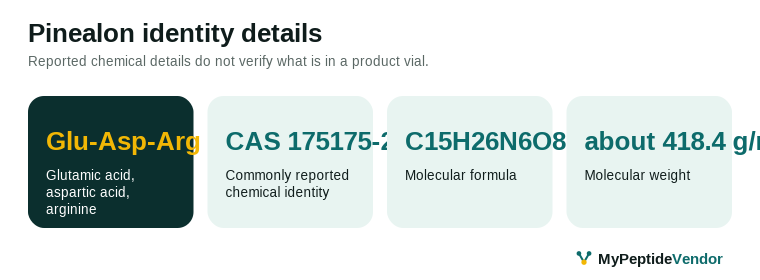
Pinealon is a short peptide made from glutamic acid, aspartic acid, and arginine, often written as Glu-Asp-Arg or EDR. Its commonly reported chemical identity is CAS 175175-23-2, formula C15H26N6O8, and molecular weight about 418.4 g/mol. These are identity details, not proof that a vial contains the stated material.
A 2013 review places Pinealon among short peptides, alongside semax and kortagen, and distinguishes that group from polypeptide complexes such as cortexin and cerebrolizin 4. The distinction describes the material’s research category; it does not show that Pinealon is safer or more effective than those alternatives.
Research interests include neuroprotection 4 and circadian and mitochondrial regulation 2. Sleep, cognition, and longevity are often discussed as possible applications, but the cited clinical material does not establish those benefits for Pinealon 234.
For laboratory procurement, check that the COA’s identity testing matches the product lot and that its stated molecular weight is near 418.4 g/mol. Follow the supplier’s storage and handling directions for research material; there is no established human reconstitution or storage protocol for treatment.
Use this chart
Free to reuse with a link back:
What makes it different
Pinealon is a three-amino-acid peptide, while cortexin and cerebrolizin are polypeptide complexes in the 2013 review’s classification 4. That shorter structure is a chemical distinction, not evidence that Pinealon reaches the brain, acts faster, or has fewer side effects.
A 2026 review groups Pinealon with epithalon and delta sleep-inducing peptide as recovery peptides aimed at circadian and mitochondrial regulators 2. The same review says clinical trials are lacking for therapeutic peptides generally 2. That broad statement does not supply a Pinealon-specific trial result.
The human report most directly relevant here focused on work-related neurobehavioral symptoms, not sleep or memory testing 3. Its strongest reported outcome came from combining Pinealon with vezugen, so it cannot tell a reader what Pinealon alone did 3.
How does it work?
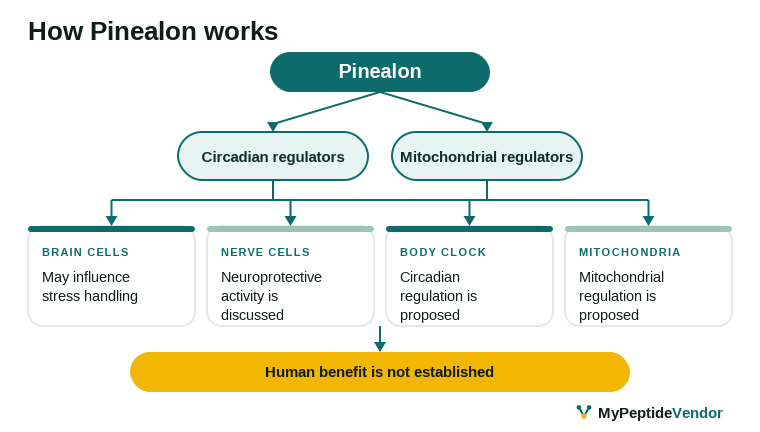
In plain words: Researchers are asking whether Pinealon can influence how brain cells handle stress and how the body keeps time. A 2026 review describes proposed links to circadian and mitochondrial regulators 2. Those proposed links do not establish a human effect.
The pineal gland produces melatonin, a hormone involved in the sleep-wake cycle. Pinealon is described as a circadian and mitochondrial regulator 2, but the clinical evidence described here does not show that it increases melatonin or improves sleep in people 34. A proposed link is not the same as a demonstrated hormone change.
In technical terms, neuroprotection refers to limiting injury to nerve cells. A 2013 review groups Pinealon with short peptides discussed for neuroprotective activity 4. The clinical details available do not establish a specific human pathway, amount reaching the brain, or duration of action 34.
Use this chart
Free to reuse with a link back:
What the clinical evidence actually shows

The clearest named human report is Bashkireva and colleagues’ 2012 study, “The peptide correction of neurotic disorders among professional truck-drivers” 3. It examined 150 male lorry drivers, with a mean age of 43.3 years, and 150 male metal craftsmen, with a mean age of 42.8 years 3. The drivers had more unstable psychological adaptation and borderline mental-disorder symptoms than the control group 3.
The report says bioregulating peptide treatment improved psychoemotional measures, resistance to work stress, and occupational risk, with significance levels from p < 0.001 to p < 0.05 3. The best effect was reported when Pinealon was combined with vezugen 3. The report does not give a numerical size of improvement, a Pinealon-only result, a clear Pinealon dose, or treatment duration 3.
The study’s occupational setting matters: the participants were working men in two trades, and the report linked symptoms among drivers to occupational exposure and work schedules 3. It cannot establish that Pinealon treats insomnia, improves memory, or prevents a brain disease.
A 2013 review describes clinical applications of peptide bioregulators in elderly and old-age people, but gives no Pinealon-specific trial details such as a sample size, dose, duration, or numerical result 4. The 2026 review says clinical trials are lacking for therapeutic peptides generally 2. Neither source supplies a controlled Pinealon trial with a defined clinical benefit.
Human dosing, long-term safety, effects on melatonin, and interactions with sleep medicines remain unestablished in the clinical material described here 234. No Pinealon-specific traumatic brain injury trial dose or result can be given from these reports. The clinical report also does not provide a Pinealon-only treatment arm or a treatment duration 3.
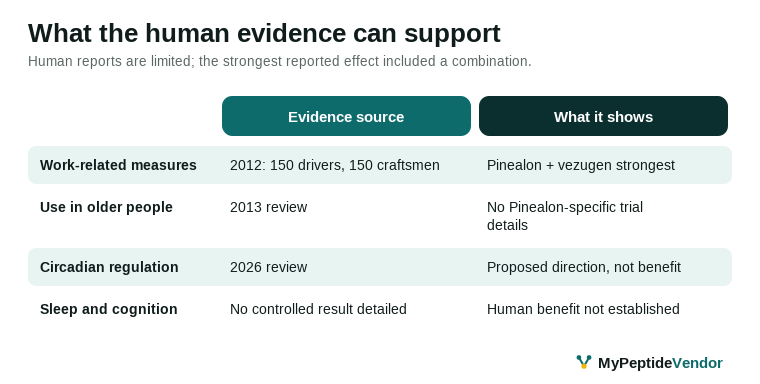
The human reports and reviews describe different kinds of evidence, with important limits for each 234.
| Claim or topic | Evidence type and size | What it can support |
|---|---|---|
| Work-related neurobehavioral measures | 2012 occupational study: 150 drivers and 150 craftsmen | Peptide treatment was reported to improve measures; the strongest effect involved Pinealon plus vezugen, so Pinealon’s separate effect is unclear. |
| Use in older people | 2013 review of peptide bioregulators | Describes clinical applications in older people, but provides no Pinealon-specific trial numbers or outcome. |
| Circadian and mitochondrial regulation | 2026 review of therapeutic peptides | A proposed research direction, not a demonstrated Pinealon treatment benefit. |
| Sleep, melatonin, cognition, or longevity | No controlled human result is detailed in these sources | Human benefit for these outcomes is not established. |
Use this chart
Free to reuse with a link back:
Typical dosing

No human Pinealon dose, treatment length, or approved route is established in the described clinical reports and reviews 234. The 2012 occupational study does not report a Pinealon-only regimen or a duration 3. That leaves no evidence-based personal dosing schedule.
| Setting | What is reported | How to read it |
|---|---|---|
| Human occupational study | No Pinealon-only dose or treatment duration is stated | The best reported effect involved Pinealon combined with vezugen. |
| Review of older adults | No Pinealon-specific schedule is provided | A review of peptide applications is not a dosing protocol. |
| Human use | No established dose or course is described | There is no supported regimen to recommend. |
For research material, reconstitution and storage directions depend on the product and its documentation. Check the lot-specific COA and handling instructions before laboratory work. A research-use-only disclaimer is not a human-use dosing guide.
Side effects: what to actually expect
No dependable percentage describes Pinealon side effects because the clinical report and reviews do not provide a Pinealon-specific adverse-event rate 234. The correct percentage is unknown, not 0%. There is no human safety dataset here that lets a reader estimate how often headache, nausea, sleep changes, or other reactions might occur.
The 2012 occupational report gives no Pinealon-specific safety analysis or adverse-event percentage 3. The 2013 review discusses peptide bioregulators in older people but does not provide a Pinealon-specific safety rate 4. A lack of a reported reaction count is not proof of safety.
Interactions with melatonin, prescription sleep medicines, or other drugs have not been established in the described clinical material 234. Do not treat research-use material as a medicine; a supplier’s purity statement or COA does not establish safety for injection or personal use.
Regulatory & access status in the US (as of 2026)
FDA’s Category 2 page concerns certain bulk substances nominated for compounding that may present significant safety risks 1. Whether Pinealon appears on FDA's Category 2 list of bulk drug substances with significant safety risks is not established by the cited FDA listing 1. The excerpt also does not establish FDA approval or eligibility for compounding 1.
Research-use-only labeling means a product is supplied for laboratory research, not as a human medicine. That label does not establish that a substance is approved, safe to use, or legal for every purpose. The regulatory information cited here does not settle Pinealon’s general purchase or possession status in every US jurisdiction 1.
Before buying, check the current federal, state, and local rules that apply to the product and intended use. For laboratory work, confirm the COA matches the lot, verify the stated identity, and follow the supplier’s storage and handling directions. Those checks support material identification; they do not make it suitable for human use.
Research-grade Pinealon is available from American Peptides (PINEALON, from $60.00); code MYPEPTIDEVENDOR takes 15% off. Sold for laboratory research only, not for human use. Affiliate link
How it compares with semax
Semax is a close comparison because a 2013 review groups it with Pinealon as a short peptide discussed for neuroprotective activity 4. The same review contrasts these short peptides with polypeptide complexes such as cortexin and cerebrolizin 4. It does not describe a head-to-head Pinealon-versus-semax clinical trial 24.
The comparison below reflects the categories and human evidence described in the reviews and occupational report 234.
| Feature | Pinealon | Semax |
|---|---|---|
| Research category | Short peptide; discussed in relation to circadian and mitochondrial regulators | Short peptide grouped with neuroprotective peptides |
| Human evidence described here | Occupational report involving peptide treatment; Pinealon’s separate effect is unclear | Named in a review, without comparative trial details |
| Established human dose and safety rate | Not established in the described reports | Not established by the cited comparison |
| Direct comparison | No head-to-head clinical comparison is described. | |
Neither the shared research category nor a proposed mechanism establishes that either peptide is a proven sleep treatment 24. The cited comparison does not show which would be more effective or safer for an individual.
Where to Buy Pinealon for Research
American Peptides
PINEALON · from $60.00
US-made research peptides, every lot third-party tested with a lot-matched COA.
15% offMYPEPTIDEVENDOR at checkout
- ≥99% purity verified by HPLC + mass spec, endotoxin tested
- Ships tracked from Louisiana, free shipping over $300
- 15% off your first order with code MYPEPTIDEVENDOR
Certified-Pep
US-made research peptides with batch-specific lab reports (COA) and a QR code on every vial.
- Independent laboratory testing (Vanguard Laboratory)
- Made in the USA, ships in 1-2 business days
- Research use only, not for human or veterinary use
Affiliate disclosure: we may earn a commission if you order through the link above. Pinealon is not approved by the FDA for human use.
Frequently asked questions
What is Pinealon peptide used for?
Research discusses Pinealon in connection with neuroprotection and circadian or mitochondrial regulation 24. Those interests do not establish a medical use, and the 2012 human report focused on occupational neurobehavioral symptoms rather than a Pinealon-only treatment 3.
What are the side effects of Pinealon?
A human side-effect percentage has not been established; the occupational report does not give a Pinealon-specific adverse-event count 3. Interactions with melatonin or sleep medicines are also not established in the described clinical material 234.
What peptide does Joe Rogan take?
The clinical studies and reviews described here do not establish what peptides Joe Rogan takes. They also do not provide clinical evidence for a Pinealon sleep benefit 234.
What peptides help the pineal gland?
Pinealon is discussed in relation to circadian biology, but the human evidence described here does not establish that it improves pineal-gland function or increases melatonin 234. No peptide is established by these sources as a proven way to improve the gland’s function.
References
- FDA: Certain bulk drug substances for use in compounding that may present significant safety risks
- Rahman et al. Therapeutic Peptides in Orthopaedics: Applications, Challenges, and Future Directions. J Am Acad Orthop Surg Glob Res Rev. 2026.
- Bashkireva et al. [The peptide correction of neurotic disorders among professional truck-drivers]. Adv Gerontol. 2012.
- Umnov et al. [Neuroprotective effects of peptides bioregulators in people of various age]. Adv Gerontol. 2013.
Written by the MyPeptideVendor editorial team from the FDA label, peer-reviewed studies and ClinicalTrials.gov records listed above, fact-checked line by line and reviewed 2026-11-12.
Cite this page
MyPeptideVendor Editorial Team. Pinealon Peptide: Evidence, Dose & Safety. MyPeptideVendor. Updated November 12, 2026. https://mypeptidevendor.com/peptides/pinealon/MyPeptideVendor Editorial Team. (2026, November 12). Pinealon Peptide: Evidence, Dose & Safety. MyPeptideVendor. https://mypeptidevendor.com/peptides/pinealon/Related peptides
Semax
Not approvedSemax has limited human evidence after stroke, but benefits for focus, ADHD, and long-term safety remain unestablished.
Learn moreSelank
Not approvedSelank has been studied for anxiety, but small trials leave its dose, side-effect rates, and long-term safety uncertain.
Learn moreCerebrolysin
Not approvedCerebrolysin is an injectable brain-derived mixture used in some countries, but its benefits remain uncertain and it is not FDA-approved in the United States.
Learn more