Peptides for Immune System: Evidence & Safety
Thymosin alpha-1 has the most clinical evidence, but mixed results do not support routine peptide injections to boost immunity in healthy adults.
Peptides for immune system support are molecules studied for how they signal or affect immune cells. Thymosin alpha-1 has the strongest clinical evidence among the peptides discussed here, but results differ by condition and do not show that healthy adults need immune-boosting injections.
In a 508-patient trial of severe pancreatitis, thymosin alpha-1 did not significantly reduce infected pancreatic necrosis 11. A sepsis meta-analysis found a possible benefit overall, but not in its high-quality or multicenter trial subgroups 10. These findings call for care, not a general promise to prevent illness.
Key takeaways
- Thymosin alpha-1 has been studied in hepatitis B, sepsis, and severe pancreatitis, with both positive and null findings 3,10,11.
- A meta-analysis of 11 sepsis trials found an overall odds ratio of 0.73 for 28-day mortality, while high-quality and multicenter subgroups were not significant 10.
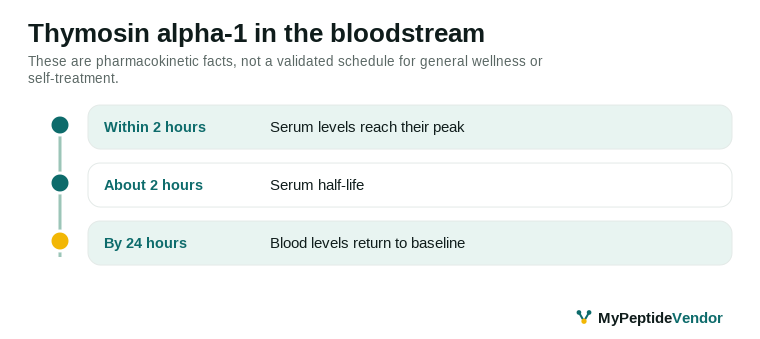
- Thymosin alpha-1 peaks in the blood within about 2 hours, has a roughly 2-hour half-life, and returns to baseline within 24 hours 3.
- Thymosin beta-4 binds G-actin; that finding should not be confused with thymosin alpha-1 or assumed to prove an immune benefit 2.
- No cited source establishes that BPC-157 increases immune function in humans.
Peptides for immune support
Thymogen
Not establishedThymogen is a Russian-origin Glu-Trp dipeptide studied in small clinical reports; its benefits, safe dose, and US regulatory status remain uncertain.
Learn moreThymosin Alpha-1
Not establishedThymosin alpha 1 is an immune-modulating peptide studied for hepatitis, sepsis, cancer support, and vaccine response; evidence and US status vary.
Learn moreVIP
Research UseVIP is a 28-amino-acid signaling peptide studied in laboratory and animal research; a 6 mg vial is not an established human dose.
Learn moreARA-290
Not approvedARA-290 is an investigational peptide with small, short neuropathy trials, but no established dose or proof of lasting nerve recovery.
Learn moreWhat peptide therapy for immune support means
A peptide is a short chain of amino acids, the same building blocks that form proteins. Some peptides act as signals: they bind to receptors or affect cell processes, which can change how cells communicate. In an immune response, T cells recognize foreign material presented by other immune cells and respond when they receive the appropriate signals. That is ordinary immune signaling, not proof that an injected peptide will prevent infection.
Peptide therapy for immune support usually means giving a manufactured peptide to try to change immune activity. The intended effect may be to adjust a particular immune pathway, rather than simply turn the whole immune system up. A change in a blood marker is not the same as fewer infections, a quicker recovery, or better survival.
Thymosin alpha-1, also called thymalfasin, is the main immune-focused peptide with clinical findings discussed on this page. It is thought to augment T-cell function and may affect the development or activity of thymocytes, the developing cells in the thymus 3. The human trials described here involve conditions such as hepatitis B, sepsis, and severe pancreatitis, not routine prevention in healthy adults 3,10,11.
The phrase “immune booster” can hide an important difference: an immune response can be too weak, misdirected, or excessive. Severe COVID-19 illustrates the risk of treating immune activity as a simple on-off switch; dysregulated immunity and immunomodulatory approaches have been linked with concern about secondary infections such as pulmonary aspergillosis 4. A peptide that affects immune signaling should therefore be considered in light of the person’s diagnosis and other treatment.
How immune peptides work
Immune cells communicate through chemical signals, cell-surface receptors, and contact with other cells. T cells can respond to pieces of foreign material displayed by antigen-presenting cells, including dendritic cells, macrophages, and B cells. A peptide that affects one part of this process may act differently in a person with a chronic infection than in someone whose immune function is normal.
Thymosin alpha-1 is described as an immunomodulator: a substance that may adjust immune activity rather than merely increase it. Its proposed effects include supporting T-cell function, and it has been studied in settings where immune function may be impaired or dysregulated 3,6. The proposed mechanism does not tell a clinician whether a particular patient will benefit.
After an injection, thymosin alpha-1 reaches peak serum levels within about 2 hours. Its serum half-life is about 2 hours, and blood levels return to baseline within 24 hours 3. These are pharmacokinetic facts (how the body handles a drug) not a validated schedule for general wellness or self-treatment.
One example of why the clinical outcome matters: researchers tested thymosin alpha-1 as an immune-enhancing treatment in predicted severe acute pancreatitis, but the primary outcome did not improve 11. A plausible mechanism, a short time in the bloodstream, and a measurable immune effect do not by themselves establish that a treatment helps patients feel better or avoid complications.
Use this chart
Free to reuse with a link back:
Main peptides discussed for immune support
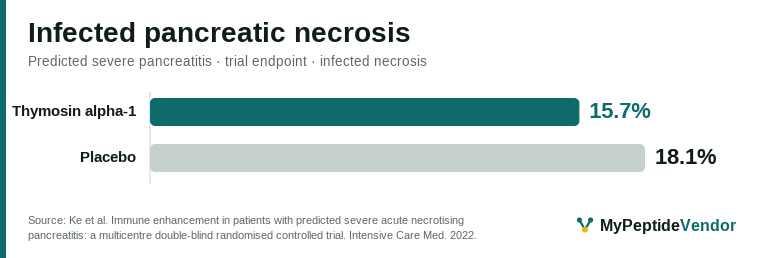
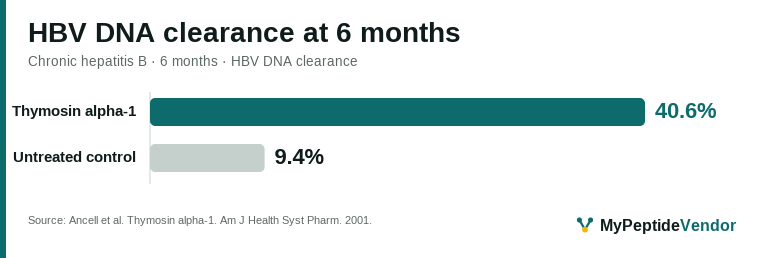
Thymosin alpha-1 (thymalfasin). This is the leading immune peptide in the human evidence discussed here. A hepatitis B review reported viral DNA clearance in 40.6% of treated patients at 6 months, compared with 9.4% of untreated controls; the reported treatment-group rate was 25.6% at 12 months 3. Results are not uniformly positive: in a randomized trial of 508 patients with predicted severe pancreatitis, infected pancreatic necrosis occurred in 15.7% of the thymosin group and 18.1% of the placebo group, a nonsignificant difference (p=0.48) 11.
Thymosin beta-4. This is a different peptide from thymosin alpha-1. A review describes beta-thymosins, including thymosin beta-4, as the main intracellular G-actin-sequestering peptides in most vertebrate cells 2. G-actin is a form of actin, a protein involved in cell structure and movement. This finding does not establish that injected thymosin beta-4 improves immune outcomes in people.
TB-500. TB-500 is a name used for products marketed in the peptide field, but it should not be treated as another name for thymosin alpha-1 or assumed to be the same as a defined thymosin beta-4 medicine. Ask a prescriber to name the exact active ingredient rather than relying on a product nickname.
“Thymosin beta-1.” This name can lead to a mix-up. The beta-thymosin review identifies polypeptide beta-1 as ubiquitin shortened by two terminal glycine residues; it attributes G-actin sequestration to thymosin beta-4 2. Neither name should be confused with thymosin alpha-1, and the review does not make polypeptide beta-1 an established immune treatment.
BPC-157. There is no established human evidence that BPC-157 increases immune function, prevents infections, or treats immune deficiency. A human immune benefit has not been established in the clinical evidence cited on this page. Claims about a proposed mechanism or a product description are not a substitute for a human trial measuring a meaningful immune outcome.
CJC-1295, ipamorelin, GHRP-6, and IGF-1. These names may appear on commercial lists of immune peptides, but the clinical evidence discussed here does not establish that they prevent or treat immune illness. A product being marketed for wellness or another purpose does not make it an evidence-based immune treatment. Ask the clinician to explain the human outcome data for the exact condition being treated.
What the clinical evidence shows

The most useful evidence is tied to a specific illness and patient group. The trial findings below include hepatitis B, sepsis, severe pancreatitis, and hepatitis C; they do not test whether a healthy person can avoid ordinary infections by taking a peptide 3,10,11.
In clinical studies, thymosin alpha-1 had different results across hepatitis B, sepsis, severe pancreatitis, and hepatitis C 3,10,11. The registered immune-support studies also include sepsis, vaccine response, and cancer treatment 12.
| Condition | Study and treatment | Key result |
|---|---|---|
| Chronic hepatitis B | Randomized, controlled trial summarized in a review | HBV DNA clearance was 40.6% after 6 months of treatment versus 9.4% in untreated controls; the treatment-group figure was 25.6% at 12 months. |
| Sepsis | Meta-analysis of 11 randomized trials; 967 patients received thymosin alpha-1 and 960 were controls | The overall odds ratio for 28-day mortality was 0.73. High-quality trials (OR 0.82) and multicenter trials (OR 0.86) did not show significant benefit. |
| Predicted severe acute pancreatitis | Multicenter, double-blind, randomized trial; 508 patients | Infected pancreatic necrosis occurred in 15.7% with thymosin alpha-1 and 18.1% with placebo (p=0.48); treatment did not reduce the primary outcome. |
| Hepatitis C | Three clinical trials, with 162 patients in total, as summarized in a review | One trial found no significant difference in normal ALT levels with thymosin alpha-1 versus placebo. Results from combination treatment varied. |
| Immune recovery and other conditions | ClinicalTrials.gov entries include studies in sepsis, vaccine response, and cancer treatment | A registry listing describes a study’s status, not a positive result. Examples include studies listed as recruiting or completed. |
The sepsis meta-analysis pooled 11 randomized trials and found lower 28-day mortality odds overall (OR 0.73) 10. But the high-quality subgroup (OR 0.82) and multicenter subgroup (OR 0.86) were not statistically significant 10. Trial sequential analysis suggests the current sample size is inadequate, so the overall pooled result is not a final answer 10.
The pancreatitis study is a direct test of a broad claim that thymosin alpha-1 reliably strengthens immunity. Investigators gave 1.6 mg by subcutaneous injection every 12 hours for 7 days, then 1.6 mg once daily for 7 days 11. Among 508 patients, the primary outcome (infected pancreatic necrosis) was not significantly lower with treatment 11. This was a hospital trial in severe illness, not a schedule for self-treatment or general immune support.
The hepatitis B result is more encouraging for that particular infection, but it should not be stretched to other conditions. In the randomized, controlled trial summarized in the review, HBV DNA clearance was 40.6% at 6 months and 25.6% at 12 months among treated patients, compared with 9.4% in untreated controls 3. Those findings do not establish that thymosin alpha-1 prevents colds, flu, or other common infections.
Hepatitis C results were mixed as well. The review describes three trials involving 162 patients: one found no significant difference in normal ALT levels with thymosin alpha-1 versus placebo, while two combination-treatment studies reported differing results 3. A result from a combination with interferon cannot show that thymosin alpha-1 alone caused the outcome.
ClinicalTrials.gov lists 31 studies under an “Immune Support” search, including studies in sepsis, older-adult vaccine response, and cancer treatment 12. Some examples are listed as recruiting, while others are completed 12. Neither status means the treatment has been proven effective; a registered study is a research plan or record, not a recommendation for routine care.
For healthy adults with normal immunity, the cited clinical results do not establish a benefit from routine thymosin alpha-1 use. The major examples concern chronic infection or serious illness, and even those results vary by condition 3,10,11. A clinician should match any proposed treatment to a diagnosis and a meaningful outcome, not just to a desire to “boost” immunity.
Use this chart
Free to reuse with a link back:
Use this chart
Free to reuse with a link back:
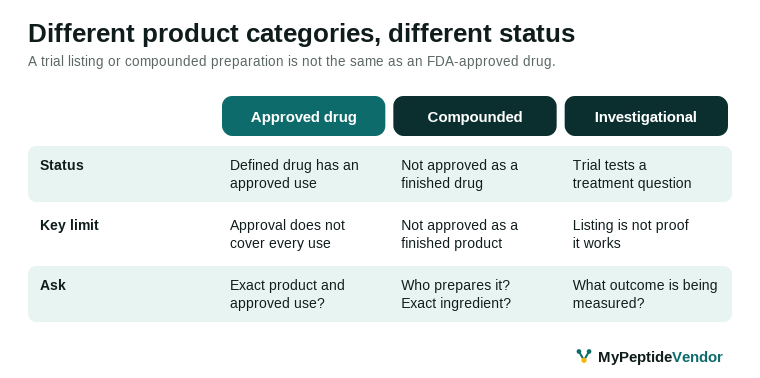
FDA-approved, compounded, and research-only products

Regulatory status depends on the exact product and its intended use. A 2023 review describes thymalfasin (Zadaxin) as a thymosin-based drug used for chronic hepatitis B and C and as a chemotherapy inducer 5. That description does not establish US FDA approval or approval for general immune support. Confirm the product’s current US status and labeling with a clinician or pharmacist before treatment.
Compounding is not the same as FDA approval. FDA places certain nominated bulk drug substances in Category 2 when its review identifies potential significant safety risks 1. Category 2 is a safety warning under FDA’s interim policies, not a statement that a substance is an approved drug or that a compounded product has been proven safe and effective 1. Check the exact substance against current FDA information rather than assuming that every peptide has the same status.
Thymalfasin, compounded preparations, clinical-trial treatments, and research-grade products have different regulatory standing 1,5,12. The categories below are not interchangeable.
| Category | What it means | Patient questions |
|---|---|---|
| FDA-approved drug | A defined drug product has an approved use; that approval does not automatically cover general immune support. | Is this the exact approved product? What is the approved indication? Thymalfasin is described as a thymosin-based drug used for chronic hepatitis B and C and as a chemotherapy inducer. |
| Compounded preparation | A compounded product is not FDA-approved as a finished drug product. Some bulk substances nominated for compounding may be in FDA Category 2 because of potential safety risks. | Who prepares it? What is the exact ingredient? Does the substance appear on a current FDA list? Why is compounding appropriate for this patient? |
| Investigational treatment | A clinical trial is testing a question; registration does not establish that the treatment works. | Is there a relevant trial, and is it recruiting? What outcome is being measured? ClinicalTrials.gov entries include thymosin alpha-1 studies in sepsis and vaccine response. |
| Research-grade or unproven product | A research label is not evidence of safe or effective human treatment, and it is not a prescription for self-injection. | What evidence supports this exact product? No cited source establishes human immune benefits for BPC-157, CJC-1295, ipamorelin, or GHRP-6. |
Ask the prescriber to identify the exact active ingredient, manufacturer or compounding pharmacy, route, and reason for treatment. If a clinic calls a product “FDA-approved,” ask for the approved product name and indication; thymalfasin’s reported uses are not the same as approval for general immune enhancement 5.
Also ask whether a product’s bulk substance raises an FDA safety concern. FDA Category 2 means potential significant safety risks were identified during review of nominated substances; it does not, by itself, tell you that every product containing a peptide is in that category 1. The exact ingredient and current regulatory status matter.
Use this chart
Free to reuse with a link back:
Research-grade Immune Support is available from American Peptides; code MYPEPTIDEVENDOR takes 15% off. Sold for laboratory research only, not for human use. Affiliate link
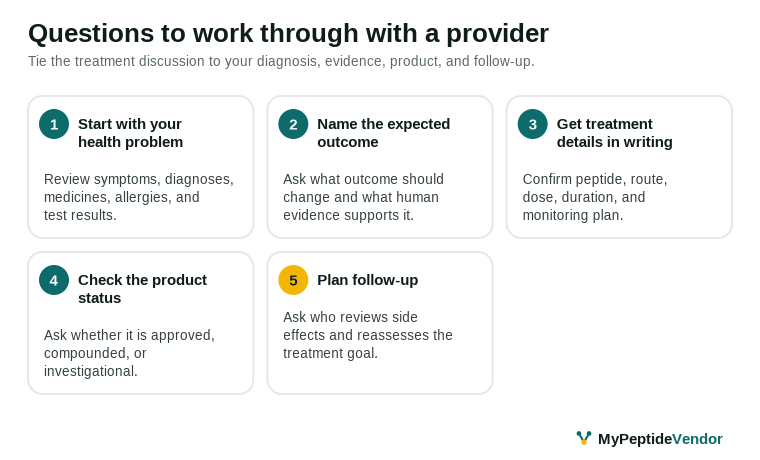
How to choose an immune peptide provider
Start with a health problem, not a peptide name. A clinician should review your symptoms, past infections, diagnoses, current medicines, allergies, and relevant test results. The thymosin alpha-1 evidence discussed here concerns conditions such as hepatitis B, sepsis, and severe pancreatitis, not routine prevention in healthy adults 3,10,11.
Ask what outcome the treatment is meant to change and what human evidence supports that use. A useful explanation names the patient group, treatment, and measured result. For example, a sepsis meta-analysis found an overall association with lower 28-day mortality, but its high-quality and multicenter subgroups did not show a significant benefit 10.
Get the treatment details in writing: the exact peptide, formulation, route, prescribed dose, duration, monitoring plan, and instructions if you develop a reaction. The pancreatitis trial’s 1.6 mg schedule was used for a defined hospital population and cannot be carried over as a general immune regimen 11.
Ask whether the product is an approved drug, a compounded preparation, or investigational. If it is compounded, ask who prepares it and whether the exact bulk ingredient has FDA safety concerns 1. If the clinic cannot identify the ingredient or explain the product’s status, pause before paying or injecting it.
Compare follow-up care as well as the product. Ask who will review side effects and whether the clinician will reassess the treatment goal. A registry entry marked recruiting or completed does not establish a positive result, so do not accept trial registration as proof of benefit 12.
Be cautious of promises to prevent infections, restore youthful immunity, or treat several unrelated conditions with one protocol. The evidence for thymosin alpha-1 differs between hepatitis B, sepsis, and pancreatitis 3,10,11. A claim that ignores those differences is broader than the clinical results.
Use this chart
Free to reuse with a link back:
Cost of peptide therapy

There is no established standard price for immune peptide therapy, so an exact dollar figure would be unsupported. The total cost can depend on the specific product, whether it is a finished drug or compounded preparation, the number of doses, treatment duration, clinician visits, and any monitoring or tests.
Ask for an itemized estimate before starting. Check whether the quoted amount includes medication, injection supplies, pharmacy or shipping charges, follow-up visits, and laboratory monitoring. A package price cannot show whether the treatment is appropriate or whether evidence supports it for your condition.
Ask what costs continue if the clinician recommends stopping because of side effects or lack of benefit. A trial dose and a longer course can have different medication and visit costs, so the expected treatment length should be clear before the first injection.
Safety, who should avoid treatment, and injection basics
Immune-modifying treatment can affect more than the intended target. In severe COVID-19, dysregulated immunity and immunomodulatory approaches have been linked with concern about secondary infections, including coronavirus-associated pulmonary aspergillosis 4. This does not prove thymosin alpha-1 caused those infections, but it is a reason to avoid unsupervised immune treatment during serious illness.
Active autoimmune disease: Do not start an immune peptide without advice from the clinician managing the condition. An intervention that changes immune signaling could complicate an illness in which immune activity is already misdirected; a standard safe approach for these patients is not established in the clinical findings discussed here.
Cancer or cancer treatment: Discuss any immune peptide with the oncologist before use. Thymosin alpha-1 has been studied in cancer-related settings, but that does not establish that it is appropriate for every cancer or compatible with every treatment 5,9. Do not replace, delay, or change cancer treatment on the basis of a peptide claim.
Pregnancy or breastfeeding: Avoid nonessential peptide treatment unless the obstetric clinician specifically recommends it. No cited source establishes thymosin alpha-1 safety in pregnancy or breastfeeding. A prescription from a wellness clinic does not replace an individualized risk review.
Transplant recipients and people taking immunosuppressants: Talk with the transplant team or prescribing specialist before considering an immune peptide. Treatment decisions in these situations depend on the balance between immune activity and protection of the transplanted organ; do not adjust immunosuppressant medicines yourself.
Active infection or severe illness: Seek standard medical care rather than relying on an unproven peptide. Sepsis and severe pancreatitis are hospital-level conditions in the studies described here, and their trial results do not support treating an infection at home with a wellness product 10,11.
The thymosin alpha-1 review reports that most studies observed local irritation at the injection site as the main adverse effect 3. That observation does not rule out uncommon or long-term harms. Before treatment, tell the prescriber about prior injection reactions, allergies, autoimmune disease, cancer care, transplant medicines, and every prescription or nonprescription medicine you take.
Thymosin alpha-1 has been studied as a subcutaneous injection, meaning an injection into the fatty tissue under the skin. One severe-pancreatitis trial used 1.6 mg every 12 hours for 7 days, followed by 1.6 mg once daily for 7 days 11. This is a research schedule for a specific hospital population, not instructions to copy for another illness or product.
If a clinician prescribes an injectable product, follow that product’s pharmacy and prescriber instructions for dose, storage, injection technique, and disposal. Confirm the exact dose and route before the first injection. Do not share needles or inject a product labeled for research use.
Thymosin alpha-1 levels rise and fall quickly: the peak occurs within about 2 hours, the serum half-life is about 2 hours, and levels return to baseline within 24 hours 3. Those figures explain why a study may use repeated injections, but they do not determine the right schedule for an individual patient.
How to get started: telehealth or clinic
A primary-care clinician or relevant specialist can first check whether your concern has a diagnosis and an established treatment. For chronic hepatitis B, the reported thymosin alpha-1 evidence concerns viral DNA clearance in a specific trial, not general immune enhancement 3. That distinction helps keep treatment decisions tied to the condition being treated.
Telehealth can be a first step when the clinician can review your medical history, medicines, and records and arrange any needed testing. An in-person clinic may be useful when an examination, injection teaching, or close monitoring is needed. Either way, the prescriber should identify the exact product and explain why it fits your diagnosis.
Before agreeing to treatment, ask what outcome is expected, what human evidence supports the use, whether the product is approved or compounded, what alternatives exist, and what follow-up is planned. If the option is investigational, ask whether a relevant clinical trial is available; a registry listing alone does not show that a treatment works 12.
This page is general education, not a diagnosis or prescription. Talk with a licensed clinician who knows your health history before starting, stopping, or changing a medicine or peptide.
Dosing protocols
Where to Buy Immune Support for Research
American Peptides
US-made research peptides, every lot third-party tested with a lot-matched COA.
15% offMYPEPTIDEVENDOR at checkout
- ≥99% purity verified by HPLC + mass spec, endotoxin tested
- Ships tracked from Louisiana, free shipping over $300
- 15% off your first order with code MYPEPTIDEVENDOR
Certified-Pep
US-made research peptides with batch-specific lab reports (COA) and a QR code on every vial.
- Independent laboratory testing (Vanguard Laboratory)
- Made in the USA, ships in 1-2 business days
- Research use only, not for human or veterinary use
Affiliate disclosure: we may earn a commission if you order through the link above. Immune Support is not approved by the FDA for human use.
Frequently asked questions
What is the best peptide for the immune system?
Thymosin alpha-1 has the most clinical evidence among the peptides discussed here, but no peptide is established as the best routine immune treatment. Its results vary by illness, and a 508-patient pancreatitis trial found no significant reduction in infected pancreatic necrosis 11.
What peptide helps with being sick?
No peptide is established as a general treatment for being sick with a routine infection. Thymosin alpha-1 has been studied in serious conditions such as sepsis and hepatitis B, but those results do not establish that it treats a cold or flu 3,10.
Who should avoid peptides?
People who are pregnant or breastfeeding, have active autoimmune disease or cancer, have a transplant, take immunosuppressants, or have a serious active infection should not start an immune peptide without advice from their treating clinician. Immune effects and safety may be uncertain in these situations, and serious illness needs standard medical care 4.
Does BPC-157 increase the immune system?
No cited source establishes that BPC-157 increases immune function in humans or prevents infection. Its immune benefit has not been established by the clinical evidence cited on this page.
References
- FDA: Certain bulk drug substances for use in compounding that may present significant safety risks
- Hannappel et al. beta-Thymosins. Ann N Y Acad Sci. 2007.
- Ancell et al. Thymosin alpha-1. Am J Health Syst Pharm. 2001.
- Costantini et al. Covid-19-Associated Pulmonary Aspergillosis: The Other Side of the Coin. Vaccines (Basel). 2020.
- Quagliata et al. Therapeutic applications of thymosin peptides: a patent landscape 2018-present. Expert Opin Ther Pat. 2023.
- Matteucci et al. Thymosin alpha 1 and HIV-1: recent advances and future perspectives. Future Microbiol. 2017.
- Simonova et al. Aging and Thymosin Alpha-1. Int J Mol Sci. 2025.
- Hadden et al. Thymic endocrinology. Ann N Y Acad Sci. 1998.
- Dominari et al. Thymosin alpha 1: A comprehensive review of the literature. World J Virol. 2020.
- Gu et al. Efficacy of thymosin α1 for sepsis: a systematic review and meta-analysis of randomized controlled trials. Front Cell Infect Microbiol. 2025.
- Ke et al. Immune enhancement in patients with predicted severe acute necrotising pancreatitis: a multicentre double-blind randomised controlled trial. Intensive Care Med. 2022.
- ClinicalTrials.gov: 31 registered studies (search: Immune Support)
Written by the MyPeptideVendor editorial team from the FDA label, peer-reviewed studies and ClinicalTrials.gov records listed above, fact-checked line by line and reviewed 2026-11-12.
Cite this page
MyPeptideVendor Editorial Team. Peptides for Immune System: Evidence & Safety. MyPeptideVendor. Updated November 12, 2026. https://mypeptidevendor.com/treatment/immune-support/MyPeptideVendor Editorial Team. (2026, November 12). Peptides for Immune System: Evidence & Safety. MyPeptideVendor. https://mypeptidevendor.com/treatment/immune-support/