Thymagen Thymogen: Evidence, Dosing & Safety
Immunomodulatory dipeptide
Brand names: Thymogen; also called oglufanide or IM862 in some literature
“Thymagen thymogen” usually refers to Thymogen, a two-amino-acid dipeptide made from L-glutamic acid and L-tryptophan (L-Glu-L-Trp) 4.
Small clinical studies examined Thymogen in tuberculosis, inflammatory illness, wound care, and before surgery 5689. They do not establish a reliable dose, broad benefit, or safety for healthy people, and the FDA bulk-substances list does not establish its US approval or compounding status 1.
Key takeaways
- Thymogen is the L-Glu-L-Trp dipeptide, not Thymosin Alpha-1 or Thymulin 4.
- A double-blind, placebo-controlled preoperative study used intranasal Thymogen daily for 7 days, but its abstract reports an unclear 100 mg dose 9.
- The tuberculosis report used 1 mL of a 1% solution per injection, 10 doses over 2 days, in courses during treatment at 2 and 4 months 6.
- The clinical reports do not provide dependable side-effect percentages or establish a standard dose for routine use 5689.
- The FDA bulk-substances list in 1 does not include Thymogen, so it does not establish Thymogen's US approval or compounding status 1.
Thymogen at a glance
- Class
- L-Glu-L-Trp immunomodulatory dipeptide
- Mechanism
- Proposed immune modulation; the precise human mechanism is not established
- FDA Status
- Not established by the FDA bulk-substances list
- Brand names
- Thymogen; also called oglufanide or IM862 in some literature
- Administration
- Clinical reports describe injection and intranasal use; they do not establish subcutaneous, intramuscular, or oral-capsule equivalence
- Typical Dose
- No standard dose established; study regimens differ
- Half-life
- Not established in the cited clinical reports
- Primary Uses
- Studied as an add-on for inflammatory illness, tuberculosis, wound care, and preoperative care
What is it?

Thymogen is a synthetic dipeptide: two linked amino acids, L-glutamic acid and L-tryptophan 4. Russian clinical literature describes it as an immunomodulating drug 5, and a review lists it among interferon inducers used in former socialist countries 2. That classification does not prove a particular mechanism or clinical benefit.
Thymogen has been studied as an add-on, not as proven routine immune support. Reports cover destructive pulmonary tuberculosis, inflammatory disease of the uterus and its appendages, purulent soft-tissue wounds, and preparation for abdominal or retroperitoneal tumor surgery 5689. Those patient groups do not represent healthy people seeking to prevent everyday infections.
Product identity matters. Human reports describe the Russian drug, but do not establish that an online vial or oral capsule has the same sequence, formulation, quality, or effects 5689. Whether a capped oral capsule is equivalent to the Russian Thymogen drug has not been established in humans.
What makes it different
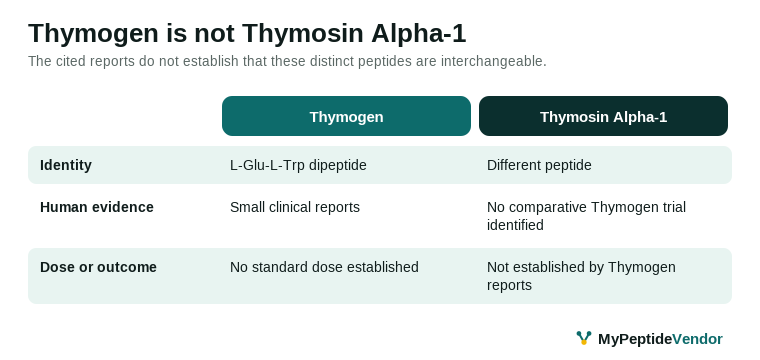
Thymogen is a dipeptide; Thymosin Alpha-1 is a different molecule. Similar names do not make them interchangeable, and the clinical reports discussed here do not compare the two directly 5689. The Thymogen reports also do not establish a Thymosin Alpha-1 dose or outcome.
“Immune booster” is too simple a description. A review describes L-Glu-L-Trp Thymogen as immunostimulating and its D-amino-acid counterpart, Thymodepressin, as immunosuppressive 4. This opposite activity suggests that the chemical handedness of a peptide can matter. It does not show that Thymogen reliably corrects an individual person's immune response.
Thymulin is another distinct peptide name; evidence about Thymulin should not be treated as evidence about Thymogen. Vilon and Thymosin Alpha-1 are also sometimes discussed alongside Thymogen, but the clinical reports here do not show that stacking any of these compounds improves outcomes 5689. No cited trial tests a Thymogen combination with Vilon or Thymosin Alpha-1.
The oral capsule question remains separate from the drug question. The clinical reports describe Thymogen, not a capped oral capsule, and do not show that either capped Glu-Trp or a capsule containing it has been tested in humans 5689.
Use this chart
Free to reuse with a link back:
How does it work?
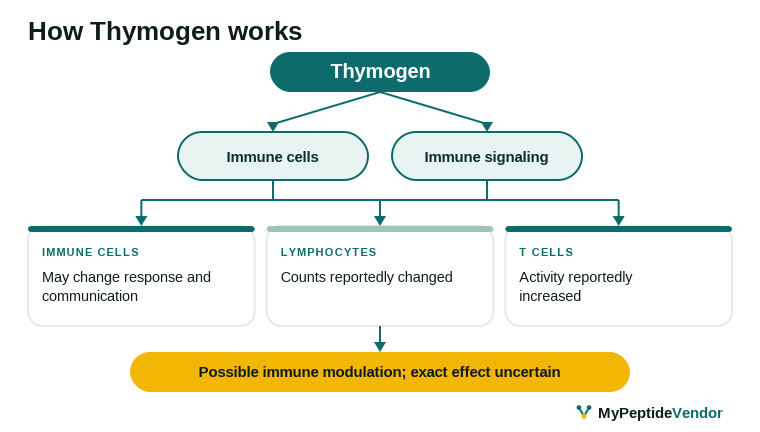
In plain terms, researchers propose that Thymogen may change how immune cells respond and communicate. In small clinical reports, investigators described changes in lymphocyte counts and T-cell activity; those observations do not prove how the peptide caused the changes 56.
The proposed action is immune modulation, meaning a possible change in immune signaling, rather than a guaranteed increase in every immune defense. A review groups Thymogen with interferon inducers 2. That label does not prove that one interferon pathway explains the reported clinical outcomes.
The precise mechanism in people has not been established. Nasal, injected, and oral products should not be assumed to work alike.
Thymogen is not a hormone in the usual sense of a signaling substance made by an endocrine gland and released into circulation. It is a short peptide studied for immune-modulating activity; its exact effects in people remain uncertain 456.
Use this chart
Free to reuse with a link back:
What the clinical evidence actually shows

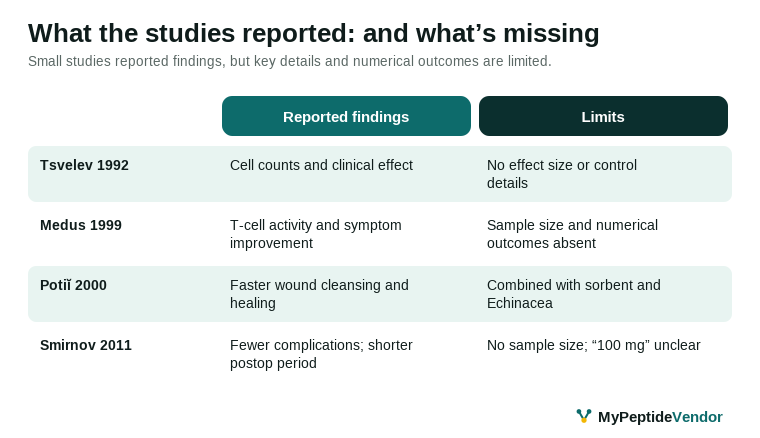
The human evidence consists of small or incompletely reported studies. Some describe outcomes without numerical effect sizes, and three used Thymogen alongside other treatments: Tsvelev et al. 5, Medus et al. 6, and Potiĭ et al. 8. The findings are reasons for further study, not proof that Thymogen treats these conditions or helps healthy people.
The reports below give the participant counts, regimens, and outcomes that were reported; missing sample sizes and effect estimates remain unknown 5689.
| Study | Participants, route, and regimen | Reported outcome | Quality and limits |
|---|---|---|---|
| Tsvelev et al., 1992 | 46 patients with acute endomyometritis, exacerbations of chronic salpingo-oophoritis, or purulent tubo-ovarian formations. Route and dose are not stated. | Authors reported normalized lymphocyte and T- and B-cell counts, increased T-cell activity, and a clinical effect. | Clinical-trial abstract; no numerical effect size or control-group details are supplied. |
| Medus et al., 1999 | Patients with destructive pulmonary tuberculosis. The report describes 1 mL of a 1% solution by injection, 10 doses over 2 days, in courses during treatment at 2 and 4 months. | Authors reported increased T-cell activity, better tolerance of tuberculosis medicines, and improvement in symptoms and disease findings. | Comparative-study abstract; sample size and numerical outcomes are not supplied. |
| Potiĭ et al., 2000 | 31 patients with purulent soft-tissue wounds; Thymogen was combined with a silica sorbent and Echinacea tincture. | Authors reported faster wound cleansing and healing and normalization of immune measures. | Clinical-trial abstract; the combination prevents separating Thymogen's contribution. |
| Smirnov et al., 2011 | Elderly patients having abdominal or retroperitoneal tumor surgery; intranasal treatment once daily for 7 days before surgery. The abstract does not give the sample size. | Authors reported fewer postoperative complications, a shorter postoperative period, and improved cellular immune measures. | Double-blind, randomized, placebo-controlled trial; the abstract reports “100 mg” per day, a dose needing clarification. |
The tuberculosis report describes 1 mL of a 1% (10 mg/mL) solution by injection, 10 doses, or 100 mg total per course 6. The injection route is not specified as intramuscular 6. The report describes courses during the 2- and 4-month treatment points, but does not provide a standard regimen for other conditions 6.
Smirnov et al. is the strongest design in this group because it was randomized, double-blind, and placebo-controlled 9. However, its abstract gives neither the participant count nor complication rates. It states 100 mg intranasally each day; that figure may be a reporting error, but it cannot be safely changed to 100 mcg without confirmation 9.
The reports do not establish a dependable time to effect. They measured different things, including immune-cell measures, wound healing, and postoperative complications, without giving a consistent onset timeframe 5689. A review comparing thymic and pineal peptides reports that pineal peptides had a stronger geroprotective effect on thymus involution than thymic peptides such as Thymogen 37.
What remains unknown includes whether Thymogen benefits healthy people, prevents infection, or produces outcomes that hold up in larger trials. The reports also do not establish human outcomes for oral capsules or capped forms of the peptide 5689. Western cancer-trial benefit is not established by these clinical reports; the preoperative study measured surgical complications, not tumor response 9.
Use this chart
Free to reuse with a link back:
Typical dosing

No standard dose is established by the clinical reports. The tuberculosis study used 1 mL of a 1% solution by injection, with 10 doses over 2 days and courses during treatment at 2 and 4 months 6. The preoperative study used intranasal treatment once daily for 7 days, but its abstract reports the unclear amount “100 mg” 9. Neither regimen is a self-treatment instruction.
The evidence does not support turning either study regimen into a general dose for immune support. A 100 mg intranasal amount should not be silently read as 100 mcg; the report needs clarification before anyone could interpret it as a practical dose 9.
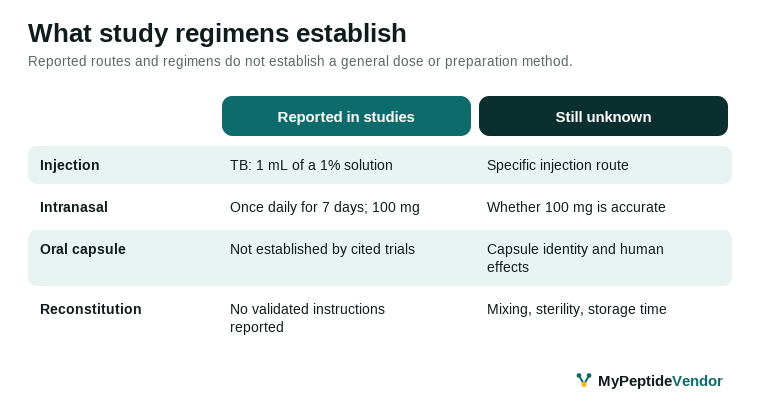
| Route or preparation question | What the clinical reports establish | What remains unknown |
|---|---|---|
| Injection | Used in the tuberculosis report; the specific injection route is not stated. | Whether the study regimen applies to subcutaneous or intramuscular use. |
| Intranasal | Used once daily for 7 days before surgery; dose reported as 100 mg. | Whether 100 mg is accurate or a reporting error. |
| Oral capsule | Not established by the cited human trials. | Whether a capsule contains the same molecule or has human effects. |
| Reconstitution and storage | No validated mixing or storage instructions are reported in these clinical abstracts. | Water volume, concentration, sterility, and usable storage time for any specific vial. |
Subcutaneous injection and oral capsules may appear in online product listings, but the clinical studies cited here do not establish those routes, doses, or equivalence. The published injection report does not specify intramuscular administration 6. Do not use vial-size arithmetic to prepare a product: the studies provide no general mixing instructions or validated storage period 5689. This dosing information is not medical advice.
Use this chart
Free to reuse with a link back:
Side effects: what to actually expect
The clinical reports do not provide dependable side-effect percentages. Tsvelev et al. state that the drug induces no complications 5. No per-patient complication count is given, so this is not a calculated rate. The other study abstracts do not provide enough detail to calculate adverse-event rates 689.
Pregnancy, a bleeding disorder, or an infected area of skin at a planned injection site are reasons to ask a clinician before considering an injection. The cited studies do not establish these as Thymogen-specific contraindications or quantify the added risk 5689. Avoid injecting through infected skin as a general injection-safety precaution.
Safety has not been established in people with autoimmune disease, organ transplants, or those taking immunosuppressants. The reports do not assess these groups or drug interactions 5689. Ask the clinician managing that condition before considering an immune-modulating product.
Seek urgent medical care for trouble breathing, swelling of the face or throat, fainting, severe or spreading redness at an injection site, or a high fever after an injection. These are warning symptoms that need prompt assessment, regardless of whether Thymogen caused them.
Regulatory & access status in the US
The excerpted FDA bulk-substances list in 1 does not show Thymogen, so it does not establish Thymogen's US approval or compounding status 1. Category 2 is an interim category for nominated bulk substances that may present significant safety risks in compounding; the FDA list includes substances such as cesium chloride and chloral hydrate 1. Category 2 status is not the same as FDA approval.
Compounded medicines and dietary supplements follow different regulatory pathways. A bulk-substance category does not establish that an online vial or capsule is safe, effective, or legally marketed for a particular use 1. Russian clinical abstracts describe Thymogen as an immunomodulating drug 5, but its current registration status for Russian or online formulations is not established.
For US access, check the exact product, route, and intended use with a licensed clinician and pharmacist. Do not assume that a research-use label, a supplement label, or a claim of Russian origin establishes FDA approval or a lawful compounding basis 1.
How it compares to its closest alternative
Thymosin Alpha-1 is the closest comparison by name, not a substitute with an interchangeable dose. Vilon and Thymulin are also distinct names.
| Feature | Thymogen | Thymosin Alpha-1 | Vilon / Thymulin |
|---|---|---|---|
| Identity | L-Glu-L-Trp dipeptide | Different peptide; not compared head-to-head in the Thymogen studies | Different peptide names; the Thymogen studies do not establish their structures or effects. |
| Human evidence in the cited sources | Small clinical reports and one randomized, placebo-controlled preoperative study | No comparative Thymogen trial identified | No Thymogen combination trial identified |
| Route and dose | Injection and intranasal regimens are reported; no standard dose is established | Not established by the Thymogen reports. | Not established by the Thymogen reports. |
| US regulatory status | The FDA bulk-substances list does not establish Thymogen's status | Not established by the cited Thymogen sources. | Not established by the cited Thymogen sources. |
Thymogen should not be treated as a shorter version of Thymosin Alpha-1 or as a proven alternative to it. The Thymogen reports do not provide a direct comparison, shared dose, or evidence that combining the two improves an outcome 5689.
Frequently asked questions
What are the benefits of taking Thymulin peptides?
Thymulin and Thymogen are different peptides, so evidence about one does not establish benefits for the other. Thymogen has been studied as an add-on in tuberculosis, inflammatory disease, wound care, and before surgery, but these studies do not prove benefit for healthy people 5689.
How long does it take to see results from thymosin alpha 1?
There is no single timeframe that applies to every condition or product. Thymosin Alpha-1 is not Thymogen, and the Thymogen studies measured different outcomes rather than a consistent time to improvement 5689. Ask the prescribing clinician what response and timeframe apply to the specific treatment.
Is thymosin a peptide hormone?
Thymosins are peptides, but the name covers different molecules. Calling a molecule a peptide does not make it interchangeable with Thymogen or establish that it acts like a conventional circulating hormone.
What does thymosin beta-4 do to the body?
Thymosin beta-4 is a separate molecule from Thymogen and Thymosin Alpha-1. It is associated with actin, a structural protein inside cells, and is studied for roles in cell movement and tissue repair; that does not establish it as a treatment or show that it shares Thymogen's effects.
References
- FDA: Certain bulk drug substances for use in compounding that may present significant safety risks
- Silin et al. Synthetic and natural immunomodulators acting as interferon inducers. Curr Pharm Des. 2009.
- Lin'kova et al. [Influence of peptides from pineal gland on thymus function at aging]. Adv Gerontol. 2010.
- Deigin et al. The First Reciprocal Activities of Chiral Peptide Pharmaceuticals: Thymogen and Thymodepressin, as Examples. Int J Mol Sci. 2024.
- Tsvelev et al. [Thymogen in the complex treatment of inflammatory diseases of the female genital system]. Akush Ginekol (Mosk). 1992.
- Medus et al. [The effect of thymogen on the state of immunity in destructive pulmonary tuberculosis]. Voen Med Zh. 1999.
- Lin'kova et al. [Characteristics of the pineal gland and thymus relationship in aging]. Adv Gerontol. 2011.
- Potiĭ et al. [Applications of immunomodulators in complex of treatment of the soft tissue purulent wounds]. Klin Khir. 2000.
- Smirnov et al. [Application thymogen for preoperative preparation of elderly patients with tumor processes in abdominal cavity]. Adv Gerontol. 2011.
Written by the MyPeptideVendor editorial team from the FDA label, peer-reviewed studies and ClinicalTrials.gov records listed above, fact-checked line by line and reviewed 2026-11-12.
Cite this page
MyPeptideVendor Editorial Team. Thymagen Thymogen: Evidence, Dosing & Safety. MyPeptideVendor. Updated November 12, 2026. https://mypeptidevendor.com/peptides/thymagen-thymogen/MyPeptideVendor Editorial Team. (2026, November 12). Thymagen Thymogen: Evidence, Dosing & Safety. MyPeptideVendor. https://mypeptidevendor.com/peptides/thymagen-thymogen/Related peptides
Thymosin Alpha-1
Not establishedThymosin alpha 1 is an immune-modulating peptide studied for hepatitis, sepsis, cancer support, and vaccine response; evidence and US status vary.
Learn moreVIP
Research UseVIP is a 28-amino-acid signaling peptide studied in laboratory and animal research; a 6 mg vial is not an established human dose.
Learn moreARA-290
Not approvedARA-290 is an investigational peptide with small, short neuropathy trials, but no established dose or proof of lasting nerve recovery.
Learn more