VIP 6mg: Evidence, Dosing & U.S. Status
Neuropeptide
Brand names: VIP; vasoactive intestinal peptide; vasoactive intestinal polypeptide; aviptadil
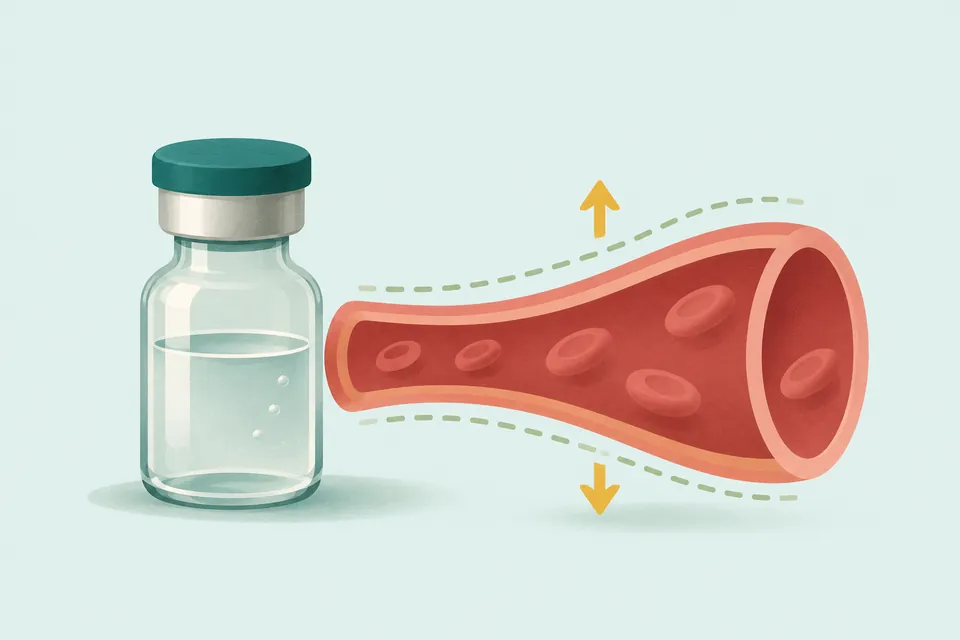
VIP 6mg refers to a vial said to contain 6 milligrams of vasoactive intestinal peptide, not a tested or approved dose for a person. VIP is a 28-amino-acid signaling peptide, also called vasoactive intestinal polypeptide or aviptadil.
Researchers study its effects on blood vessels, the gut, immune signals, and the nervous system. No validated human dose, clinical benefit, or FDA-approved use for VIP is established.
Key takeaways
- VIP is a 28-amino-acid peptide; the 6 mg figure describes vial contents, not a clinical dose.
- VIP can signal through VPAC1, VPAC2, and PAC1 receptors, with adenylate cyclase and cAMP acting as intracellular relays.
- The sources cited here provide no named VIP treatment trial with participant count, duration, or numerical outcome.
- ClinicalTrials.gov returned 320 keyword matches for “VIP,” but the listed matches do not establish the status of aviptadil trials 11.
- A 6 mg vial and storage specification do not establish identity, purity, sterility, safety, or suitability for human use.
VIP at a glance
- Class
- Neuropeptide
- Mechanism
- VPAC1, VPAC2, and PAC1 receptor binding; adenylate cyclase/cAMP signaling
- FDA Status
- The cited primary sources do not show an FDA-approved VIP treatment; research material is not for human use
- Brand names
- VIP; vasoactive intestinal peptide; vasoactive intestinal polypeptide; aviptadil
- Administration
- No approved route or patient-use instructions established here
- Typical Dose
- No supported human dose established
- Half-life
- A frequently repeated estimate of about 2 minutes is unverified in the cited primary sources
- Primary Uses
- Laboratory and animal research into vascular, gut, immune, and nervous-system signaling
What is it?

VIP is a naturally occurring 28-amino-acid peptide signal. Its full name is vasoactive intestinal peptide; vasoactive intestinal polypeptide is another name, and aviptadil is used as a name for the peptide in some contexts. A product marked VIP 6mg states an amount in the vial, not an amount shown to help a person.
The commonly listed full-length sequence is His-Ser-Asp-Ala-Val-Phe-Thr-Asp-Asn-Tyr-Thr-Arg-Leu-Arg-Lys-Gln-Met-Ala-Val-Lys-Lys-Tyr-Leu-Asn-Ser-Ile-Leu-Asn-NH2. These product details are not verified by the primary sources cited here 1-11.
Using average atomic masses, the second formula calculates to approximately 3325.85 g/mol. Neither formula has been independently verified, so the small mass difference does not establish which specification is correct.
| Specification | Commonly listed value | What can be confirmed here |
|---|---|---|
| Sequence | 28 amino acids, ending in amide (NH2) | Not independently verified in- |
| CAS number | 40077-57-4 | Not independently verified in- |
| Formula and mass | C147H237N43O43S / 3326.8 g/mol, or C147H238N44O42S / about 3325.85 g/mol by calculation | Conflicting listings; neither verified in- |
| Presentation and storage | Lyophilized powder; 6 mg vial; −20 °C | Commercial specifications, not a stability finding in- |
Lyophilized means dried; it does not prove that a vial is sterile or stable after it is opened or mixed. The cited primary sources give no validated post-reconstitution storage period for a 6 mg VIP vial 1-11.
What makes it different
VIP signaling is studied in several tissues rather than one single target organ. Research areas include inflammation and immune modulation, gut-barrier function, blood-brain-barrier biology, cardiac fibrosis, and behavior. A result in a cell or animal model does not show that the same effect happens in people.
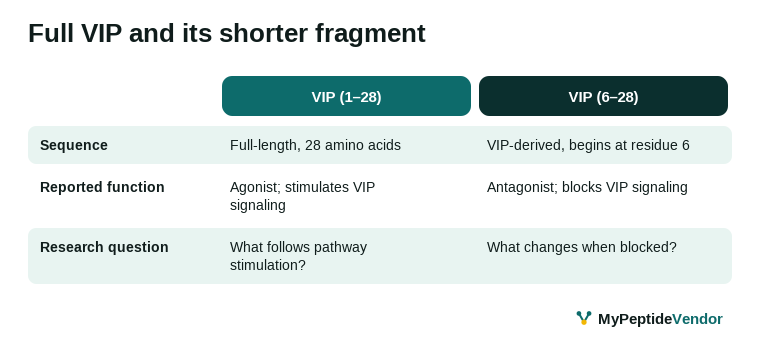
The name can also refer to a different molecule: VIP (6–28), a shorter fragment, rather than full-length VIP (1–28). Full VIP is used to study receptor stimulation; the 6–28 fragment is described as a receptor antagonist, which researchers use to test what happens when VIP signaling is blocked. Product descriptions report CAS 69698-54-0 for the fragment, but that identifier and its function are not verified by 1-11.
This difference matters when planning an experiment. An agonist stimulates a receptor pathway; an antagonist blocks or interferes with it. They are not interchangeable, even though both names include “VIP.
| Feature | VIP (1–28), full peptide | VIP (6–28), fragment |
|---|---|---|
| Sequence | Full-length VIP sequence, 28 amino acids | VIP-derived sequence beginning at residue 6 |
| Reported function | Agonist; stimulates VIP signaling | Antagonist; blocks or tests VIP signaling |
| Reported CAS | 40077-57-4 | 69698-54-0 |
| Typical research question | What follows when VIP signaling is stimulated? | What changes when VIP signaling is blocked? |
Use this chart
Free to reuse with a link back:
How does it work?
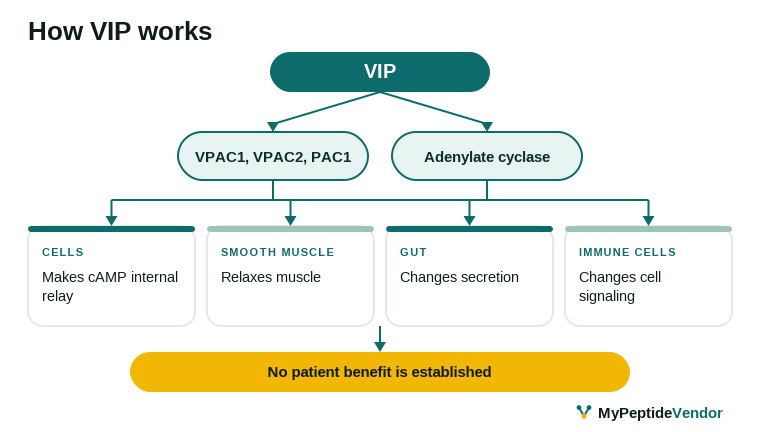
In plain terms, VIP attaches to receptors on a cell and changes the cell’s internal activity. The receptor names are VPAC1, VPAC2, and PAC1. Which receptor is present, and which cell it sits on, can shape the response.
After VIP binds, the cell can activate adenylate cyclase, an enzyme that makes cyclic AMP (cAMP). Think of cAMP as an internal relay: it carries the receptor’s message farther into the cell. That relay can influence smooth-muscle relaxation, secretion, and immune-cell signaling, but it does not produce one identical result in every tissue.
Researchers examine this signaling in inflammation, gut-barrier function, the blood-brain barrier, cardiac fibrosis, and behavior. Those are research questions, not established benefits for patients. Numerical VIP laboratory or animal results quantifying these effects are not reported 1-11.
Use this chart
Free to reuse with a link back:
What the clinical evidence actually shows

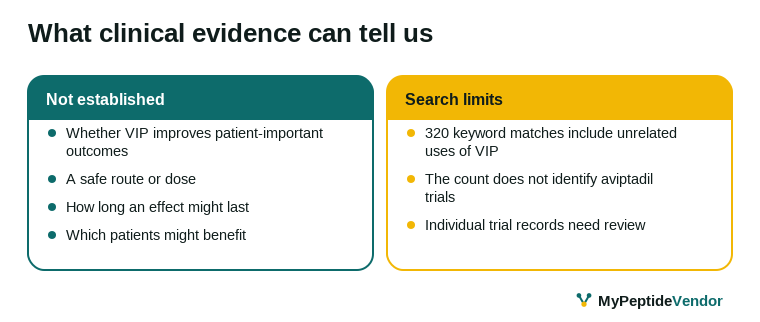
No named VIP treatment trial reporting a participant count, treatment duration, and numerical clinical result has been published 1-11. That means there is no response rate, symptom-change percentage, or patient treatment timeline to report from this evidence set. It also means an online dosing protocol should not be presented as a proven clinical regimen.
ClinicalTrials.gov returned 320 records for the keyword “VIP,” but the listed matches include studies where those letters do not refer to vasoactive intestinal peptide 11. That keyword result does not identify how many aviptadil studies exist, their names, their enrollment, or whether they are recruiting. A name-based search and review of individual trial records would be needed to establish those details.
A claim sometimes repeated online says daily VIP in neonatal mice on postnatal days 5–9 reduced intestinal IL-6 and TNF-alpha and increased Claudin-3. The cited reference attached to that claim is a dry-needling review about lateral elbow pain, not a VIP experiment 6. It cannot verify the claimed dose, animal sample size, or results.
What remains unknown from the cited evidence is whether VIP improves a patient-important outcome, which route or dose could be safe, how long an effect might last, and which patients might benefit. A frequently repeated half-life estimate of about 2 minutes and bioavailability estimates of 70% by subcutaneous delivery and 50% by intranasal delivery are unverified in 1-11. They should not be used to estimate exposure or plan dosing.
Use this chart
Free to reuse with a link back:
Typical dosing

No approved VIP patient label or supported human dosing range appears in the primary sources cited here 1-11. The often-repeated ranges of 100–400 mcg by injection and 200–600 mcg intranasally are unsupported by these sources and should not be treated as clinical instructions.
For vial arithmetic only, 6 mg equals 6,000 mcg. If a 6 mg vial were divided into 3 mL, the nominal concentration would be 2 mg/mL; a 0.1 mL laboratory aliquot would contain 0.2 mg, or 200 mcg. This is a calculation, not a mixing or injection recommendation. The vial size and concentration example do not establish sterility, an appropriate research protocol, or human safety.
The number of research aliquots depends on the aliquot volume and the validated laboratory method. There is no supported post-reconstitution time limit in the cited primary sources, so a 6 mg vial cannot be assigned a reliable number of days of use after mixing 1-11.
| Claim repeated online | Status in the cited primary sources | Why it matters |
|---|---|---|
| About 2-minute half-life | Unverified in- | Cannot predict duration or dosing frequency |
| 70% subcutaneous bioavailability | Unverified in- | Cannot convert exposure between routes |
| 50% intranasal bioavailability | Unverified in- | Cannot estimate systemic exposure |
| 100–400 mcg injection; 200–600 mcg intranasal | Unsupported in- | Not evidence-based patient protocols |
Side effects: what to actually expect
No reliable adverse-effect percentages for VIP treatment can be reported from the cited sources. They contain no VIP patient label or treatment trial with a defined dose and safety population 1-11. That gap does not mean VIP is harmless; it means the rate and severity of harm at a given exposure are not established here.
Because VIP can relax blood vessels, low blood pressure, flushing, dizziness, or headache are reasonable pharmacology-based concerns. Its role in gut secretion also makes digestive effects a concern. These are possible effects based on how VIP signaling works, not measured event rates from a validated human dosing study.
No patient group has been established as safe to use research VIP. People with low blood pressure, pregnant people, people with significant medical illness, and people taking medicines that lower blood pressure should not assume the material is safe. No human use instructions or clinical monitoring standard are established in the cited sources 1-11.
For laboratory work, follow the institution’s chemical hygiene and exposure-control rules, consult the material’s safety documentation, and avoid accidental skin or eye contact. Do not treat a product label as proof of identity, purity, or sterility. A research-use-only disclaimer means the material is not intended for human or veterinary use.
Regulatory & access status in the US
VIP or aviptadil has no FDA-approved treatment or human indication 1-11. This statement is limited to the evidence cited here; it is not a claim that every historical or ongoing aviptadil study has been identified. FDA's category 2 list of bulk substances used in compounding 2 does not mention VIP or aviptadil and does not address their approval status.
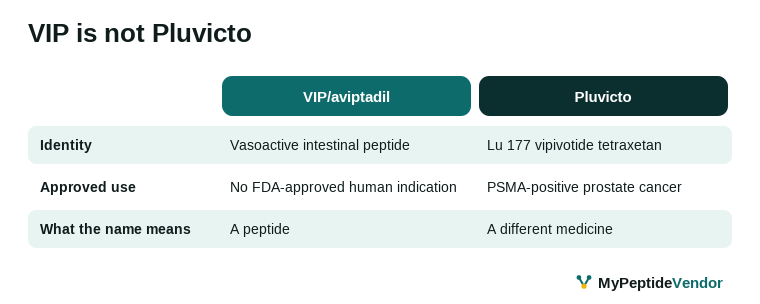
Do not confuse VIP with Pluvicto. Pluvicto is lutetium Lu 177 vipivotide tetraxetan, a radioligand medicine for specified PSMA-positive prostate-cancer settings; it is not vasoactive intestinal peptide 1. The similar letters in the drug name do not mean the two substances share a target or use.
The ClinicalTrials.gov keyword result of 320 “VIP” records does not establish aviptadil trial status 11. A research supplier’s availability or a “research use only” label is not evidence of FDA approval, legal patient access, or medical suitability. The cited sources do not establish a route for patient access to VIP as a treatment 1-11.
Use this chart
Free to reuse with a link back:
Research-grade VIP is available from Certified-Pep. Sold for laboratory research only, not for human use. Affiliate link
How it compares to its closest alternative
The closest mechanistic comparison is VIP (6–28), a shorter VIP-derived antagonist, rather than a different strength of full VIP. Full VIP is used to study stimulation of the pathway; the fragment is used to test pathway blockade. The product-specific sequence and CAS descriptions below are reported specifications, not independently verified by the primary sources cited here 1-11.
| Comparison | VIP (1–28) | VIP (6–28) |
|---|---|---|
| Form | Full-length vasoactive intestinal peptide | Shorter VIP-derived fragment |
| Reported role | Receptor agonist | Receptor antagonist |
| Reported CAS | 40077-57-4 | 69698-54-0 |
| Research use | Study signaling after VIP stimulation | Test what changes when VIP signaling is blocked |
| Human dose | Not established in the cited sources- | Not established in the cited sources- |
Where to Buy VIP for Research
Certified-Pep
US-made research peptides with batch-specific lab reports (COA) and a QR code on every vial.
- Independent laboratory testing (Vanguard Laboratory)
- Made in the USA, ships in 1-2 business days
- Research use only, not for human or veterinary use
Affiliate disclosure: we may earn a commission if you order through the link above. VIP is not approved by the FDA for human use.
Frequently asked questions
What does VIP peptide do for you?
VIP is a body signal involved in processes such as blood-vessel relaxation and gut secretion. Research also examines immune and nervous-system signaling, but a benefit from taking VIP has not been established in the cited clinical evidence 1-11.
Who should not take VIP peptide?
A product marked for research use should not be self-administered. Because no safe patient group or clinical dose is established here, people with low blood pressure, pregnant people, and anyone taking blood-pressure-lowering medicine should not assume it is safe.
References
- FDA prescribing information: Pluvicto (Lutetium Lu 177 Vipivotide Tetraxetan) Injection, Solution (DailyMed)
- FDA: Certain bulk drug substances for use in compounding that may present significant safety risks
- Jing et al. Correlations between social media addiction and anxiety, depression, FoMO, loneliness and self-esteem among students: A systematic review and meta-analysis. PLoS One. 2025.
- Zhang et al. Massage therapy can effectively relieve cancer pain: A meta-analysis. Medicine (Baltimore). 2023.
- Liang et al. Effects of aerobic, resistance, and combined exercise on metabolic syndrome parameters and cardiovascular risk factors: a systematic review and network meta-analysis. Rev Cardiovasc Med. 2021.
- Ma et al. Therapeutic Effects of Dry Needling on Lateral Epicondylitis: An Updated Systematic Review and Meta-analysis. Arch Phys Med Rehabil. 2024.
- Xie et al. The prevalence of compassion satisfaction and compassion fatigue among nurses: A systematic review and meta-analysis. Int J Nurs Stud. 2021.
- Chu et al. Comparative efficacy and safety of biologics and systemic immunomodulatory treatments for chronic urticaria: Systematic review and network meta-analysis. J Allergy Clin Immunol. 2025.
- Yang et al. Systematic Review and Meta-analysis: Changes of Gut Microbiota before and after Menopause. Dis Markers. 2022.
- Dong et al. Evidence on risk factors for knee osteoarthritis in middle-older aged: a systematic review and meta analysis. J Orthop Surg Res. 2023.
- ClinicalTrials.gov: 320 registered studies (search: VIP)
Written by the MyPeptideVendor editorial team from the FDA label, peer-reviewed studies and ClinicalTrials.gov records listed above, fact-checked line by line and reviewed 2026-11-12.
Cite this page
MyPeptideVendor Editorial Team. VIP 6mg: Evidence, Dosing & U.S. Status. MyPeptideVendor. Updated November 12, 2026. https://mypeptidevendor.com/peptides/vip-6mg/MyPeptideVendor Editorial Team. (2026, November 12). VIP 6mg: Evidence, Dosing & U.S. Status. MyPeptideVendor. https://mypeptidevendor.com/peptides/vip-6mg/Related peptides
Thymogen
Not establishedThymogen is a Russian-origin Glu-Trp dipeptide studied in small clinical reports; its benefits, safe dose, and US regulatory status remain uncertain.
Learn moreThymosin Alpha-1
Not establishedThymosin alpha 1 is an immune-modulating peptide studied for hepatitis, sepsis, cancer support, and vaccine response; evidence and US status vary.
Learn moreARA-290
Not approvedARA-290 is an investigational peptide with small, short neuropathy trials, but no established dose or proof of lasting nerve recovery.
Learn more