Thymosin Alpha-1: Uses, Dosing & Safety
Immunomodulatory peptide
Brand names: Thymalfasin is the synthetic drug form; Zadaxin is a name used outside the United States.
Thymosin alpha 1 is a thymus-associated peptide studied for its effects on immune cells, including T cells. Thymalfasin is its synthetic drug form, and clinical studies have examined it for hepatitis B and C, sepsis, cancer support, immune deficiency, and vaccine response 4578.
Its blood level peaks in about 2 hours and returns to baseline within 24 hours, but those measurements do not tell us how long an immune effect lasts 4. Hepatitis studies report specific outcomes; for many other proposed uses, the evidence does not establish who benefits or how much 47.
Key takeaways
- In a randomized hepatitis B study, HBV DNA clearance was 40.6% after 6 months of thymosin alpha 1, versus 9.4% in untreated controls 4.
- Three hepatitis C trials included 162 patients; in one, ALT normalization did not differ significantly between thymosin alpha 1 and placebo 4.
- The hepatitis regimen described in a clinical review was 1.6 mg under the skin twice weekly; it is a study dose, not personal dosing advice 4.
- Thymosin alpha 1 peaks in serum within about 2 hours, has an approximately 2-hour half-life, and returns to baseline within 24 hours 4.
- ClinicalTrials.gov lists 69 thymosin alpha 1 studies, including recruiting sepsis research and cancer trials at different stages 10.
Thymosin Alpha-1 at a glance
- Class
- Thymic immunomodulatory peptide
- Mechanism
- May stimulate thymocyte differentiation or conversion to active T cells; the full mechanism is not established.
- FDA Status
- Current US approval status is not established by the FDA information summarized here.
- Brand names
- Thymalfasin is the synthetic drug form; Zadaxin is a name used outside the United States.
- Administration
- Subcutaneous injection in the hepatitis regimens described.
- Typical Dose
- 1.6 mg (900 micrograms per square meter of body surface area) under the skin twice weekly in hepatitis studies.
- Half-life
- About 2 hours; serum levels returned to baseline within 24 hours.
- Primary Uses
- Investigated for hepatitis B and C, sepsis, cancer adjunct therapy, immune deficiency, and vaccine response.
What is it?

Thymosin alpha 1 (Tα1) is a small peptide associated with the thymus, an organ where many T cells develop. Thymalfasin is the synthetic drug form studied in clinical settings; it is not material extracted from a person’s thymus 47. Researchers describe it as an immune modulator: it may change parts of an immune response rather than simply raising or lowering all immune activity at once 5.
The word “thymosin” does not identify one molecule. Early work on thymus-derived material separated thymosin alpha 1 from thymosin beta 4, which have different biological roles 2. Beta 4 is present in many cells and binds G-actin, a protein involved in the cell’s internal framework; that role is distinct from alpha 1’s immune-focused research 2.
Researchers have studied thymosin alpha 1 for hepatitis B and C, severe infection, cancer as an add-on treatment, immune deficiency, and vaccine response 4578. These are not equally supported uses. The hepatitis reports provide specific outcome figures, while the reviews describe several other uses as areas for further study 47.
A product called “thymosin” cannot be assumed to be thymalfasin. A vial’s name alone does not establish its peptide sequence, strength, purity, or suitability for injection. That distinction matters when products are sold outside a regulated drug supply.
What makes it different
Thymosin alpha 1 is being studied for immune effects, not as a muscle-building drug. Its clinical rationale centers on immune function, including the development or activity of T cells 45. Thymosin beta 4 has a different, well-described molecular role: it binds and sequesters G-actin inside cells 2.
TB-500 is not another name for thymosin alpha 1. The beta-thymosin review explains that beta 4 and related peptides are distinct from alpha 1, but it does not verify the identity or contents of every product sold as TB-500 2. Treat a product’s exact composition as unverified unless it can be independently established; a label saying “thymosin” does not prove that it contains alpha 1 or beta 4.
Refnot is a separate hybrid drug discussed in a review on aging and thymosin alpha 1. It fuses tumor necrosis factor alpha (TNFα) with Tα1 and is designed to pair TNF’s antitumor activity with Tα1’s immune effects while reducing toxicity 6. Refnot is not another name for thymalfasin, and results from a fusion product cannot automatically be applied to alpha 1 alone 6.
Alpha 1 also has a short measured time in the bloodstream: its serum half-life is about 2 hours, with levels back to baseline within 24 hours 4. Those blood measurements do not show how long an immune effect may last. The duration of such an effect has not been established by the pharmacokinetic figures 4.
How does it work
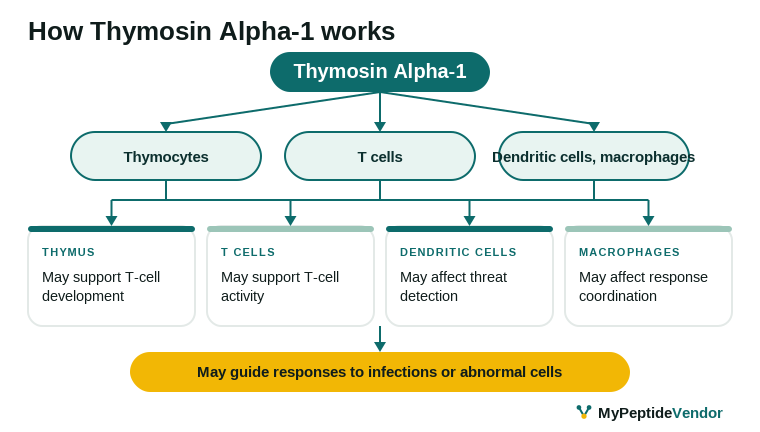
In plain terms, thymosin alpha 1 may help guide immune cells involved in recognizing and responding to infections or abnormal cells. T cells are white blood cells that coordinate parts of the immune response. Researchers have proposed that Tα1 supports their development or activity, but it is not a simple on-off switch for immunity 45.
More technically, Tα1 may stimulate thymocyte differentiation or convert thymocytes to active T cells 4. Reviews also describe possible effects on dendritic cells and macrophages, immune cells that help detect threats and coordinate responses 6. The full chain of molecular steps is not settled, so the proposed mechanism cannot predict with confidence which patient will benefit.
Thymosin alpha 1 is rapidly absorbed, reaches peak serum levels within about 2 hours, has a serum half-life of approximately 2 hours, and returns to baseline within 24 hours 4. A 2-hour half-life means the measured amount in blood falls by about half over that period. It does not mean a clinical effect necessarily ends after 2 hours.
Timing in brief: after dosing, serum levels peak at about 2 hours, then fall with an approximately 2-hour half-life and return to baseline within 24 hours 4. The hepatitis regimen used repeat injections twice weekly, not injections every 2 hours 4. Blood-level timing alone does not establish the ideal schedule for another disease.
Use this chart
Free to reuse with a link back:
What the clinical evidence actually shows

The most specific clinical outcome figures reported in the 2001 review are from hepatitis studies 4. It describes study designs and treatment groups rather than providing formal trial names. Those historical results do not show that Tα1 should replace current care for hepatitis or any other condition.
Hepatitis B
Four hepatitis B clinical trials included 195 patients 4. In one small study, HBV DNA was cleared at 6 months in 9 of 17 people receiving Tα1, or about 53%, compared with 10 of 16 receiving interferon alfa-2b and 4 of 15 historical controls 4. The comparison with historical controls is less reliable than a randomized comparison, and each group was small.
An open-label study reported HBV DNA clearance in 53% of patients at 6 months 4. A separate randomized, controlled study reported clearance in 40.6% after 6 months of Tα1 and 25.6% after 12 months, compared with 9.4% in untreated controls 4. These percentages come from different treatment-duration groups; they do not prove that a longer course works less well.
HBV DNA clearance is a laboratory result. By itself, it does not prove cure or show that treatment prevents cirrhosis, liver cancer, or death. The review does not report long-term liver outcomes for these studies, and the results predate current antiviral options 4. They cannot establish how Tα1 compares with modern treatment on outcomes measured over years.
Hepatitis C
Three hepatitis C trials included 162 patients 4. In one trial, the number of patients whose alanine aminotransferase (ALT), a liver enzyme, returned to normal did not differ significantly between Tα1 and placebo 4. That study did not show a clear ALT-normalization benefit from Tα1 alone.
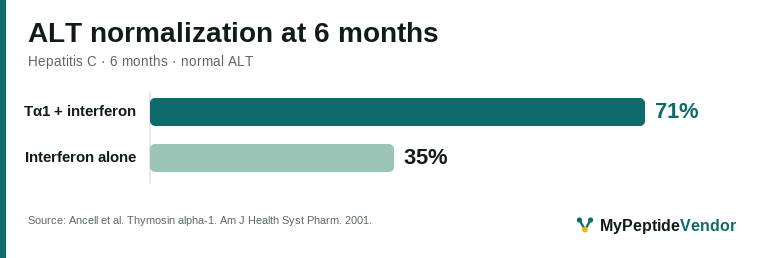
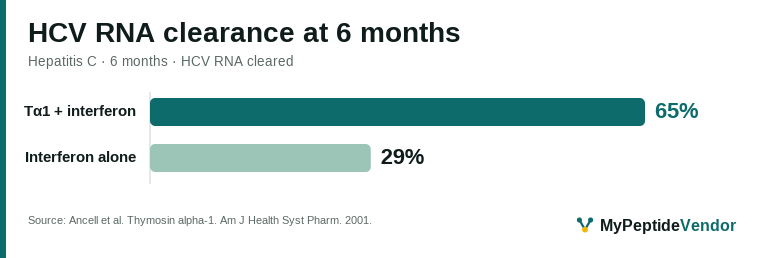
Two other trials compared Tα1 plus interferon alfa-2b with interferon alfa-2b alone. In one, ALT was normal at 6 months in 71% of the combination group and 35% of the interferon-only group; hepatitis C virus RNA cleared in 65% and 29%, respectively 4. In the other, normal ALT at 6 months was reported in 37.1% with combination treatment, 16.2% with interferon alone, and 2.7% with placebo 4. These are interferon-era findings. They do not show that Tα1 adds benefit to current direct-acting antiviral treatment.
Sepsis, cancer, and immune support
Sepsis can involve both a weakened immune response and harmful inflammation, so immune-modulating treatment has been studied. Reviews describe Tα1 as a possible sepsis treatment, but the review abstract reports no patient counts or mortality outcomes 7. A biological rationale is not proof that a treatment improves survival.
ClinicalTrials.gov lists sepsis studies, including NCT07866118, a recruiting study of immune recovery in adults with sepsis, and NCT07922954, a Phase 4 study listed as active but not recruiting 10. The registry descriptions do not provide completed results establishing a survival benefit. Neither study status nor a trial’s existence is evidence that treatment works 10.
Cancer research has examined Tα1 as an add-on to other therapies, not as a replacement for standard cancer treatment. The cited reviews discuss possible use in malignancy, including melanoma, but do not provide a complete outcome set for a specific thymalfasin cancer regimen 47. Refnot, the TNFα–Tα1 fusion drug, is a different product and needs to be assessed separately 6.
Several oncology studies are registered. NCT07884201 is listed as a Phase 2 study of thymalfasin with chemotherapy and immunotherapy for triple-negative breast cancer, and NCT07780721 is a not-yet-recruiting Phase 2 study of a combination for esophageal cancer 10. Their registry entries describe research questions, not demonstrated patient benefit 10.
For HIV, the research question includes whether Tα1 might address incomplete immune recovery in some people receiving antiretroviral therapy 5. That possibility does not establish that Tα1 prevents HIV complications or replaces antiretroviral treatment. The review describes an area of investigation, not a proven alternative to HIV care 5.
Vaccine response is another proposed use, including in older adults whose immune function may change with age. A review describes preclinical and clinical research suggesting Tα1 could improve vaccine response, but it does not provide a response percentage or a standard vaccine-adjuvant schedule 6. The size and durability of any benefit remain unclear.
COVID-19 claims also need care. A review discussed possible immune effects in severe COVID-19 without establishing that Tα1 improves clinical outcomes 7. Severe viral illness can also be complicated by secondary infections such as pulmonary aspergillosis, a reminder that changing immune activity may involve trade-offs 3.
An association does not show that low or high Tα1 caused a more severe infection, or that injecting thymalfasin improves outcomes. The report does not settle the treatment question.
What remains unknown
For many proposed uses, it is not known which patients would respond, whether changes in immune markers improve survival, or how long a benefit lasts. Safety in pregnancy, autoimmune disease, and organ-transplant recipients has not been established as a safe regimen 467; clinician oversight is needed.
ClinicalTrials.gov lists 69 studies involving thymosin alpha 1, with studies in sepsis, cancer, and other conditions 10. The status of a registered study can change as recruitment and follow-up proceed. Registration means a question is being studied; it does not mean the treatment has been shown to work 10.
The registry lists several active or planned studies that may clarify specific questions, but none of the entries below is itself a positive result 10.
| Study record | Indication | Phase and status | Question under study |
|---|---|---|---|
| NCT07866118 | Immune recovery in adults with sepsis | Phase listed as NA; recruiting | Whether immune recovery is a useful treatment target. |
| NCT07922954 | Tα1 and IgM levels in sepsis | Phase 4; active, not recruiting | How Tα1 relates to immune markers in sepsis. |
| NCT07884201 | Thymalfasin with chemotherapy and immunotherapy for triple-negative breast cancer | Phase 2; not yet recruiting | Whether an add-on regimen merits further testing in this cancer setting. |
| NCT07780721 | Thymalfasin with adebrelimab and chemotherapy for esophageal cancer | Phase 2; not yet recruiting | Whether this combination has a role in a defined cancer treatment plan. |
| NCT07675980 | Thymosin alpha 1 for recurrent implantation failure | Phase 2/3; recruiting | Whether the approach changes outcomes in this reproductive setting. |
For example, NCT07866118 is listed as recruiting with phase recorded as NA, while NCT07922954 is listed as Phase 4 and active but not recruiting 10. A registry status does not tell a patient whether a treatment is effective or appropriate.
Use this chart
Free to reuse with a link back:
Use this chart
Free to reuse with a link back:
Typical dosing

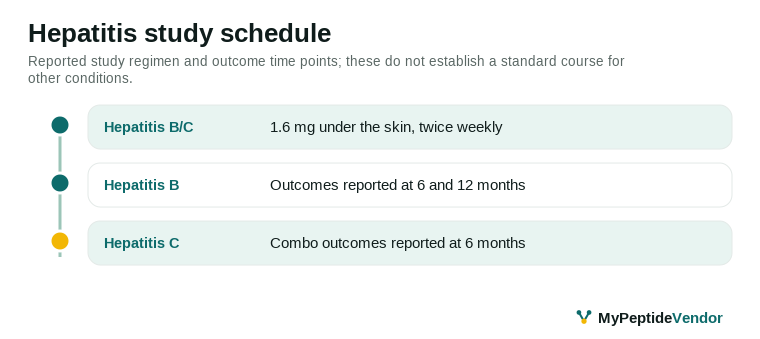
For hepatitis B and C, the clinical review describes 1.6 mg, equivalent to 900 micrograms per square meter of body surface area, injected under the skin twice weekly 4. This is a study regimen, not an individualized prescription or a recommendation for self-treatment.
Study duration depended on the disease and protocol. The randomized hepatitis B study reported outcomes after 6 and 12 months of treatment, while the hepatitis C combination studies reported outcomes at 6 months 4. These timeframes do not establish a standard course for sepsis, cancer, or another condition.
The approximately 2-hour serum half-life did not mean participants injected every 2 hours. The reported hepatitis schedule was twice weekly, while blood levels returned to baseline within 24 hours 4. The blood-level measurements do not establish how long an immune effect lasts.
No standard dose is established here for sepsis, cancer support, vaccine response, HIV-related immune dysfunction, or general immune enhancement 4578. Do not transfer the hepatitis schedule to a different condition; each use would need its own evidence and clinician oversight.
Use this chart
Free to reuse with a link back:
Side effects: what to actually expect
The hepatitis review describes thymosin alpha 1 as generally well tolerated, with local irritation at the injection site as the most commonly reported problem 4. It does not give a reliable percentage for injection-site irritation or a complete event-by-event rate, so a trial percentage cannot be stated from the reported figures 4.
“Generally well tolerated” does not mean risk-free. The review does not provide a percentage for fever, fatigue, headache, or other whole-body symptoms, and it does not give a current adverse-event table 4. Do not assume that an unreported rate means an effect never occurs.
Safety in pregnancy, autoimmune disease, and organ-transplant recipients has not been established as a safe regimen in the clinical evidence described here. People in these groups, or people taking immune-suppressing treatment, should not self-start an immune-modulating peptide; they should discuss the uncertainty with the clinician managing their care.
Who should pause and get medical advice: someone who is pregnant, has an autoimmune condition, has received an organ transplant, or uses immune-suppressing treatment should consult a clinician before considering Tα1. The clinical evidence described here does not define a reliable dose or safety plan for these situations.
Product quality is a separate concern from the peptide’s biological effects. For a product outside an approved drug supply, the name on a vial does not confirm its identity, strength, sterility, or ingredients. “Research use” on a label is not evidence that a product is suitable for human injection.
Regulatory & access status in the US
The FDA Category 2 page describes bulk drug substances nominated for compounding that may present significant safety risks under the agency’s interim policies 1. Category 2 is a compounding-policy designation, not proof that a substance is approved, safe, or effective 1. Thymalfasin does not appear in Category 2 in the listing cited 1, and whether it belongs to that category cannot be determined from 1.
The available FDA information does not establish thymalfasin’s current US approval status. The clinical review describes hepatitis research and dosing, but does not provide current US approval information 4. Do not treat study use, overseas use, or an online seller’s claim as proof of FDA approval.
FDA’s Category 2 page concerns potential safety risks for certain nominated bulk substances used in compounding 1. That warning does not, by itself, determine whether a particular thymalfasin product is legal to buy or safe to use. A clinician and pharmacist can help assess access, product source, and clinical risk; a seller’s description cannot confirm identity or quality.
Research remains active: ClinicalTrials.gov lists 69 studies, including sepsis and oncology studies at different stages 10. A trial listing is not approval to sell a product and is not evidence that it works 10.
Research-grade Thymosin Alpha-1 is available from American Peptides (THYMOSIN ALPHA-1, from $125.00); code MYPEPTIDEVENDOR takes 15% off. Sold for laboratory research only, not for human use. Affiliate link
How it compares with its closest alternative
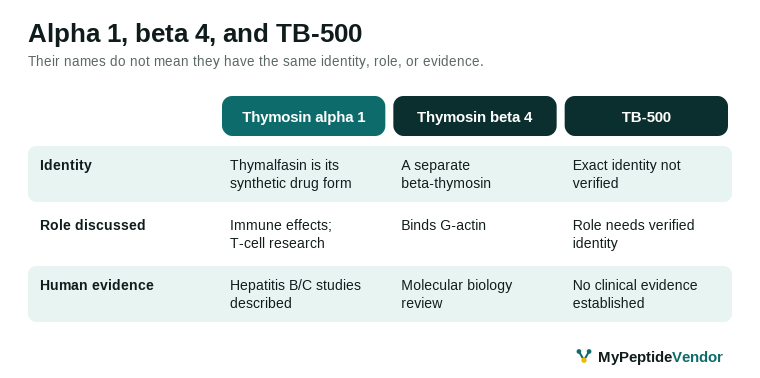
Thymosin beta 4 is the closest comparison by name, but it is not a substitute for thymosin alpha 1. Beta 4 binds G-actin; alpha 1 is studied for immune effects. The beta-thymosin review does not verify the identity of products sold as TB-500 2.
| Feature | Thymosin alpha 1 (thymalfasin) | Thymosin beta 4 | TB-500 |
|---|---|---|---|
| Identity | A distinct thymus-associated peptide; thymalfasin is its synthetic drug form. | A separate beta-thymosin found in many cells. | A product name whose exact identity is not verified by the cited beta-thymosin review. |
| Primary function discussed | Immune modulation, including research on T-cell function. | Sequesters G-actin, a protein involved in the cell’s internal framework. | No single biological role can be assigned without a verified product identity. |
| Human evidence described | Clinical studies include hepatitis B and C, with results varying by condition. | The cited review focuses on molecular biology, not clinical evidence equivalent to alpha 1. | The cited review does not establish clinical evidence for products sold under this name. |
| US regulatory information | Current US approval status is not established by the FDA information summarized here. | Current US approval status is not established by the cited review. | A product name does not establish approval, contents, or quality. |
The distinction matters because beta 4’s actin-binding role is not the same as alpha 1’s immune research 24. FDA’s Category 2 page describes safety concerns for certain nominated bulk substances, but the thymalfasin listing status cannot be confirmed from the information shown 1.
Use this chart
Free to reuse with a link back:
Frequently asked questions
These short answers distinguish research uses from proven treatment, and explain the main identity and safety questions 1410.
Where to Buy Thymosin Alpha-1 for Research
American Peptides
THYMOSIN ALPHA-1 · from $125.00
US-made research peptides, every lot third-party tested with a lot-matched COA.
15% offMYPEPTIDEVENDOR at checkout
- ≥99% purity verified by HPLC + mass spec, endotoxin tested
- Ships tracked from Louisiana, free shipping over $300
- 15% off your first order with code MYPEPTIDEVENDOR
Certified-Pep
US-made research peptides with batch-specific lab reports (COA) and a QR code on every vial.
- Independent laboratory testing (Vanguard Laboratory)
- Made in the USA, ships in 1-2 business days
- Research use only, not for human or veterinary use
Affiliate disclosure: we may earn a commission if you order through the link above. Thymosin Alpha-1 is not approved by the FDA for human use.
Frequently asked questions
What is thymosin alpha 1 used for?
Researchers have studied it for hepatitis B and C, sepsis, cancer adjunct treatment, immune deficiency, and vaccine response 45678. The strongest numerical detail in the clinical review is from older hepatitis studies; evidence for other uses is less conclusive 47.
Who should not take thymosin alpha 1?
A safe regimen has not been established for pregnancy, autoimmune disease, or organ-transplant recipients. People in these groups, and those using immune-suppressing treatment, should not self-start it and should ask their treating clinician about the risks.
References
- FDA: Certain bulk drug substances for use in compounding that may present significant safety risks
- Hannappel et al. beta-Thymosins. Ann N Y Acad Sci. 2007.
- Costantini et al. Covid-19-Associated Pulmonary Aspergillosis: The Other Side of the Coin. Vaccines (Basel). 2020.
- Ancell et al. Thymosin alpha-1. Am J Health Syst Pharm. 2001.
- Matteucci et al. Thymosin alpha 1 and HIV-1: recent advances and future perspectives. Future Microbiol. 2017.
- Simonova et al. Aging and Thymosin Alpha-1. Int J Mol Sci. 2025.
- Dominari et al. Thymosin alpha 1: A comprehensive review of the literature. World J Virol. 2020.
- Hadden et al. T-cell adjuvants. Int J Immunopharmacol. 1994.
- Hadden et al. Thymic endocrinology. Ann N Y Acad Sci. 1998.
- ClinicalTrials.gov: 69 registered studies (search: Thymosin Alpha-1)
Written by the MyPeptideVendor editorial team from the FDA label, peer-reviewed studies and ClinicalTrials.gov records listed above, fact-checked line by line and reviewed 2026-11-12.
Cite this page
MyPeptideVendor Editorial Team. Thymosin Alpha 1: Uses, Dosing & Safety. MyPeptideVendor. Updated November 12, 2026. https://mypeptidevendor.com/peptides/thymosin-alpha-1/MyPeptideVendor Editorial Team. (2026, November 12). Thymosin Alpha 1: Uses, Dosing & Safety. MyPeptideVendor. https://mypeptidevendor.com/peptides/thymosin-alpha-1/Related peptides
Thymogen
Not establishedThymogen is a Russian-origin Glu-Trp dipeptide studied in small clinical reports; its benefits, safe dose, and US regulatory status remain uncertain.
Learn moreVIP
Research UseVIP is a 28-amino-acid signaling peptide studied in laboratory and animal research; a 6 mg vial is not an established human dose.
Learn moreARA-290
Not approvedARA-290 is an investigational peptide with small, short neuropathy trials, but no established dose or proof of lasting nerve recovery.
Learn more