Retatrutide: Phase 3 Results, Dosing & FDA Status
Investigational triple receptor agonist
Brand names: No FDA-approved brand name

Retatrutide is an investigational once-weekly peptide that activates GLP-1, GIP and glucagon receptors. It is not FDA-approved, and FDA says it has not been found safe and effective for any condition 14.
In a phase 2 obesity trial, participants receiving 12 mg lost a mean 24.2% of their starting weight over 48 weeks 4. That result does not prove retatrutide is better than approved medicines, and it does not settle long-term safety 47.
Key takeaways
- Phase 3 TRIUMPH-1 reported 28.3% mean weight loss with 12 mg at 80 weeks, and 30.3% at 104 weeks in an extension 12.
- The phase 2 obesity trial reported 24.2% mean weight loss with 12 mg after 48 weeks 4.
- Retatrutide activates GLP-1, GIP and glucagon receptors; researchers call this a triple agonist 34.
- Trial doses ranged from 1 to 12 mg once weekly, but retatrutide has no FDA-approved dose or prescribing label 14.
- Gastrointestinal events were the most common side effects in phase 2, and heart-rate increases peaked at week 24 before declining 4.
- FDA says retatrutide cannot be used in compounding; Lilly plans to file for approval in Q1 2027 113.
Retatrutide at a glance
- Class
- Investigational GLP-1, GIP and glucagon receptor triple agonist
- Mechanism
- Activates three hormone-receptor pathways involved in appetite and glucose regulation
- FDA Status
- Not approved; Lilly plans to file in Q1 2027; FDA says it cannot be compounded
- Brand names
- No FDA-approved brand name
- Administration
- Once-weekly injection in clinical trials
- Typical Dose
- No approved dose; phase 3 maintenance doses were 4, 9 and 12 mg weekly, starting at 2 mg
- Half-life
- No approved product label establishes a clinical-use half-life
- Primary Uses
- Investigational studies include obesity, type 2 diabetes, chronic kidney disease, and cardiovascular and kidney outcomes
What is it?

Retatrutide, also called LY3437943, is an investigational peptide drug designed to activate three receptors: glucose-dependent insulinotropic polypeptide (GIP), glucagon-like peptide-1 (GLP-1), and glucagon 4. In clinical research, it is given as an injection once a week 4.
“Triple agonist” is the clearest short description: one molecule activates three hormone receptors 34. This is a description of its drug action, not a guarantee that it works better than a medicine with one or two targets.
Retatrutide is not an approved medicine. FDA says it has not been found safe and effective for any condition and cannot be used in compounding under federal law 1. A vial advertised for weight loss is not an FDA-approved treatment, even if its seller provides dosing instructions.
Researchers are studying retatrutide in obesity and type 2 diabetes, as well as in studies of kidney function and cardiovascular and kidney outcomes 11. A study of a condition is not proof that the drug treats it; each use remains investigational until regulators review evidence and approve it.
ClinicalTrials.gov lists 34 retatrutide studies 11. The registry includes different study phases and conditions, and a study record does not mean that enrollment is open or that the treatment is available outside research.
What makes it different
Semaglutide activates the GLP-1 receptor, while tirzepatide activates GLP-1 and GIP receptors. Retatrutide adds activity at the glucagon receptor, giving it three targets rather than one or two 348. Adding a target is a design choice, not proof of better results for every person.
The strongest published obesity result in the phase 2 trial was a mean 24.2% weight reduction at 12 mg after 48 weeks 4. For a person starting at 225 pounds, that percentage would equal about 54 pounds. It is an illustration of a group average, not a forecast for an individual.
Retatrutide remains investigational, unlike FDA-approved semaglutide and tirzepatide products 18. It has no approved label or standard prescribing dose 1. It is unapproved and cannot be compounded 1. Results from a trial do not make an unapproved product interchangeable with a prescription medicine.
FDA has warned companies about selling retatrutide labeled “for research purposes” or “not for human consumption” while marketing it directly to consumers for human use 1. Those words do not show that a vial is safe, correctly made or suitable for injection.
How does it work?
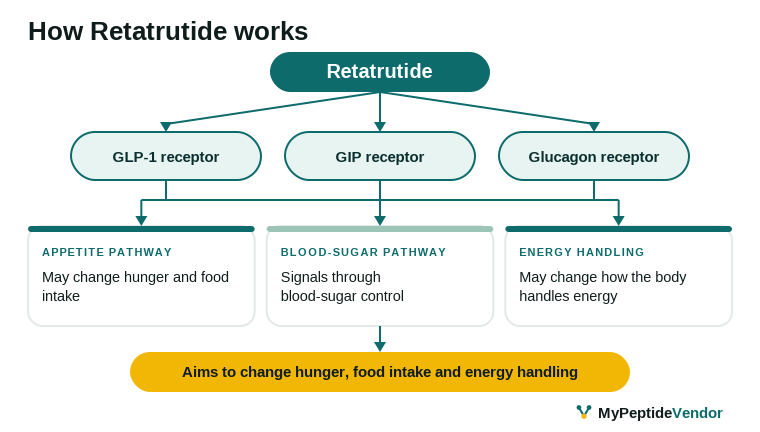
In plain terms, retatrutide sends signals through three hormone pathways involved in appetite and blood-sugar control. The aim is to change hunger, food intake and the body’s handling of energy 35. Researchers are still working out how much each receptor contributes to the total weight-loss effect in people.
GLP-1, GIP and glucagon are the three receptor targets in retatrutide’s design 34. Their combined activity may affect more than one part of metabolism at a time, but the receptor count alone cannot tell us how much benefit or risk a person will experience.
Retatrutide is one molecule, rather than three separate drugs taken together 4. In the phase 2 trial, weight loss increased with dose, while gastrointestinal events also tended to be dose-related 4. That pattern is one reason a trial schedule should not be copied from a seller’s instructions.
“Triple agonist” describes the receptors the drug activates; it does not mean three times the benefit or three times the harm. Clinical studies must establish how weight loss, blood-sugar effects and side effects compare with available treatments 49.
Use this chart
Free to reuse with a link back:
What the clinical evidence actually shows

The main published obesity study is NCT04881760, a phase 2 randomized, double-blind, placebo-controlled trial 4. It enrolled 338 adults with a body mass index (BMI) of at least 30, or a BMI from 27 to under 30 plus at least one weight-related condition, and treated them for 48 weeks 4. That is about 11 months; it is not long enough to answer questions about several years of use.
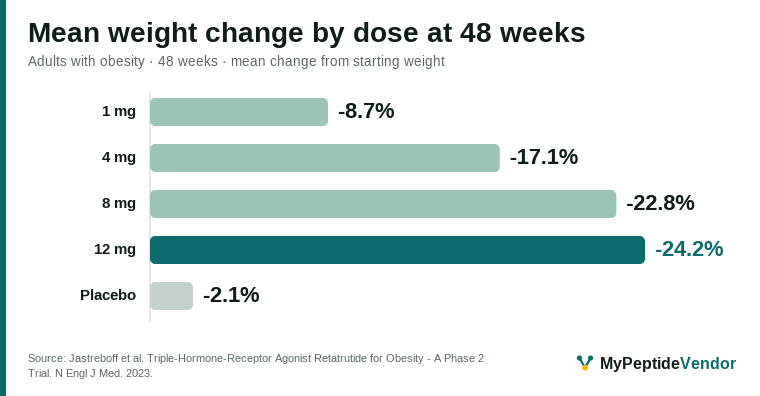
At 48 weeks, mean weight change was −8.7% with 1 mg, −17.1% with the combined 4 mg groups, −22.8% with the combined 8 mg groups, and −24.2% with 12 mg. The placebo group changed by −2.1% 4. At 225 pounds, those treatment averages would represent roughly 20, 38, 51 and 54 pounds, respectively; individual results can differ.
The 48-week dose results below come from the 338-adult phase 2 trial. The 4 mg and 8 mg figures combine groups that used different starting doses 4.
| Weekly trial dose | Mean weight change at 48 weeks | Participants who lost at least 15% |
|---|---|---|
| 1 mg | −8.7% | Not reported in the trial summary |
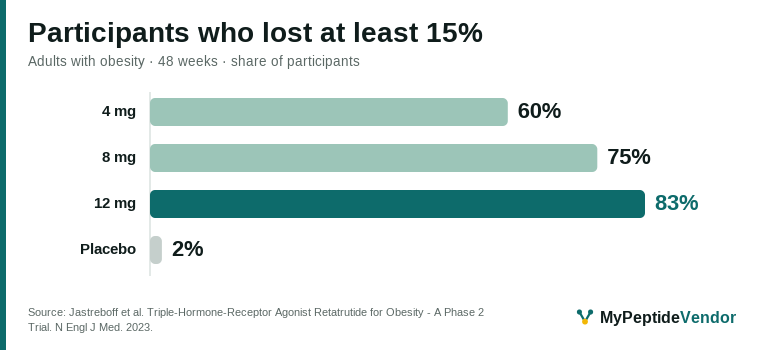
| 4 mg | −17.1% | 60% |
| 8 mg | −22.8% | 75% |
| 12 mg | −24.2% | 83% |
| Placebo | −2.1% | 2% |
At week 24, mean weight change was −7.2% with 1 mg, −12.9% in the combined 4 mg groups, −17.3% in the combined 8 mg groups, and −17.5% with 12 mg, compared with −1.6% on placebo 4. At week 48, 83% of participants in the 12 mg group had lost at least 15% of their starting weight, compared with 2% receiving placebo 4.
A 2025 meta-analysis pooled three randomized trials with 878 participants and found an average HbA1c reduction of 0.91 percentage points 6. HbA1c reflects average blood sugar over roughly the prior few months. In that analysis, adverse events did not differ significantly from placebo (relative risk 1.11, P=0.24), but the authors called for larger, longer trials 6.
A systematic review of 26 trials in adults without diabetes reported up to 22.1% weight loss with retatrutide 12 mg after 48 weeks, up to 17.8% with tirzepatide 15 mg after 72 weeks, and up to 13.9% with semaglutide 2.4 mg after 68 weeks 7. These figures come from separate trials, with different treatment periods and participants. The review found no head-to-head randomized trials for those comparisons 7.
A separate network meta-analysis of 19 trials and 29,506 adults estimated mean weight loss of 11.0 kg for retatrutide and 11.0 kg for dual agonists across the included studies 10. The analysis also estimated the highest adverse-event risk with retatrutide 10. These pooled estimates do not mean that two individual patients will lose the same amount, or that the treatments have identical safety profiles.
Those results do not answer whether retatrutide is better than Ozempic. TRANSCEND-T2D-2 is a registered comparison with semaglutide, but it studies adults with type 2 diabetes whose blood sugar is not adequately controlled with metformin, with or without an SGLT2 inhibitor 11. It is not a completed general weight-loss comparison in adults without diabetes.
Researchers are also studying retatrutide in type 2 diabetes, kidney function, and cardiovascular and kidney outcomes 11. A registry entry shows what researchers plan to test, not what the results will be. Current evidence does not establish whether retatrutide prevents heart attacks, strokes, kidney failure or death, or how much weight loss lasts after treatment stops 911.
Long-term safety is another open question. A 48-week obesity trial can show common effects over about 11 months, but it cannot settle rare events or risks that may emerge after years of treatment 49. Longer follow-up and results in a wider range of patients are needed before those questions can be answered.
The table below lists selected registry records, including the registered semaglutide comparison and studies of kidney or cardiovascular outcomes. Registry status can change, so check each record for the latest enrollment details 11.
| NCT number | Phase | Study focus | Listed status |
|---|---|---|---|
| NCT05936151 | Phase 2 | Kidney function in overweight or obesity with chronic kidney disease | Completed |
| NCT06260722 | Phase 3 | TRANSCEND-T2D-2; comparison with semaglutide in type 2 diabetes | Active, not recruiting |
| NCT06383390 | Phase 3 | TRIUMPH-Outcomes; cardiovascular and kidney outcomes | Active, not recruiting |
| NCT06982859 | Phase 1 | Insulin secretion and sensitivity in type 2 diabetes | Active, not recruiting |
| NCT07232719 | Phase 3 | Obesity or overweight | Active, not recruiting |
The published 48-week obesity trial is NCT04881760 4. Its registry status is not included in the selected ClinicalTrials.gov records above 11.
Use this chart
Free to reuse with a link back:
Use this chart
Free to reuse with a link back:
Phase 3 TRIUMPH results (2025 to 2026)
Since the phase 2 trial, Eli Lilly has reported topline results from four phase 3 trials in the TRIUMPH program. These are company announcements; full peer-reviewed papers were not all published at the time of writing 121314.
| Trial | Who was studied | Length | Mean weight loss (efficacy estimand) |
|---|---|---|---|
| TRIUMPH-1 | 2,339 adults with obesity or overweight and a weight-related condition, without diabetes | 80 weeks | 4 mg: 19.0% · 9 mg: 25.9% · 12 mg: 28.3% |
| TRIUMPH-2 | 1,152 adults with type 2 diabetes and obesity or overweight | 80 weeks | 4 mg: 12.7% · 9 mg: 19.1% · 12 mg: 20.8% · placebo: 4.0% |
| TRIUMPH-3 | 1,949 adults with BMI of 35 or more and established cardiovascular disease | 80 weeks | 9 mg: 21.6% · 12 mg: 22.6% · placebo: 3.2% |
| TRIUMPH-4 | 445 adults with obesity or overweight and knee osteoarthritis, without diabetes | 68 weeks | 9 mg: 26.4% · 12 mg: 28.7% · placebo: 2.1% |
In TRIUMPH-1, 45.3% of people on 12 mg lost 30% or more of their starting weight, and 65.3% ended below the obesity threshold (BMI under 30) at 80 weeks 12. In a blinded extension to 104 weeks for 532 participants with a BMI of at least 35, those first assigned to 12 mg reached a mean loss of 30.3% 12.
In TRIUMPH-3, cardiovascular events were less frequent than expected in both groups. There were 44 MACE-5 events with retatrutide versus 52 with placebo (hazard ratio 0.82, 95% CI 0.55 to 1.22) and 27 MACE-3 events versus 23 (hazard ratio 1.12, 95% CI 0.64 to 1.96) 13. These confidence intervals cross 1, so the trial does not show that retatrutide lowers or raises heart risk; the dedicated outcomes trial is still running 11.
Results in type 2 diabetes
In a 36-week phase 2 trial of 281 adults with type 2 diabetes, HbA1c fell by 2.02 percentage points with the 12 mg escalation dose at 24 weeks, versus 0.01 with placebo and 1.41 with dulaglutide 1.5 mg 15. Body weight fell by 16.94% at 36 weeks on 12 mg, versus 3.00% on placebo 15.
In the phase 3 TRIUMPH-2 trial, HbA1c fell from a baseline of 7.7% by 1.4, 1.6 and 1.5 percentage points with 4, 9 and 12 mg at 80 weeks, versus 0.2 with placebo 13. Weight loss was smaller than in people without diabetes (20.8% at the highest dose), a pattern also seen with other GLP-1 medicines 13.
Typical dosing

Retatrutide has no FDA-approved dose, product label or prescribing schedule 1. The amounts here describe research protocols only. They are not instructions for self-treatment.
In the 48-week phase 2 obesity trial, researchers tested 1, 4, 8 and 12 mg by injection once weekly, alongside placebo 4. Some participants assigned to 4 mg or 8 mg started at 2 mg; others started at 4 mg. The 12 mg group started at 2 mg 4.
Gastrointestinal side effects were partly reduced when participants began at 2 mg rather than 4 mg 4. That finding applies to the trial’s monitored dose-escalation schedules. It does not validate a schedule for an online product or make an unapproved vial safe to use.
Do not use trial amounts to measure or inject a product sold online. FDA says unapproved versions do not undergo its review for safety, effectiveness and quality before marketing, and it has warned about retatrutide sold for human use under “research” labels 1. A seller’s concentration, syringe directions or dose increases are not an approved medical regimen.
The phase 3 trials used a slower ramp. Everyone started at 2 mg once weekly and stepped up every four weeks: 2 then 4 mg to reach 4 mg; 2, 4 then 6 mg to reach 9 mg; and 2, 4, 6 then 9 mg to reach 12 mg 13. The phase 3 maintenance doses were 4, 9 and 12 mg 1213.
To see what a trial dose looks like in syringe units for a given vial, use the retatrutide calculator; to total the milligrams a step-up schedule uses, see the titration calculator. These tools do math only; they are not a treatment plan.
Side effects: what to actually expect
In the phase 2 obesity trial, gastrointestinal events were the most common side effects. They tended to increase with dose, were mostly mild to moderate, and were partly reduced by starting at 2 mg rather than 4 mg 4. The trial report does not give retatrutide-specific percentages for nausea, vomiting, diarrhea or constipation 4.
Across trials of several medicines in a 2025 systematic review, any adverse event occurred in 80% to 97% of active-treatment participants and 63% to 100% of placebo participants 7. Gastrointestinal events occurred in 47% to 84% of active-treatment groups and 13% to 63% of placebo groups 7. Those ranges combine different drugs and trials; they are not retatrutide-only rates.
Heart rate rose in a dose-dependent way in the phase 2 trial. The rise peaked at week 24 and declined afterward 4. The trial report does not give a percentage of participants with a heart-rate increase, so there is no reliable rate to quote from that report.
Across the medicines in the systematic review, adverse events leading to treatment discontinuation ranged from 0% to 26% with active treatment and 0% to 9% with placebo; serious adverse events ranged from 0% to 10% and 0% to 12%, respectively 7. Those broad ranges include different medicines, doses and study populations. They should not be used as retatrutide-specific estimates.
There is no FDA-approved retatrutide label with formal contraindications, warnings or monitoring instructions 1. Available studies do not settle safety over several years, and the fact that common trial events were often mild does not rule out rare or delayed harms 49.
Products from illegal sellers add risks beyond the possible effects of the drug itself. FDA warns that unapproved drugs may be counterfeit, contain the wrong or harmful ingredients, or contain too much, too little or no active ingredient 1. A “research use only” label does not verify a product’s contents or make it safe for people 1.
Phase 3 gives clearer numbers. In TRIUMPH-1, nausea affected 28.6%, 38.4% and 42.4% of people on 4, 9 and 12 mg versus 14.8% on placebo, and 4.1%, 6.9% and 11.3% stopped because of side effects versus 4.9% on placebo 12.
In TRIUMPH-2, diarrhea was the most common event (27.4% to 33.6% versus 13.2% on placebo) 13. Dysesthesia, an unusual or unpleasant skin sensation, occurred in 4.5%, 5.6% and 7.3% on 4, 9 and 12 mg versus 0.7% on placebo; in TRIUMPH-3 it occurred in 6.4% on both doses versus 1.3% 13. Lilly described these events as generally mild to moderate, with most resolving during treatment 13.
Regulatory & access status in the US (as of 2026)
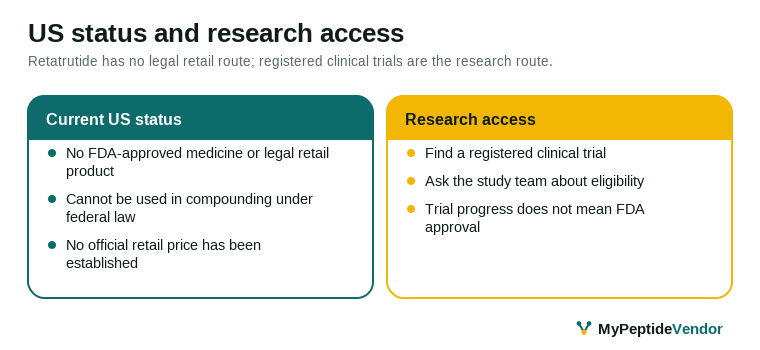
FDA says retatrutide has not been found safe and effective for any condition and cannot be used in compounding under federal law 1. It is not an FDA-approved medicine, and there is no legal retail product for human use 1.
Compounded retatrutide is not a legal workaround. FDA says retatrutide cannot be used in compounding, and the agency has warned companies involved in marketing it and distributors involved in selling its active ingredient 1. Compounded drugs do not receive FDA review for safety, effectiveness or quality before they are marketed 1.
There is no routine prescription route today. The legitimate research route is to find a registered clinical trial and ask its study team about eligibility 11. The phase 2 obesity trial enrolled people with BMI of at least 30, or BMI from 27 to under 30 plus a weight-related condition, but each trial can set different criteria 4. A clinician can help someone assess whether research participation may fit; an online seller is not a trial site.
The registry includes phase 3 studies, a cardiovascular and kidney outcomes trial, and a semaglutide comparison in type 2 diabetes 11. Trial progress does not equal FDA approval. On July 23, 2026, Lilly said it plans to submit a Biologics License Application to FDA in the first quarter of 2027, after completing its manufacturing data package 13. A filing is not an approval, and FDA review usually takes months; any launch date before a decision is speculation.
There is no official retatrutide price because there is no approved retail product 1. Online “research peptide” prices are not legitimate prescription prices and do not establish what is in a vial. Insurance coverage and any future patient cost have not been established.
Warning signs of an unsafe seller
- Be cautious if a seller claims an unapproved product is “the same as” an FDA-approved drug; FDA identifies that claim as a warning sign 1.
- Avoid sellers offering unusually deep discounts, skipping screening by a licensed prescriber, or providing no clinician to answer questions 1.
- Do not treat “for research purposes” or “not for human consumption” wording as proof of quality. FDA has warned about retatrutide products with those labels being sold directly to consumers for human use 1.
- FDA advises patients using prescription medicines to get a prescription from a doctor and fill it at a state-licensed pharmacy 1. That advice does not create a legal pharmacy route for retatrutide while it remains unapproved.
Use this chart
Free to reuse with a link back:
Research-grade Retatrutide is available from Certified-Pep. Sold for laboratory research only, not for human use. Affiliate link
What we still do not know
- Long-term heart outcomes. TRIUMPH-3 was not designed to prove a heart benefit, and its results are inconclusive; a dedicated cardiovascular and kidney outcomes trial is ongoing 1113.
- Safety beyond about two years. The longest reported data run to 104 weeks 12.
- What happens after stopping. The phase 3 announcements do not report weight regain after treatment ends 1213.
- Dysesthesia. Unusual skin sensations were reported more often on retatrutide than placebo; why this happens is not explained in the announcements 13.
- Full peer-reviewed phase 3 data. Several TRIUMPH results are still topline company data 1213.
How it compares to its closest alternatives
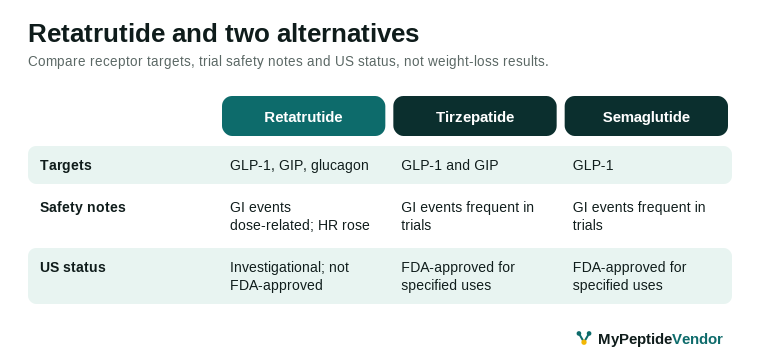
The comparison below uses separate trials and pooled estimates, not one head-to-head weight-loss trial 47810. Retatrutide’s registered semaglutide comparison is in adults with type 2 diabetes, while the weight-loss estimates come from different studies and follow-up periods 711.
| Medicine | Receptor targets | Weight-loss evidence | Known safety points | US status |
|---|---|---|---|---|
| Retatrutide | GLP-1, GIP and glucagon | Up to 22.1% with 12 mg after 48 weeks in a systematic review; 24.2% mean change in the phase 2 trial | GI events were dose-related; heart-rate rise peaked at week 24 in phase 2 | Investigational; not FDA-approved |
| Tirzepatide (Zepbound or Mounjaro) | GLP-1 and GIP | Up to 17.8% with 15 mg after 72 weeks in the systematic review; up to 22.5% in phase 3 obesity trials in a separate review | GI events are frequent across trials of these medicines | FDA-approved products exist for specified uses |
| Semaglutide (Wegovy or Ozempic) | GLP-1 | Up to 13.9% with 2.4 mg after 68 weeks in the systematic review | GI events are frequent across trials of these medicines | FDA-approved products exist for specified uses |
The percentages in the table are not a direct ranking. Retatrutide’s 24.2% result came from a 48-week phase 2 trial, while comparison estimates came from other trials, doses and follow-up periods 478. The systematic review found no head-to-head randomized trials for its weight-loss comparisons 7.
Ozempic and Wegovy both contain semaglutide, but the 13.9% estimate above is for semaglutide 2.4 mg in obesity trials, not a direct retatrutide-versus-Ozempic result 7. Whether retatrutide is better for a particular person has not been proven.
Tirzepatide is a close comparison because it activates two of retatrutide’s three receptor targets 38. Even a larger average result in separate studies would not establish which medicine is safer or more effective for an individual. For treatment decisions now, approved product information and a clinician’s assessment matter alongside average weight-loss figures 18.
Use this chart
Free to reuse with a link back:
Where to Buy Retatrutide for Research
Certified-Pep
US-made research peptides with batch-specific lab reports (COA).
- Retatrutide 30 mg vial in the Shredder research bundle
- Independent lab testing, QR code on every vial
- Ships from the US in 1-2 business days
American Peptides
AP-RTA-3™ · from $105.00
US-made research peptides, every lot third-party tested with a lot-matched COA.
15% offMYPEPTIDEVENDOR at checkout
- ≥99% purity verified by HPLC + mass spec, endotoxin tested
- Ships tracked from Louisiana, free shipping over $300
- 15% off your first order with code MYPEPTIDEVENDOR
Affiliate disclosure: we may earn a commission if you order through the link above. Retatrutide is not approved by the FDA for human use.
Ranked in our guides
Frequently asked questions
Is retatrutide better than Ozempic?
That has not been proven. Separate trials reported different average weight losses, but the participants, doses and study periods differed 47. The registered TRANSCEND-T2D-2 comparison is in adults with type 2 diabetes, and its listed status is active, not recruiting 11.
How can I obtain retatrutide?
There is no approved prescription or legal retail source for human use in the US, and FDA says retatrutide cannot be used in compounding 1. You can ask a clinician about registered studies and contact a study team to check whether enrollment is open 11. Avoid online vials labeled for research; FDA has warned about their sale directly to consumers for human use 1.
What are the risks of using retatrutide?
The phase 2 trial found dose-related gastrointestinal events and a dose-dependent heart-rate rise that peaked at week 24 4. It did not provide percentages for individual GI symptoms, and long-term safety remains unestablished 49. Products sold outside approved research add risks because their ingredients and amounts may be wrong or unknown 1.
How much does retatrutide peptide cost?
There is no official price because retatrutide is not an approved retail medicine 1. Prices advertised by “research peptide” sellers are not prescription prices and do not verify a product’s ingredients or quality 1.
How much weight do people lose on retatrutide in phase 3?
In TRIUMPH-1, mean weight loss at 80 weeks was 19.0% with 4 mg, 25.9% with 9 mg and 28.3% with 12 mg in adults without diabetes 12. People with type 2 diabetes lost less: up to 20.8% in TRIUMPH-2 13.
When will retatrutide be FDA approved?
It is not approved. Lilly said on July 23, 2026 that it plans to submit its application to FDA in the first quarter of 2027 13. Approval would only come after FDA review.
What is dysesthesia on retatrutide?
Dysesthesia is an unusual or unpleasant skin sensation. In TRIUMPH-2 it was reported in 4.5% to 7.3% of people on retatrutide versus 0.7% on placebo, and was generally mild to moderate 13.
References
- FDA: Concerns with unapproved GLP-1 drugs used for weight loss
- FDA: Certain bulk drug substances for use in compounding that may present significant safety risks
- Drucker et al. Efficacy and Safety of GLP-1 Medicines for Type 2 Diabetes and Obesity. Diabetes Care. 2024.
- Jastreboff et al. Triple-Hormone-Receptor Agonist Retatrutide for Obesity - A Phase 2 Trial. N Engl J Med. 2023.
- Katsi et al. Retatrutide-A Game Changer in Obesity Pharmacotherapy. Biomolecules. 2025.
- Abdrabou Abouelmagd et al. Efficacy and safety of retatrutide, a novel GLP-1, GIP, and glucagon receptor agonist for obesity treatment: a systematic review and meta-analysis of randomized controlled trials. Proc (Bayl Univ Med Cent). 2025.
- Moiz et al. Efficacy and Safety of Glucagon-Like Peptide-1 Receptor Agonists for Weight Loss Among Adults Without Diabetes : A Systematic Review of Randomized Controlled Trials. Ann Intern Med. 2025.
- Melson et al. What is the pipeline for future medications for obesity? Int J Obes (Lond). 2025.
- Kokkorakis et al. Emerging pharmacotherapies for obesity: A systematic review. Pharmacol Rev. 2025.
- Sinha et al. Efficacy and Safety of GLP-1 Receptor Agonists, Dual Agonists, and Retatrutide for Weight Loss in Adults With Overweight or Obesity: A Bayesian NMA. Obesity (Silver Spring). 2025.
- ClinicalTrials.gov: 34 registered studies (search: Retatrutide)
- AJMC: Retatrutide Achieves Up to 30.3% Average Weight Loss in Phase 3 TRIUMPH-1 Trial (May 21, 2026), reporting Eli Lilly topline results
- Eli Lilly: Retatrutide successful in two additional Phase 3 obesity trials (TRIUMPH-2, TRIUMPH-3), July 23, 2026
- Eli Lilly: Retatrutide first successful Phase 3 trial (TRIUMPH-4, knee osteoarthritis), December 11, 2025
- Rosenstock et al. Retatrutide, a GIP, GLP-1 and glucagon receptor agonist, for people with type 2 diabetes: a phase 2 trial. Lancet. 2023.
Written by the MyPeptideVendor editorial team from the FDA label, peer-reviewed studies and ClinicalTrials.gov records listed above, fact-checked line by line and reviewed 2026-11-17.
Cite this page
MyPeptideVendor Editorial Team. Retatrutide: Phase 3 Results, Dosing & FDA Status. MyPeptideVendor. Updated November 17, 2026. https://mypeptidevendor.com/peptides/retatrutide/MyPeptideVendor Editorial Team. (2026, November 17). Retatrutide: Phase 3 Results, Dosing & FDA Status. MyPeptideVendor. https://mypeptidevendor.com/peptides/retatrutide/Related peptides
5-Amino-1MQ
Not approved5-Amino-1MQ is a small molecule, not a peptide; its human benefits, dose, side effects, and long-term safety are not established.
Learn moreAdipotide (FTPP)
Not approvedAdipotide is an experimental fat-vessel-targeting peptide with animal findings, kidney concerns, and no established human dose or benefit.
Learn moreAOD-9604
Not approvedAOD-9604 was studied for obesity, but available evidence does not establish meaningful weight loss, a standard dose, or FDA approval.
Learn more