Liraglutide: Uses, Dosage & Safety
GLP-1 receptor agonist
Brand names: Victoza and Saxenda
liraglutide is a prescription peptide medicine injected under the skin once daily. It activates the GLP-1 receptor, helping lower blood sugar and reduce calorie intake 1.
In the United States, the two familiar brand names are Victoza for type 2 diabetes and Saxenda for chronic weight management. In a 56-week weight trial, adults taking the 3 mg dose lost an average of 8.4 kg (18.5 lb), compared with 2.8 kg (6.2 lb) on placebo 11.
Key takeaways
- Liraglutide is injected once daily; Saxenda reaches a 3 mg daily maintenance dose, while Victoza is used at lower doses for diabetes 1.
- In a 56-week trial, adults without diabetes lost an average of 8.4 kg (18.5 lb) with liraglutide and 2.8 kg (6.2 lb) with placebo 11.
- In LEADER, the primary cardiovascular outcome occurred in 13.0% with liraglutide and 14.9% with placebo over a median 3.8 years 6.
- Nausea, diarrhea, constipation and vomiting occurred in 39.3%, 20.9%, 19.4% and 15.7% of adults taking Saxenda in clinical trials 1.
- Do not use liraglutide if you or a family member has had medullary thyroid carcinoma or if you have MEN 2 1.
Liraglutide at a glance
- Class
- GLP-1 receptor agonist peptide
- Mechanism
- Mimics GLP-1 to support glucose-dependent insulin release, reduce glucagon, slow stomach emptying and lower calorie intake.
- FDA Status
- FDA-approved prescription products include Victoza and Saxenda, with different labeled uses and doses.
- Brand names
- Victoza and Saxenda
- Administration
- Subcutaneous injection once daily, with or without food.
- Typical Dose
- Saxenda: titrate from 0.6 mg to 3 mg daily. Victoza: diabetes dosing is lower, up to 1.8 mg daily.
- Half-life
- About 13 hours after subcutaneous injection.
- Primary Uses
- Blood sugar control in type 2 diabetes; cardiovascular risk reduction for eligible adults with type 2 diabetes; chronic weight management with Saxenda.
What is it?

Liraglutide is a medicine made to act like glucagon-like peptide-1 (GLP-1), a hormone involved in blood sugar control and appetite. It is a GLP-1 receptor agonist, meaning it activates the receptor that responds to the natural hormone. The medicine is injected under the skin once daily, rather than once weekly 1.
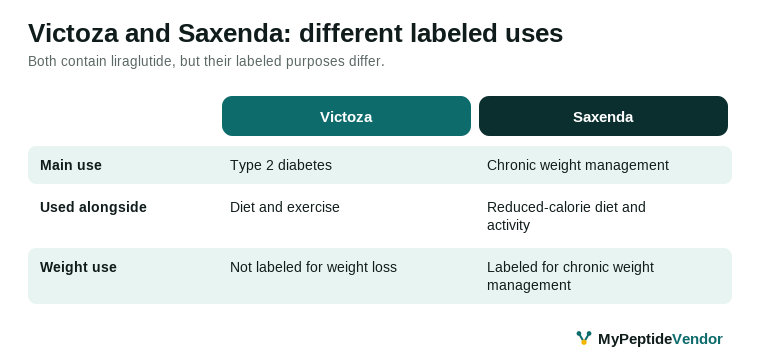
The same active ingredient is sold in the United States as Victoza and Saxenda. Victoza is used with diet and exercise to improve blood sugar in people with type 2 diabetes; liraglutide also reduced cardiovascular events in a trial of adults with type 2 diabetes and high cardiovascular risk 6. Saxenda is the 3 mg daily product for chronic weight management alongside a reduced-calorie diet and increased physical activity 1. The brand names and doses are not interchangeable on your own.
For diabetes, liraglutide can improve glucose levels and lower A1C, the blood test that reflects average blood sugar over roughly the prior few months. It is not insulin and does not replace insulin when insulin is needed. Saxenda is not a diabetes treatment, and using it with Victoza or another GLP-1 receptor agonist is not recommended 1.
Weight loss expectations depend on the product and dose. Victoza is used for diabetes, not as a weight-loss product; some people lose weight while taking it. Saxenda is specifically labeled for chronic weight management, and its target maintenance dose is higher than Victoza’s diabetes dose 1. The average trial result is a group estimate, not a promise for one person.
Use this chart
Free to reuse with a link back:
What makes it different
The everyday difference is the injection schedule. Liraglutide is taken daily because its plasma half-life is about 13 hours. Semaglutide for weight management was studied as a once-weekly injection in STEP 8 8. A daily routine may be easy for some people to remember, while others prefer fewer injections.
The dose also depends on the treatment goal. Victoza’s maximum diabetes dose is 1.8 mg daily; Saxenda is dosed up to 3 mg daily for weight management. That 3 mg dose is not a diabetes dose to add to Victoza, and the products should not be used together 1.
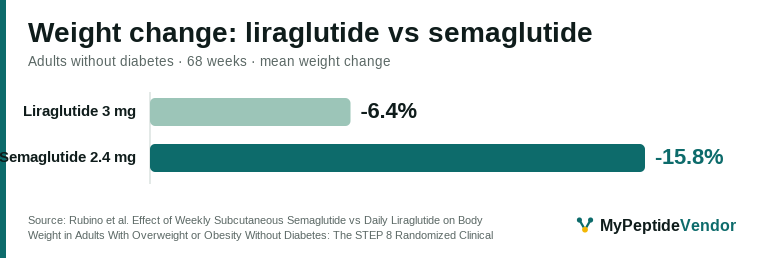
In direct weight-management research, liraglutide produced less average weight loss than weekly semaglutide. At week 68 in STEP 8, mean weight change was -6.4% with liraglutide 3 mg daily and -15.8% with semaglutide 2.4 mg weekly, a difference of 9.4 percentage points 8. That is an average from one trial, not a forecast for every patient.
Liraglutide also has cardiovascular trial evidence in people with type 2 diabetes at high cardiovascular risk. LEADER tested liraglutide against placebo added to standard care and found fewer major cardiovascular events over follow-up 6. Results for one drug should not be assumed to apply equally to every GLP-1 medicine.
How does it work?
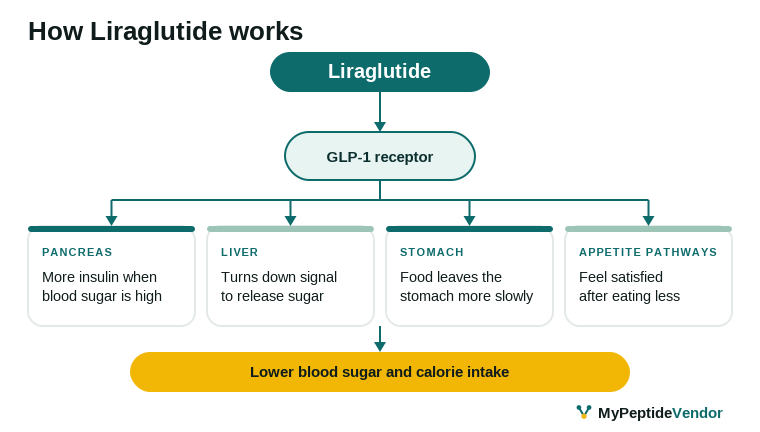
In plain terms, liraglutide helps the body release insulin when blood sugar is high, turns down a signal that tells the liver to release sugar, and slows the movement of food out of the stomach. It also acts on appetite pathways, which can help some people feel satisfied after eating less 1.
More technically, liraglutide binds to and activates the GLP-1 receptor. Its effects on insulin and glucagon depend partly on glucose levels (glucose-dependent): the insulin effect is stronger when blood sugar is raised 1. Liraglutide by itself is therefore less likely to cause low blood sugar than insulin or a sulfonylurea, but risk can rise when these medicines are combined.
For weight, the main effect is lower calorie intake, not an increase in energy burned. Liraglutide delays gastric emptying, meaning food leaves the stomach more slowly 1. That action can contribute to fullness and digestive symptoms, including nausea.
The natural GLP-1 hormone is broken down quickly in the body. Liraglutide is chemically modified to resist that breakdown, and its plasma half-life after injection is about 13 hours, which supports daily rather than weekly dosing 1.
Use this chart
Free to reuse with a link back:
What the clinical evidence actually shows

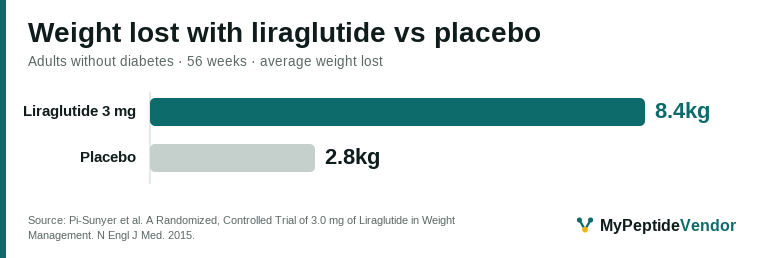
Weight loss in adults without diabetes. The SCALE Obesity and Prediabetes trial reported by Pi-Sunyer and colleagues randomized 3,731 adults to liraglutide 3 mg daily or placebo for 56 weeks. Participants had obesity or overweight with a weight-related condition, and both groups received lifestyle counseling 11.
At week 56, the liraglutide group lost an average of 8.4 kg (18.5 lb), compared with 2.8 kg (6.2 lb) on placebo. The difference between groups was 5.6 kg (12.3 lb). At least 5% of starting weight was lost by 63.2% with liraglutide and 27.1% with placebo; more than 10% was lost by 33.1% and 10.6%, respectively 11.
Weight loss in adults with type 2 diabetes. In a separate 56-week Saxenda study, participants with type 2 diabetes lost an average of 5.4% of body weight, compared with 1.7% on placebo. At least 5% weight loss occurred in 49% versus 16.4% 1. This lower average than the non-diabetes SCALE trial is a useful reminder that results from one group do not precisely predict results in another.
Cardiovascular outcomes: LEADER. This trial randomized 9,340 adults with type 2 diabetes and high cardiovascular risk to liraglutide or placebo, added to standard care. Median follow-up was 3.8 years. The first occurrence of cardiovascular death, nonfatal heart attack or nonfatal stroke affected 608 of 4,668 people taking liraglutide (13.0%) and 694 of 4,672 taking placebo (14.9%); the hazard ratio was 0.87 6. In everyday terms, the absolute difference was 1.9 percentage points across the trial follow-up.
Cardiovascular death occurred in 4.7% of the liraglutide group and 6.0% of the placebo group, with a hazard ratio of 0.78. Death from any cause occurred in 8.2% and 9.6%, respectively 6. LEADER supports cardiovascular risk reduction for adults with type 2 diabetes and high cardiovascular risk; it does not show the same benefit in people without diabetes or establish the same result for every patient.
Children younger than 12. SCALE Kids randomized 82 children aged 6 to under 12 with obesity to once-daily liraglutide, up to 3 mg or the maximum tolerated dose, or placebo, alongside lifestyle support. After 56 weeks, BMI changed by -5.8% with liraglutide and +1.6% with placebo, an estimated difference of -7.4 percentage points. A BMI reduction of at least 5% occurred in 46% versus 9% 9. This was a small trial; its results do not mean the medicine is FDA-approved for children younger than 12.
What happens after stopping? A 2025 systematic review and meta-analysis of 8 randomized trials involving 2,372 participants estimated that people stopping liraglutide regained an average of 2.20 kg. The pooled estimate for people stopping semaglutide or tirzepatide was 9.69 kg 4. These are pooled results from different trials and different starting weight losses, not a direct comparison of how much any one person will regain.
What remains uncertain. The trials do not establish how well weight loss is maintained for every person over many years, who can stop without substantial regain, or the best way to manage treatment when stopping 411. Nor does an average result tell an individual exactly how much weight they will lose. The 16-week response checkpoint in the Saxenda label helps identify adults unlikely to achieve and sustain clinically meaningful weight loss 1.
Use this chart
Free to reuse with a link back:
Use this chart
Free to reuse with a link back:
Typical dosing

The schedules below describe labeled or trial doses, not a personal prescription. A prescriber chooses the product and target based on the reason for treatment, other medicines, side effects and medical history. Victoza and Saxenda contain liraglutide, but the Saxenda 3 mg weight-management dose should not be copied onto a Victoza prescription 1.
Type 2 diabetes: Victoza
Victoza dosing is individualized, and a prescriber adjusts it based on glycemic response and tolerability.
Weight management: Saxenda
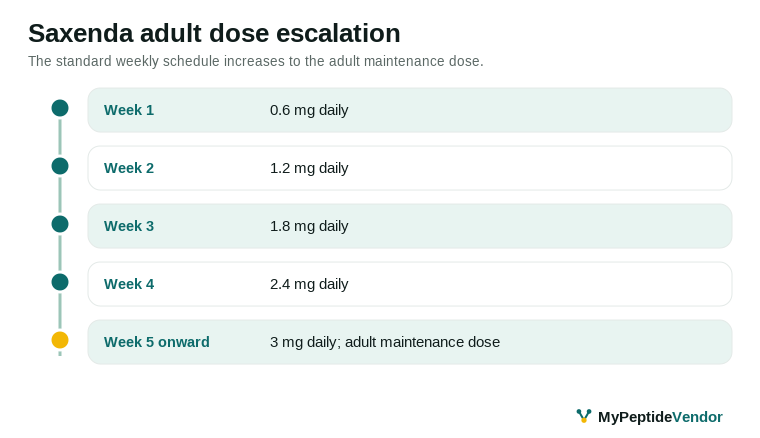
The Saxenda label starts at 0.6 mg once daily and increases the dose at weekly intervals until 3 mg daily. The lower steps are for titration; the recommended adult maintenance dose is 3 mg. If an adult cannot tolerate 3 mg, the label says to discontinue Saxenda. If an increase is not tolerated, a prescriber may consider delaying the next increase for about one additional week 1.
The weekly schedule below shows the standard adult Saxenda escalation. The diabetes schedule is shorter and has a different maximum target 1.
| Week | Saxenda daily dose | Diabetes schedule context |
|---|---|---|
| 1 | 0.6 mg | Victoza starts at 0.6 mg daily |
| 2 | 1.2 mg | Victoza may increase to 1.2 mg daily |
| 3 | 1.8 mg | Victoza may increase to 1.8 mg if more glucose control is needed |
| 4 | 2.4 mg | Saxenda continues titration |
| 5 and onward | 3 mg | Saxenda adult maintenance dose |
For adults using Saxenda, assess weight change 16 weeks after starting. The label recommends stopping if weight loss is less than 4% of starting weight, because it is unlikely that continued treatment will produce and maintain clinically meaningful weight loss 1. Reaching that checkpoint is not a guarantee of ongoing loss.
Inject into the abdomen, thigh or upper arm at any time of day, with or without food. If more than 3 days have passed since the last Saxenda dose, the label directs restarting at 0.6 mg daily and repeating the escalation schedule to reduce the chance of gastrointestinal reactions 1. Do not take an extra dose to make up for a missed injection.
Use this chart
Free to reuse with a link back:
Side effects: what to actually expect
Digestive symptoms are the side effects people most often report with Saxenda. In adult placebo-controlled trials, nausea occurred in 39.3% of people taking Saxenda versus 13.8% on placebo; diarrhea in 20.9% versus 9.9%; constipation in 19.4% versus 8.5%; and vomiting in 15.7% versus 3.9% 1. These are trial rates, not a prediction that a particular person will have each symptom.
Nausea can occur because liraglutide slows stomach emptying and changes appetite signals. The label does not give a reliable week when nausea will stop. Smaller meals may be easier for some people, but ongoing vomiting or diarrhea can lead to dehydration and kidney problems 1. Do not continue escalating a dose without discussing troublesome symptoms with the prescriber.
Other reactions reported in at least 5% of adults taking Saxenda included injection-site reactions (13.9%), headache (13.6%), indigestion (9.6%), fatigue (7.5%) and dizziness (6.9%) 1. A network meta-analysis of non-diabetic adults with overweight or obesity ranked liraglutide as having the lowest nausea risk among the GLP-1 medicines it compared, while orforglipron had the highest. That comparison does not mean liraglutide is free of nausea 7.
Low blood sugar. Hypoglycemia risk matters most when liraglutide is combined with insulin or a sulfonylurea. In one trial, among participants taking a sulfonylurea, blood glucose below 54 mg/dL occurred in 28.2% taking Saxenda and 12.7% taking placebo, even though the protocol reduced sulfonylurea doses by half at the start. Severe hypoglycemia requiring another person’s help occurred in 0.7% of Saxenda-treated participants in that trial; all were taking a sulfonylurea 1. A prescriber may need to reduce insulin or sulfonylurea and review glucose readings.
Gallbladder and pancreas. Gallstones were reported in 2.2% of adults taking Saxenda and 0.8% taking placebo; gallbladder inflammation occurred in 0.8% and 0.4%, respectively 1. Rapid or substantial weight loss can increase gallstone risk, but gallbladder disease can also occur without major weight loss. Contact a clinician for persistent pain under the right ribs, fever or yellowing of the skin or eyes.
Confirmed pancreatitis occurred in 0.3% of Saxenda-treated adults and 0.1% of placebo-treated adults in clinical trials 1. Stop the medicine and seek prompt medical advice if severe, persistent abdominal pain develops, particularly if it spreads to the back; nausea or vomiting may or may not occur.
Boxed warning: thyroid C-cell tumors. Liraglutide caused thyroid C-cell tumors in rats and mice, but whether it causes these tumors in humans is unknown. Do not use liraglutide if you or a family member has had medullary thyroid carcinoma (MTC), or if you have multiple endocrine neoplasia syndrome type 2 (MEN 2) 1. Report a lump in the neck, trouble swallowing, trouble breathing or persistent hoarseness. Routine calcitonin testing or thyroid ultrasound has uncertain value for early detection in people taking Saxenda 1.
Seek prompt medical help for signs of a serious allergic reaction, such as swelling or trouble breathing. Contact a clinician about persistent vomiting, diarrhea, inability to keep fluids down or a racing heartbeat at rest. Tell the care team before planned surgery or deep sedation because delayed stomach emptying can raise concern about aspiration during anesthesia 1.
Regulatory & access status in the US (as of 2026)
Liraglutide is available in FDA-approved prescription products in the United States. Saxenda is labeled for chronic weight management with reduced-calorie eating and increased physical activity in adults with obesity, adults with overweight and at least one weight-related condition, and certain adolescents with obesity 1. Victoza is a lower-dose liraglutide brand used for type 2 diabetes. The product, dose and labeled use matter: approval for one product or purpose does not automatically apply to another.
The Saxenda label includes adults and adolescents aged 12 years and older who meet its weight-management criteria. It says the safety and effectiveness of Saxenda for pediatric type 2 diabetes have not been established 1. The SCALE Kids trial in children aged 6 to under 12 is research evidence, not an FDA-approved indication for that age group 9.
Saxenda should not be used with Victoza or another GLP-1 receptor agonist 1. Do not switch between Victoza and Saxenda or convert doses without a prescriber’s direction; their target doses and labeled uses differ.
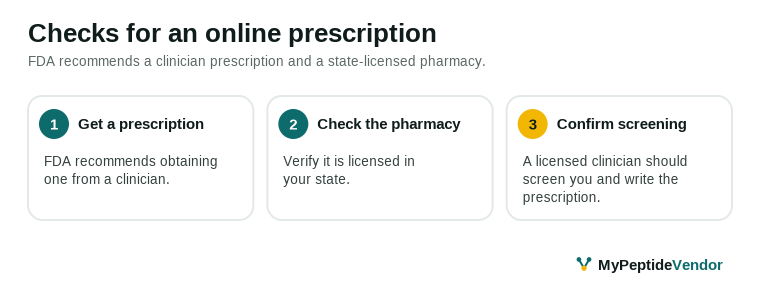
FDA says unapproved versions of GLP-1 medicines do not receive its review for safety, effectiveness or quality before marketing. A compounded medicine may be appropriate when a patient’s medical need cannot be met by an FDA-approved product, but compounded medicines are not FDA-approved products 2. FDA recommends obtaining a prescription from a clinician and filling it at a state-licensed pharmacy 2.
Before filling an online prescription, check that the pharmacy is licensed in your state and that a licensed clinician screens you and writes the prescription. Warning signs include a claim that a compounded product is the same as an FDA-approved drug, a price that seems too good to be true, damaged or unfamiliar packaging, missing instructions, no medical screening, no clinician available for questions, spelling errors, or pharmacy details that cannot be verified 2.
For injectable GLP-1 drugs, FDA also warns against using a product that arrives warm or without enough refrigeration, because poor shipping conditions may affect quality 2. For a multi-dose compounded vial, FDA recommends discarding it within 28 days after first use and using a new sterile needle and syringe for each dose 2. Those instructions do not replace the storage directions for an FDA-approved pen.
An FDA-approved pen is not the same thing as a research-labeled vial or a product sold without a prescription. A “research use” label does not establish that a product is sterile, accurately dosed or suitable for human injection. If the product, pharmacy or instructions look different from what was prescribed, pause and verify them with the pharmacist before using it 2.
Use this chart
Free to reuse with a link back:
If you and a clinician decide it fits, one option is HumeCare: online GLP-1 weight-loss program with a licensed US provider (US only). Affiliate link
How it compares to its closest alternative
Semaglutide is a close alternative because it also activates the GLP-1 receptor. STEP 8 directly compared once-weekly semaglutide 2.4 mg with once-daily liraglutide 3 mg for weight management in adults without diabetes; the stopping estimates and nausea ranking below come from separate analyses 478.
| Feature | Liraglutide | Semaglutide |
|---|---|---|
| Weight-management schedule | Once daily | Once weekly |
| Dose in STEP 8 | 3 mg daily | 2.4 mg weekly |
| Average weight change at week 68 | -6.4% | -15.8% |
| Participants losing at least 10% in STEP 8 | 25.6% | 70.9% |
| Participants losing at least 15% in STEP 8 | 12.0% | 55.6% |
| Participants losing at least 20% in STEP 8 | 6.0% | 38.5% |
| Nausea comparison in network analysis | Lowest risk among the compared GLP-1 medicines | Higher risk than liraglutide in that analysis |
| Average regain after stopping in a separate meta-analysis | 2.20 kg | Part of a pooled 9.69 kg estimate for semaglutide and tirzepatide |
In STEP 8, 338 adults without diabetes were randomized and followed for 68 weeks. The average weight difference favored semaglutide by 9.4 percentage points 8. The active-drug comparison was open-label, and the participants were not a diabetes population, so the result is strong direct evidence for that study group, not a guarantee for an individual.
The nausea ranking came from a network meta-analysis that compared results across studies, not from a single head-to-head side-effect trial 7. The weight-regain estimates also came from a separate meta-analysis and should not be read as proof that semaglutide causes more regain than liraglutide: the pooled studies differed in treatment and weight loss before stopping 4.
For an individual choosing between treatments, factors include the target for blood sugar or weight, other health conditions and medicines, tolerability, access and whether a daily or weekly injection fits their routine. A clinician should verify the exact product and label before a switch; there is no dose-for-dose conversion between liraglutide and semaglutide 18.
Where to Get Liraglutide Legally
Through your own doctor
The FDA-approved product needs a prescription. Your doctor decides whether it fits your health history and insurance may cover part of the cost.
HumeCare
Online GLP-1 weight-loss program with a licensed US provider.
- Short online assessment reviewed by a licensed provider
- If prescribed, medication ships to your door
- Ongoing support to adjust your plan
Affiliate disclosure: we may earn a commission if you sign up through the link above. It never changes what we write.
Ranked in our guides
Frequently asked questions
What are the benefits of taking liraglutide?
For type 2 diabetes, it can help lower blood sugar as part of care that includes diet and activity; LEADER also found fewer major cardiovascular events among adults with diabetes and high cardiovascular risk 6. For chronic weight management, the higher Saxenda dose can support weight reduction alongside lifestyle changes: participants in a 56-week trial lost an average of 8.4 kg with liraglutide 11. The likely benefit depends on the reason for treatment and the person’s response.
What is the once-a-week injection used for type 2 diabetes?
Semaglutide is a GLP-1 medicine that is also given as a once-weekly injection; STEP 8 directly studied the weekly schedule for weight management 8. Liraglutide is a daily injection 1. The STEP 8 comparison was in adults without diabetes, so it does not answer which diabetes treatment is right for a particular person.
Has anyone lost weight on liraglutide?
Yes. In the 56-week SCALE trial, 63.2% of adults taking liraglutide 3 mg lost at least 5% of their starting weight, compared with 27.1% taking placebo 11. Some people lost more, some lost less, and some did not lose weight; the average result cannot predict an individual outcome.
Is liraglutide stronger than Ozempic?
For weight loss in STEP 8, no: semaglutide 2.4 mg weekly produced an average 15.8% weight reduction at week 68, compared with 6.4% for liraglutide 3 mg daily 8. Ozempic is a semaglutide brand, but STEP 8 tested weight-management doses in adults without diabetes. That direct comparison does not decide which treatment is best for a specific person.
Why can liraglutide cause nausea, and how long might it last?
Liraglutide slows gastric emptying and affects appetite signals, which can contribute to nausea 1. In adult Saxenda trials, nausea was reported by 39.3% of participants, but trial data do not give a dependable end date for an individual 1. Contact the prescriber if symptoms are severe or persistent, especially if vomiting makes it hard to keep fluids down.
What can happen to weight or blood sugar after stopping liraglutide?
Weight regain can follow discontinuation: a meta-analysis estimated an average regain of 2.20 kg after liraglutide was stopped, although the pooled result cannot predict one person’s course 4. Blood sugar may rise when a glucose-lowering medicine is stopped. Plan any change with the prescriber rather than stopping without follow-up.
Can liraglutide be used with pregnancy plans, alcohol or a history of gallbladder disease?
Saxenda should be discontinued when pregnancy is recognized; weight loss has no benefit during pregnancy and may harm the fetus 1. A history of gallstones or gallbladder inflammation should be discussed with the prescriber because these events occurred in trials 1. A specific alcohol interaction is not established here, so ask a clinician or pharmacist about alcohol alongside your health conditions and other medicines.
Are Victoza and Saxenda the same drug, and can I switch without changing the dose?
Both contain liraglutide, but Victoza is used for diabetes and Saxenda for chronic weight management, with different target doses 1. Do not take both together or switch doses on your own; ask the prescriber to set the new schedule.
References
- FDA prescribing information: Saxenda (Liraglutide) Injection, Solution (DailyMed)
- FDA: Concerns with unapproved GLP-1 drugs used for weight loss
- FDA: Certain bulk drug substances for use in compounding that may present significant safety risks
- Berg et al. Discontinuing glucagon-like peptide-1 receptor agonists and body habitus: A systematic review and meta-analysis. Obes Rev. 2025.
- Tsapas et al. Comparative Effectiveness of Glucose-Lowering Drugs for Type 2 Diabetes: A Systematic Review and Network Meta-analysis. Ann Intern Med. 2020.
- Marso et al. Liraglutide and Cardiovascular Outcomes in Type 2 Diabetes. N Engl J Med. 2016.
- Ismaiel et al. Gastrointestinal adverse events associated with GLP-1 RA in non-diabetic patients with overweight or obesity: a systematic review and network meta-analysis. Int J Obes (Lond). 2025.
- Rubino et al. Effect of Weekly Subcutaneous Semaglutide vs Daily Liraglutide on Body Weight in Adults With Overweight or Obesity Without Diabetes: The STEP 8 Randomized Clinical Trial. JAMA. 2022.
- Fox et al. Liraglutide for Children 6 to <12 Years of Age with Obesity - A Randomized Trial. N Engl J Med. 2025.
- Bethel et al. Cardiovascular outcomes with glucagon-like peptide-1 receptor agonists in patients with type 2 diabetes: a meta-analysis. Lancet Diabetes Endocrinol. 2018.
- Pi-Sunyer et al. A Randomized, Controlled Trial of 3.0 mg of Liraglutide in Weight Management. N Engl J Med. 2015.
- ClinicalTrials.gov: 554 registered studies (search: Liraglutide)
Written by the MyPeptideVendor editorial team from the FDA label, peer-reviewed studies and ClinicalTrials.gov records listed above, fact-checked line by line and reviewed 2026-11-12.
Cite this page
MyPeptideVendor Editorial Team. liraglutide: Uses, Dosage & Safety. MyPeptideVendor. Updated November 12, 2026. https://mypeptidevendor.com/peptides/liraglutide/MyPeptideVendor Editorial Team. (2026, November 12). liraglutide: Uses, Dosage & Safety. MyPeptideVendor. https://mypeptidevendor.com/peptides/liraglutide/Related peptides
5-Amino-1MQ
Not approved5-Amino-1MQ is a small molecule, not a peptide; its human benefits, dose, side effects, and long-term safety are not established.
Learn moreAdipotide (FTPP)
Not approvedAdipotide is an experimental fat-vessel-targeting peptide with animal findings, kidney concerns, and no established human dose or benefit.
Learn moreAOD-9604
Not approvedAOD-9604 was studied for obesity, but available evidence does not establish meaningful weight loss, a standard dose, or FDA approval.
Learn more