SLU-PP-332: Evidence, Dosing & Safety
Small-molecule ERR agonist
Brand names: No approved prescription brand name is established in the cited research

SLU-PP-332 is an experimental small molecule, not a peptide, that activates estrogen-related receptors (ERRs) and exercise-linked signals. Research reports effects in cells and mice, but no human trial results are available in the cited studies 3,7.
That means increased endurance or reduced fat-mass accumulation in mice does not tell us what a person would experience. Animal studies have measured specific effects, while human questions about dose, side effects, and whether any effects last after treatment stops remain unanswered 3,5,7.
Key takeaways
- SLU-PP-332 activates ERRα, ERRβ, and ERRγ, with an ERRα-dependent exercise-response program reported in mice 7.
- Mouse obesity models showed higher energy expenditure and fat oxidation, with less fat-mass accumulation 3.
- In a study of 21-month-old mice, researchers reported kidney changes after 8 weeks of treatment 5.
- No human dose, side-effect rate, or treatment duration has been established in the cited research 3,5,7.
- SLU-PP-332 lacks oral bioavailability; the chemically distinct SLU-PP-915 is orally active in research 10.
SLU-PP-332 at a glance
- Class
- Small-molecule estrogen-related receptor (ERR) pan-agonist
- Mechanism
- Activates ERR signaling linked to mitochondrial metabolism and exercise-responsive genes
- FDA Status
- Research compound; no FDA-approved human indication or prescribing label is established
- Brand names
- No approved prescription brand name is established in the cited research
- Administration
- Studied by intraperitoneal injection in animals; it lacks oral bioavailability
- Typical Dose
- No established human dose or clinical-trial dose range
- Half-life
- A human half-life has not been established in the cited studies
- Primary Uses
- Research into exercise-responsive metabolism, muscle function, and metabolic disease
What is it?

SLU-PP-332 is a synthetic compound that activates estrogen-related receptors, or ERRs. These proteins help regulate energy use and exercise-responsive genes. Despite “estrogen” in their name, ERRs are not the classic estrogen receptors. SLU-PP-332 is a small molecule, not a peptide, and research studies it as an exercise mimetic rather than as an approved treatment 3,7.
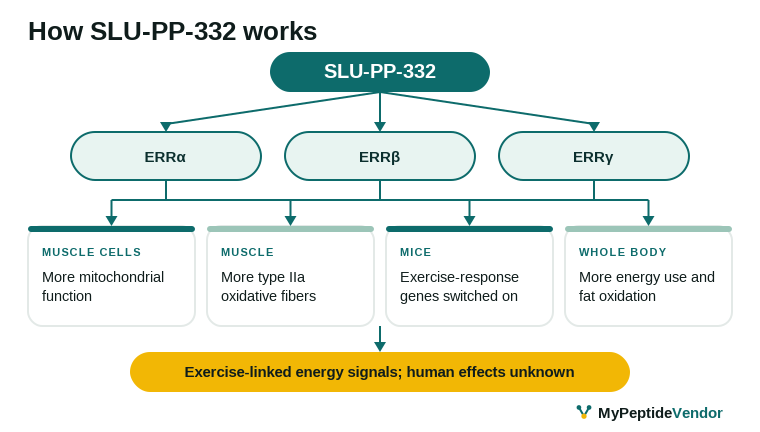
The compound activates all three ERR subtypes: ERRα, ERRβ, and ERRγ. “Pan-agonist” means it activates several related receptor types; it does not mean it produces every effect of exercise. In a mouse exercise study, ERRα activation was necessary for the reported endurance effect 7.
“Exercise mimetic” describes a research approach: activating some of the same biological signals that respond to aerobic activity. It does not mean the compound replaces exercise. The mouse studies measured selected outcomes such as gene activity, muscle fibers, endurance, and metabolism, not the full range of effects associated with physical activity 3,7.
What makes it different
SLU-PP-332 is studied for changes in energy use and fat metabolism. In mouse models, researchers reported increased energy expenditure and fatty-acid oxidation, alongside reduced fat-mass accumulation 3. No appetite effect has been reported in the cited studies 3,7, and no human study establishes an effect on hunger, food intake, or body weight.
It has also been tested for exercise-related muscle changes. Mice given SLU-PP-332 had more type IIa oxidative skeletal muscle fibers and enhanced exercise endurance; the reported endurance effect depended on ERRα 7. The study abstract does not give a numerical increase in running time or distance, so there is no supported percentage improvement to quote.
Oral absorption is a key limitation. SLU-PP-332 lacks oral bioavailability and was studied by injection into the abdomen in animal research 10. SLU-PP-915 is a chemically distinct pan-ERR agonist that is orally bioavailable; it is not an oral version of SLU-PP-332 10.
Researchers have also changed the SLU-PP-332 chemical scaffold. A structure–activity study found analogues with improved ligand efficiency, solubility, or metabolic stability in particular tests 4. Those laboratory properties may help drug design, but they do not establish that an analogue is safer, more effective in animals, or suitable for people.
How does it work?
In plain terms, SLU-PP-332 switches on some cell signals that also respond to aerobic exercise. It activates ERR proteins, which help control how cells use fuel and support mitochondrial energy production. Mitochondria are structures inside cells that help turn nutrients into usable energy 3,7.
In muscle-cell experiments, SLU-PP-332 increased mitochondrial function and cellular respiration. In mice, it induced an acute aerobic-exercise gene program that depended on ERRα 7. A gene connected with that program is DDIT4, also called DNA damage-inducible transcript 4. Research on SLU-PP-915 reported that both 915 and 332 induced Ddit4 in mice, with the response varying by muscle examined 10. These results do not show that the compound reproduces all the effects of exercise.
In obese mouse models, ERR activation increased whole-body energy expenditure and fatty-acid oxidation. Researchers also reported reduced fat-mass accumulation, reduced obesity, and improved insulin sensitivity 3. The findings do not show how much energy expenditure would change in a person, whether a person's appetite would change, or whether the changes would lead to meaningful human weight loss.
ERR activation has also been studied in mouse models of kidney and heart disease. In a kidney study, 21-month-old mice received SLU-PP-332 for 8 weeks; researchers reported reversal of age-related increases in albuminuria and podocyte loss, alongside changes in mitochondrial dysfunction and inflammatory markers 5. A separate pressure-overload heart-failure study reported improved ejection fraction and survival with SLU-PP-332 and SLU-PP-915 in mice 6. Neither study establishes a treatment for kidney disease or heart failure in people.
Use this chart
Free to reuse with a link back:
What the clinical evidence actually shows

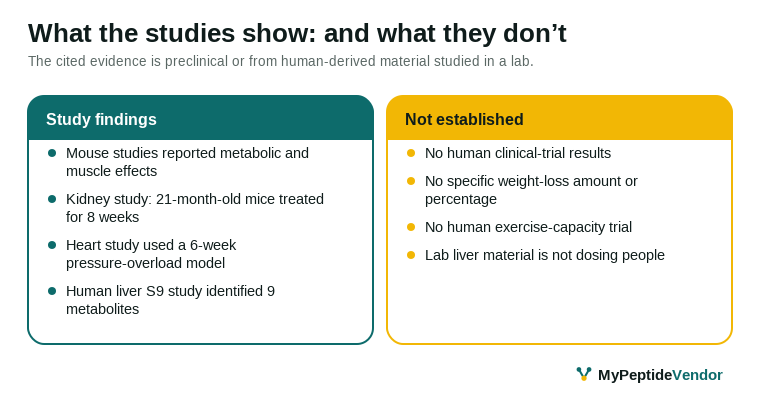
The cited studies do not report a human clinical trial of SLU-PP-332. The evidence comes from cells, mice, or human-derived liver material studied outside the body; it does not show that people have safely taken the compound in a clinical trial 3–10. The study abstracts do not consistently provide animal group sizes, exact dose schedules, or numerical effect sizes. Where a study does not report a number, it cannot support a human estimate.
Fat mass and metabolic syndrome: “A Synthetic ERR Agonist Alleviates Metabolic Syndrome” tested SLU-PP-332 in diet-induced obese and ob/ob mice. Researchers reported increased energy expenditure and fatty-acid oxidation, decreased fat-mass accumulation, reduced obesity, and improved insulin sensitivity 3. The abstract gives no specific pounds lost, percentage of body weight lost, group size, or study duration 3.
Endurance and muscle fibers: “Synthetic ERRα/β/γ Agonist Induces an ERRα-Dependent Acute Aerobic Exercise Response and Enhances Exercise Capacity” reported increased type IIa oxidative fibers and enhanced exercise endurance in mice. Muscle-cell experiments showed increased mitochondrial function and cellular respiration 7. The abstract does not state the numerical endurance change or animal group size, and it reports no human exercise-capacity trial 7.
Aging kidney: “Estrogen-Related Receptor Agonism Reverses Mitochondrial Dysfunction and Inflammation in the Aging Kidney” treated 21-month-old mice with SLU-PP-332 for 8 weeks. Researchers reported reversal of age-related increases in albuminuria and podocyte loss, alongside changes in mitochondrial function and inflammatory markers 5. The abstract does not report a human comparison or human safety result.
Heart failure: “Novel Pan-ERR Agonists Ameliorate Heart Failure Through Enhancing Cardiac Fatty Acid Metabolism and Mitochondrial Function” studied SLU-PP-332 and SLU-PP-915 in a pressure-overload mouse model. Both compounds improved ejection fraction, reduced fibrosis, and increased survival without changing cardiac hypertrophy 6. The study is preclinical; it does not report a human treatment effect. Its heart metabolic analysis describes a 6-week pressure-overload model 6.
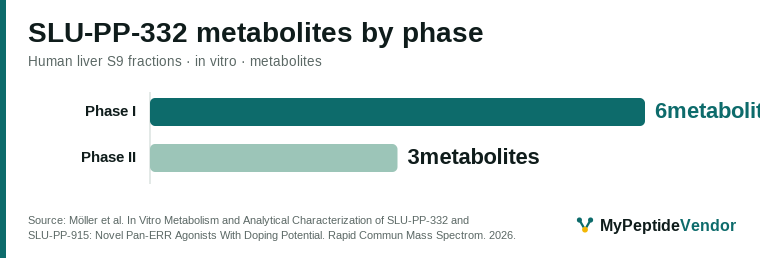
Metabolism in human-derived laboratory material: A 2026 in vitro study used human liver S9 fractions to examine how SLU-PP-332 may be metabolized. It identified 9 metabolites: 6 Phase I metabolites and 3 Phase II conjugates 9. Liver material studied in a lab is not the same as dosing people. These results do not establish how quickly a person would clear the compound or whether its metabolites are safe.
What remains unknown: Human safety, effective dose, absorption, half-life, long-term effects, drug interactions, and effects on fat mass or endurance have not been established in the cited studies 3,5–10. Mouse studies also do not answer whether effects last after stopping, whether tolerance develops, or whether cycling is needed 3,5,7.
Fat-loss, endurance, timing, and cycling claims are supported only to the extent stated in the cited animal or laboratory research 3,7,10.
| Claim | Evidence model | What was reported | Confidence for people |
|---|---|---|---|
| Fat loss | Obese and metabolic-syndrome mouse models | Reduced fat-mass accumulation; no human weight-loss figure | Very low |
| Endurance | Mouse exercise testing | Enhanced endurance; no numerical change in the abstract | Very low |
| Time to work | Cell and mouse research | Exercise-related gene effects were measured; human onset is unknown | Unknown |
| Need to cycle | No cycling study reported | No evidence establishes a schedule, tolerance, or rebound effect | Unknown |
Timeline: Mouse research reports an acute exercise-responsive gene program, increased type IIa oxidative fibers and endurance, and metabolic changes in obese models 3,7. It does not establish a human onset time, a week-by-week fat-loss pattern, or what happens after stopping. Personal claims such as a particular number of pounds lost over several weeks are anecdotes, not results from a human SLU-PP-332 trial 3,7.
Use this chart
Free to reuse with a link back:
Use this chart
Free to reuse with a link back:
Typical dosing

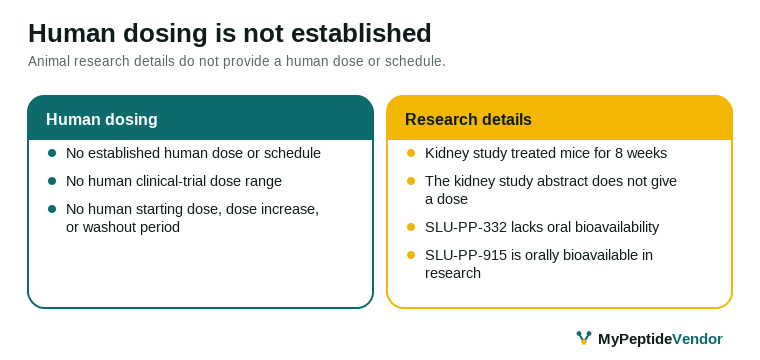
Human dose: There is no established human dose, schedule, or approved prescribing label for SLU-PP-332 in the cited research 3,5,7. No human clinical-trial dose range is available. A human “typical dose” cannot be responsibly inferred from mouse findings.
Animal research: The kidney study reports treatment of 21-month-old mice for 8 weeks, but the abstract does not give a dose 5. The cited abstracts do not supply a complete mouse dose range that could guide human use 3,5,7. Animal dosing cannot be converted into a safe human dose by simple body-weight arithmetic.
Route matters as well as dose. SLU-PP-332 lacks oral bioavailability, while the chemically distinct SLU-PP-915 is orally bioavailable in research 10. Neither finding establishes a safe injection or oral schedule for people.
Online protocols, vial instructions, and suggested cycles are not clinical dosing guidance. The cited studies do not establish a human starting dose, dose increase, injection schedule, or washout period 3,5,7.
Use this chart
Free to reuse with a link back:
Side effects: what to actually expect
No human side-effect rate or percentage is available because the cited research does not report human clinical trials of SLU-PP-332 3,5–10. The animal and laboratory study summaries also do not provide a complete adverse-event table with rates that can be translated into a percentage for people. No reported percentage does not mean zero risk.
The kidney and heart studies examined outcomes in specific mouse disease models, but they were designed to test biological effects, not to establish a human safety profile 5,6. They cannot rule out uncommon, delayed, dose-related, or organ-specific harms in people.
Human drug interactions and long-term effects of ERR activation have not been established in these studies 3,5–10. Nor do the cited results establish heart rhythm, liver, kidney, or reproductive safety in people. A research result in mice cannot answer those safety questions.
Regulatory & access status in the US (as of 2026)
As of 2026, SLU-PP-332 has no established FDA-approved human indication or prescribing label for weight loss, endurance, kidney disease, or heart failure 3,7,10. It is a research compound, not an approved treatment. FDA warnings about unapproved products falsely labeled “for research purposes” or “not for human consumption” concern specific unapproved drugs and are not a SLU-PP-332-specific FDA action 1.
The cited research does not establish a specific US federal controlled-substance schedule for SLU-PP-332. A seller’s purchase restriction or legal wording is not proof of federal scheduling status.
Sport rules are separate from FDA approval and US drug scheduling. A 2026 study on SLU-PP-332 metabolites states that the World Anti-Doping Agency prohibits exercise mimetics and metabolic modulators 8. Athletes subject to WADA rules should not assume that research access means the compound is permitted in competition.
Metabolism studies have also examined SLU-PP-332 for doping-control purposes. One study identified 9 SLU-PP-332 metabolites using human liver material 9, while another identified 22 in vitro metabolites 8. These laboratory findings support analytical research; they do not show that the compound has been tested or approved as a human medicine.
| Body or setting | Status | What that means |
|---|---|---|
| FDA / medical use | No approved human indication or prescribing label is established | No human dose or approved treatment use is established |
| US controlled-substance scheduling | Not established by the cited research | The research does not confirm a specific federal schedule |
| WADA-regulated sport | Exercise mimetics and metabolic modulators are prohibited | Research access does not mean an athlete may use it under WADA rules |
Research-grade SLU-PP-332 is available from American Peptides (SLU-PP-332 TABLETS, from $60.00); code MYPEPTIDEVENDOR takes 15% off. Sold for laboratory research only, not for human use. Affiliate link
How it compares to its closest alternative
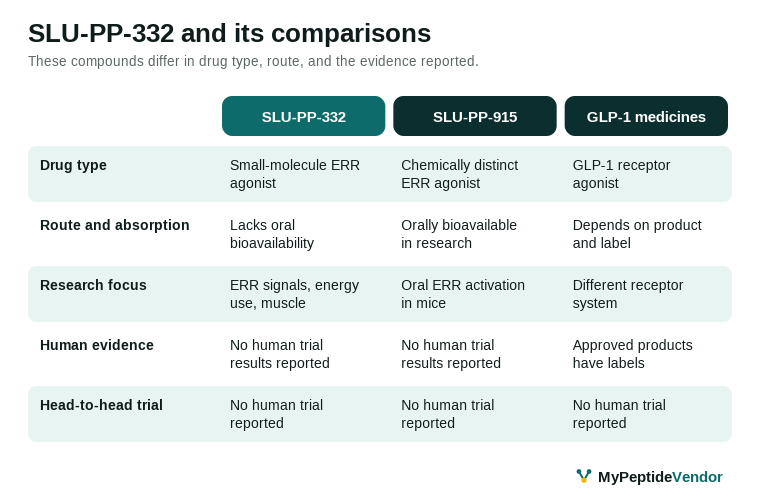
SLU-PP-915 is the closest research alternative in the cited studies because it is another pan-ERR agonist studied for exercise-related effects. It is a chemically distinct compound, not a different brand or oral form of SLU-PP-332 10. Semaglutide is a different kind of comparison: it is a GLP-1 receptor agonist, and FDA guidance distinguishes approved medicines from unapproved versions that have not undergone FDA review for safety, effectiveness, and quality 1.
SLU-PP-332 is not established as an appetite-suppressing treatment. Its reported mouse research centers on ERR signaling, energy expenditure, fat oxidation, and muscle effects 3,7. No appetite effect has been reported in the cited studies 3,7. GLP-1 medicines use a different receptor system; results for an FDA-approved GLP-1 medicine cannot be transferred to SLU-PP-332 1.
The published work reports oral bioavailability for SLU-PP-915 and lack of oral bioavailability for SLU-PP-332; FDA guidance addresses the separate issue of approved and unapproved GLP-1 products 1,10.
| Feature | SLU-PP-332 | SLU-PP-915 | GLP-1 medicines, such as semaglutide |
|---|---|---|---|
| Drug type | Experimental small-molecule ERR agonist | Experimental, chemically distinct ERR agonist | GLP-1 receptor agonist |
| Research focus | Exercise-linked gene activity, energy use, and muscle endurance in mice | Oral ERR activation and exercise capacity in mice | Approved medicines exist for specific uses; unapproved versions have not undergone FDA review for safety, effectiveness, and quality |
| Appetite effect | Not established in people; no appetite effect reported in cited studies | Not established in people | Different drug class; its evidence cannot be applied to SLU-PP-332 |
| Route and absorption | Lacks oral bioavailability; studied by injection in mice | Orally bioavailable in research | Depends on the specific approved product and its label |
| Human evidence in the cited material | No human trial results reported | No human trial results reported | FDA-approved products have product-specific evidence and labeling |
| Direct comparison | No head-to-head human trial reported | No head-to-head human trial reported | No head-to-head human trial reported |
SLU-PP-332 should not be treated as a proven alternative to semaglutide or another GLP-1 medicine. The cited research does not compare these compounds directly, and it does not establish human weight-loss results for SLU-PP-332 1,3,10.
Use this chart
Free to reuse with a link back:
Where to Buy SLU-PP-332 for Research
American Peptides
SLU-PP-332 TABLETS · from $60.00
US-made research peptides, every lot third-party tested with a lot-matched COA.
15% offMYPEPTIDEVENDOR at checkout
- ≥99% purity verified by HPLC + mass spec, endotoxin tested
- Ships tracked from Louisiana, free shipping over $300
- 15% off your first order with code MYPEPTIDEVENDOR
Certified-Pep
US-made research peptides with batch-specific lab reports (COA) and a QR code on every vial.
- Independent laboratory testing (Vanguard Laboratory)
- Made in the USA, ships in 1-2 business days
- Research use only, not for human or veterinary use
Affiliate disclosure: we may earn a commission if you order through the link above. SLU-PP-332 is not approved by the FDA for human use.
Frequently asked questions
What does SLU-PP-332 do to you?
Evidence label: cell and mouse research. It activates ERR-related signals involved in exercise-responsive gene activity and energy metabolism; mouse studies report changes in fat oxidation and endurance 3,7. How a person would feel or respond has not been established in a human trial.
How long does SLU-PP-332 take to work?
There is no established human onset time. Researchers measured gene and metabolic effects in cells and mice, but those findings do not show when a person would feel an effect or see a body-composition change 3,7.
Does SLU-PP-332 need to be cycled?
No cycling schedule has been established. The mouse studies do not answer whether people would develop tolerance, need breaks, or have a rebound effect after stopping 3,5,7.
What were the results of using SLU-PP-332 for fat loss?
Evidence label: mouse models, not human use. Researchers reported less fat-mass accumulation and improved obesity-related measures, but the study abstract gives no specific pounds or percentage of body weight lost 3.
References
- FDA: Concerns with unapproved GLP-1 drugs used for weight loss
- FDA: Certain bulk drug substances for use in compounding that may present significant safety risks
- Billon et al. A Synthetic ERR Agonist Alleviates Metabolic Syndrome. J Pharmacol Exp Ther. 2024.
- Okda et al. Chemical optimization of the exercise mimetic SLU-PP-332 enables insight into estrogen-related receptor signaling. Int J Biol Macromol. 2026.
- Wang et al. Estrogen-Related Receptor Agonism Reverses Mitochondrial Dysfunction and Inflammation in the Aging Kidney. Am J Pathol. 2023.
- Xu et al. Novel Pan-ERR Agonists Ameliorate Heart Failure Through Enhancing Cardiac Fatty Acid Metabolism and Mitochondrial Function. Circulation. 2024.
- Billon et al. Synthetic ERRα/β/γ Agonist Induces an ERRα-Dependent Acute Aerobic Exercise Response and Enhances Exercise Capacity. ACS Chem Biol. 2023.
- Avliyakulov et al. Analysis and Identification of In Vitro Metabolites of Exercise Mimetic SLU-PP-332 ERRα/β/γ Agonist for Doping-Control Purposes. Drug Test Anal. 2026.
- Möller et al. In Vitro Metabolism and Analytical Characterization of SLU-PP-332 and SLU-PP-915: Novel Pan-ERR Agonists With Doping Potential. Rapid Commun Mass Spectrom. 2026.
- Billon et al. An orally active estrogen receptor-related receptor agonist, SLU-PP-915, enhances aerobic exercise capacity. J Pharmacol Exp Ther. 2026.
Written by the MyPeptideVendor editorial team from the FDA label, peer-reviewed studies and ClinicalTrials.gov records listed above, fact-checked line by line and reviewed 2026-11-12.
Cite this page
MyPeptideVendor Editorial Team. slu pp 332: Evidence, Dosing & Safety. MyPeptideVendor. Updated November 12, 2026. https://mypeptidevendor.com/peptides/slu-pp-332/MyPeptideVendor Editorial Team. (2026, November 12). slu pp 332: Evidence, Dosing & Safety. MyPeptideVendor. https://mypeptidevendor.com/peptides/slu-pp-332/Related peptides
5-Amino-1MQ
Not approved5-Amino-1MQ is a small molecule, not a peptide; its human benefits, dose, side effects, and long-term safety are not established.
Learn moreAdipotide (FTPP)
Not approvedAdipotide is an experimental fat-vessel-targeting peptide with animal findings, kidney concerns, and no established human dose or benefit.
Learn moreAOD-9604
Not approvedAOD-9604 was studied for obesity, but available evidence does not establish meaningful weight loss, a standard dose, or FDA approval.
Learn more