NAD+: Evidence, Dosing & FDA Status
Cellular coenzyme
Brand names: No FDA-approved NAD+ drug brand established in the cited evidence
NAD+ is a coenzyme found in cells that helps transfer electrons during energy production. It is not a peptide, and the human evidence described here does not show that NAD+ treatment reverses aging or treats low energy. 35
The clearest dose-specific human trial tested oral NMN, a precursor to NAD+, in 80 healthy middle-aged adults for 60 days. Blood NAD+ rose in the NMN groups, but this does not establish a benefit from NAD+ injections or IV infusions. 6
Key takeaways
- NAD+ and NADH are two forms of the same electron-carrying coenzyme, cycling as cells use nutrients for energy. 35
- In an 80-person trial, daily oral NMN at 300, 600, or 900 mg raised blood NAD+ at day 30 and day 60 versus placebo (p≤0.001). 6
- The NMN study lasted 60 days; it did not test NAD+ injections or show that participants lived longer. 6
- NAD can turn over in minutes in some tissues, so a temporary rise is not the same as a stored reserve. 7
- Whether restoring NAD+ is safe and beneficial for human aging over the long term remains unknown. 3
NAD+ at a glance
- Class
- Cellular coenzyme; not a peptide
- Mechanism
- Carries electrons in energy reactions and serves as a cosubstrate for enzymes such as sirtuins, PARPs, and CD38/CD157
- FDA Status
- No FDA-approved NAD+ treatment indication is established in the cited evidence; FDA compounding rules are separate from drug approval
- Brand names
- No FDA-approved NAD+ drug brand established in the cited evidence
- Administration
- NAD+ may be described as IV or injectable; human dose-specific evidence here is for oral NMN
- Typical Dose
- No established NAD+ treatment dose; oral NMN trial arms were 300, 600, and 900 mg once daily for 60 days
- Half-life
- NAD has a half-life on the order of minutes in some tissues; this is not a single whole-body half-life
- Primary Uses
- Essential cellular metabolism; no treatment benefit for aging, energy, or cognition is established by the cited human trial
What is it?

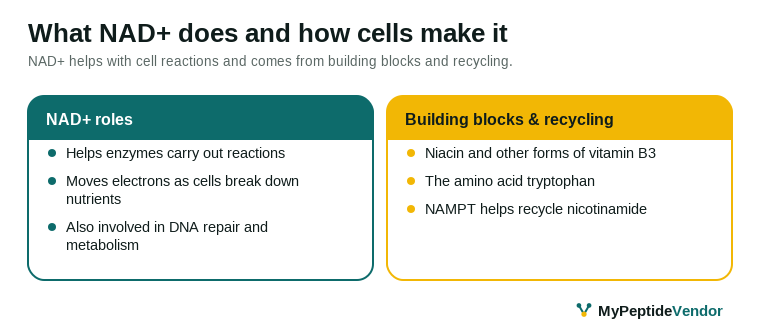
NAD+ stands for nicotinamide adenine dinucleotide. It is a coenzyme, a molecule that helps enzymes carry out chemical reactions, and it is present in living cells. Its best-known role is helping cells move electrons as they break down nutrients and make usable energy. NAD+ also participates in DNA repair, metabolism, and other cell functions. 359
NAD+ is the oxidized form of the molecule. When it accepts electrons, it becomes NADH, the reduced form. NADH can then pass those electrons to other reactions. The two forms work as a shuttle: cells repeatedly convert one into the other rather than keeping NAD+ or NADH fixed in one state. 35
NAD+ levels decline with ageing in multiple model organisms, including rodents and humans 38.
Your body makes NAD+ from building blocks that include niacin and other forms of vitamin B3, as well as the amino acid tryptophan. NAD+ itself cannot be taken directly from food. Cells also recycle nicotinamide through an enzyme called NAMPT, which helps generate much of the cellular NAD+ supply. 39
Products sold or described as NAD+ therapy can mean different things: NAD+ given by IV or injection, oral NAD+, or oral precursors such as NMN and NR. These are not interchangeable. The dose-specific human trial discussed below tested oral NMN, not NAD+ delivered by injection or IV. 6
Use this chart
Free to reuse with a link back:
What makes it different
NAD+ is a coenzyme, not a peptide hormone, a direct fuel like glucose, or a weight-loss medicine. It takes part in many reactions inside cells. That broad role makes it possible for NAD+ changes to affect several pathways, but a change in a blood test does not by itself prove a noticeable health benefit. 35
NAD+ and NADH are related but not identical in their current chemical state. NAD+ can accept electrons; NADH is carrying them. The cell moves between these forms as metabolism proceeds, so taking NAD+ does not simply hold every cell in a permanent high-energy state. 35
NAD+ also serves several enzyme groups, not only sirtuins. Sirtuins, PARP enzymes involved in DNA-damage responses, and CD38/CD157 enzymes all use NAD+ as a cosubstrate. A change in NAD+ availability could therefore touch several processes at once; it is not a single switch for a so-called longevity pathway. 348
NMN and NR are precursors that can feed into the body’s NAD+ production pathways. Niacin and tryptophan can also contribute to NAD+ synthesis. A result from one precursor cannot be assumed to apply to another precursor or to NAD+ given by IV or injection. 369
Myth versus evidence: The claim that NAD+ reverses aging goes beyond the human results described here. Reviews discuss promising work in animals and laboratory models, but they also identify unanswered questions about how to restore NAD+ effectively, whether doing so is safe, and whether it improves human health or lifespan. 38
How does it work?
In plain words: NAD+ helps cells pass electrons around while they turn food into energy. It also supplies material that certain enzymes need to do their jobs. Changing NAD+ levels can therefore affect more than one cell process, but it does not guarantee that a person will feel more energetic. 35
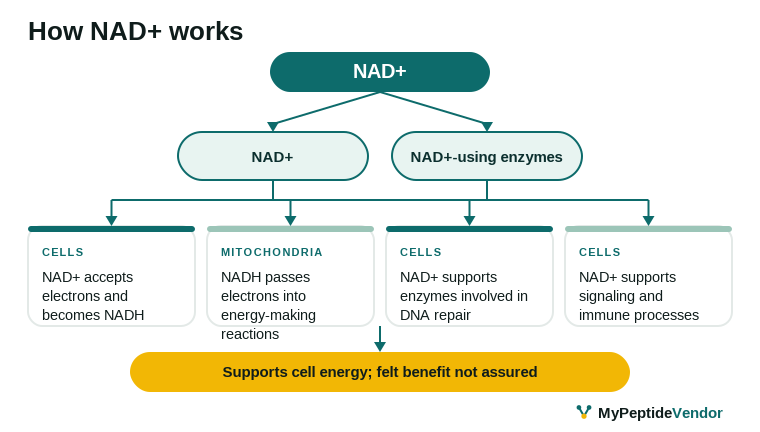
During energy-producing reactions, NAD+ accepts electrons and becomes NADH. NADH carries those electrons into later reactions, including mitochondrial processes that help make cellular energy. The cell then regenerates NAD+ so the cycle can continue. 39
Some NAD+-using enzymes do jobs beyond energy production. Sirtuins use NAD+ in reactions that modify proteins; PARPs use it in responses to DNA damage; and CD38/CD157 consume it in signaling and immune-related processes. These enzymes draw on a shared molecule, so increasing NAD+ may affect several systems rather than just one. The consequences in a person are not predictable from a supplement label alone. 348
NAD+ levels are dynamic, not a reserve that simply accumulates. A review reports that NAD has a half-life on the order of minutes in some tissues. That rapid turnover helps explain why an oral NAD+ dose cannot be assumed to create a lasting supply inside every cell; how NAD and its precursors move between blood, cells, and organelles remains an active research question. 7
Food supplies building blocks rather than NAD+ itself. NAMPT helps recycle nicotinamide into NAD+, which is one reason nutrient intake and cellular recycling matter to NAD+ metabolism. This pathway explains how the body can make NAD+; it does not prove that a particular supplement improves health. 9
The link between NAD+ and cellular aging may run in more than one direction. Low NAD+ can contribute to DNA damage and mitochondrial dysfunction that promote cellular senescence, a state in which cells stop dividing. Yet low NAD+ may also limit the senescence-associated secretory phenotype (SASP), an inflammatory signaling pattern that takes energy to produce. The overall effect is not settled. 10
Use this chart
Free to reuse with a link back:
What the clinical evidence actually shows

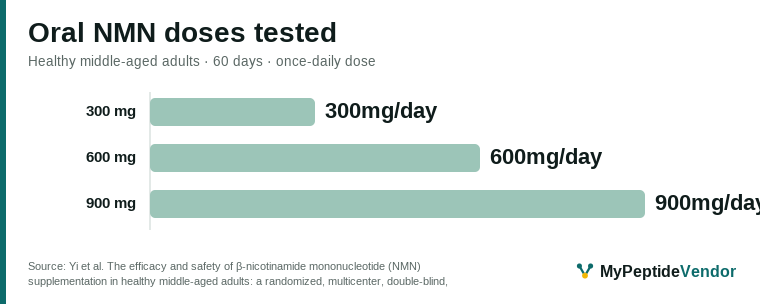
The clearest dose-specific human evidence here comes from a randomized, multicenter, double-blind, placebo-controlled trial of NMN, not NAD+ injections. In “The efficacy and safety of β-nicotinamide mononucleotide (NMN) supplementation in healthy middle-aged adults,” 80 healthy middle-aged adults were assigned to placebo or once-daily oral NMN for 60 days. The NMN dose groups received 300, 600, or 900 mg per day. 6
At day 30 and day 60, blood NAD+ concentrations were significantly higher in each NMN group than in both the placebo group and the participants’ baseline levels (all p≤0.001). The highest blood NAD+ concentrations were in the 600 mg and 900 mg groups. The reported results do not give the actual concentration changes in numeric units, so the size of the increase cannot be converted into a percentage or compared with a target level. 6
The trial also measured distance covered in a six-minute walking test. All three NMN groups increased their walking distance more than placebo at day 30 and day 60 (all p<0.01), with the longest distances in the 600 mg and 900 mg groups. The available results do not provide the group distances in meters, so they do not show how large the difference would be in everyday activity. 6
A blood-based biological-age calculator score increased in the placebo group and stayed unchanged in the NMN groups by day 60; the differences between treated groups and placebo were significant (all p<0.05). This was a short-term calculator result, not proof that participants became younger or would live longer. HOMA-IR, a measure related to insulin resistance, did not differ significantly between NMN and placebo at day 60. 6
Self-reported SF-36 health scores improved more in the NMN groups than placebo at day 30 and day 60, except that the 300 mg group did not show that difference at day 30. These questionnaire results do not establish prevention or treatment of disease, a lasting effect after NMN is stopped, or a benefit from NAD+ infusions. 6
All 80 participants completed the trial. The investigators reported no safety issues based on adverse-event monitoring, laboratory tests, and clinical measures. The reported summary does not give percentages for individual symptoms, and a 60-day study of 80 people cannot establish uncommon or long-term harms. 6
A ClinicalTrials.gov search for NAD+ returned 764 studies, but that count includes studies that are not direct tests of NAD+ treatment. One listed Phase 1 study, NCT07880925, is recruiting healthy adults to assess trigonelline monohydrate, including its effects on NAD+ metabolism, pharmacokinetics, safety, and tolerability. A study registration describes a planned investigation, not a result. 11
What is still unknown: whether restoring NAD+ is safe over years in humans; whether raising NAD+ in blood changes the relevant tissues; which route or precursor works best; and whether any rise leads to lasting improvements in health, function, or lifespan. A review identifies whether restoring NAD+ is safe in humans as unresolved. 3
Use this chart
Free to reuse with a link back:
Typical dosing

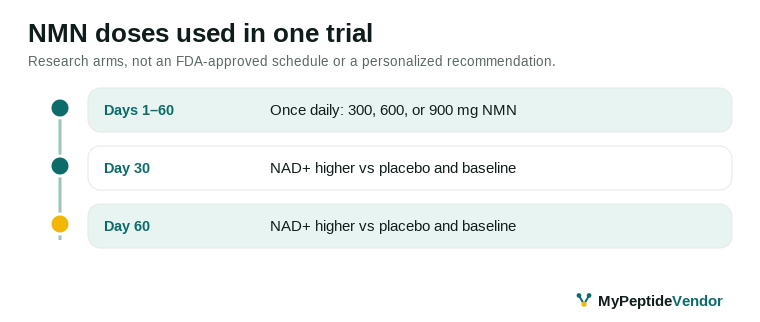
There is no established treatment dose for NAD+ itself in the evidence described here. The best-defined human dose range is for oral NMN: 300 mg, 600 mg, or 900 mg once daily for 60 days in the randomized trial of 80 healthy middle-aged adults. These were research arms, not an FDA-approved dosing schedule or a personalized recommendation. 6
Blood NAD+ increased in all three NMN groups at day 30 and day 60, with the highest levels in the 600 mg and 900 mg groups. The trial did not establish that the highest dose produces the best clinical outcome, or that a higher blood NAD+ result is necessarily better for health. 6
Do not transfer the NMN doses to NR, niacin, or NAD+ injections. They are different substances, and the trial did not compare them. The cited human evidence does not establish a typical IV or injection dose, a treatment schedule, or a dose that improves health outcomes. 569
A trial dose answers a limited question: what amount researchers used under that study’s conditions. The 60-day NMN trial does not establish what to take for longer use or whether an individual should take a precursor at all. 6
Use this chart
Free to reuse with a link back:
Side effects: what to actually expect
In the 80-person NMN trial, investigators reported that supplementation was well tolerated and found no safety issues during 60 days of monitoring. The available results do not provide percentages for individual symptoms. There is not enough information here to give a reliable rate for nausea, headache, flushing, or another symptom from NMN, and those rates should not be assumed to apply to NAD+ injections. 6
No source provides adverse-event percentages for IV or injected NAD+ 356. That leaves the frequency of common reactions and the rate of serious complications uncertain. A reaction rate from a different injected product would not be a valid estimate for NAD+.
The main safety gap is longer exposure. A review says it remains unknown whether restoring NAD+ levels is safe in humans. The NMN trial followed 80 adults for 60 days, which cannot rule out uncommon harms or establish safety over years. 36
Talk with a clinician first: If you are pregnant or breastfeeding, have cancer or a history of cancer, have kidney or liver disease, or take prescription medicines, ask for individual advice before using an NAD+ product. Safety of NAD+ in pregnancy, breastfeeding, cancer, kidney or liver disease, or among people taking prescription drugs has not been established 39.
For an injectable product, ask what substance is being administered, how it was prepared, and whether it is compounded. FDA describes a compounding framework for certain bulk drug substances and notes that some may present significant safety risks; the cited FDA page does not provide NAD+-specific adverse-event rates or establish the status of a particular NAD+ preparation. 2
Regulatory & access status in the US
The FDA compounding page does not establish an FDA-approved NAD+ drug or product 2.
Compounding and FDA approval are different. FDA describes a framework for bulk substances nominated for use in compounding and identifies some substances as presenting potential significant safety risks. Inclusion on, or absence from, the FDA's Category 2 bulk drug substances list 2 does not by itself establish whether a specific NAD+ substance or formulation may be compounded, or whether a particular product meets applicable requirements.
For a compounded product, availability and legal status depend on the specific preparation and the rules that apply to the pharmacy and prescriber. A clinic offering an infusion or injection does not, by itself, show that the preparation is FDA-approved or that FDA has reviewed it for a particular health claim. 2
The NMN trial provides research dosing data, not an FDA-approved treatment label. It studied healthy middle-aged adults for 60 days and does not establish a medical indication for NMN or NAD+. 6
ClinicalTrials.gov listings show ongoing research, including the recruiting Phase 1 study NCT07880925 on trigonelline monohydrate and NAD+ metabolism. A listing is not regulatory approval and does not show that the approach works. 11
If you and a clinician decide it fits, one option is Menergy Meds: nAD+ program for men, delivered to your door (US only). Affiliate link
How it compares to its closest alternative
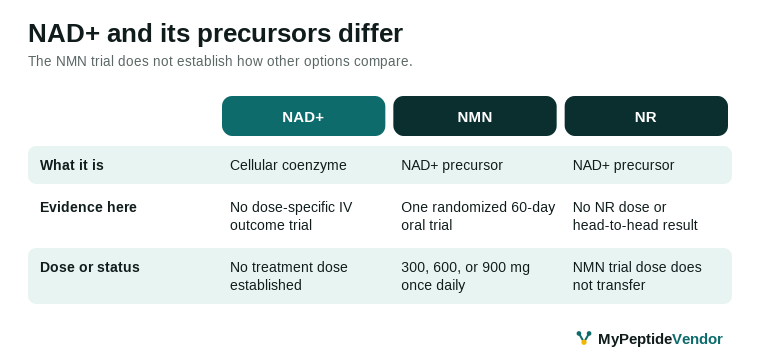
The closest alternatives are NAD+ precursors, which the body can use to make NAD+, rather than products that all deliver the same substance in the same way. The 300 mg, 600 mg, and 900 mg dose arms below are from a 60-day oral NMN trial; they should not be applied to the other options. 369
| Option | What it is | Relationship to NAD+ | Human evidence described here | Dose or status point |
|---|---|---|---|---|
| NAD+ | Cellular coenzyme | Participates directly in electron-transfer reactions and is used by several enzyme groups | No dose-specific NAD+ IV or injection outcome trial is described here | No treatment dose established in the cited evidence |
| NMN | NAD+ precursor | Can feed into pathways that produce NAD+ | One randomized trial tested oral doses for 60 days in 80 adults | Trial doses were 300, 600, and 900 mg once daily |
| NR | NAD+ precursor | Can contribute to cellular NAD+ production | No NR dose or head-to-head outcome result is described here | The NMN trial dose cannot be carried over to NR |
| Niacin | Vitamin B3 form | Can serve as a building block for NAD+ production | No niacin trial for NAD+ treatment outcomes is described here | Not equivalent to an NAD+ infusion |
| Tryptophan | Amino acid | Can contribute to NAD+ synthesis | No dose or NAD+ treatment outcome trial is described here | A nutrient building block, not an NAD+ drug |
There is not enough human comparison evidence here to say that IV NAD+, injected NAD+, oral NMN, oral NR, or niacin works best. The trial measured NMN against placebo, not against another route or precursor. 56
NAD+ is not like Ozempic. NAD+ is a coenzyme involved in cell reactions, while Ozempic contains semaglutide, a medicine that acts on GLP-1 receptors. They work through different mechanisms, and NAD+ is not a substitute for semaglutide.
Use this chart
Free to reuse with a link back:
Where to Get NAD+ Legally
Through your own doctor
Ask your doctor whether this treatment is appropriate and which licensed pharmacy can supply it.
Menergy Meds
NAD+ program for men, delivered to your door.
- Online intake reviewed by a licensed provider
- NAD+ shipped to your home if appropriate
- Program aimed at energy and healthy aging
Brightmeds NAD+
Prescription NAD+ injections with a licensed US provider.
- Online consultation with a licensed provider
- NAD+ shipped to your home if prescribed
- Ongoing provider support
Affiliate disclosure: we may earn a commission if you sign up through the link above. It never changes what we write.
Ranked in our guides
Frequently asked questions
What does NAD+ do for your body?
It helps cells move electrons during the chemical reactions that turn nutrients into energy. NAD+ also supports enzymes involved in DNA repair, metabolism, and cell signaling. 359
Is NAD+ like Ozempic?
No. NAD+ is a coenzyme used in many cell reactions; Ozempic contains semaglutide, which acts on GLP-1 receptors. They have different mechanisms and are not substitutes.
What is the downside of taking NAD+?
The key drawback is that long-term human safety and meaningful health benefits have not been established. The 80-person NMN study lasted 60 days, reported no safety issues, and did not test NAD+ injections. 36
Who should not take NAD+?
The evidence described here does not establish a complete list of people who must avoid NAD+. People who are pregnant or breastfeeding, have cancer or kidney or liver disease, or take prescription medicines should discuss use with a clinician because safety in these groups is not established by the cited studies. 39
References
- FDA prescribing information: Bexsero (Neisseria Meningitidis Serogroup B Nhba Fusion Protein Antigen, Neisseria Meningi (DailyMed)
- FDA: Certain bulk drug substances for use in compounding that may present significant safety risks
- Covarrubias et al. NAD+ metabolism and its roles in cellular processes during ageing. Nat Rev Mol Cell Biol. 2021.
- Imai et al. NAD+ and sirtuins in aging and disease. Trends Cell Biol. 2014.
- Verdin et al. NAD⁺ in aging, metabolism, and neurodegeneration. Science. 2015.
- Yi et al. The efficacy and safety of β-nicotinamide mononucleotide (NMN) supplementation in healthy middle-aged adults: a randomized, multicenter, double-blind, placebo-controlled, parallel-group, dose-dependent clinical trial. Geroscience. 2023.
- Chini et al. Evolving concepts in NAD+ metabolism. Cell Metab. 2021.
- Katsyuba et al. NAD+ homeostasis in health and disease. Nat Metab. 2020.
- Navas et al. NAD+ metabolism, stemness, the immune response, and cancer. Signal Transduct Target Ther. 2021.
- Chini et al. NAD metabolism: Role in senescence regulation and aging. Aging Cell. 2024.
- ClinicalTrials.gov: 764 registered studies (search: NAD+)
Written by the MyPeptideVendor editorial team from the FDA label, peer-reviewed studies and ClinicalTrials.gov records listed above, fact-checked line by line and reviewed 2026-11-12.
Cite this page
MyPeptideVendor Editorial Team. NAD+: Evidence, Dosing & FDA Status. MyPeptideVendor. Updated November 12, 2026. https://mypeptidevendor.com/peptides/nad-plus/MyPeptideVendor Editorial Team. (2026, November 12). NAD+: Evidence, Dosing & FDA Status. MyPeptideVendor. https://mypeptidevendor.com/peptides/nad-plus/Related peptides
Argireline (Acetyl Hexapeptide-3)
Not approvedA small 4-week trial found wrinkle improvements, but lasting effects, ideal concentration, and Argireline-specific side-effect rates remain unknown.
Learn moreAHK-Cu
Not approvedAHK-Cu has early lab findings related to hair follicles, but human hair benefits, safe dosing, and side-effect rates are not established.
Learn moreAHK (Tripeptide-3)
Not establishedAHK-Cu is a copper tripeptide used as a cosmetic ingredient, but human hair-growth benefit and a proven scalp dose remain unestablished.
Learn more