Ghk Cu Dosage 50mg: Vial Math & Safety
A 50 mg GHK-Cu vial is not a 50 mg dose; no FDA-approved human dose or validated injection schedule exists.
Quickstart Highlights for a 50 mg Vial
No established single-injection dose of GHK-Cu has been documented 39. GHK-Cu is not FDA-approved for the uses discussed here, and no approved human dose or validated injectable schedule exists 349.
At a concentration of 20 mg/mL, a 50 mg vial contains 2.5 mL of solution. That is more than the 1 mL capacity of a standard U-100 syringe, which holds 100 units per mL. The vial’s total contents are not a recommended dose.
- Vial amount is not dose: 50 mg is the total labeled peptide amount in the vial. No human study using a 50 mg GHK-Cu injection is identified, and no injectable dose range is established 39.
- No approved titration: GHK-Cu has no FDA-approved dose, step-up plan, or treatment cycle for skin, wound, hair, aging, or musculoskeletal use 34.
- Syringe math only: At 20 mg/mL (200 mcg per U-100 unit), 0.5 mg (500 mcg) = 2.5 U, 1 mg = 5 U, and 2 mg = 10 U. These are volume calculations only and do not establish that any amount is safe or effective to inject.
- Full-vial volume: At 20 mg/mL, 50 mg occupies 2.5 mL. A 1 mL U-100 syringe cannot hold that volume in one draw. Do not treat all vial contents as one dose.
- Evidence is limited: Reviews discuss mechanisms and preclinical findings, but do not establish an injectable human regimen or reliable side-effect frequencies 2349.
- Compounding is a separate question: FDA’s category 2 page addresses certain bulk substances nominated for compounding; it does not list GHK-Cu 1. That absence is not a finding that a GHK-Cu product is approved or safe.
Key takeaways
- A 50 mg label describes total vial contents, not a tested or established injection amount 39.
- No FDA-approved GHK-Cu titration schedule, dose range, or cycle is established for these uses 39.
- At 20 mg/mL, 0.5 mg is 2.5 U, 1 mg is 5 U, and 2 mg is 10 U on a U-100 syringe; these are volume calculations only.
- A 2025 review reports a surprising absence of clinical studies of topical GHK-Cu and Pal-GHK for wrinkles 5.
- Rigorous human safety data for unapproved peptides are scarce, and serious harm is possible 4.
Dosing Schedule: No Validated Week-by-Week Plan

GHK-Cu is a research-only, unapproved compound for the uses discussed here. No FDA label or human trial establishes an injectable dose, titration, weekly frequency, or treatment duration 39. No validated dose is established for injection 39.
| Week | Dose in mg | Dose in mcg | U-100 units | What is known |
|---|---|---|---|---|
| Week 1 | Not established | Not established | Not established | No validated starting dose |
| Weeks 2–4 | Not established | Not established | Not established | No validated titration or weekly schedule |
| Week 5 onward | Not established | Not established | Not established | No established maintenance dose or duration |
Math reference only, not a protocol: At 20 mg/mL, the following values show how example amounts translate to syringe volume. These are volume calculations only and do not establish that any amount is safe or effective to inject.
| Example amount | Equivalent amount | U-100 units at 20 mg/mL |
|---|---|---|
| 0.5 mg | 500 mcg | 2.5 U |
| 1 mg | 1,000 mcg | 5 U |
| 2 mg | 2,000 mcg | 10 U |
A 50 mg vial can create a misleading impression that 50 mg is a sensible dose. It is a container strength, not evidence for a one-time injection. Even a small syringe volume can contain an untested amount. Reviews identify dosing and treatment duration as unresolved questions 39.
Some online schedules describe daily use, dose increases, or set cycles. Those schedules are not FDA titration instructions, and the reviews do not establish a human dose range, dose ceiling, or schedule that can be recommended 39. Do not turn a community report or a conversion chart into personal medical instructions.
Syringe Unit Conversion Table
Units to draw on a U-100 insulin syringe (100 units = 1 mL) from a 50 mg vial. Find your dose, then read the column for the water you added. Every number is calculated, not estimated.
| Dose | 2.5 mL water 20 mg/mL · 1 unit = 200 mcg | 4 mL water 12.5 mg/mL · 1 unit = 125 mcg | 5 mL water 10 mg/mL · 1 unit = 100 mcg |
|---|---|---|---|
| 50 mcg | 0.25 · 1000 doses | 0.4 · 1000 doses | 0.5 · 1000 doses |
| 100 mcg | 0.5 · 500 doses | 0.8 · 500 doses | 1 · 500 doses |
| 200 mcg | 1 · 250 doses | 1.6 · 250 doses | 2 · 250 doses |
| 250 mcg | 1.25 · 200 doses | 2 · 200 doses | 2.5 · 200 doses |
| 300 mcg | 1.5 · 166 doses | 2.4 · 166 doses | 3 · 166 doses |
| 500 mcg | 2.5 · 100 doses | 4 · 100 doses | 5 · 100 doses |
| 750 mcg | 3.75 · 66 doses | 6 · 66 doses | 7.5 · 66 doses |
| 1 mg | 5 · 50 doses | 8 · 50 doses | 10 · 50 doses |
| 1.5 mg | 7.5 · 33 doses | 12 · 33 doses | 15 · 33 doses |
| 1.7 mg | 8.5 · 29 doses | 13.6 · 29 doses | 17 · 29 doses |
| 2 mg | 10 · 25 doses | 16 · 25 doses | 20 · 25 doses |
| 2.4 mg | 12 · 20 doses | 19.2 · 20 doses | 24 · 20 doses |
| 2.5 mg | 12.5 · 20 doses | 20 · 20 doses | 25 · 20 doses |
| 3 mg | 15 · 16 doses | 24 · 16 doses | 30 · 16 doses |
| 4 mg | 20 · 12 doses | 32 · 12 doses | 40 · 12 doses |
| 5 mg | 25 · 10 doses | 40 · 10 doses | 50 · 10 doses |
| 7.5 mg | 37.5 · 6 doses | 60 · 6 doses | 75 · 6 doses |
| 10 mg | 50 · 5 doses | 80 · 5 doses | 100 · 5 doses |
| 12.5 mg | 62.5 · 4 doses | 100 · 4 doses | over 100 |
| 15 mg | 75 · 3 doses | over 100 | over 100 |
GHK-Cu 50 mg Vial Dosage Calculator
Shows the exact insulin-syringe units to draw. Pre-loaded with the 50 mg vial; change any value to match yours.
Total volume of your syringe?
How much mg is in the vial?
How much bacteriostatic water are you adding?
Dose per injection?
Educational tool only. Concentration = vial ÷ water; units = dose ÷ concentration × 100 (U-100 syringe). Confirm every dose with your prescriber. Different vial or peptide? Use the peptide calculator.
MYPEPTIDEVENDORAffiliate link · we may earn a commission.
Reconstitution Steps: Follow Product-Specific Directions
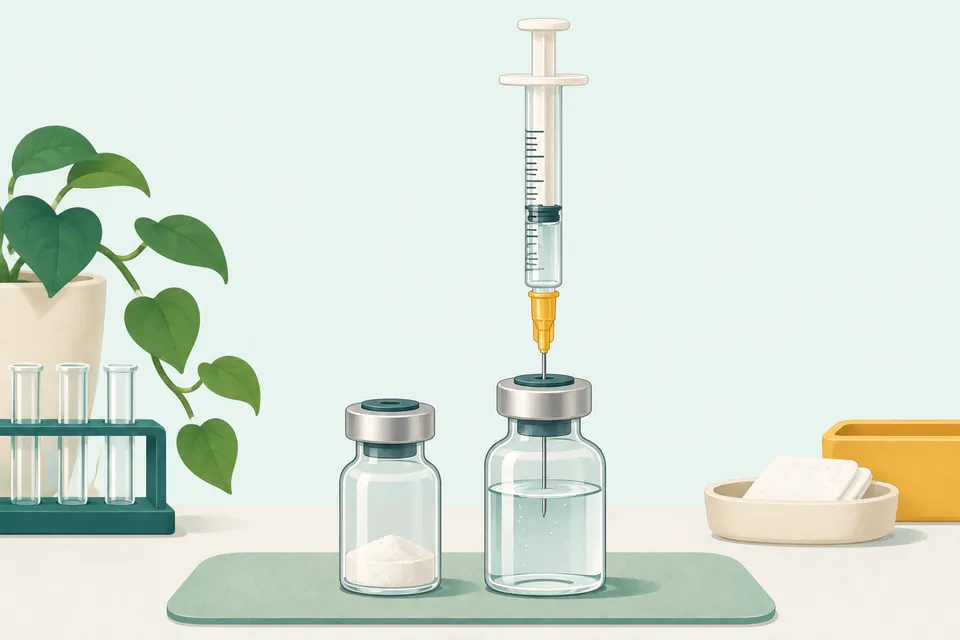
There is no standard, evidence-based home reconstitution recipe for GHK-Cu. Use the product only if a licensed clinician has prescribed it and the dispensing pharmacy has supplied clear instructions for that exact vial.
- Confirm the intended use. Ask the prescriber why this product and route are being considered, given that no approved human dose or injectable schedule is established 39. Do not assume a 50 mg vial is meant to be used all at once.
- Read the pharmacy label before opening it. Confirm the drug name, vial strength, patient name, route, pharmacy identity, storage directions, and beyond-use date. Stop if information is missing, unclear, or inconsistent.
- Use only the stated diluent and volume. Do not choose bacteriostatic water, sterile water, or a mixing volume from a generic online recipe. The dispensing pharmacy should provide product-specific directions.
- Have the pharmacist verify concentration and syringe markings. Ask the pharmacist to confirm the final concentration and the exact marking for any prescribed amount. A different dilution changes the volume calculation.
- Check product quality before preparation. Ask how the pharmacy verifies identity, potency, sterility, and copper-to-peptide composition. A label or seller’s certificate by itself does not confirm those properties.
- Do not use a questionable vial. Contact the pharmacy if the seal is damaged, the appearance has changed, particles are visible, or the storage history is uncertain. Do not try to filter or salvage it.
FDA identifies potential significant safety risks for certain bulk drug substances nominated for compounding. GHK-Cu is not listed on the category 2 page 1. That page does not establish that a particular GHK-Cu product is safe, appropriate for you, or eligible for compounding.
Supplies Needed for a Full Vial
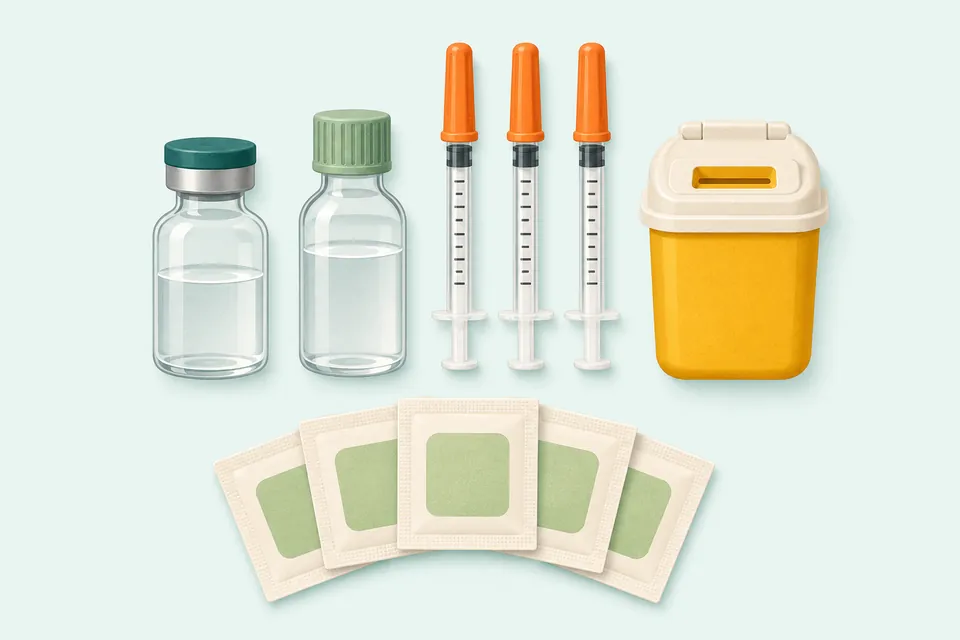
There is no evidence-based supply kit for a GHK-Cu injection course because no validated injectable regimen exists 39. If a clinician directs use of a dispensed product, have the pharmacy specify the supplies for that product and the prescribed route. The vial size alone cannot tell you how many injections to take.
- One pharmacy-labeled 50 mg vial, only if prescribed and dispensed for the intended use.
- One pharmacy-specified diluent container in the exact amount written for the vial. A universal diluent or volume is not established for GHK-Cu.
- One new sterile syringe and needle per directed injection. Ask the clinician or pharmacy which type and size are appropriate for the product.
- Alcohol prep pads: Obtain enough for each required vial-stopper cleaning and injection-site cleaning step. Use a fresh pad for each step and let the area dry as directed.
- One puncture-resistant sharps container for used needles and syringes.
- One set of written product instructions covering storage, handling, and the beyond-use date.
Do not assume that bacteriostatic water is suitable or that refrigeration makes a mixed vial usable for a fixed number of days. Diluent choice and beyond-use dating depend on the specific dispensed product and pharmacy instructions, not on whether the vial contains 50 mg.
Protocol Overview, Evidence, and Cycle Notes
GHK-Cu is a copper-binding tripeptide, meaning it consists of three amino acids (glycine, histidine, and lysine) associated with copper. GHK occurs naturally in the human body 27. Age-related hormonal decline is mentioned in general terms 9, but there is no established age-based target level or replacement dose for GHK-Cu.
In plain language, GHK-Cu is studied as a signal that may change which genes cells use and how cells respond during repair. Those gene-expression changes may influence collagen production and tissue remodeling, the process of rebuilding and reorganizing tissue. A review describes effects involving collagen, elastin, glycosaminoglycans, and tissue repair 2; these findings do not prove injection improves outcomes.
Research reviews also describe anti-inflammatory and cell-protective activity 2. Those descriptions are not the same as proof that an injection heals a wound, reduces pain, changes skin appearance, or prevents aging in a person. Claims that GHK-Cu shifts hair follicles into the anagen, or growth, phase are not established as a proven human treatment in the evidence reviewed here. Hair-growth effects of GHK-Cu are not established.
| Claim or use | Evidence category | What that evidence can support |
|---|---|---|
| Collagen, elastin, and tissue remodeling | Biological and preclinical findings summarized in a review | A mechanism worth studying; not proof that injection improves a person’s outcome |
| Wound repair and inflammation | Review-level discussion that includes preclinical findings | Potential biological activity; human benefit and dose remain uncertain |
| Topical wrinkle treatment | A 2025 review reports a surprising absence of clinical studies of topical GHK-Cu and Pal-GHK for wrinkles | Cellular findings do not establish clinical wrinkle reduction |
| Topical delivery into skin | Review of skin permeation and delivery methods | GHK-Cu is hydrophilic and has limited passage through the outer skin barrier; liposome delivery has received little research attention |
| Musculoskeletal treatment | Review of injectable peptide therapy | No clinical data support GHK-Cu for musculoskeletal conditions |
No evidence-based cycle length, break period, or restart schedule is established 39. Repeated dosing raises unanswered questions about cumulative copper exposure, a safe dose ceiling, and what monitoring might be useful. The reviews identify optimal dosing, combination effects, and monitoring biomarkers as knowledge gaps 39. Do not assume that daily use, a particular cycle, or combining GHK-Cu with another injectable improves results.
Registered-study tracker: ClinicalTrials.gov lists four relevant records with different purposes and statuses 10. A registered study does not prove a treatment works or establish a recommended dose.
| Study | Status and phase | What it tests |
|---|---|---|
| NCT07437586 | Recruiting; Phase 2 | Topical GHK-Cu gel for acute skin wound healing |
| NCT07888595 | Enrolling by invitation; Early Phase 1 | Systemic and topical geroprotective interventions assessed with aging clocks |
| NCT07706361 | Not yet recruiting; phase not applicable (NA). | Effects of an X39 patch on circulating GHK and GHK-Cu levels in healthy adults |
| NCT05932732 | Completed; Phase 4 | Three Hydrafacial treatments and facial skin quality, hydration, and barrier measures |
The Phase 2 record concerns topical gel, not a validated injectable schedule, and the completed Phase 4 record concerns Hydrafacial treatments 10. None of these listings supplies a general injectable dose for a 50 mg vial.
Storage and Handling
Follow the exact storage temperature, light protection, and beyond-use instructions printed by the dispensing pharmacy. A universal storage period for reconstituted GHK-Cu is not established, so do not assume that refrigeration makes a vial usable for a set number of days.
Keep the vial in its original labeled packaging and out of children’s reach. Do not use it if the label is missing, the seal is broken, the appearance has changed, or the storage history is uncertain. Ask the pharmacy what to do with a questionable vial. A label strength does not by itself confirm potency or sterility.
Do not share a vial, syringe, or needle. Use a new sterile needle and syringe for every directed injection, and dispose of used sharps in a puncture-resistant container. Ask the pharmacy or local health department how to dispose of the full sharps container safely.
Injection and Tracking Tips
Do not self-inject from a conversion chart. If a clinician prescribes an unapproved product, ask for direct instruction and written directions that identify the product, route, concentration, prescribed amount, syringe type, and stopping plan. A unit conversion cannot replace an assessment of whether the product is appropriate.
Before use, ask who dispensed the product, whether the pharmacy is licensed for the relevant compounding, and how it checks identity, potency, sterility, and copper-to-peptide composition. FDA’s category 2 framework identifies potential safety concerns for certain nominated bulk substances; it does not list GHK-Cu 1.
If a clinician directs use, keep a dated record of the product label, prescribed amount, route, injection site, and symptoms. Record the date and time of any reaction, how long it lasted, and whether it changed after another exposure. This record can help a clinician assess a reaction; it does not prove that GHK-Cu caused or prevented a symptom.
Ask the prescriber: What is the medical reason for this product? What human evidence supports this route and amount? Is monitoring appropriate, and is copper testing relevant to my health history? What treatment duration and stop criteria do you recommend? What should I do if a reaction occurs? Reviews identify dosing, combination effects, and monitoring biomarkers as unresolved questions 9.
Stop and contact a clinician for a new or worsening reaction. Seek urgent care for severe symptoms such as trouble breathing, fainting, or facial swelling. Increasing pain, warmth, drainage, or fever after an injection also warrants prompt medical attention because infection needs assessment.
Safety, Side Effects, and Who Should Avoid It
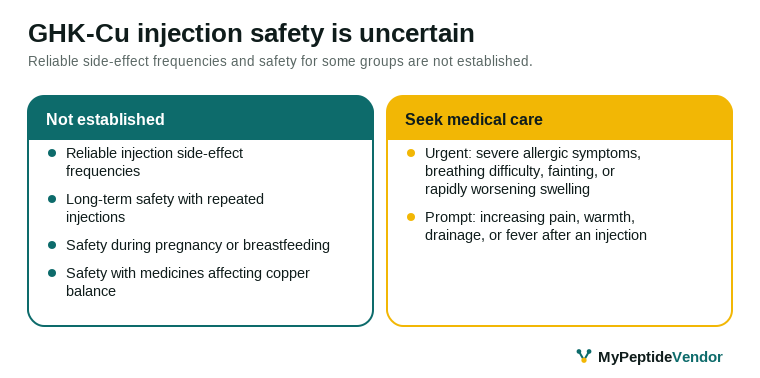
Reliable side-effect frequencies are not established for GHK-Cu injections. There is no FDA-approved injectable label with an adverse-event table for these uses, and reviews do not provide dependable percentages for injection-site reactions or other harms 34. The absence of a percentage does not mean a reaction is rare.
A 2026 review says rigorous human safety data for unapproved peptides are scarce and serious harm is possible 4. Long-term safety with repeated GHK-Cu injections, effects on copper exposure, and safety when combined with other peptides are not established 349.
No complete, validated contraindication list is established for GHK-Cu. People who are pregnant or breastfeeding, have a significant medical condition, take medicines that affect copper balance, or have had a serious reaction to a peptide or injection should discuss the risks with a clinician before exposure. Safety has not been established for these groups.
Topical use is not automatically risk-free. The amount of GHK-Cu reaching deeper tissue is uncertain because it has limited passage through the outer skin barrier 57. Interaction rules for combining GHK-Cu with retinoids, vitamin C, wound products, or other injectables are not established. Ask a clinician or pharmacist before combining them, especially on irritated, broken, or recently treated skin.
Seek urgent medical care for severe allergic symptoms, breathing difficulty, fainting, or rapidly worsening swelling after exposure. Contact a clinician promptly for increasing pain, warmth, drainage, fever, or other possible signs of an injection-site infection.
Use this chart
Free to reuse with a link back:
Legal Status and Compounding
GHK-Cu is not FDA-approved for injectable skin rejuvenation, wound healing, hair growth, anti-aging, or musculoskeletal treatment. No FDA-approved label establishes a titration schedule for these uses 34. A compounded product is not the same as an FDA-approved drug.
FDA’s category 2 page describes certain bulk substances nominated for compounding that may present significant safety risks; GHK-Cu is not listed on that page 1. That absence does not certify GHK-Cu as safe, establish that a specific product may be compounded, or confirm that a pharmacy product is suitable for a particular patient.
Do not infer approval or product quality from a clinic’s use, an online certificate, or a “research grade” claim. Unapproved peptides can lack the regulatory oversight and rigorous human safety evidence available for approved medicines 4. Ask the dispensing pharmacy about its licensing, prescription requirements, quality checks, sterility, potency, and storage directions.
Injectable vs. Topical GHK-Cu and Cost
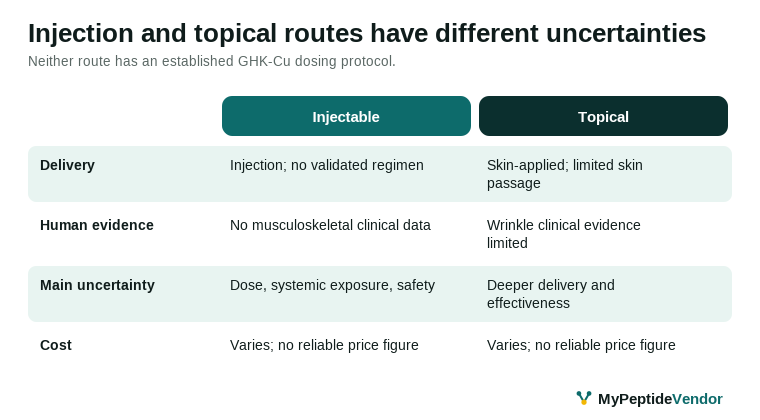
The route changes the main uncertainty. Injection raises questions about systemic exposure, dose, sterile preparation, and long-term safety. Topical products must cross the outer skin barrier, and clinical evidence for wrinkle treatment is limited 357. Neither route has an established GHK-Cu dosing protocol 359.
| Feature | Injectable | Topical |
|---|---|---|
| Delivery | Introduces product by injection; no validated human regimen is established | Applied to the skin; hydrophilic GHK-Cu has limited passage through the stratum corneum, the outer skin layer |
| Human evidence | A review reports no clinical data supporting GHK-Cu for musculoskeletal conditions | A review reports no clinical studies of topical GHK-Cu or Pal-GHK for wrinkles |
| Main uncertainty | Dose, product quality, systemic exposure, and long-term safety | Delivery to deeper skin and clinical effectiveness |
| Cost | Costs vary by formulation, pharmacy, and location, and no single reliable market price figure applies across settings. | Reliable market price data are not available in this context |
Reliable market price data are not available in this context; costs vary by formulation, pharmacy, clinic, and location. Compare the full cost of clinician visits, dispensing, testing, and supplies rather than vial price alone. A lower vial price does not establish potency, sterility, or clinical value.
For a topical product, the delivery problem matters: GHK-Cu is hydrophilic, so it has limited permeation through the lipophilic outer skin barrier. Liposomes may improve delivery, but their transport of GHK-Cu has received little research attention 7. A product’s presence on the skin therefore does not show how much reaches deeper tissue.
Use this chart
Free to reuse with a link back:
Medical Disclaimer and References
This page is educational, not individualized medical advice or a prescription. It does not recommend obtaining, reconstituting, or injecting GHK-Cu. Discuss any proposed use with a licensed clinician who can review your health history and the exact product.
- 1 FDA. Certain Bulk Drug Substances for Use in Compounding That May Present Significant Safety Risks.
- 2 Pickart et al. “Regenerative and Protective Actions of the GHK-Cu Peptide in the Light of the New Gene Data.” International Journal of Molecular Sciences, 2018.
- 3 Mayfield et al. “Injectable Peptide Therapy: A Primer for Orthopaedic and Sports Medicine Physicians.” American Journal of Sports Medicine, 2026.
- 4 Mendias et al. “Safety and Efficacy of Approved and Unapproved Peptide Therapies for Musculoskeletal Injuries and Athletic Performance.” Sports Medicine, 2026.
- 5 Mortazavi et al. “Topically Applied GHK as an Anti-Wrinkle Peptide: Advantages, Problems and Prospective.” Bioimpacts, 2025.
- 6 Rahman et al. “Therapeutic Peptides in Orthopaedics: Applications, Challenges, and Future Directions.” Journal of the American Academy of Orthopaedic Surgeons Global Research & Reviews, 2026.
- 7 Ogórek et al. “Are We Ready to Measure Skin Permeation of Modern Antiaging GHK-Cu Tripeptide Encapsulated in Liposomes?” Molecules, 2025.
- 8 Renke et al. “Therapeutic Peptides in Aesthetic, Metabolic and Endocrine Conditions: Effects, Safety, Clinical Applications, and Future Perspectives.” International Journal of Molecular Sciences, 2026.
- 9 Mavrych et al. “Therapeutic Peptides in Gerontology: Mechanisms and Applications for Healthy Aging.” Frontiers in Aging, 2026.
- 10 ClinicalTrials.gov records: NCT07437586, NCT07888595, NCT07706361, and NCT05932732.
Frequently asked questions
Is 50 mg the GHK-Cu dose or the vial size?
It usually describes the total amount in the vial, not an established injection amount. No approved human GHK-Cu dose exists, and no human study using a 50 mg injection is identified 39.
How many U-100 units is 1 mg from a 50 mg vial?
At 20 mg/mL, 1 mg corresponds to 5 U on a U-100 syringe. This is a volume calculation only; it does not recommend injecting 1 mg or using that dilution.
Has a human study used a 50 mg GHK-Cu injection?
No human study using a 50 mg GHK-Cu injection is identified, and no injectable dose range is established 39. A vial labeled 50 mg does not show that its full contents have been tested as one dose.
How long should a GHK-Cu cycle last?
No validated cycle length, break, or restart schedule is established 39. A clinician should not infer a schedule from the vial strength or an online protocol.
Is topical GHK-Cu proven to reduce wrinkles?
A 2025 review reports a surprising absence of clinical studies of topical GHK-Cu and Pal-GHK for wrinkles 5. GHK-Cu also has limited passage through the outer skin barrier, and liposome delivery has received little research attention 7.
Can GHK-Cu be combined with retinoids or vitamin C?
Interaction rules for these combinations are not established. Ask a pharmacist or clinician before combining products, especially on irritated, broken, or recently treated skin.
References
- FDA: Certain bulk drug substances for use in compounding that may present significant safety risks
- Pickart et al. Regenerative and Protective Actions of the GHK-Cu Peptide in the Light of the New Gene Data. Int J Mol Sci. 2018.
- Mayfield et al. Injectable Peptide Therapy: A Primer for Orthopaedic and Sports Medicine Physicians. Am J Sports Med. 2026.
- Mendias et al. Safety and Efficacy of Approved and Unapproved Peptide Therapies for Musculoskeletal Injuries and Athletic Performance. Sports Med. 2026.
- Mortazavi et al. Topically applied GHK as an anti-wrinkle peptide: Advantages, problems and prospective. Bioimpacts. 2025.
- Rahman et al. Therapeutic Peptides in Orthopaedics: Applications, Challenges, and Future Directions. J Am Acad Orthop Surg Glob Res Rev. 2026.
- Ogórek et al. Are We Ready to Measure Skin Permeation of Modern Antiaging GHK-Cu Tripeptide Encapsulated in Liposomes? Molecules. 2025.
- Renke et al. Therapeutic Peptides in Aesthetic, Metabolic and Endocrine Conditions: Effects, Safety, Clinical Applications, and Future Perspectives. Int J Mol Sci. 2026.
- Mavrych et al. Therapeutic peptides in gerontology: mechanisms and applications for healthy aging. Front Aging. 2026.
- ClinicalTrials.gov: 4 registered studies (search: GHK-Cu)
Written by the MyPeptideVendor editorial team from the FDA label, peer-reviewed studies and ClinicalTrials.gov records listed above, fact-checked line by line and reviewed 2026-11-12.
Cite this page
MyPeptideVendor Editorial Team. ghk cu dosage 50mg: Vial Math & Safety. MyPeptideVendor. Updated November 12, 2026. https://mypeptidevendor.com/protocols/ghk-cu-dosing-50mg/MyPeptideVendor Editorial Team. (2026, November 12). ghk cu dosage 50mg: Vial Math & Safety. MyPeptideVendor. https://mypeptidevendor.com/protocols/ghk-cu-dosing-50mg/Related protocols
Cardiogen 20 mg
Research UseNo approved human dose or validated cycle exists for Cardiogen peptide; its published findings are preclinical, not a dosing protocol.
View protocolChonluten 20 mg
Research UseNo human Chonluten dose or titration schedule is established; the cited research tested cells, not people.
View protocolCortagen 20 mg
Research UseCortagen has no established human dose; this guide explains 20 mg vial math and the limits of the animal and laboratory evidence.
View protocol